37.4% of Americans aged 1 year and older reported taking a supplement containing vitamin D in an analysis of national survey data from 2011–2014 summarized by the NIH Office of Dietary Supplements. That's evidence of widespread vitamin D supplementation, not proof that everyone needs it or that gummies work better than other formats. The useful question is whether a gummy supplies an appropriate dose for your diet, health and daily routine.
Table of Contents
- What Vitamin D Gummies Are and Who Takes Them
- Gummies Versus Pills and Liquid Drops
- Why Gummies Can Deliver More Vitamin D
- Counting Your Total Daily Vitamin D
- Reading the Label on a Vitamin D Gummy
- Safety Rules for Children, Adults and Special Groups
- Confirm Your Dose Before You Buy Gummies
What Vitamin D Gummies Are and Who Takes Them
Vitamin D gummies are a legitimate supplement format for people who struggle with pills, but needing an easier format isn't the same as needing a supplement. Start with your current intake and health circumstances. A clinician can help determine whether blood testing is appropriate, particularly when deficiency is suspected.
A gummy is a chewable, gel-based supplement containing vitamin D, usually identified as D3 or D2. Manufacturers use ingredients such as pectin or gelatin to create the texture, alongside sweeteners, flavorings and sometimes an oil-containing base. Those ingredients affect dietary suitability and the eating experience, so the vitamin amount isn't the only label detail that matters.
The national intake figures help explain why supplements can make a meaningful contribution. In the same NIH analysis, average vitamin D intake from foods and beverages alone was 192 IU daily, compared with 796 IU when supplements were included. These findings concern vitamin D supplements overall, not gummies specifically.
Convenience and need are separate questions
People often choose gummies because swallowing capsules is uncomfortable, they dislike tablets, or chewing a supplement fits their routine more easily. None of those reasons tells you whether your vitamin D level is low.
Keep these distinctions in mind:
- Maintenance: You're supporting adequate intake over time, taking account of food and existing supplements.
- Deficiency treatment: A clinician is correcting confirmed low levels with an individualized plan.
- Format preference: You're choosing how to take an appropriate dose, not changing how much your body needs.
A pleasant taste can remove a practical barrier. It shouldn't determine the dose, replace a varied diet or turn supplementation into an automatic purchase.
Gummies Versus Pills and Liquid Drops
Gummies can make chewing and routine easier; pills and drops offer other ways to manage ingredients and dosing. No format automatically wins on accuracy, absorption or value. Compare the actual products rather than assuming every gummy, capsule or dropper works alike.
Vitamin D formats compared
| Criterion | Gummies | Pills or softgels | Liquid drops |
|---|---|---|---|
| Typical vitamin D per unit | Read the amount per gummy, not just per serving | Read the amount per tablet or softgel | Check whether the amount is per drop or measured volume |
| Adjusting the dose | Choose the correct strength; don't rely on splitting | Split only when the product permits it | Adjust only with the product's stated measuring method |
| Swallowing and taste | Chewed; usually sweetened | Usually swallowed with water | Measured into the mouth or food if directions permit |
| Sugar and additives | Check sweeteners, flavorings and gelling agents | Check fillers, coatings and capsule ingredients | Check carrier oil, flavorings and sweeteners |
| Absorption evidence | Product-specific evidence, not a category-wide advantage | Tablet comparison discussed below | Don't infer performance from liquid format alone |
| Storage | Protect from conditions that cause sticking or softening | Follow package temperature and moisture instructions | Follow light, temperature and after-opening instructions |
| Child overdose risk | Candy-like appearance requires particular care | Secure storage remains necessary | Secure storage plus careful measurement |
| Cost per equivalent amount | Compare price against total labeled vitamin D | Use the same dose-matched calculation | Account for concentration and usable bottle contents |
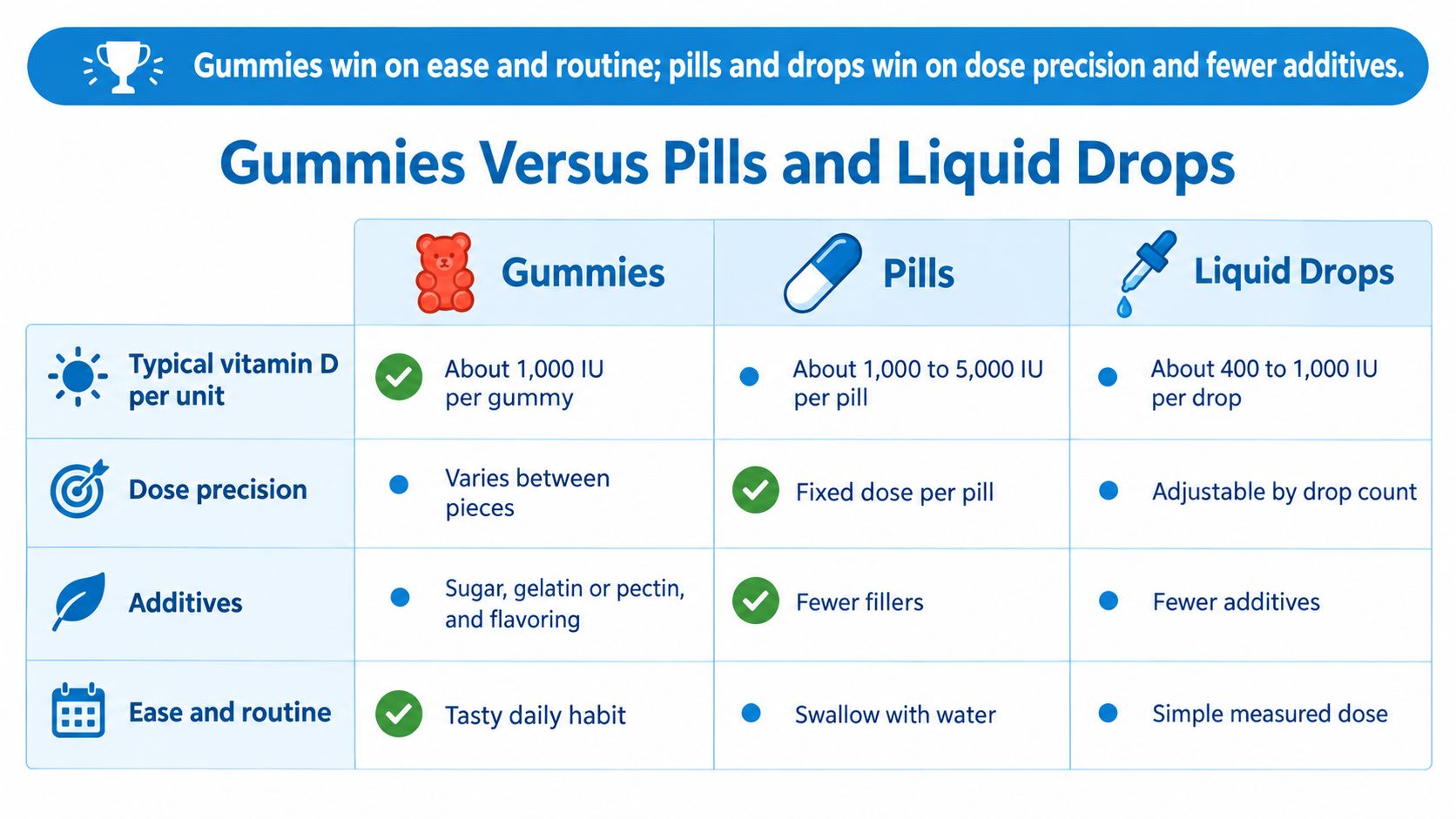
The visual below highlights the format differences. Treat any typical strengths shown as illustrations, not substitutes for the product label.
Match the format to the obstacle
- Choose gummies for a chewing preference: Check that their texture, ingredients and serving size suit you. They aren't appropriate for someone who cannot chew safely.
- Consider pills for simplicity: A plain formulation may suit someone who doesn't want sweetness or flavoring. Compare ingredients rather than assuming fewer additives.
- Consider drops for measured dosing: Use the supplied device and stated concentration. A drop and a full dropper aren't interchangeable.
Vitamin form is a separate choice from delivery format. The guide to whether vitamin D3 is the same as vitamin D helps clarify that terminology.
For value, compare the cost of the dose you really need, not the largest strength or lowest bottle price. Choose a format you can use correctly and consistently, then verify its dose.
Why Gummies Can Deliver More Vitamin D
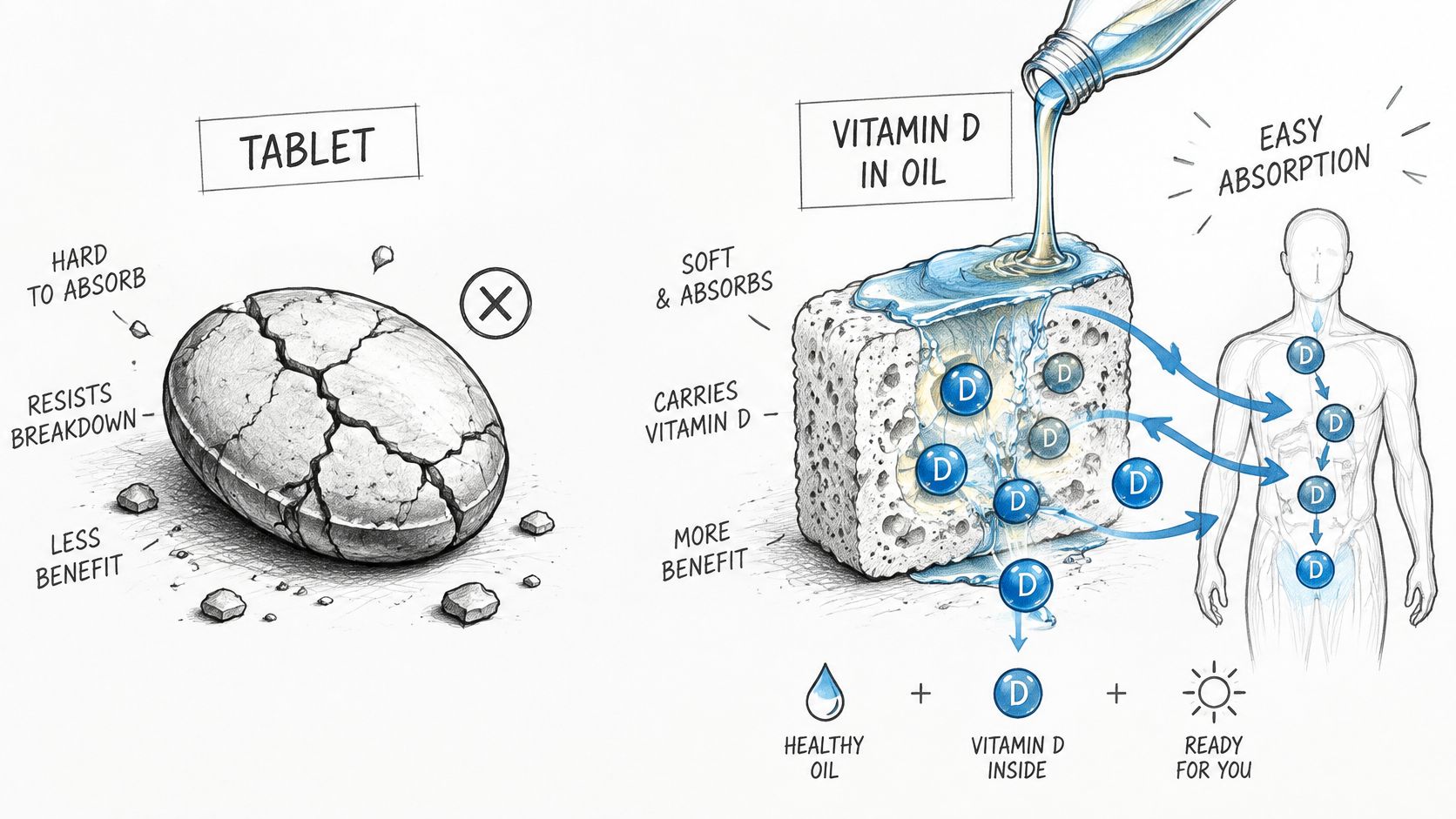
A dry tablet and an oil-containing gummy can be compared loosely to a pebble that must break apart and a sponge carrying an ingredient through a softer mixture. The analogy explains a possible difference in release, but it doesn't prove that tablets dissolve poorly or that every gummy contains an absorption-enhancing formulation.
Formulation matters more than the word gummy. Chewing, carrier ingredients and how vitamin D is dispersed can affect what happens after swallowing.
This diagram illustrates the proposed difference between delivery systems, not a guaranteed advantage for every product.
What the comparison study found
In a randomized crossover bioequivalence study indexed by PubMed, healthy adults received a single 20,000-IU vitamin D3 dose as gummies or tablets; in the confirmatory group of 31 participants, mean exposure was 1,474 versus 774 ng·h/mL, respectively.
Exposure here means the area under the blood concentration-time curve. In plain language, researchers measured how much vitamin D3 appeared in the bloodstream over the sampling period, not merely whether a supplement contained the labeled ingredient.
The crossover design allowed participants to receive both formulations at different times. That helps researchers compare delivery while reducing some of the differences that arise when entirely separate groups receive different products.
What that result doesn't establish
The gummy formulation's oil content and dispersion during chewing may help explain the finding. Those are plausible explanations, not proof that chewing alone caused the difference.
Several boundaries matter:
- The dose wasn't a maintenance recommendation: A high-dose absorption experiment doesn't tell shoppers how much to take daily.
- The finding was formulation-specific: Different carrier ingredients, manufacturing processes and storage conditions can produce different results.
- Blood exposure isn't the same as a better health outcome: The experiment doesn't establish that gummies prevent more illness or correct deficiency more safely.
- The result isn't a conversion formula: Don't reduce or increase your dose based on an assumed gummy absorption multiplier.
Evidence check: A product can deliver vitamin D effectively without being the right dose for you.
For shopping, look for credible independent potency testing and clear identification of the vitamin D form. Don't assume equal labels guarantee identical blood exposure, but don't guess at an adjustment either. If you're receiving monitored treatment, discuss a formulation change with the clinician managing it.
Counting Your Total Daily Vitamin D
A gummy is only one line in your daily total. The NIH consumer fact sheet lists daily recommended amounts for every age group: 400 IU (10 mcg) for infants, 600 IU (15 mcg) for ages 1 through 70 and 800 IU (20 mcg) for adults over 70, with upper limits that climb from 1,000 IU (25 mcg) in early infancy to 4,000 IU (100 mcg) from age 9 onward.
Recommended and upper daily vitamin D by age group
| Age group | Daily amount for maintenance | Upper limit from all sources |
|---|---|---|
| Infants aged 0–6 months | 400 IU (10 mcg) | 1,000 IU (25 mcg) |
| Infants aged 6–12 months | 400 IU (10 mcg) | 1,500 IU (38 mcg) |
| Children aged 1–3 years | 600 IU (15 mcg) | 2,500 IU (63 mcg) |
| Children aged 4–8 years | 600 IU (15 mcg) | 3,000 IU (75 mcg) |
| Children aged 9–18 years | 600 IU (15 mcg) | 4,000 IU (100 mcg) |
| Adults aged 19–70 years | 600 IU (15 mcg) | 4,000 IU (100 mcg) |
| Adults over 70 years | 800 IU (20 mcg) | 4,000 IU (100 mcg) |
| Confirmed low vitamin D levels | Dose set by clinician | Treatment and monitoring set by clinician |
Pediatric feeding and supplementation plans still belong with a clinician. These figures are general reference values by age group, and a child's exact intake depends on feeding, existing supplementation and individual guidance.
The chart below shows the same age-based picture at a glance.
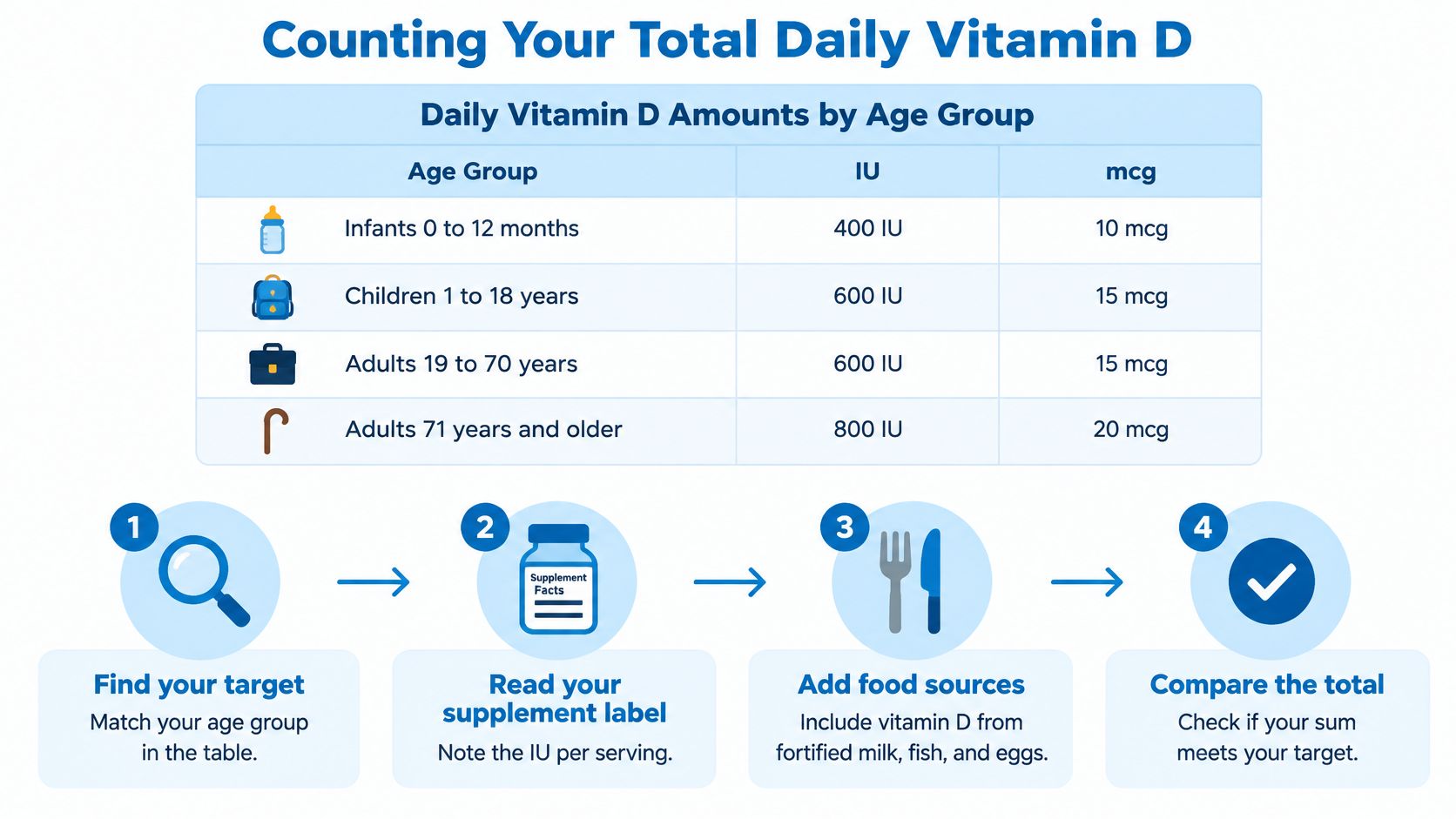
Build a daily intake worksheet
- Find the amount you take. Read serving size and vitamin D per serving together. If you take less or more than that serving, calculate the corresponding amount.
- Put every label in the same unit. Use IU throughout or micrograms throughout. The paired NIH amounts show that 15 mcg and 600 IU describe the same quantity, so 1 mcg corresponds to 40 IU.
- Add every daily source. Include your gummy, multivitamin, calcium formula, fortified foods and any prescribed vitamin D. Record a non-daily prescription separately for pharmacist review rather than treating it as an ordinary daily supplement.
- Compare the total with the appropriate limit. The upper limit works like a speed limit: staying under it is the point, and nobody needs to reach it.
- Resolve uncertainty before adding another product. Bring label photographs and prescription directions to a pharmacist or clinician if you can't confidently reconcile the total.
A hypothetical calculation shows why the worksheet matters: two gummies labeled 1,000 IU each plus a multivitamin labeled 400 IU give 2,400 IU before food. Measured against the 4,000 IU adult upper limit, that leaves about 1,600 IU of room for fortified milk, cereal and other sources. The arithmetic shows where a total sits; it doesn't make the amount necessary or suitable for a particular person.
Why overlapping products deserve attention
The NIH health professional fact sheet reports potentially concerning vitamin D concentrations in 30.6% of people taking multiple vitamin-D-containing supplements, compared with 11.4% among those taking a single such supplement. That association doesn't prove combined products cause toxicity. It does make the case for checking your combined intake rather than assuming separate bottles stay separate in your bloodstream.
NIH also explains that excessive supplementation can cause high blood calcium and high urinary calcium, with severe toxicity potentially damaging the kidneys and affecting heart rhythm. Taking extra vitamin D to cover uncertainty carries real risk rather than acting as a free safety margin.
Count ingredients across products, not just the number of bottles on your shelf.
Combination-product shoppers can also use the guide to zinc and vitamin D to keep separate nutrients and their doses distinct.
If a video format helps you review vitamin D information, the following resource offers another explanation.
Reading the Label on a Vitamin D Gummy
Read the Supplement Facts panel before the flavor description or front-label promises. The serving size, vitamin amount and ingredient list tell you whether the product fits your plan. Attractive packaging can't answer those questions.
A general guide to how to read a supplement label can help you distinguish active ingredients from the ingredients used to make the gummy.
Check the dose first
Vitamin D identity and units: Look for vitamin D3, also called cholecalciferol, or vitamin D2. Record whether the amount is expressed in IU, micrograms or both, and don't confuse the vitamin's name with its quantity.
Serving size: Determine whether the listed amount applies to a single piece or a serving containing multiple gummies. Divide the serving amount by the number of pieces when you need the amount per gummy.
Sweeteners and sugar: Review the amount per serving and the full ingredient list. Someone managing carbohydrate intake, dental concerns or intolerance to particular sweeteners needs more information than a front-label sugar claim.
Gelling ingredients and dietary requirements: Check for gelatin, pectin and other ingredients relevant to your preferences. A plant-based gel doesn't establish that every ingredient is vegan, and gelatin-free doesn't automatically mean halal.
Check what comes with the vitamin
Other active ingredients: Calcium, vitamin K and multivitamin ingredients create additional considerations. A combination formula should fit your whole supplement plan, not just provide a convenient vitamin D amount.
Independent verification: Look for an identifiable testing organization and confirm what its verification covers. Potency testing addresses a different question from contaminant testing, and neither guarantees that the dose is right for you.
Expiration and storage: Find the expiry date, seal information and storage directions before ordering. Consider whether you can store the product as directed, particularly in a warm or humid home.
Avoid a product that hides its vitamin D quantity inside a proprietary blend. You need a clearly stated amount per serving and an understandable serving size; a separate per-gummy statement is helpful but isn't essential when the arithmetic is clear.
Label rule: If you can't determine how much vitamin D your intended serving supplies, choose a clearer label.
Don't interpret reviews about taste or texture as evidence of potency. Customer comments can help with preferences, while the Supplement Facts panel and credible testing information address what you're taking.
Safety Rules for Children, Adults and Special Groups
The practical risk is often an unnoticed combination of products, not an obviously excessive handful. A shopper may remember the dedicated vitamin D gummy while overlooking vitamin D in a calcium formula or multivitamin. Give every product a place in the intake review.
Some people also need a more individualized decision because of their health conditions, medicines or feeding needs. The action isn't always to avoid supplementation. It's to make sure the person managing those needs knows exactly what the product contains.
Vitamin D gummy safety by population
| Population | Main risk | Action before taking gummies |
|---|---|---|
| Healthy adults | Unnoticed overlap between supplements | Review the complete intake and choose an appropriate maintenance dose |
| Older adults | Assuming a different age recommendation permits unrestricted dosing | Confirm the plan, especially when several medicines or supplements are used |
| Infants and young children | Accidental ingestion and an unsuitable chewable format | Follow pediatric advice and keep all supplements inaccessible |
| Pregnant or breastfeeding people | Adding a high-dose product to an existing prenatal routine | Have the prenatal and proposed gummy reviewed together |
| Kidney disease, kidney stones, sarcoidosis or previous high blood calcium | A need for individualized assessment of calcium and vitamin D handling | Ask a clinician before starting |
| Taking thiazide diuretics, orlistat, statins or steroids | Possible interactions or altered vitamin D handling | Ask a pharmacist or clinician to review the exact medicine |
| Taking calcium supplements or high-dose multivitamins | Duplicate ingredients and a more complicated intake plan | Bring every product label to the review |
Make storage part of the dosing plan
Keep the bottle in its original container, close it fully and place it where children cannot reach or access it. Don't transfer gummies into a candy dish or describe them as sweets. A child-resistant closure doesn't replace secure storage.
If several caregivers give a child supplements, designate who administers them and keep a shared record. The same approach helps adults who receive assistance with medicines: the person giving the gummy needs to know whether someone else has already supplied it.
- Suspected accidental ingestion: Contact your local poison service or urgent medical service promptly. Have the container, estimated amount and time of ingestion available.
- Unclear prescription instructions: Ask the prescribing team before adding an over-the-counter gummy. Don't substitute a daily product for a prescribed schedule on your own.
- A newly changed medicine: Request another supplement review rather than assuming an earlier recommendation still fits.
Know when a routine question becomes a medical one
Persistent vomiting, pronounced weakness, confusion or marked changes in thirst or urination need medical assessment, particularly after suspected excessive intake. These symptoms have many possible causes, so don't diagnose vitamin D toxicity yourself or try to correct it with another supplement.
A pharmacist can clarify ingredients and possible interactions. A clinician can assess symptoms, decide whether testing is needed and determine whether supplementation should continue.
Pleasant taste doesn't change those responsibilities. Keep the daily dose tied to a written plan rather than appetite, habit or how many pieces remain in the bottle.
Confirm Your Dose Before You Buy Gummies
Buy a supplement to fill an identified need, not to settle uncertainty about your health. If you're worried about deficiency, discuss your diet, symptoms, medical history and current products with a clinician. They can decide whether a 25-hydroxyvitamin D blood test would help guide care; not every healthy adult needs routine testing.
A sufficient result doesn't automatically mean you need to add maintenance gummies. Your existing diet and supplement routine may already provide an appropriate intake. Equally, a low result deserves an actual treatment plan rather than a guess based on the strongest bottle available.
Use a decision path rather than a strength ranking
Start by gathering your current labels and prescription directions. Write down what you take, how often you take it and why it was recommended. Include products marketed for bones, general wellness or another nutrient, since their front labels may not emphasize vitamin D.
Then choose between the practical options:
- Gummies: A reasonable option when chewing preference or pill swallowing is the main obstacle and the labeled serving fits your plan.
- Tablets or softgels: Worth comparing when you want a straightforward formulation without a sweetened chew.
- Drops: Useful when a measured liquid is appropriate and you can follow the concentration and device instructions accurately.
- No new supplement: The appropriate choice when you don't have an identified intake gap or clinical reason to add one.
Check the full label, independent testing information and storage requirements before committing. For dietary or ethical requirements, verify the specific product's marks rather than assuming an entire brand or retailer's catalog meets the same standard.
Prepare for consistent use
Choose a reminder that records completion, not just an alarm that sounds. Keep the original label available, and make sure anyone helping with your routine knows the intended serving. Reassess the plan when prescriptions, feeding arrangements or other supplements change.
Before ordering, resolve unanswered questions about serving size, ingredients or testing through the retailer's support team. Questions about treatment doses, symptoms and medicine interactions belong with a pharmacist or clinician.
CalVitamin offers an online selection of supplements in different formats, with labeled dietary attributes on select items. Visit CalVitamin to compare product labels and serving details, and contact its support team with ingredient or packaging questions before ordering. Have a clinician or pharmacist review any high-dose plan or potential medication interaction before you start.