
You're standing in the supplement aisle, or scrolling through product pages, trying to answer what sounds like a simple question. Should you buy calcium carbonate or calcium citrate?
Then the confusion starts. One label says “high potency.” Another says “better absorbed.” A friend says citrate is always better. A pharmacist says carbonate is fine with food. If you take an acid blocker, had bariatric surgery, or just want fewer pills, the answer gets even less obvious.
That's why “best” isn't one-size-fits-all. Calcium carbonate vs citrate absorption depends on stomach acid, whether you take your supplement with meals, how many tablets you're willing to swallow, and whether your digestion has changed because of age, medication, or surgery.
The good news is that the choice becomes much easier once you understand one basic idea: some calcium forms need stomach acid to dissolve well, and some don't. From there, the rest of the decision starts to make sense.
Table of Contents
- Choosing Your Calcium Supplement An Introduction
- How Your Body Absorbs Calcium Carbonate and Citrate
- What the Science Says About the Absorption Showdown
- Calcium Carbonate vs Citrate At a Glance
- How Much Elemental Calcium Are You Really Getting
- Personalized Recommendations for Your Health Profile
- Your Final Calcium Shopping Guide
Choosing Your Calcium Supplement An Introduction
A patient once asked me a very practical question: “If citrate absorbs better, why does anyone still buy carbonate?” That's exactly the right question, because it gets past marketing and into how real people use supplements.
Calcium carbonate and calcium citrate are two common supplement forms. They both provide calcium, but they behave differently in the digestive tract. That difference affects how much calcium your body can use, when you should take it, and whether the product fits your routine.
Many shoppers hear a simplified message that citrate wins every time. That idea has some truth behind it, especially for people with low stomach acid. But it's incomplete. Carbonate has one major advantage that matters in daily life: it provides more elemental calcium in less tablet weight. For some people, that makes it easier to reach their target intake.
Here's the more useful way to understand it:
- If absorption flexibility matters most, citrate often makes more sense.
- If pill burden matters most, carbonate may be more practical.
- If you take acid-reducing medicine or absorb poorly, the decision changes again.
- If you always take calcium with meals, carbonate may work better than many online summaries suggest.
Bottom line: The right calcium supplement isn't the one with the loudest label. It's the one that matches your stomach acid, meal pattern, medical history, and tolerance for large tablets.
That's the framework I use with patients. Not “which one is best in theory,” but “which one is most likely to work well for you.”
How Your Body Absorbs Calcium Carbonate and Citrate
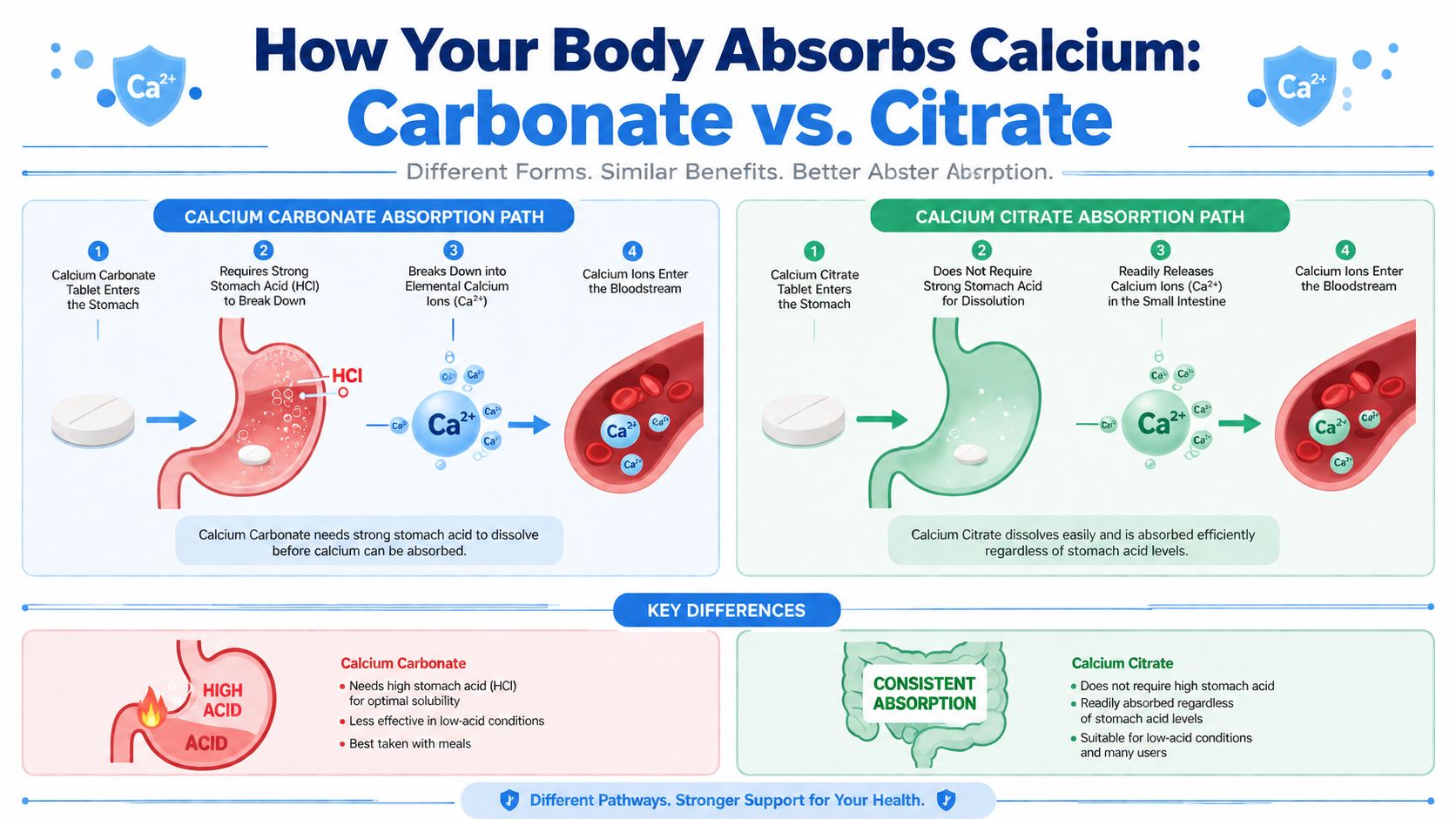
The easiest way to understand this is to focus on dissolving. Your body can't absorb a calcium tablet well if that tablet doesn't dissolve properly first.
Calcium Carbonate Needs More Help
Calcium carbonate depends on stomach acid. Think of acid as the tool that breaks the tablet down into a form your body can move along and absorb. If stomach acid is strong and the supplement is taken with food, carbonate can work well.
If stomach acid is low, carbonate has a harder time dissolving. That's why people taking proton pump inhibitors, older adults with lower acid production, or people with altered digestion may not absorb it as reliably.
A simple analogy helps. Carbonate needs the right key to open the door, and that key is stomach acid.
Calcium Citrate Is Less Dependent on Acid
Calcium citrate is more soluble and doesn't rely on a highly acidic stomach in the same way. It can dissolve and remain available for absorption even when acid levels are lower.
That's why citrate is usually the more dependable option when digestion isn't ideal. It gives you more flexibility. You're not relying as heavily on meal timing or acid production.
If you want a product-focused example of the citrate form, this KAL calcium citrate review shows the kind of supplement many shoppers look at when they want that lower-acid advantage.
Carbonate can be a good supplement. It just asks more from your digestive system.
Why This Matters In Real Life
This isn't just chemistry on paper. It affects how you take the product.
- With carbonate, taking it with a meal is usually the smarter move because food helps support acid production and dissolution.
- With citrate, timing is less restrictive. That can make adherence easier if your schedule is irregular.
- With low stomach acid, citrate is often the steadier choice because it doesn't depend on an acidic environment the same way carbonate does.
Later, I'll get into the numbers. But if you only remember one idea from this section, remember this: the absorption difference starts with dissolving.
A short walkthrough can help reinforce the concept:
What the Science Says About the Absorption Showdown
You stand in the supplement aisle, pick up a citrate bottle, and assume the decision is easy because “citrate absorbs better.” The research is a little more useful than that. It shows a real citrate advantage overall, but it also shows why the best choice still depends on how you eat, digest, and take your pills.
What A Meta Analysis Found
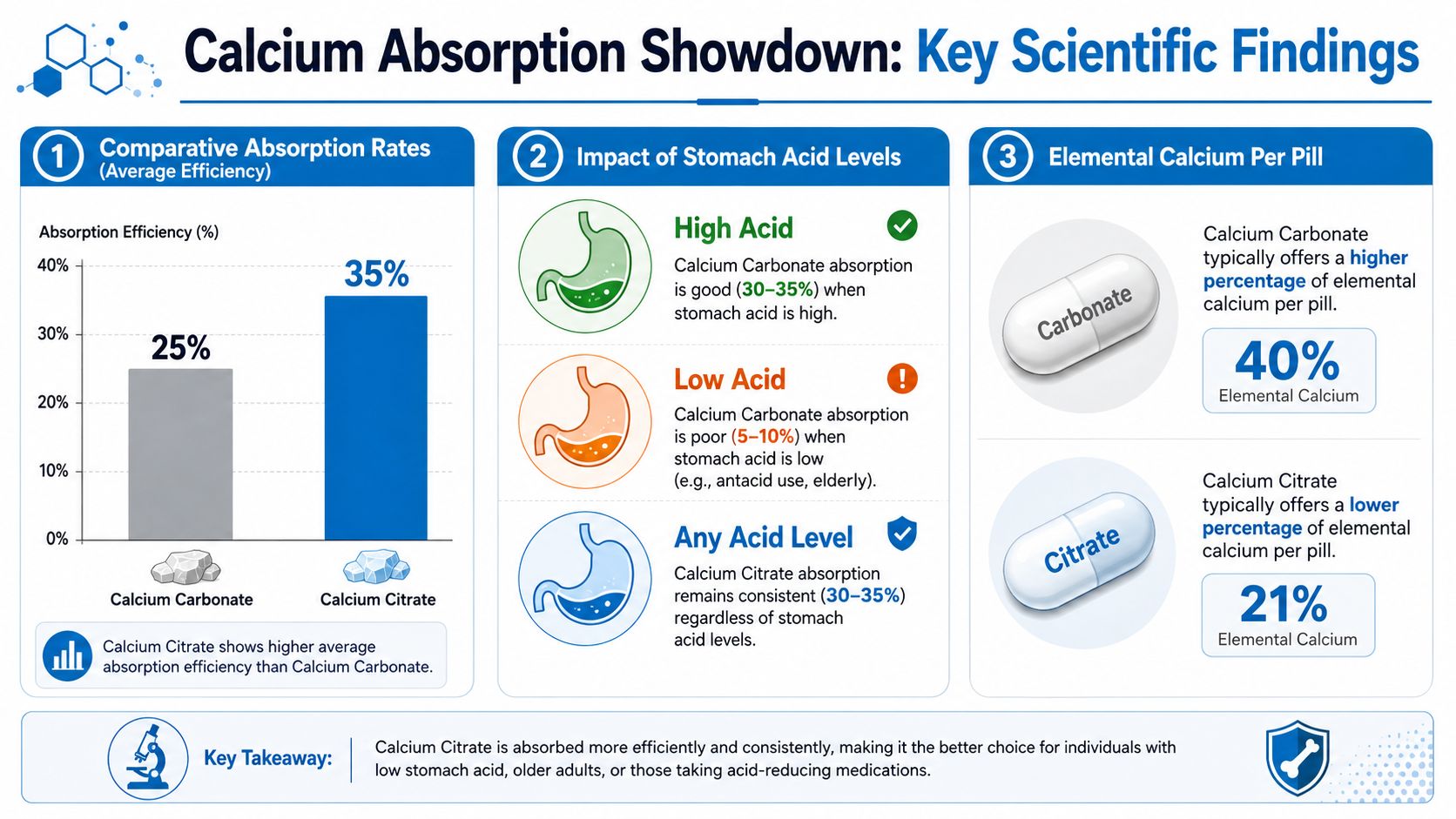
A meta-analysis reported that calcium citrate absorption was approximately 24.0% higher on an empty stomach and 21.6% higher when taken with meals compared with calcium carbonate, with the advantage reaching 27.2% in specific clinical categories. The same PubMed study summary also described a study of 20 women in which fractional absorption was 39.2% (+/- 8.6%) for calcium citrate versus 31.2% (+/- 9.4%) for calcium carbonate, with p < 0.001.
That is why citrate has earned its reputation. In both pooled research and a smaller human study, more of the citrate dose was absorbed.
Why Citrate Often Wins, But Not By The Same Margin Every Time
A common misconception is that the absorption gap is fixed. It is not.
The size of the difference can change with stomach acid levels, meal timing, and the person taking the supplement. If someone has low stomach acid, takes calcium between meals, or has digestive issues, citrate often keeps its edge more reliably. If someone has normal digestion and takes calcium with food, the practical difference may narrow enough that cost, pill size, and adherence matter just as much.
That is the part many articles skip. “Better absorbed” does not always mean “better choice for every person.”
Formulation adds another layer. A study in healthy premenopausal women found that calcium carbonate powder was more bioavailable and absorbed faster than calcium citrate tablets when taken with a light meal, based on the findings summarized in this PMC article on formulation differences.
This nuance is often overlooked. Comparing carbonate with citrate is helpful, but comparing a powder with a tablet can matter too. In real life, you are not choosing a chemistry term. You are choosing a specific product in a specific form that you will take under specific conditions.
The Most Useful Way To Read The Evidence
A practical reading of the research looks like this:
- Citrate has the stronger overall absorption record
- Its advantage becomes more relevant when stomach acid is lower or meal timing is inconsistent
- Carbonate can still be an excellent option if you take it with food and tolerate it well
- The product form, such as powder versus tablet, can change the outcome
That is why the simple slogan “citrate is always better” falls short. The better question is: Which form fits your body and your routine well enough that you will absorb it consistently and keep taking it?
Calcium Carbonate vs Citrate At a Glance
If you want the shortest practical comparison, use this table.
| Factor | Calcium Carbonate | Calcium Citrate |
|---|---|---|
| Dependence on stomach acid | More dependent on stomach acid for dissolution | Less dependent on stomach acid |
| Best timing | Usually best with food | Can be taken with or without food |
| Elemental calcium concentration | Higher concentration by weight | Lower concentration by weight |
| Pill burden | Often fewer tablets to reach a target calcium amount | Often more tablets or more total tablet mass |
| Absorption flexibility | Less forgiving if digestion is impaired | More forgiving in low-acid settings |
| Good fit for | People with normal digestion who take supplements with meals | People with low stomach acid, irregular meals, or absorption concerns |
| Formulation nuance | Powder form may perform better than many expect | Tablet form isn't always automatically superior |
| Main trade-off | Convenient dose density, but more acid dependent | Better absorption profile, but bulkier dosing |
Calcium Carbonate vs. Calcium Citrate Comparison
The table looks simple, but the trade-off is important. Carbonate is the denser option. Citrate is the more flexible absorber.
People often get stuck because they're trying to pick the “stronger” product. That's not quite the right question. A better question is, which form fits how I take supplements?
If you routinely take calcium with meals and want fewer pills, carbonate may be a strong practical option. If your digestion is less predictable, citrate gives you more room for error.
Another point patients appreciate is that labels can be misleading if you don't know whether the number on the bottle refers to total compound weight or elemental calcium. That's where many shoppers accidentally compare unlike with unlike.
How Much Elemental Calcium Are You Really Getting
Supplement labels are most confusing on this point. The important number isn't just the weight of the compound. It's the amount of elemental calcium, meaning the actual calcium available within that compound.
Why The Label Can Be Misread
Calcium carbonate contains 40% elemental calcium by weight, while calcium citrate contains 21% elemental calcium by weight, according to this GoodRx comparison of calcium carbonate and calcium citrate.
That difference changes everything about tablet size and pill count.
If you're trying to get 1,000 mg of elemental calcium, the same source explains that you'd need 2,500 mg of calcium carbonate but about 4,760 mg of calcium citrate. So even if citrate absorbs better, you may need much more total material to reach the same labeled elemental calcium target.
Simple Math That Helps At The Store
It's like carrying groceries.
Carbonate packs more calcium into less total weight. Citrate carries less elemental calcium per gram, so reaching the same target usually means more bulk. That can mean larger tablets, more capsules, or more servings.
This doesn't mean carbonate is “better.” It means carbonate is denser.
The Practical Trade Off
Here's how I explain it to patients:
- Carbonate gives you more elemental calcium in less product weight
- Citrate gives you a more absorption-friendly form in many digestive situations
- You're balancing density against absorption reliability
That trade-off matters if you dislike swallowing large tablets. It also matters if you already take several medications and don't want more pill burden.
A smart label-reading checklist looks like this:
- Check the form. Look specifically for carbonate or citrate.
- Find the elemental calcium amount. That's the meaningful number.
- Look at serving size. One tablet and one serving aren't always the same.
- Match the dose to your routine. A theoretically excellent supplement won't help much if you avoid taking it because it's too bulky.
A supplement that absorbs well but sits untouched in the bottle isn't the right supplement for you.
Personalized Recommendations for Your Health Profile
At this point, the decision gets personal. Two people can read the same data and reasonably choose different products.
Healthy Adult With Normal Digestion
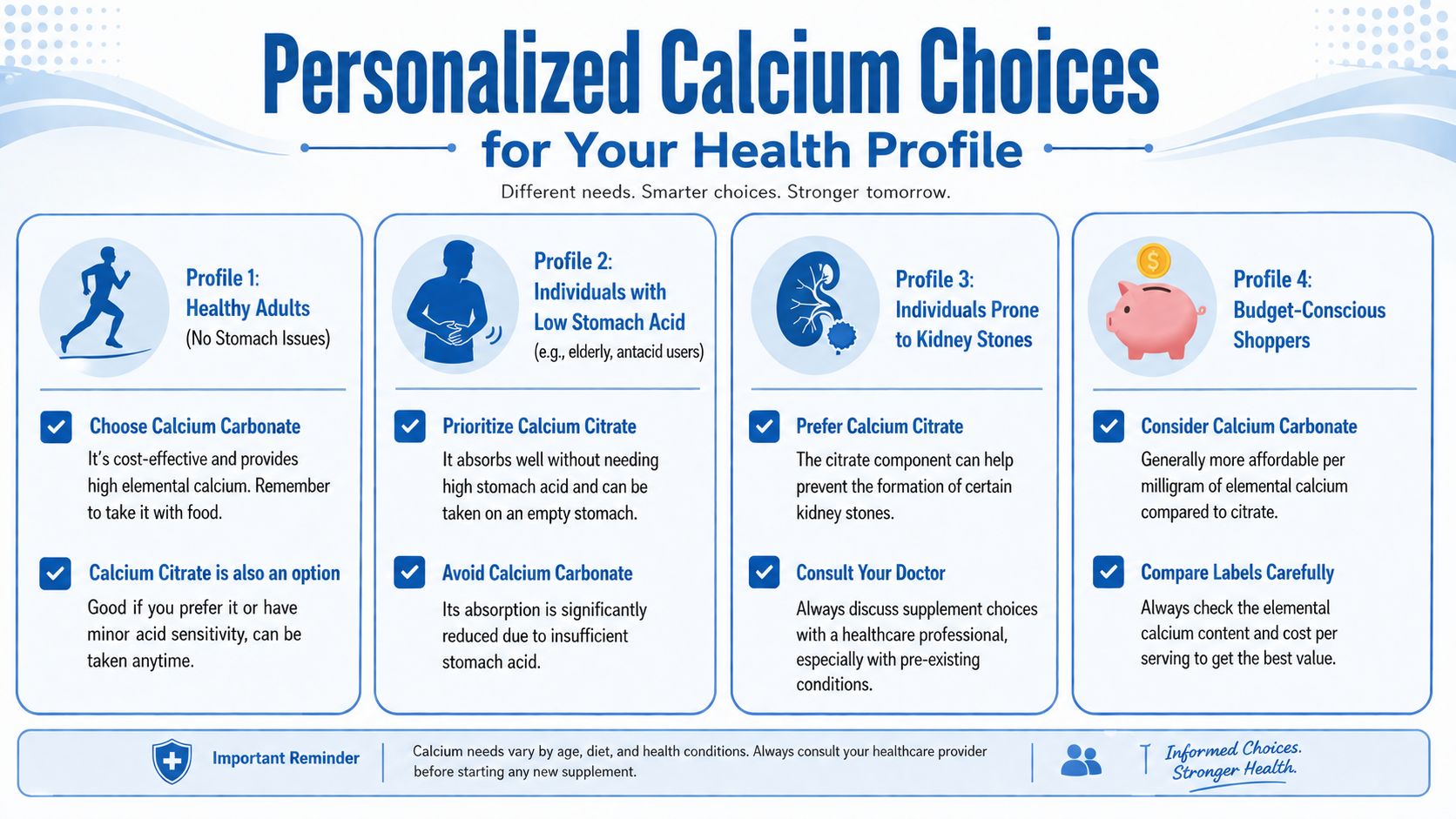
If you have no known stomach acid issue, no bariatric history, and you reliably take supplements with meals, calcium carbonate can be a very reasonable choice.
Why? It's efficient from a pill-burden standpoint. You get more elemental calcium in less weight, which many people find easier to manage. For shoppers who want a capsule-based citrate option instead, products like Life Extension Calcium Citrate with Vitamin D reflect the kind of alternative some people prefer when flexibility matters more than tablet count.
Your decision may come down to comfort and routine. If carbonate sits well in your stomach and you always take it with food, it may fit your life better than citrate.
You Take Acid Blocking Medication
This group needs more nuance than most articles give.
In patients with absent gastric acid, such as those taking proton pump inhibitors, calcium citrate absorption can be up to 10 times higher than calcium carbonate when taken on an empty stomach, according to this review of citrate versus carbonate in low-acid conditions.
That sounds like an automatic victory for citrate, and in some situations it is. But there's an important detail. A clinical review noted that calcium carbonate is much better absorbed with meals than in the fasting state for achlorhydria patients, and food can improve carbonate absorption by 10–30% even in low-acid environments, based on this PMC review on calcium absorption and acid suppression.
So the practical advice becomes more refined:
- If you take calcium away from meals, citrate is usually the safer pick.
- If you take calcium with regular meals, carbonate may still be workable for some people.
- If you want the least dependence on timing and acid, citrate remains easier to use.
The myth is “PPI users should never take carbonate.” The more accurate version is “carbonate is less forgiving, especially without food.”
You Had Bariatric Surgery Or Have Very Low Stomach Acid
This is the group where citrate pulls clearly ahead.
People who've had bariatric surgery, or who have very low or absent stomach acid, often don't handle carbonate well from an absorption standpoint. Verified data also notes that in Roux-en-Y gastric bypass patients, citrate produced significantly higher serum calcium responses and greater urinary calcium increments than carbonate in low-acid physiology, as summarized in the earlier linked low-acid review.
For these patients, I'd usually lean toward citrate unless a clinician gives a different plan. When digestion has been structurally altered, you want the form that asks the least from the stomach.
Form Matters More Than Many People Realize
One of the most useful corrections to the “citrate is always better” myth is this: the delivery form can change the outcome.
As noted earlier, carbonate powder outperformed citrate tablets in one study of healthy premenopausal women when taken with a light meal. That doesn't erase citrate's general absorption advantage. But it does show that comparing salts alone can oversimplify things.
If you're choosing between a chalky carbonate tablet, a carbonate powder, and a citrate capsule, you're not just choosing chemistry. You're choosing chemistry plus delivery system plus your method of intake.
Your Final Calcium Shopping Guide
By the time consumers often finish comparing labels, they want a simple answer. Here it is.
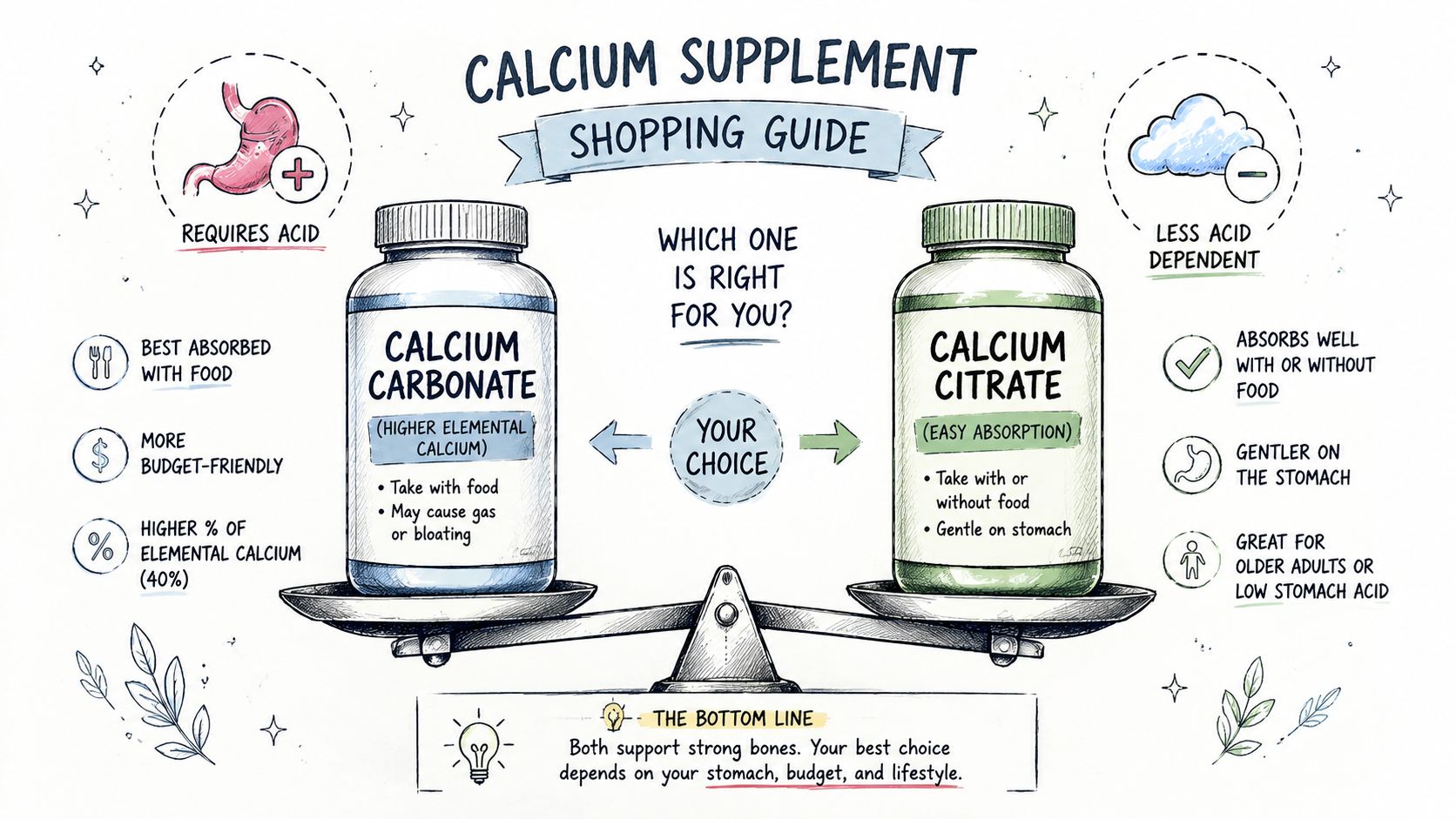
Choose Carbonate If
You want a more concentrated form of elemental calcium, you don't mind taking it with food, and your digestion is normal enough that acid-dependent absorption isn't a major concern.
This is often the practical choice for people who want fewer tablets. If you're already taking a combination mineral product, something like a calcium magnesium zinc D3 complex may appeal to shoppers who prefer an all-in-one format.
Choose Citrate If
You take acid-suppressing medication, have low stomach acid, had bariatric surgery, prefer the option to take calcium without food, or want the form with the stronger overall absorption track record.
Citrate is often the safer “works in more situations” option.
Keep These Final Checks In Mind
- Read elemental calcium carefully. Don't compare products by tablet size alone.
- Match the supplement to your meal habits. Carbonate depends more on food and acid.
- Think about adherence. The best supplement is the one you'll consistently take.
- Pay attention to side effects. Some people find carbonate more likely to cause gas or constipation, while citrate may feel easier on the stomach.
- Ask for individualized advice if you have kidney disease, a bariatric history, or complex medication use.
A key lesson from calcium carbonate vs citrate absorption is that the “best” product depends less on internet slogans and more on how your body works. Once you know that, the shelf starts looking a lot less confusing.
If you're ready to compare options, CalVitamin offers a wide range of calcium supplements and wellness products in different forms, so you can choose the one that fits your health needs, routine, and preferences.






