
Feeling tired doesn't automatically mean you need an “energy vitamin.” A B-complex can be useful when a deficiency is limiting metabolism, but taking more of a nutrient your body already has enough of may change little beyond the color of your urine. The useful question isn't, “Which supplement gives me energy?” It's, “Which metabolic process might be under-supported, and is there evidence that I'm short of a required nutrient?”
That distinction separates correcting a nutritional problem from buying an attractive promise. B vitamins help your cells process food, but they aren't a stimulant, and vitamin B12 supplementation doesn't appear to improve athletic performance or endurance in people whose B12 status is already sufficient, according to the NIH Office of Dietary Supplements' professional fact sheet.
Table of Contents
- Why More Vitamins Does Not Always Mean More Energy
- How Your Cells Turn Nutrients Into Usable Energy
- Key Vitamins and Nutrients That Support Metabolic Health
- Food Sources Versus Supplements for Energy Support
- Tailored Guidance for Different Lifestyles and Life Stages
- Dosing Safety and Supplement Interactions to Know
- Evaluating Energy Supplement Claims With Confidence
Why More Vitamins Does Not Always Mean More Energy
Your body doesn't produce energy by collecting vitamins in a larger pile. It produces usable cellular energy through coordinated chemical reactions, and each reaction depends on the right ingredients, enzymes, and cofactors. B vitamins are essential tools in that system, but an extra supply of one tool won't necessarily speed production if another step is already working normally.
A factory analogy makes the point. Imagine an assembly line turning raw materials into finished products. Thiamin may support one station, riboflavin another, and niacin a later transfer process. If the riboflavin-dependent station lacks materials, adding more thiamin won't solve the delay. The missing nutrient becomes rate-limiting, meaning its shortage restricts the output of the entire process.
That's why supplementation can feel dramatically helpful to one person and pointless to another. Someone with a genuine deficiency may remove a bottleneck and restore impaired metabolism. Someone with adequate intake already has enough of the relevant cofactor, so a high-dose product may offer no meaningful increase in energy production.
Practical rule: Treat a documented deficiency, not the word “energy” on a label.
The National Academies review of B vitamins and energy metabolism describes thiamin, riboflavin, niacin, vitamin B6, and pantothenic acid as nutrients required for chemical steps involved in energy utilization. Those steps include decarboxylation, transamination, acylation, oxidation, and reduction. In plain language, the vitamins help the body process carbohydrate, fat, and protein substrates so cells can use their stored chemical energy.
The marketing mistake is turning “required for normal metabolism” into “creates extra energy.” A supplement can help when low nutrient status is impairing the system. It can't manufacture more energy from an already adequate system, and it can't automatically correct fatigue caused by poor sleep, illness, medication effects, thyroid problems, anemia, or excessive stress.
How Your Cells Turn Nutrients Into Usable Energy
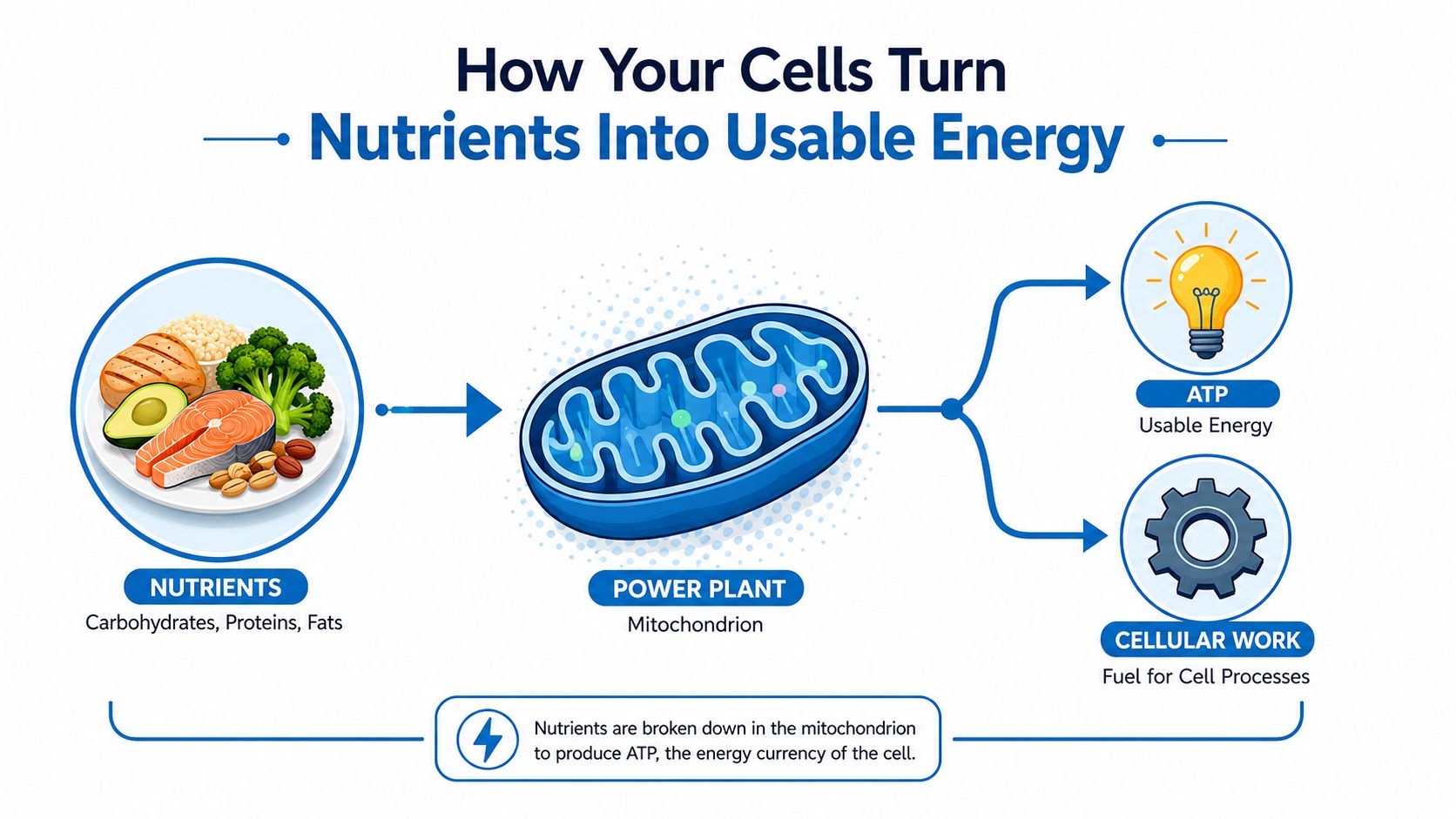
Think of a cell as a building with a small power plant. The mitochondria process molecules derived from food and help generate ATP, the energy currency used for cellular work. Your muscles need ATP to contract, your nervous system needs it to communicate, and every active cell relies on energy transfer to maintain its functions.
Carbohydrates, fats, and proteins enter metabolism through different routes, but they eventually feed chemical intermediates into shared pathways. The citric acid cycle acts like a processing loop. It strips usable electrons from nutrient-derived molecules and loads them onto carrier molecules. Those carriers then deliver electrons to the electron transport chain, a sequence in the inner mitochondrial membrane.
The electron transport chain uses that electron flow to create a gradient, similar to water building pressure behind a dam. Hydrogen ions move back through ATP synthase, a molecular machine that uses the flow to help form ATP. Oxygen participates at the end of the chain, allowing the process to continue and contributing to water formation.
Where the B vitamins fit
B vitamins don't act like fuel. They act more like specialized tools or access cards that allow enzymes to perform particular reactions.
- Thiamin, or B1, supports decarboxylation reactions involved in processing carbohydrate-derived molecules.
- Riboflavin, or B2, helps form flavin coenzymes that participate in oxidation and electron transfer.
- Niacin, or B3, contributes to coenzymes that carry electrons between metabolic reactions.
- Vitamin B6 supports transamination, a process involved in amino-acid metabolism.
- Pantothenic acid, or B5, contributes to coenzyme A, which helps transfer acyl groups in metabolism.
The National Academies reference on B-vitamin functions connects these nutrients with the citric acid cycle, electron transport chain, and ATP formation. That chemistry is universal. Human cells need the same broad cofactor-dependent reactions regardless of whether a person follows a mixed diet, vegetarian diet, or another eating pattern.
A shortage in one cofactor can slow a particular reaction and reduce the flow through connected pathways. Calories alone aren't enough if the enzymes processing those calories lack required helpers. This explains why someone can eat enough food yet still experience fatigue linked to inadequate nutrient status.
Key Vitamins and Nutrients That Support Metabolic Health
Energy metabolism depends on a network, not a single “energy vitamin.” The B-complex group is central because its members support connected reactions involving carbohydrates, fats, and amino acids. Riboflavin is especially important to understand because a systematic review on riboflavin and energy metabolism describes its involvement in primary metabolic pathways and lipid, protein, and glucose metabolism.
Vitamin B12 deserves a separate warning. It has a legitimate role in metabolism, but the NIH Office of Dietary Supplements notes that supplementation doesn't appear to improve athletic performance or endurance when B12 status is sufficient. That makes B12 a good example of the difference between deficiency correction and performance enhancement.
| Nutrient | Metabolic role | Deficiency signs | Top food sources |
|---|---|---|---|
| Thiamin, B1 | Supports chemical reactions involved in carbohydrate and energy metabolism | Fatigue and impaired metabolic function may occur | Whole grains, legumes, seeds, nuts, pork, and fish |
| Riboflavin, B2 | Helps support oxidation, electron transfer, and broader carbohydrate, fat, and protein metabolism | Fatigue and impaired energy processing may occur | Eggs, lean meats, green vegetables, and fortified cereals |
| Niacin, B3 | Contributes to electron-carrying coenzymes used in metabolism | Low energy and impaired metabolic function may occur | Poultry, fish, brown rice, peanuts, and other varied foods |
| Vitamin B6 | Supports amino-acid processing and related metabolic reactions | Fatigue and metabolic impairment may occur | Fish, poultry, legumes, and varied whole foods |
| Pantothenic acid, B5 | Contributes to coenzyme A and acyl-group transfer | Deficiency is uncommon but can affect metabolism | Meat, eggs, legumes, mushrooms, and whole grains |
| Vitamin B12 | Supports cellular metabolism and neurological function | Fatigue and neurological changes can occur with deficiency | Meat, fish, eggs, dairy, and fortified foods |
| Iron | Supports oxygen transport and cellular processes | Weakness and fatigue can occur with iron deficiency | Meat, seafood, legumes, leafy vegetables, and fortified foods |
| Magnesium | Helps enzymes use ATP and supports metabolic reactions | Muscle symptoms and fatigue may occur | Nuts, seeds, legumes, whole grains, and leafy vegetables |
| Vitamin D | Supports broader health, including muscle and immune function | Muscle weakness and other deficiency-related effects may occur | Fatty fish, fortified foods, and sunlight-related production |
| CoQ10 | Participates in electron transfer within cellular energy production | Low levels may be relevant in selected clinical contexts | Meat, fish, and some plant foods |
The table is a guide, not a diagnosis. Symptoms overlap, food intake varies, and a supplement containing every listed nutrient isn't automatically appropriate. For product research, readers can compare a targeted Life Extension B12 Elite formula, but the decision should still follow dietary intake, risk factors, and clinical assessment.
Food Sources Versus Supplements for Energy Support
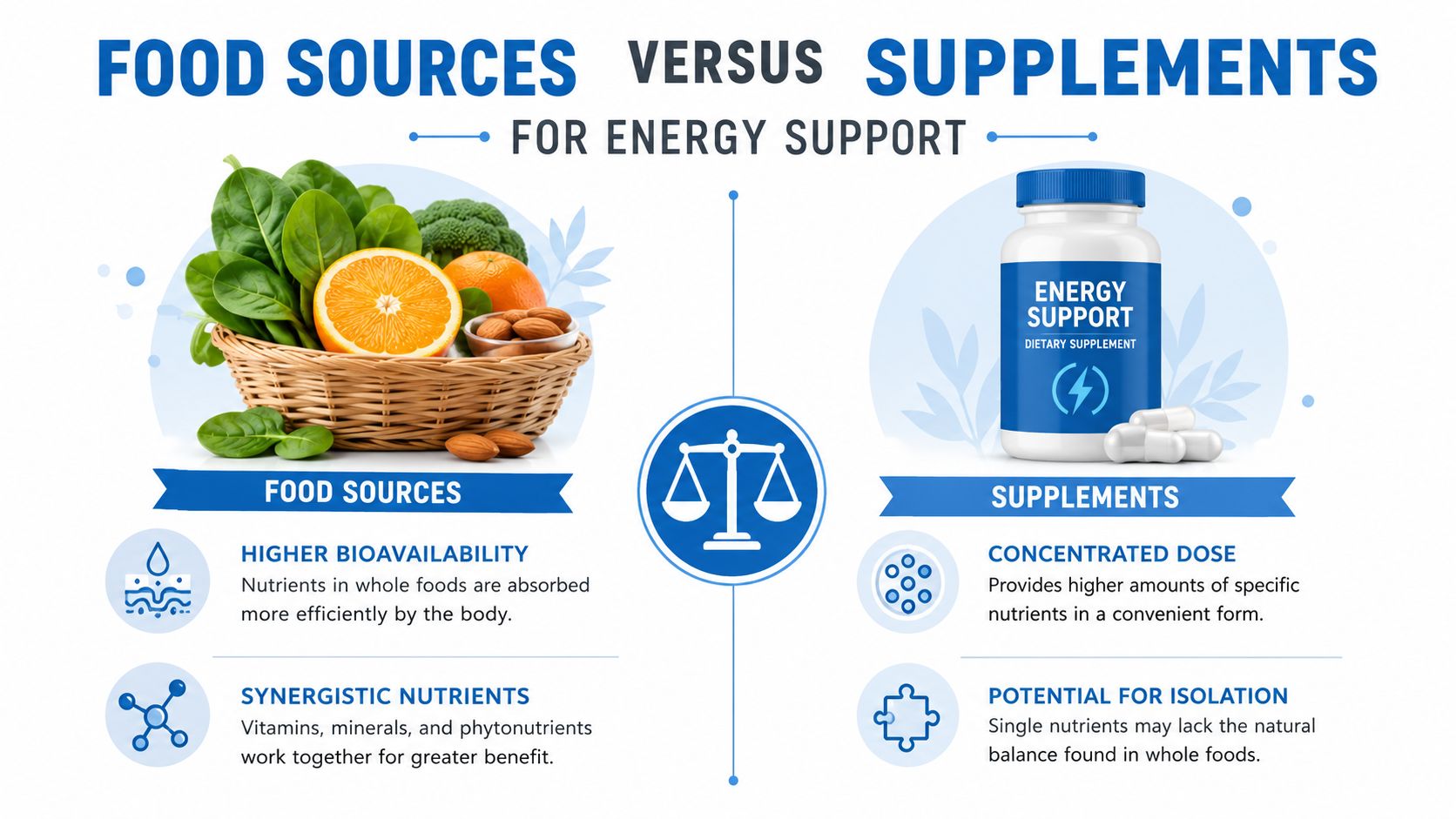
Whole foods usually offer the most sensible starting point because they combine several nutrients with protein, carbohydrates, fats, and fiber. A meal containing legumes, whole grains, vegetables, eggs, fish, or dairy can support overall nutrient intake in a way a single capsule can't replicate. Food also makes it easier to improve the broader diet pattern rather than chase one symptom.
Supplements have a different advantage: concentration and convenience. A tablet can provide a defined nutrient when diet alone is difficult, and a fortified food can help people who avoid particular food groups. That convenience matters for someone with a restrictive diet, poor appetite, limited food access, or a diagnosed absorption problem.
Choose the approach that matches the problem
A varied diet may be enough when meals regularly include multiple food groups and there's no reason to suspect malabsorption or deficiency. A supplement becomes more rational when a person can't reliably obtain a nutrient from food, has a condition affecting absorption, or has a confirmed low status.
The review of B vitamins and energy metabolism identifies adults with restrictive diets, alcohol use, malabsorption, or high metabolic demand as groups who may benefit from assessment of multiple B-vitamin status. Assessment is more useful than guessing because fatigue rarely points to one vitamin with certainty.
Food-first doesn't mean supplement-never. It means the product should solve a defined nutritional problem.
Someone following a fully plant-based diet may need particular attention to nutrients that are difficult to obtain without fortified foods or supplementation. Someone with heavy alcohol use may need professional evaluation rather than a generic “energy blend.” Someone with gastrointestinal disease or a history of digestive surgery may absorb nutrients differently from someone with a healthy digestive tract.
For general multivitamin comparison, a Naturelo Whole Food Men's Multivitamin review can help you examine formulation details, but reviews can't determine whether your body needs a product. Use the label as a source of information, not as proof that supplementation will improve fatigue.
Tailored Guidance for Different Lifestyles and Life Stages
The same supplement can have different value for different people because baseline nutrient status changes the expected result. A person with adequate intake has less room for improvement than someone whose metabolism is limited by a deficiency or increased requirement.

Athletes and highly active adults
Training increases energy demand, but that doesn't mean every athlete needs a B-complex. Start with adequate food, fluids, recovery, and carbohydrate and protein intake appropriate to the training routine. If fatigue, poor recovery, or declining performance persists, a clinician can decide whether nutrient assessment makes sense.
A supplement may help correct low status. It shouldn't be treated as a shortcut to endurance when B-vitamin status is already adequate, particularly because B12 supplementation doesn't appear to improve performance in sufficient individuals, as explained by the NIH B12 evidence summary.
Adults with ongoing fatigue
Fatigue deserves a broader differential. Sleep disorders, anemia, thyroid dysfunction, mood disorders, infection, medication effects, and inadequate calorie intake can all resemble “low vitamins.”
Write down when fatigue began, how it changes during the day, your sleep quality, dietary restrictions, alcohol intake, exercise load, and any neurological symptoms. That record gives a healthcare professional a clearer starting point than a random supplement trial.
Older adults
Age and baseline status may influence who benefits from supplementation. A 2023 randomized trial summarized in a review of riboflavin and energy metabolism found that multivitamin and multimineral supplementation prevented or reversed declines in vitamin biomarkers and cellular energy metabolism in healthy older men.
That finding supports targeted evaluation, not automatic high-dose use. Older adults who eat little, take medications, or have digestive problems may need a more individualized discussion about food, fortified products, and laboratory testing.
Plant-based and restrictive diets
A restricted diet can be nutritionally sound, but it requires planning. Review fortified foods, protein variety, and nutrients that may be difficult to obtain from the chosen pattern. If fatigue appears after a major dietary change, discuss the change with a clinician or registered dietitian rather than assuming the cause is one missing vitamin.
Dosing Safety and Supplement Interactions to Know
A supplement label can make a product look harmless because many vitamins are water-soluble, but “water-soluble” doesn't mean unlimited doses are automatically appropriate. Excess intake can create side effects, interfere with treatment, or obscure the cause of fatigue.
Iron requires particular caution. The mandatory safety guidance for this topic specifies not exceeding 45 mg per day unless a healthcare professional has directed otherwise. Don't start iron because you feel tired. Iron status requires appropriate evaluation, and unnecessary iron can be harmful.
Read the whole label
Check the amount of each nutrient, serving size, duplicate ingredients, and whether a proprietary blend hides individual quantities. “Energy” formulas may combine vitamins with stimulants, including caffeine, so read the full ingredient panel rather than relying on the front label.
Vitamin B12 is generally considered to have low toxicity even at high doses, but that doesn't make it a universal fatigue treatment. If symptoms are persistent, testing and diagnosis are more useful than escalating the dose.
Medication timing matters too. Minerals can interfere with absorption of some medicines, including thyroid drugs and certain antibiotics. People taking anticoagulants should also ask a pharmacist or doctor to review any multivitamin or herbal blend before use, especially if it contains nutrients that affect clotting.
For an ingredient-focused option, you can examine Thorne Niacel 400 Nicotinamide Riboside, but product selection shouldn't replace medication review or clinical advice.
Seek medical evaluation for unexplained or worsening fatigue, fainting, chest discomfort, shortness of breath, neurological changes, unusual bleeding, or major changes in weight or sleep.
Evaluating Energy Supplement Claims With Confidence
A credible energy supplement claim should answer three questions:
- What nutrient does it provide?
- What problem is it designed to address?
- What evidence supports benefit in people like you?
Start with the ingredient panel. A transparent label lists each active ingredient and its amount. A proprietary blend makes it harder to tell whether the product contains a meaningful dose or a collection of trace ingredients chosen for marketing appeal.
Next, match the promise to the evidence. “Supports normal energy metabolism” is a biochemical statement. “Boosts athletic performance” is a much stronger outcome claim. The latter needs evidence in people with comparable nutrient status, age, health, and activity level.
Finally, decide how you'll judge whether the product helped. Record the symptom, the start date, relevant diet changes, sleep, training, and any laboratory results. Don't keep adding products when fatigue continues. Persistent symptoms call for medical assessment, not an expanding supplement shelf.
The most defensible approach to energy and metabolism vitamins is simple: build a varied diet, identify genuine risk factors, test when appropriate, and supplement for a clear reason. Vitamins can remove a metabolic bottleneck, but they can't replace diagnosis, sleep, food, or treatment for an unrelated condition.
CalVitamin offers vitamins, minerals, multivitamins, and targeted wellness products that can help you compare options for a nutrition plan based on your needs. Visit CalVitamin to review product labels and choose supplements as part of an evidence-informed approach, ideally with guidance from a qualified healthcare professional.






