Echinacea is a useful example of why “natural” and “proven” aren't opposites, but they aren't synonyms either. One major review found mixed prevention results, with one pooled analysis not reaching statistical significance, while another analysis of all eligible trials found a reduced risk of catching a cold. The result is neither a miracle herb nor a useless one. It's a plant whose effects depend heavily on species, plant part, extract composition, dose, and timing.
That distinction matters if you're shopping for echinacea immune support. A capsule containing a standardized Echinacea purpurea extract isn't interchangeable with a weak tea, a root tincture, or a product that says “echinacea blend.” The evidence becomes easier to understand once you stop treating echinacea as one uniform ingredient.
Table of Contents
- Why Echinacea Is America's Favorite Herb and Where the Evidence Actually Stands
- What Echinacea Really Is and Where It Comes From
- How Echinacea Interacts With Your Immune System
- What the Clinical Research on Echinacea Actually Shows
- Forms, Species, and Dosages That Matter Most
- Who Should and Should Not Use Echinacea for Immune Support
- Choosing a Quality Echinacea Supplement Without the Guesswork
- Key Takeaways and Common Questions About Echinacea Use
Why Echinacea Is America's Favorite Herb and Where the Evidence Actually Stands
Echinacea is widely used for echinacea immune support, but its reputation is steadier than its clinical evidence. People often reach for it during cold season. Research on prevention is mixed, and treatment benefits are not consistent across preparations. The practical question is not whether echinacea works in every situation, but which product was tested, for what purpose, and at what point in an illness.
Trial results diverge because each study tested a different preparation under different conditions. Species, plant part, extraction method, dose, and timing can all change what a product delivers. Taking echinacea before illness is also a different question from starting it when symptoms appear.
The practical lesson: “Does echinacea work?” is too broad a question. “Which preparation, taken for what purpose and when?” is answerable.
A useful reading framework has four parts. Separate prevention from early treatment. Check whether the label names the species and plant part. Compare the product's dosage with the preparation used in positive trials. Then review safety limits, especially if daily use is being considered.
For broader reading on botanicals, explore the herbal supplements category. A category page can help you compare products, but it cannot establish that every echinacea formula has the same evidence. Label transparency matters because a root tincture, a fresh-pressed aerial-part extract, and an unspecified blend are not interchangeable.
Earlier dismissive headlines treated echinacea as ineffective, while enthusiastic marketing often presents it as a dependable daily shield. The evidence supports a narrower conclusion: some preparations may provide modest short-term support for certain respiratory outcomes, but research does not establish a guaranteed benefit from long-term daily use. The details on the bottle, and the reason for taking it, determine how much confidence the evidence deserves.
What Echinacea Really Is and Where It Comes From
Echinacea isn't one herb. It's a genus of flowering plants in the Asteraceae family, native to North America, and the supplement market mainly uses Echinacea purpurea, Echinacea angustifolia, and Echinacea pallida.
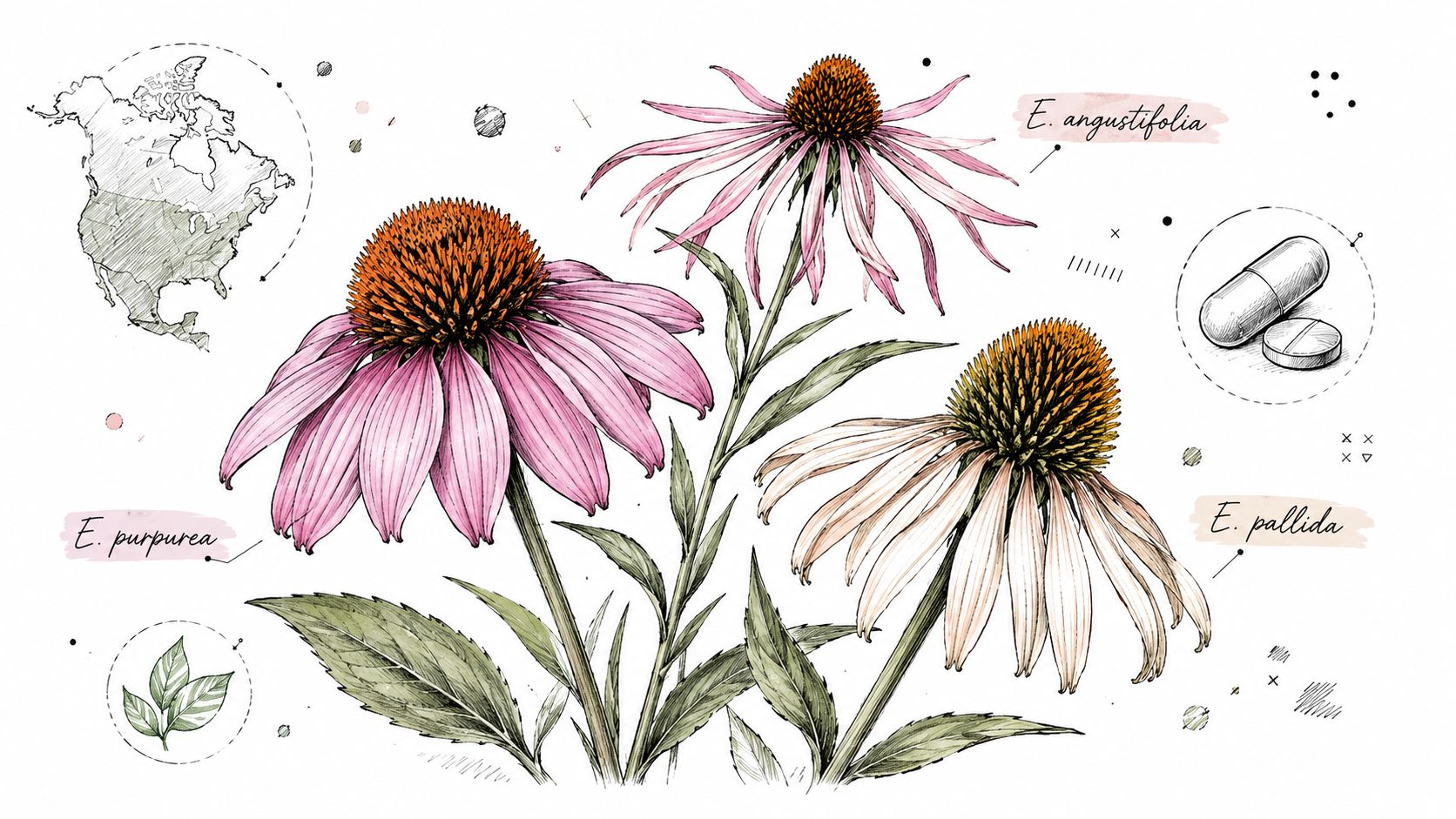
Three species, three label clues
Echinacea purpurea is the most studied species and appears frequently in modern products. Researchers have tested both its above-ground parts, called aerial parts, and preparations made from fresh-pressed juice.
Echinacea angustifolia is commonly associated with the root. It also appears in traditional North American preparations and in commercial tinctures and combination formulas.
Echinacea pallida is less common in everyday supplements and is generally represented by root-based products. Its chemical profile differs from the other species, so findings from a purpurea product shouldn't automatically be transferred to pallida.
The plant's history adds context. Indigenous peoples in North America used echinacea in medicinal practice, and the herb later entered American eclectic medicine. Modern European herbal regulation, including a German Commission E monograph developed in the 1980s, also influenced the dosage conventions used in products and trials.
For shoppers, the key point is simple: the name on the front of the bottle doesn't tell the whole story. A root extract and a fresh-pressed aerial-part preparation can contain different proportions of alkamides, caffeic acid derivatives, polysaccharides, and other constituents.
Read the label in this order
Start with the species. Then identify the plant part, such as root, aerial parts, or whole plant. Finally, look for the extraction method and any marker compounds used for standardization.
That information helps you compare like with like. The herbal supplement range may include multiple forms, but a product's usefulness depends on whether its label gives enough detail to connect it with the preparation studied in research.
How Echinacea Interacts With Your Immune System
Echinacea is better described as a possible immune-response modulator than as a brute-force immune booster. A useful analogy is a rehearsal coach. The coach doesn't send every performer onto the stage at maximum volume. Instead, the coach helps the first responders coordinate their timing and roles.
The proposed activity comes from several bioactive families, not one magic molecule.
The compounds behind the proposed activity
Alkamides can influence immune signaling, including cytokine communication, and are considered important contributors to the activity of several echinacea extracts. Their presence and concentration can vary between species and extraction methods.
Caffeic acid derivatives, including compounds such as chicoric and chlorogenic acids, are associated in review literature with antioxidant activity and effects related to phagocytosis. Phagocytosis is the process through which certain immune cells surround and remove unwanted material.
Polysaccharides have been linked in preclinical and review literature with macrophage and natural killer cell function. Macrophages act as cellular clean-up and defense units, while natural killer cells help identify and respond to compromised cells.
Flavonoids contribute to the broader phytochemical profile and may participate in antioxidant and immune-modulating activity. These mechanisms are biologically plausible, but laboratory activity doesn't automatically prove that a supplement will prevent illness in people.
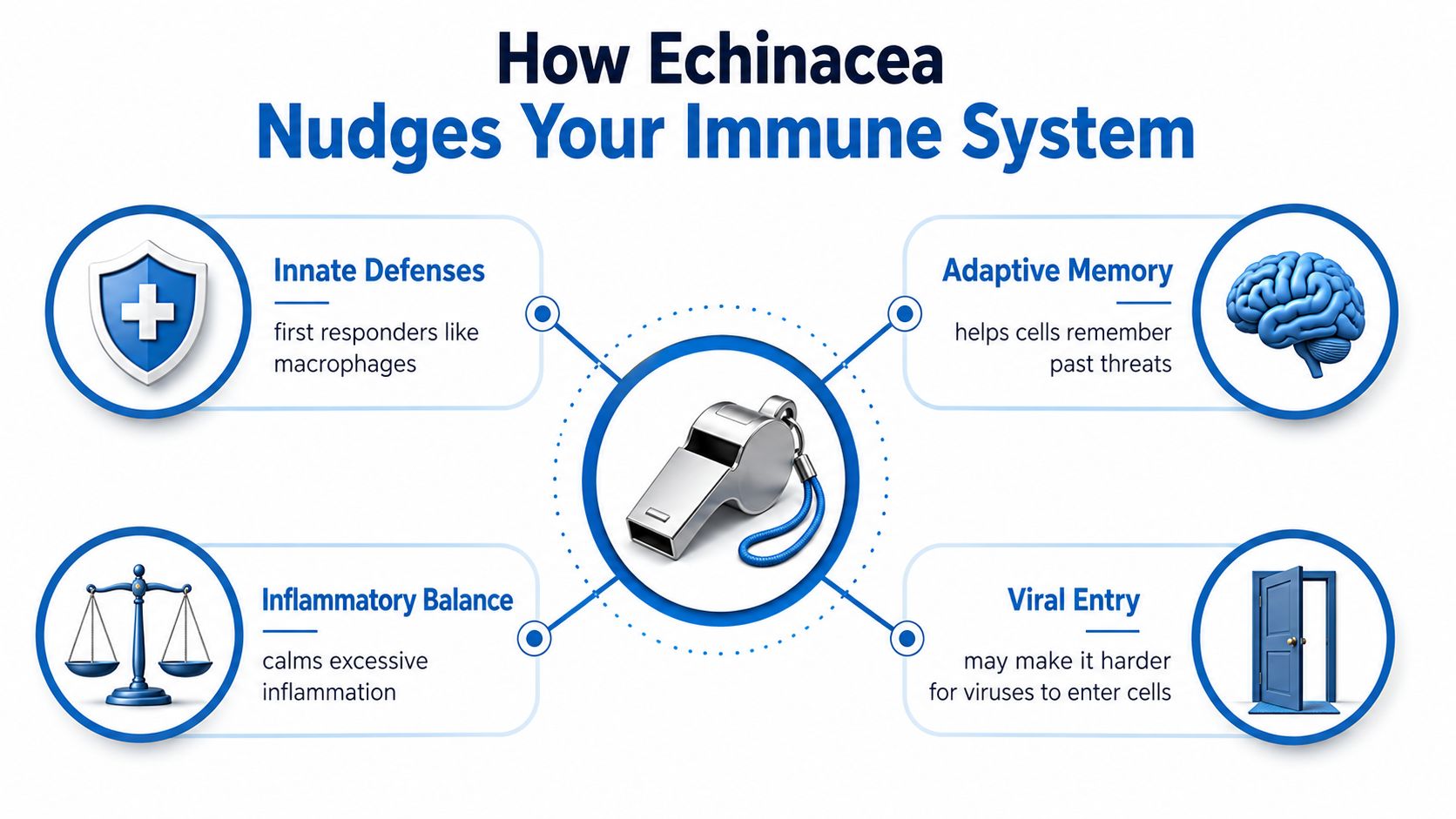
The review of echinacea's bioactive compounds and immune effects explains why product identity matters. Different species and plant parts produce different ratios of alkamides, caffeic acid derivatives, flavonoids, and polysaccharides. Extraction can change that profile again.
Think of “echinacea” as a recipe category, not a finished recipe. Two products can share the name while delivering different chemical inputs.
A trial tests a defined preparation, even when the article title uses the broad word echinacea. That's why a favorable result from a standardized E. purpurea extract shouldn't be used as proof for every tea, gummy, or blended formula on the shelf.
What the Clinical Research on Echinacea Actually Shows
Echinacea research supports a careful conclusion, not a simple yes-or-no answer. Some analyses report fewer colds or shorter illness, while broader reviews find that prevention results vary and overall treatment benefits remain uncertain.
As noted earlier, the pooled prevention result was mixed. An exploratory analysis that combined all trials found a lower risk of catching a cold, but the studies differed in their preparations, schedules, and definitions of illness.
Other evidence is more favorable. One synthesis reported a 58% reduction in the odds of developing a cold, an odds ratio of 0.42, and an average reduction of 1.4 days in cold duration. A separate analysis of recurrent respiratory tract infections found a lower risk, with a risk ratio of 0.649. These findings appear in the independent evidence review of echinacea.
Why the trials disagree
Researchers have not tested one standardized intervention under identical conditions. Studies used different species, roots or aerial parts, fresh-pressed juices, dried extracts, tinctures, and dosing schedules. They also defined and measured “a cold” differently.
Timing creates another important difference. A preparation may be taken continuously to prevent illness or started after symptoms appear. Those approaches answer separate questions, so combining them can blur the result.
| Study or review | Type | Species or form | Effect reported |
|---|---|---|---|
| Cochrane review | Broad review of randomized trials | Multiple preparations | Prevention findings were mixed, with no clear overall treatment benefit |
| Independent evidence synthesis | Meta-analysis | Varied echinacea preparations | Odds of developing a cold were 0.42, with illness shortened by 1.4 days |
| Recurrent respiratory infection analysis | Meta-analysis | Varied preparations | Risk of recurrent respiratory tract infections was 0.649 |
| Early-intervention evidence | Meta-analysis | Echinacea preparations used near symptom onset | A stronger signal appeared with short-term treatment or early intervention |
These results are not interchangeable. A favorable finding for one defined extract does not prove that every tea, gummy, tincture, or blended formula works the same way.
The most defensible interpretation is weak certainty for daily prevention in healthy adults and a modest possible benefit when use begins early. The Lancet Infectious Diseases analysis reported the same 58% lower odds, a mean reduction of 1.4 days, and a number needed to treat of 6, while emphasizing variation across trials and formulations. Daily, long-term use therefore has less direct support than matching a defined preparation to short-term use near symptom onset.
Forms, Species, and Dosages That Matter Most
A tea bag, a tincture, and a standardized capsule aren't equivalent. Form affects how much plant material you consume, how precisely you can measure it, and how closely the product resembles a preparation used in a clinical trial.
Match the form to the evidence
Tinctures are liquid extracts that can be convenient when someone wants frequent dosing. Their strength depends on the herb-to-extract ratio, solvent, and label accuracy, so milliliters alone don't tell you the amount of active extract.
Capsules and tablets offer easier measurement and usually better convenience. They're most useful when the label names the species, plant part, extract type, and amount per serving.
Tea can provide warmth, hydration, and a soothing ritual. It may be less comparable to concentrated clinical preparations, especially when the label gives little information about the amount of extract or marker compounds.
The evidence is especially tied to Echinacea purpurea, including aerial-part fresh-pressed juice and other defined extracts. Echinacea angustifolia products are often root-based, while Echinacea pallida is also mainly represented by the root. Those distinctions matter because plant chemistry changes with species and plant part.
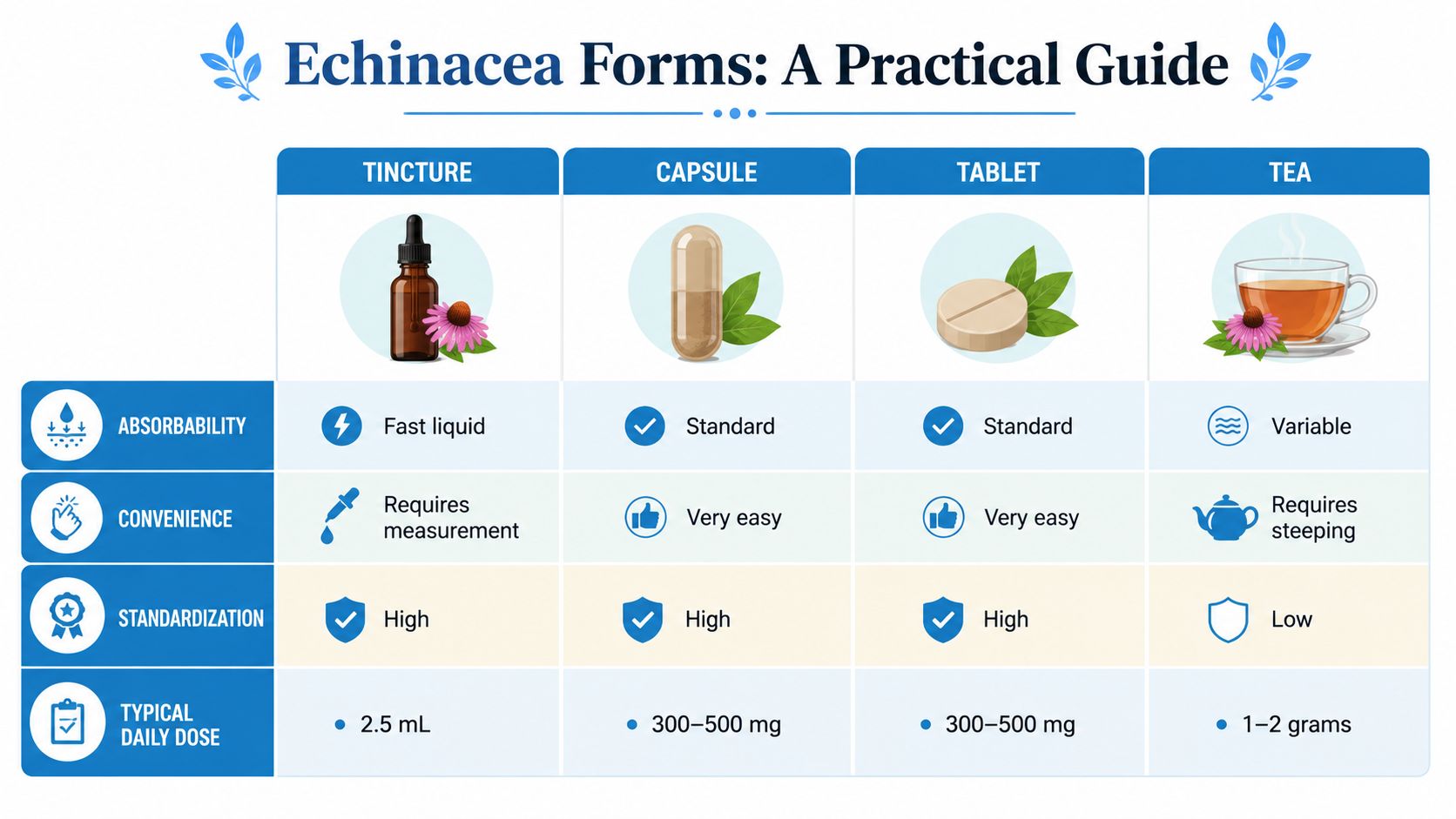
Representative trial dosing
The clinical dosage and species review describes product- and dose-specific findings, including E. purpurea preparations studied at 300 to 900 milligrams three times daily for prevention and 1,000 milligrams three times daily at symptom onset for treatment. Other representative regimens include 2.5 milliliters three times daily for tinctures and 6 to 9 milliliters daily for pressed juice.
These figures describe trial regimens, not a universal personal prescription. A product listing “400 milligrams” may contain dried plant powder, a concentrated extract, or a blend, and those aren't interchangeable.
For shoppers comparing options such as an Echinacea 400 mg capsule product, check the Supplement Facts panel for species, plant part, extract details, and serving instructions. More isn't automatically better, especially when the product differs from the preparation used in research.
Who Should and Should Not Use Echinacea for Immune Support
Echinacea is not a universal daily immune shield. Its most reasonable use is short term, for healthy adults seeking seasonal support or considering it when respiratory symptoms first appear. The evidence does not show that everyone benefits, and echinacea cannot replace diagnosis, vaccination, rest, or medical treatment.
People who need extra caution
Avoid echinacea, or consult a clinician first, if you are allergic to Asteraceae plants such as ragweed, daisies, chrysanthemums, or marigolds. Herbal ingredients can cause allergic reactions because “natural” does not mean biologically inactive. The NCCIH echinacea guidance also describes uncertainty about benefits and risks, with limited safety information for children.
People with autoimmune conditions need individualized advice. Lupus, rheumatoid arthritis, multiple sclerosis, and organ-transplant care involve carefully managed immune activity. A product promoted for immune stimulation may not fit that situation without professional supervision.
Pregnancy and breastfeeding also call for caution because safety information is insufficient.
Medication rule: If you take an immunosuppressant, cyclosporine, or certain chemotherapy medicines, ask your prescriber or pharmacist before using echinacea.
Drug interactions deserve more attention than blanket claims that echinacea is harmless or dangerous. Available evidence suggests a generally low interaction profile, yet mild effects on drug-metabolizing pathways have been discussed. That possibility matters more when a medicine has a narrow safety margin.
What about daily use?
The NCCIH guidance on echinacea and consumer medical references note that researchers still do not know enough about the benefits, safety, and risks of taking echinacea every day for a long time. Many studies are short, so they cannot establish whether continuous use beyond a few weeks provides useful support.
This uncertainty does not prove that long-term use causes harm. It does mean year-round daily use is not a well-supported default. A short course that follows the product label and clinical guidance is easier to justify than indefinite maintenance, especially when the specific species, extract, and dose may differ from those studied.
Choosing a Quality Echinacea Supplement Without the Guesswork
A quality echinacea label should let you identify what was tested. If it only says “immune blend” or “echinacea complex,” you may not have enough information to compare it with human research.
Use this checklist before buying:
Confirm the species. Look for Echinacea purpurea, E. angustifolia, or E. pallida. A blend should identify each species rather than hiding them under one proprietary name.
Identify the plant part. The label should say root, aerial parts, fresh-pressed juice, or whole plant. This detail helps explain why two products have different marker compounds.
Look for extraction information. An extract ratio, solvent description, or equivalent manufacturing detail gives you more context than a raw herb amount alone.
Check standardization markers. Labels may disclose phenolic compounds, alkamides, polysaccharides, or another marker used to keep batches more consistent. No single marker proves clinical effectiveness, but transparency improves comparison.
Prefer independent testing. Seals or verification from organizations such as USP, NSF, or ConsumerLab can provide additional quality information when the verification applies to that specific product.
Scan allergens and excipients. Check capsules, sweeteners, dyes, binders, and other inactive ingredients, particularly if you have plant allergies or dietary restrictions.
Red flags include claims that a product “cures” colds, undisclosed proprietary blends, and mixed-species formulas that don't list proportions. A polished front label can't compensate for missing identity and dosage information.
Shopping shortcut: Choose the label that gives you the clearest answer to “what exactly was tested?”
A transparent product also makes it easier to stop if you develop a reaction or to tell a clinician precisely what you've taken. Product quality and clinical effectiveness aren't the same question, but poor labeling makes both questions harder to answer.
Key Takeaways and Common Questions About Echinacea Use
Three points best capture what the evidence supports:
- Early, short-term use has the clearest rationale. The more favorable findings relate to starting echinacea near the first signs of a cold, not to guaranteed year-round prevention.
- Preparation matters more than the word echinacea. Species, plant part, extraction method, and standardization can change what a product provides. The label is a map of the preparation, not proof that every echinacea product works the same way.
- Daily long-term use remains unsettled. Current guidance does not establish continuous use as a reliable immune-maintenance strategy.
Common questions
Does echinacea interfere with antibiotics?
No major interaction is established in the evidence summarized here. Echinacea should not replace prescribed antibiotics. If you take several medicines, ask a pharmacist about possible interactions and timing.
Is echinacea safe for children?
Evidence remains insufficient for a clear conclusion in children, according to NCCIH's consumer guidance. Do not adapt an adult dose by guesswork. A pediatric clinician should help choose the product, amount, and duration.
Does taking echinacea every day prevent colds?
There is no dependable yes. Prevention findings are mixed, while the benefits and risks of long-term daily use remain unclear.
What if I have an autoimmune diagnosis or take immunosuppressants?
Avoid starting echinacea on your own. Discuss the specific product with a physician or pharmacist, since immune activity and medication effects need to be considered together.
CalVitamin offers dietary supplements and herbal products in capsules, veggie capsules, liquids, and gummies. Visit CalVitamin to compare labeled options and choose a product that fits your needs, preferred form, and clinician's advice.