
You're standing in a beauty aisle, comparing three moisturizers that all say cruelty-free, while one also says vegan and another promises “clean” ingredients. The rabbit logos look similar, the claims don't explain their scope, and the product that seems gentlest may still contain a fragrance or active your skin dislikes.
That confusion is understandable. The best cruelty free skin care products aren't identified by attractive packaging alone. A reliable choice starts with verifying what the claim covers, checking whether a recognized certification supports it, and then matching the formula to your skin rather than choosing by ethics language alone.
Table of Contents
- What Cruelty Free Means in Skincare
- How Cruelty Free Standards Became Global
- Cruelty Free vs Vegan vs Clean Beauty
- Reading Labels and Spotting Real Certifications
- Building a Full Cruelty Free Skincare Routine
- Cruelty Free Certifications Worth Knowing
- Smart Shopping Habits and What to Check First
- Putting It All Together for Confident Choices
What Cruelty Free Means in Skincare
A cruelty-free claim describes how a product and its ingredients were tested, not how gentle the formula feels on skin. At its broadest, cruelty-free skincare means the brand and its suppliers did not use animal testing during development. The scope matters because a company might avoid testing a finished moisturizer while depending on a raw-material supplier that tested one ingredient.
In the United States, the FDA explains that cosmetics do not require animal testing and that “cruelty-free” and “not tested on animals” have no single legal definition. Treat the wording as a brand promise to verify, rather than a standardized regulatory seal.
Separate testing from ingredients
Cruelty-free describes testing practices. It does not identify the source of every ingredient. A product can avoid animal testing and still contain:
- Beeswax, which comes from bees
- Lanolin, derived from sheep's wool
- Carmine, a colorant made from insects
These ingredients make a product non-vegan, but they do not automatically make it non-cruelty-free. Vegan skincare focuses on ingredient sources. Cruelty-free skincare focuses on animal-testing policies.
The wording can also vary in scope. “Not tested on the finished product” covers the final item only. It may not address testing on individual ingredients, supplier practices, parent companies, or sales in markets with different requirements.
Practical rule: Read “cruelty-free” as a question about the supply chain, not only the jar in your hand.
Turn the claim into a short verification task. Look for a brand policy that states whether it covers raw materials, finished products, suppliers, parent companies, and fixed cut-off dates. A vague bunny image offers less evidence than a policy that explains monitoring and accountability.
A product page can show how a claim appears in practice. You can review this cruelty-free conditioner example, then check the brand's current policy and certification status before ordering. That sequence keeps shopping secondary to verification.
How Cruelty Free Standards Became Global
Today's cruelty-free claims reflect layers of regulation, voluntary certification, and market adaptation. The European Union became a major influence after banning animal testing for finished cosmetic products in 2004, extending the prohibition to cosmetic ingredients in 2009, and applying the full marketing ban in 2013, according to the European Commission's cosmetics testing policy.
The EU's approach did more than change products sold within Europe. It gave brands, suppliers, and retailers a highly visible regulatory model for separating cosmetic development from animal testing. EU policy documents also identify more than EUR 1 billion in funding for non-animal research and innovation over the last two decades, supporting the development of alternative methods.
Regulation doesn't create one worldwide standard
A product can comply with one market's cosmetic rules and still face different requirements elsewhere. The United States, for example, doesn't require cosmetics to undergo animal testing, but its labeling framework doesn't provide one legal definition of “cruelty-free.” That leaves brands responsible for explaining the scope of their claims and shoppers responsible for assessing the evidence.
This is why a label can look reassuring while remaining incomplete. Regulatory compliance answers whether a product may be sold under a particular system. Certification can add another layer by requiring a brand to document its policies and supplier relationships.
Why history still affects your shopping choices
The global shift away from animal testing wasn't created by a single company or one universal rule. It developed through legislation, research investment, supplier controls, and consumer pressure.
That history explains why third-party certification still matters. A certification program can turn an ethical statement into a documented standard, although the strength of that assurance depends on its scope, renewal process, and treatment of parent companies and ingredients.
Cruelty Free vs Vegan vs Clean Beauty
These labels don't stack neatly. They describe different decisions, and treating them as interchangeable can lead you to buy a product that meets one priority while missing the others.
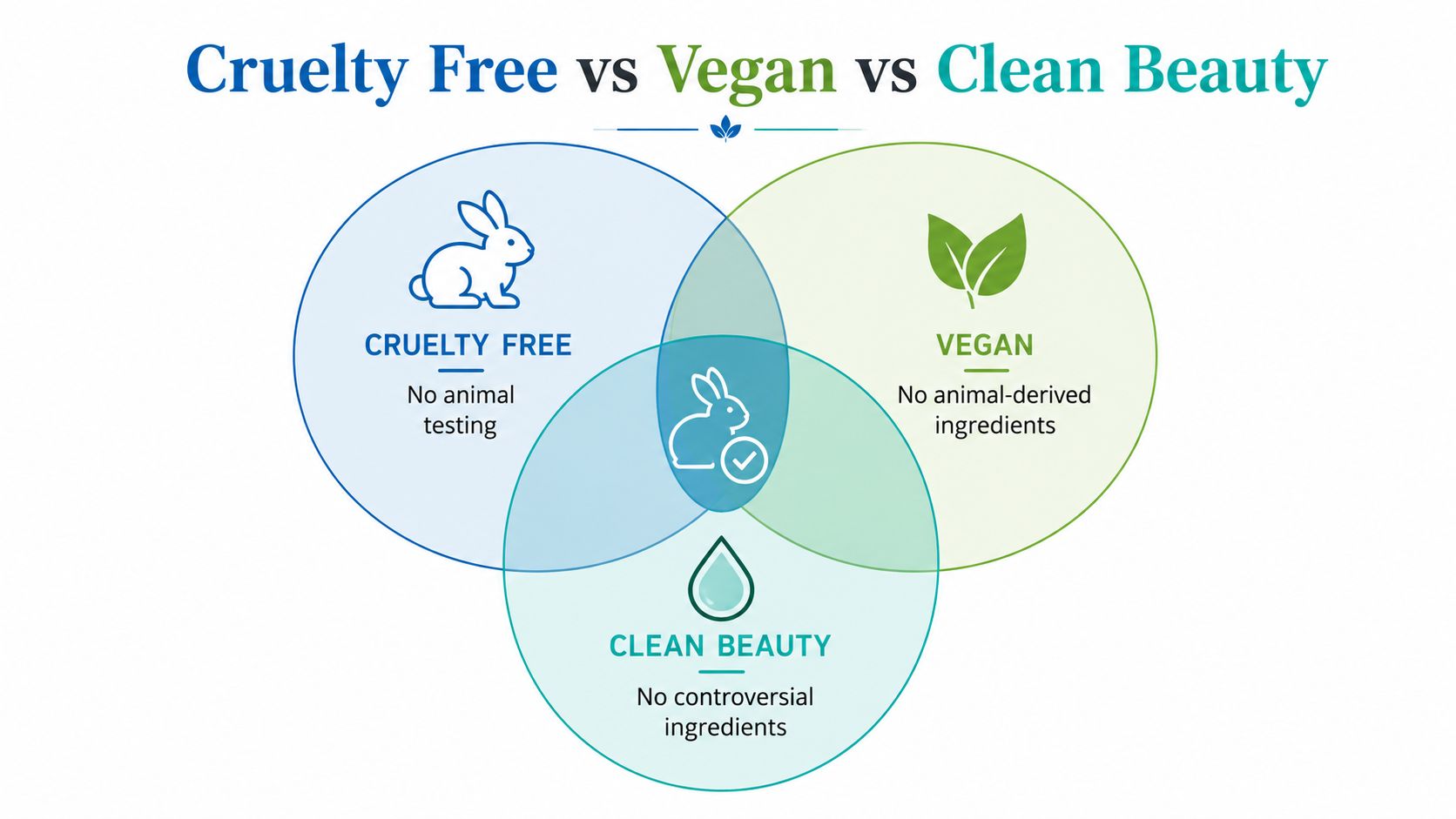
Cruelty-free concerns animal testing. Vegan concerns animal-derived ingredients. Clean beauty usually refers to a brand's chosen list of ingredients it excludes, such as parabens, sulfates, or synthetic fragrance. The FDA doesn't provide a universal definition for cruelty-free claims, and clean beauty is also not one regulated formulation standard.
Three labels, three separate questions
Ask these questions independently:
- Testing ethics: Was the product and each ingredient developed without animal testing?
- Ingredient ethics: Does the formula avoid animal-derived ingredients such as beeswax, lanolin, and carmine?
- Formulation philosophy: What does the brand mean by “clean,” and which ingredients does it exclude?
A honey-based balm could be cruelty-free but not vegan. A vegan serum could still lack a credible cruelty-free commitment if its suppliers' practices aren't addressed. A product marketed as clean could be either vegan or non-vegan, and the claim says little about testing unless the brand provides separate evidence.
Clean doesn't mean gentle
“Clean” also doesn't automatically mean better for sensitive skin. A formula can exclude a brand's selected “controversial” ingredients and still contain fragrance, essential oils, exfoliating acids, or preservatives that your skin doesn't tolerate.
Choose the combination that fits your values and skin. You might prioritize cruelty-free certification but accept beeswax. You might require both cruelty-free and vegan status. Or you might ignore the clean label altogether and focus on an ingredient list, barrier compatibility, and proven sun protection.
The useful mindset is simple: these are independent switches, not a quality ladder.
Reading Labels and Spotting Real Certifications
A bunny icon on a bottle can look reassuring, yet it may reveal little about supplier checks, contract manufacturers, or the parent company's policy. As noted earlier, “cruelty-free” has no single legal definition in the United States. Treat the phrase as a starting point, not as proof.
Read the brand's policy beside the product label. Self-declared language comes directly from the company and may be meaningful, but a brand-created rabbit logo is still only the brand's own claim. A stronger certification names its requirements, lists participating companies, and explains how current status is maintained.
What stronger evidence looks like
Check for these details on the brand's website or the certifier's listing:
- Supply-chain scope: The policy includes ingredients, raw materials, finished products, and contract manufacturers.
- Parent-company transparency: It explains whether a change in ownership affects eligibility.
- Fixed cut-off dates: The brand states when it stopped permitting animal testing and how it treats older ingredients.
- Supplier documentation: The company describes attestations or other records used to verify ingredient providers.
Wording such as “finished product only,” “no animal testing after a certain date,” or “where required by law” needs careful interpretation. Each phrase may describe a narrower commitment than shoppers assume.
The same check applies to a product page featuring a vegan scalp-care formula. The page can identify a product's positioning, while the certifier's database and policy explain what the certification covers.
A quick red-flag checklist
- Vague wording: “Kind” or “ethical” appears without a testing definition.
- Generic imagery: A rabbit is shown, but no program name or verification details appear.
- Missing validity information: The logo provides no clear renewal or current-status information.
- Narrow coverage: The policy discusses only the finished product.
- Unclear ownership: The parent company is not identified or addressed.
- No supplier explanation: The brand does not explain how ingredient providers are checked.
Use certification to answer one focused question: how the product and its supply chain were handled in relation to animal testing. It cannot tell you whether a moisturizer suits rosacea, acne, dryness, or fragrance sensitivity. That boundary makes the label more useful, because it prevents an ethics claim from being mistaken for a complete assessment of product quality.
Building a Full Cruelty Free Skincare Routine
A cruelty-free routine works best when you build it around skin function, not a single brand's aesthetic. Start with the smallest routine that covers cleansing, treatment, moisturization, and daily sun protection.
Start with a compatible cleanser
Choose a low-pH cleanser that removes sunscreen, oil, and daily residue without leaving tightness. Leave-on skincare is commonly formulated in a mildly acidic range, and a cleanser that respects the skin's acid mantle can be easier to pair with barrier-focused products.
An example of a product to investigate is Avalon Organics Vitamin C Cleansing Gel. Check the current ingredient list, fragrance content, and cruelty-free documentation rather than assuming a product fits your skin because it contains vitamin C.
Add one treatment at a time
Pick a serum for a clearly defined concern. Niacinamide can support the appearance and function of the skin barrier, while vitamin C is commonly chosen for antioxidant support and uneven-looking tone. Introduce one active first so you can identify irritation if it appears.
A treatment should feel comfortable during use. Persistent stinging, redness, or worsening dryness is a reason to pause, even if the product carries every ethical certification you want.
Finish with barrier support
Ceramides and squalane can help create a moisturizer profile suited to dry or barrier-stressed skin. Ceramides remain stable across roughly pH 4 to 7, a range that overlaps with many moisturizers and barrier creams, as described in this formulation discussion of ceramides and pH.
The practical implication is that a mildly acidic moisturizer can support compatibility with barrier lipids and ingredients such as niacinamide. Pushing a formula too acidic may create compatibility problems for ceramide integrity and other barrier-repair actives.
Make sunscreen the daytime final step
Use a broad-spectrum sunscreen with SPF 30 or higher as the final morning step. Mineral formulas may leave more visible cast or feel heavier, while hybrid formulas can offer a different texture. Those are formulation trade-offs, not evidence that one category is automatically more ethical or effective.
For each product, confirm the certification, retain the batch code if your skin reacts easily, and allow enough time to judge comfort and consistency. Ethical sourcing and formula performance are separate checkpoints, and your routine needs both.
Cruelty Free Certifications Worth Knowing
Certification names can help, but their requirements aren't identical. Compare the scope before treating a logo as proof of everything you care about.
| Certification | What It Covers | Audit Method | Renewal Cycle | Geographic Reach |
|---|---|---|---|---|
| Leaping Bunny | Animal-testing policy across products, ingredients, and suppliers | Supplier monitoring and program review, with parent-company considerations | Ongoing program commitments and renewal requirements | International |
| PETA Beauty Without Bunnies | Brand's stated cruelty-free policy and listing eligibility | Brand application and self-attestation | Program terms vary by listing | International |
| Choose Cruelty Free | Cruelty-free standards with ingredient-focused criteria | Program review against its stated criteria | Program requirements apply to listed brands | Australian-focused, with broader relevance |
| Vegan Society | Vegan ingredient and production criteria | Review against vegan standards | Certification terms apply to registered products | International |
| EWG Verified | Ingredient transparency and restricted-ingredient standards, with relevant ethical information where applicable | Documentation and ingredient review | Product and program requirements apply | International availability |
The important distinction is what the mark covers. A program that examines suppliers and individual ingredients provides a different level of assurance from one that mainly records a brand's declaration. A vegan mark can help verify ingredient origin, but it doesn't replace a cruelty-free certification.
Treat renewal as part of the evidence. Some programs require recurring commitments, while others rely on a continuing listing or a longer-term declaration. Before buying, check the certifier's current directory because brand ownership, product ranges, and eligibility can change.
Match rigor to your priority. Choose supply-chain depth if animal-testing verification is your central concern. Add a vegan mark if animal-derived ingredients matter. Use ingredient-transparency programs when you want a clearer view of formulation restrictions.
Smart Shopping Habits and What to Check First
Verification becomes easier when you turn it into a repeatable routine. Don't research every product from the beginning each time. Build a short list of certification programs and brand policies you trust, then use it as a filter.
A pre-purchase check
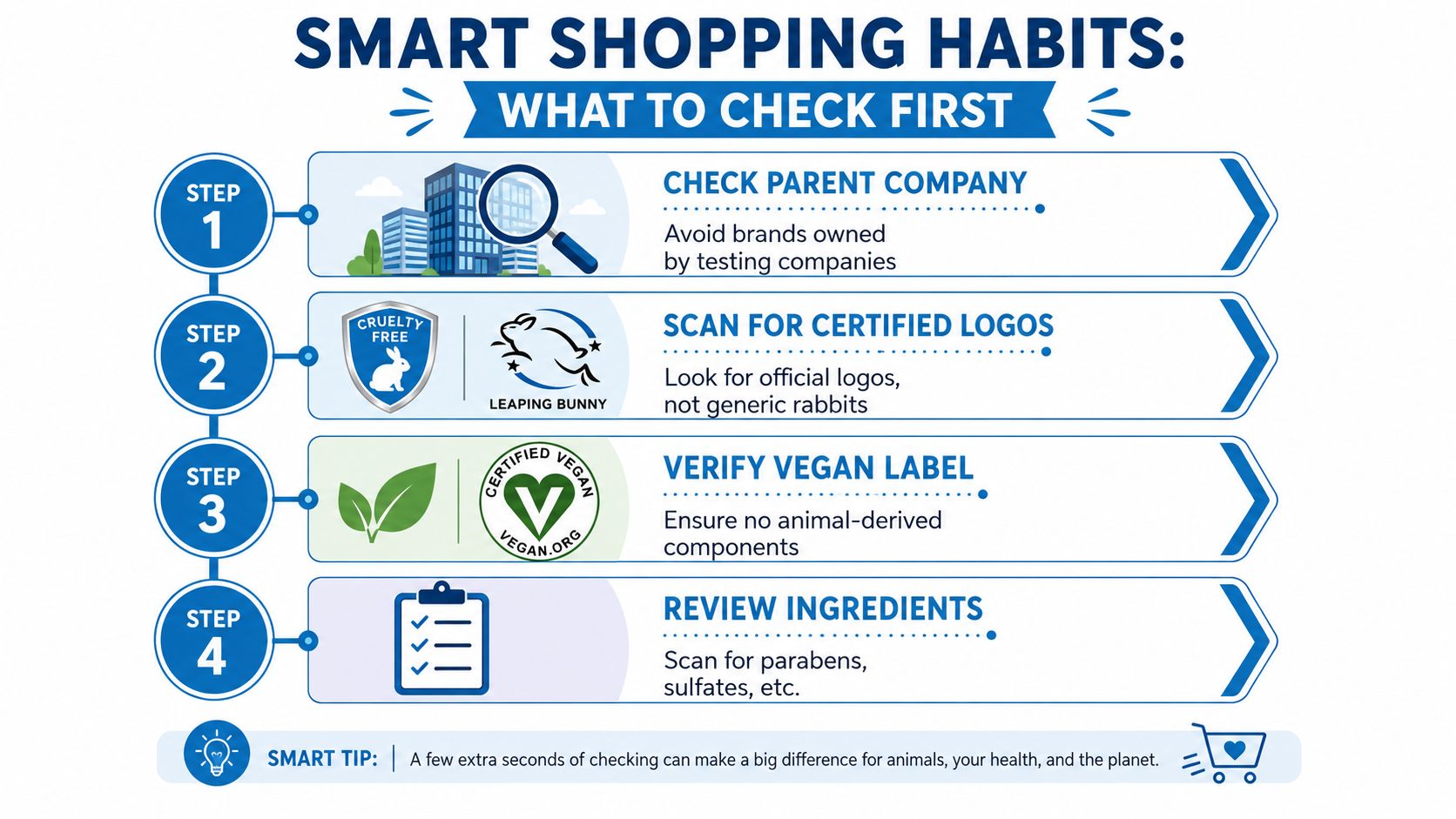
- Check the parent company: Find out who owns the brand and whether the cruelty-free policy applies across the group.
- Scan for official logos: Look for the named certification program, not just a decorative rabbit.
- Verify vegan status separately: Confirm that the product avoids animal-derived components if that matters to you.
- Review the full ingredients: Compare the formula with your own sensitivities, especially fragrance and essential oils.
- Compare sizes: Price per milliliter can reveal whether a larger package offers better value.
- Read formulation feedback: Retailer reviews can reveal texture, pilling, scent, and packaging issues that a certification cannot address.
CalVitamin presents beauty and personal-care products with labeled attributes, including cruelty-free options, so shoppers can use those filters to narrow the field before reviewing individual product pages. Use retailer filters as a starting point, then cross-check the certification and ingredients on the product or brand site.
Make the process easier next time
Bookmark the brand's cruelty-free policy page and save product batch numbers when your skin is reactive. If a formula changes, the updated ingredient list may matter more to you than the front label. You can also keep a personal note of products that caused irritation, including the fragrance or active ingredients they shared.
The goal isn't to eliminate every bit of research. It's to reduce repeated effort while keeping the final decision informed.
Putting It All Together for Confident Choices
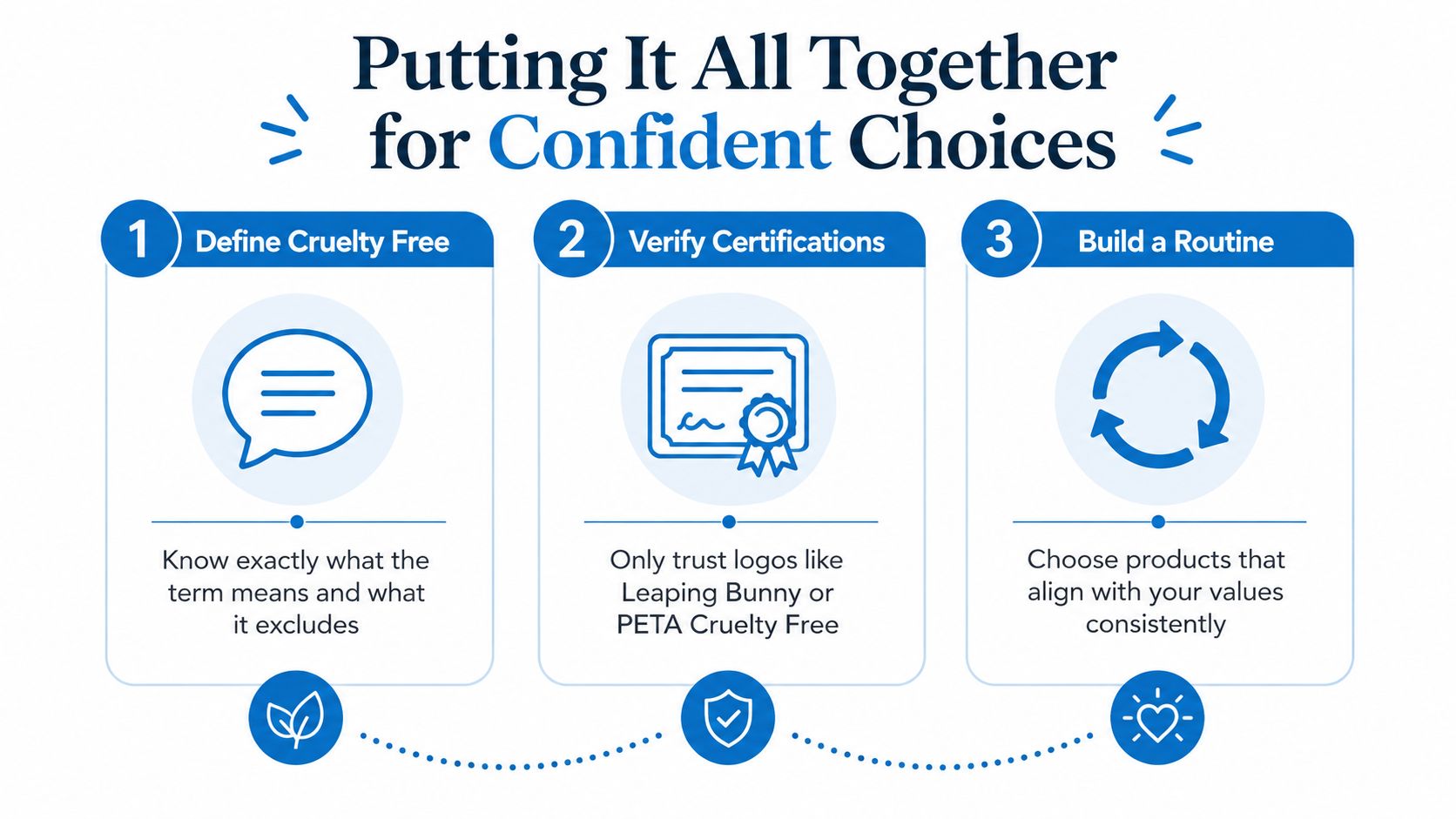
Confident cruelty-free shopping rests on three decisions. Define the claim, verify the evidence, and choose a formula that serves your skin. Reversing that order can leave you with a beautiful ethical label and a product your skin can't tolerate.
The category is expanding, not standing still. The cruelty-free cosmetics market was valued at USD 14.84 billion in 2023 and is projected to reach USD 23.54 billion by 2030, with a projected 6.8% CAGR from 2024 to 2030, according to Grand View Research's cruelty-free cosmetics market analysis. Skincare represented the largest product segment in 2023, at 44.2% of revenue, while U.S. sales are projected to grow at a 7.0% CAGR from 2024 to 2030, so shoppers can expect more claims, certifications, and formulation choices to compare.
Use this short framework:
- Create a verification shortlist: Keep the certification logos and policy details that meet your standards.
- Build a four-part routine: Choose a compatible cleanser, one targeted serum, a barrier-support moisturizer, and sunscreen.
- Recheck periodically: Review ingredient lists, ownership, certification status, and your skin's changing needs.
Vegan and clean beauty may overlap with cruelty-free skincare, but neither automatically replaces it. Label literacy is the tool that lets you choose deliberately instead of trusting the most appealing promise.
CalVitamin offers an online selection of beauty and personal-care products with labeled attributes such as cruelty-free, alongside wellness categories for broader shopping needs. Visit CalVitamin to filter available options, review product details, and begin building a skincare routine that matches both your ethical priorities and your skin's needs.






