
You're standing in front of two CoQ10 bottles that look almost identical. One says 200 mg ubiquinol. The other says 200 mg ubiquinone. The matching numbers suggest an easy choice, but they don't tell you how much CoQ10 your body will absorb, how long it will remain in circulation, or whether that dose fits your goal.
That's why 200 mg ubiquinol deserves a closer look. It's a clinically studied dose, but it isn't automatically the right dose for everyone. The form of CoQ10, your health history, medications, age, and reason for supplementing all influence the decision.
Table of Contents
- Why 200 mg Ubiquinol Is a Specific Decision
- What Ubiquinol Actually Is and How It Works
- What the Research Shows at 200 mg per Day
- Ubiquinol vs Ubiquinone at the Same 200 mg Dose
- Who Typically Reaches for 200 mg Ubiquinol
- Safety, Side Effects, and Drug Interactions
- Reading Labels and Choosing a Quality 200 mg Product
- Is 200 mg the Right Dose for You
Why 200 mg Ubiquinol Is a Specific Decision
The number on a supplement label describes the amount placed in the softgel. It doesn't equal the amount that reaches your bloodstream or the amount your tissues use. With CoQ10, the chemical form matters because ubiquinol and ubiquinone can produce different blood-level responses at the same nominal dose.
Ubiquinol is the reduced form of coenzyme Q10. Ubiquinone is the oxidized form. Both belong to the same CoQ10 system, and the body can convert between them, but digestion and conversion influence how much becomes available after swallowing a capsule.
A dose of 200 mg sits within the commonly used adult supplementation range of 100 to 200 mg per day, while broader clinical use can extend from 100 to 300 mg per day, according to the clinical overview of coenzyme Q10 dosing and safety. That makes 200 mg a practical midpoint. It's more substantial than a starter dose, yet it doesn't represent the highest amount used in every research setting.
What the dose can and can't tell you
A 200 mg serving has been tested in controlled human research involving endothelial function and exercise performance. Those studies make the dose more meaningful than an arbitrary retail serving size. They still don't prove that every adult needs 200 mg, or that a larger dose would always produce a better result.
Your decision should begin with the purpose:
- General support: A lower serving may be enough for some healthy adults.
- Cardiometabolic concerns: A clinician may consider a higher intake in the context of your overall care.
- Exercise goals: Research has used 200 mg in trained men, but performance outcomes shouldn't be treated as guaranteed.
- Medication use: Statins, anticoagulants, and blood-pressure medicines make professional guidance more important.
The most useful comparison isn't just 100 mg versus 200 mg. It's form, exposure, purpose, and personal context. A 200 mg ubiquinol softgel may not be equivalent to a 200 mg ubiquinone softgel in the bloodstream, which is why shoppers should read beyond the large number on the front label.
What Ubiquinol Actually Is and How It Works
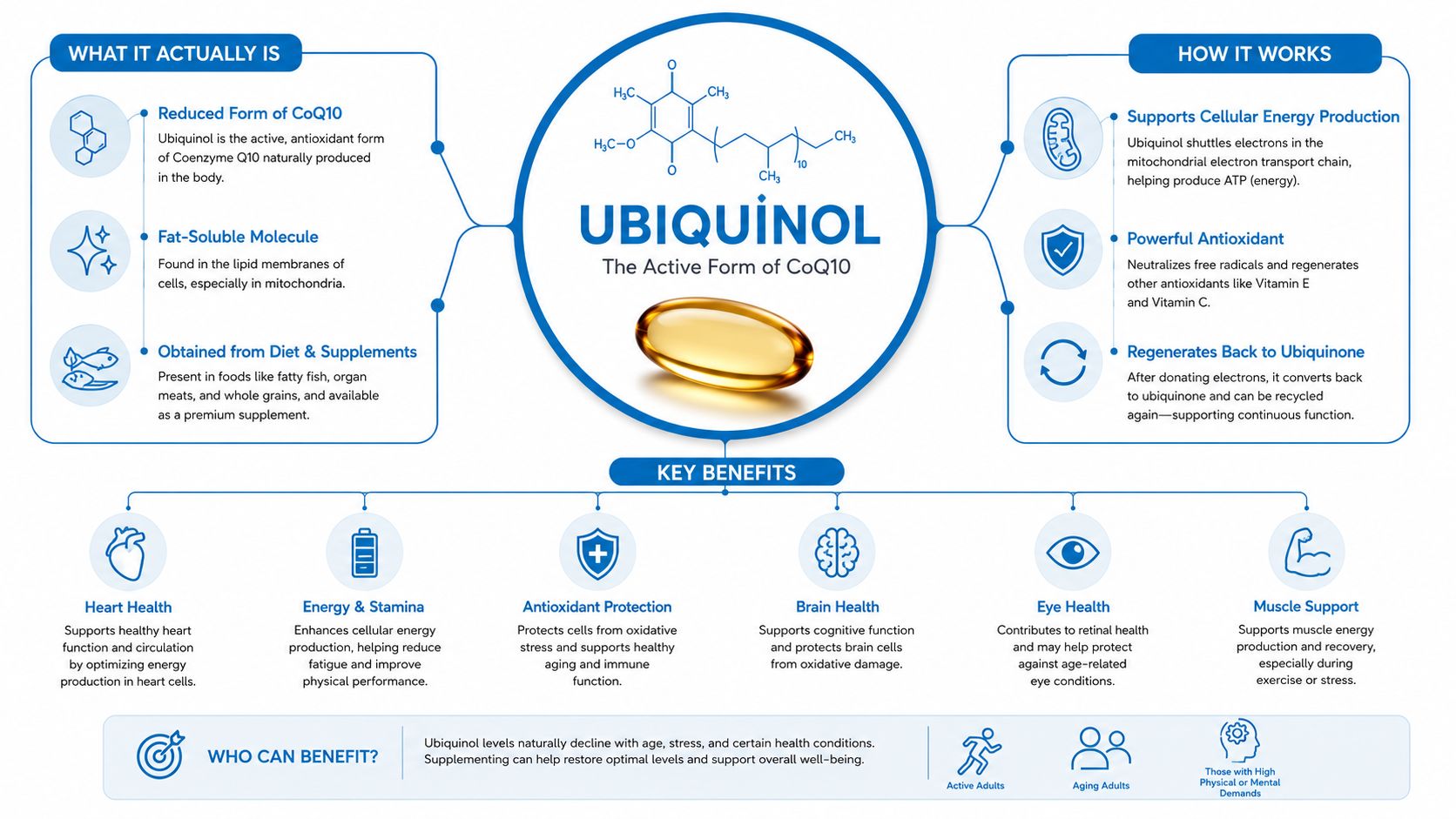
Coenzyme Q10 is a fat-soluble compound found throughout the body, with especially important roles in tissues that require substantial energy, including the heart, liver, kidneys, and skeletal muscle. Ubiquinol is the reduced form of CoQ10, while ubiquinone is the oxidized form.
A battery analogy helps. Ubiquinol resembles a charged battery that can participate in the energy process. Ubiquinone resembles the same battery after it has released its charge. The body continually moves CoQ10 between these forms as mitochondria transfer electrons and produce ATP, the molecule cells use as an energy currency.
CoQ10 sits in the inner mitochondrial membrane, where it helps carry electrons through the electron transport chain. It also acts as a lipid-soluble antioxidant, helping protect fatty parts of cells and circulating lipoproteins from oxidative reactions. That combination gives CoQ10 a dual identity. It supports energy conversion while also participating in antioxidant defense.
Why form and age enter the discussion
The body makes CoQ10 naturally, but production changes across adulthood. Conversion of ubiquinone into ubiquinol may also become less efficient with age or certain health conditions. That's the reasoning behind choosing a supplement that already supplies the reduced form, although direct supplementation still doesn't bypass every factor affecting digestion and absorption.
Ubiquinol is fat-soluble, so taking it with a meal containing dietary fat is a sensible routine. The vitamins, supplements, and nutrition collection can help shoppers compare supplement categories, but the product label remains the authority for serving instructions and ingredients.
The mechanism is biologically plausible, but mechanism alone isn't proof of a clinical outcome. To judge 200 mg ubiquinol fairly, you need to look at controlled human studies.
What the Research Shows at 200 mg per Day
A shopper comparing labels may see 200 mg as a clear target. The research supports a more careful view. 200 mg ubiquinol is clinically studied, but it is not automatically the right midpoint for every person or purpose.
One randomized, double-blind, placebo-controlled trial published in 2020 followed adults with mild-to-moderate dyslipidemia for 8 weeks. Participants received 100 mg per day, 200 mg per day, or placebo. Researchers measured flow-mediated dilation, a test used to assess endothelial function.
The 200 mg group showed a mean change of +1.28% ± 0.90%, compared with −0.41% ± 1.51% for placebo. The overall treatment effect was statistically significant, with F = 9.145 and p < 0.001, as reported in the CoQ10 research report.
That finding gives 200 mg a defined research role for vascular function in this particular adult population. It does not show that ubiquinol treats dyslipidemia, replaces prescribed cardiovascular care, or produces the same result for everyone. A study dose is a point of reference, not a personal prescription.
The exercise evidence is narrower
A separate randomized, double-blind, placebo-controlled trial studied 29 trained men aged 20 to 30 for 6 weeks. Participants took 200 mg ubiquinol once daily or placebo. The ubiquinol group showed reductions in body mass index, body fat percentage, systolic blood pressure, and diastolic blood pressure.
VO2max rose from 42.1 ± 0.4 to 42.4 ± 0.3 ml/kg/min, with p = 0.011, according to the Nutrition study on ubiquinol and trained men. Those results give 200 mg a research foothold in exercise science, while the narrow participant group limits how broadly they apply. Older adults, untrained people, and individuals with medical conditions may respond differently.
| Population | Daily dose | Duration | Key outcome |
|---|---|---|---|
| Adults with mild-to-moderate dyslipidemia | 200 mg ubiquinol | 8 weeks | Improved flow-mediated dilation versus placebo, with a mean change of +1.28% ± 0.90% |
| Trained men aged 20 to 30 | 200 mg ubiquinol | 6 weeks | VO2max increased from 42.1 ± 0.4 to 42.4 ± 0.3 ml/kg/min versus placebo |
The practical conclusion is measured: 200 mg is a studied dose, not a universal answer. The intended goal, the person taking it, and the product's form all affect whether that amount makes sense.
Ubiquinol vs Ubiquinone at the Same 200 mg Dose
Two CoQ10 products can display the same milligram amount and still deliver different circulating exposure. That's the central shopping mistake: treating 200 mg ubiquinol and 200 mg ubiquinone as interchangeable because the front labels match.
Ubiquinol has already been supplied in the reduced form that participates in the body's CoQ10 cycle. Ubiquinone must undergo additional handling and conversion before the body can use it in that reduced state. The difference is not merely theoretical. Human comparison research has reported higher systemic exposure from 200 mg ubiquinol than from the same nominal amount of ubiquinone.
One randomized comparison found baseline-corrected geometric mean ratios of 2.20 for Cmax and 2.01 for AUC0–t, while AUC0–∞ increased 3.4-fold for ubiquinol, as detailed in the human pharmacokinetic comparison. Cmax refers to the highest measured concentration, while AUC reflects exposure over time.
Why digestion still matters
Ubiquinol doesn't become automatically absorbable just because it's the reduced form. CoQ10 is fat-soluble, and the formulation, oil carrier, particle characteristics, meal composition, and storage conditions can influence delivery.
A mechanistic study found that ubiquinol showed greater micellarization during digestion and stronger GSH-dependent uptake and basolateral secretion in Caco-2 cells. A later review also cited a 4-week trial in which 200 mg per day of ubiquinol was about 70% more bioavailable than ubiquinone, as described in the review of CoQ10 absorption and bioavailability.
| Factor | 200 mg ubiquinol | 200 mg ubiquinone |
|---|---|---|
| Chemical form | Reduced form | Oxidized form |
| Conversion requirement | May require less conversion before participation in the CoQ10 cycle | Requires conversion into the reduced form |
| Human exposure | Higher exposure reported in comparative research | Lower exposure in the cited comparison |
| Label interpretation | 200 mg doesn't guarantee identical absorption across products | The same label weight may not produce the same blood levels |
| Shopping priority | Compare formulation, testing, and serving instructions | Don't judge value by milligrams alone |
The practical rule is simple: compare the form before comparing price. A lower-cost ubiquinone product may not provide the same systemic exposure as a 200 mg ubiquinol product, even when the serving size looks identical.
Who Typically Reaches for 200 mg Ubiquinol
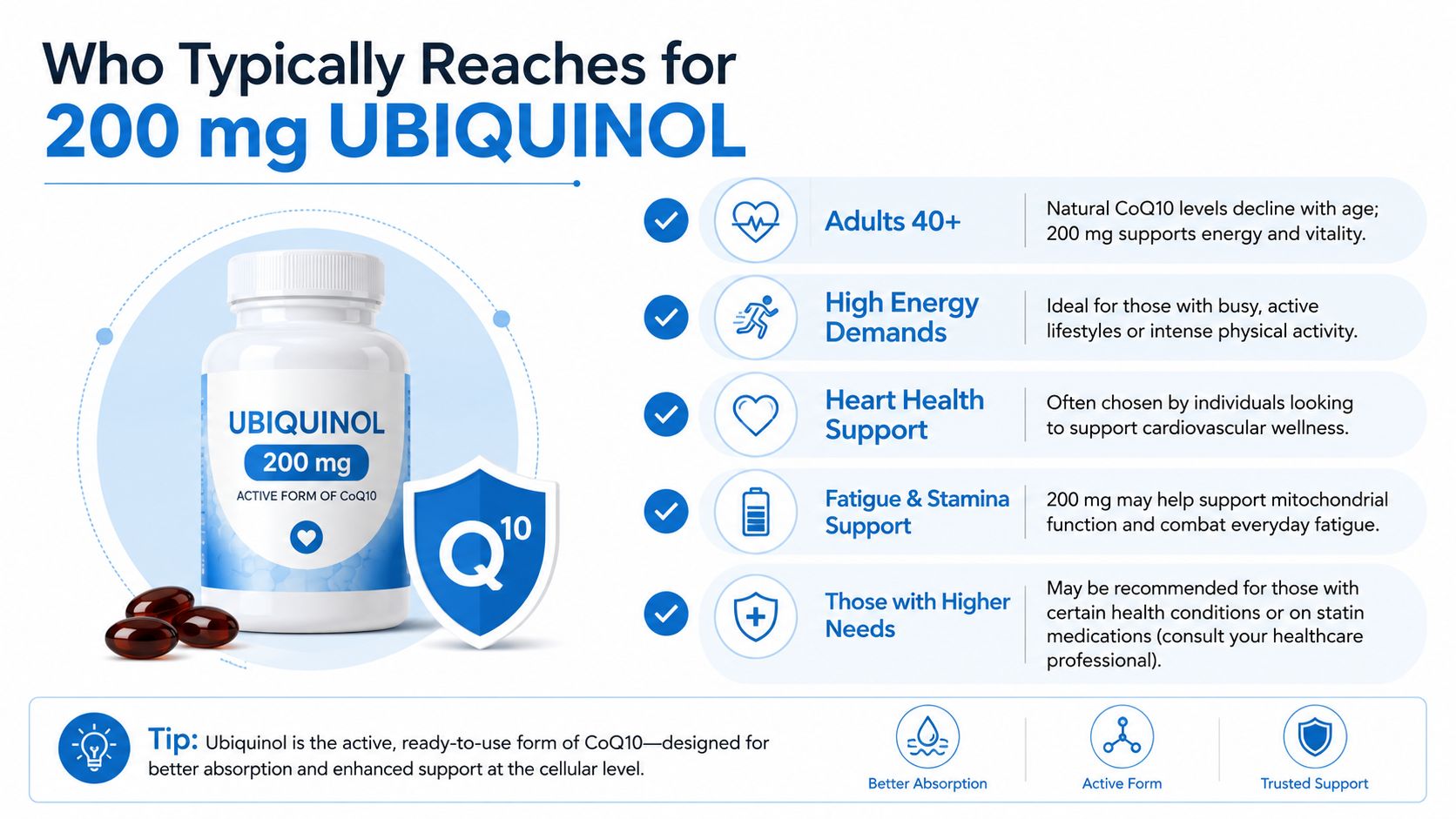
People usually consider this dose for one of four reasons, but those reasons don't carry equal evidence. A shopper should separate a research population from a personal promise.
Adults seeking broad cellular support
Mid-life adults often choose 200 mg because it sits between a lower introductory serving and higher amounts used in some targeted protocols. The rationale is straightforward: CoQ10 participates in mitochondrial energy production and antioxidant activity, while age-related changes may affect natural production and conversion.
That doesn't mean age alone creates a requirement. A healthy adult with no symptoms or medication concerns may have a different starting point from someone managing a diagnosed condition.
People taking statins
Statins inhibit HMG-CoA reductase, a pathway involved in the body's production of cholesterol and CoQ10. This is why some clinicians discuss CoQ10 replacement with patients who use statins, particularly when symptoms or laboratory concerns warrant review.
The right response isn't to stop a prescribed statin or add a supplement without discussion. Bring the exact medication, dose, and supplement label to a clinician or pharmacist.
Athletes and physically active adults
The controlled exercise trial described earlier used 200 mg ubiquinol in trained men and reported changes in body composition, blood pressure, and VO2max. That makes the dose relevant to sports nutrition conversations, but it doesn't establish a universal performance benefit.
An athlete should also examine sleep, total energy intake, carbohydrate availability, hydration, training load, and recovery. Ubiquinol can be one part of a plan, not a substitute for those foundations.
Adults investigating persistent fatigue
Fatigue has many possible causes, including anemia, thyroid disorders, sleep problems, medication effects, mood disorders, and inadequate nutrition. A 200 mg ubiquinol supplement shouldn't become a diagnostic shortcut.
Take the softgel with a meal that contains fat and follow the product's directions. If fatigue is persistent, worsening, or accompanied by other symptoms, medical assessment matters more than changing supplement strength.
Safety, Side Effects, and Drug Interactions
Research and clinical reviews generally describe CoQ10 as well tolerated within commonly used supplementation ranges. Even so, “well tolerated” doesn't mean “risk-free.” Some users may experience digestive upset, headache, or sleep disturbance, and taking a softgel with food may be easier on the stomach.
The interaction question deserves more attention than the side-effect list. Ubiquinol may affect the action of warfarin and other anticoagulants, so anyone using blood-thinning medication should ask a clinician whether monitoring, including INR monitoring, is appropriate. Don't change an anticoagulant dose yourself.
Ubiquinol may also modestly lower blood pressure. If you take antihypertensive medication, monitor according to your clinician's instructions and report dizziness, faintness, or unusually low readings.
Situations that need extra caution
Evidence and interaction concerns can vary by medication and health status. Discuss supplementation before starting if you:
- Take anticoagulants: Ask about possible effects on blood-thinning control and monitoring.
- Use blood-pressure medication: Review the combination if your pressure is already controlled or tends to run low.
- Receive chemotherapy: Ask the oncology team before using an antioxidant supplement because treatment plans differ.
- Use thyroid medication: Have a pharmacist or clinician check the full combination.
- Prepare for surgery: Tell the surgical team about every supplement, including the product name and serving size.
- Are pregnant or breastfeeding: Seek individualized medical advice rather than relying on general supplement guidance.
- Take several prescriptions: A complete medication review can identify risks that a single interaction chart may miss.
The medicine information section can be a useful starting point for organizing medication questions, but it can't replace advice from the professional managing your care.
Medication rule: Add 200 mg ubiquinol to your medication list before your next appointment, not after a problem appears.
A supplement can support a plan, but it shouldn't override prescribed treatment, delay evaluation of symptoms, or conceal a change in blood pressure or overall health.
Reading Labels and Choosing a Quality 200 mg Product
Start with the form. A strong label should clearly state ubiquinol, not merely “CoQ10,” if the product is claiming to provide the reduced form. If it lists ubiquinone, treat it as a different formulation even when both products provide 200 mg per serving.
Next, inspect the serving statement. Confirm whether 200 mg applies to one softgel or to multiple capsules. Look for the amount of ubiquinol itself, rather than assuming the total oil weight represents the active ingredient.
A practical label checklist
- Form: Check for “ubiquinol” or “ubiquinone,” rather than relying on the broad term CoQ10.
- Serving size: Verify how many softgels provide the stated amount.
- Delivery: A softgel with an oil carrier may suit a fat-soluble compound such as CoQ10.
- Testing: Look for credible third-party verification, such as USP, NSF, or ConsumerLab when applicable.
- Ingredients: Review allergens, gelatin, colorants, and other additives against your needs.
- Traceability: Check the lot information, expiration date, and manufacturer details.
- Storage: Follow the label's directions, especially if refrigeration is recommended after opening.
A product page may provide useful details, but the physical container should match the online description. CalVitamin offers an online supplement catalog where shoppers can review available supplement categories and product information.
Store CoQ10 away from heat, humidity, and direct light. Opaque blister packaging or a dark bottle can help limit light exposure. Before use, inspect the softgels for unusual discoloration, leakage, or odor, and don't use a product that appears degraded or has passed its expiration date.
Is 200 mg the Right Dose for You
You are comparing two bottles. One lists 200 mg of ubiquinol, the other 200 mg of ubiquinone. The labels match, but your body may not reach the same blood level from each form. That is why 200 mg should be treated as a clinically studied midpoint, not an automatic target.
The appropriate amount depends on your goal, health status, treatment duration, formulation, and starting level. A younger adult seeking general support might discuss starting lower with a clinician. Someone taking a statin, managing a cardiovascular concern, or experiencing age-related changes may have more reason to consider 200 mg or above.
In male subfertility research, 200 mg per day is commonly used. A clinical review also notes that one study found better results at 400 mg per day, so a higher amount may suit one goal without being necessary for another. The same label strength also does not guarantee equal absorption between ubiquinol and ubiquinone.
Common practical questions
Should you take it with food? Yes. A meal containing fat is a sensible choice because CoQ10 is fat-soluble.
Should you split the dose? Follow the label or your clinician's instructions. One softgel may be convenient. Splitting the amount can help when the product uses several capsules or when stomach comfort matters.
How soon will you notice something? One serving is too soon to judge. Controlled studies have examined outcomes over 6 weeks and 8 weeks, while individual experiences vary.
Should you cycle it? There is no clear basis here for saying cycling is required. Discuss longer-term use with a clinician if you take prescription medicines or have a chronic condition.
Write down your goal, medications, current supplements, and the exact CoQ10 form on the label. A pharmacist or clinician can help decide whether 200 mg ubiquinol is appropriate, unnecessary, or worth adjusting.
CalVitamin offers vitamins, minerals, proteins, probiotics, and other wellness products for comparison. Review product details at CalVitamin alongside your medication list and health goal.






