

Why do some liquid turmeric supplements feel like a smart shortcut, while others are just expensive yellow bottles? The answer isn't the liquid part by itself. It's the delivery system inside the bottle, and whether that system helps curcumin reach your bloodstream instead of getting lost on the way.
That's the gap most shoppers run into. Turmeric has a long wellness history, but the modern supplement aisle is really about formulation, not just ingredient name. The label can say turmeric, curcumin, liquid, micellar, liposomal, or piperine, and those words do not mean the same thing.
Table of Contents
- What Liquid Turmeric Supplements Actually Are
- Why Curcumin Bioavailability Is the Central Issue
- The Liquid Delivery Technologies Worth Knowing
- Liquid Turmeric vs Capsules and Powders
- How to Use Liquid Turmeric Day to Day
- Safety, Side Effects, and Interactions to Watch
- A Practical Buyer's Checklist for 2026
What Liquid Turmeric Supplements Actually Are
A bottle labeled liquid turmeric usually contains an extract made from the rhizome of Curcuma longa, suspended or dissolved in a liquid carrier. That carrier might be water, glycerin, oil, medium-chain triglycerides, or a blended base designed to keep the active compounds stable and easier to take. In practice, the bottle is less “turmeric juice” and more a formulated extract built for dosing and mixing.
Turmeric, curcumin, and curcuminoids are not identical
The part people confuse most is the ingredient name. Turmeric is the plant material, while curcuminoids are the main active compounds, including curcumin, demethoxycurcumin, and bisdemethoxycurcumin. Many liquid products use the words interchangeably in marketing, but what matters for the body is how much of those active compounds are present and absorbable.
That's why a liquid product can be very different from a simple herbal tincture. Traditional tinctures are often alcohol-based and may be lower in curcumin concentration, while modern extracts can be standardized and engineered for more predictable delivery. A shopper who only looks at the front label can miss that difference completely.
Practical rule: if the bottle doesn't tell you what's inside the liquid, it's selling convenience more than clarity.
Turmeric's rise in supplements also didn't happen in a vacuum. In the U.S., turmeric became a major herbal category by the mid-2010s, and by 2016 it was the top-selling herbal dietary supplement in the natural retailer channel for the fourth straight year, with more than $47 million in sales and a 32% increase from the prior year PMC review. That growth helped normalize capsules, softgels, powders, and now liquids.
One useful way to think about liquid turmeric is this. The format is not the benefit. It's the vessel. The question is whether that vessel carries a formulation that solves turmeric's absorption problem or just makes it easier to swallow.
Why Curcumin Bioavailability Is the Central Issue
Curcumin can look impressive on a label and still disappoint in the body if the formulation does not help it get absorbed. A bottle can be easy to swallow and still leave most of the ingredient outside the bloodstream.
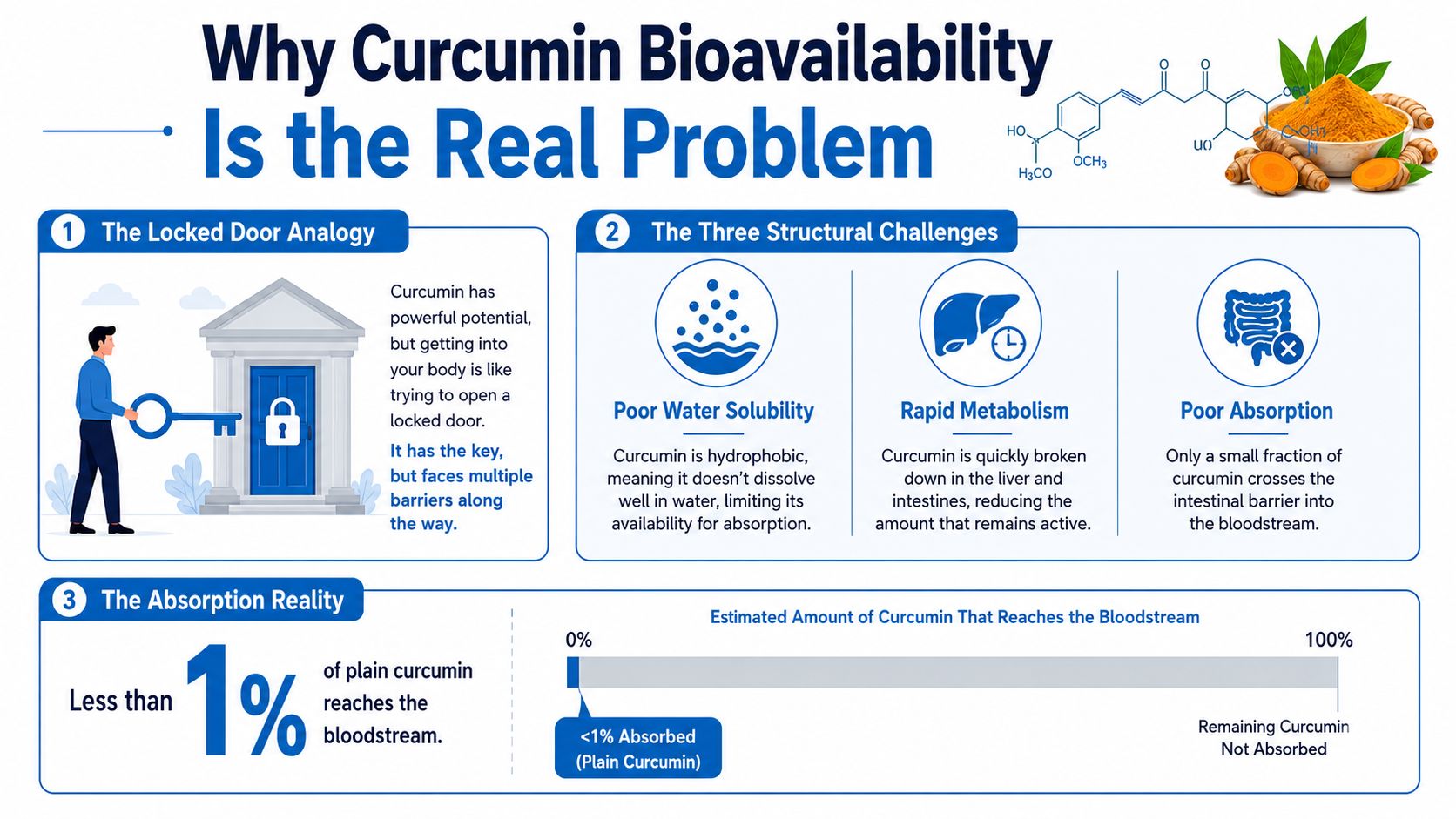
The three barriers that keep curcumin out of circulation
First, curcumin is poorly soluble in water, which matters because the gut is a watery environment. Second, it is metabolized quickly in the gut wall and liver. Third, it crosses the intestinal lining inefficiently, so only a small fraction makes it into circulation. A pharmacokinetic review reported poor absorption predictions of 0 to 20% in a Caco-2 model, and another review summarized human bioavailability at roughly 0.16% to 1% for curcumin PMC review.
That helps explain why the market shifted toward products built to improve absorption. One review noted that 55% of the turmeric dietary supplement market in the United States was made up of products designed to enhance curcumin bioavailability, often with lipophilic carriers or piperine PMC review. The shelf tells the same story. People are not just buying turmeric, they are buying a way to get more of it past the gut wall.
A higher milligram count can still mislead. If most of the curcumin never reaches circulation, the number on the front label is only part of the story. That applies to powders, capsules, and liquids alike.
Liquid format often creates a second layer of confusion because “easy to take” gets mistaken for “easy to absorb.” Those are different things. Liquids can help with convenience, mixing, and dose flexibility, but that does not automatically solve the absorption problem.
For a plain capsule comparison, this high-absorption turmeric curcumin complex shows how brands often frame the same absorption challenge in another format. The label may look different, but the buyer is still asking the same question, does the product help curcumin get into the body?
The Liquid Delivery Technologies Worth Knowing
The label words matter here. Some liquids are mainly about taste and convenience, while others are true delivery systems that change how curcumin behaves in the body. If you can read the technology, you can separate bottles doing real formulation work from ones that are mostly a standard extract in liquid form.
The main technologies and what they do
Piperine-based emulsions use black pepper extract to slow curcumin's breakdown in the gut and liver. That can help because piperine is commonly used to support absorption, but it is still a workaround rather than a full fix. Good labels name piperine or black pepper extract clearly.
Micellar and water-soluble matrices surround curcumin with surfactant-like structures that keep it dispersed in water. That is why these products often look clear, cloudy, or highly mixable. Human data show that a micellar formulation can outperform native curcumin by a very large margin, with one study reporting 277-fold, 114-fold, and 185-fold higher bioavailability in women, men, and the full cohort, respectively, based on AUC PMC study. The same study reported no meaningful changes in safety parameters.
Liposomal curcumin packages curcumin in phospholipid vesicles. That can protect the compound and help it interact with intestinal membranes. The evidence base looks promising, but product quality varies, so the word liposomal alone does not guarantee performance.
Lipid-based oils and triglyceride carriers are simpler. Curcumin dissolves better in fat than in water, so oil-based liquids can make practical sense, especially when the formula is straightforward and the ingredient list is short.
A plain label that says “enhanced absorption” tells you very little. A better label tells you what is doing the work.
| Technology | Mechanism | Typical Absorption Gain (human data) | Common Label Cues |
|---|---|---|---|
| Piperine-based emulsion | Slows curcumin breakdown | Enhanced bioavailability is the goal, but gains vary by product | Piperine, black pepper extract, absorption support |
| Micellar matrix | Keeps curcumin dispersed in water | Very large increases reported, with 277-fold, 114-fold, and 185-fold in one human study | Micellar, water-soluble, dispersible, liquid micelles |
| Liposomal system | Encapsulates curcumin in phospholipids | Improved exposure reported, but highly product-dependent | Liposomal, phospholipid, lecithin |
| Oil or triglyceride carrier | Uses fat as the solvent base | Better than plain powder in principle, but usually less dramatic than engineered systems | MCT, oil blend, triglyceride, lipid base |
For a non-turmeric example of how liquid delivery gets marketed across supplement categories, this liquid mineral concentrate format shows how a liquid can be a vehicle first and a delivery system second, depending on the ingredient.
Liquid Turmeric vs Capsules and Powders
Liquid turmeric is not automatically better, it is better at different jobs. If a capsule already uses a strong delivery system, the liquid's main advantage is often flexibility, not higher absorption. That is why the question is how you plan to use it, not which format sounds best on the shelf.
A liquid fits people who dislike swallowing pills, want to adjust a dose drop by drop, or prefer to mix turmeric into a smoothie, milk drink, or functional shot. It also works well for splitting intake across the day instead of taking one fixed serving at once.
A capsule is stronger for portability, taste avoidance, and pre-measured dosing. That matters most when the capsule already contains micellar, liposomal, or piperine-containing curcumin. In those cases, the shell is just the delivery format, while the chemistry inside does the heavy lifting.
A powder sits in the middle. It can work well for recipes and custom blends, but it asks more from the user. You have to mix it yourself, so the result depends on how evenly it disperses and how much turmeric flavor you can tolerate. If you want a plain turmeric powder option, this bare root powder is a useful reference point for how simple powders compare with liquid products.
| Format | Absorption Potential | Convenience | Dosing Flexibility | Taste | Shelf Life |
|---|---|---|---|---|---|
| Liquid | Varies widely by formulation | High for mixing and fast use | High | Often noticeable | Depends on opening and storage |
| Capsule | Often strong if engineered well | Very high for travel | Low to moderate | Neutral | Usually stable |
| Powder | Usually lowest unless specially formulated | Moderate | High | Most noticeable | Generally stable if kept dry |
A practical rule helps here. If the delivery technology is strong, the format is mostly about convenience. If the technology is weak, a liquid bottle will not fix it.
With that frame, the choice gets easier. A liquid is a better buy when you want control and usability. A capsule makes more sense when you want consistency and the label already shows a credible delivery technology.
How to Use Liquid Turmeric Day to Day
The easiest way to use a liquid turmeric product is to stop thinking in “drops” and start thinking in curcuminoid milligrams. The bottle might list serving size in mL or drops, but what you want to find is how many milligrams of curcuminoids you're getting per serving. Without that number, you're guessing.
Build a simple routine you can actually follow
For general use, many people stay in a 200 to 500 mg curcuminoid range per day, with clinician guidance for higher intake. Because labels vary so much, the first step is reading the Supplement Facts panel, not trusting the front-of-bottle claim. If the serving size is 1 mL and the panel lists 250 mg curcuminoids, then you know what one serving means. If the panel is vague, the product is too.
Timing matters too. Taking liquid turmeric with a meal that contains fat can support uptake, since curcumin is fat-soluble. Some people take it as a straight shot and chase it with water, while others mix it into a smoothie, milk, or coffee. That can work fine, as long as the product's flavor and stability hold up.
Avoid leaving the bottle in sunlight, and check whether the label says to refrigerate after opening. Liquids can be less forgiving than capsules once air, light, and repeated opening get involved. If the bottle has a short open-life window, use it like a fresh product instead of treating it like shelf-stable spice.
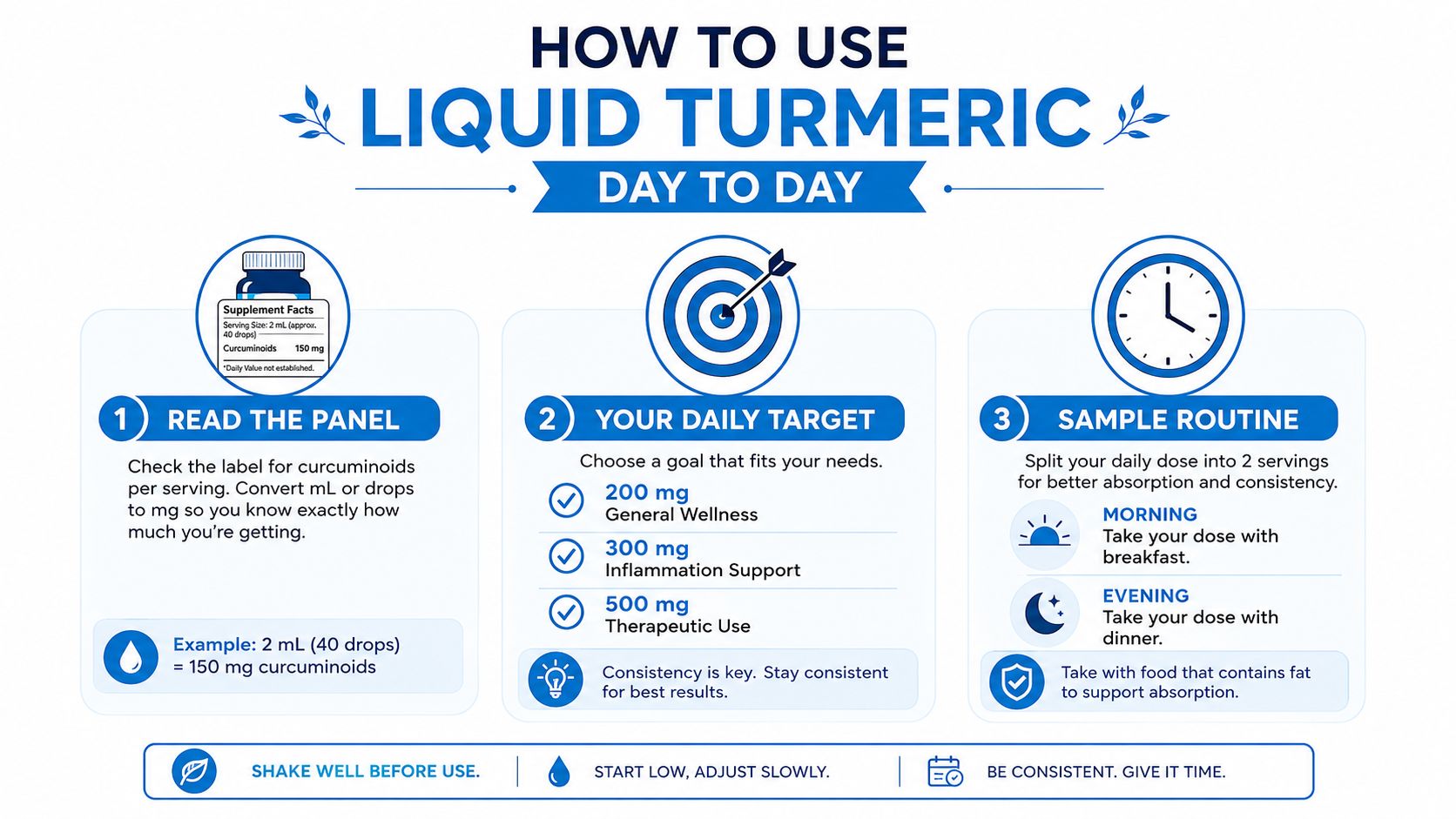
A few stacking rules keep things simple
Do not take liquid turmeric at the same time as iron or zinc if you're trying to optimize mineral intake, because spacing them is the cleaner move. If you use any blood-thinning medication, ask a clinician first before making turmeric a daily habit. The same caution applies if you're layering several supplements that already target inflammation or circulation.
A practical daily setup can be very plain. Breakfast, a measured serving, and a note in your phone if you're testing tolerance. That's usually enough to spot whether the product is easy to use or whether the flavor, timing, or dose becomes annoying after a week.
Safety, Side Effects, and Interactions to Watch
Turmeric deserves respect, not alarm. Concentrated liquid extracts can carry more curcuminoids than the kitchen spice version, so safety should be judged on the formulated product, not the spice rack version of the ingredient.
The main issues people run into
The most common complaints are digestive upset, reflux, and looser stools, especially with concentrated extracts. That risk goes up when the formula is strong, taken on an empty stomach, or mixed with other ingredients that bother the gut. If a liquid relies on emulsifiers or several carriers, some people also react to the formula itself.
Interaction risk matters just as much. Turmeric can potentiate anticoagulants like warfarin and clopidogrel, and it may also affect diabetes medications or blood pressure drugs. It can interfere with iron absorption when taken at the same time, which is why spacing matters if you already watch your mineral intake.
People with gallbladder issues, pregnant or nursing individuals, and anyone scheduled for surgery should check with a clinician before starting. If you use a higher-dose liquid, stop it at least two weeks before surgery and tell your prescriber you use it. That keeps the conversation clear and avoids surprises on the day of the procedure.
Plain advice: if you're on a medication list, liquid turmeric is not a solo decision.
One detail shoppers miss is dosing psychology. A teaspoon can look mild, but if the extract is concentrated, that small serving may deliver more active compound than a casual user expects. Read the label the way you would read a medication strength, because that mindset is closer to how these products behave in practice.
A Practical Buyer's Checklist for 2026
Most bad turmeric purchases fail for the same reason. The shopper checks the front label, sees “high strength” or “liquid absorption,” and never verifies what the bottle contains. A cleaner buying process starts with the back panel and ends with the evidence behind the delivery system.
Use the label before you use the marketing
Look for standardized curcuminoid content first. A transparent label should state both the mg per serving and the percentage or form of the extract, so you know whether you're buying a diluted botanical drink or a serious extract. If the bottle doesn't quantify the active fraction, it's hiding the most important detail.
Next, identify the delivery system and ask whether there's human bioavailability data behind it. Micellar, liposomal, oil-based, and piperine-containing products all work differently, and the proof should match the claim. In vitro testing can be useful, but it does not replace human pharmacokinetic evidence.
Then check the carrier ingredients. Some formulas use simple bases, while others rely on flavor systems, sweeteners, emulsifiers, or extra botanicals that may not be necessary. If you have allergies or a sensitive stomach, this matters as much as the curcumin itself.
After that, confirm third-party testing where possible. Certifications such as USP, NSF, or Informed Choice give you a better chance of seeing what the label promises. The bottle should also tell you the shelf life after opening and whether the dropper is calibrated or just approximate.
| What to verify | Why it matters |
|---|---|
| Standardized content | Tells you how much curcuminoid you're actually getting |
| Delivery technology | Separates true formulation from plain liquid packaging |
| Third-party testing | Helps reduce label and quality surprises |
| Open-life guidance | Matters for liquids exposed to air and light |
| Ingredient transparency | Shows whether the formula is simple or padded with extras |
The last step is price per mg of bioavailable curcumin, not price per bottle. A cheap bottle can be expensive if most of the content never gets absorbed. A pricier bottle can be reasonable if the formulation is clear, tested, and backed by human data.
If you want to buy with less guesswork, CalVitamin carries supplement options across liquid and capsule formats, so you can compare form, label detail, and dosing style in one place. Visit CalVitamin and use the checklist above before you add anything to cart.






