
The inbox is full, the deadline hasn't moved, and by mid-afternoon your shoulders are tight enough to notice. You want something simple that might help you feel steadier, but a brightly flavored gummy can make the decision harder, not easier. Is it a meaningful dose, or just a pleasant way to consume a vague blend?
Stress relief gummies are chewable dietary supplements that deliver ingredients such as botanicals, amino acids, minerals, or vitamins in a measured serving. Their flavor and texture can make them more convenient than pills, especially for adults who carry supplements to work, travel frequently, or struggle with tablets. But convenience isn't the same as effectiveness. The useful questions are which ingredient is present, how much is in each serving, and whether the label can be trusted.
Table of Contents
- What Stress Relief Gummies Are and Who They Help
- Common Active Ingredients and How They Work
- Do Stress Relief Gummies Actually Work
- How to Compare and Choose a Quality Product
- Safe Dosing and How to Use Them Day to Day
- Matching Ingredients to the Stress You Actually Feel
- Finding the Right Options on the CalVitamin Site
- Frequent Questions and Smart Shopping Mindset
What Stress Relief Gummies Are and Who They Help
A stress gummy may fit an adult dealing with ordinary work pressure, a busy family schedule, or difficulty settling down because thoughts keep circulating at bedtime. It can also suit someone who dislikes swallowing capsules and prefers a portable format that doesn't require water. Those are practical use cases, not promises that one chewable product will resolve every form of distress.
The category includes very different formulas. One product may focus on ashwagandha, another on L-theanine or magnesium, while a nighttime formula may include melatonin. The word “stress” on the front label doesn't tell you whether the product is designed for daytime calm, sleep timing, or longer-term support for a taxed stress response.
A useful boundary: stress relief gummies may support a wellness routine, but they aren't a treatment for an anxiety disorder, a replacement for therapy, or a substitute for prescribed medication.
You also shouldn't expect an instant calm switch. Some ingredients may be noticeable relatively soon, while others are intended for consistent use and gradual support. A person who feels persistently panicked, depressed, unable to sleep, or unable to function should seek qualified medical care rather than relying on a supplement label.
The rest of the buying decision comes down to dose reliability and label transparency. Taste matters because a product you won't take consistently has little practical value, but flavor should come after checking the Supplement Facts panel, the ingredient form, manufacturing standards, and relevant safety warnings.
Common Active Ingredients and How They Work
Start with the active ingredient, not the product name. “Stress support” is a marketing category, while the Supplement Facts panel tells you what the gummy delivers.
Five ingredient families to recognize
Ashwagandha is an adaptogen, a botanical category used to support the body's response to stress. Its withanolides are associated with pathways involved in cortisol and stress signaling. Extract identity matters, because a standardized extract isn't interchangeable with an unspecified root powder. For a useful comparison with capsule-based delivery, see this overview of NatureWise Ashwagandha for Stress.
L-theanine is an amino acid found in tea. It's generally discussed as supporting a calmer form of alertness rather than forcing sleep, which is why it may appeal to someone who wants to stay functional during the day.
Magnesium, often supplied as glycinate or citrate, supports normal nerve and muscle function. People sometimes choose it when physical tension or difficulty winding down is part of their experience, although the form and amount still need careful review.
Melatonin is a hormone-like compound involved in sleep timing. It's more relevant to circadian support and sleep onset than to daytime stress itself, and a nighttime gummy containing it shouldn't automatically be treated as a general mood formula.
B-complex vitamins contribute to normal energy metabolism and nervous-system processes. B6, B9, and B12 are commonly included, but their presence doesn't prove that a gummy will create a noticeable calming effect.
| Ingredient | Mechanism | Best For |
|---|---|---|
| Ashwagandha | Adaptogen support for stress-response pathways | Ongoing stress support |
| L-theanine | Calm, relaxed alertness | Daytime tension |
| Magnesium | Neuromuscular and nervous-system support | Tension and evening routines |
| Melatonin | Sleep-timing signal | Circadian or sleep-onset support |
| B-complex | Nutritional support for nervous-system processes | Formulas addressing broader nutritional needs |
Blends can be sensible, but they can also hide weak dosing. Ingredient form matters as much as the ingredient name, particularly when a label lists a proprietary blend without identifying the amount of each active.
Do Stress Relief Gummies Actually Work
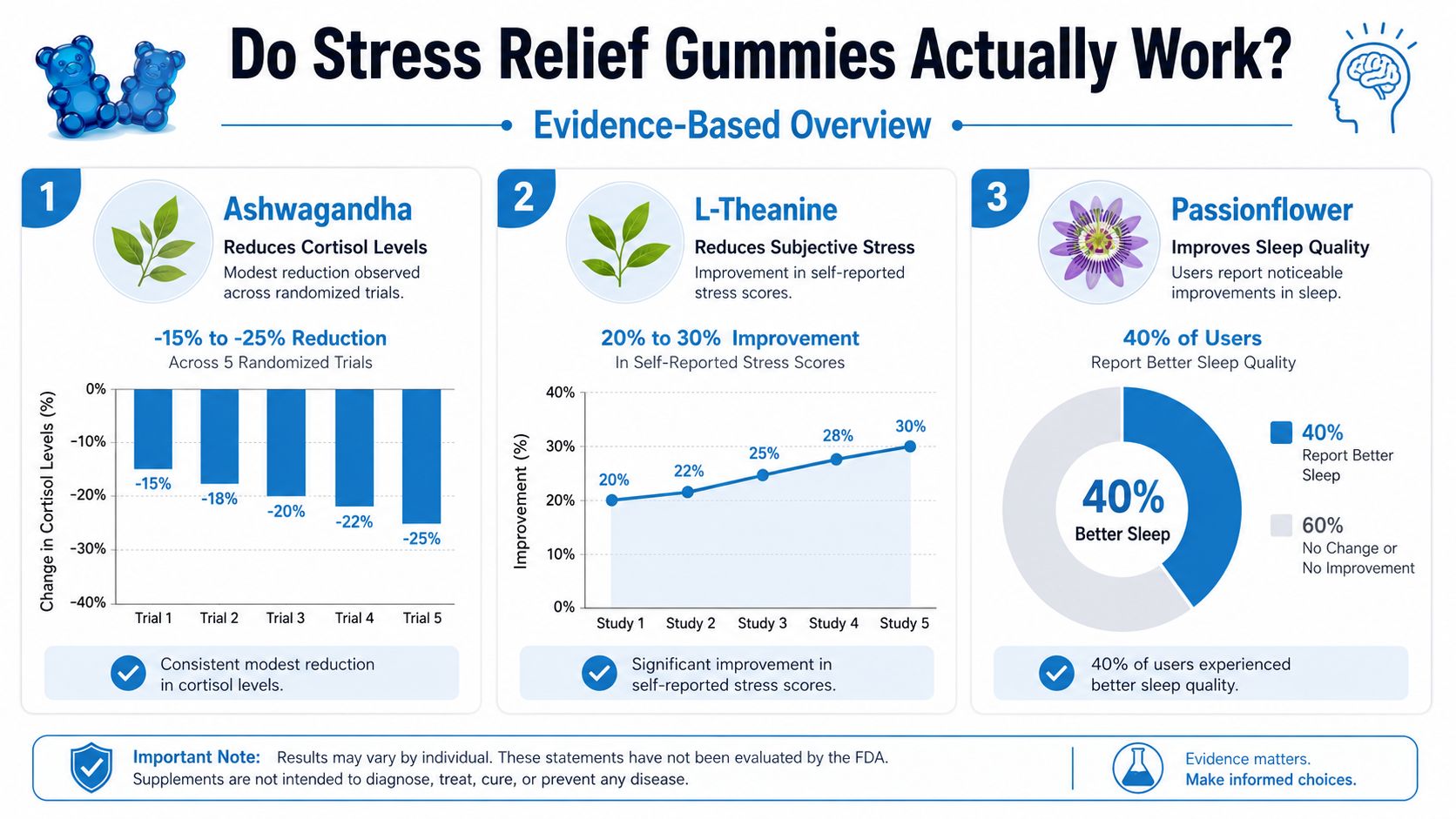
Some formulas can be useful, but the evidence doesn't support treating every stress gummy as equivalent. The strongest category-specific signal in the provided evidence concerns standardized ashwagandha extracts. One commonly cited trial used roughly 600 mg per day for eight weeks and associated daily use with about a 30% reduction in cortisol, as described in this review of whether stress relief gummies work. That result supports a gradual stress-response mechanism, not an immediate sedative effect.
The same distinction applies to format. A gummy may deliver a helpful active, but manufacturers sometimes put less active material into gummies than they would into capsules. Storage can also affect gummy stability, so dose accuracy, validated manufacturing, and clear labeling are part of the effectiveness question, not administrative details.
The label problem changes the buying question
A product can fail in two ways. It may contain an ingredient with limited relevance to your goal, or it may claim a useful ingredient while delivering an amount that's inconsistent or unclear. Evidence about gummy quality is especially concerning in adjacent products. In a U.S. study of 25 melatonin gummy products, 22, or 88%, were inaccurately labeled, and only 3 products were within 10% of the stated amount, according to AARP's coverage of melatonin gummy labeling.
That finding doesn't prove that every stress gummy is mislabeled. It does show why shoppers shouldn't assume that a chewable format guarantees predictable dosing. The practical outcome depends on the active, the dose, your baseline nutritional status, your goal, and the product's manufacturing controls.
How to Compare and Choose a Quality Product
Treat the shopping process like a label audit. Put two products side by side and ignore the front-panel language until you've checked the details that determine what you'll consume.
Begin with the Supplement Facts panel
For Brand A, the serving may be two gummies. Brand B may require four. Comparing the bottle count alone can make Brand B look stronger or more economical when the meaningful comparison is the active amount per serving and per gummy.
Check these fields in order:
- Serving size: Record the number of gummies required for the labeled serving.
- Active amount: Look for the actual milligrams of each ingredient, not only a blend name.
- Extract detail: For botanicals, check whether the label identifies a standardized extract or a generic plant powder.
- Daily Value: Review the percentage where one is provided, especially for vitamins and minerals.
- Inactive ingredients: Note sweeteners, colorants, allergens, and the source of the gummy texture.
A proprietary blend deserves caution because it can prevent you from seeing how much of each active you're getting. If a brand won't disclose the per-gummy dose, you can't make a reliable comparison.
Understand what testing seals cover
A third-party seal can indicate that an independent organization has assessed certain aspects of a product. Programs associated with USP, NSF, or ConsumerLab may address label accuracy, identity, or contaminants, depending on the specific program and product. Other marks, including some sports-oriented certifications, may focus more narrowly on banned-substance screening rather than confirming the full dose of every calming ingredient.
Don't treat a seal as proof that a formula is right for your health history. Treat it as one piece of verification, then review the certificate details or ask the manufacturer what the program tests.
For a dietary checklist, confirm whether the product is gelatin-free, pectin-based, vegan, gluten-free, or free from listed allergens. Also look at added sugar, because a wellness product can still contribute a meaningful sweetener load if you use it routinely.
Safe Dosing and How to Use Them Day to Day
Dose the active ingredient, not the gummy count. One brand's serving might be two pieces, while another's might be four, so “take two gummies” has no universal meaning.
Timing should follow the formula's purpose and your response. B-complex products and stimulating adaptogens such as rhodiola are generally more appropriate earlier in the day. Ashwagandha and L-theanine may fit late morning or early afternoon for some users. Melatonin and evening magnesium products are commonly reserved for the pre-bed routine, but the label and your clinician's advice take priority.
Take a product consistently enough to evaluate it, and avoid changing several supplements at once. A small snack may be useful for compounds that absorb better with dietary fat, while food can also reduce the stomach discomfort some people experience from minerals or botanicals.
Start conservatively: using less than the full labeled serving for an initial trial may help you assess sensitivity, but don't alter a product intended for children or medical use without professional guidance.
Stacking creates avoidable problems. Don't combine melatonin casually with prescription sleep aids or other sedating products. Ask a clinician or pharmacist before using ashwagandha with thyroid medication, or L-theanine with blood-pressure medication. Pregnancy, breastfeeding, thyroid conditions, autoimmune disease, liver concerns, and regular prescription use all justify a conversation before starting a new formula.
If you're comparing capsule options, this NOW L-Theanine 200mg with Inositol product illustrates why form should be considered alongside dose transparency. The most pleasant format isn't automatically the most suitable one.
Matching Ingredients to the Stress You Actually Feel
“One gummy for stress” is too broad a promise to guide a good purchase. Sleep-onset tension, a sharp daytime pressure spike, and long-running exhaustion may feel related, but they don't necessarily call for the same ingredient.
Use the symptom as the starting point
Sleep-onset stress often involves racing thoughts at bedtime. A formula may use melatonin, magnesium glycinate, or L-theanine, but melatonin makes the product a sleep-timing aid rather than a general daytime calm supplement.
Daytime acute stress calls for a different emphasis. L-theanine may suit someone who wants relaxed alertness, while a B-complex can provide nutritional support without making the formula overtly sedating. Check the label carefully if you need to drive, work, or make decisions after taking it.
Ongoing resilience and burnout recovery may lead shoppers toward standardized ashwagandha extracts or rhodiola. These are not quick fixes, and they deserve more attention to extract identity, medication interactions, and consistent dosing than a generic “mood balance” label suggests.
| Stress Profile | Best-Fit Ingredients | Typical Daily Range |
|---|---|---|
| Sleep-onset tension | Melatonin, magnesium glycinate, L-theanine | Use the product label and clinician guidance |
| Daytime acute stress | L-theanine, selected B-complex support | Use the product label and individual response |
| Ongoing resilience | Standardized ashwagandha, rhodiola | Evidence-informed dosing varies by extract |
Some people may prefer separate products for separate goals rather than one overloaded blend. That approach makes it easier to identify what helps, what causes unwanted effects, and whether the gummy's dose is practical.
Finding the Right Options on the CalVitamin Site
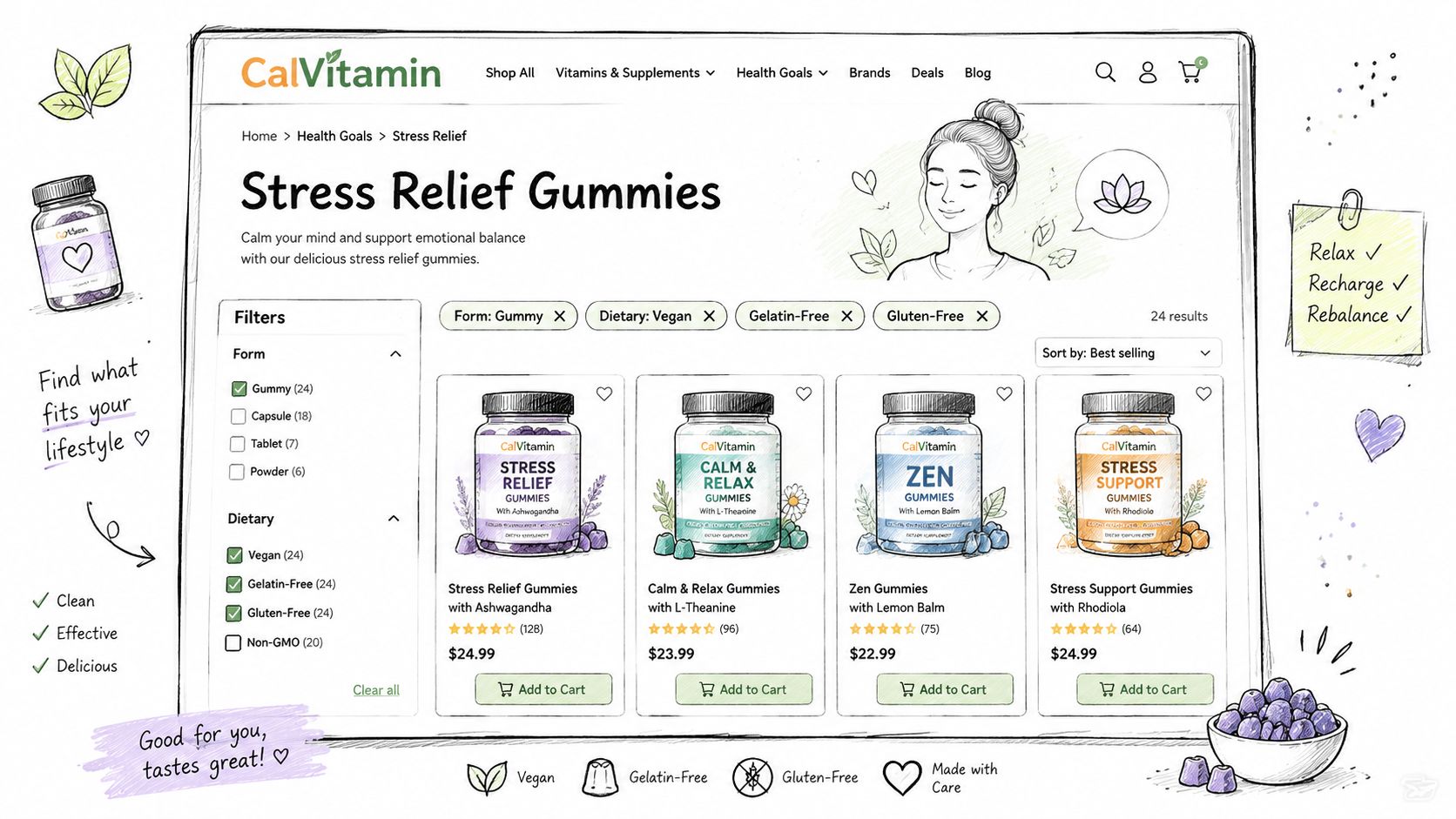
A useful catalog search starts with your goal and constraints, not a flavor. Open the stress relief gummies collection, then narrow the results by form and dietary requirements where those filters are available.
Build a shortlist instead of impulse-buying
Use filters for gummy format, vegan, gelatin-free, gluten-free, and sugar-free if those attributes matter to you. Certification and manufacturing markers can help narrow the field, but verify them on the product page and label rather than assuming every item in a category shares the same standards.
Next, compare product details:
- Active ingredient: Identify whether the formula uses ashwagandha, L-theanine, magnesium, melatonin, or a blend.
- Dose per serving: Confirm the amount and the number of gummies required.
- Servings per container: This helps you compare routine practicality without relying on bottle size.
- Flavor and dietary details: Check whether the flavor system and ingredient list fit your preferences.
- Ratings and reviews: Sort by rating and review count together, so a high score with very little feedback doesn't outweigh a broader pattern.
A product such as WellPath Zen Stress Relief Formula Vegan Gummies can be placed on the same shortlist as capsule or liquid alternatives. The point isn't to choose by format alone. It's to compare its active ingredients, serving information, dietary attributes, and available quality documentation with competing options.
Save two or three candidates before deciding. If you have questions about a batch, certificate of analysis, or testing documentation, contact the retailer or manufacturer's support team and ask for a direct answer rather than inferring quality from packaging.
Frequent Questions and Smart Shopping Mindset
How quickly should you notice an effect? That depends on the active and your goal. A nighttime ingredient may feel different from a botanical intended for regular use, and a product won't correct an underlying deficiency or sleep problem immediately.
Can you take a stress gummy with coffee? The answer depends on the formula and your sensitivity. Coffee may work against the calm experience you're seeking, while acidic drinks or taking supplements on an empty stomach can contribute to digestive discomfort for some people.
Can you combine one with magnesium? Sometimes, but check the total amount and avoid duplicating ingredients across multiple blends. If a gummy already contains magnesium, adding a separate magnesium product changes the overall intake.
What's the difference between daytime and nighttime formulas? Daytime products may emphasize relaxed alertness, while nighttime products can include sleep-oriented ingredients such as melatonin. Don't use a sedating nighttime formula before activities that require full alertness.
What if nothing happens? Recheck the active dose, serving size, consistency, and your original goal. If the label is vague or the product relies on an undisclosed blend, switching to a clearly labeled option may make evaluation easier. Stop if you develop concerning effects, and ask a clinician or pharmacist about persistent symptoms.
Children, pregnancy, breastfeeding, chronic conditions, and medication use all warrant individualized advice. A supplement can interact with treatment or be unsuitable even when the front label sounds gentle.
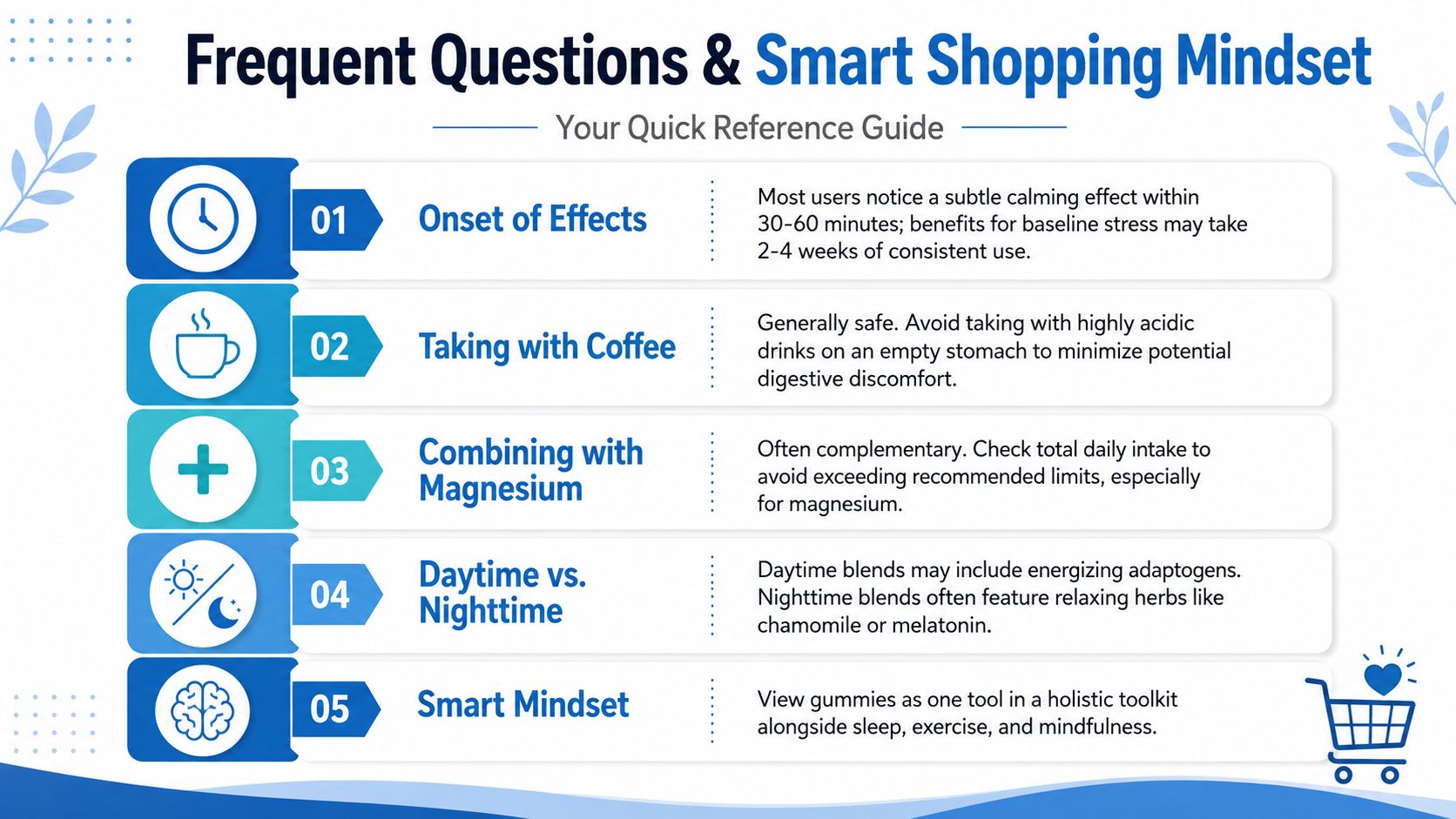
The calm-shopping mindset is simple: verify the dose before admiring the flavor. Expect support to be subtle rather than dramatic, and treat a gummy as one tool alongside sleep, movement, therapy when appropriate, and practical stress skills. A transparent label and suitable ingredient matter more than colorful packaging.
CalVitamin offers a broad selection of supplement formats, including gummies and capsules, so you can compare delivery forms while checking active amounts and dietary attributes. Visit CalVitamin to build a short list of stress-support options, review product details, and choose based on dosing clarity rather than flavor alone.






