
The most popular advice about reishi mushroom capsules is also the least useful: “Choose a natural product and follow the label.” Natural doesn't guarantee a meaningful dose, clean raw material, or honest standardization. Two capsules can both claim to contain reishi while delivering very different amounts of biologically active compounds.
The practical question isn't whether reishi works. It's what kind of reishi is in the capsule, how the extract is standardized, and whether an independent test confirms the label. The human evidence is tied to defined preparations, not vague mushroom powder, and product testing has found wide variation in glucan composition across marketed products PLOS ONE's analysis of reishi preparations.
Table of Contents
- What Reishi Mushroom Capsules Actually Are
- The Active Compounds and Why Extract Type Matters
- Evidence-Based Benefits and Honest Limits
- How to Decode a Reishi Capsule Label
- Capsules vs Powders and Tinctures
- Dosing, Timing, and Safety
- The Smart Shopper's Buying Checklist
- Practical Questions Shoppers Ask Most
What Reishi Mushroom Capsules Actually Are
Reishi capsules aren't interchangeable. The name usually refers to mushrooms in the Ganoderma genus, commercially associated with Ganoderma lucidum and Ganoderma lingzhi. Reishi, also called lingzhi, has a medicinal history in East Asia spanning more than 2,000 years, with ancient written references and artistic depictions appearing by around 1400 AD, as described in the historical summary reported through NIH and NCBI-linked market background.
That history explains why capsules make sense, but it doesn't prove that every modern product is effective. The fruiting body is woody, tough, and bitter. People traditionally prepared it as a tea, soup, or decoction rather than eating it like a button mushroom. A capsule gives you a measured delivery format, often using a concentrated extract that would be inconvenient to prepare from raw material.
The three label problems I watch first
“Reishi mushroom” without a specified part tells you too little. The label should identify fruiting body, mycelium, or a combination. If it only says “mushroom biomass,” you can't tell what you're buying.
“Proprietary blend” is another problem. It may list several mushrooms while hiding the actual reishi quantity inside one combined figure. A blend can be useful, but the absence of individual amounts prevents a serious dose comparison.
Then there's the familiar “500 mg per capsule” claim. That number describes weight, not necessarily active extract. The capsule may contain whole powder, a diluted mycelium-on-grain material, or a concentrated extract. Those are not equivalent just because the capsule weighs the same.
Buyer's rule: Treat capsule weight as packaging information until the label discloses the mushroom part, extraction method, and active-compound testing.
Reishi products have become a major commercial category. Market estimates vary, but one report valued the global market at USD 6.24 billion in 2023 and projected USD 13.60 billion by 2030, while another estimated USD 5.03 billion in 2025 and forecast USD 7.3 billion by 2030. Those figures come from different methodologies, but both indicate broad movement from traditional use into mainstream supplement commerce, as summarized by Fortune Business Insights' reishi mushroom market report. Commercial scale makes label literacy more important, not less.
For general herbal and supplement browsing, CalVitamin's herbs collection is one place to compare ingredient formats. Use the same standard there that you'd use anywhere else: identify the active material before judging the price.
The Active Compounds and Why Extract Type Matters
A reishi label becomes useful when it tells you what the extraction process captured. The two compound groups that matter most are beta-glucans and triterpenes, including ganoderic acids.
Beta-glucans are water-soluble structural polysaccharides associated with immune-modulating activity. Serious labels disclose their percentage or total amount instead of relying on the word “polysaccharides,” which can include compounds that aren't beta-glucans. Triterpenes are more closely associated with reishi's bitterness and are extracted more effectively through alcohol or a combined water-and-alcohol process.
Think of extraction like making coffee. A hot-water extract is similar to brewed coffee made from ground beans. It pulls out the water-soluble compounds. A dual extract adds the oily fraction that water alone misses. Mycelium grown on grain is different again. It may contain fungal material, but the grain substrate can dilute the mushroom-derived content.
What each preparation captures
| Extract Type | Beta-glucans | Triterpenes | Label Signal |
|---|---|---|---|
| Fruiting-body hot-water extract | Usually the primary target | Limited compared with dual extraction | Disclosed beta-glucan testing |
| Fruiting-body alcohol extract | Not the main strength | Better suited to triterpenes | Ganoderic-acid or triterpene disclosure |
| Fruiting-body dual extract | Captures water- and alcohol-soluble fractions | More comprehensive compound profile | Both beta-glucans and triterpenes listed |
| Whole mushroom powder | Present but less concentrated | Present in the raw material | Clear mushroom-part identification |
| Mycelium-on-grain powder | May be present but diluted by substrate | Variable | Ingredient panel identifies grain or starch |
“Full spectrum” sounds impressive but doesn't define a measurable standard. A product can use that phrase while failing to disclose whether it contains fruiting body, mycelium, grain, or a meaningful beta-glucan level.
For a useful comparison point, inspect how a product such as Life Extension Mushroom Immune Support with beta-glucans presents its active ingredients. The product name alone isn't proof of quality, but disclosed compound information is more useful than an unqualified “mushroom complex” claim.
The PLOS ONE analysis linked earlier is the key reason I favor standardization. Marketed preparations showed broad differences in alpha- and beta-glucan composition. That means two products with identical capsule weights may provide materially different active doses. A standardised extract with a disclosed assay beats a vague whole-mushroom promise.
Evidence-Based Benefits and Honest Limits
Reishi's human evidence is narrower than its marketing. The most defensible claim is immune modulation, not guaranteed disease prevention. A randomized, double-blind, placebo-controlled trial enrolled 157 healthy adults and tested a standardized reishi beta-glucan capsule providing 200 mg per day for 84 days. Compared with placebo, the reishi group showed higher lymphocyte, CD3+, CD4+, CD8+, CD4/CD8 ratio, and natural-killer-cell indices. The trial also reported no significant between-group differences in AST, ALT, creatinine, or hematology, supporting short-term use without observable laboratory safety signals in that study the full clinical trial report.
That result matters, but it doesn't mean the capsule prevents colds, treats infections, or strengthens every person's immune system in a noticeable way. Immune markers are not the same as fewer illnesses or better long-term outcomes.
What deserves cautious confidence
Immune markers have the clearest direct human support. The trial above used a defined beta-glucan preparation, which is precisely why a capsule containing only an unspecified amount of mushroom powder shouldn't borrow the same evidence.
Sleep and well-being are plausible but less settled. Some clinical work has examined subjective sleep, fatigue, and well-being, but these outcomes are sensitive to expectations, baseline health, and study design. If a product helps, the effect is more likely to appear as a gradual change in routine than as a dramatic sedative response.
Stress, cortisol, liver support, allergy relief, and cardiovascular claims remain weaker. Much of the support comes from laboratory research, animal models, traditional use, or small exploratory human studies. Those findings can justify further research, but they don't justify treating reishi as a replacement for medication.
Evidence boundary: A rise in immune-cell indices is not proof that reishi prevents disease, treats cancer, or replaces clinical care.
Reishi cannot treat cancer. It cannot substitute for prescribed immunosuppressants, anticoagulants, or other medication. It also won't produce a reliable acute effect from a single capsule. Anyone making those promises is selling certainty that the clinical literature doesn't provide.
The sensible interpretation is narrower. A well-characterized reishi extract may support measurable immune-related changes over sustained use, while the broader wellness claims remain provisional. That distinction should determine what you pay for.
How to Decode a Reishi Capsule Label
Read the Supplement Facts panel and the front label as if they were two separate documents. The front sells an identity. The panel should reveal the material, amount, and serving structure.
Start with the mushroom part. Fruiting body is the clearest choice when you want the structure used in most quality-focused reishi products. Mycelium can be legitimate fungal material, but mycelium-on-grain products deserve closer inspection because the grain contributes bulk and can dilute the mushroom content. “100% mushroom” still isn't enough if the label doesn't identify the part.
Next, find the extraction method. A hot-water extract is aimed mainly at water-soluble compounds such as beta-glucans. An alcohol or dual extract is intended to include more triterpenes. If the label says only “reishi extract,” you can't determine the compound profile from that phrase alone.
A practical label translation
| Label Claim | What It Actually Means | What to Look For |
|---|---|---|
| “Fruiting body” | Identifies the mushroom structure used | A clear botanical ingredient name |
| “Mycelium on grain” | Fungal biomass combined with a grain substrate | Grain listed openly, plus beta-glucan testing |
| “Hot-water extract” | Extraction focused on water-soluble material | A disclosed beta-glucan result |
| “Dual extract” | Water and alcohol extraction were combined | Beta-glucans and triterpenes both disclosed |
| “8:1 extract” | Raw material was concentrated during extraction | The ratio paired with an assay, not used alone |
| “Full spectrum” | A broad marketing description | Specific mushroom part and compound data |
| “Proprietary blend” | Combined ingredients with hidden individual amounts | Individual reishi amount stated separately |
An extract ratio is helpful but incomplete. An 8:1 ratio indicates that a larger amount of raw mushroom was processed into a smaller amount of extract, but it doesn't prove the finished capsule contains a meaningful beta-glucan concentration. A high ratio without a Certificate of Analysis is a marketing shortcut, not a quality guarantee.
Look for a lot-specific Certificate of Analysis, or COA, that identifies beta-glucans and confirms contaminant testing. The report should correspond to the batch you're buying, not merely show a generic laboratory document from an earlier production run.
Avoid products that bury reishi inside a mushroom blend while advertising the total blend weight as if it were reishi. If you can't calculate the reishi dose, you can't compare the product with clinical evidence.
Capsules vs Powders and Tinctures
Format affects convenience, taste, and dosing discipline. It does not determine extract quality.
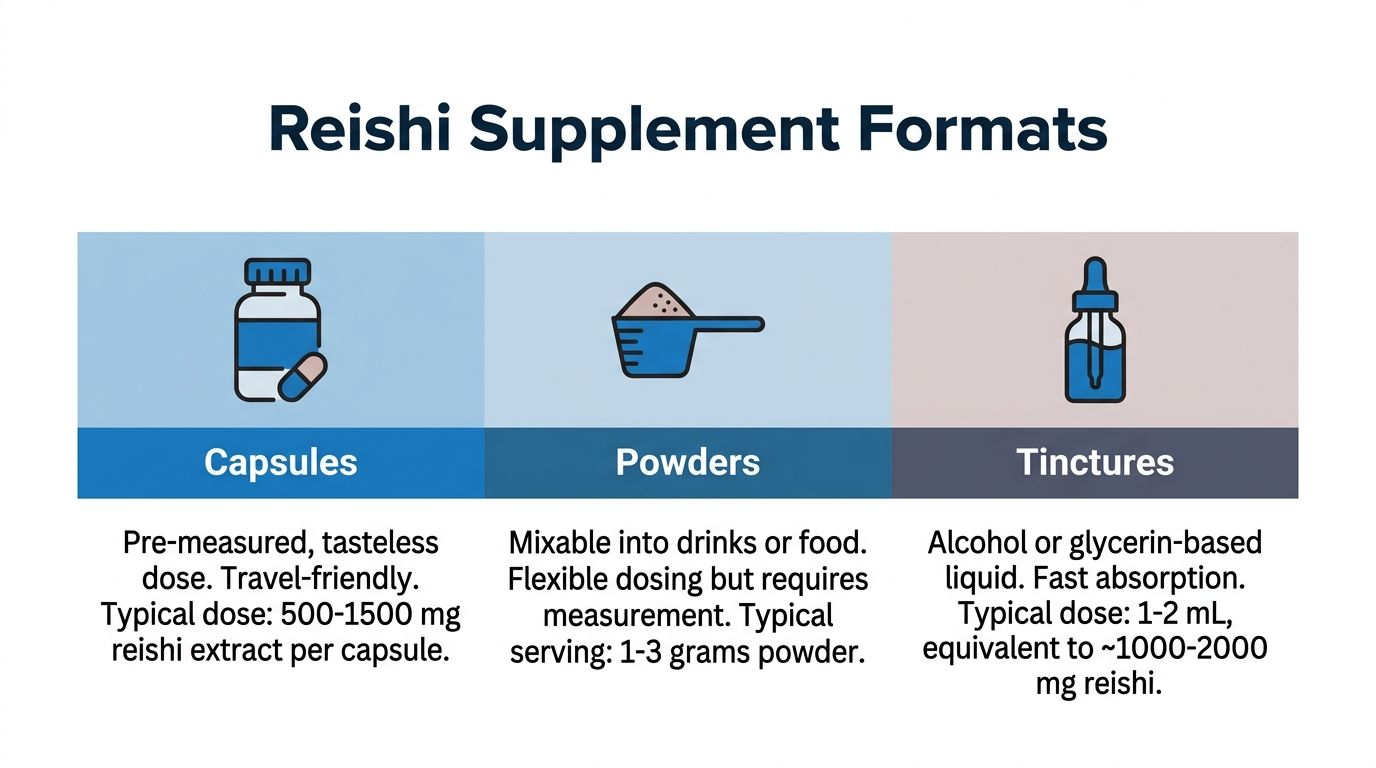
Capsules suit buyers who want a consistent routine. They are pre-measured, portable, and conceal reishi's bitterness, with no scoop, scale, or brewing required. Check the serving size rather than judging potency by capsule count. A capsule can contain less extract than its appearance suggests.
Powders provide more control. You can mix them into coffee, broth, or a smoothie and adjust the amount gradually. The tradeoff is taste. Reishi has a woody bitterness, and household teaspoons do not measure concentrated extracts reliably. Use a proper scale if the label gives a powder weight without a measured serving.
Tinctures provide liquid dosing, usually through alcohol or glycerin. They work for people who dislike capsules, but the extraction method determines what compounds reach the bottle. Alcohol alone is poorly suited to extracting beta-glucans, so do not assume a tincture matches a capsule. Require clear details on the mushroom material, extraction process, and active-compound testing.
Choose the format you can measure and use consistently.
- Choose capsules for a tasteless, repeatable routine.
- Choose powder if you cook with supplements and can measure accurately.
- Choose a tincture if liquid dosing matters and the manufacturer discloses extraction details.
For shoppers considering another delivery format, reishi mushroom gummies show the same tradeoff. A gummy may be easier to take, yet the label must still identify the reishi extract and disclose its active compounds.
Capsules are the practical choice for most buyers because they reduce dosing friction. They do not guarantee greater potency. The ingredient panel and testing determine that.
Dosing, Timing, and Safety
Dose from the evidence, not from the biggest number printed on the bottle. Human research has used defined preparations across a wide range, and traditional recommendations also vary. The Drugs.com reishi monograph describes traditional recommendations ranging from 0.5 to 1 gram daily up to 6 to 12 grams of extract in the Chinese Pharmacopoeia, while some trials have used 5.4 grams per day of a standardized extract.
That range is too broad to turn into a universal prescription. It shows why “take two capsules” is meaningless without knowing whether the capsules contain whole powder, a hot-water extract, or a dual extract.
A practical starting method
Use the manufacturer's serving size only after checking the extract identity and assay. If the label provides no beta-glucan result and no meaningful extraction information, increasing the number of capsules won't solve the uncertainty.
Take reishi with food if it causes mild digestive discomfort. Morning or evening can work, but consistency matters more than chasing a perfect clock time. If you're using it for a calming routine, evening may be more practical. If it makes you feel unsettled or affects sleep, move it earlier or stop.
The interaction risk deserves more attention than the marketing usually gives it. Speak with a clinician before using reishi alongside immunosuppressants, blood thinners, or chemotherapy, and avoid starting it near surgery. Pregnant or breastfeeding people, anyone with a mushroom allergy, and people with significant medical conditions should get professional advice before use.
Stop taking it and reassess if you develop dry mouth, dizziness, rash, digestive upset, or unusual bleeding. A “natural” label doesn't remove the possibility of pharmacological effects or individual intolerance.
Safety rule: Don't use a supplement to manage a medication interaction on your own. Bring the exact product label and COA to the clinician who manages your treatment.
The Smart Shopper's Buying Checklist
A trustworthy reishi capsule should survive a sequence of uncomfortable questions. If the brand answers them with slogans instead of documents, move on.
Start with the raw material
Look for a clearly identified fruiting-body extract or a transparent fruiting-body and mycelium formula. If grain appears in the ingredient panel, determine whether the product is selling fungal extract or mostly substrate. “Whole mushroom” and “full spectrum” aren't substitutes for an ingredient breakdown.
Then inspect the extract ratio. A ratio in the 8:1 to 20:1 range can be plausible, but the ratio should be supported by a beta-glucan assay. A 50:1 claim without active-compound testing is a red flag because the ratio alone doesn't tell you what survived processing.
I want the label or COA to disclose beta-glucans, with triterpene information if the product claims a dual extract. Don't treat a total polysaccharide number as automatically equivalent to beta-glucans.
Demand independent verification
The laboratory report should cover heavy metals, including lead, cadmium, arsenic, and mercury, because mushroom powders and capsules can carry contamination concerns from the growing substrate or environment. Pesticide screening is also useful when the producer claims organic or carefully controlled cultivation.
Look for credible third-party verification, such as testing associated with USP or NSF, or a clearly identified independent laboratory with batch-specific documentation. A logo without a verifiable report is decoration.
Packaging matters too. Prefer an opaque container with a desiccant, a visible expiration date, and a lot number that matches the COA. Choose pullulan or HPMC capsules if you want a vegan option, and confirm that the capsule shell isn't gelatin.
| Quality Marker | What to Look For | Red Flag |
|---|---|---|
| Mushroom part | Fruiting body stated clearly | “Mushroom biomass” with no breakdown |
| Extract method | Hot-water or dual extraction identified | “Extract” with no method |
| Active compounds | Beta-glucan result, plus triterpenes when claimed | Total polysaccharides only |
| Testing | Batch-specific COA for metals and pesticides | Generic lab badge |
| Dose transparency | Individual reishi amount shown | Proprietary blend |
| Packaging | Opaque bottle, lot number, expiration date | Missing traceability |
| Capsule shell | Pullulan or HPMC for vegan use | Unspecified capsule material |
If your budget forces a tradeoff, prioritize identity, active-compound testing, and contaminant screening over exotic claims, premium packaging, or a long ingredient list. A simple, tested reishi extract is a better purchase than a fashionable blend that hides its dose.
Practical Questions Shoppers Ask Most
How should reishi capsules be stored? Keep the sealed bottle away from heat, direct light, and moisture. An opaque container, a desiccant, a lot number, and a clear expiration date are basic signs that the manufacturer is treating stability seriously. Once opened, close the container promptly and avoid storing it in a humid bathroom.
Can reishi be combined with other supplements? It may fit alongside common wellness products such as vitamins, melatonin, or other adaptogens, but stacking doesn't remove interaction risk. Use extra caution with anticoagulants, antiplatelet drugs, immunosuppressants, chemotherapy, blood-pressure medication, diabetes medication, or medicines that affect the liver.
How long should you test it? Don't judge a capsule by the sensation it creates on day one. Subjective changes in sleep, calmness, or seasonal wellness may emerge gradually, and a meaningful personal evaluation is better handled over 8 to 12 weeks than through random single-dose experiments.
Track outcomes instead of chasing sensations
Keep a short weekly log. Record sleep quality, energy, digestive comfort, skin changes, and any unusual bruising or bleeding. If your goal is immune support, record illness episodes without assuming that every change proves the supplement caused it.
Pause the capsules if you develop a rash, persistent digestive upset, or unusual bleeding. Consult a clinician before restarting, especially if you take prescription medication or have a history of liver, immune, or bleeding problems.
The buying decision remains straightforward. Choose a clearly identified extract, demand active-compound and contaminant testing, and reject labels that make you calculate blindly. That approach is more reliable than paying extra for the word “natural.”
CalVitamin offers an online catalog of dietary supplements and wellness products, including capsule, gummy, liquid, and other formats, with product details and shopping support. Visit CalVitamin to compare available supplement options, then apply this reishi capsule checklist before you buy.






