
A calcium supplement isn't automatically a safer choice just because it comes as a gummy. In a randomized study of 36,282 postmenopausal women, combined calcium and vitamin D supplementation, alongside high total calcium intake, was associated with a 17% higher kidney-stone risk over seven years, according to the NIH calcium fact sheet. That finding doesn't mean everyone should avoid supplements. It means your daily total matters more than the promise on the bottle.
Calcium and vitamin D gummies can help fill a nutritional gap, especially if swallowing tablets is difficult. The important question isn't which gummy is best. It's how much calcium and vitamin D you already get, what's missing, and whether a particular serving supplies that missing amount without adding unnecessary extras.
Table of Contents
- What Calcium and Vitamin D Gummies Deliver
- Daily Calcium and Vitamin D Targets by Age
- Who Benefits From Calcium and Vitamin D Gummies
- How to Split a Safe Daily Dose
- Side Effects, Interactions and Upper Limits
- Gummies Compared With Tablets, Capsules and Food
- Choose a Gummy You Can Verify Before You Buy
What Calcium and Vitamin D Gummies Deliver
Calcium and vitamin D gummies are chewable supplements that pair calcium with vitamin D, usually in the D3 form. Vitamin D works like a key that helps the gut absorb calcium, while calcium supplies building material for bones and teeth and supports normal muscle and nerve function.
The pairing makes biological sense. The front label, however, says little about how much of either nutrient a serving contains, and a gummy can deliver a full vitamin D dose while contributing far less calcium than its name implies.
The serving size tells you more than the front label
Three similarly named products show how wide the spread runs. Treat them as label examples illustrating the range; the prices cited are snapshots rather than guaranteed checkout prices.
Calcium and vitamin D3 per serving in three gummy products
| Product | Calcium per serving | Vitamin D3 per serving |
|---|---|---|
| Nature Made Calcium Gummies with D3 | 500 mg | 1,000 IU |
| LIVS Calcium and Vitamin D3 Gummies | 170 mg | 1,000 IU (25 mcg) |
| Lifeable Calcium and Vitamin D Gummies for Kids | 500 mg | 25 mcg |
Medical News Today reported 500 mg calcium and 1,000 IU vitamin D3 per 2-gummy serving for Nature Made, with 40 servings per container, in 2026. Target's LIVS listing listed 170 mg calcium and 1,000 IU (25 mcg) vitamin D3 per 2-gummy serving for $21.99 in 2026. Target's Lifeable listing listed 500 mg calcium and 25 mcg vitamin D per 2-gummy serving, with 60 gummies for $17.99, in 2026.
Check the units before comparing. The LIVS label equates 1,000 IU with 25 mcg, so all three products deliver the same vitamin D dose. The meaningful spread sits in the calcium column, running from 170 mg to 500 mg per serving: a LIVS serving supplies about a third of the calcium the other two provide. Treated as one input in a daily total that also counts food, other supplements and medicines, that difference determines how much of your gap a serving closes.
Read the Supplement Facts panel in order
- Serving size first: Check how many gummies make a serving before interpreting any nutrient amount.
- Calcium next: Look for calcium in milligrams, rather than a general bone-support claim.
- Vitamin D after that: Record the amount and unit exactly, and convert before adding an IU figure to a microgram figure.
- Bottle quantity last: Servings per container tells you how long the bottle lasts at the intended serving.
All three products above count two gummies as one serving. Misread that line and you could end up taking half or twice what you planned.
Daily Calcium and Vitamin D Targets by Age
Find your age group first. The NIH calcium guidance sets daily calcium needs at 1,300 mg for ages 9 to 18, 1,000 mg for adults 19 to 50 and men 51 to 70, and 1,200 mg for women 51 to 70 and adults 71 or older.
Daily calcium and vitamin D intake by age group
| Group | Calcium recommended | Vitamin D recommended |
|---|---|---|
| Ages 9 to 18 | 1,300 mg | 600 IU (15 mcg) |
| Adults 19 to 50 | 1,000 mg | 600 IU (15 mcg) |
| Men 51 to 70 | 1,000 mg | 600 IU (15 mcg) |
| Women 51 to 70 | 1,200 mg | 600 IU (15 mcg) |
| Adults 71 and older | 1,200 mg | 800 IU (20 mcg) |
The same guidance caps adults at 2,500 mg of calcium daily through age 50 and 2,000 mg from age 51 onward, and at 100 mcg (4,000 IU) of vitamin D per day from all sources combined. For children, a pediatrician can confirm the ceiling that applies at a specific age.
A target isn't a supplement prescription
A recommended intake works like a daily budget. Food, fortified drinks, multivitamins and gummies all draw from the same total, so the figure in the table describes everything you consume, not what one product should supply. The gummy is one input in that total.
An upper limit is a safety ceiling. Filling the space between your usual intake and that ceiling doesn't offer an automatic benefit.
Practical rule: Subtract what you already consume before choosing what to supplement.
Dietary gaps are real, but population averages can't tell you your personal shortfall. The same NIH guidance describes an analysis of 2007–2010 U.S. survey data in which 39% of people age 4 and older consumed less than the estimated average requirement for calcium from food and supplements, rising to 49% among children ages 4 to 18.
Those are dated intake estimates, not a current diagnosis for every adult or child. They also measure against the estimated average requirement, a different yardstick from the recommended intake in the table.
Use your own diet as the starting point
Write down the calcium-containing foods you normally eat: fortified drinks, yogurt, cheese, tofu and similar staples. Use each package's serving size and nutrient amount rather than assuming brands match, then add the vitamin D from any multivitamin you already take.
Say your food log totals roughly 700 mg of calcium on a typical day and your target is 1,000 mg. The gap is about 300 mg, so a modest supplement dose closes it. Doubling the dose would overshoot your need and push you toward the ceiling, where extra calcium stops helping.
For younger children, don't borrow an older child's target or choose an adult product by cutting the serving. Ask the pediatrician to confirm the age-appropriate recommendation, product, and dose.
Who Benefits From Calcium and Vitamin D Gummies
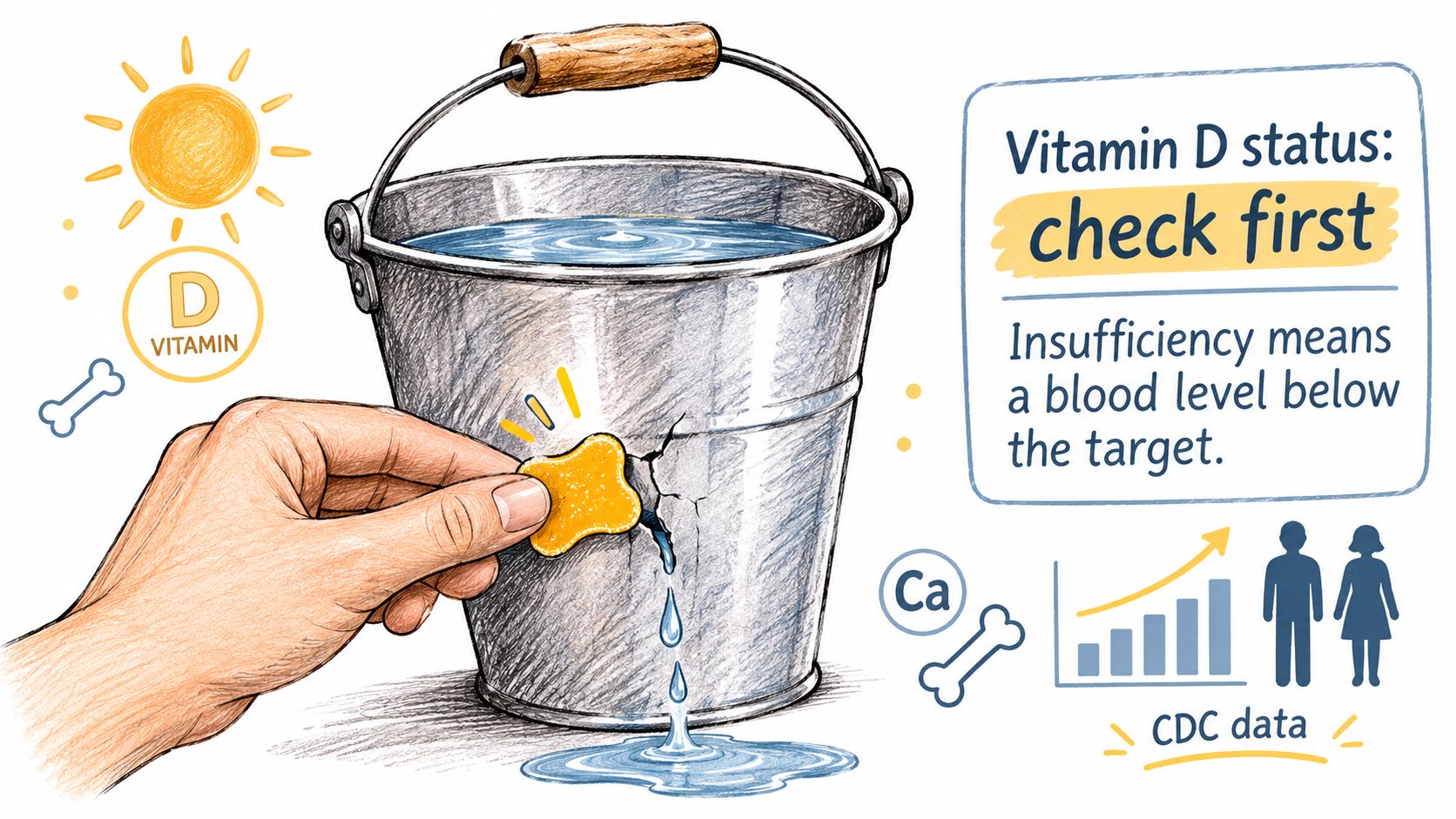
A gummy is like a patch for a leaky bucket. It's useful when there's a real gap, but adding patches doesn't help if the bucket isn't leaking.
The CDC vitamin D factsheet reports that vitamin D insufficiency, defined there as blood 25-hydroxyvitamin D below 50 nmol/L, fell from 28% in 2001–2002 to 22% in 2021–2023 among U.S. people age 6 and older. That supports targeted attention to vitamin D, not the assumption that everyone needs more.
The illustration captures the difference between addressing a gap and just adding another supplement.
Who should assess their intake
- People with limited sunlight exposure: Review vitamin D intake rather than assuming calcium is also low.
- People avoiding dairy: Check whether fortified alternatives and other foods replace the calcium they'd otherwise receive.
- Vegans: Assess the full eating pattern and check that the gummy's ingredients suit it.
- Adults with a documented dietary gap: A chewable format may make a suitable plan easier to follow.
- Children with restricted diets: A pediatrician or dietitian can assess intake without treating a gummy as a substitute for feeding support.
Avoiding dairy doesn't automatically mean you're calcium deficient. Likewise, spending time outdoors doesn't prove that your vitamin D status is adequate, and sunlight doesn't supply calcium.
When another gummy may add little
If your food and existing supplements already meet your needs, another combined product may only duplicate nutrients. Someone who needs vitamin D alone may be better served by a product that doesn't add calcium.
This video provides an additional visual resource on the topic.
Low intake and diagnosed deficiency aren't interchangeable. A clinician can assess risk and decide whether testing is appropriate; a vitamin D blood test can help establish vitamin D status. Don't use symptoms, a gummy label, or a dietary estimate to diagnose yourself.
How to Split a Safe Daily Dose
Start with a written calculation, not a handful of gummies. You need your dietary intake, your target, and the amount supplied by the product you're considering.
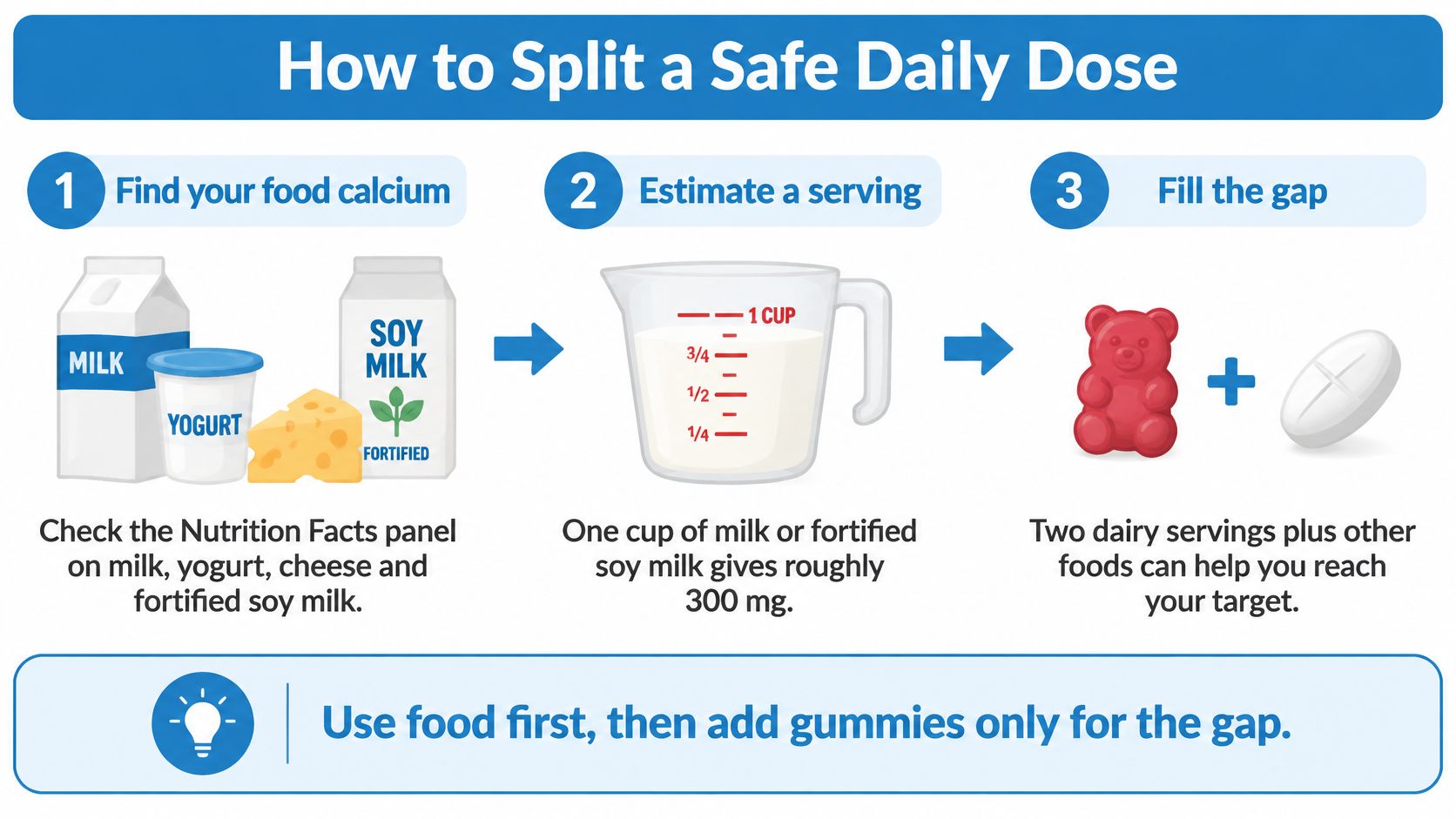
The process begins with food labels rather than an assumed serving value.
Build your daily total
Record your food calcium. Check the Nutrition Facts panels on milk, yogurt, cheese, fortified soy milk, and other foods you eat regularly. Multiply the label amount by the portion you consume. Fortified products deserve particular attention because brands can differ.
Include supplements and medicines. Add calcium from multivitamins, separate mineral products, and calcium-containing antacids. Keep these entries separate so you can see what would change if a medicine or supplement changes.
Find the remaining gap. Subtract your existing intake from your age-appropriate target. For a hypothetical worksheet, someone with a target of 1,000 mg and an existing intake of 600 mg would have a 400 mg gap. These are example inputs, not estimates of what your diet supplies.
Test the proposed serving. Add the gummy's labeled calcium amount to your worksheet. If the product supplies more than the gap, consider whether improving food intake or choosing another formulation would be a better fit. Don't automatically round up to multiple servings.
Run vitamin D separately. List vitamin D from fortified foods, multivitamins, dedicated vitamin D products, and the proposed gummies. A calcium serving that fits your calculation can still bring more vitamin D than you need.
Split calcium thoughtfully
The NIH consumer calcium guide states that calcium absorption is best when you consume 500 mg or less at one time; it also advises taking calcium carbonate with food, while calcium citrate can be taken with or without food.
For a hypothetical clinician-approved plan involving a substantial supplemental amount, separate meal-time portions may make more sense than taking the whole day's supplement at once. Don't increase a combined gummy's serving merely to make the calcium arithmetic work, because every extra serving also adds vitamin D and other ingredients.
Elemental calcium means the calcium itself, rather than the total weight of the calcium compound. Use the calcium amount shown in Supplement Facts for your calculation, not a larger ingredient weight elsewhere on the package.
Convenience doesn't guarantee better absorption. The calcium form, timing, and amount still matter.
Our guide to how to take calcium supplements can help you organize meal timing and a consistent routine. If a large gap remains after realistic food changes, bring the worksheet to a clinician before increasing the dose.
Side Effects, Interactions and Upper Limits
The main hazard is cumulative intake, not whether a particular gummy looks low-dose. A multivitamin, fortified drink, antacid, and bone-support gummy can overlap without any individual package looking excessive.
According to the NIH vitamin D fact sheet, the adult vitamin D upper limit is 100 mcg (4,000 IU) daily from all sources. Excess vitamin D can raise calcium absorption enough to cause hypercalcemia, meaning high blood calcium, or hypercalciuria, meaning excess calcium in urine.
That upper limit isn't a line at which poisoning suddenly begins. It's a ceiling for routine intake, and a clinician may prescribe a different regimen for a specific medical reason with appropriate monitoring.
Recognize problems without self-diagnosing
- Digestive discomfort: Calcium supplements can cause constipation, gas, or bloating. Persistent symptoms deserve a review of the product, dose, and formulation.
- Possible excess intake: Nausea, vomiting, unusual thirst, frequent urination, weakness, or confusion warrant medical advice, especially after an increase in supplementation.
- Severe toxicity: Excess vitamin D can cause serious complications, including kidney failure and abnormal heart rhythms. Seek urgent care for severe symptoms rather than trying to correct the problem with food changes.
- Gummy ingredients: Check added sugar and sweeteners, particularly if several gummy supplements are part of your routine.
Kidney-stone counseling is especially important for people with a previous stone. The trial described at the beginning involved a specific population and combined intake pattern; it doesn't prove that every gummy causes stones or that avoiding calcium-rich foods is the solution.
Review medicines before setting the schedule
Calcium can interfere with the absorption of medicines, including levothyroxine and some antibiotics. Don't apply a single spacing rule to every drug. Ask a pharmacist for the exact interval required for your prescription.
People taking thiazide diuretics also need a review because these medicines can affect calcium handling. Bring both prescription names and supplement labels, rather than asking only whether a generic bone supplement is safe.
Get clinician guidance before use if you have kidney disease, prior calcium-based stones, hyperparathyroidism, or an interacting medicine. FDA doesn't preapprove dietary supplements for safety or effectiveness, so a product's availability isn't proof that it's suitable for your medical circumstances.
Gummies Compared With Tablets, Capsules and Food
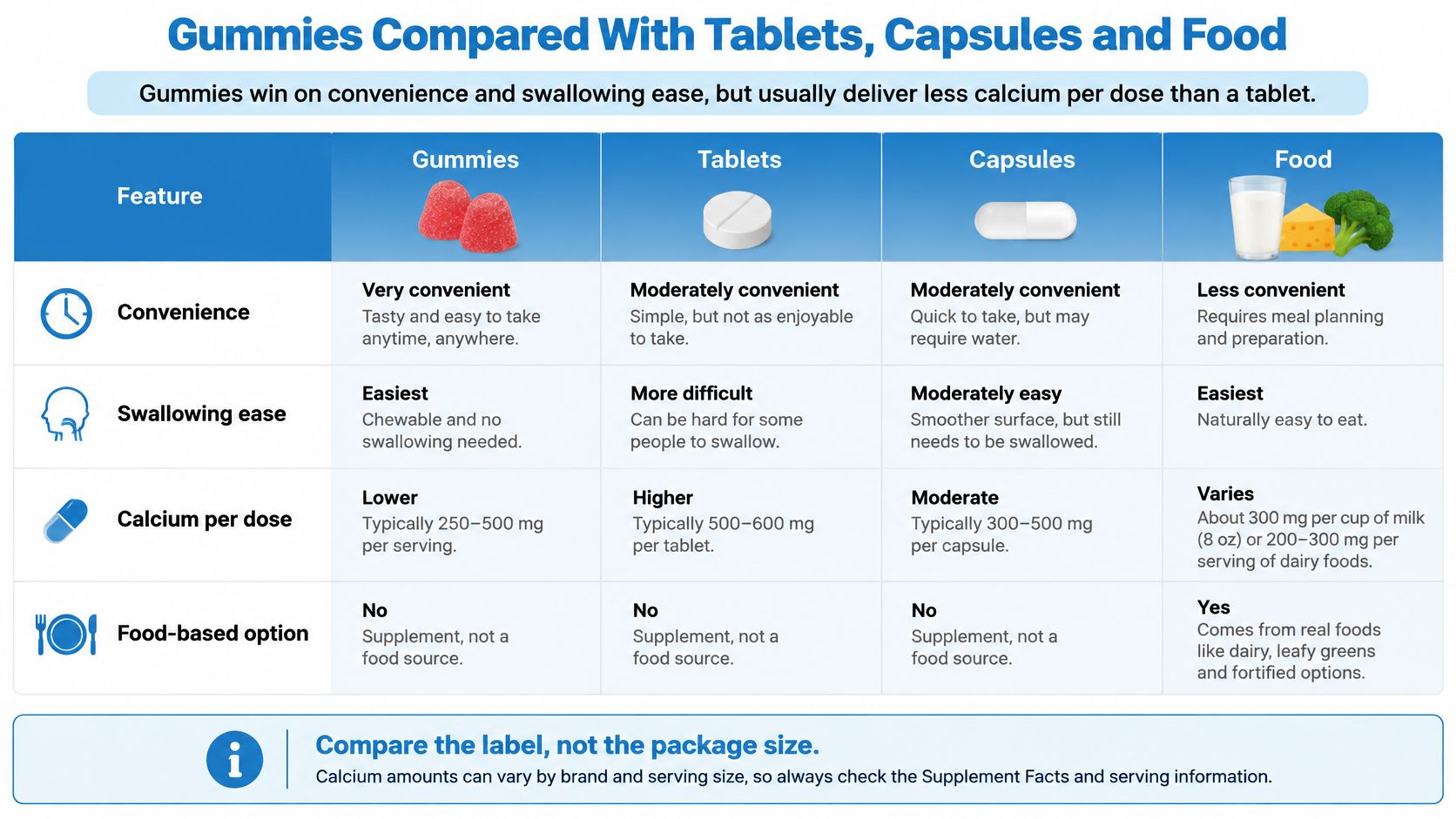
Format shapes how easy a supplement is to take. The label still decides how much it delivers, which is why the right comparison starts with milligrams and micrograms rather than taste or texture.
Calcium sources compared by form
| Form | Needs food? | Best fit | Main drawback |
|---|---|---|---|
| Calcium carbonate tablet | Yes, with a meal | People comfortable with tablets and regular meals | May cause constipation or gas |
| Calcium citrate tablet | No | People with low stomach acid or taking acid reducers | May require more tablets for the desired amount |
| Calcium and vitamin D gummy | Preferably with a meal, per the label | People who dislike swallowing pills | Fixed calcium-to-vitamin-D ratio and possible added sugar |
| Vitamin D3 liquid drops | Follow product directions | People needing vitamin D separately | Drop concentration must be checked carefully |
| Milk or fortified soy milk | Already a food | Building a food-based daily intake | Dietary suitability and fortification differ |
A single serving looks smaller once it sits next to the daily total. Two Okay Bone Support Gummies provide 35 mg of calcium, which is 4% of the daily value, along with 1,000 IU (25 mcg) of vitamin D3. Measured against a 1,000 mg daily calcium target, that serving works as a top-up: food and any other supplement already in the routine supply the rest. The fixed pairing matters too, because taking extra gummies for calcium raises the vitamin D by the same proportion.
Meal timing still applies to the gummy row. The calcium ingredient sets the rule, just as it does in a tablet or capsule, and the label states whether a meal is preferred.
The chart gives an overview; the Supplement Facts panel settles the decision.
Match the format to the situation
- Your food already covers calcium: Skip a combined supplement that duplicates what meals provide, even if it is marketed for bones.
- You dislike pills: Pick a gummy whose labeled serving matches the actual gap, rather than the strongest gummy available.
- You take acid reducers: Discuss citrate with a pharmacist, since low stomach acid changes which calcium form absorbs reliably.
- You need independent vitamin D adjustment: A vitamin-D-only product adjusts without changing calcium intake.
- You have dietary restrictions: Build on suitable fortified foods first, then check the ingredient list of any supplement still needed.
Our comparison of calcium carbonate versus citrate absorption explains how meal timing and stomach acid affect the choice.
Compare usable value
Bottle price only makes sense per nutrient, not per gummy. The method: divide the bottle price by the total labeled calcium it contains, using servings per container rather than gummy count.
A worked example keeps it honest. A 90-count bottle of Okay Bone Support Gummies at $17.69 holds 45 two-gummy servings, or 1,575 mg of calcium in all. Dividing $17.69 by that total gives the true cost per milligram, and running the same math on a tablet or capsule shows whether the pricier bottle is actually pricier per unit of calcium.
Cost per milligram never justifies excess intake. A cheap gummy that overshoots vitamin D, or a low-cost tablet supplying more calcium than needed, is poor value at any price. Food also supplies more than calcium alone, so supplements fill a measured gap rather than replace what meals provide.
Choose a Gummy You Can Verify Before You Buy
Choose the product whose labeled serving fits your calcium gap and your vitamin D plan. If matching one nutrient forces you to oversupply the other, choose a different formulation rather than multiplying servings.
A reliable buying decision starts with readable labeling and evidence you can inspect.
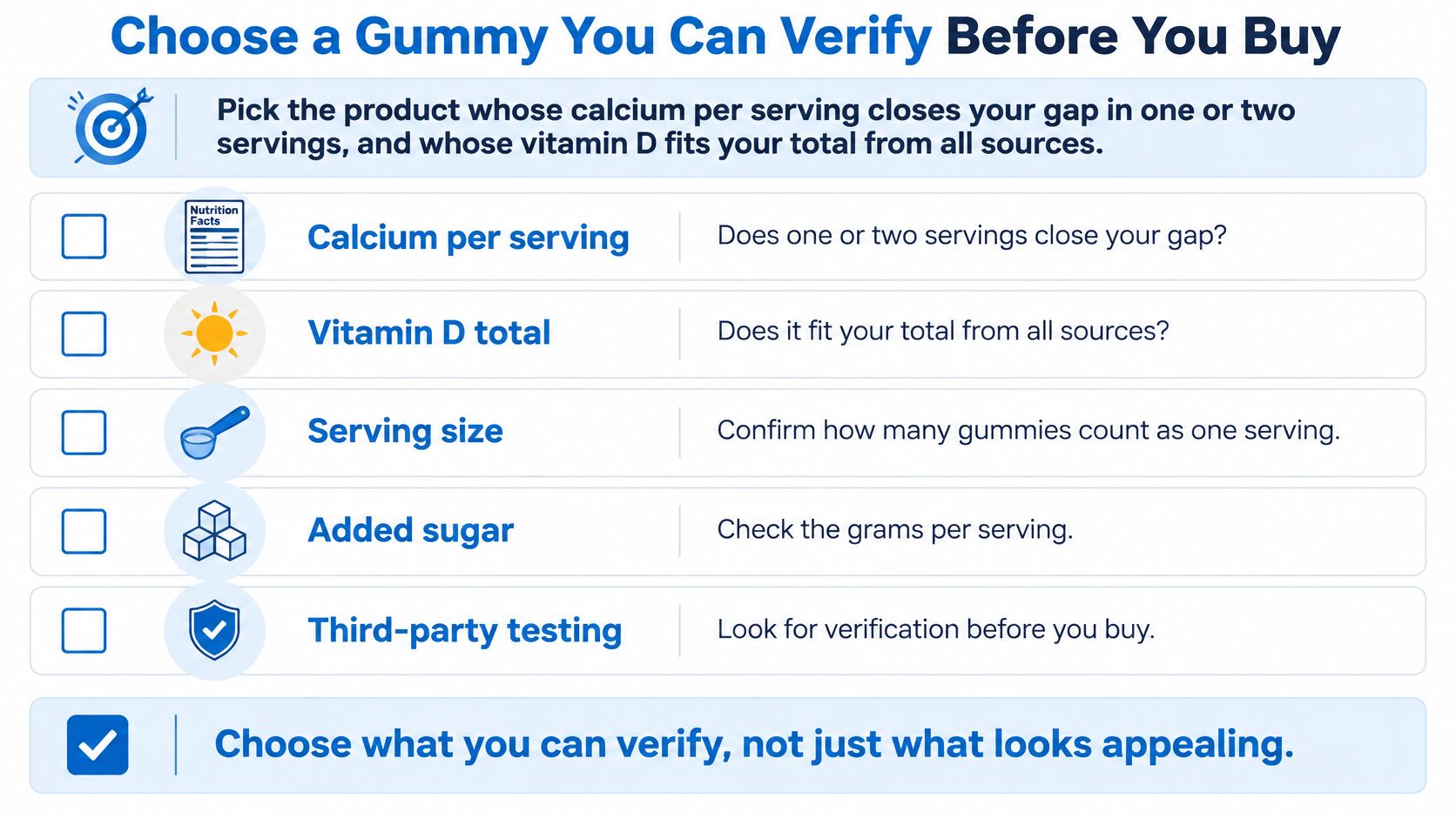
Check the label and quality evidence
- Nutrient amounts: Confirm calcium in milligrams and vitamin D in the stated units. Check whether the amount applies to a gummy or a full serving.
- Directions and quantity: Read the intended age group, daily serving, servings per container, and expiration date.
- Independent verification: Look for a named third-party verifier and check what its verification covers. A vague tested-for-quality statement isn't the same as accessible evidence.
- Lot identification: Keep the lot number available, and look for testing information that identifies the relevant product or batch.
- Manufacturing standards: GMP certification concerns manufacturing practices. It doesn't establish that the formula is the right dose for you.
Our guide to how to read a supplement label can help you distinguish nutrient amounts, serving instructions, and marketing language.
Apply that same standard to our listings. Our Okay Bone Support Gummies provide 1,000 IU (25 mcg) vitamin D3 and 35 mg calcium as dicalcium phosphate per serving of 2 gummies; the 90-count bottle is priced at $17.69. That label describes a product with a modest calcium contribution, not a replacement for a substantial dietary calcium gap.
Verify dietary fit and storage
Gelatin is animal-derived, but its suitability for a halal diet depends on its source and certification. Look for a recognized halal certification mark rather than assuming that a loose halal-friendly description settles the question.
Pectin is a plant-based gelling alternative, but gelatin-free doesn't automatically establish every other dietary attribute. Read the complete ingredient and allergen statements, including added sugars and sweeteners.
Choose what you can verify, not just what looks appealing.
Keep the bottle tightly closed and follow its storage directions. A cool, dry location away from bathroom humidity and hot cars is a sensible default, and gummies should stay out of children's reach rather than beside ordinary sweets.
Before buying, write down your proposed daily total from food, supplements, and calcium-containing medicines. Compare it with your target, check the safety ceiling, and resolve any medicine or medical-condition questions before starting.
CalVitamin offers vitamins, minerals, and gummy supplements for different daily nutrition needs. Visit CalVitamin to compare ingredient lists and labeled servings, then choose only a product that fits your written calcium and vitamin D plan.


