Recent trial evidence shows calcium supplements don't prevent fractures in community-dwelling adults. If you still need a supplement to close a dietary gap, keep each dose at 500 mg or less of elemental calcium and split larger amounts across the day.
That directly challenges the most popular advice about calcium. Many people treat a calcium bottle as automatic insurance for stronger bones, then take a large tablet once daily without checking their diet, medication schedule, or total calcium intake. That routine can be unnecessary, poorly absorbed, and harder on the digestive system.
The better approach is simple: decide whether supplementation makes sense first, identify the amount of elemental calcium you need, choose a form that fits your stomach and medicines, and then take it in divided doses. The NIH calcium guidance supports the practical 500 mg limit because absorption is best at that amount or less at one time.
Table of Contents
- Do You Actually Need a Calcium Supplement
- How Much Calcium You Need and How to Hit the Target
- Choosing the Right Calcium Form for Your Body
- Timing, Meals, and Stacking With Other Medications
- Side Effects, Safety Signals, and When to Back Off
- Special Populations and a Quick Product Selection Checklist
- Calcium Supplement FAQs Answered Quickly
Do You Actually Need a Calcium Supplement
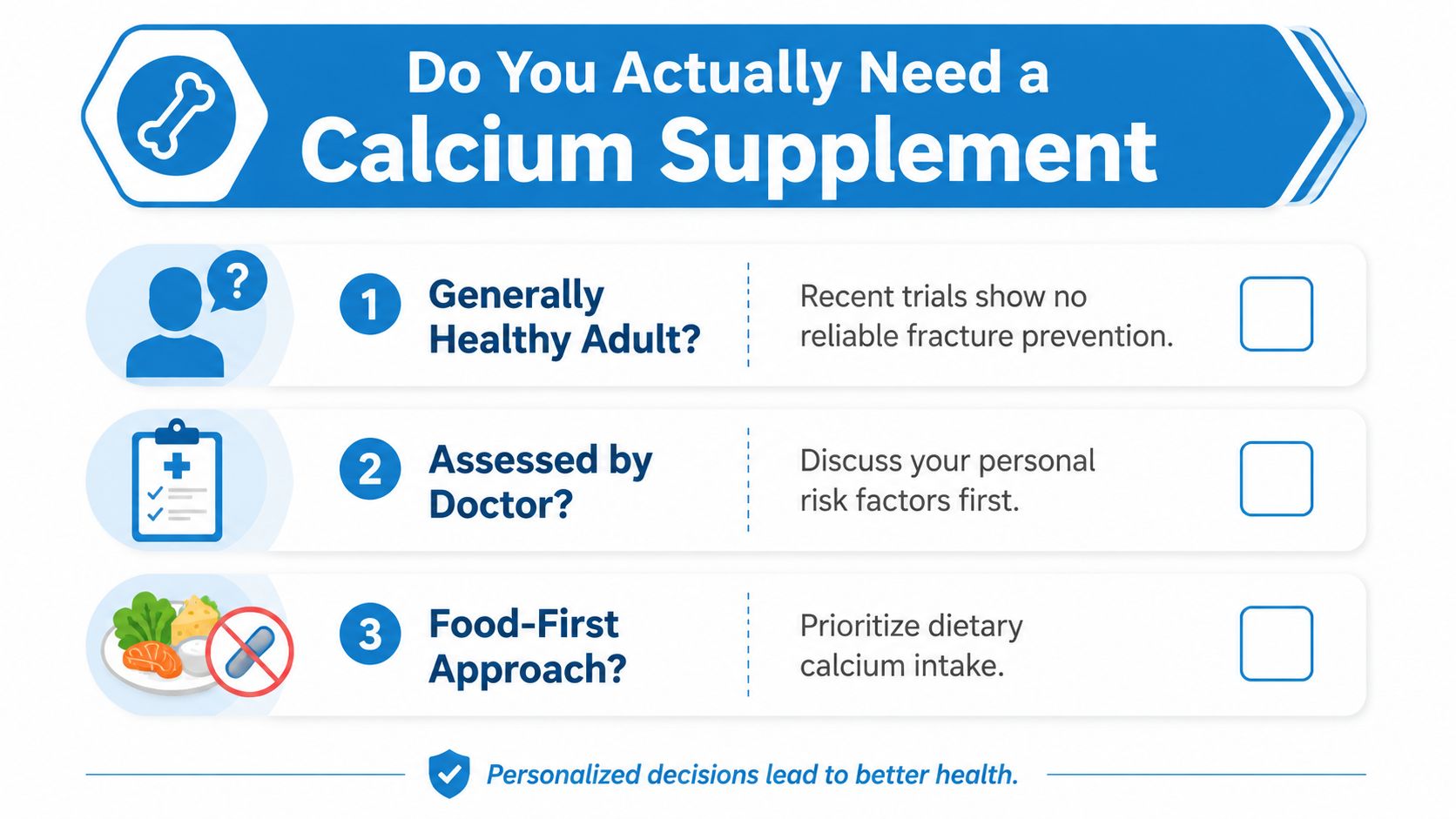
A calcium supplement isn't automatically part of healthy aging. A recent PubMed review of calcium supplementation and fracture outcomes reports that trial evidence shows calcium supplements don't prevent fractures in community-dwelling adults. The same review discusses gastrointestinal effects, kidney stone risk, and meta-analysis findings suggesting a possible 10% to 20% increase in myocardial infarction risk with supplementation.
That doesn't mean calcium is unimportant. Your skeleton stores calcium, and your body also uses the mineral for normal muscle and nerve function. It means a pill should fill a genuine shortfall, not replace a food-first diet or serve as a reflex response to getting older.
Start with your plate
Estimate your calcium intake over several typical days rather than judging it from one unusually healthy meal. Look at dairy products, calcium-fortified plant milks, tofu prepared with calcium, canned fish eaten with bones, and calcium-containing greens. Check labels on fortified foods because calcium content varies considerably between products.
Food usually offers a steadier way to consume calcium throughout the day. It also lets you assess whether a supplement would add useful calcium or push your total intake higher than necessary.
A supplement becomes more reasonable when:
- Your food intake stays low: Dietary changes haven't closed the gap.
- Your diet excludes reliable sources: Vegan, dairy-free, allergy-related, or highly restricted eating patterns can make adequate intake harder.
- A clinician identifies increased risk: Osteoporosis, a history of fragility fracture, malabsorption, or a measured dietary shortfall may change the recommendation.
- Treatment requires a measured amount: Your healthcare professional may prescribe a specific calcium and vitamin D plan alongside other bone treatment.
Ask before you add calcium
Get medical advice before supplementing if you have osteoporosis, kidney disease, kidney stones, hypercalcemia, parathyroid disease, or medicines affected by minerals. Bone density results, fracture history, menopausal status, vitamin D status, overall diet, and current prescriptions matter more than choosing a high-dose product from a shelf.
Review calcium from food, drinks, antacids, and supplements together. The number printed on the bottle is only one part of your daily intake. Vitamin D supports calcium absorption, but adding calcium isn't useful when your dietary intake and bone-health plan are already adequate.
How Much Calcium You Need and How to Hit the Target
Calcium targets refer to elemental calcium, the actual mineral supplied by the compound in a tablet. They don't refer to the total weight of calcium carbonate or calcium citrate.
For general planning, many adults use a target of 1,000 mg daily, while women at least 51 and men at least 71 use 1,200 mg daily under the guidance summarized by the NIH Office of Dietary Supplements. Adolescents need 1,300 mg daily, while younger children have age-specific needs. Pregnant and breastfeeding adults generally follow the target for their age.
Calculate food first. If meals provide most of your target, a supplement may only need to cover the remaining gap. Don't automatically take a full “daily serving” from the label if your diet already supplies substantial calcium.
Read the elemental calcium line
Calcium carbonate is about 40% elemental calcium, while calcium citrate is roughly 21%, as described in the Mayo Clinic comparison of calcium supplements. A tablet containing 1,250 mg of calcium carbonate therefore supplies about 500 mg of elemental calcium. The larger compound number isn't the dose your body uses.
Use the Supplement Facts panel, not the front of the bottle. Confirm whether the serving means one tablet, two tablets, or another quantity, then calculate the elemental calcium per tablet.
| Common supplement form | Approximate elemental calcium | Example needed for a 500 mg dose | Best use |
|---|---|---|---|
| Calcium carbonate | About 40% | A product providing 500 mg elemental calcium per serving, often based on roughly 1,250 mg of compound | Concentrated and usually economical, take with food |
| Calcium citrate | About 21% | Select the label serving that provides 500 mg elemental calcium, often requiring more compound than carbonate | Flexible timing and people who don't tolerate carbonate |
| Other calcium salts | Varies and is generally lower | Follow the elemental calcium amount on the label | Useful only when the product or clinician specifically favors that form |
Absorption becomes less efficient when a single dose exceeds about 500 mg, so split a larger supplemental target into separate doses. The NIH guidance recommends dividing a 1,000 mg supplement dose into two smaller doses rather than swallowing it all at once.
Avoid routinely exceeding the tolerable upper intake level of 2,500 mg daily for adults, or 2,000 mg daily for older adults, teens, and pregnant or breastfeeding women, from all sources. Kidney, absorption, and bone disorders require individualized advice.
Choosing the Right Calcium Form for Your Body
The useful comparison usually starts with calcium carbonate versus calcium citrate. Both are widely available and well studied, but they behave differently in the stomach and fit different routines.
Calcium carbonate contains about 40% elemental calcium, so it delivers more mineral in less compound. That makes it the practical budget choice for many healthy adults with normal digestion. Take it with food, because stomach acid helps release the calcium from the compound.
Carbonate can also be the form most likely to cause gas, bloating, constipation, or upper digestive discomfort. If you already use acid-reducing treatment or know you have low stomach acid, I wouldn't make carbonate your default.
Match the form to your routine
Calcium citrate contains about 21% elemental calcium, so you may need more tablets to reach the same elemental dose. Its advantage is flexibility. You can take it with or without food, and it doesn't depend on stomach acid in the same way carbonate does.
That makes citrate a sensible option for people using proton-pump inhibitors or H2 blockers, people with low stomach acid, and people who develop constipation or bloating with carbonate. It may also suit some people with intestinal disorders, although those conditions deserve individualized medical guidance.
| Form | Elemental calcium | When to take | Best fit and drawbacks |
|---|---|---|---|
| Calcium carbonate | About 40% | With a meal | More concentrated and often less expensive, but may worsen digestive symptoms |
| Calcium citrate | About 21% | With or without food | Flexible and often better suited to low stomach acid, but usually requires more tablets |
| Calcium lactate or gluconate | Lower and variable | Follow label directions | May be appropriate in specific products, but often supplies less elemental calcium per tablet |
| Gummy or liquid calcium | Varies | Follow label directions | Helpful for swallowing preferences, but check elemental calcium, sweeteners, and additives |
“Natural” doesn't mean superior. Coral calcium, seaweed, dolomite, and bone-meal claims don't guarantee better absorption or safety. Prefer products with transparent labeling and credible third-party testing when available, particularly for lead testing.
If you're comparing an algae-based or vegetarian product, review the label against your actual calcium gap rather than assuming the source makes it more effective. CalVitamin's NOW Red Mineral Algae Vegetarian Calcium product page is one example of a product listing to examine for form and dose details.
Timing, Meals, and Stacking With Other Medications
The most reliable routine is to keep each calcium dose at 500 mg or less of elemental calcium, separate doses by roughly 4 to 6 hours, and pair carbonate with food. The Mayo Clinic's calcium supplement guidance explains why divided doses work better. Once intestinal active transport becomes saturated, the body absorbs much less of the additional calcium.
For a 1,000 mg supplemental target, take one 500 mg dose with breakfast and another with dinner. Calcium citrate can be taken without food, but taking it with meals often makes the routine easier to remember and may improve tolerance.
Protect your medication schedule
Calcium can bind with certain medicines and reduce their absorption. Don't place it casually beside thyroid medication, iron, or particular antibiotics.
| Substance | Minimum gap from calcium dose | Notes |
|---|---|---|
| Iron supplement | 2 hours | Calcium can reduce iron absorption |
| Levothyroxine | 4 hours | Keep calcium well separated from thyroid medication |
| Quinolone antibiotics | At least 2 hours, according to prescription instructions | Follow the specific antibiotic label or pharmacist's directions |
| Tetracycline antibiotics | At least 2 hours, according to prescription instructions | The required interval can vary by medicine |
| Magnesium or zinc | Review the combined product and total mineral intake | Concurrent use may be possible, but avoid unexamined high combined doses |
Vitamin D helps the intestine absorb calcium, but don't add a high-dose vitamin D product automatically. The plan notes for this guide specify 800 to 2,000 IU of vitamin D3 as a commonly discussed range, but your dose should reflect your diet, blood results, medical history, and clinician's advice.
Oxalate-rich foods can also reduce calcium uptake when consumed together. If you rely heavily on foods such as spinach, don't count every listed milligram as equally available, and don't use a supplement to compensate without reviewing the overall diet.
Practical rule: Put calcium on the meal schedule, not the medication schedule.
For someone taking thyroid medication in the morning and a daily multivitamin containing iron, a workable routine might be thyroid medicine on waking, the multivitamin later with lunch, and calcium citrate with breakfast only if the spacing is medically appropriate, followed by a second calcium dose with dinner. Confirm the exact timing with a pharmacist, especially if the multivitamin or prescription contains additional minerals.
If you're considering a combined mineral product, check the full label before buying. CalVitamin lists a calcium, magnesium, zinc, and D3 complex, but the combined ingredients still count toward your total intake and medication-interaction review.
Side Effects, Safety Signals, and When to Back Off
The problems I see most often are practical rather than dramatic: constipation, bloating, gas, and difficulty maintaining the routine. Calcium carbonate is the usual suspect when digestive symptoms appear, especially when someone takes a large dose at once.
Start by checking the dose. More water, smaller divided doses, and taking carbonate with a meal can improve tolerance. If symptoms persist, switching to calcium citrate is a reasonable discussion with your clinician or pharmacist.
Treat kidney stone risk as personal
Supplemental calcium can increase urinary calcium and may raise kidney stone risk, while calcium from food may be protective. Your own history matters most. Tell your clinician if you've had a kidney stone, have a strong family history, or have kidney disease before starting a supplement.
The cardiovascular evidence also deserves a measured response. Meta-analyses discussed in the PubMed review of calcium supplement outcomes suggest a possible 10% to 20% increase in myocardial infarction risk, but that signal doesn't prove that every person taking calcium will experience a heart problem. It does support avoiding unnecessary supplementation and preventing excessive total intake.
Keep total elemental calcium from food and supplements within the applicable upper limit, 2,500 mg daily for adults or 2,000 mg daily for older adults, teens, and pregnant or breastfeeding women, unless a clinician gives you a specific medical plan.
Stop the supplement and seek prompt clinical advice for severe stomach pain, vomiting blood, irregular heartbeat, or painful urination with blood. Those symptoms aren't routine adjustment effects.
Special Populations and a Quick Product Selection Checklist
Postmenopausal women often need a more deliberate calcium review, but “more deliberate” doesn't mean “take a pill automatically.” A commonly used target is 1,200 mg of total calcium daily for women at least 51, including food and supplements, as summarized by the NIH calcium fact sheet. Start with meals, then supplement only the documented shortfall.
Older adults with reduced stomach acid should generally consider citrate first. Pregnant adults generally follow the calcium target for their age, and they should avoid stacking multiple products, especially prenatal formulas that already contain other nutrients.
People with chronic kidney disease or hyperparathyroidism shouldn't self-supplement. Their calcium balance can be abnormal, and the right plan may require blood testing, medication review, and specialist input.
Use this shopping checklist
- Verify testing: Look for credible third-party quality verification, such as USP or NSF marks when available.
- Check elemental calcium: Identify the actual elemental amount per tablet, not just the compound weight.
- Match the form: Choose carbonate for a food-paired, budget-conscious routine when tolerated, or citrate for low stomach acid, acid-reducing medicines, or digestive sensitivity.
- Inspect the ingredients: Favor a short, transparent ingredient list and check sweeteners in gummies or chewables.
- Compare the dose: Judge cost per 500 mg of elemental calcium, not cost per bottle.
- Ask about lead testing: Choose a manufacturer that discloses testing for contaminants, especially with mineral, coral, bone-meal, or algae claims.
A supplement is the wrong answer when your diet already supplies enough calcium or when you're trying to use calcium alone to solve a broader bone-health problem. It's also the wrong answer when kidney disease, hyperparathyroidism, recurrent stones, or medication interactions make unsupervised use unsafe.
For a chewable option, inspect the serving size and elemental calcium before purchasing. CalVitamin lists KAL high-potency calcium citrate chewables as a product example, but the same selection rules still apply.
Calcium Supplement FAQs Answered Quickly
Should I take calcium in the morning or at night
Neither time is automatically superior. Take calcium with a meal that fits your schedule, keep each dose at 500 mg or less, and separate it from medicines that interact with minerals.
Can I take calcium and magnesium together
You may be able to take them together when the product's amounts fit your needs and your clinician has no concerns. Evidence for a special absorption synergy is weak, so don't buy a combined formula solely for that promise. Review total mineral intake and medication timing instead.
What should I do if I miss a calcium dose
Skip the missed dose rather than doubling the next one. Resume your usual divided schedule, because taking a large catch-up dose works against the absorption principle covered earlier.
Is food better than a calcium supplement
Food should be the foundation whenever possible. Dairy products, fortified plant milks, tofu set with calcium, canned fish with edible bones, and selected greens can help you build intake across meals, while a supplement should close a specific shortfall rather than replace those foods.
Use the form guidance above if digestion or medication timing complicates your choice, and review the special-population checklist before starting a routine.
CalVitamin offers calcium products in different forms, including citrate options and combination mineral formulas, so you can compare elemental calcium and serving instructions against your dietary gap. Visit CalVitamin to review the labels, then discuss your choice with a clinician or pharmacist if you have a medical condition or take prescription medicines.