
You're comparing supplement stores with a dozen tabs open. The product photos look nearly identical, labels use unfamiliar blends, and every retailer promises quality. The question that matters is simpler: can this store prove what it sells, protect the product in transit, and help you if something goes wrong?
The best online supplement store isn't automatically the one with the lowest price or the largest catalog. It's the retailer that matches your health goal with clearly labeled products, meaningful verification, dependable fulfillment, and responsive support. Use the guide below to evaluate the retailer and the brand together.
| Buyer priority | What to examine first | Why it matters |
|---|---|---|
| Product safety and authenticity | Third-party certifications, testing access, batch documentation | You need evidence beyond marketing copy |
| Accurate selection | Full ingredient panels, dosage amounts, allergen details | Transparent labels make comparison possible |
| Goal fit | Category depth, formats, dietary attributes | The right product must suit your routine |
| Delivery confidence | Packaging, storage, fulfillment, shipping terms | Supplements can lose value when mishandled |
| Purchase protection | Returns, guarantees, customer service | You need recourse if the order is unsuitable |
| Reputation | Verified reviews, photos, detailed feedback | Experience can reveal operational weaknesses |
| Personal guidance | Qualified support and useful product information | Complex routines require better answers |
Table of Contents
- Why Choosing an Online Supplement Store Matters in 2026
- Seven Criteria That Separate Good Stores From the Rest
- Matching Criteria to Real Buying Scenarios
- Trust Signals and Verification You Should Never Skip
- How CalVitamin Stacks Up Against the Criteria
- Best CalVitamin Categories for Specific Buyer Needs
- Final Decision Checklist and Common Questions
Why Choosing an Online Supplement Store Matters in 2026
You order magnesium glycinate from several websites and receive very different levels of information and service. One retailer provides a full Supplement Facts panel, lot details, testing records, and storage guidance. Another shows a polished bottle, a discount, and almost no supporting detail. The ingredient name alone cannot confirm careful inventory handling or responsible customer support.
The market's size makes retailer evaluation necessary. A widely cited review places the global dietary supplements market near USD 152 billion in 2021, with longer-range projections approaching USD 300 billion to USD 308 billion by 2028, at roughly 8.9% CAGR, as reported in this peer-reviewed market review. That scale gives shoppers more choice, while also creating more opportunities for inconsistent sourcing, confusing claims, and weak oversight.
Three avoidable purchase failures
Start by identifying the problems a store must help you avoid:
- Poor storage or old inventory: Heat, moisture, and extended warehouse time can reduce confidence in powders, oils, gummies, and other products with specific handling needs.
- Unclear or inaccurate dosing: Proprietary blends, incomplete panels, and vague serving directions make the actual intake difficult to assess.
- No meaningful recourse: If an item arrives damaged, differs from its listing, or does not suit your needs, an unclear return process leaves you responsible for the loss.
Retail selection shapes more of the purchase than the brand label suggests. The store may decide which inventory ships, how products are packed, what details appear beside the listing, and whether someone answers your question clearly.
Practical rule: Evaluate the retailer first, then evaluate the individual brand. A reputable manufacturer still needs a retailer that describes products accurately and fulfills orders properly.
The FDA's cGMP compliance guide for dietary-supplement businesses separates responsibilities across manufacturing, packaging, labeling, holding, retail, and storage operations. That distinction matters online. A storefront's existence does not prove that every product has the same documentation, handling, or oversight. For more context on the company and its operating approach, review CalVitamin's company information.
Testing and label transparency deserve more weight than decorative merchandising. Shipping, returns, reviews, and support show whether the retailer can deliver the product responsibly and help resolve problems after purchase.
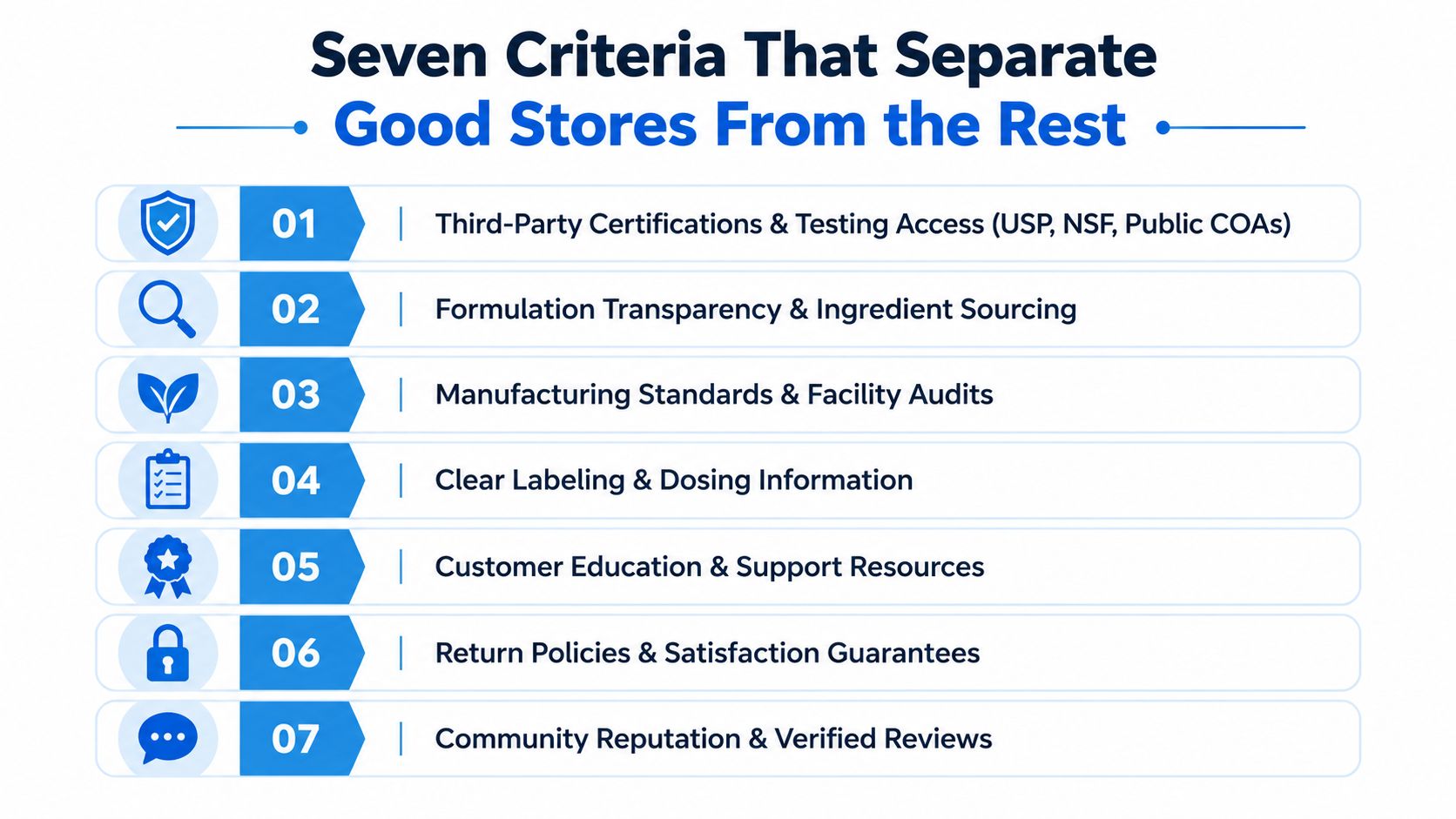
Seven Criteria That Separate Good Stores From the Rest
A strong store passes several filters at once. Don't give every feature equal weight. A beautiful website can't compensate for missing testing access, and a low price can't fix an incomplete label.
1. Third-party certifications and testing access
Look for recognizable programs such as USP, NSF, or Informed Sport, plus access to public or batch-specific Certificates of Analysis. A strong signal is a certification icon that links to an explanation or verification record, not a badge placed beside an unsubstantiated claim. A weak signal is “tested for purity” without the laboratory, method, batch, or document.
2. Formulation transparency
The product page should show the complete ingredient panel, amounts per serving, serving size, allergens, and relevant excipients. Avoid products that hide meaningful quantities inside proprietary blends. Transparent labeling tells you whether the formulation fits your goal, diet, medication considerations, and tolerance.
3. Product range and category depth
Assortment matters when it helps you shop intelligently. A useful store offers single ingredients as well as blends, and provides practical formats such as capsules, powders, liquids, and gummies. Depth across sports nutrition, cognitive products, herbal formulas, probiotics, minerals, or pet supplements can reduce the need to combine information from multiple retailers, but breadth should never outrank verification.
4. Shipping, packaging, and reach
Check where orders ship from, how products are protected, whether tracking is provided, and whether the retailer serves your location. Packaging should suit the product. A leaking liquid, crushed container, or heat-exposed shipment deserves a clear resolution path.
5. Returns and guarantees
Read the actual policy, including the treatment of opened bottles, damaged orders, subscription purchases, and sale items. “Satisfaction guaranteed” is useful only when the store explains the process, eligibility, timeframe, and refund method.
6. Verified reviews and reputation
Star ratings are a starting point, not proof. Prioritize reviews marked as verified purchases, detailed comments about packaging and delivery, and customer photos that show the received item. Repeated complaints about missing seals, stale products, or unresponsive support deserve more attention than a handful of enthusiastic one-line reviews.
7. Support quality
A good support team can answer questions about ingredients, formats, order status, and returns without making medical promises. Stores that identify qualified staff, offer phone or live-chat support, and provide useful written product information create a stronger buying environment than stores that leave every question to the customer.
Treat these criteria as a sequence. Verify the product, understand the formulation, confirm the store can deliver it, then assess the protection you receive after checkout.
Matching Criteria to Real Buying Scenarios
The right evaluation standard changes with the purchase. An athlete buying a tested performance product shouldn't use the same priority order as a parent choosing household essentials or a buyer comparing a complex nootropic stack.
| Evaluation criterion | Scenario A: Competitive Athlete | Scenario B: Family Daily Essentials | Scenario C: Biohacker Stack |
|---|---|---|---|
| Third-party certifications and testing access | Highest priority, especially sport-focused screening | High priority for routine products | High priority for identity and purity evidence |
| Formulation transparency | Highest priority for active amounts and banned-substance concerns | Highest priority for allergens and household suitability | Highest priority for exact doses and ingredient combinations |
| Product range and category depth | High for creatine, electrolytes, and beta-alanine | Moderate, focused on practical essentials | Highest, especially nootropics, adaptogens, and amino acids |
| Shipping, packaging, and reach | High because training routines depend on availability | High for dependable replenishment | Moderate, unless products require special handling |
| Returns and guarantees | Moderate, with attention to opened products | High because several household users may test fit | Moderate, with caution around opened specialty items |
| Verified customer reviews | High, especially for mixability, taste, and delivery | High for usability and packaging | High for tolerability and product consistency |
| Support quality | High when staff understand sports products | Moderate, with clear general guidance | Highest because stacking questions need careful answers |
Scenario A, the competitive athlete
An athlete sourcing creatine, electrolytes, and beta-alanine should put testing access and formulation clarity ahead of discount depth. Look for sport-specific certification references such as Informed Sport or BSCG, then verify the exact product and serving information. Reviews can help with mixability and packaging, but they don't replace laboratory documentation.
Scenario B, the household buyer
For a parent choosing a multivitamin and vitamin D, the label deserves the most attention. Check allergens, dosage amounts, serving directions, and format preferences before comparing prices. A clear return policy matters because household suitability may not be obvious until the product is inspected.
Scenario C, the biohacker
A buyer assembling nootropics, adaptogens, and targeted amino acids needs category depth without losing control of the stack. Exact ingredient amounts, accessible testing records, and support that can explain product attributes are more useful than a generic “performance” label. Don't treat a broad catalog as permission to combine products casually. If your routine involves medication, a medical condition, or uncertain interactions, ask a qualified clinician before adding it.
Trust Signals and Verification You Should Never Skip
Trust infrastructure is visible in the details a store chooses to publish. The strongest retailers make it easy to move from a product listing to evidence about identity, potency, manufacturing, and batch quality. They don't ask you to treat a colorful badge or a confident claim as proof.
NSF Certified for Sport is relevant to athletes because the program addresses sport-product screening and manufacturing controls. USP Verified can provide evidence related to ingredient identity, purity, potency, and manufacturing quality. Informed Sport or Informed Choice focuses on screening relevant to sports products. A GMP facility registration or audit signal supports manufacturing discipline, but none of these certifications automatically proves that every product on a retailer's website carries the same certification.
How to inspect a COA
A Certificate of Analysis should identify the product and the tested batch. Before buying, look for:
- Batch identity: The lot or batch number should connect the document to the product you receive.
- Active ingredient identity: The report should indicate that the declared ingredient was identified.
- Potency: Results should relate to the labeled amount or an explained specification.
- Heavy metals: The document should show whether relevant contaminants were tested and how results compare with limits.
- Microbial results: Products vulnerable to microbial contamination should have relevant testing information.
- Laboratory details: Independent laboratory information, methods, dates, and accreditation details make a report more credible.
Independent lab testing adds a layer beyond a manufacturer's internal quality assurance. In-house QA can be valuable, but the buyer should be able to distinguish the two. Country-of-origin and allergen disclosures also matter because they help you assess dietary fit and sourcing transparency.
Open-comment reviews are easy to create and difficult to interpret. Verified-purchase reviews with photos, specific product observations, and consistent delivery feedback provide more useful operational evidence. They still don't establish purity or potency, but they can reveal broken seals, poor packaging, or inaccurate listings.
Missing lot numbers, vague sourcing language, and unverifiable proprietary blends are reasons to pause, not details to overlook.
Finally, read the retailer's refund and return policy before placing an order. A clear policy doesn't prove product quality, but it shows whether the store has explained your options if the purchase fails.
How CalVitamin Stacks Up Against the Criteria
CalVitamin's stated operations can be assessed against the same buyer framework rather than treated as a standalone recommendation. The retailer is based in Jacksonville, Florida, lists US support information, and sells supplements and wellness products across conventional and specialized categories.
| Evaluation criterion | What to look for | CalVitamin coverage |
|---|---|---|
| Third-party certifications and testing access | Visible certification details and product-level evidence | Product listings display specifications and certification icons where available; verify the specific item before purchase |
| Formulation transparency | Ingredient panels, amounts, allergens, and attributes | Product pages present ingredient and product information; shoppers should review each label |
| Product range and category depth | Multiple categories, ingredients, formats, and specialty needs | Vitamins, minerals, proteins, probiotics, herbal formulas, sports blends, sexual wellness, beauty, and other wellness categories |
| Shipping and packaging | Clear fulfillment location, shipping terms, and order support | US-based presence and customer support channels are listed; confirm current delivery terms for the order |
| Returns and guarantees | Accessible terms, eligibility, and opened-product handling | Returns and refund information is published for shoppers to review before checkout |
| Verified customer reviews | Ratings, detailed feedback, and purchase context | Product pages show ratings and customer reviews where available |
| Support quality | Phone, email, live chat, and usable account tools | Toll-free phone support, email support, live chat availability, accounts, wish lists, and advanced search are presented |
What the catalog enables
The store covers vitamins, minerals, proteins, probiotics and prebiotics, herbal extracts, sports nutrition, sexual wellness, beauty, and ingredient-focused products. Formats include capsules, veggie capsules, liquid shots, gummies, and powders. That range supports different swallowing preferences, dietary choices, and routine designs, but the format itself isn't evidence of quality. Review the label, serving information, and any certification details on the individual listing.
Pricing is displayed through special-price and “as low as” structures, which can help shoppers compare promotional or quantity-based value. The practical trade-off is that a low displayed price shouldn't distract from shipping terms, ingredient disclosure, or return eligibility. CalVitamin also provides customer accounts, wish lists, advanced search, featured products, and a blog, which can make repeated shopping more organized.
The store's breadth is most useful when you already know your shopping goal. If you need proof of a particular certification, a batch document, or advice about combining products, check the listing and ask support directly rather than assuming catalog depth answers the question.
Best CalVitamin Categories for Specific Buyer Needs
A store becomes easier to evaluate when you start with a concrete routine. Don't browse every aisle at random. Choose the department that matches your goal, then apply the same label and verification standards to the products inside it.
The beginner building a daily foundation
A first-time shopper will usually benefit from a focused path through multivitamins, vitamin D3 and K2, magnesium, and omega-3 categories rather than a crowded stack. Compare serving sizes, ingredient amounts, capsule or gummy formats, and allergen information. If you prefer to avoid gelatin or follow a specific dietary standard, use the product attributes shown on the listing, then confirm the label before checkout.
The CalVitamin vitamins, supplements, and nutrition department brings these broad needs into one shopping environment. That convenience helps with comparison, but it doesn't remove the need to check product-level details.
The fitness-focused buyer
A training routine calls for a different route. Explore protein powders, creatine, pre-workout formulas, BCAAs, and recovery electrolytes, then compare active amounts, flavor or format, stimulant disclosures, and mixing instructions. Athletes should place sport-focused testing access above a flashy performance claim, especially when product screening matters to competition eligibility.
A protein product also deserves context. People with kidney disease or other relevant health conditions should discuss protein intake and supplement use with a clinician or registered dietitian, as explained in the American Kidney Fund's protein guidance. The product aisle can't determine an individual's safe intake.
The targeted-wellness shopper
For a narrower goal, browse sleep support, adrenal or adaptogenic blends, joint formulas, and metabolic or cellular-health categories. These products often combine several ingredients, so full dosing information becomes especially important. Avoid choosing solely from the front-of-package promise. Check the complete panel, serving directions, allergens, and available testing details.
If you take medication or manage a condition, ask a qualified professional about interactions before building a targeted routine. A retailer can provide product information and order support, but it shouldn't replace individualized medical advice.
Final Decision Checklist and Common Questions
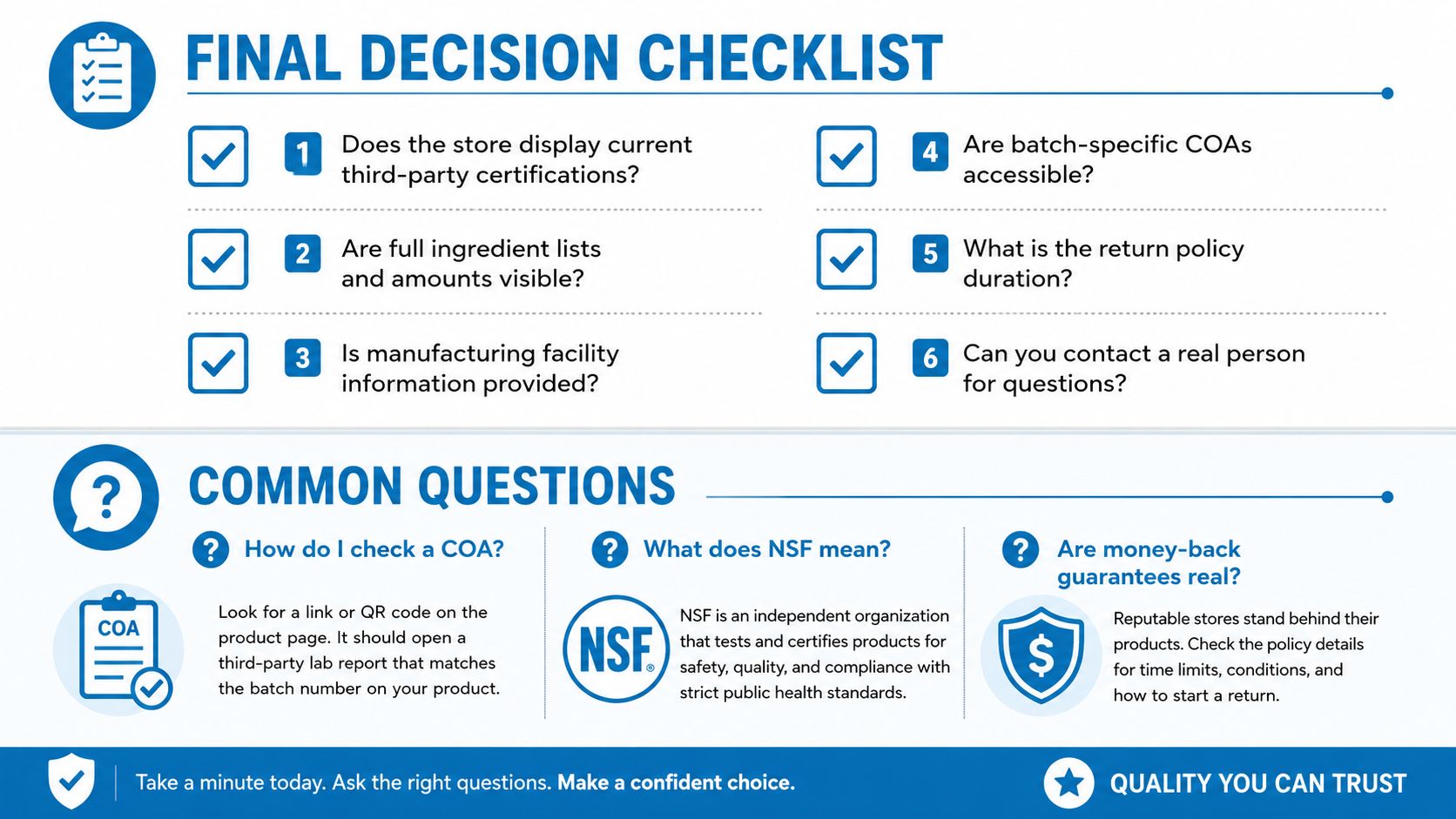
Before paying, verify the store and the exact product against these points:
- Certification evidence: Does the retailer display current third-party certifications or clear testing information?
- Complete label: Are every ingredient, amount, serving size, and allergen listed plainly?
- Manufacturing information: Can you find relevant GMP or facility-quality details?
- Batch documentation: Is a product-specific or batch-specific COA available and understandable?
- Purchase protection: Are shipping, opened-product returns, refunds, and guarantees explained?
- Real support: Can you reach a person through a practical support channel?
- Goal fit: Do the product's format, dose, dietary profile, and formulation match your routine?
- Review quality: Do reviews include verified-purchase context, photos, or useful delivery details?
Common questions
Are online supplement stores safe?
Some are, but safety depends on retailer transparency, product documentation, accurate labels, fulfillment practices, and customer recourse. An online storefront alone proves little.
How can I spot a counterfeit?
Compare the delivered item with its listing, inspect seals and lot information, and contact the retailer if the packaging or label differs. Missing batch details or unexplained discrepancies are reasons to avoid the product.
Which certifications matter?
Choose certifications that match your purpose. Athletes may prioritize sport-focused screening, while general shoppers should review evidence for identity, potency, purity, and manufacturing quality.
Are subscriptions worth it?
A subscription can simplify repeat purchases when the product suits you and the price, cancellation rules, and shipment timing are clear. Test the product and read the terms before subscribing.
How do returns work?
Policies often differ for opened supplements and sale items. Read the written terms before ordering, and keep your order information if support becomes necessary.
CalVitamin offers an online selection covering vitamins, minerals, proteins, probiotics, herbal formulas, sports nutrition, sexual wellness, and multiple dosage formats. Use the checklist to compare the exact product information, verification signals, shipping terms, and return conditions, then visit CalVitamin based on your specific goal.






