

Chicken bone broth powder is dehydrated simmered chicken-bone broth, and a prepared cup typically supplies about 5–10 grams of gelatin-derived protein. It isn't a meaningful calcium or magnesium supplement, and treating every scoop as a standardized collagen supplement is a mistake.
The useful question isn't how impressive the dry powder sounds. It's what ends up in the cup you drink. The amount of powder, the water you add, and whether you finish the whole serving determine how to interpret the label.
There's an important distinction: adding water lowers the concentration of protein, sodium, and any contaminants, but it doesn't remove them. Drink the entire mixture, and you'll consume the same total amount from that scoop.
Table of Contents
- What Chicken Bone Broth Powder Really Is
- Collagen Amino Acids and Realistic Benefits
- How to Mix and Cook with the Powder
- Everyday Uses from Soup to Sip
- Quality Checks Before You Buy
- Store It Safely and Choose Wisely
What Chicken Bone Broth Powder Really Is
Chicken bone broth powder starts as liquid broth. Manufacturers extract material from chicken bones and associated tissues, strain the liquid, concentrate it, and remove water to make a convenient dry ingredient.
Harvard's Nutrition Source describes simmering bones, sometimes with a little vinegar, for approximately 4–24 hours, and estimates that a typical cup supplies 5–10 grams of protein, primarily from gelatin. It also reports that studied homemade and commercial broths supplied less than 5% of the recommended daily allowance for calcium and magnesium.
What a prepared serving supplies
| Form | Protein | Minerals and contaminants | How to read it |
|---|---|---|---|
| Prepared bone broth, a cup | Primarily gelatin-derived protein; use the broth range above as context | Not a substantial calcium or magnesium source in the studied broths | Culinary protein, not a mineral pill |
| Chicken bone broth powder | Dehydrated broth protein; the labeled scoop determines the amount | Drying concentrates extracted solids, without establishing a verified mineral dose | Compare the amount in your finished cup, not per dry gram |
| Hydrolyzed collagen peptides | A declared collagen dose when the label specifies it | Not a broth mineral source | A supplement ingredient, not instant soup stock |
| Meat-only chicken broth | Not equivalent to a collagen-focused product | Bone-derived and meat-only broths aren't interchangeable for contaminant assessment | A flavor base, not a standardized collagen product |
The table is a framework, not a substitute for a particular jar's nutrition panel. A lightly dosed seasoning powder and a concentrated broth powder can both make a savory drink while delivering quite different amounts of protein.
Why the scoop isn't the serving
Drying removes water, not uncertainty about composition. Bone selection, acidity, extraction temperature, cooking time, and processing affect what manufacturers recover. A scoop's weight therefore can't tell you its protein content without a nutrition label.
Also separate serving amount from serving concentration. Mix a labeled serving into a larger mug and finish it, and you've still consumed the labeled protein and sodium. Divide that same mixture between several people, and each person receives only a share.
Practical rule: Write down the powder amount and finished liquid volume together. Neither tells you enough on its own.
The same caution applies to claims about purity. In the small comparison summarized by Harvard, chicken-bone broth contained three times more lead than meat-only chicken broth. That's a reason to examine testing, not evidence that every powder is unsafe.
Choose your comparison unit before comparing brands: a finished cup at the manufacturer's stated mixing ratio is usually more useful than a dry teaspoon. If you prefer stronger broth, assess the extra powder you use rather than the lighter preparation pictured on the package.
Collagen Amino Acids and Realistic Benefits
Collagen-derived protein has a distinctive amino-acid profile. Chicken bone broth powder can supply those building blocks, but that doesn't make it interchangeable with meat, whey, or a measured collagen peptide supplement.
The infographic highlights the collagen-associated amino acids. Its references to joints and skin describe areas of interest, not proven outcomes from an ordinary cup of broth.
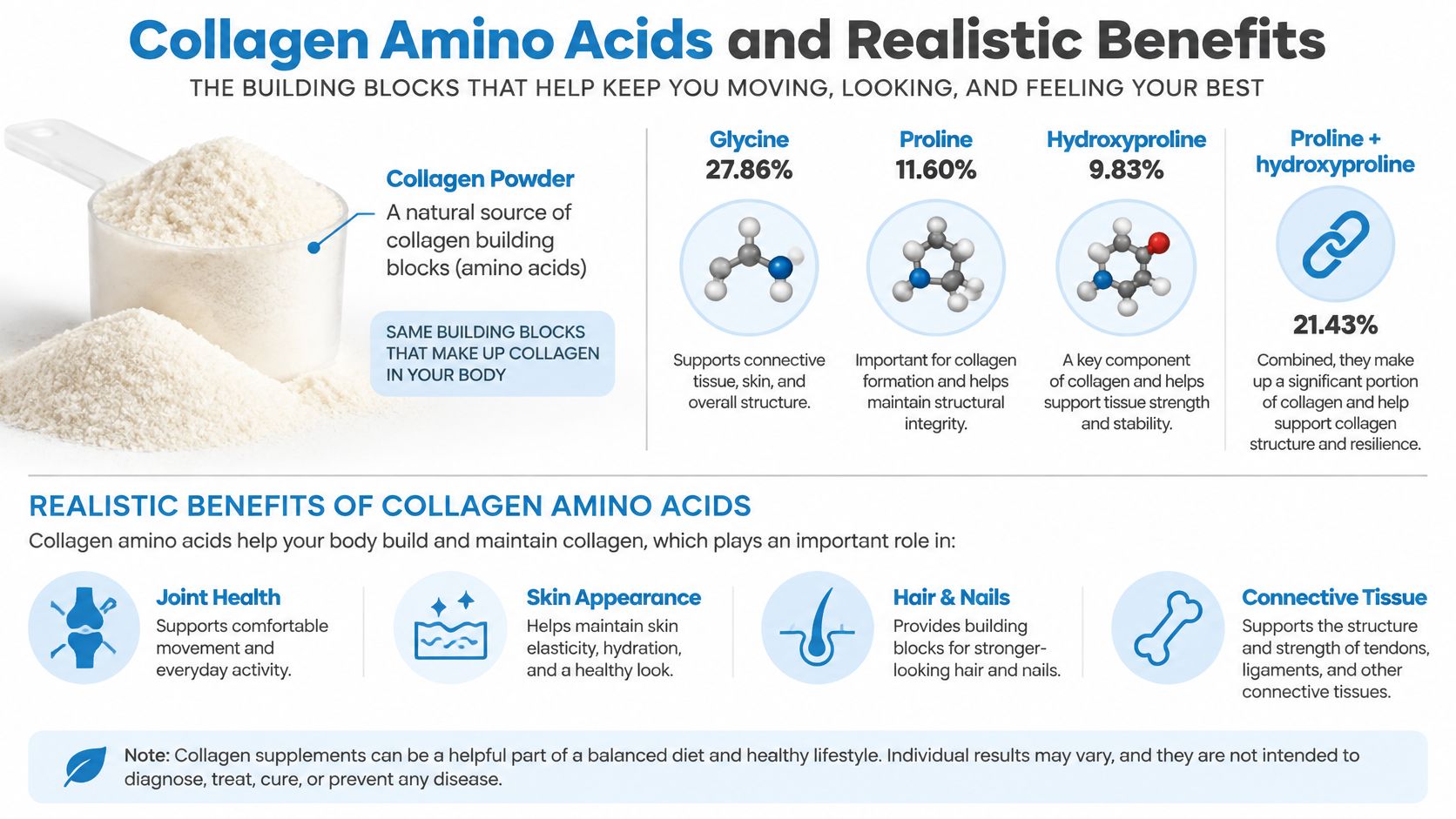
A 2022 study of chicken bone collagen peptides measured the following amino-acid shares, including 27.86% glycine and 21.43% combined proline and hydroxyproline.
Amino acids measured in chicken bone collagen
| Amino acid | Share of measured amino acids | Why it matters |
|---|---|---|
| Glycine | 27.86% | Nearly three-tenths of the measured profile, characteristic of collagen |
| Proline | 11.60% | A prominent collagen-associated amino acid |
| Hydroxyproline | 9.83% | A signature collagen amino acid |
| Alanine | 9.61% | A major nonessential amino acid in the sample |
| Glutamic acid | 9.14% | Present in the sample, but not a collagen signature by itself |
| Arginine | 5.22% | A smaller measured share than glycine or proline |
| Lysine | 3.15% | Doesn't establish equivalence to a complete protein |
These percentages describe the analyzed collagen sample, not the composition of every retail scoop. You can't multiply a scoop's total weight by the glycine percentage and assume you've calculated your glycine intake. The scoop may also contain salt, fat, seasonings, or other ingredients.
Protein quantity isn't protein quality
Cleveland Clinic's bone broth guide gives a general cup approximately 9 grams of protein and 450 milligrams of sodium. Neither figure guarantees what a specific powdered product will supply.
For muscle-focused meals, collagen has a less suitable amino-acid profile than complete proteins such as chicken or whey. An athlete or older adult shouldn't treat a mug of broth as a direct replacement for the protein anchor of a meal. Add it to a meal for flavor and additional protein rather than asking it to do everything.
The distinction between collagen types can also cause confusion. Our guide to collagen types and their differences helps explain the terminology, but a collagen type name still doesn't establish a dose or a clinical result.
What benefits can you reasonably expect?
The clearest benefits are practical: a shorter preparation time, savory flavor, and gelatin-derived body. These are useful reasons to keep the jar in the cupboard.
The Children's Hospital of Philadelphia discussion of therapeutic broths doesn't establish ordinary bone broth as a treatment for gut, joint, skin, immune, or detoxification outcomes. Findings about particular collagen supplements shouldn't automatically become claims about a differently formulated broth powder.
For a visual explanation alongside the label discussion, the following video provides additional context.
If the label doesn't state collagen grams per prepared serving, don't assume a supplement-level dose. Even a declared dose needs to match the formulation and purpose you're evaluating.
How to Mix and Cook with the Powder
Start with the manufacturer's powder-to-water ratio, not a universal tablespoon recommendation. Scoops differ, and a heaped spoon can make both your flavor and your nutrition calculations unreliable.
The basic method is simple, but your jar's directions take precedence over generic mixing advice.
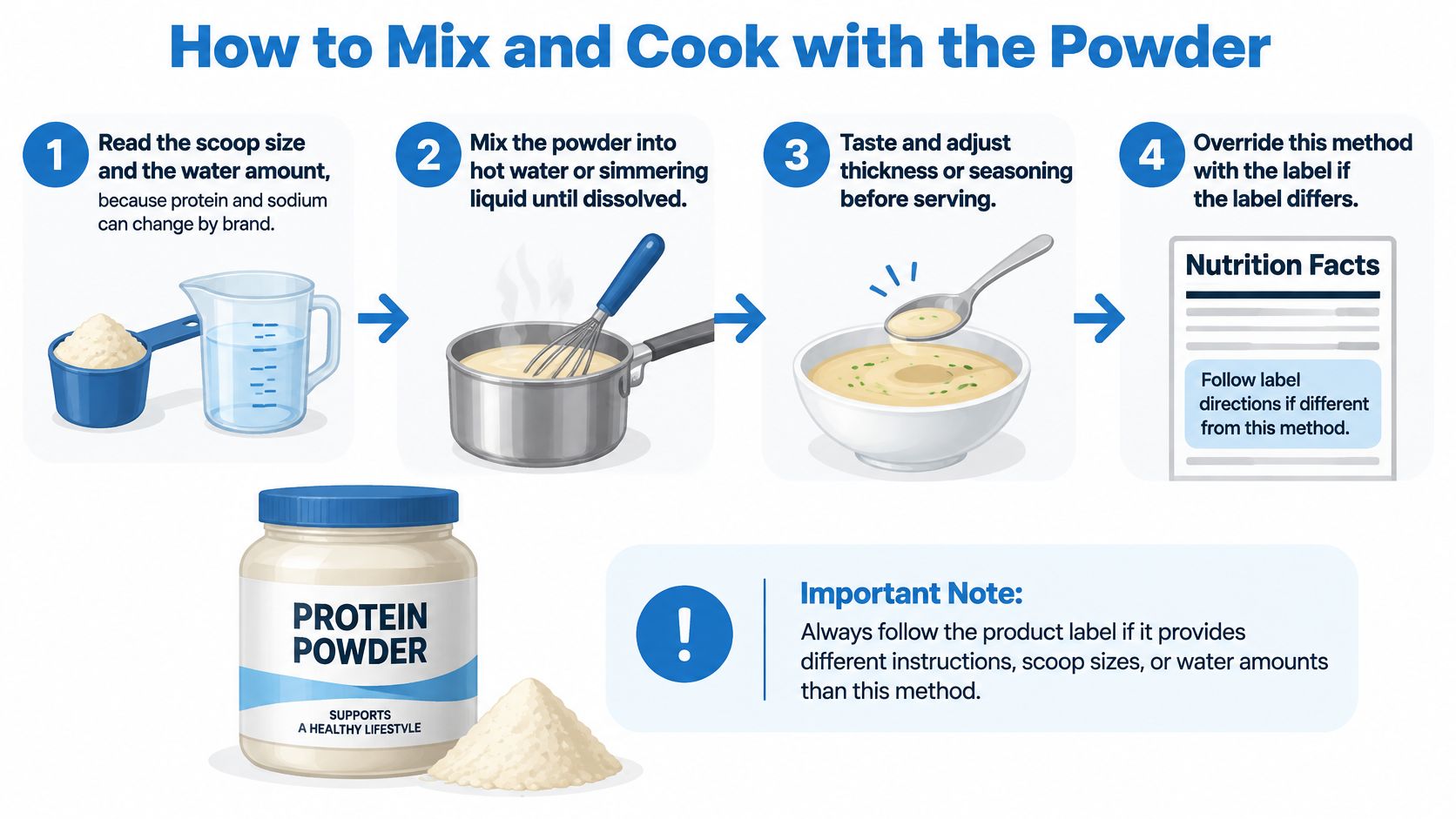
Read the serving instructions before heating water. Find the powder weight, the suggested water amount, and whether the nutrition panel describes dry powder or prepared broth. Use a kitchen scale when the manufacturer provides a gram weight and your scoop is missing.
Heat the stated amount of water in a kettle or saucepan. Steaming water is a practical starting point unless the manufacturer specifies otherwise; you don't need to keep the mixture at a rolling boil to dissolve it.
Add powder gradually while whisking. A small whisk works well in a measuring jug, while a spoon can press stubborn lumps against the side of a mug. Avoid dumping a compact heap onto the surface and expecting it to dissolve untouched.
Let the mixture stand briefly, then stir again. Some products need extra mixing to distribute fat or hydrated particles evenly. Don't assume a little sediment means the jar has failed.
Taste before adding salt. Adjust pepper, herbs, ginger, or lemon first if the broth needs interest rather than more salt. If you add extra powder for body, count that as extra product consumed.
For soup, dissolve the powder in hot liquid before stirring it through the pot. Adding it near the end makes seasoning easier to control and avoids unnecessary reduction after you've already adjusted the taste.
For gravy, rice dishes, or a skillet sauce, make a smooth concentrate with hot water first. Stir that into the dish so you don't leave dry pockets trapped in starch or thickened sauce.
Portion leftovers and refrigerate promptly. Once hydrated, the product is perishable broth, not shelf-stable powder. Use clean containers rather than leaving the remainder in a warm saucepan.
Fix the texture without losing track of the serving
A strong gel after chilling can reflect a gelatin-rich mixture or a concentrated preparation. It isn't, by itself, proof of spoilage or proof of superior nutrition.
A weak-tasting cup may be over-diluted, but check the ingredient list before adding more. A broth-only powder can taste less intensely seasoned than bouillon even when it supplies more protein.
Our guide to mixing protein powder offers additional help with clumps and texture. For chicken broth, keep the flavor of the final dish in mind: unseasoned doesn't necessarily mean flavorless.
More water makes a lighter cup. It doesn't cancel the sodium in the powder you've already added.
Finish with a yield check. If you've prepared a batch, divide its total labeled nutrients by the portions you serve, not by the number of mugs you hoped it would fill.
Everyday Uses from Soup to Sip
On a workday afternoon, a mug of chicken bone broth can be a savory alternative to another coffee. Use a labeled serving, add black pepper or sliced ginger, and treat it as a drink alongside food rather than a complete meal.
At dinner, the same prepared broth can become the liquid for couscous. Or use it to loosen the browned bits in a skillet after cooking chicken, then finish the sauce with lemon and parsley. The powder earns its place by making a small cooking task easier.
Give the jar a job in an actual meal
- Noodle soup: Add dissolved broth powder to a pot with noodles, shredded chicken, and vegetables. Taste the completed soup before adding soy sauce or another salty condiment.
- Congee: Stir prepared broth into the rice as it cooks, or use it to loosen leftover congee during reheating. A plain powder gives you more control over the final seasoning.
- Beans: Add dissolved powder near the end of cooking when you want savory depth. Check the beans' existing seasoning first, especially if they're canned.
- Mashed potatoes: Replace some of the usual liquid with prepared broth. Add it gradually so the potatoes don't become loose.
- Quick gravy: Deglaze a pan with prepared broth, then thicken as your recipe requires. The broth adds flavor, but it doesn't automatically replace the thickener.
A cook seeking only flavor might use a lightly seasoned powder where a bouillon cube would otherwise go. Someone seeking a defined collagen intake has a different task and shouldn't keep increasing the broth dose until the meal tastes excessively salty.
Make convenience work beyond the kitchen
For office lunches, carry dry powder in a clean, tightly sealed container and add water when you're ready to eat. For camping, protect the container from rain, condensation, and wet utensils.
Batch preparation can also help with weekday cooking. Chill prepared broth in portions suited to your usual soup or sauce, rather than repeatedly opening and reheating a large container.
Sweet baking is a less forgiving destination. Even an unseasoned chicken powder can leave a savory note in smoothies or desserts, so test a small portion before committing the whole recipe.
A sustainable routine is one you'll use: a mug when you want something savory, broth for a grain dish, and a pan sauce later in the week. There's no nutritional requirement to turn every meal into a broth opportunity.
Quality Checks Before You Buy
Read the back label before the front-of-pack claims. Serving size, ingredients, and the prepared amount tell you more than a large collagen claim beside a picture of chicken bones.
The checklist below provides a quick visual scan. Its typical broth reference isn't a promise about any particular brand.
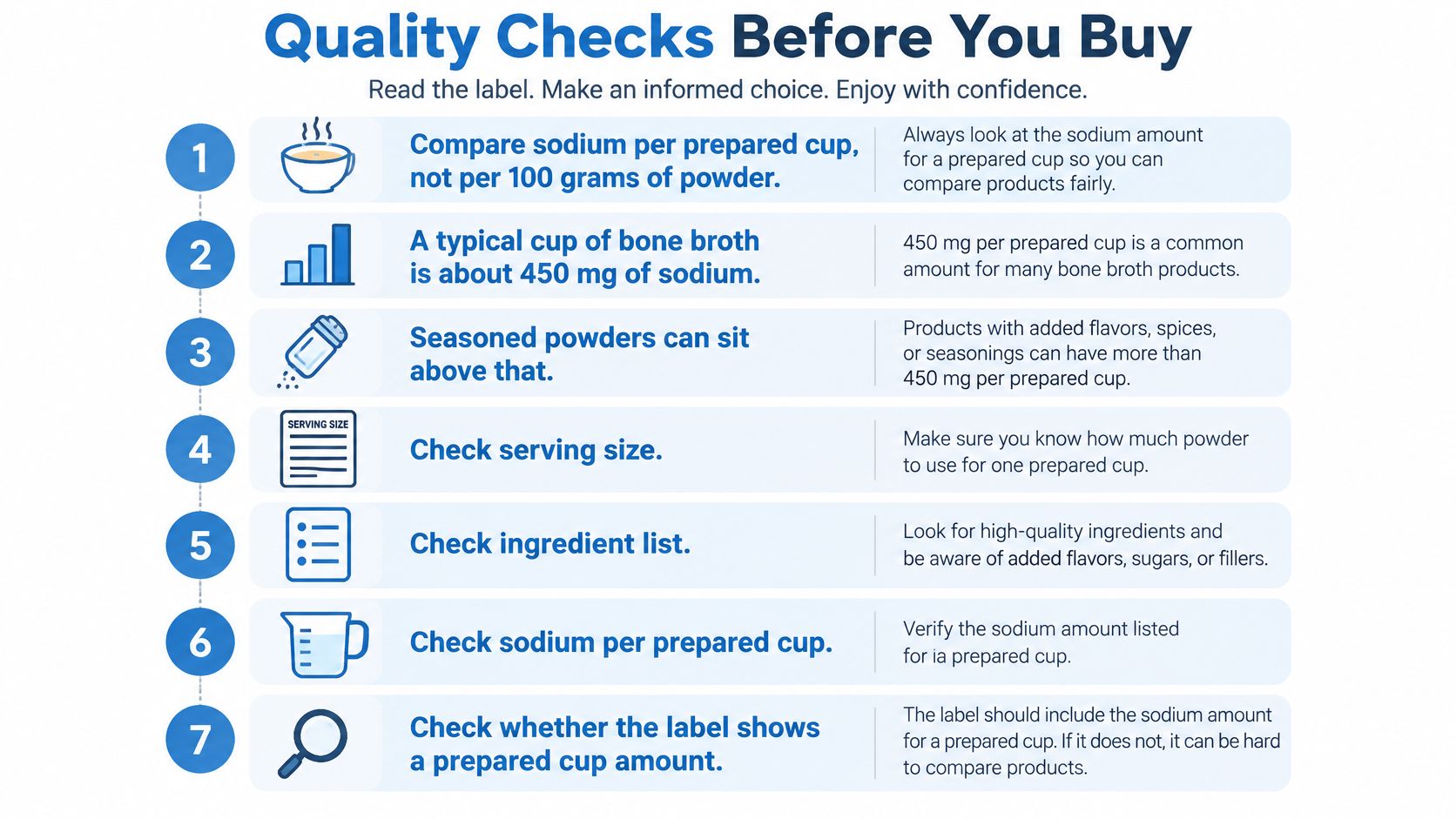
An analysis of minerals and metals in chicken and beef bone broths illustrates why mineral content and contaminant exposure need product-specific assessment: extraction conditions affect what enters the broth. A generic claim about bones can't replace the finished product's nutrition panel or testing documentation.
Label checks for chicken bone broth powder
| Check | Typical finding | Pass rule |
|---|---|---|
| Sodium per prepared cup | Seasoning can materially affect the amount | Compare the preparation you'll actually drink with your dietary limits |
| Protein source | Broth protein, added collagen, or a blend | Prefer declared grams per prepared serving and clear ingredient identification |
| Minerals | Mineral-focused marketing without a meaningful declared dose | Don't buy it as a calcium supplement unless the panel supports that purpose |
| Heavy-metal testing | A purity claim without accessible batch documentation | Prefer a finished-powder certificate covering lead, cadmium, arsenic, and mercury |
| Diet fit | Chicken-derived gelatin and collagen | Not gelatin-free or vegetarian; choose appropriate halal certification when required |
Read ingredients before calculating value
Plain dehydrated broth and broth blended with hydrolyzed collagen are different products. Neither is automatically the better purchase, but the manufacturer should make the distinction clear.
Look for seasonings, added salt, and other protein ingredients. A short list may be easier to interpret, although ingredient count alone doesn't prove safety or nutritional quality.
For help separating serving information from marketing language, use our guide to reading a supplement label. Pay particular attention to whether the panel's serving matches the preparation instructions.
Shopping filter: Reject an unclear serving size before comparing prices. Cheap powder isn't good value if you can't tell what your usual cup supplies.
Match the product to your restrictions
If you're managing hypertension, kidney disease, or a clinician-set sodium limit, assess the actual amount you'll consume. A smaller cup doesn't reduce sodium if it contains the same powder serving.
For halal requirements, look for certification that applies to the finished product rather than relying on chicken imagery or a pork-free statement. Check allergen information separately, because dietary certification and allergen controls answer different questions.
Finally, compare price only among products that meet your needs. An Amazon Canada listing for Organika chicken bone broth powder listed CAD 44.99 for 300 grams in 2026, equivalent to CAD 149.97 per kilogram. Package weight helps compare purchase cost, but it doesn't establish value per useful prepared serving.
Store It Safely and Choose Wisely
A dry powder stays convenient only while it stays dry. Store the sealed container in a cool cupboard away from steam, direct sunlight, and the heat of the stove. Keep it in its original packaging when that packaging provides the storage directions and lot identification.
After opening, use a clean, dry scoop and close the container immediately. Don't hold the open tub over a steaming pot, and don't return a spoon that has touched broth to the powder.
Protect the powder and the prepared broth differently
- Keep moisture out: Close resealable pouches carefully and wipe powder from the sealing track if it prevents closure.
- Discard clearly compromised powder: Mold, a sour or otherwise abnormal odor, or accidental wetting warrants disposal. Don't taste questionable powder to decide whether it's safe.
- Treat mixed broth as perishable: Refrigerate promptly in clean, shallow containers, and freeze portions you won't use soon. Reheat refrigerated broth thoroughly.
- Keep the lot details: Retain the container or photograph its lot code and date information before transferring powder to another vessel.
Caking alone doesn't identify a particular hazard, but moisture exposure deserves attention. Don't assume drying makes a food immune to spoilage after opening or reconstitution.
Ask for evidence without assuming the worst
A peer-reviewed analysis of animal bone broths reported lead and cadmium exposure in the range of a few micrograms per serving, with calculated hazard quotients generally low. That supports proportionate monitoring, not a claim that all products are contaminated dangerously or that every product contains none.
For a powder, useful documentation identifies the finished product and matching lot, the substances tested, and results that can be interpreted against the labeled serving. Testing incoming bones alone doesn't establish what a concentrated scoop contains. Microbiological controls and moisture management matter alongside elemental testing.
If you're pregnant, nursing, considering broth for an infant, or following a medical diet, discuss regular use with your clinician. Broth isn't infant formula, and an appealing wellness claim doesn't establish suitability for a particular person.
Choose plain or lightly seasoned broth powder for convenient savory cooking. Choose a clearly labeled collagen peptide product when a stated collagen dose is your priority, or vegetable stock when you need a vegetarian, gelatin-free cooking ingredient. If the serving doesn't fit your diet, leave it on the shelf.
CalVitamin offers protein products, vitamins, minerals, and other wellness products, along with guides to help you interpret their labels. Visit CalVitamin to compare options against your actual goal, whether that's convenient cooking, a clearly declared supplement dose, or a product that fits your dietary requirements.


