

Quick answer: Collagen 1 2 3 refers to the three commonly marketed collagen types—Type I, Type II, and Type III—each serving different structural roles in the body. Type I is linked to skin and bone, Type II to cartilage and joints, and Type III to elastic tissues and repair.
Table of Contents
- Quick Guide to Collagen 1 2 3 and What Each Type Does
- What Collagen Actually Is and Why the Numbers Matter
- Type I Collagen: The Body's Structural Backbone for Skin, Bone, and Tendons
- Type II Collagen and Why Joint Formulas Lean on Cartilage
- Type III Collagen And Its Work Alongside Type I
- How to Pick the Right Collagen for Your Goal
- FAQ on Collagen Types I, II, and III
Quick Guide to Collagen 1 2 3 and What Each Type Does

Think of collagen 1 2 3 as building materials for one house: Type I is the steel rebar and concrete, Type II is the foam padding under the floors, and Type III is the elastic stitching in curtains and upholstery. This analogy keeps the roles distinct and memorable.
Type I basics is where most people start, and for good reason—it makes up roughly 90% of the collagen in your body. It's what keeps your skin from sagging, your bones from weakening, and your tendons from tearing. If you're after firmer skin or better bone resilience, this is the one you'll see in most supplements. It typically shows up as hydrolyzed peptides pulled from bovine hide or marine sources.
Type II basics plays a completely different game. This is the collagen hiding in your cartilage—the stuff that cushions your knees, hips, and every joint in between. When you see "Type II" on a label, you're usually looking at chicken cartilage, and it's almost always undenatured, meaning it hasn't been broken down the way other types are. That matters because the undenatured form works through a different mechanism in the gut.
Type III basics often flies under the radar, but it's just as important. It gives your blood vessels their flexibility, helps hold your organs in place, and shows up when your body is trying to repair tissue. You'll rarely find Type III sold on its own—most of the time it's bundled with Type I in those multi-collagen blends lining store shelves.
Use Type I for skin and bone goals, Type II for joint-focused needs, and Type III when elasticity or repair matters.
Collagen 1 2 3 at a Glance
| Collagen Type | Main Tissue Location | Common Goal | Typical Source |
|---|---|---|---|
| Type I | Skin, bone, tendons | Skin firmness, bone support | Bovine hide, marine |
| Type II | Cartilage | Joint comfort | Chicken cartilage (undenatured) |
| Type III | Vessels, organs, muscle | Elasticity, repair | Bovine hide, mixed blends |
The table above is what I actually point people to when they're staring at a wall of supplements wondering which bottle to grab. It cuts through the marketing noise and gets straight to what each type does, where it lives in your body, and where it comes from.
Practical note about supplements
Here's where things get tricky, because collagen labels are inconsistent at best. You'll see "hydrolyzed" on most Type I and Type III products—that just means the proteins have been chopped into smaller peptides so your body absorbs them faster. Type II, on the hand, is often labeled "undenatured," which is a specific processing method that keeps the protein structure intact.
The dosages aren't interchangeable either. Hydrolyzed Type I and III blends typically fall somewhere in the 2.5–10 g/day range, while undenatured Type II works at a much smaller dose—usually 40–80 mg/day. That's not a typo. The milligram-range Type II supplements look tiny on paper compared to the gram-range multi-collagens, but the research supports those lower numbers.
And if dietary restrictions are part of your decision, pay close attention to the source and capsule type. Many retailers now label the animal origin and whether the capsule itself is gelatin-based or plant-based. That matters if you need halal or gelatin-free options, since the capsule can be just as important as the collagen inside it.
This quick guide answers whether collagen 1 2 3 matters: it does, because picking the right type and form aligns your purchase with the goal you want to support.
What Collagen Actually Is and Why the Numbers Matter
Collagen is the body's most abundant structural protein, acting as the scaffolding that holds skin, bones, cartilage, muscles, and organs together.
Collagen is the connective fiber system that keeps tissues shaped, strong, and able to recover from daily wear.
Think of the collagen family as a toolbox with at least sixteen different tools. The market highlights three because they do most of the heavy lifting for everyday wellness goals.
Type I, II, and III dominate because they map neatly onto the outcomes people care about: smoother-looking skin, easier movement, and resilient internal tissues. This is why you see labels marketing "Collagen 1 2 3" rather than a long list of obscure types.
Type I is the dense, load-bearing fiber found in skin, bone, tendons, and ligaments. It’s like the steel rebar inside concrete, providing tensile strength and structure. For most consumers, Type I targets skin firmness, hydration, and bone resilience.
Type II is concentrated in cartilage and acts as the shock-absorbing foam under a shoe sole. It’s the main player in joint cushioning and mobility. Joint formulas often use undenatured Type II to preserve its native structure, which explains why these supplements can be effective at much smaller doses compared with other collagens.
Type III works alongside Type I and functions like elastic stitching in a fabric, allowing tissues to stretch and return. It’s common in vessel walls, organs, and muscles. You’ll often find it paired with Type I in multi-collagen blends to support repair and flexibility.
Key points to remember when shopping or reading labels:
- Biological roles matter more than marketing buzz; each type serves different tissues.
- Processing differences such as hydrolyzed peptides versus undenatured forms affect how the product is dosed and used.
- Source matters for dietary and ethical needs—bovine, marine, or chicken origins are commonly listed on labels.
In the sections that follow, you’ll get a focused breakdown of each type with practical guidance on sources, typical doses, and how to read supplement labels so you can choose the right collagen for your specific goal.
Type I Collagen: The Body's Structural Backbone for Skin, Bone, and Tendons
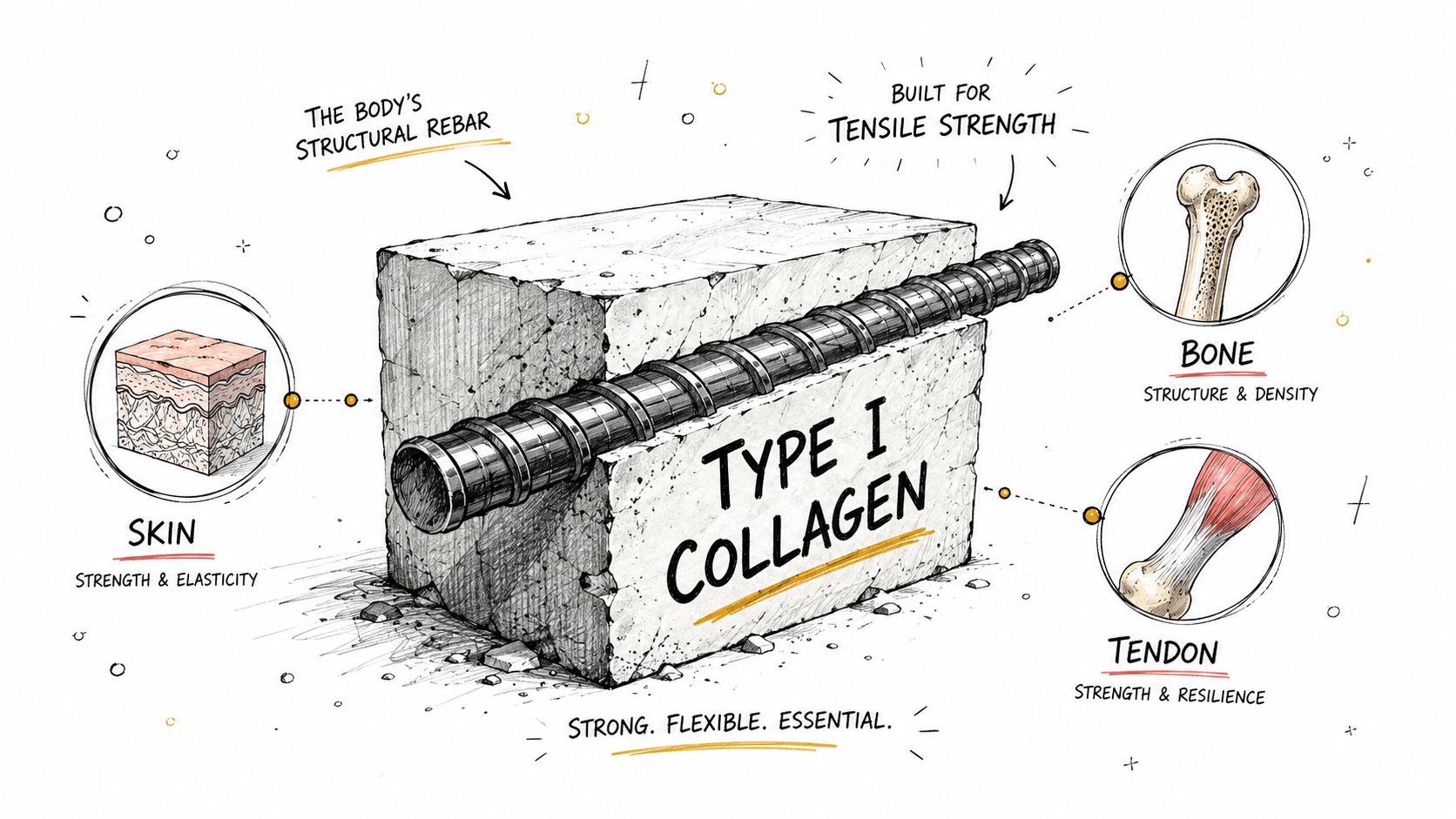
When you see collagen on a supplement label, there's a good chance you're looking at Type I. It’s the most dominant type in the human body, making up an incredible 90% of our total collagen.
Think of it as the steel rebar running through concrete. You don't see it, but it provides essential tensile strength and rigidity. This is exactly what Type I collagen does for our skin, bones, tendons, and ligaments. When skin loses this internal structure, it starts to sag. When bones lose it, their density declines.
Because it's so fundamental, Type I collagen is found in all the places that need to be strong yet flexible: the dermis layer of the skin, our bones, and the dense connective tissues that make up tendons and ligaments. This is why so many people turn to it for specific goals like improving skin firmness, supporting bone density, or helping tendons stay resilient.
How to Best Supplement with Type I Collagen
For Type I, the best supplements use hydrolyzed collagen peptides. The hydrolyzation process breaks down the long, complex collagen fibers into smaller, more bioavailable pieces that your body can easily absorb and use.
This pre-digested form makes dosing straightforward and effective. Most clinical studies and quality products use a daily serving in the 2.5–10 gram range.
- Bovine collagen (from cowhide) is a fantastic source, rich in both Type I and Type III, making it a go-to for skin health and general tissue repair.
- Marine collagen (from fish) is another popular option, often prized for specific peptides that are particularly good at boosting skin hydration.
- Bone-derived collagen (from bovine bone) is often the top choice for anyone specifically targeting bone density and strength.
At its core, Type I is the body's primary structural protein. Supplementing with it gives your body the raw materials it needs to support its natural repair and maintenance cycles.
Here’s a quick breakdown:
| Feature | Role |
|---|---|
| Main Locations | Skin (dermis), bones, tendons, ligaments |
| Common Goals | Improving skin firmness, supporting bone density, strengthening tendons |
| Typical Form | Hydrolyzed peptides, 2.5–10 g/day |
| Common Sources | Bovine hide, bovine bone, marine (fish) |
You’ll often find Type I collagen in multi-collagen blends simply because it’s the most abundant protein in the body. Its versatility makes it a foundational ingredient even in products marketed for general wellness, not just for skin or bones.
Tips for Shoppers
- Always check the label for the word "hydrolyzed" or "peptides" to ensure you're getting the most absorbable form.
- Look for the source—bovine, marine, or porcine—especially if you have dietary restrictions or preferences.
- For the best results, choose products that clearly state the dose in grams, so you know you're getting a meaningful amount.
While Type I is a fantastic all-rounder for skin, bone, and connective tissue, it's not the best choice if your main concern is joint cartilage. For that, you’ll need to look at Type II, which works quite differently.
You can also learn more about how Type I blends are formulated for skin and nails by checking out the Vital Proteins Beauty Collagen Powder product page.
Type II Collagen and Why Joint Formulas Lean on Cartilage
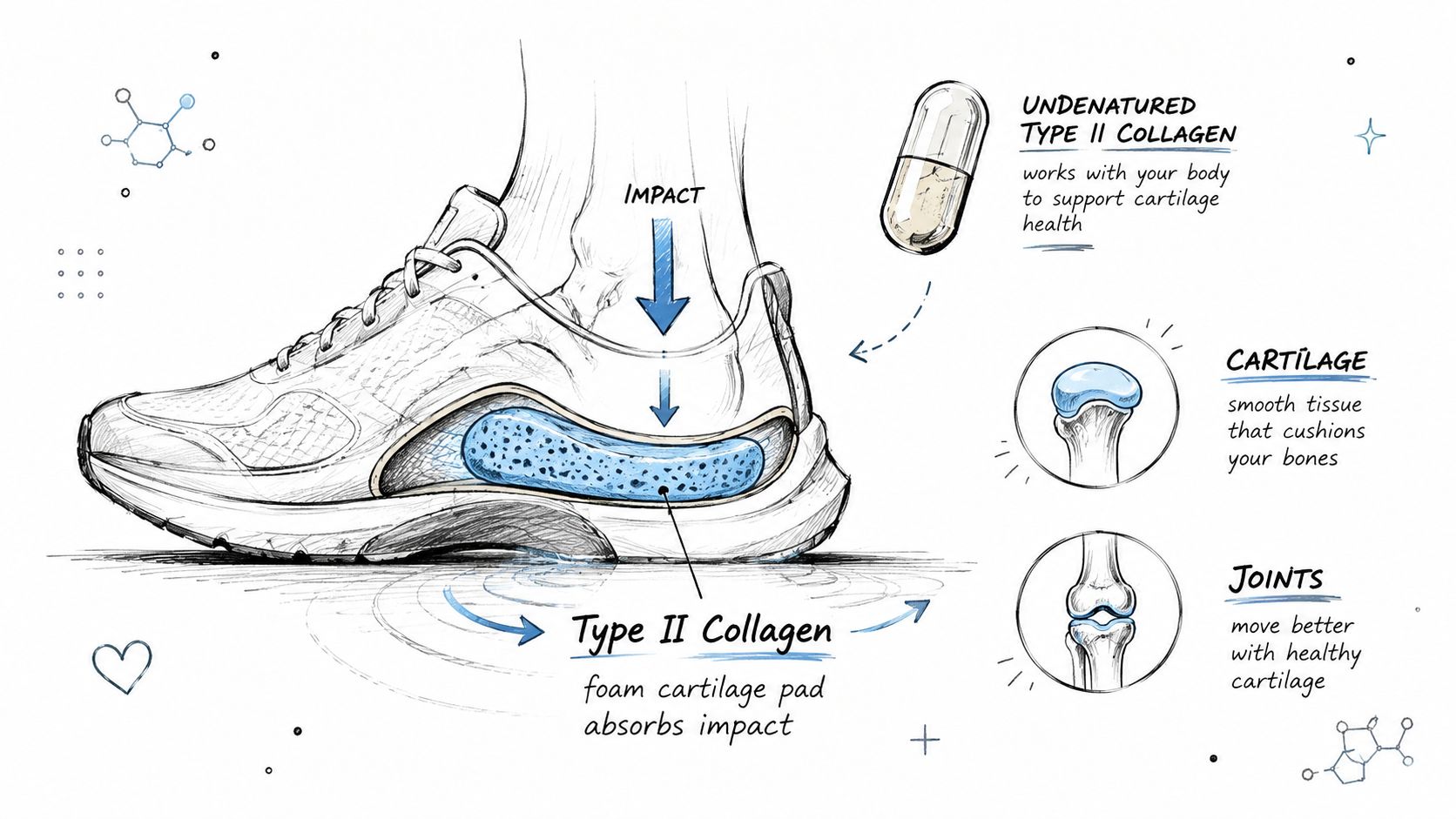
If you’ve ever wondered why joint supplements don’t just use the same collagen powders marketed for skin, the answer starts with cartilage. Type II collagen is the main structural protein there—it accounts for more than half of cartilage’s dry weight. Picture the soft foam insert inside a running shoe. That insert is Type II, absorbing impact and letting bones glide instead of grind.
This foam-pad comparison is exactly why joint formulas put Type II front and center. A hydrolyzed collagen blend aimed at skin is more like adding fresh concrete to a wall—great for surface support, but it doesn’t replicate the resilient, shock-absorbing quality of cartilage.
Type II is the cushioning in cartilage that helps joints handle force and stay flexible.
Joint-focused supplements often rely on undenatured Type II, which keeps its native triple-helix structure intact. That structural integrity matters because undenatured forms work at tiny doses—typically 40–80 mg/day. They target immune-mediated gut pathways that support joint tolerance, rather than simply dumping bulk amino acids into your system like hydrolyzed peptides do.
Speaking of hydrolyzed collagen peptides (the common format for Types I and III), they’re broken into smaller pieces and dosed in grams, usually 2.5–10 g/day. That processing makes them excellent for skin, bone, and general connective tissue, but it doesn’t recreate the high Type II concentration your joints specifically need.
The regional distribution of collagen is dramatic. In cartilage-rich joint regions, Type II can be 18 to over 100 times more concentrated than in muscle. This fact alone explains a practical shopping rule: a multi-collagen beauty powder won’t deliver the same joint-specific benefits as a dedicated Type II product.
How Type II Fits Into Collagen 1 2 3
- Type I provides tensile strength across skin and bone.
- Type III adds elasticity alongside Type I.
- Type II supplies the specialized padding in cartilage.
Grouping them as collagen 1 2 3 makes sense because each type maps to a different tissue and a different goal. If joint comfort is your main priority, look for a product that clearly specifies undenatured Type II or chicken cartilage-derived Type II, rather than a generic multi-collagen blend.
Practical Label Tips
- Scan for the word undenatured or the abbreviation UC-II when shopping for joint support.
- Check the dose in milligrams for Type II—effective formulas list 40–80 mg.
- Confirm the source if dietary restrictions matter (chicken, bovine, marine) and whether the capsules are gelatin-free or halal.
You might also be interested in a focused product overview and sourcing details in our article NOW Foods UC‑II Undenatured Type II Collagen Joint Health.
Type III Collagen And Its Work Alongside Type I
Type III doesn't get the spotlight often, but it's the elastic stitching that keeps tissues flexible and ready for repair. Picture Type I as the steel rods in a bridge and Type III as the sewn seams that let the deck flex in wind without tearing.
You'll find Type III in muscles, arteries, organs, and other elastic tissues. It shows up wherever resilience matters — places that need to stretch and bounce back. When injury strikes, Type III lays down the early repair scaffold before stronger fibers move in. That's why tissues built for stretching and rebounding carry a higher share of Type III.
Healthy tissues maintain specific Type I to Type III ratios. Skin typically runs about 2–3 to 1 (Type I to Type III), blood vessels sit in a similar range, while tendons and ligaments can hit roughly 38 to 1. Those numbers explain why supplement blend formulations aren't random — they're designed to mirror what tissues actually need.
Where Type III Lives And Why That Matters
- Muscles and vessel walls lean on Type III for flexibility, letting arteries expand with every heartbeat.
- Organs and elastic connective sheets depend on it during growth and healing.
- Tendons and ligaments carry very little Type III because they prioritize tensile strength over stretch.
Type III acts like elastic stitching in fabric — it allows stretch without ripping and supports the heavier threads around it.
Many hydrolyzed collagen products combine Type I and Type III because the two commonly share the same tissues. A multi-type blend mirrors the natural neighborhood of these proteins, supplying raw materials that support both strength and elasticity. For anyone choosing between single-type and multi-type labels, the takeaway is straightforward: match the blend to the tissue behavior you want to support, not just the marketing on the front of the bottle.
Practical Takeaways For Shoppers
- If skin elasticity and wound repair are your goals, a Type I+III hydrolyzed blend in the 2.5–10 g/day range usually makes sense.
- For structural bone or tendon repair, a higher Type I proportion matters more.
- Look for explicit Type I/III ratios on labels when available. A 1:1 or 2:1 I:III blend suits skin-focused goals, while blends skewed toward Type I target firmness.
Source and processing count too. Bovine hide commonly supplies both Types I and III, and hydrolyzed peptides improve absorption. At the end of the day, the exact type matters less than your specific goal — choose the form and dose aligned with what you're actually trying to support.
How to Pick the Right Collagen for Your Goal
Start by identifying what you actually want to achieve. Once you know your primary goal, you can match the specific collagen type and format to get the best results. For visible skin improvements, reach for Type I hydrolyzed peptides at 2.5–10 g/day, sourced from bovine hide or marine life. If joint comfort is the priority, look for Type II—often undenatured—dosed at 40–80 mg/day from chicken cartilage. For bone support, stick with Type I hydrolyzed at the higher end of 5–10 g/day using bovine bone sources. And if you just want general maintenance, a multi-collagen blend combining Types I and III at 5–10 g/day does the trick.
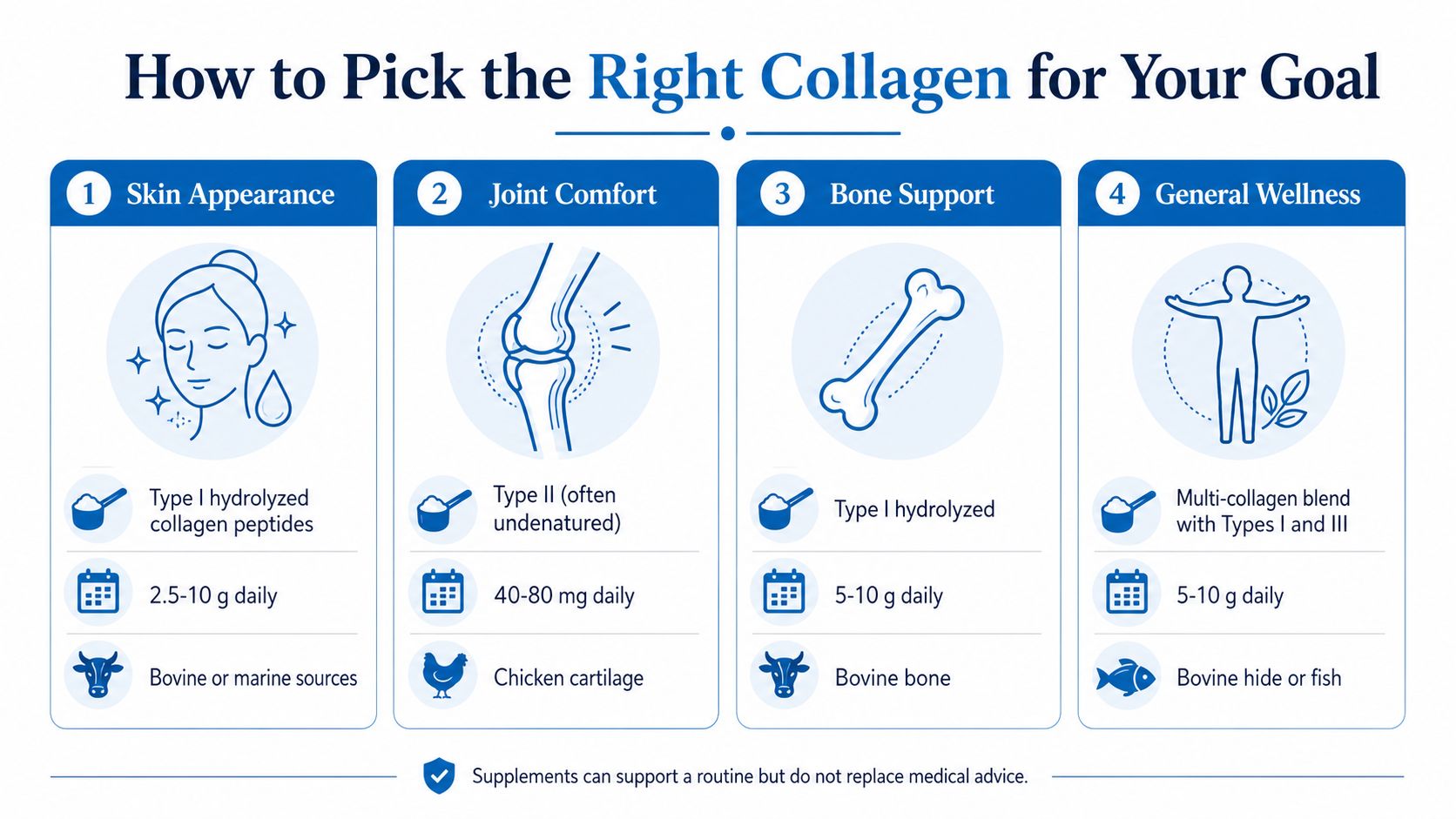
This infographic breaks down the recommended collagen types, forms, doses, and source animals across those four common goals.
You will notice a clear pattern in the dosing. Hydrolyzed Type I and I+III blends rely on gram-range dosing for skin, bone, and overall wellness. Meanwhile, undenatured Type II uses milligram-range dosing, which aligns with how joint biology actually works.
How to Read Labels and Shop Smart
- Search for "hydrolyzed," "peptides," or "collagen peptides" when you want highly absorbable Type I or III in gram doses.
- Look for "undenatured," "UC‑II," or "undenatured Type II" if you are shopping for joint support, and ensure the label lists 40–80 mg per serving.
- Check the source animal—whether bovine, marine, chicken, or porcine—to fit your dietary or ethical needs. This step is crucial for anyone avoiding pork or needing halal options.
Quick decision rule: If skin or bone is your main focus, pick hydrolyzed Type I or I+III measured in grams. If joints are the priority, choose undenatured Type II measured in milligrams.
Practical Shopping Checklist
- Check the serving size and do the math. Make sure the labeled dose reflects the actual active collagen amount, not just the total product weight.
- Verify the capsule type. Gelatin capsules often come from pork; look for vegetable or plant-based capsules if you need gelatin-free options.
- Seek out explicit halal certification or third-party labeling if that matters to you.
- Choose products that clearly state the source tissue—like hide, bone, or cartilage—rather than making vague "collagen" claims.
Dosing Examples and Use Cases
- Skin glow routine: Try 5 g/day of Type I hydrolyzed peptides stirred into your morning coffee or shake to support hydration and firmness.
- Joint comfort regimen: Take 40–80 mg/day of undenatured Type II once daily on an empty stomach, following the product directions.
- Bone support regimen: Combine 5–10 g/day of Type I hydrolyzed with calcium and vitamin D to support overall bone health.
Safety and Practical Notes
Collagen supplements generally fall within safe ranges, but talk to your clinician if you are pregnant, nursing, or managing a chronic condition. Remember, supplements support a routine; they do not replace medical care or targeted therapies.
If you want product ideas with clear sourcing, check out WellPath Renew Multi Collagen Protein Powder, which lists its blend details directly on the product page.
Treat these decision rules as your personal shopping playbook. That way, the bottle you toss in your cart actually matches the tissue you want to support, the doses research backs up, and the dietary requirements you need.
FAQ on Collagen Types I, II, and III
Can One Product Cover Everything, or Should I Split by Goal?
The short version: match your supplement to your goal. Think of collagen types like different building materials for a house—you wouldn't use drywall where you need steel, and you wouldn't use insulation where you need framing. A multi-collagen blend handles general maintenance just fine, but when you're chasing specific results, the right type at the right dose makes a real difference. Go with Type I or a I+III combination for skin and bone support, and stick with undenatured Type II for joints.
How Much Should I Take Daily?
For hydrolyzed Type I and Type III peptides, most people land somewhere between 2.5 and 10 grams per day. A lot of folks find 5 grams daily hits the sweet spot for skin and general support without overcomplicating their routine. Undenatured Type II is a different story—it works at 40 to 80 milligrams per day, which seems almost absurdly small until you understand it's signaling your immune system rather than just building tissue. Whatever you take, actually read the label to confirm the active collagen amount, not just the total scoop weight.
When Will I Notice Changes?
Patience pays off here. Skin hydration and firmness tend to show up after 6 to 12 weeks of consistent use—nothing overnight, but the changes sneak up on you. Joint comfort with undenatured Type II can surface within 4 to 12 weeks, though that window depends on how stiff things were to begin with and whether you're actually taking it every day. Bone density moves on a completely different timeline, measured in months or years, and it works best paired with adequate calcium and vitamin D.
Are Halal or Gelatin-Free Options Available?
Absolutely. You just have to know what to look for on the label. Keep an eye out for these markers:
- Vegetable-based or plant capsules if you're avoiding animal gelatin
- Clear halal certification when pork derivatives are a concern
- Marine or bovine-hide sources listed explicitly so you can steer clear of porcine origins
How to Read Labels and Choose the Right Form
Check the processing method. Hydrolyzed or peptides on the label means gram-level doses for Type I and III. Undenatured or UC-II signals milligram doses for Type II.
Look at the serving size and the actual collagen amount per serving, not the total package weight.
Confirm the animal source and capsule type to line up with your dietary or religious needs.
What About Safety and Interactions?
Collagen supplements sit well with most people, but it's worth flagging a few things. If you're pregnant, nursing, or managing a chronic condition, run it by your healthcare provider first. Allergies tied to the source are the main thing to watch—fish, chicken, and bovine sources each carry their own risk profile. Start on the lower end of the dose range to see how your body responds, then nudge up if needed.
Quick Takeaway For skin or bone goals, go with hydrolyzed Type I or I+III in gram doses. For joints, undenatured Type II in the 40 to 80 mg range is your move. And always verify the source and capsule type to meet halal or gelatin-free needs.
For convenient shopping and clear labeling on sources and capsule types, visit CalVitamin.






