

Ever buy a supplement because the label promised energy, only to realize later you never knew whether it contained a wild fungus, a cultured extract, or a different species entirely? That's the cordyceps question, and it matters more than the promise on the front of the bottle.
A cordyceps sinensis supplement can mean very different things depending on how the ingredient was sourced, processed, and standardized. Some products are built around cultured material because wild C. sinensis is scarce and costly, while others lean on substitute species or mycelium-based inputs, so two bottles with similar names can behave very differently in practice.
Table of Contents
- What Cordyceps Sinensis Is
- Cordyceps Species and Formulations Compared
- What the Research Shows
- How to Dose and Time Cordyceps
- Safety, Side Effects, and Interactions
- How to Choose a Quality Cordyceps Supplement
- Putting It All Together
What Cordyceps Sinensis Is
Consumers often begin by looking for an energy supplement. The better first question is simpler, what is in the bottle? Cordyceps sinensis is a parasitic fungus that grows on ghost moth larvae in nature, and that life cycle is part of why the ingredient carries a premium reputation. An infographic explaining that Cordyceps Sinensis is a parasitic fungus that grows on ghost moth larvae.
A useful comparison is wild-caught versus farmed salmon. Both can be called salmon, but they do not come from the same system, and they do not always look, taste, or cost the same. Cordyceps works the same way, because the label can cover very different raw materials, from wild material to cultured biomass to blended products.
The category exists because wild C. sinensis became commercially impractical. One industry summary puts wild material at around $20,000 per kilogram, which helps explain why manufacturers moved toward cultivation and standardization instead of relying on the natural supply alone. That shift is why a modern cordyceps sinensis supplement is usually a manufactured ingredient, not a spoonful of rare wild fungus.
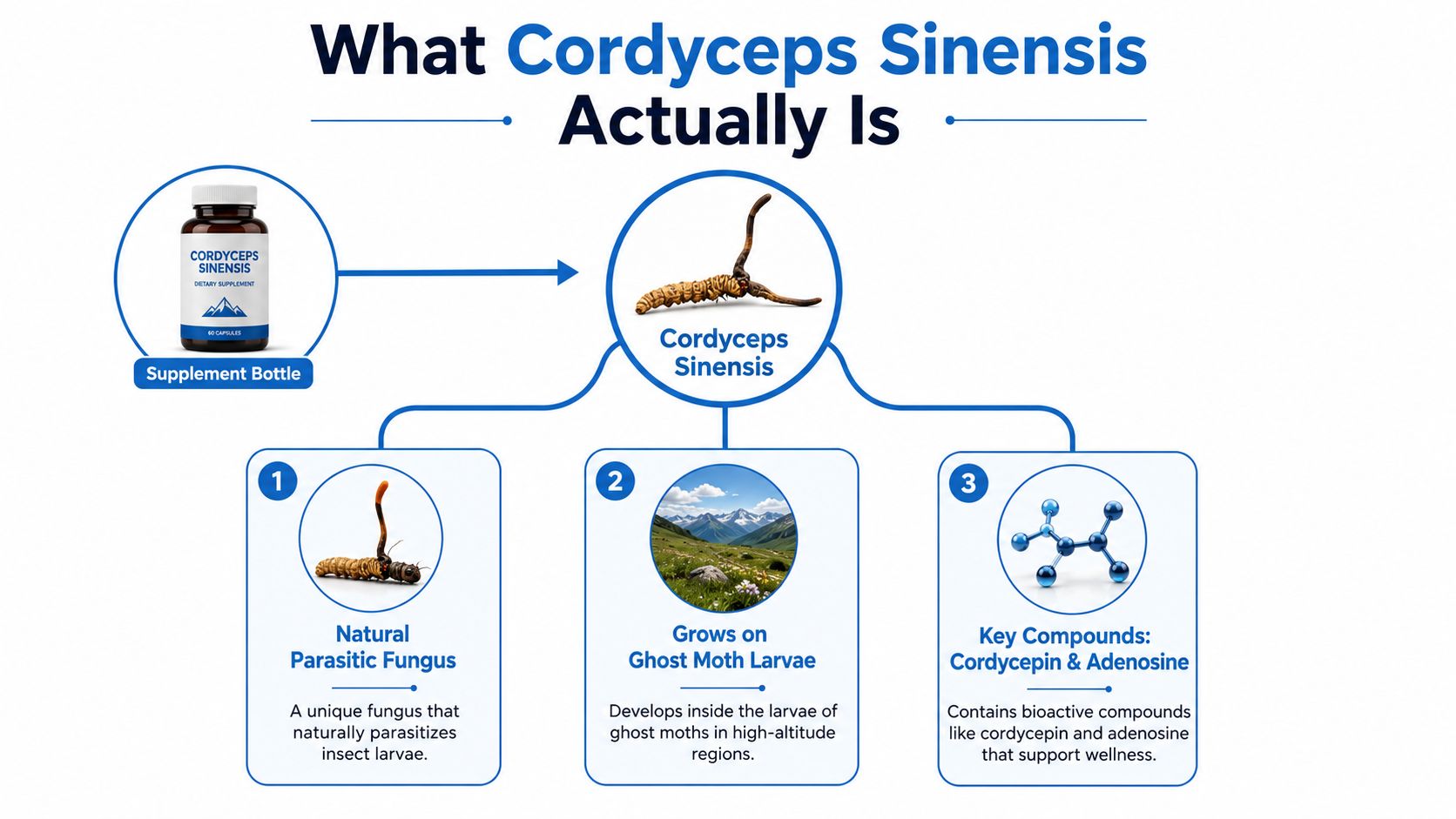
Practical rule: if a product does not clearly tell you whether it uses cultivated mycelium, fruiting body material, or another cordyceps source, you are guessing about the ingredient before you even look at dose.
The composition question matters because cordyceps products are not a single standardized substance. Scientific reviews note that different products can contain different levels of biologically active compounds, which means the same name on the label does not guarantee the same chemistry in the capsule. For a broader look at herbal supplement categories, see CalVitamin's herbs section.
Cordyceps Species and Formulations Compared
The biggest shopping mistake is assuming Cordyceps sinensis and Cordyceps militaris are interchangeable. They're related, but they're not the same ingredient story, and the differences show up in cultivation, cost, and compound profile.
What changes from species to species
- C. sinensis is the traditional name most shoppers recognize, but the market often uses cultivated or mycelial forms because wild supply is limited.
- C. militaris is easier to cultivate and is often discussed for its higher cordycepin content.
- A product may use fruiting body material, mycelium, or a blend, and each route can shift the final chemistry.
One review reported cordycepin ranging from 0.006 mg/g to 6.36 mg/g across Cordyceps products, with wild C. sinensis generally lower in cordycepin than cultured C. militaris Cordyceps species comparison and compound variability. That range is the reason label reading matters. Two bottles can both say “cordyceps,” yet still deliver very different active profiles.
| Ingredient | Source | Typical Standardization | Notes |
|---|---|---|---|
| Cordyceps sinensis | Traditional species, often cultivated in commercial products | May be listed as mycelium, extract, or blended material | Rare wild material is costly and usually not the commercial norm |
| Cordyceps militaris | Separate cordyceps species, commonly cultivated | Often positioned around cordycepin content | Usually easier to scale than wild C. sinensis |
| Mycelium-on-grain products | Fungal growth on a substrate | Sometimes not clearly standardized | Composition depends on how much fungal material versus substrate ends up in the final powder |
| Simple powders | Ground material with minimal processing | Often little or no standardization | Can be straightforward, but quality depends heavily on sourcing and identity |
A plain powder is not automatically better, and a strong extract is not automatically superior. The question is whether the manufacturer tells you what part of the fungus they used, how they processed it, and what compound markers they measured. If they don't, you can't compare products fairly.
What the Research Shows
The human evidence is more restrained than the marketing. A major NIH review notes that studies have looked at respiratory, renal, hepatic, cardiovascular, immune, glucose-metabolism, and inflammatory outcomes, but it also emphasizes that laboratory effects do not reliably translate into proven human benefit NIH review of cordyceps clinical evidence.
Endurance and aerobic performance
The clearest trial pattern is gradual, not immediate. In a randomized, double-blind, placebo-controlled trial in amateur marathoners, 2 grams daily of C. sinensis for 12 weeks improved aerobic performance, with the effect appearing at the 12-week mark rather than earlier clinical trial and review summary. Another clinical study of Cs-4, a Cordyceps sinensis preparation, found that after 12 weeks the metabolic threshold increased by 10.5% and the ventilatory threshold increased by 8.5%, while placebo did not show a comparable shift.
That timing matters. Cordyceps does not behave like a stimulant that hits in minutes. The better-supported use case is a slow change in exercise physiology over weeks of use, more like training adaptation than a pre-workout buzz.
Kidney-related outcomes and mixed indications
Kidney support is the other area that gets attention, but the evidence is still uneven. A 2024 meta-analysis in renal dysfunction pooled 15 studies with 1,310 patients and reported an area under the curve of 0.88, while still calling the evidence quality low and calling for better trials 2024 renal dysfunction meta-analysis. A separate review also found some favorable kidney-marker changes, but concluded that the methodological quality was too weak for firm conclusions.
The pattern is consistent across indications. Small positive signals exist, but the label claim is usually bigger than the human evidence.
Immunity, libido, and fatigue claims
These are popular marketing themes, but the human evidence is less settled than the endurance data. Reviews note immune, glucose, inflammatory, respiratory, and sexual-wellness interest, yet the same literature also warns that broad benefits from preclinical work have not been confirmed across human trials overall. For fatigue and general wellness, that means the claim should stay cautious unless a brand can point to a specific, well-controlled human study on the exact product.
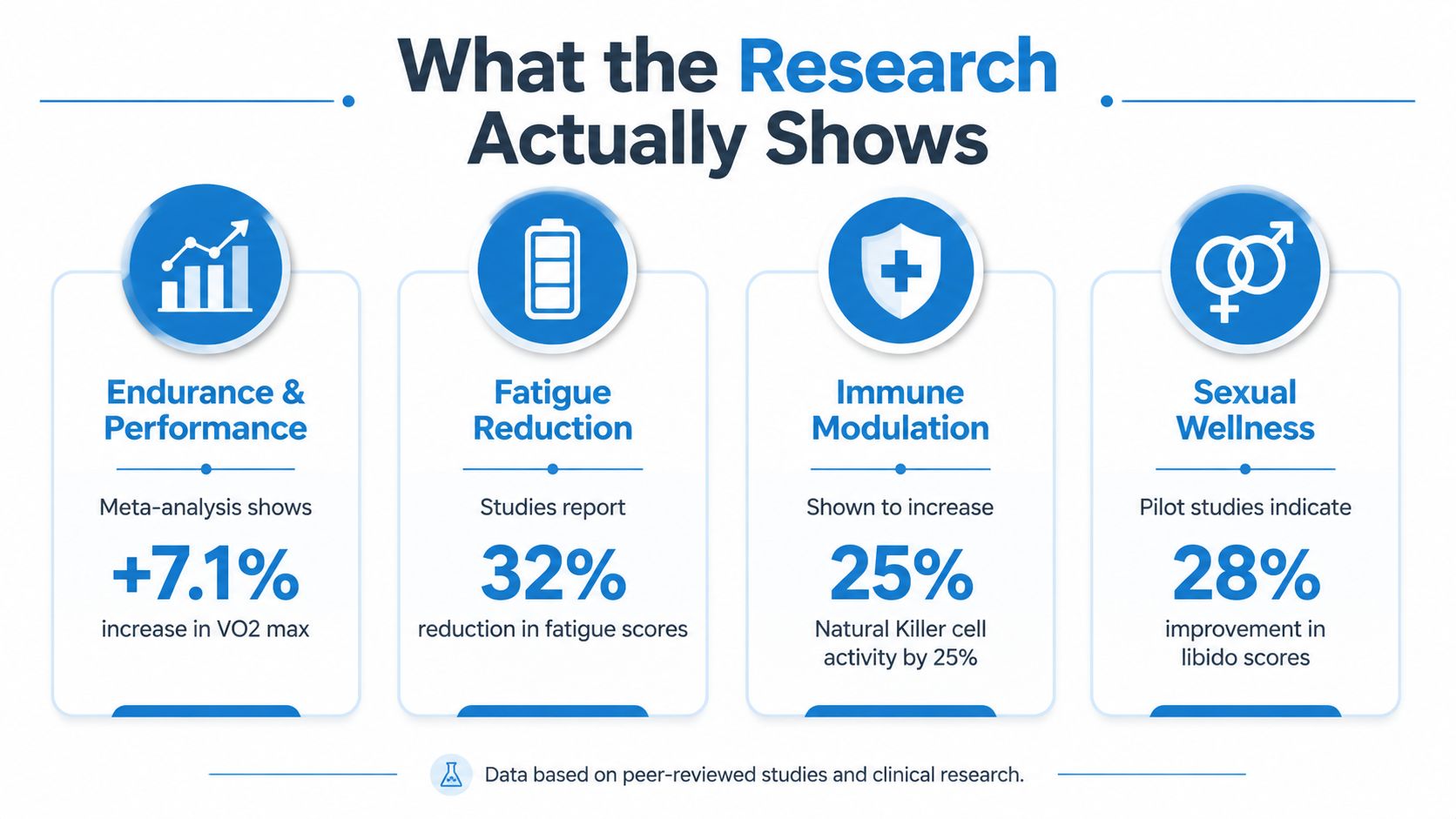
A simple way to read the evidence is this: cordyceps has a few promising human studies, but the strongest signals are narrow and slow to appear. That is very different from the broad, quick, all-purpose benefits often implied on labels. If you are comparing products, the question is not only whether the bottle says cordyceps, but whether it identifies the species, the form, and the evidence behind the exact ingredient.
That is why a label with little detail is hard to trust. A capsule may look similar on the shelf and still differ in species, extraction, or whether the active material is mostly mycelium, fruiting body, or substrate. For a concrete example of how much product format can matter, see this cordyceps-adjacent mushroom formula page.
How to Dose and Time Cordyceps
A dose makes more sense when you know what you are dosing. Cordyceps products are not interchangeable just because they share a name, and the species, form, and extraction method can change how a capsule is used day to day. That matters even more here, because timing advice only works after the product itself is identified clearly.
The clearest human evidence points to steady use rather than a one-off effect. In the marathon trial discussed earlier, people took 2 grams daily for 12 weeks, and the measurable performance change appeared late. That pattern is useful because it shows why cordyceps is better treated like a gradual routine than a quick fix.
A practical way to think about timing
Morning use is the simplest option if the goal is general daily support. If someone is using cordyceps around exercise, the expectation should still be cumulative use over time, not a same-day surge. That is why many people place it in the same category as a steady supplement rather than a pre-workout stimulant.
The label deserves the same attention as the clock. A capsule may be plain powder, an extract, or a mycelium-based product, and those choices can change what is inside the bottle even when the front panel looks similar. For a concrete example of how capsule format and ingredient detail affect comparison shopping, see a beta-glucans and mushroom immune support capsule product page.
Simple starting mindset: use the product consistently, give it time, and judge it by the same goal each time, not by one morning that happens to feel energetic.
Food and tolerability
Taking cordyceps with meals is common because it is easier on the stomach for many people, especially when the product is a concentrated extract. Other people prefer it earlier in the day so it does not interfere with their evening routine. The practical point is consistency, since the human trial signal that looks most promising developed over weeks, not hours.
If a label gives a serving suggestion, start there. Then pay attention to how your body responds before changing the dose or the timing.
Safety, Side Effects, and Interactions
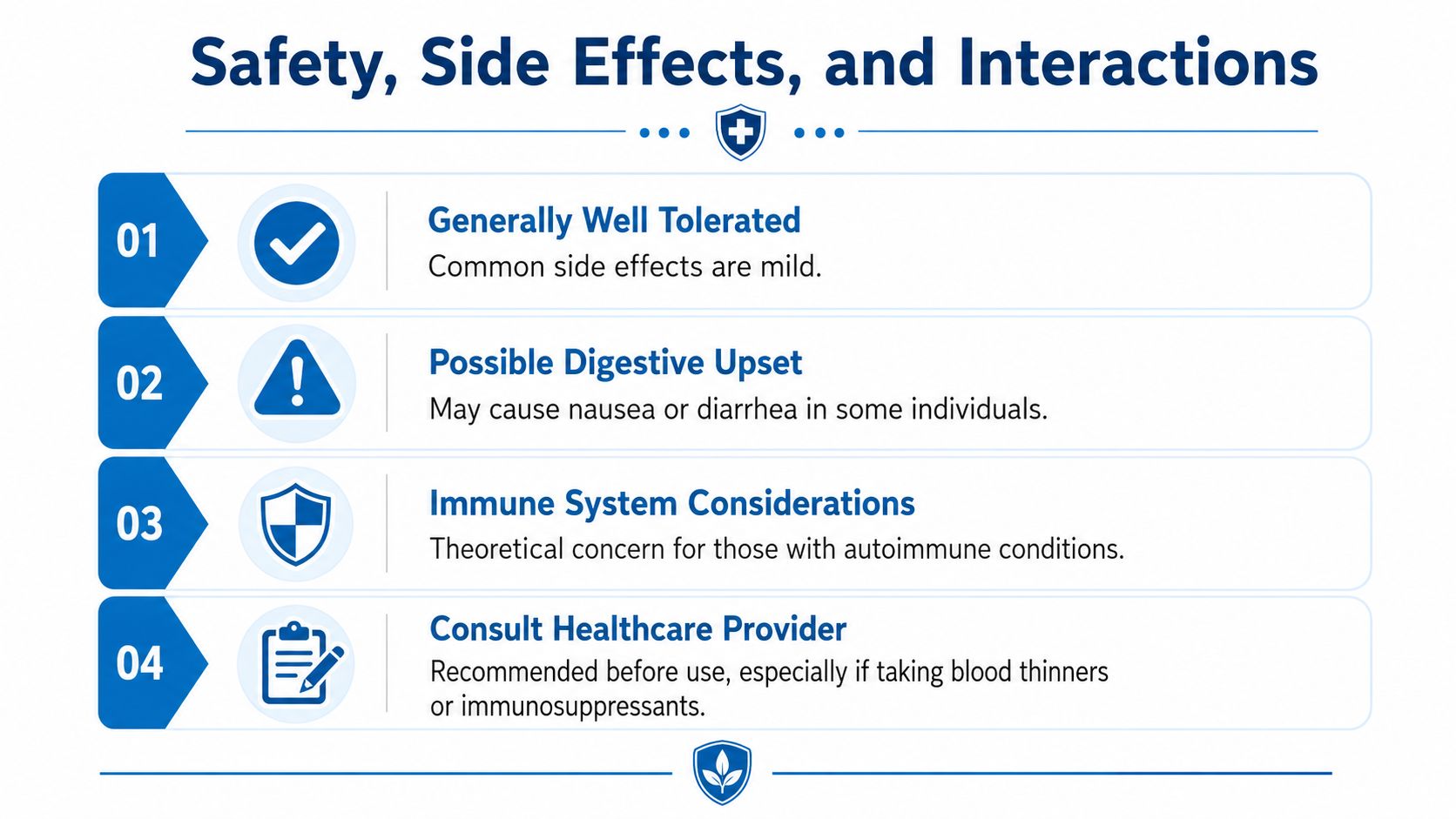
Is cordyceps a gentle supplement for everyone, or does the label hide a few important cautions? The best human-facing references describe cordyceps as generally well tolerated, but that still leaves room for product differences, individual sensitivity, and drug interactions. A mushroom supplement can look simple on the shelf and still behave differently once it meets your body, especially if you are taking medication or have an immune-related condition.
Who should be cautious
People taking immunosuppressants should check with a clinician before using cordyceps, because products with immune-modulating activity can work against the treatment plan even when they seem mild on paper. Anyone using blood thinners should also speak with a healthcare professional first, since supplement and drug combinations are where avoidable problems tend to appear.
Pregnancy and breastfeeding are another gray area. There is not enough good safety data to treat cordyceps as a default choice in those situations, so the practical answer is caution rather than confidence.
What side effects can look like
Users report mild digestive upset first when they do not tolerate a mushroom supplement well. Dry mouth and mild stomach discomfort are also common-sense examples of the kinds of complaints that can show up with concentrated extracts, especially when they are taken on an empty stomach.
Quality matters here too. Poor sourcing can add contamination risk, including heavy metals in some mushroom products, so a low-grade bottle can create a bigger problem than the herb itself. That is one reason it helps to read the label carefully instead of choosing only by price. For a broader example of how product format and ingredient context can shape a supplement choice, see a cordyceps coffee blend with maca and guarana.
If you have an autoimmune condition, take prescription medication, or are pregnant or breastfeeding, ask a clinician before you start.
How to Choose a Quality Cordyceps Supplement
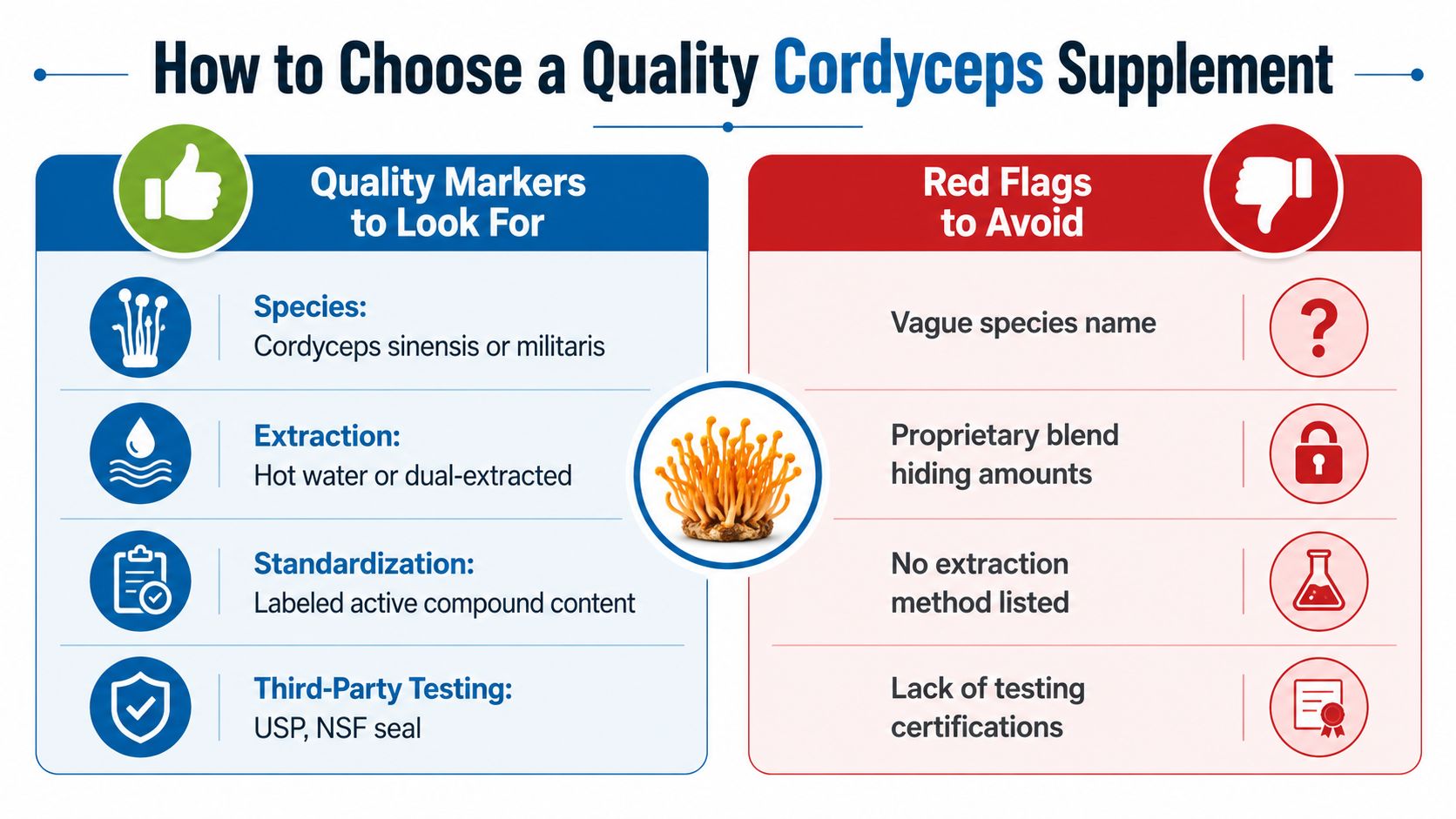
Good buying decisions start with identity, not marketing. The first thing to check is whether the product names the species clearly, because “cordyceps” alone doesn't tell you enough, and “cordyceps sinensis” still doesn't tell you whether you're getting cultivated mycelium, fruiting body material, or a blend.
Read the label in this order
- Species identity. Look for a clear statement such as Cordyceps sinensis or Cordyceps militaris. If the label is vague, you can't compare it well against other products.
- Extraction method. Hot-water or dual-extracted products usually tell you more about how the manufacturer handled the raw material than a plain “mushroom complex” claim does.
- Standardization. Look for labeled active compounds when they're provided, because product-to-product variability is real.
- Third-party testing. Look for a seal or documentation from groups such as USP or NSF when available, because testing helps reduce guesswork.
- Form and fit. Vegan, gelatin-free, or halal status can matter, but those are filters after identity and testing, not replacements for them.
For buyers who want a broader wellness supplement catalog with clearly labeled product attributes, the CalVitamin product listing for a cordyceps-containing blend is a useful example of how format and labeling can change the shopping experience.
Watch for marketing shortcuts
A product that hides its amounts inside a proprietary blend doesn't help you evaluate dose. The same goes for labels that brag about “ancient energy” while skipping the species, extraction, or testing details. Those are red flags because they make comparison impossible.
Buying rule: choose the bottle that gives you the most identity and testing detail, not the one with the loudest promise.
If two products both look acceptable, pick the one that matches your goal. Endurance buyers should care most about clear identity and consistency, while general wellness shoppers may value transparent sourcing and easier daily use. That's a more honest way to shop than picking by the biggest headline claim.
Putting It All Together
A cordyceps sinensis supplement makes sense for three kinds of shoppers. Endurance-focused buyers should look for a product with clear species identity, a consistent dose, and realistic expectations built around weeks of use, not instant stimulation. People shopping for general energy or immune support should be even stricter about label clarity, because those claims are broader than the human evidence. Shoppers interested in sexual wellness should be especially careful, since much of the marketing in that lane leans on general cordyceps research rather than strong product-specific human trials.
The best next move is simple. If the label doesn't tell you what species it uses, how it's extracted, and whether it's tested, pass on it. If you're taking medications, have an immune condition, or are pregnant or breastfeeding, talk to a clinician before you buy.
If you want a supplement retailer that makes it easier to compare formats, labels, and wellness goals in one place, visit CalVitamin and review the options with the same checklist you'd use for any cordyceps product. Their catalog spans herbs, sports blends, and attribute-based choices, so you can shop with a clearer idea of what's in the bottle.






