
You may be here because “take more fiber” sounded simple, but your gut had other plans. A scoop of the wrong product can feel like tossing kindling onto a fire. More bloating, more cramping, and a lot more gas than you bargained for.
Acacia fiber stands out because it tends to be gentler than many people expect from a fiber supplement. Its reputation comes from how slowly it ferments in the gut, which often makes it easier for sensitive digestive systems to handle. That “gentle giant” quality is the reason many people look into it when they want help with regularity and fullness without the usual rough ride.
Interest has grown steadily in recent years. Industry reporting noted a 36% CAGR in acacia fiber supplement product launches between 2017 and 2021, and the acacia fiber powder market was projected to reach $865.5 million globally by 2025. If you prefer a simpler format than loose powder, some people also compare options such as advanced fiber gummies for daily digestive support.
The key question is not just whether acacia fiber is popular. It is whether it fits your gut, your routine, and your tolerance. That practical side matters most.
Table of Contents
- The Search for a Kinder, Gentler Fiber
- The Science Behind How Acacia Fiber Works
- Proven Health Benefits of Acacia Fiber
- Acacia Fiber vs Other Popular Fibers
- How to Use Acacia Fiber for Best Results
- Choosing a High-Quality Acacia Fiber Supplement
- Frequently Asked Questions About Acacia Fiber
The Search for a Kinder, Gentler Fiber
A lot of people come to fiber supplements the same way. They feel backed up, irregular, or just “off.” They try a popular powder, stir it into water, and within a day or two they feel puffed up instead of relieved. So they stop. Then the cycle starts again a few weeks later.
That pattern doesn't mean fiber is wrong for you. It usually means the type, amount, or pace wasn't a good match for your gut.
Acacia fiber supplement products stand out because many people describe them as easier to tolerate than harsher fibers. That fits the larger market story. Acacia fiber has moved well beyond a niche ingredient, with launches climbing rapidly and market value expanding, as noted in Kerry's acacia fiber market summary.
Why this fiber gets so much attention
Some fibers behave like a heavy broom. They sweep through and bulk things up, but they can feel intense.
Acacia is different. Think of it more like a calm support system. It mixes easily, tends to disappear into drinks and foods, and is often chosen by people who want daily gut support without feeling like they swallowed a science experiment.
Practical rule: If a fiber supplement makes you dread taking it, it's not the right long-term fit for your body.
Where people often get confused
The word “fiber” sounds simple, but different fibers act very differently in the gut. Some thicken. Some ferment quickly. Some mainly bulk the stool. Some act more like food for beneficial gut bacteria.
That's why one person can swear by psyllium while another feels much better on acacia. The goal isn't to find the most famous fiber. It's to find the one you'll use consistently, because your gut feels better on it, not worse.
The Science Behind How Acacia Fiber Works
Acacia fiber can sound more complicated than it is. It is a water-soluble, non-viscous fiber made from the dried sap of Acacia senegal and A. seyal. “Non-viscous” means it does not turn into a thick gel like some other fibers, so it behaves differently in a glass and in your gut.

What Is Acacia Fiber?
Acacia fiber is also a prebiotic, which means you do not break it down for calories the way you would digest sugar or starch. It passes through the upper digestive tract largely intact and reaches the colon, where gut microbes can use it as fuel.
The key detail is the pace.
Acacia works like slow-burn fuel for your gut bacteria. According to the Prebiotic Association's acacia fiber overview, it can support the growth of bifidobacteria and lactobacilli, two groups commonly linked with a healthier gut environment. If probiotic bacteria are the garden, prebiotic fiber is the fertilizer. Acacia feeds that garden in a steadier, gentler way than fibers that ferment fast.
Why Slow Fermentation Matters
This is the part that helps explain acacia's “gentle giant” reputation.
Some fibers are fermented quickly. That quick fermentation can create a fast wave of gas, which may feel like bloating, pressure, rumbling, or cramping in a sensitive gut. Acacia is different because it is fermented more gradually. For many people, that slower pace feels easier to live with day after day.
Here's the basic process:
- You take acacia fiber.
- It moves through the small intestine without being fully digested.
- It reaches the colon, where gut bacteria ferment it gradually.
- That fermentation creates short-chain fatty acids, or SCFAs.
- Those compounds help support the gut environment.
One SCFA people often hear about is butyrate. Butyrate helps support the gut barrier, which you can picture as the lining that helps keep digestion orderly and selective. When that lining is well supported, the gut often feels less reactive and more predictable.
That is why “gentle” should not be confused with “weak.” Acacia still does meaningful work. It just tends to do it with less digestive commotion, which is exactly what many people with sensitive stomachs want from a daily fiber supplement.
Proven Health Benefits of Acacia Fiber
Acacia fiber earns its reputation by being useful in ways sensitive stomachs can live with. The goal is not dramatic overnight change. The goal is steadier digestion, better day-to-day comfort, and microbiome support without the digestive backlash that can happen with faster-fermenting fibers.
That matters for a simple reason. A fiber supplement only helps if you can keep taking it.
Digestive support that feels manageable
Acacia does more than add bulk. It feeds beneficial gut bacteria, which can help support a healthier digestive environment over time. For someone with a reactive gut, that slower, quieter action is often the difference between a supplement they quit after three days and one they can use consistently.
A helpful comparison is a dimmer switch versus a floodlight. Some fibers hit the colon fast and can create a rush of gas and pressure. Acacia tends to work more like a gradual turn of the dial. You may notice less drama, but that does not mean less value.
This slower pace can be especially appealing for people who want prebiotic support but feel wary after bad experiences with other fibers. If your gut tends to protest when you increase fiber, acacia is often one of the gentler places to start.
Satiety and appetite support
Acacia may also help with fullness. In a peer-reviewed human trial summarized in this PubMed Central article on gum acacia, researchers studied 48 healthy subjects and found that 40 grams per day significantly reduced hunger and increased fullness after breakfast compared with controls.
The effects showed up at several time points after the meal, including early and later in the morning. That suggests acacia can slow the return of hunger for some people. Still, there is an important catch. The 40-gram dose also caused more bloating and flatulence than lower doses, even though the fiber was considered well tolerated overall.
Real-life takeaway: fullness support is possible, but pushing the dose too high can trade one benefit for another problem.
For readers comparing fibers for appetite support, this is also a good reminder that different products work in different ways. A bulking fiber such as glucomannan powder for fullness and portion control support behaves differently from acacia, which is prized more for gentle prebiotic use.
Prebiotic activity at practical doses
You do not need a very large amount to get microbiome benefits from acacia. Research has confirmed prebiotic activity at 10 grams per day, which is much more practical for daily use than the higher satiety-study dose mentioned above.
That distinction helps clear up a common point of confusion. The amount used to study fullness is not the same as the amount many people use for gut support. If your main goal is to feed beneficial bacteria and keep your digestion calm, a moderate daily dose often makes more sense than chasing the biggest number on paper.
That is the heart of acacia's “gentle giant” appeal. It can do meaningful work at a dose many people tolerate well, especially those who want steady support instead of an intense digestive jolt.
Acacia Fiber vs Other Popular Fibers
Most shoppers don't compare fibers by chemistry. They compare them by lived experience. Will it mix well? Will it bloat me? Is it mainly for regularity, or does it feed the microbiome too?
That's where acacia starts to separate itself.
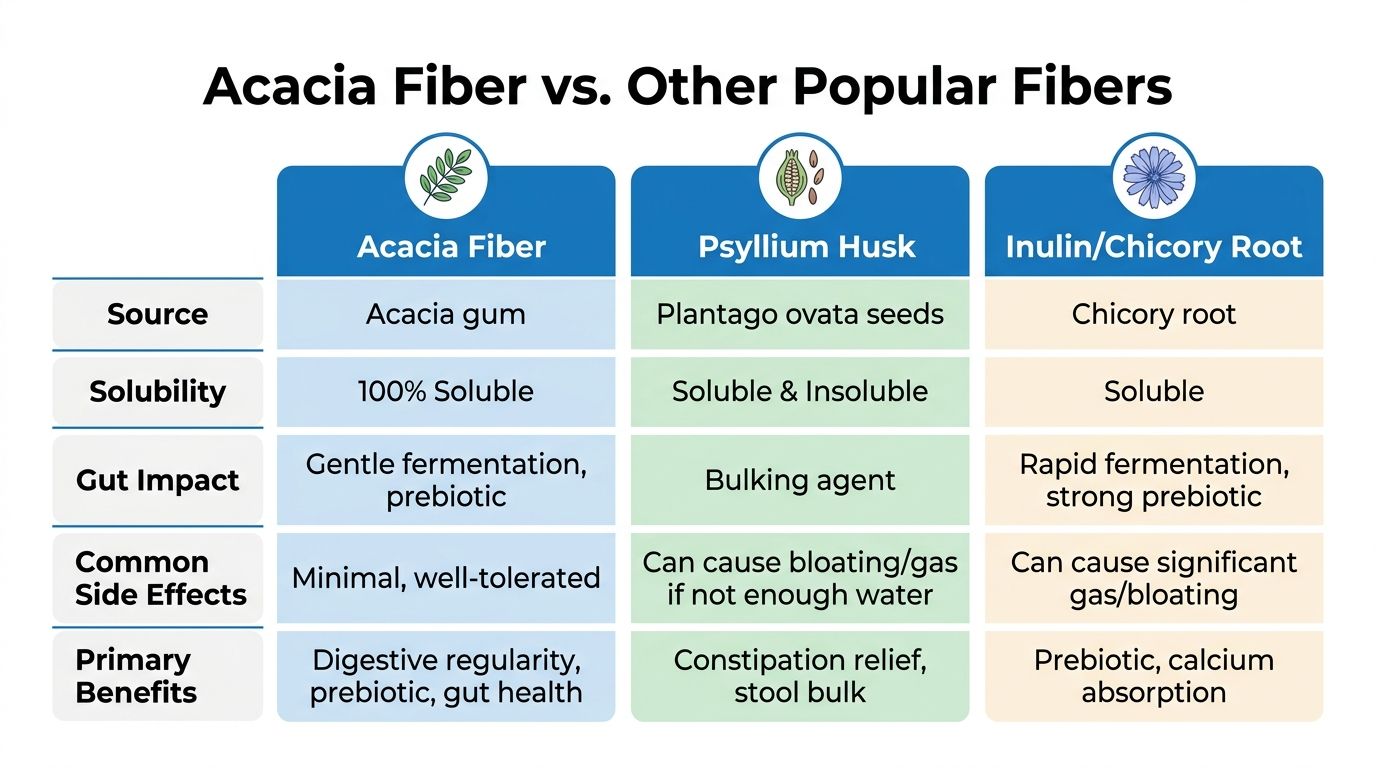
The quick comparison that matters most
| Feature | Acacia Fiber | Psyllium Husk | Inulin (Chicory Root) |
|---|---|---|---|
| Primary role | Prebiotic support with gentle fermentation | Bulking fiber often used for regularity | Strong prebiotic effect |
| Texture | Usually dissolves with little thickening | Often thickens and can feel gel-like | Usually mixes fairly well |
| Gas and bloating potential | Often better tolerated by sensitive users | Can feel heavy for some people | Often more likely to cause gas in sensitive users |
| Gut action | Slow fermentation | More bulking-focused | Faster fermentation |
| Best fit | Sensitive guts, daily prebiotic support | People focused on stool bulk and regularity | People seeking prebiotic effects and who tolerate fermentation well |
Psyllium husk has a well-known role in regularity support. It can be useful, but it behaves very differently from acacia. It thickens, has a more noticeable texture, and usually asks for more attention to mixing and hydration. Some people like that “I can feel it working” effect. Others don't.
Inulin sits at almost the opposite end of the comfort spectrum for some users. It's a prebiotic too, but it tends to ferment more quickly. For a resilient gut, that may be fine. For a sensitive one, it can be the reason someone decides all prebiotics are a bad idea.
Who each fiber tends to fit best
Acacia often fits people who say things like:
- “Other fibers make me gassy.” Slow fermentation is the main reason acacia gets considered here.
- “I want prebiotic support, not just bulk.” Acacia does more than add mass.
- “I need something I can hide in my routine.” Its low-texture feel is a real advantage.
Psyllium often fits people who say:
- “Constipation is my main issue.”
- “I don't mind a thicker drink.”
- “I want a fiber with a more obvious bulking effect.”
Inulin often fits people who say:
- “I tolerate fiber well.”
- “I'm mainly interested in prebiotic effects.”
- “A little extra gas doesn't bother me much.”
If you're comparing outside the acacia category, some people also look at other specialty fibers such as glucomannan powder, which works through a different texture and satiety profile. That can be useful context, because not all “fiber supplements” aim to solve the same problem.
If your gut is sensitive, the best comparison question isn't “Which fiber is strongest?” It's “Which fiber can I take every day without regretting it?”
How to Use Acacia Fiber for Best Results
You buy a fiber supplement because your gut needs support, then the supplement itself becomes the problem. That is often what sends people looking for acacia in the first place.

Acacia tends to work best when you treat it like a slow-burn fuel for your gut bacteria, not a product to take in a big scoop and judge by the end of the day. As noted earlier, it has a strong safety record and is commonly used in moderate daily amounts. The practical lesson is simple. Gentle does not mean “start anywhere.”
Start low and let your gut adjust
I usually frame this the same way I would for a client with a sensitive stomach. Give your gut a small, steady signal first. Then build.
A practical approach looks like this:
Begin with a partial serving
Use less than the full label dose for the first several days. That gives your digestive system time to get used to the extra fermentable fiber.Hold steady before increasing
Day one can be misleading. Some people feel fine right away, then notice extra gas or bloating after several days of repeat use.Increase in small steps
If things feel comfortable, slowly work up to the amount that matches your goal. Someone using acacia for general prebiotic support may land at a different dose than someone experimenting with appetite support.Back down if needed
A little extra gut activity can happen during adjustment. If your abdomen feels too “noisy,” reduce the dose instead of quitting immediately.
This slow build matters even more if you already eat plenty of fiber, use magnesium, or take another supplement that changes bowel habits.
Easy ways to make it a daily habit
Acacia's “gentle giant” advantage shows up here too. It usually mixes in without turning your drink into gel, which makes daily use easier for people who dislike thick, gritty fibers.
You can stir it into:
- Coffee or tea if mornings are your most repeatable routine
- Smoothies if breakfast is already blended
- Yogurt if you prefer eating your fiber with a spoon
- Soup for a savory option
- Water when you want the fewest variables
The best method is the one you will repeat without dread.
This short video gives a helpful visual for how people work fiber into a gut-support routine:
A few practical reminders can save you frustration:
- Drink fluids normally. You do not need to force excessive water, but fiber works better when you are reasonably hydrated.
- Separate it from medications when appropriate. Fiber can change how quickly some medications and supplements move through the digestive tract. Your pharmacist or clinician can tell you whether timing matters for yours.
- Match the dose to the job. A small daily amount for gentle microbiome support is different from a larger dose used for another goal.
- Give it time. Acacia is not the kind of fiber that announces itself with dramatic urgency. For sensitive guts, that is often the benefit.
If loose stools are part of the picture, this guide to diarrhea relief and gut support can help you sort through the bigger pattern, not just the fiber question alone.
Choosing a High-Quality Acacia Fiber Supplement
Once you decide acacia sounds like a fit, the next challenge is shopping. Labels can make simple products look complicated.
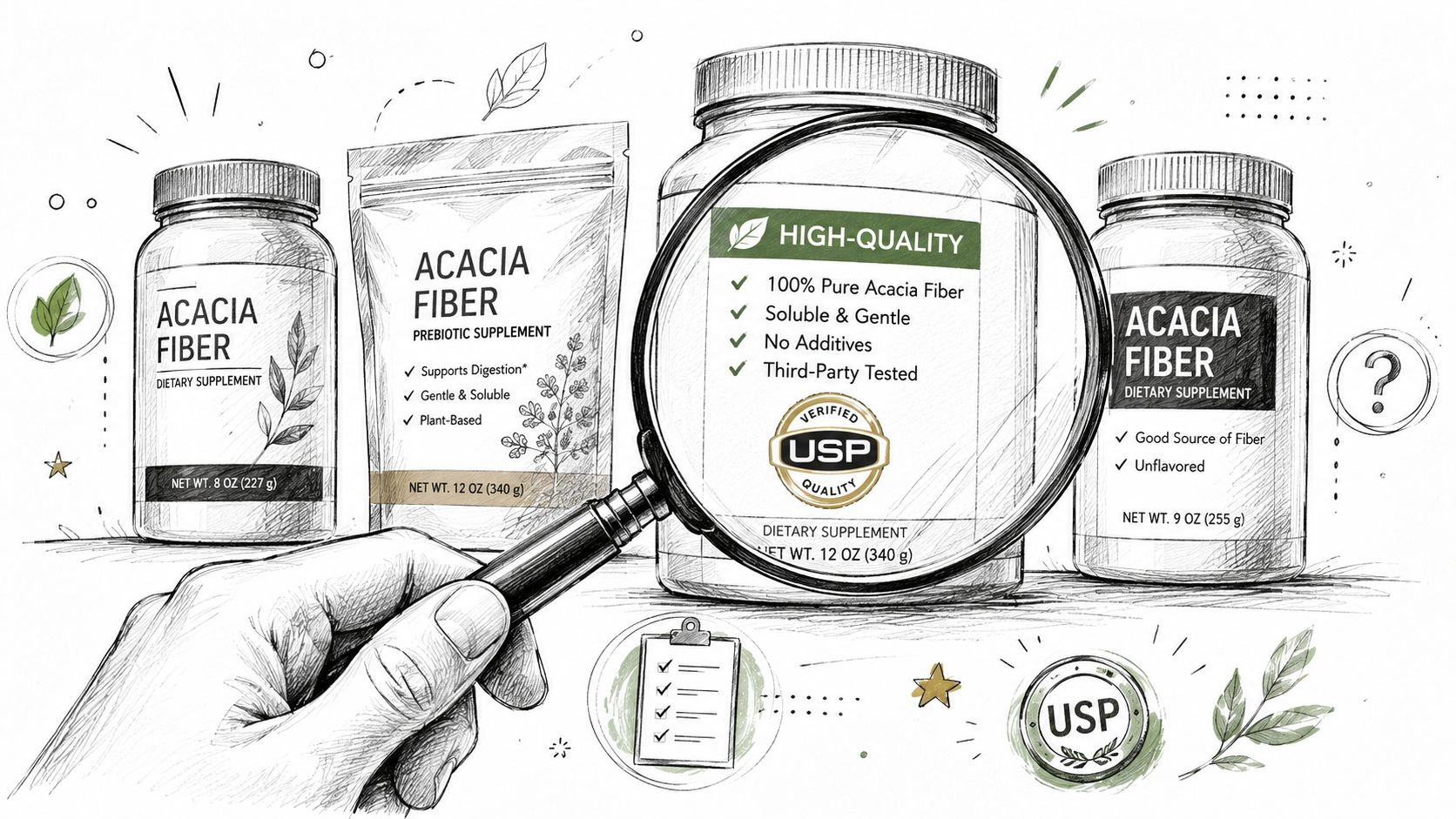
What to look for on the label
Start with the ingredient panel, not the front-of-package marketing.
A solid product usually keeps things simple:
- Look for 100% acacia fiber or a very short ingredient list.
- Check for added sweeteners or fillers. If your gut is sensitive, extra ingredients can muddy the picture.
- Notice the botanical source. Acacia fiber comes from Acacia senegal and A. seyal. Clear sourcing is a good sign.
- Prefer brands that share quality practices. Third-party testing, organic certification, or clear manufacturing details can add confidence.
If you're troubleshooting gut symptoms, the fewer moving parts the better. A flavored powder with sweeteners, gums, and extras may taste nicer, but it makes it harder to know what your body is reacting to.
A clean label won't guarantee a perfect experience, but it makes your experiment much easier to read.
Powder vs capsules
There isn't one right form. There's a right form for your habits.
Powder usually makes the most sense if you want flexibility. It's easier to adjust the amount, easier to mix into food, and often more practical when your goal is a meaningful daily dose.
Capsules can work if convenience matters most. They're simple for travel and don't require mixing. The tradeoff is that getting a substantial amount of fiber through capsules can be less convenient than using a powder.
If you know you dislike mixing drinks, capsules may help you stay consistent. But if you want to fine-tune your dose or build gradually, powder usually gives you more control.
Frequently Asked Questions About Acacia Fiber
Is acacia fiber safe to take long term
Acacia fiber has a strong safety profile, and the FDA recognizes it as GRAS. The human review cited earlier reports that most safety studies used daily amounts in the 5 to 30 gram range for up to three months without concerns. For longer-term personal use, it's smart to check in with your clinician if you have digestive disease, are pregnant, or use medications regularly.
Can I take acacia fiber with medications or other supplements
Possibly, but don't take that casually. Fiber can affect how some medications move through the digestive tract. A practical habit is to separate it from medications unless your clinician or pharmacist tells you otherwise.
Does acacia fiber help with weight loss
It's better to say it may support satiety rather than promise weight loss. The human study discussed earlier found reduced hunger and greater fullness at a 40-gram daily dose, but that higher amount also increased bloating for some people. For many adults, acacia works best as a support tool within a broader eating pattern, not as a stand-alone weight strategy.
Is acacia fiber good for sensitive stomachs
That's one of its biggest selling points. Its slow fermentation is the key reason many people find it easier to tolerate than fast-fermenting prebiotic fibers.
Is more always better
No. A dose that supports your gut and feels comfortable is better than a large dose that makes you miserable. Consistency beats intensity with fiber.
If you're looking for a practical way to support digestion, regularity, and gut comfort, CalVitamin offers a broad range of wellness products, including digestive support options in different formats so you can choose what fits your routine best.