You're probably here because turmeric keeps showing up everywhere. A friend swears it helped their joints. A podcast praised curcumin for inflammation. Then you looked at supplement labels and found a confusing mix of terms like BioPerine, phytosome, liposomal, high absorption, and 95% curcuminoids.
That confusion makes sense. Curcumin is the best-known active compound in turmeric, but it has a big practical problem. Your body doesn't absorb it easily. That's why so many products pair it with piperine, the compound in black pepper, or use newer delivery systems designed to help more of it get into circulation.
If you're trying to choose a curcumin and piperine supplement, the question isn't just “Does black pepper help?” It's also “How much does it help, for whom, and is it still the best option today?” The answer is more nuanced than supplement marketing usually suggests.
Table of Contents
- Your Guide to Curcumin and Piperine Supplements
- Understanding Curcumin's Challenge and Piperine's Solution
- The Science-Backed Benefits of Curcumin with Piperine
- How to Use Curcumin and Piperine Supplements Safely
- Is Piperine Still the Gold Standard? A Look at Formulations
- A Smart Shopper's Guide to Curcumin Supplements
- Finding the Best Curcumin Supplement at CalVitamin
Your Guide to Curcumin and Piperine Supplements
Many people start with turmeric because they want a natural way to support joints, recovery, or general wellness. Then they buy a basic turmeric capsule and assume all turmeric products work the same. They don't.
The first thing to know is that turmeric and curcumin are not interchangeable. Turmeric is the whole root or spice. Curcumin is one of its key active compounds, and it's the ingredient often sought for anti-inflammatory and antioxidant support.
The second thing is where most confusion begins. Curcumin sounds promising, but by itself it's a poor traveler inside the body. You can swallow it, but only a limited amount may become available where you want it to act.
Curcumin is a bit like a useful package that keeps getting turned away at the door before it reaches the right address.
That's where piperine comes in. Piperine is the active compound in black pepper, and it became popular because it seemed to help curcumin get past one of its biggest obstacles: rapid breakdown and clearance.
For years, this pairing became the default solution. A curcumin and piperine supplement was considered the smart version of a turmeric supplement. That's still partly true. Many people do choose this combination, and there is meaningful clinical interest behind it.
But it's also not the whole story anymore.
Today, you'll see piperine-based products sitting next to liposomal, phytosome, micellar, and water-dispersible curcumin formulas. Some are designed to improve absorption without relying on black pepper. That matters because the best choice may depend on your goals, your medications, your tolerance, and how cautious you want to be about interactions.
Understanding Curcumin's Challenge and Piperine's Solution
Curcumin's biggest weakness isn't a lack of interest from researchers. It's a delivery problem. A compound can look impressive on paper and still disappoint in the body if very little of it gets absorbed.
Why curcumin struggles on its own
Think of curcumin as a VIP trying to get through a building with very strict security. Your digestive system, intestinal lining, and liver all have checkpoints. Curcumin often gets processed and cleared so quickly that only a small amount stays available.
That's what people mean by bioavailability. In plain language, it means how much of a substance gets absorbed and becomes available for the body to use.
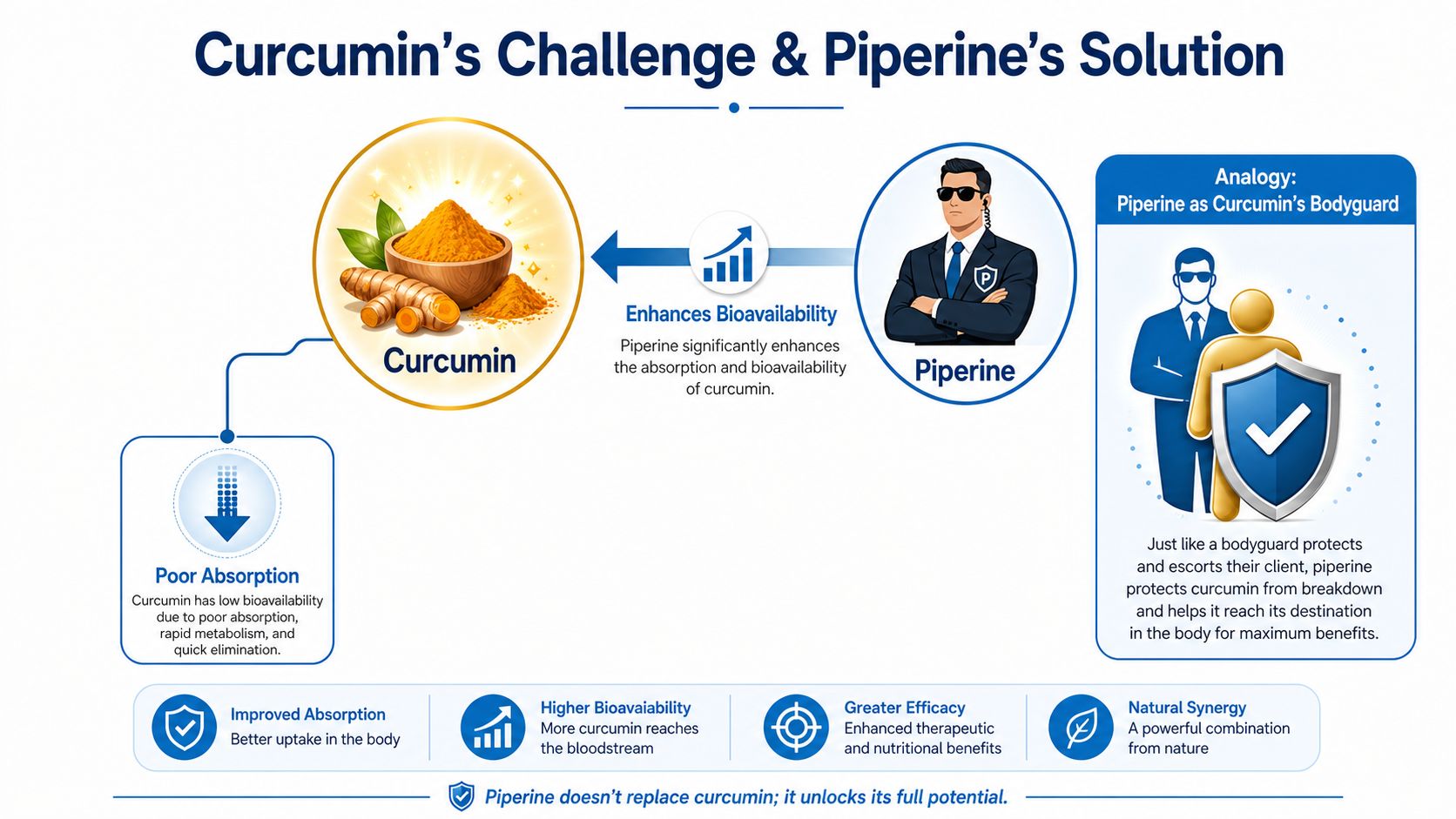
A landmark human study made piperine famous because it reported that combining curcumin with piperine enhanced curcumin bioavailability by up to 2000%. In that same line of evidence, co-administering 2 grams of curcumin and 20 mg of piperine increased serum concentration by about 20-fold compared with curcumin alone, as discussed in this NIH-hosted review of curcumin bioavailability.
How piperine changes the picture
Piperine works largely by interfering with glucuronidation, a metabolic pathway that helps the body break down and eliminate curcumin. If curcumin is the VIP, piperine acts like the bodyguard who gets it through the lobby before security sends it back out.
That's why a curcumin and piperine supplement became such a common formula. It offered a practical answer to the “good ingredient, poor absorption” problem.
If you compare labels, you'll often see products built around this traditional strategy, such as formulas that combine turmeric extract with black pepper extract like Amazing Formulas Turmeric Ginger with BioPerine. The key idea is not the brand name itself. It's the pairing of a concentrated curcumin source with a specific absorption helper.
Practical rule: If a turmeric product doesn't explain how it improves absorption, that's a sign to slow down and read the label more carefully.
That said, the “bodyguard” story is useful, but it isn't the full modern picture. As you'll see later, researchers and clinicians now debate whether piperine's famous absorption advantage translates as cleanly as older marketing implies.
The Science-Backed Benefits of Curcumin with Piperine
A common real-world question sounds simple: if piperine helps curcumin get into the system, does that translate into benefits a person might care about?
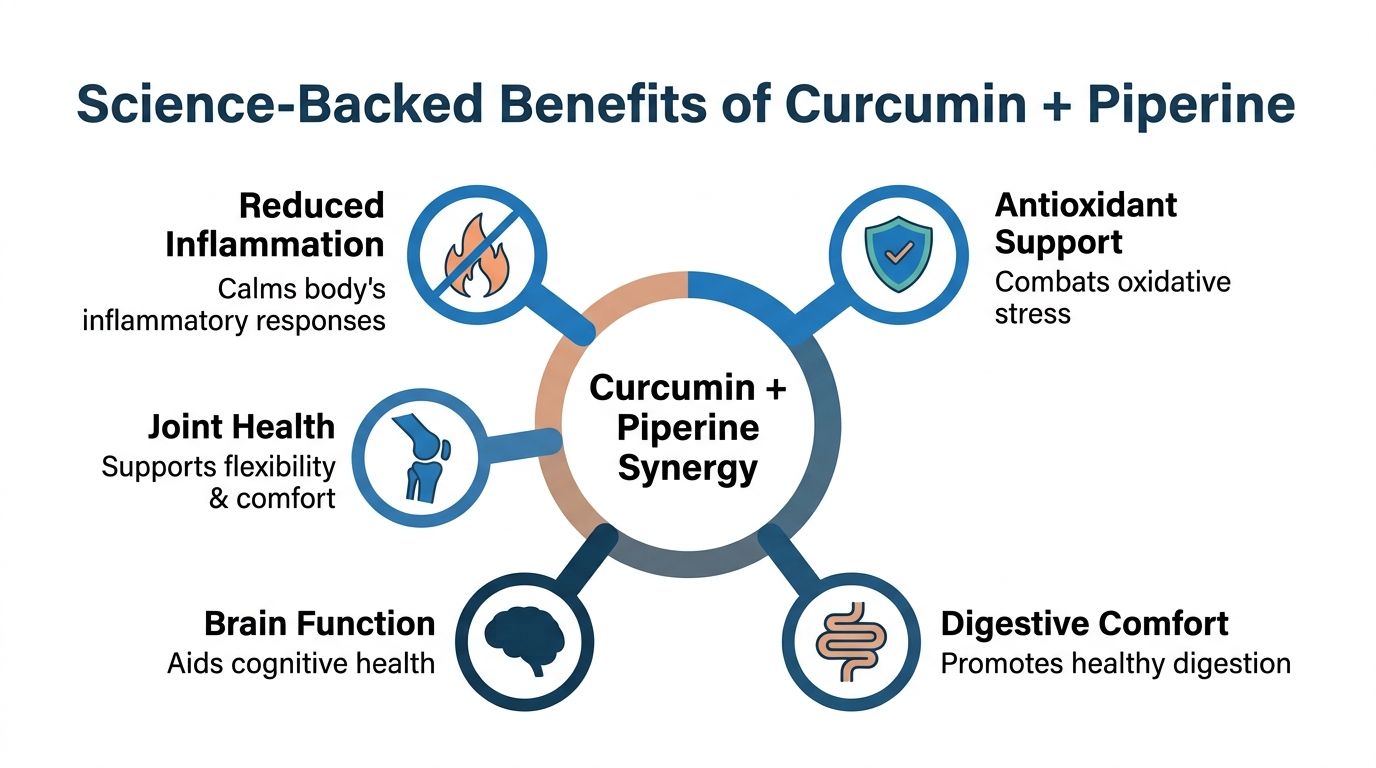
The short answer is yes, with some nuance. Human studies and research reviews suggest curcumin formulas that include piperine can support inflammatory balance, antioxidant status, exercise recovery, and in some cases metabolic markers. The harder part is interpreting what that means in practice, because supplement studies use different doses, different populations, and different curcumin technologies.
What researchers have studied most often
The strongest pattern in the literature is support for inflammation-related outcomes. In plain language, researchers often measure whether the body is sending fewer biochemical “distress signals” over time. That usually means tracking markers such as CRP, ESR, IL-6, and TNF-α.
A published systematic review and meta-analysis in Clinical Nutrition ESPEN examined randomized controlled trials of curcumin supplementation and found reductions in inflammatory markers including CRP and IL-6 in several studied settings, although the size of benefit differed across trials and formulations (Clinical Nutrition ESPEN review on curcumin and inflammatory markers30474-9/fulltext)).
That matters because it moves the conversation beyond the old marketing line about “2000% more bioavailable.” Better absorption only matters if it leads to useful biological effects. The current evidence suggests it sometimes does, but the result depends on the product form, the dose, and the health issue being studied.
Here is a practical summary of where the evidence is most often discussed:
| Area | What the evidence suggests |
|---|---|
| Inflammation | Reviews report improvements in markers such as CRP, IL-6, and related inflammatory signals in some groups |
| Oxidative stress | Some human studies show shifts in antioxidant-related markers |
| Lipid support | Certain trials report modest improvements in triglycerides, LDL cholesterol, or total cholesterol |
| Recovery | Some exercise studies suggest less soreness or improved recovery after strenuous activity |
What those findings may mean outside a lab
Biomarkers can feel abstract. Few people notice a lab value changing from one week to the next.
What they may notice is a slower, steadier effect. Someone using curcumin for joint comfort, post-exercise soreness, or general inflammatory support usually is not looking for the jolt they would get from caffeine or a pain reliever. Curcumin works more like background maintenance. If it helps, the change is often gradual and easier to appreciate after a few weeks than after a single dose.
That is also where confusion starts. A formula that combines curcumin with piperine may work well for one person, while another person does better with a phospholipid, micellar, or liposomal form. The benefit is not just about whether curcumin entered the bloodstream. It is also about where it goes, how long it stays available, and whether the formulation was tested in humans.
A general science overview from the NCCIH explains that turmeric and curcumin have been studied for osteoarthritis, metabolic health, and other inflammatory conditions, while also noting that results are mixed and product quality varies across the market (NCCIH overview of turmeric).
If you like learning visually, this quick overview helps summarize the practical use cases:
A few grounded takeaways help keep expectations realistic:
- Joint comfort: Curcumin is often used as part of a broader plan for stiffness and everyday mobility support.
- Exercise recovery: Some studies suggest a role in reducing soreness, but it does not replace sleep, protein intake, and sensible training.
- Metabolic support: Researchers continue to study curcumin in people with cardiometabolic risk factors, with mixed but interesting results.
- Antioxidant support: This is best understood as quiet cellular support, not something you will necessarily “feel” right away.
Curcumin with piperine has real clinical interest, but it is not the final word on curcumin absorption or effectiveness. The better question is not whether piperine helps. It is whether a given formulation has human evidence that matches your goal.
How to Use Curcumin and Piperine Supplements Safely
People often make one of two mistakes with curcumin. They buy a low-quality product, take it inconsistently, and assume curcumin “does nothing,” or they choose a stronger formula with piperine and forget that better absorption can also mean a higher chance of interactions.
A safer approach is simpler than the marketing makes it sound. Start with the serving size on the label of a product that clearly lists its curcumin source, any absorption enhancer, and the amount per serving. Then give it time. Curcumin is usually used daily and with meals, not once in a while like a pain reliever.
Food matters here. Curcumin is fat-soluble, so taking it with a meal that contains some fat can support absorption. That is one reason many people do better with breakfast or dinner than with an empty stomach.
Consistency matters too.
If you are comparing products, read the label carefully. Some formulas list amounts per capsule, while others list them per two-capsule serving. That small detail causes a lot of confusion.
A few practical habits help:
- Start low and assess tolerance: Begin with the labeled serving rather than jumping to a high-dose formula.
- Take it with food: A meal can make curcumin easier on the stomach and may support absorption.
- Use it regularly: Daily use is more typical than occasional use.
- Check the full formula: Piperine, phospholipids, or other delivery systems can change how a product behaves.
If you want a concrete example of a modern delivery-system product, Life Extension Super Bio-Curcumin turmeric extract 400 mg shows why the label details matter more than a single headline claim about absorption.
Who should be extra careful
Piperine is popular because it can increase absorption. That same trait is also the reason for caution. A useful analogy is a doorstop. If piperine helps hold the door open for curcumin, it may also affect how your body handles other compounds that come through the same doorway, including some medications.
That does not mean piperine is unsafe for everyone. It means people who take prescription drugs should pause before adding it casually, especially if those drugs require stable blood levels or are processed through the liver.
Watch for a few practical concerns:
- Digestive sensitivity: Black pepper extracts can bother some stomachs.
- Medication review: Ask a clinician or pharmacist if you take daily prescriptions.
- Surgical timing: Check supplement use with your care team before a procedure.
“Natural” does not automatically mean low-risk. Plant compounds can still change absorption, metabolism, or tolerability.
For many adults, a curcumin and piperine supplement can be a reasonable choice. The better question is whether that specific format fits your health history, your medication list, and your reason for taking curcumin in the first place.
Is Piperine Still the Gold Standard? A Look at Formulations
For years, piperine was treated as the default answer to curcumin's absorption problem. In many stores, it still is. But the science and the marketplace have both moved on.
Why the famous absorption claim needs context
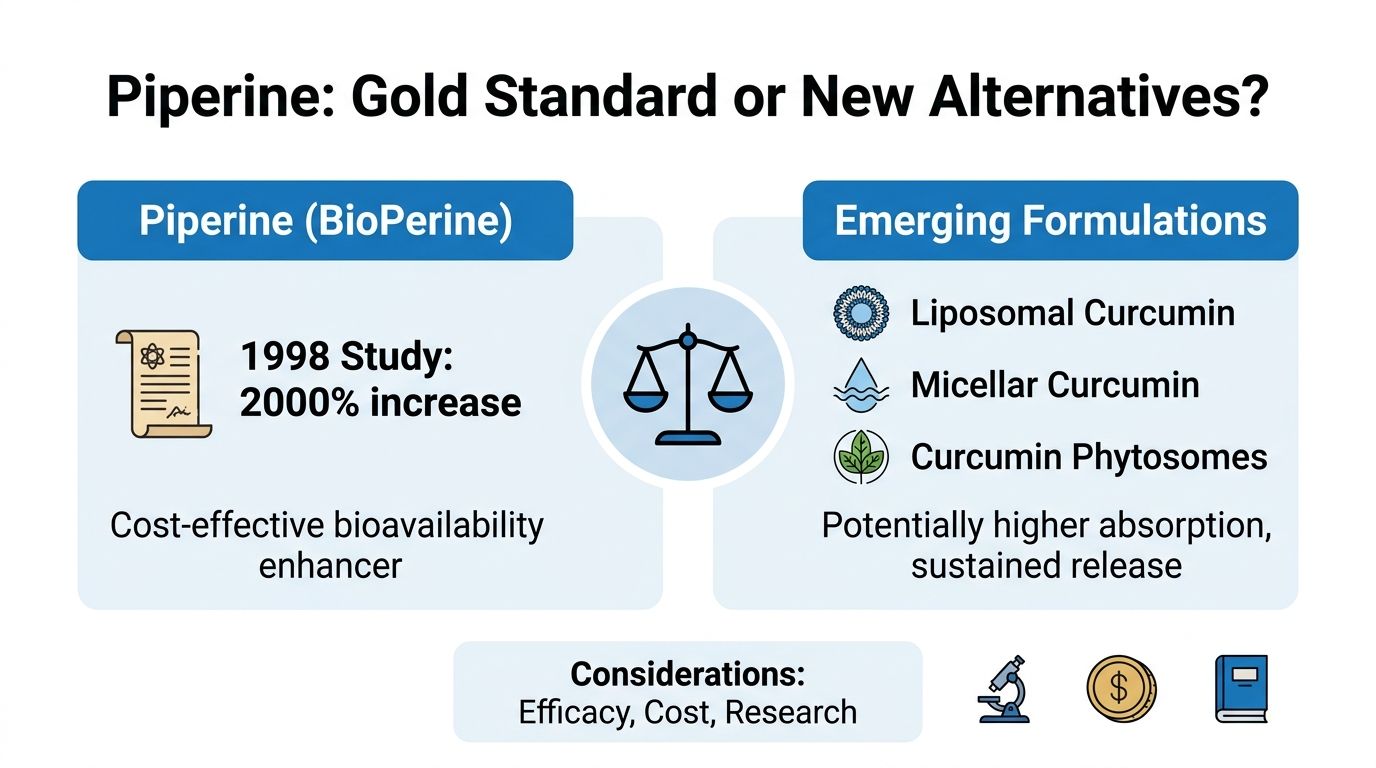
The biggest marketing claim in this category is the familiar 2000% bioavailability increase. The problem isn't that the number appeared from nowhere. The issue is that the claim traces back to a single 1998 study and has not been independently replicated, and modern analyses suggest piperine may not meaningfully increase the active, unconjugated form of curcumin to the degree older marketing implies, as discussed in this doctor-facing review on the black pepper standard debate.
That doesn't automatically make piperine useless. It does mean the claim should be handled with more care.
Many readers find this aspect confusing. A supplement can still have real-world usefulness even if one famous number is overstated or incomplete. At the same time, a strong legacy claim shouldn't stop you from considering better-designed options.
How newer formulations differ
Newer curcumin products try to solve the same delivery problem with different technology. The names vary, but the basic idea is simple.
- Liposomal formulas wrap curcumin in fat-like carriers.
- Phospholipid or phytosome formulas bind curcumin to phospholipids to improve transport.
- Water-soluble or micellar formulas try to help curcumin disperse more effectively in fluid.
Each approach asks the same question: how do we help curcumin survive digestion and become more available without relying on black pepper?
A plain-language comparison helps:
| Formulation type | Core idea | Main advantage | Main caution |
|---|---|---|---|
| Piperine-based | Slow breakdown | Familiar, common, often affordable | Interaction concerns |
| Liposomal | Fat-like carrier system | Different delivery strategy | Label quality varies |
| Phospholipid/phytosome | Bound to phospholipids | Popular for improved uptake | Often costs more |
| Water-dispersible | Better mixing in fluids | Attractive for people avoiding piperine | Product quality differs |
If you're browsing modern options, you'll see examples that lean into non-piperine absorption technologies, such as Life Extension Super Bio-Curcumin Turmeric Extract.
The best formulation isn't always the one with the loudest number on the label. It's the one that fits your body, your medication profile, and the level of evidence you're comfortable with.
If you're healthy, not taking interacting medications, and want a traditional approach, piperine may still be a reasonable choice. If you want to avoid black pepper extract because of sensitivity or interaction concerns, newer formulations deserve a serious look.
A Smart Shopper's Guide to Curcumin Supplements
Supplement shelves are full of labels that sound impressive but don't tell you much. “Turmeric complex,” “high potency,” and “extra strength” can all mean very different things.
How to read the front of the label
Start by separating turmeric powder from curcumin extract. A product can contain a large amount of turmeric root and still provide a modest amount of actual curcuminoids.
Look for details that tell you what's doing the heavy lifting.
- Standardized extract: A better label usually tells you whether the product contains a standardized curcumin or curcuminoid extract.
- Named absorption strategy: It should identify whether it uses piperine, phospholipids, liposomes, or another delivery method.
- Transparent serving information: You should be able to tell how much you get per serving, not just per bottle.
What a better supplement facts panel looks like
When I read a label for a client, I want clarity more than hype. I'm looking for a product that tells me what form it uses and why.
A useful checklist:
Identify the active form
“Turmeric” alone is less informative than “turmeric extract” or a clearly named curcuminoid formula.
Check whether absorption support is specific
If the product uses black pepper extract, it should say so plainly. If it uses a phospholipid or liposomal delivery system, that should also be spelled out.
Notice whether the formula is simple or crowded
Some blends combine turmeric with ginger, boswellia, or other herbs. That's not necessarily bad, but it can make it harder to judge what's helping.
Make sure the serving makes sense
Tiny amounts hidden inside a long proprietary blend make evaluation harder.
A good label reduces uncertainty. A weak label asks you to trust branding more than information.
One more point matters in real life. If you know you're sensitive to black pepper or already take multiple medications, don't ignore that just because a piperine product is common. A newer non-piperine formula may be the more practical purchase for you.
Finding the Best Curcumin Supplement at CalVitamin
Once you know what to look for, shopping gets much easier. You're no longer choosing based on a bright yellow bottle or a “high absorption” slogan. You're comparing formulation strategy, label clarity, and whether the product fits your situation.

A practical way to shop is to search by the kind of formula you want. Try terms like curcumin with piperine, turmeric with black pepper, phytosome curcumin, or liposomal curcumin. Then open the product page and read the Supplement Facts panel before you look at the marketing copy.
If you want a more traditional black pepper style formula, compare those against modern “high absorption” products like Qunol Turmeric Curcumin Complex 1000mg High Absorption. The goal isn't to pick the most aggressive promise. It's to pick the product with the clearest explanation of what it contains and how it's meant to work.
Use a short mental checklist as you browse:
- Match the formulation to your needs
- Check the serving size and active ingredients
- Avoid vague proprietary language when possible
- Pause if you take medications and the product uses piperine
An informed choice is the best choice here. Curcumin can be useful. Piperine can be useful too. But the smartest buyer reads past the old headline claim and chooses the formula that makes sense for their body and their goals.
If you're ready to compare curcumin options with a more informed eye, browse CalVitamin and use the product pages to check formulation type, active ingredients, and absorption strategy before you buy.