

The bottle with the biggest number on the front is often the one with the least to tell you. Probiotic labels compete on colony-forming units, strain counts and phrases like "50 billion live cultures," while the detail that predicts whether a product will do anything useful, the exact strain designation and the dose it was studied at, sits in small print or isn't printed at all.
That flips the usual ranking. A sensible shortlist of the best probiotic supplements isn't a top ten of bottles. It's a set of matches between a goal and a named strain, with the count, the format and the storage instructions checked afterward.
Get the order right and most of the confusion falls away. Get it wrong and you can spend real money on a premium multi-strain capsule that has never been tested for the problem you're trying to solve.
Table of Contents
- Quick Picks by Goal and the Strain Behind Each One
- Why the Strain Decides What a Probiotic Can Do
- Reading CFU Counts and Supplement Labels Correctly
- Gummies, Capsules and Delayed-Release Formats Compared
- Targeted Formulas for IBS, Immunity and Women's Health
- Safety, Side Effects and When to Ask a Clinician First
- Frequently Asked Questions About Probiotic Supplements
- Confirm the Right Product Before You Buy
Quick Picks by Goal and the Strain Behind Each One
A product is best for a goal when its label names the strain that was studied for that goal. Not the highest CFU total, not the longest ingredient list, not the loudest packaging claim. That one rule carries most of the decision, and the table below applies it.
| Goal | Strain to look for | Evidence strength | Format to prefer |
|---|---|---|---|
| Antibiotic-associated diarrhea | Saccharomyces boulardii or Lactobacillus rhamnosus GG, named on the label | Strongest of the goals covered | Capsule or powder with the named strain |
| Acute viral gastroenteritis in children | L. rhamnosus GG, L. reuteri ATCC 55730 or L. casei DN-114 001 | Shortened illness by about 1 day in pediatric studies | Named-strain capsule or powder |
| Constipation | Any strain the label names in full, genus, species and strain code, alongside a study in constipation | Mixed; results depend on strain | Product that discloses strain and dose |
| Bloating or IBS-type symptoms | The specific strain tested in symptom trials, not a species name alone | Mixed; results depend on strain and condition | Product that discloses strain, dose and duration studied |
| General wellness | Multi-strain blend with every strain named | Limited; many claims unsupported | Any format; judge by disclosure |
The top row is the one to trust most. The NIH Office of Dietary Supplements explains that benefits depend on the specific microorganisms or strains and their quantity, not CFUs alone, and the evidence base is strongest for selected preparations in particular uses, especially antibiotic-associated diarrhea. Results for other digestive and non-digestive conditions remain heterogeneous and strain-specific, which is the polite way of saying some products work for some people and many don't.
Row two is narrower than it looks. In pediatric studies, oral probiotics shortened acute diarrheal illness by about one day, and the evidence was more convincing for viral gastroenteritis than for bacterial or parasitic infections. One day is a real benefit for a miserable child. It's not a reason to skip medical care for a sick infant.
Rows three and four are honest about the gap. Constipation and bloating are common reasons people buy probiotics, and they're also the goals where the label rarely tells you which strain was tested, at what dose, for how long. The NIH analysis also found that many probiotic labels omit strain-specific quantities and references supporting health claims, so comparison shopping is harder than it should be.
Row five is where marketing lives. A general wellness blend can be perfectly reasonable, but "supports digestive health" on a bottle is not a studied outcome.
The one-line rule: if the label doesn't name the strain, the goal row doesn't apply to that product.
Read down the table until you find your goal, then match the named strain exactly. Dose and format come next.
Why the Strain Decides What a Probiotic Can Do
A probiotic's name is a three-level address, and only the last level matches a study to the capsule you bought. Probiotics are live microorganisms that, taken in adequate amounts, may confer a health benefit. The "may" is doing real work. Genus sits at the top, species in the middle, strain at the bottom. Evidence attaches to the strain, not to the family name printed in large type.
Vehicles make the hierarchy easier to see. "Lactobacillus" works like the category "car." Hatchbacks and heavy trucks both count as cars, and they do not handle the same jobs. The strain designation, those extra letters and numbers after the species name, is the specific model. That model is what decides which effect, if any, you can reasonably expect.
The World Gastroenterology Organisation's probiotics and prebiotics guideline states the principle directly: evidence from one probiotic strain should not automatically be applied to another, even when the organisms are closely related. Two bottles can both say Lactobacillus and still share almost nothing that a trial tested.

Where evidence exists, it clusters around full names. For acute infectious diarrhea, that same WGO guideline points to several specific preparations, including Lactobacillus rhamnosus GG, Lactobacillus reuteri ATCC 55730, Lactobacillus casei DN-114 001 and Saccharomyces cerevisiae var. boulardii. Each of those names is complete enough to search in a paper and to find, or fail to find, on a label.
Effects on diarrhea stay modest, and they depend on the strain and on the kind of illness being studied. A positive result for one named organism in one setting does not travel to a different organism, a different dose, or a vague blend. Specific strains have specific, limited effects under specific conditions, and many other claims sit on thinner ground.
Strain identification, the studied use, and the dose therefore tell you more than a high CFU figure or a "multi-strain" banner. Before two bottles go side by side, copy the exact strain designation from each label. Without that designation, the comparison is only packaging.
Reading CFU Counts and Supplement Labels Correctly
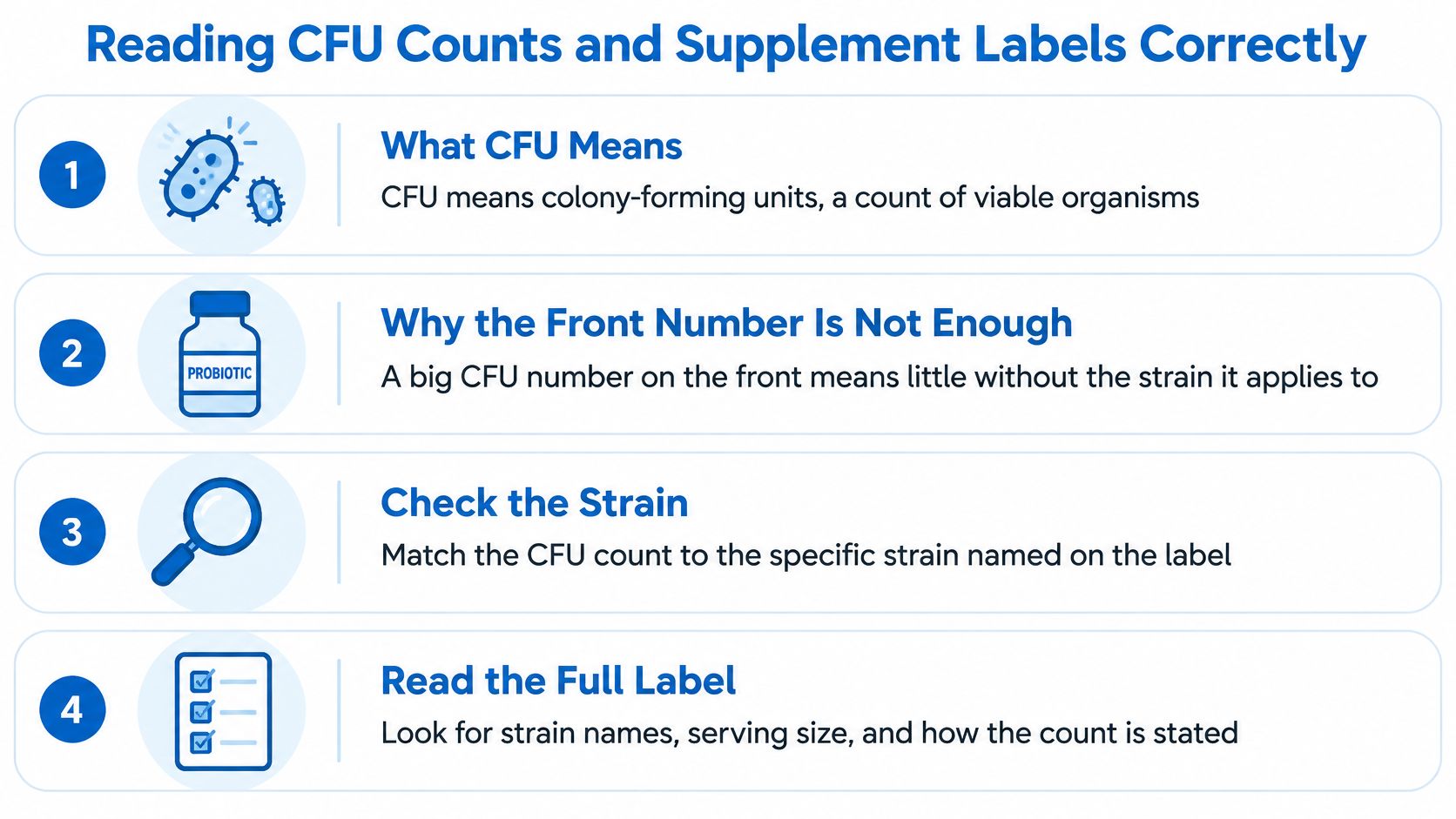
CFU stands for colony-forming units, a count of viable organisms. It answers a fair question, how much live material is in a serving, and it answers it only for the strain it's attached to.
What the number on the front really means
A big CFU figure means little without the strain it applies to. It also means little if it describes the count at manufacture rather than at expiry, because counts fall during storage. A product that promises 50 billion at bottling may hold a fraction of that by the time you open it in month eight.
What US rules do and don't guarantee
Probiotic supplements in the United States sit in a different regulatory lane from prescription medicines. Under the Dietary Supplement Health and Education Act, the FDA does not approve dietary supplements before they are marketed. Manufacturers and distributors are responsible for safety and for keeping labeling claims truthful and not misleading, and if a product contains a new dietary ingredient, generally one introduced after October 15, 1994, the company must notify the FDA at least 75 days before selling it, with the basis for concluding it can reasonably be expected to be safe.
Current good manufacturing practices cover identity, purity, quality, strength and composition. Labels must identify the product as a dietary supplement and generally include a Supplement Facts panel, other ingredients, business information and net quantity. What none of this proves is clinical superiority. Retail availability is not FDA preapproval, and "probiotics" isn't even a formal product category under federal law.
The short video below walks through the same label decisions at shelf level.
Storage is part of the label story. Counts survive differently depending on whether a product needs cold chain, which is why the trade-offs in our comparison of refrigerated vs shelf-stable probiotics matter as much as the number printed on the front.
Five things to confirm on any label before you buy:
- A named strain code. Genus, species and strain letters or numbers, not just "Lactobacillus."
- CFU guaranteed to expiry. The label should state the count through the expiration date, not only at manufacture.
- A complete Supplement Facts panel. Strain amounts per serving, other ingredients, manufacturer or distributor, net quantity.
- References behind any health claim. A study citation or a strain-specific dose you can verify beats confident wording.
- A quality statement. GMP compliance, third-party testing or an equivalent manufacturing claim.
Guaranteed, not at manufacture: a count that holds to the expiration date is the only count you can plan around.
Gummies, Capsules and Delayed-Release Formats Compared
Live organisms have to survive manufacturing, months on a shelf and, for oral products, stomach acid. Format changes how well each of those stages goes, and it changes what else lands in the serving.
| Format | Strain stability | Typical additions | Best for | Watch for |
|---|---|---|---|---|
| Capsules | Usually stable when sealed and stored as labeled | Few added ingredients | Daily routine with named-strain dosing | Some strains need refrigeration |
| Gummies | Lower stability; heat and moisture reduce counts | Sugar, flavorings and gelling agents | People who avoid swallowing capsules | Check guaranteed CFU at expiry |
| Delayed-release capsules | Enteric coating protects strains through stomach acid | Often higher cost | Acid-sensitive strains | Coating does not prove added benefit |
| Refrigerated products | Cold storage keeps counts more stable for longer | Often fewer shelf-stable additives | Products labeled refrigerate | Shipping temperature matters |
Capsules dominate for a reason. Sealed and stored as directed, they hold counts well and add little beyond the strain and a carrier, which suits a daily routine built around one named strain at a studied dose.
Gummies solve a real problem, since plenty of adults won't swallow capsules. They also introduce heat, moisture and processing into a product full of living cells, plus sugar and flavorings you didn't ask for. In that format the guaranteed CFU at expiry is the number that counts, and the rest of the ingredient list deserves a read too. CalVitamin's gummy range shows how much label detail varies within one format: the Okay Immune Health Support Gummies are non-GMO, gluten-free, and crafted under GMP standards, and their label directs you to pair them with a meal containing healthy fats for best absorption. It's an immune formula rather than a probiotic, but it's a fair example of the specifics a good label volunteers.
Delayed-release capsules earn their price when the strain inside is acid-sensitive. The coating helps it past the stomach. It doesn't independently prove the product works, and the extra engineering shows up in the cost.
Refrigerated products keep counts steadier over long storage, provided the cold chain holds from warehouse to your kitchen. A bottle that sat in a warm delivery van for a day isn't the product the label describes.
A coating buys protection through the stomach. It doesn't buy proof.
If you want to compare formats on the CalVitamin site, read the strain designation and the guaranteed CFU first, then choose the format your routine and storage can support. More on the gummy side of that decision sits in our guide to prebiotic and probiotic gummies.
Targeted Formulas for IBS, Immunity and Women's Health
Targeted formulas are built around a condition and priced accordingly. The test is the same for all of them: does the named strain on this label match a studied use for my specific problem?
IBS-type symptoms
Look for a named strain that has been tested in symptom trials, then check whether the product's dose matches the dose studied. Many don't, which is why a bottle can carry the right strain name and still deliver too little of it. Bloating and abdominal pain also have causes unrelated to gut bacteria, including diet, medication and conditions that need diagnosis. Symptoms that persist, worsen or come with weight loss or bleeding call for a clinician, not a supplement trial.
Immunity claims that outrun the evidence
Strain-specific evidence exists for some immune-related uses. Much of what's sold under the immunity banner rests on general wellness language instead, which is why "boosts your immune system" is a phrase to treat as decoration. Prefer products that name their strains and point to studies, and expect any honest product to describe support rather than protection.
Women's health formulas
Most women's probiotic formulas lean on Lactobacillus species, so check both the species and the strain designation, then ask whether a study exists for that exact strain in that exact use. Treat any claim to prevent or treat infection as a red flag, especially when it's printed near a product that also contains D-mannose or enzymes with their own claims. Our women's probiotic review covers how those combination formulas differ.
The rule is identical across all three categories. A targeted formula earns its place when its named strain, its dose and its studied use line up with your need, and a general wellness blend can't borrow credibility from a condition it was never tested against.
Safety, Side Effects and When to Ask a Clinician First
A probiotic is a live microbe you choose to swallow. In a healthy adult it usually acts like a houseguest who leaves after a few days: the common complaint is mild gas at the start, then nothing much. Many comparisons end on that note. A buying decision should not.
The systematic review of long-duration probiotic studies is useful here because it looks past the first week. Follow-up was limited, adverse-event reporting was inconsistent, and rare or strain-specific harms could not be assessed. That review could not establish long-term safety.
Favorable short-term results in healthy adults do not cover every strain or every person. Risk looks different when someone is seriously ill, when immunity is weak, or in preterm infants, where infection is the concern rather than gas. Screen for that before you compare labels.
Ask a clinician before starting if any of these fit:
- Weakened immunity. Including immunosuppressive therapy, HIV, or recovery after transplant.
- Serious illness or hospitalization. Critical illness changes the risk calculation.
- A central venous catheter. Bloodstream access raises the stakes of any live organism.
- Pregnancy or nursing. Discuss the specific product, not the whole category.
- Infants, especially preterm babies. A clinician should choose the product and watch how it is used.
Bacteremia, fungemia, and other serious infections are uncommon, and the reported cases cluster in people who are severely ill or immunocompromised. Gas that settles is a separate event. Fever, blood in the stool, or abdominal pain that is severe and worsening means stop the product and get care. Those signs need a diagnosis.
Strain names belong in this check too. A strain documented for one use in healthy adults has not, by that documentation, been shown safe for a fragile patient. Match the strain to a studied use, then decide whether a live microbe is appropriate for you at all.
Supplements are not a substitute for diagnosis or treatment. A capsule cannot explain why your gut feels off.
Statements about dietary supplements on this website have not been evaluated by the Food and Drug Administration. The products are not intended to diagnose, treat, cure, or prevent any disease.
Frequently Asked Questions About Probiotic Supplements
How long should I take a probiotic? Use the duration studied for the named strain and goal. If there's no meaningful change by the end of that window, stop and reassess with a clinician rather than buying a second bottle on hope.
Is a higher CFU count better? Not on its own. Benefit depends on strain, dose and studied use, so a lower-count product carrying the matching strain is often the better buy.
Should I take one with antibiotics? Ask a clinician or pharmacist about timing before you start. The antibiotic-associated diarrhea evidence applies to specific strains, not to probiotics in general, and spacing doses through the day is a practical question for whoever prescribed the antibiotic.
Does it need refrigeration? Only if the label says so. Shelf-stable products hold their counts when sealed and stored as directed, and putting a shelf-stable bottle in the fridge doesn't improve it.
Can I switch strains partway through? Switch only to a product whose named strain matches your goal, and compare the label before you buy. A different strain is a different intervention.
Can children take probiotics? Only after a clinician has reviewed both the product and the child's health status, particularly for infants.
Confirm the Right Product Before You Buy
Work through these five steps in order, and don't let a sale price rush you past step two.
- Find your goal row in the quick-pick table and note the strain it names.
- Confirm the label lists that exact strain designation at a dose that matches the studied use. If it lists only a genus or species, stop here.
- Check that the CFU count is guaranteed through the expiration date, not just at manufacture.
- Choose a format that fits your routine and storage, capsules for stability or gummies if swallowing capsules is the barrier.
- Read the storage instructions and confirm whether the product needs refrigeration, including during shipping.
A product that fails steps one and two doesn't become acceptable because it carries a huge CFU number or confident marketing. Those are the two steps that decide whether the evidence applies to you at all.
CalVitamin's online store lists Pro/Pre-biotics alongside categories including Minerals, Proteins, Vitamins, Raws, Blends, Sports, Beauty and Personal Care, Enhancers, Herbs, Sexual enhancement, and Life style, so you can compare probiotic options in one place and check each label against the goal you're shopping for. To get the genuine product, buy from the official CalVitamin website or from authorized supplement retailers.
One guardrail before checkout. If you're in a higher-risk group, confirm the choice with a clinician first, then buy.
If this guide changed how you read a probiotic label, the next step is a practical one: open the CalVitamin Pro/Pre-biotics collection and put two products side by side, then check each one against your goal row, its named strain and the CFU guaranteed at expiry. CalVitamin stocks probiotic and prebiotic formulas across multiple formats, so you can compare capsules against gummies and single strains against blends using the same five steps. Start with the goal, keep the strain, and let the label earn your money.


