
Most buying guides treat pectin vs gelatin gummies as a diet checkbox. Pick pectin if you want vegan, pick gelatin if you don't. That advice is half right and it hides the decision that changes the gummy in your hand. The base sets the chew, the heat tolerance, and how the formula behaves after it leaves the factory. A gelatin-free badge doesn't tell you whether the piece will bounce, snap, or turn sticky in a warm mailbox.
Table of Contents
- Pectin and Gelatin Gummies Side by Side
- Where Each Base Comes From and Which Diets It Fits
- How Gelatin and Pectin Set Differently in Chew and Texture
- When Gelatin and Pectin Are Combined in One Gummy
- Choosing a Base for Your Situation
- Heat, Stability and What to Check Before You Buy
Pectin and Gelatin Gummies Side by Side
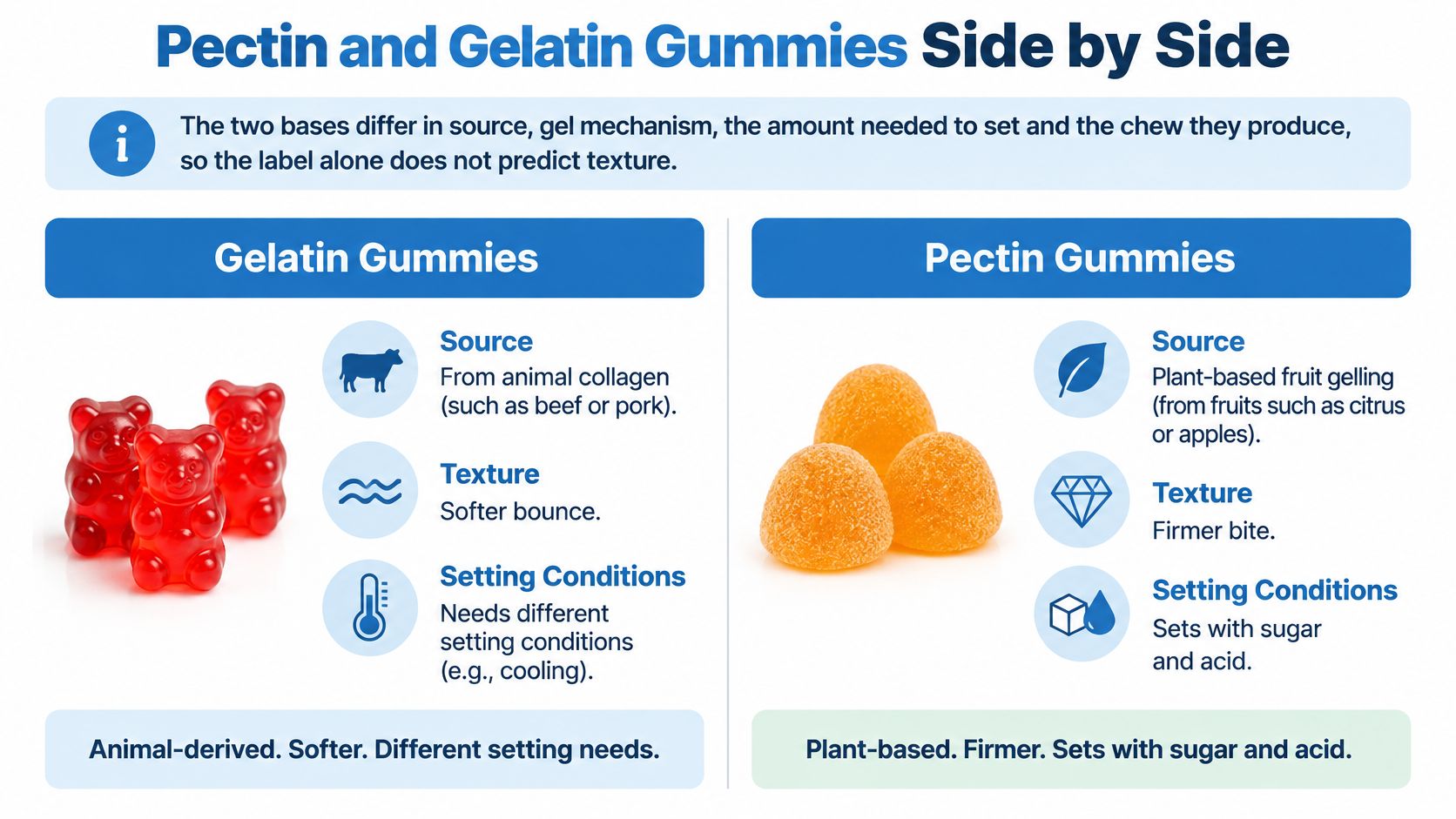
The two bases differ in source, gel mechanism, the amount needed to set, and the chew they produce, so the label alone doesn't predict texture.
| Feature | Gelatin gummies | Pectin gummies |
|---|---|---|
| Source | Animal collagen from skin and bones | Plant polysaccharide from citrus peel or apple pomace |
| Gel mechanism | Protein network that sets on cooling and is thermoreversible | Polysaccharide gel that depends on acidity and soluble solids; low-methoxyl types also need calcium |
| Typical use level in study | 5.0% to 10.0% | 1.0% to 2.0% |
| Chew profile | Elastic, traditional chew | Shorter, softer bite that can turn brittle |
| Setting behavior | Sets on cooling and is forgiving during high-speed depositing | Sets faster and needs tighter pH and temperature control |
Gelatin gives an elastic, traditional chew. Pectin gives a plant-based base that sets quickly and can turn brittle.
Those use levels aren't interchangeable doses. Gelatin builds a protein network, so formulators often run it higher to get the bounce shoppers expect. Pectin is a fruit polysaccharide. Under the right acid and sugar conditions it gels at a much lower percentage, which is why a one-for-one swap ruins both texture and process.
Raising the percentage of either agent does the same directional thing. The piece gets stronger and less stretchy. A "pectin" gummy at the low end of a working formula can feel short and soft. Push that same pectin higher, or cook it past the set point, and the bite goes firm, then brittle. Gelatin moves the other way on the same dial: more protein, less give, until the classic stretch disappears.
What to do with the label
Read the gelling agent, then match it to the chew you want.
- Want stretch: look for gelatin, or a hybrid that still lists gelatin.
- Want a short, clean bite and no animal gel: look for pectin as the only gelling agent.
- Want both bounce and a fruit snap: a hybrid is a texture choice, not a vegan one.
The cases below are where that match matters more than the front-of-pack claim.
Where Each Base Comes From and Which Diets It Fits
Gelatin is collagen from animal skin and bones, usually bovine or porcine. It isn't vegetarian or vegan. It also isn't halal or kosher unless the animal source and the processing both carry the right certificate. A beef gelatin review, including how collagen peptides show up in finished gummies, is a useful contrast if you're comparing animal gels rather than plant ones: our Vital Proteins beef gelatin review walks through that animal-collagen side.
Pectin comes from citrus peel or apple pomace. The gelling agent itself fits vegetarian and vegan formulas. The finished gummy still has to pass the same test, because flavors, colors, glazes, and the sugar source can put an animal ingredient back in.
| Requirement | Gelatin gummies | Pectin gummies |
|---|---|---|
| Vegetarian | No, animal-derived | Yes, if flavors and colors are also vegetarian |
| Vegan | No | Yes, if flavors, colors, and sugar source are also vegan |
| Halal | Only with a halal-certified animal source and processing | Only with a halal certificate covering the source and processing |
| Kosher | Only with a kosher-certified animal source | Accepted when the product carries a valid kosher certificate |
| Gelatin-free claim | Not possible | Possible, if no gelatin appears in the ingredient list |
Practical rule: A gelatin-free label only means something when gelatin is absent from the ingredient list. A plant gelling base isn't vegan if the flavor, color, or glaze is animal-derived.
Okay Bone Support Gummies are made with plant-based pectin and contain no gelatin. They're also gluten-free, non-GMO, and vegetarian-friendly. That stack is the point. The pectin base opens the vegetarian door, and the rest of the formula has to keep it open. A shopper who only reads "gummy vitamins" on the front never sees which door they walked through.
Allergens and the sources you may be avoiding
Gelatin isn't one of the major food allergens, but it is bovine or porcine unless the label says otherwise. If you avoid those animals for diet, faith, or preference, the species on the ingredient panel is the fact that matters, not a generic "collagen" word.
Pectin rarely triggers allergy on its own. Citrus or apple sensitivity still can, so the allergen statement is worth the extra ten seconds. Fruit-derived doesn't mean reaction-free.
Check the certification mark and the full ingredient list. The front claim is a headline. The panel is the recipe.
How Gelatin and Pectin Set Differently in Chew and Texture
These bases aren't a one-for-one swap. Each one builds a gel by a different route, so the percentage on a spec sheet isn't a shared dial.
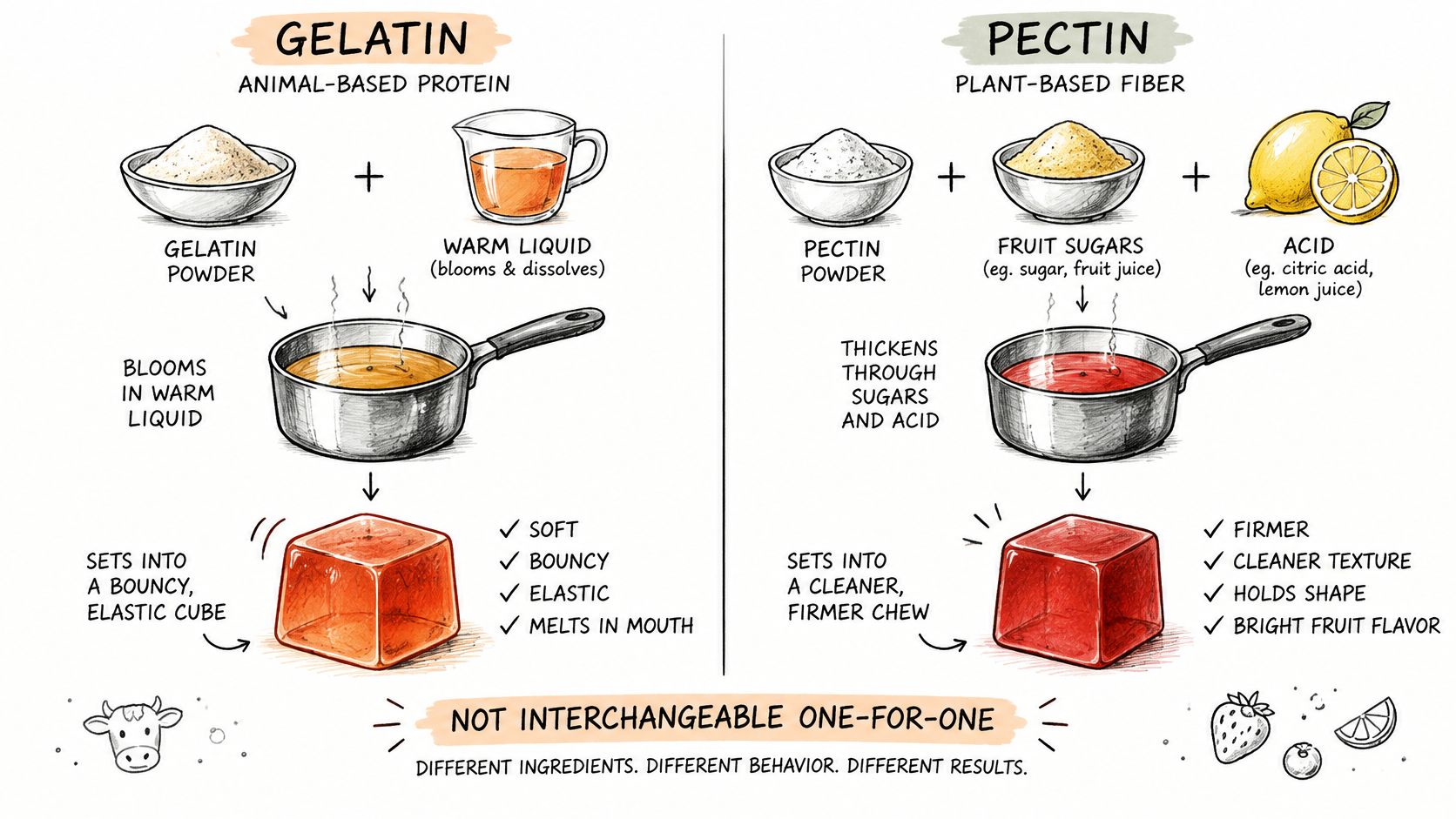
An experimental gummy-tablet study tested gelatin at 5.0%, 7.5%, and 10.0%, and pectin at only 1.0%, 1.5%, and 2.0%, as the IOP Conference Series paper records. Gelatin is a protein that forms an elastic, thermoreversible network. Heat it and the network loosens. Cool it and the network returns. Pectin is a plant polysaccharide. Its set depends strongly on acidity, soluble solids, and water activity. That's why the tested pectin levels sit far below the gelatin levels. The gels aren't doing the same job at the same dose.
What a higher percentage actually does
In that same study, raising the concentration of either gelling agent increased mechanical strength and reduced elasticity. Chewiness and firmness move with the percentage, not with the marketing name.
The researchers didn't stop at gel strength. They also measured weight variation, dimensions, swelling ratio, dispersion time, syneresis, hardness, chewiness, and gumminess. Those map onto things you can notice:
- Hardness and chewiness: how much work your teeth do before the piece breaks.
- Gumminess: whether it stays rubbery or collapses.
- Syneresis: weeping liquid that makes pieces stick together in the bottle.
- Swelling and dispersion: how the gummy takes up moisture and how fast it comes apart.
- Weight and dimensions: whether each piece is close enough in size that a "2 gummy" serving is a real dose.
A gelatin gummy, at a typical protein level, gives the longer, more elastic chew. A pectin-only gummy often feels shorter and softer, and it can go brittle when the set is pushed too far. Neither outcome is "better" until you name the chew you want.
Pectin often reaches a gel at a lower formulation percentage, so a pectin gummy isn't simply a cheaper gelatin gummy.
Those percentages also aren't nutritional doses. Pectin gels with less polymer because acid and sugar do part of the setting work. Gelatin needs more of itself because the protein network is the structure.
Judge the gummy by the chew and firmness the maker describes, and by how the pieces look in the bottle, not by the base name alone. A short clip on how these gels behave in the pan makes the cooling-versus-acid difference easier to picture.
When Gelatin and Pectin Are Combined in One Gummy
Pectin isn't only a stand-in for people who skip animal ingredients. In a mixed gummy it works as a texture-modifying co-gellant. The ratio, not the word "hybrid," decides whether you get fruit softness or a snap.
One controlled confectionery study held the sweets base at 33.4% sucrose and 29.8% corn-syrup solids, then moved gelatin across 3.0%, 4.5%, and 6.0% and high-methoxyl pectin from 0% to 1.5%, according to the Penn State publication on gelatin/pectin gummy structure. That design isolates the polymers. Sugar stays put. Only the gels move.
What changed as pectin went in
Adding pectin reduced the strain at fracture of the gelatin gels. The material could stretch less before it broke. That's the sensation of a shorter chew, even when gelatin is still the larger polymer.
Microscopy showed a second effect. Higher total polymer, or more pectin, raised phase viscosity and sped gelation. Faster set helped stop the gelatin-rich phase from coalescing into its own pockets. You get one piece instead of a gel with soft spots.
A separate 2021 study reported a synergistic interaction when pectin was added to gelatin gummies. The combined network got stronger or tighter depending on the ratio. Synergy here isn't a free upgrade. It means the blend can outperform either gel alone at that specific balance, and miss the target when the balance shifts.
The range a buyer can actually feel
At the soft end, a low pectin addition on a moderate gelatin base stays fruity and yielding. At the firm end, more pectin and more total polymer cut stretch until the piece is firm and brittle. Commercial formulas use that span to aim at elasticity, firmness, fracture resistance, and chewiness together. They don't land on all four at once.
Acid is the trap. Acidic conditions can hydrolyze gelatin and weaken the protein network. Pectin's own gel still depends on pH and soluble solids. A hybrid has to hold both constraints at the same time. Drop the pH to make the pectin set, and you can damage the gelatin you added for bounce.
A hybrid on the label means the maker is tuning texture. Read the chew description. Don't assume the result is "the best of both."
Choosing a Base for Your Situation
Pick the base for the job, not for a single slogan. Pectin vs gelatin gummies splits into three products: pectin-only, gelatin-only, and hybrid. Treating them as one category is how shoppers buy the wrong chew.
| Your priority | Better base | Why |
|---|---|---|
| Easy chewing | Pectin-only, softer formula | Shorter, softer bite that is easier to chew, though it can turn brittle if overset |
| Long, elastic chew | Gelatin | Elastic network that stretches before it breaks |
| Summer shipping and heat exposure | Pectin | Resists melting far better than gelatin, but still needs heat and stability testing |
| Gelatin-free or vegan label | Pectin-only | Pectin is the plant-based gelling base; a hybrid contains gelatin and fails both labels |
| Fruit-forward taste | Pectin-only | All three pectin formulations scored higher overall liking than the gelatin formulation in a 129-consumer test |
| Firm but not brittle | Hybrid with a tuned ratio | Pectin lowers fracture strain, so the gelatin ratio must balance it |
In controlled sensory testing of 129 consumers, all three pectin formulations scored higher for overall liking than the gelatin formulation, while texture preferences clustered around soft/smooth, hard/long-chew, and waxy/teeth-sticking profiles, as Nutritional Outlook's SupplySide West report describes. Liking isn't the same as "this base always wins." Those clusters are three different people. One wants a short smooth bite. One wants a long chew. One hates wax on the teeth.
Why the table is a start, not a rule
Patent descriptions of pectin-only gummies note they leave molds faster, and they can be more brittle and less chewy than gelatin gummies. Mixed gels that cut fracture strain run from soft and fruity to firm and brittle. The same word "pectin" covers both ends.
Say a parent wants a gummy for a child who dislikes sticky, stretchy chews. A softer pectin-only formula matches that mouthfeel better than a bouncy gelatin piece. Ask a pediatrician before giving any adult-formulated gummy to a child. An adult who wants the traditional elastic chew is in the other column. Gelatin, or a hybrid that keeps enough gelatin to stretch, fits that bite. Someone who needs the product to stay gelatin-free should skip the hybrid entirely and read a gelatin-free vitamins label the same way, ingredient by ingredient.
Sweeteners, acids, polymer concentration, and processing can move texture more than the base name does. A pectin gummy cooked hard will not feel like the soft pectin piece those 129 people liked. Match the priority in the table, then trust the chew notes on that specific product.
Heat, Stability and What to Check Before You Buy
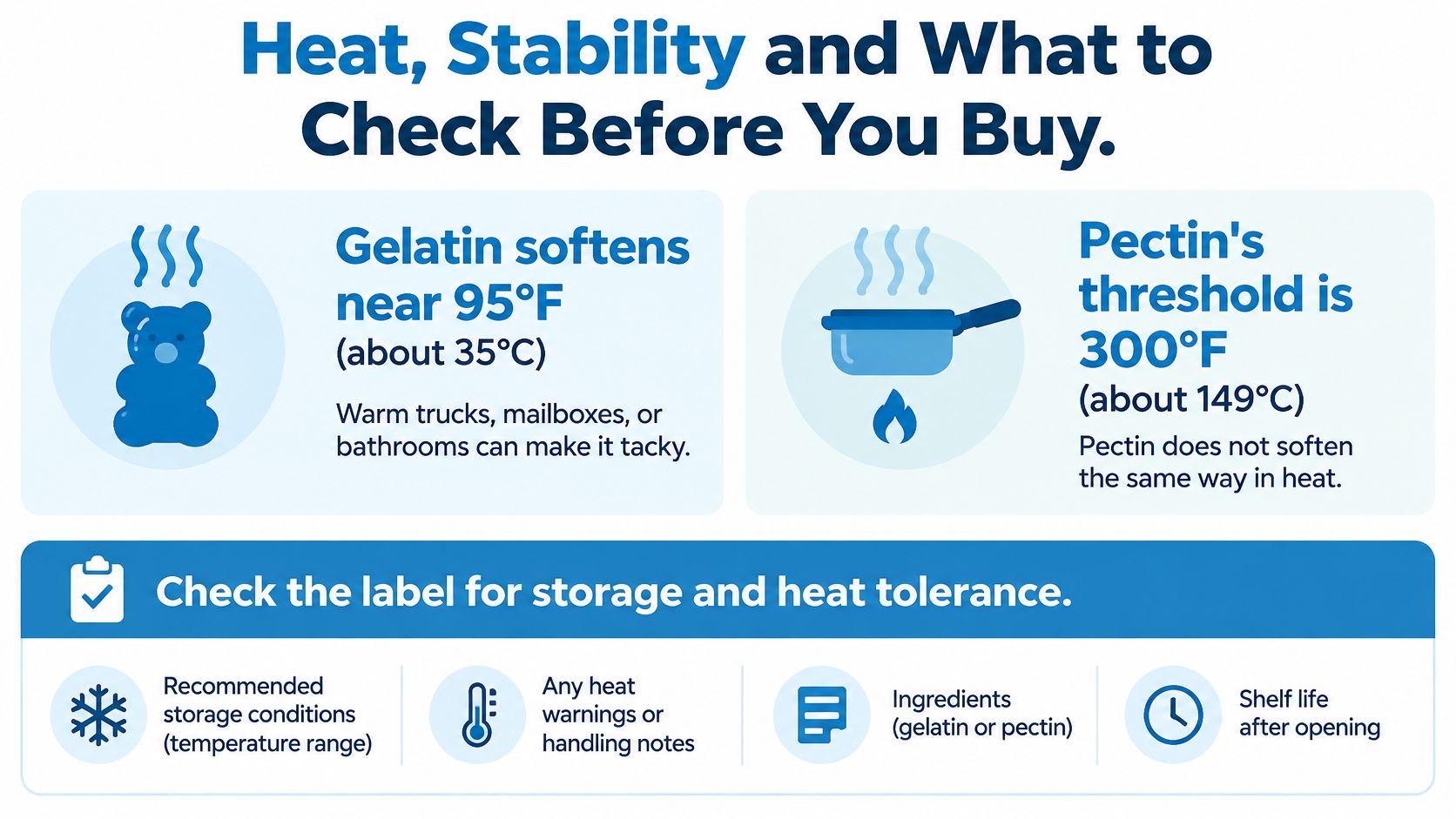
Heat is where the diet story stops helping you. Technical formulation guidance from Baker Perkins reports gelatin melting near 95°F (about 35°C). A warm truck, a mailbox in July, or a humid bathroom can soften a gelatin gummy, knock down its structure, and leave it tacky. The same source places pectin's melting point near 300°F (about 149°C). Read that as heat resistance, not as a temperature you'll ever store a bottle at. Pectin doesn't soften the way a protein gel does when the cab of a delivery truck climbs past body temperature.
What heat resistance doesn't guarantee
Pectin isn't automatically shelf-stable. Its gel still depends on pH, sugar or soluble solids, calcium for low-methoxyl systems, the cooking endpoint, and the depositing temperature. Gelatin is the more forgiving gel on a high-speed line because it sets as it cools. Pectin can set faster and punishes a miss on acid or temperature.
Will the gummy stay potent, intact, and pleasant after a hot route, a steamy bathroom, or the first week with the cap off? The gelling agent is only one input. Stability also tracks the active ingredient, water activity, packaging, acid level, dose, and the storage line on the label. A ScienceDirect candy study found pectin-based samples had less variation in physicochemical properties after a bioactive extract was added. That's better structural and compound-retention stability in that formula. It isn't proof that every pectin gummy holds actives better than every gelatin one. Mixed gels can still go brittle, and acid plus nutrients can move the set.
Okay Bone Support Gummies list organic tapioca syrup, cane sugar, pectin, natural flavors, and citric acid. The syrup and sugar are the soluble solids. Citric acid is the pH lever. Together they are why this pectin piece sets, and why a sloppy acid balance would change both bite and how well the gel holds. They're made under GMP-certified quality standards. Each bottle holds 90 gummies and lasts 45 days at 2 gummies a day, so you're not guessing the run-out date.
Shoppers sometimes treat gelatin-free as a quality grade. A careful gelatin or hybrid formula can chew better, ship more intact, or hold a dose more evenly than a pectin gummy that was never tested for heat, moisture, or weeping. Faith-based buyers have a separate check: a halal-certified vitamins mark has to cover source and processing, not just the absence of an obvious animal word.
Four checks before you buy
- Confirm the base. Find pectin, gelatin, or both on the ingredient list. Ignore the front claim until the panel agrees.
- Match your priority. Soft chew, long chew, summer shipping, or a gelatin-free label. Use the priority table, not a brand slogan.
- Check the quality mark. GMP on the Okay Bone Support Gummies is one concrete standard. Look for the certificate that matches the diet claim you need.
- Do the bottle math. Count divided by daily gummies is days of supply. 90 gummies at 2 a day is 45 days. Do that division on any bottle so you aren't short mid-month.
Ask whether the maker has run accelerated heat testing, water activity, moisture migration, syneresis, and package-blocking checks. Those five tell you if pieces melt, dry out, weep, or glue themselves to the pouch.
Pectin-only when you need gelatin-free, vegan, or a bottle that survives warm shipping. Gelatin when you want the traditional elastic chew and you can keep the bottle cool. Hybrid only when the maker has tested the ratio and the chew description matches a firm-but-still-stretchy piece. A gelatin-free option is already on our shelves if that first path is yours.
CalVitamin carries pectin-based and other gummy supplements so you can match the base to the chew, the diet, and the way the bottle will be stored. Compare ingredient panels on gelatin-free and traditional gummies, including serving size and quality marks, before you add a bottle to your routine. Visit CalVitamin to review the current gummy lineup and pick the base that fits your priority.


