Are you really buying a calcium with vitamin C supplement, or are you just buying two separate nutrients wearing one label? That confusion matters, because vitamin C and calcium do not play the same biological role, and they don't share the same dosing rules. U.S. dietary guidance sets the adult RDA for vitamin C at 75 mg/day for women and 90 mg/day for men, while the RDA for calcium is 1,000 mg/day for adult men and women, with vitamin C also carrying an upper intake level that ranges from 400 to 2,000 mg/day depending on age (guidance summary).
That's why the label can be misleading. Sometimes it means calcium ascorbate, a single compound that contains both nutrients. Sometimes it means a product that blends calcium and vitamin C in one tablet. And sometimes it's just marketing shorthand for taking two different supplements at the same time.
Table of Contents
- What Calcium With Vitamin C Actually Means
- How Vitamin C and Calcium Work Together in Bone Health
- Comparing Supplement Forms and Formulations
- Recommended Dosages and Timing for Best Results
- Safety Considerations and Kidney Stone Risk
- Dietary Sources and Practical Shopping Tips
- Frequently Asked Questions About Calcium With Vitamin C
What Calcium With Vitamin C Actually Means
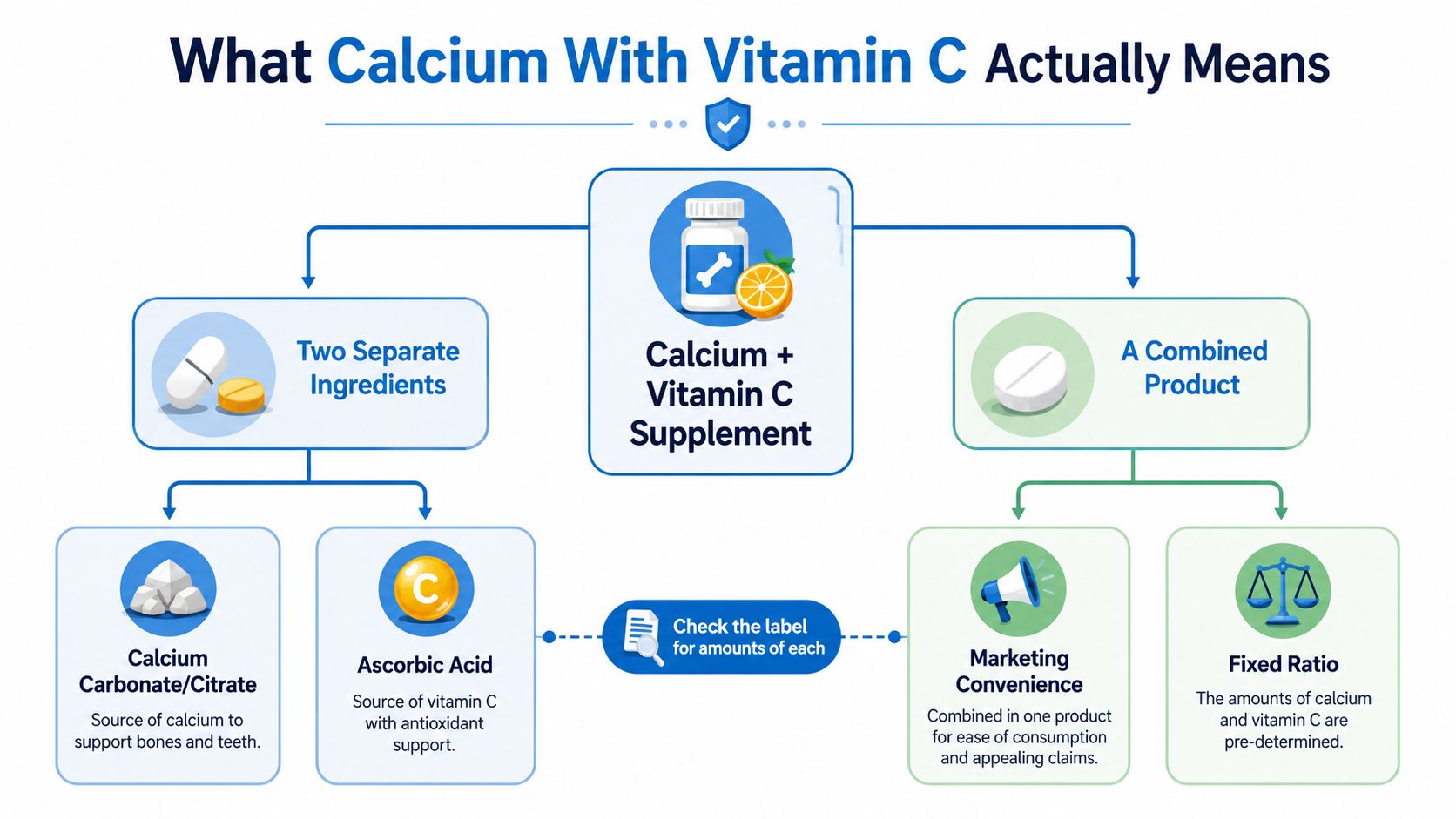
A lot of shoppers assume calcium with vitamin C must be a special synergy, but the label often hides a much simpler story. It may describe one compound, two ingredients in one product, or two separate supplements taken together. Those are not the same thing, and the difference matters for dose tracking, tolerability, and whether you're paying for something useful or just convenient packaging.
Three versions of the same search term
Calcium ascorbate is the most literal version of the phrase. It's a mineral ascorbate, so one ingredient provides both calcium and vitamin C in a buffered form that tends to be less acidic than plain ascorbic acid. A combined product is different, because it may contain calcium carbonate or calcium citrate plus added vitamin C, with each ingredient listed separately on the label.
A third version is pure routine, not formulation. You might buy a standalone calcium supplement and a separate vitamin C supplement, then take them together at breakfast or dinner. That can be perfectly reasonable, but the label won't tell you whether the product itself is a combined compound or just a mixed formula.
Why the distinction matters
The reason this gets confusing is that vitamin C and calcium are different nutrients with very different benchmarks. Vitamin C is measured in milligrams at a much lower daily target, while calcium is needed in far larger amounts for bone and mineral balance (RDA summary). So a product that says “with vitamin C” isn't automatically giving you a meaningful calcium dose, and a calcium pill with a little vitamin C isn't automatically a true “bone combo.”
Practical rule: read the Supplement Facts panel, not the front label. The front may say “with vitamin C,” but the panel tells you whether you're getting a real calcium dose, a meaningful vitamin C dose, or mostly marketing language.
The naming also affects expectations. If you're trying to prevent deficiency, support bone intake, or reduce stomach upset, the exact compound matters more than the slogan. If you're trying to use vitamin C as a broad wellness add-on, a combination product may be redundant if your diet already covers most of your needs.
How Vitamin C and Calcium Work Together in Bone Health
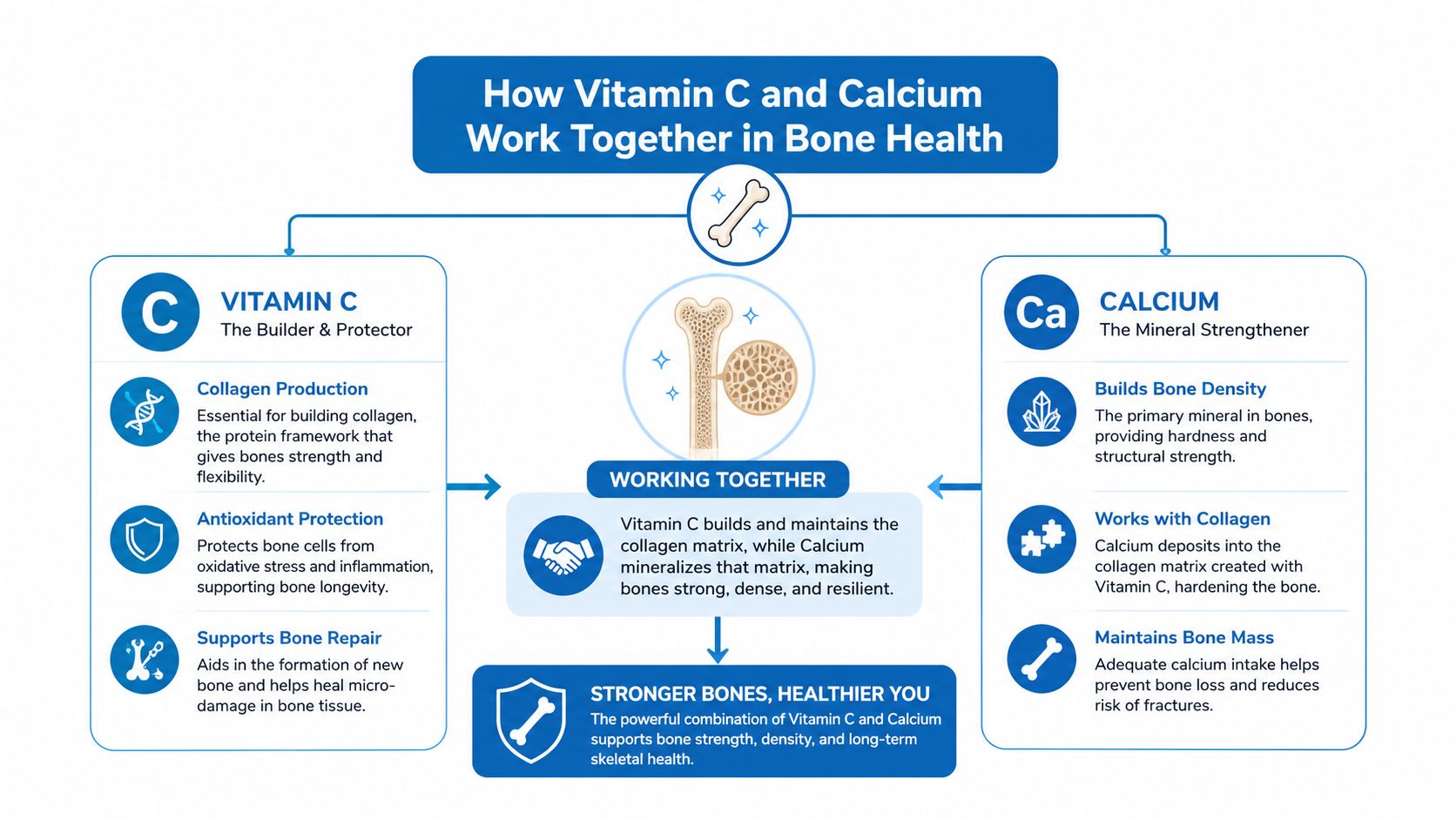
Why do these two nutrients keep showing up together in bone discussions? The short answer is that the biology lines up, but the marketing often runs ahead of the evidence. Vitamin C supports collagen synthesis, which helps form the organic framework of bone, while calcium supplies the mineral material that hardens that framework. A simple way to separate the roles is this, vitamin C helps build the scaffold, calcium helps harden it.
The collagen matrix and the mineral phase
Bone is living tissue, not a solid mineral block. Its structure starts with a protein matrix, and collagen is a major part of that base. Vitamin C supports collagen formation, so if intake is too low, the matrix is harder to assemble properly. Calcium then fills that matrix and contributes to the rigid mineral phase that gives bone its strength and load-bearing function.
The apparent synergy shows up in some studies, but only in context. In observational research among postmenopausal women, higher dietary vitamin C intake was linked with higher bone mineral density at the lumbar spine and femoral neck, and the association was clearest when calcium intake reached at least 500 mg/day (bone synergy review). That pattern suggests vitamin C may matter more when calcium intake is already adequate, rather than acting as a stand-alone bone fix.
For a deeper look at bone-support formulations, see our review of Life Extension Bone Restore with Vitamin K2.
What the clinical evidence really suggests
Calcium also has its own evidence base that should not be blurred into vitamin C marketing. In pregnancy-related bone and blood-pressure research, a Cochrane review reported that women taking at least 1 gram of calcium daily had a 35% lower risk of high blood pressure, a 55% lower risk of preeclampsia at average risk, a 78% lower risk of preeclampsia at high risk, and a 24% lower overall incidence of preterm birth (pregnancy calcium evidence). That evidence supports calcium on its own terms, which is important because a combined label can make it seem as if vitamin C is carrying the same weight.
A PubMed-indexed study also reported a statistically positive association between dietary vitamin C intake and femoral neck bone mineral density, estimating beta = 0.0002 g/cm² per mg/day of vitamin C, while calcium itself was not associated with bone mineral density in that analysis (study summary). That finding does not make vitamin C a substitute for calcium, and it does not make calcium irrelevant. It shows that bone outcomes depend on the nutrient pattern being studied, the population, and the baseline intake of each nutrient.
The practical takeaway is straightforward. The synergy is real, but it depends on the rest of the diet and the form of the supplement. A product that combines the two does not automatically outperform food-based intake plus a separate supplement when one is needed.
Comparing Supplement Forms and Formulations
The biggest shopping mistake is assuming all “calcium with vitamin C” products do the same thing. They don't. Some are built for buffering and convenience, some for absorbability, and some are just a way to bundle ingredients into one bottle.
How the main forms differ
Calcium ascorbate is a compound form. It's often gentler than plain ascorbic acid because it's buffered, and it gives you both nutrients in one ingredient. But that doesn't mean it's always the most efficient choice. A comparative study noted that calcium ascorbate at 250 mg didn't outperform plain ascorbic acid, while 500 mg calcium ascorbate changed pharmacokinetic and immune markers more strongly, which suggests that dose and formulation matter more than the generic “with calcium” label (formulation comparison).
Calcium carbonate with vitamin C is a common combination approach. It's usually the affordable option, but it's also more dependent on stomach acid and is often best with meals. That makes it a sensible pick for people who want a straightforward calcium source and don't mind taking it with food.
Calcium citrate with vitamin C is the more flexible calcium form. It's typically easier for people with digestive sensitivity, and it doesn't rely as heavily on stomach acid. If you're comparing products, this is the kind of calcium many people choose when they want a gentler option.
A quick comparison framework
| Form | Absorption | Take With Food | Elemental Calcium per Pill | Best For |
|---|---|---|---|---|
| Calcium ascorbate | Buffered, moderate and formulation-dependent | Often okay with or without food | Check label closely, varies by product | People who want one ingredient to cover both nutrients |
| Calcium carbonate with vitamin C | Depends more on meals and stomach acid | Usually yes | Often higher, but varies | Budget-conscious shoppers wanting a common calcium form |
| Calcium citrate with vitamin C | Flexible, generally easier on digestion | Can be taken with or without food | Varies by pill size and brand | People who want gentler calcium support |
A useful example is a chewable calcium citrate product such as KAL High-Potency Calcium Citrate Chewables Bone & Muscle Support 500mg, which illustrates why shoppers need to separate form, amount, and added vitamin C instead of assuming the whole category works the same way. If you're comparing products, a retailer like CalVitamin may list the form plainly, but you still need to check the label for the actual nutrient amounts.
The most practical question is simple. Are you looking for one combined compound, or do you just want a calcium supplement and some vitamin C in the same routine? If you can answer that, the label becomes much easier to read.
Recommended Dosages and Timing for Best Results
A useful way to think about calcium with vitamin C is to separate the two jobs. Calcium has a dosing pattern that benefits from spacing, while vitamin C is usually easier to fit around the rest of the day. For calcium, the brief notes that it is absorbed better in doses of 500 mg or less at a time, so one large tablet is often less practical than dividing intake across meals.
A simple daily structure
Start with the nutrient that has the tighter dosing logic. If your supplement provides a meaningful calcium dose, splitting it across meals usually makes more sense than taking everything at once. Calcium carbonate generally fits meals better because it depends more on stomach acid, while calcium citrate can be taken more flexibly and is often easier for people with digestion issues.
Vitamin C is simpler to schedule because it is water-soluble and handled differently from calcium. Adult RDA targets are 75 mg/day for women and 90 mg/day for men, while the upper intake level ranges up to 2,000 mg/day depending on age (nutrient guidance). For many adults, that means a supplement is not automatically needed in a large amount unless a clinician has recommended one for a specific reason.
Keep the vitamin C dose modest unless there is a clear reason to do otherwise. The brief describes ascorbic acid as able to improve intestinal calcium uptake, but the effect is modest and context-dependent, not a dramatic change in how calcium behaves in the body (calcium uptake study).
Practical rule: if your supplement routine is mainly for bone support, match the calcium dose to meals and treat vitamin C as a supporting player, not the main event.
What a routine can look like
- Morning with breakfast: a calcium dose if your label calls for one, especially if it is calcium carbonate.
- Midday or evening: a second calcium dose if you need to split intake for absorption.
- Any time of day: a modest vitamin C dose, either standalone or inside a combo product.
The label matters more than the marketing. A product described as calcium with vitamin C may contain a true combined compound, or it may just be a calcium supplement with added vitamin C, and those are not the same thing for dose planning. In practice, the right routine depends on your total calcium intake from food and supplements, your tolerance, and whether you are using vitamin C for general coverage or for a specific nutrition goal.
Safety Considerations and Kidney Stone Risk
What should you watch for if you are comparing calcium with vitamin C products? The main safety issue is that high-dose vitamin C can increase urinary oxalate, which can raise concern for calcium oxalate kidney stones in susceptible people. That does not mean vitamin C is off-limits for everyone, but it does mean the label should be read with a dose-first mindset, not a marketing-first one.
The safety tradeoff people miss
Vitamin C is often treated like a harmless add-on because it is a vitamin, yet the body still handles it within limits. The brief and standard safety guidance both point in the same direction, chronic megadoses are not the goal, especially for someone with a stone history or a reason to avoid unnecessary supplementation. A practical rule is simple, use the amount that fits the actual need, not the amount that sounds most impressive on the front of the bottle.
Calcium has a limit of its own. Guidance notes upper intake limits of 2,000 to 2,500 mg/day depending on age, and calcium is better absorbed in doses of 500 mg or less with meals (calcium guidance). That matters because people can overshoot their total intake without noticing, especially when fortified foods, a multivitamin, and a separate mineral tablet all add up across the day.
Who should be extra careful
People with a personal history of kidney stones, especially calcium oxalate stones, should be more cautious with vitamin C supplements than the average shopper. The concern is not abstract, it is one reason higher-dose vitamin C deserves restraint unless there is a clear reason for using it.
Pregnancy is a separate example of why the calcium side of the label should not be ignored. Evidence summarized in pregnancy evidence points to meaningful benefits from calcium supplementation in that setting, which makes calcium a nutrient to take seriously rather than as an optional extra. The same label can still combine calcium with vitamin C, so the total intake still needs to make sense for the person using it.
A useful habit is to check the full day, not one product in isolation. If food already supplies a lot of calcium, a supplement can push the total higher than expected. If the vitamin C portion is large and the person is stone-prone, the conversation changes again. For readers who want to review vitamin C supplement choices in a more targeted way, the vitamin C supplement guide can help sort form from formulation.
Dietary Sources and Practical Shopping Tips
Food should set the baseline before any supplement decision. For vitamin C, the common sources are fruits and vegetables such as citrus, strawberries, peppers, tomatoes, broccoli, and potatoes (dietary source guidance). For calcium, dairy foods are the classic source, and non-dairy options include kale, broccoli, sardines, salmon with bones, and calcium-fortified foods.
A smarter shopping checklist
When you're comparing products, start with the label, not the marketing front. Look for elemental calcium, because that's the number that matters for your actual intake. Then check whether vitamin C is part of the compound, added separately, or absent altogether.
A useful way to shop is to ask four questions:
- What form is the calcium? Calcium carbonate, calcium citrate, or calcium ascorbate each has a different practical profile.
- How much elemental calcium is in the serving? Don't rely on the tablet count alone.
- How much vitamin C is included? Some products add enough to be meaningful, others add a token amount.
- What format will you use? Capsules, veggie capsules, gummies, and chewables all affect adherence.
If you care about dietary restrictions, CalVitamin's catalog includes product labels such as halal, gelatin-free, and cruelty-free on select items, which can simplify sorting if those standards matter to you. That kind of labeling is useful only when it's clear and specific, not when it's buried in a generic wellness description.
When one bottle makes sense, and when it doesn't
Combination products make sense if you want convenience and the label gives you the exact amounts you need. Separate supplements make more sense if you need to adjust calcium without changing vitamin C, or if you already get plenty of vitamin C from food.
For broader vitamin C shopping, the CalVitamin vitamin C category is a practical place to compare standalone forms before you decide whether a combined product is worth it. That matters because a combo bottle can be redundant if your diet already covers vitamin C and you only need to focus on calcium.
The cleanest buying decision is this. Choose the form that matches your body, your diet, and your budget, not the one that sounds most advanced on the front of the bottle.
Frequently Asked Questions About Calcium With Vitamin C
Can I take calcium and vitamin C at the exact same time? Yes. Standard guidance says the two can be taken together safely, and some data suggest vitamin C may help calcium bioavailability in the gut, though the effect is modest and not a guarantee of better results for every person.
Is this combination safe if I've had kidney stones? Not automatically. If you're prone to calcium oxalate stones, high-dose vitamin C is the part that deserves caution because it can increase urinary oxalate. That risk discussion matters more than the marketing claim that the combo is universally helpful.
Do children or teenagers need a calcium with vitamin C supplement? Usually not by default. The need depends on diet, growth stage, and clinician guidance. Food-first planning is still the better starting point unless a pediatrician or dietitian has identified a gap.
Are calcium-containing effervescent vitamin C tablets a reliable option? They can be, but only if the label gives you meaningful amounts of each nutrient. Some effervescent products are mostly a vitamin C delivery system with a small calcium add-on, so don't assume the calcium dose is substantial.
Should I choose a combined product or buy the nutrients separately? Choose separately if you want control over dosage. Choose a combined product if the formula is transparent and the amounts match your goal without adding unnecessary extras.
If you're deciding between a combined formula and separate calcium and vitamin C products, compare the Supplement Facts line by line, then choose the format that fits your diet, stone risk, and daily routine. For a real-world browse of calcium and vitamin C options, visit CalVitamin and check whether the product lists elemental calcium, vitamin C dose, and the exact form before you buy.