You're lying in bed, tired enough to sleep but too alert to switch off. A supplement label promises calm from GABA, another promises support for your body clock from melatonin, and a combination product suggests that taking both must be better. The biology is more precise than that marketing story.
GABA and melatonin aren't interchangeable sleep aids. GABA is an inhibitory neurotransmitter involved in reducing neural excitability. Melatonin is mainly a timing signal that helps coordinate the sleep-wake rhythm. They may support sleep through different pathways, but the evidence for oral supplements depends on the ingredient, formulation, timing, health condition, and person using it.
Table of Contents
- Understanding GABA and Melatonin
- How GABA and Melatonin Influence Sleep
- What the Research Shows for Sleep and Anxiety
- Dosing and Timing Guidance
- Safety Considerations and Who Should Avoid Combining Them
- Key Takeaways for Responsible Use
Understanding GABA and Melatonin
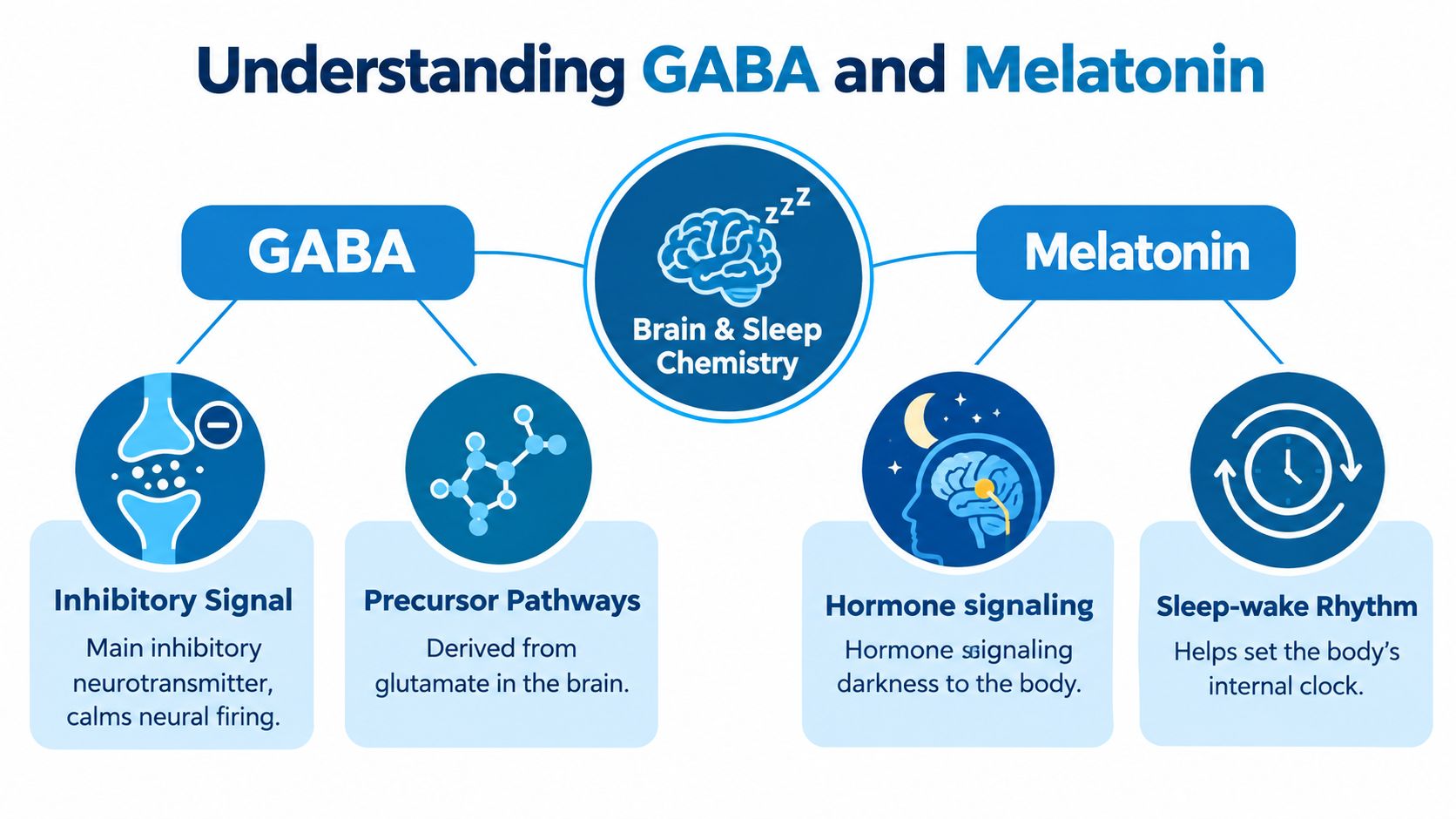
GABA is the brain's braking system
GABA, short for gamma-aminobutyric acid, is one of the main inhibitory neurotransmitters in the mammalian central nervous system. Its job is simple in concept and powerful in effect. It lowers the chance that neurons will keep firing, which helps the brain avoid a state where too many circuits stay active at once.
The history matters because it shows how established this biology is. Researchers identified GABA in biological tissues in 1910, and its presence in the central nervous system was described roughly 40 years later. By the late 1960s and early 1970s, experiments in cortical neurons clarified that GABA produces inhibition. Modern neurobiology estimates that at least 40% of inhibitory synaptic processing in the mammalian brain uses GABA, according to this historical review of GABA research.
That makes GABA a core regulator of excitability, not a trendy “relaxation molecule.”
Still, a common point of confusion starts here. The fact that the brain uses GABA does not mean an oral GABA supplement reliably reaches the brain in a predictable amount or creates a consistent sleep effect. Endogenous GABA, the GABA your nervous system makes and releases at synapses, is not the same thing as GABA swallowed in a capsule. That distinction becomes especially important when people compare ingredients as if they all work the same way.
Melatonin signals biological night
Melatonin does a different job. It is mainly a circadian-timing signal, which means it helps coordinate when the body shifts into biological night. That is why melatonin is better understood as a scheduling cue than as a general sedative.
Its effects are tied to MT1 and MT2 receptors. MT1 can suppress neuronal firing in the suprachiasmatic nucleus, the brain region involved in coordinating the internal clock. MT2 is involved in shifting circadian timing and in regulating parts of non-rapid-eye-movement sleep, as described in this clinical overview of melatonin physiology and pharmacology.
This difference helps separate two problems that often get lumped together. A person may be sleepy at the wrong clock time, or alert because arousal systems have not quieted down. Melatonin is more relevant to timing disruption, such as jet lag or a delayed schedule. GABA-related products are marketed more often around calm or tension. A product such as GABA capsules for stress support may fit that second framing, but the label alone cannot tell you whether it matches your actual sleep problem.
A useful mental model: GABA helps turn down neural activity. Melatonin helps time the body's nighttime program.
That is why combination products are never interchangeable by default. The practical question is not which ingredient is “stronger.” It is whether the formulation matches the reason sleep is off in the first place, and whether there is a reason to stop using it if it is not helping.
How GABA and Melatonin Influence Sleep
Two people can both say, “I can't sleep,” while describing different biology. One is tired but keyed up, with thoughts and body tension that do not settle. The other feels alert late at night and gets sleepy only when the clock has already drifted. That distinction matters because GABA and melatonin influence sleep through different systems, and products that combine them are not automatically interchangeable.
GABA shapes sleep most directly through inhibition. GABA-A receptors work quickly through chloride channels, while GABA-B receptors act more slowly through metabotropic signaling. In plain terms, one pathway can quiet neural firing on a short timescale, and the other can help sustain a less aroused state.
That makes GABA relevant to the shift from wakeful activation toward sleep readiness. But there is an important limit here. The effects of GABA released by neurons inside the brain are not the same as the effects of a GABA supplement swallowed in a capsule.
Oral GABA remains an open question
The main question is simple: how much orally consumed GABA reaches the human brain, and by what route? Researchers have proposed several mechanisms, including indirect signaling through the gut-brain axis. Vagal pathways, hypothalamic-pituitary-adrenal-axis effects, and immune signaling could all matter, even if only a small amount crosses the blood-brain barrier.
This is why a person may notice a calming or sleep-related effect without the supplement behaving like a drug that directly targets central GABA receptors. It also explains why the amount printed on a label is not a direct readout of brain exposure.
The human evidence is also formulation-specific. One intervention described in this review of GABA's sleep mechanisms and clinical evidence found that 100 mg of GABA combined with 50 mg of Apocynum venetum extract shortened sleep latency and increased non-rapid-eye-movement sleep more than either component alone. Useful signal, narrow conclusion. That result supports a possible additive effect in that exact combination, not in every product that contains GABA.
Melatonin adjusts the clock
Melatonin is a timing cue rather than a sedative, so a larger amount at the wrong hour is not a stronger dose. Under normal conditions, darkness increases melatonin signaling and helps align sleep with the light-dark cycle. Supplemental melatonin is most relevant when that timing signal is shifted, delayed, or otherwise mismatched to the sleep problem.
A practical way to separate the two looks like this:
- Difficulty winding down from mental arousal points more toward inhibitory signaling, including GABA-related mechanisms.
- Falling asleep at a consistently delayed hour points more toward circadian timing, where melatonin has a clearer role.
- A combination product may address both, but the outcome depends on the exact ingredients, amounts, and timing of use.
That last point is where readers often get misled. Evidence for GABA plus Apocynum venetum extract does not automatically transfer to GABA plus melatonin, GABA plus magnesium, or GABA alone. Similar labels can hide very different formulations, and the central question is whether that specific combination has been studied and whether it matches the reason sleep is off in the first place.
What the Research Shows for Sleep and Anxiety
A common pattern looks like this. Someone starts a sleep supplement hoping for a dramatic change, then notices the result is subtler than the label implied. That gap matters when comparing melatonin and GABA, because the research supports different roles and much different levels of certainty.
For melatonin, the best supported effects are measurable but usually modest. A meta-analysis of randomized trials for primary sleep disorders found that melatonin reduced sleep-onset latency by an average of 7.06 minutes compared with placebo, with a 95% confidence interval of 4.37 to 9.75 minutes, according to this meta-analysis of melatonin for sleep disorders. The same analysis found an average increase in total sleep time of 8.25 minutes, with a 95% confidence interval of 1.74 to 14.75 minutes. Sleep quality also improved statistically, with a standardized mean difference of 0.22 and a 95% confidence interval of 0.12 to 0.32.
Those numbers are useful, but they need interpretation. A statistical improvement can help at the population level while still feeling small to one person lying awake at night. In older adults, the analysis reported a larger average reduction in time to fall asleep of 7.5 minutes, a 12.8-minute increase in total sleep time, and a 2-percentage-point improvement in sleep efficiency compared with placebo. That may be meaningful when the main problem is timing, especially in people whose sleep schedule has drifted, but it is still an average effect, not a promise.
The evidence is also uneven across conditions. Melatonin fits circadian problems such as jet lag more cleanly than broad, ongoing insomnia, and that distinction often gets blurred in consumer marketing. It may help move the body clock in the right direction. It is not established as a general treatment for anxiety just because a person feels calmer after finally getting some sleep.
The GABA literature is harder to compare across products. As noted earlier, only a limited portion of the research consists of clinical studies, and oral absorption remains uncertain. That means one positive result cannot be stretched across gummies, capsules, drinks, or multi-ingredient blends as if they were interchangeable.
A practical way to read these findings is to separate mechanism from marketing. A formulation that combines ingredients aimed at relaxation, such as L-theanine with inositol, may be reasonable to examine on its own terms. It should not be treated as evidence for GABA, for melatonin, or for every “calming” sleep aid in the same aisle.
A promising result from one formulation is a reason to study that formulation more carefully, not a reason to generalize across the whole category.
Dosing and Timing Guidance
A common mistake is to treat sleep supplements like volume knobs. If a little does not help, more must work better. With melatonin, timing often matters more than pushing the dose higher, because its job is tied to circadian signaling rather than simple sedation.
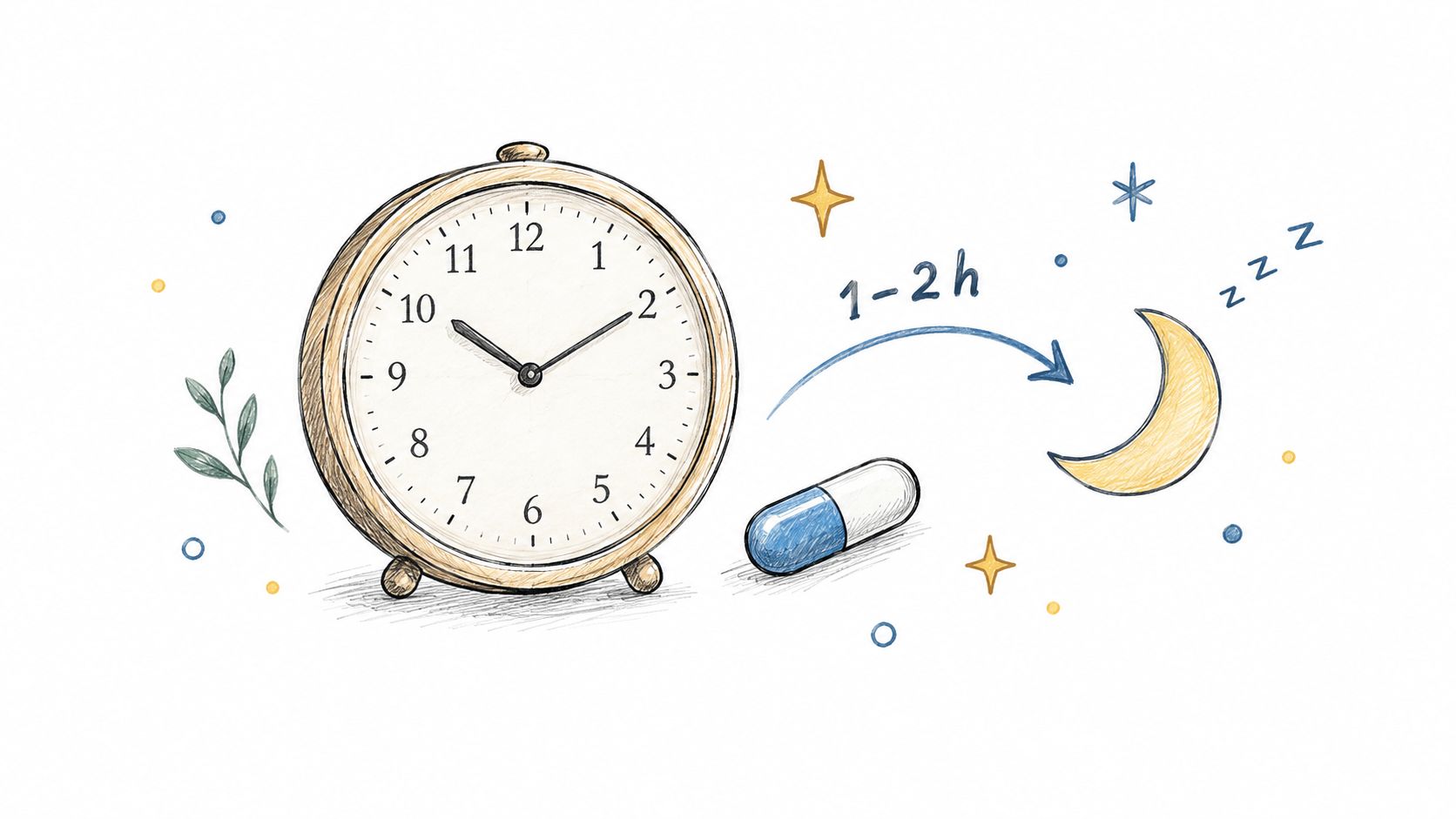
For immediate-release products, a practical starting window is about 45 to 60 minutes before usual bedtime. That window is only a starting point. Someone trying to shift a delayed sleep schedule is testing a different problem from someone who occasionally has trouble settling down at night. The same label can be used for very different reasons, which is one reason consumer advice gets confusing.
Melatonin exposure also varies widely from person to person. Oral bioavailability has been reported at about 1% to 74%, metabolism largely occurs through CYP1A2, and the usual elimination half-life is roughly 1 to 2 hours, as noted earlier in the article. In plain terms, two people can swallow the same labeled amount and end up with very different levels in the body.
Use timing as the first adjustment
Lower melatonin amounts around 0.3 to 0.5 mg may be closer to physiologic signaling and may be easier for some people to tolerate than high-dose products. That does not make low-dose melatonin the right answer for everyone. It means a higher number on the label should not be the automatic next step when sleep remains unchanged.
A careful trial is usually more informative than constant tinkering:
- Choose a steady bedtime window. Take immediate-release melatonin at the same point before the intended sleep period instead of shifting the timing from night to night.
- Hold the dose steady before changing it. If timing is inconsistent, you cannot tell whether the amount or the schedule is the issue.
- Match the product to the goal. Delayed sleep timing, occasional sleep-onset trouble, and persistent insomnia are not the same problem.
- Check factors that change exposure. Age, formulation, individual metabolism, and medicines that affect CYP1A2 can all alter response.
GABA calls for a different frame. The main uncertainty is not just how much is in the capsule. It is how much is absorbed, whether it meaningfully reaches the brain, and whether the observed effect comes from GABA itself or from other ingredients in the formula.
That is why combination products are formulation-specific. If you are considering melatonin and magnesium sleep-support gummies, read the Supplement Facts panel as you would read a recipe. Magnesium, flavoring system, serving size, and other added ingredients all shape the overall effect. The product should be judged as a multi-ingredient formula, not treated as evidence for melatonin alone or GABA alone.
A label amount is a product measure, not a brain dose. Use consistent timing, track next-day alertness, and stop increasing the amount just because the number looks modest. If you take prescription medicines, ask a pharmacist or clinician to review interactions before adding either ingredient.
Safety Considerations and Who Should Avoid Combining Them
The most useful safety question isn't “How much can I take forever?” It's “What am I testing, how will I measure it, and when will I stop?” Melatonin has limited long-term safety evidence, and its efficacy for chronic insomnia remains inconsistent. A 2025 clinical guideline described small effects on sleep latency and little improvement in other major sleep outcomes, as summarized in this clinical guidance on melatonin side effects and use.
UK prescribing guidance gives a more specific review framework for adults aged 55 and over with primary insomnia. Modified-release melatonin is generally reviewed after three weeks, limited to a maximum of 13 weeks, and followed by a later drug holiday to test whether it's still needed. That guidance isn't a universal schedule for every adult or every formulation, but it challenges the assumption that nightly use should continue without review.
Stop when the trial isn't helping
A monitored trial should have a defined reason for starting and clear criteria for stopping. Stop and seek advice if you experience:
- Morning grogginess or impaired alertness, especially if you must drive or operate equipment.
- Vivid or disturbing dreams that outweigh any sleep benefit.
- No meaningful improvement after a short, consistent trial.
- Concurrent sedative use, unless a clinician has reviewed the combination.
- Worsening sleep or unusual symptoms after introducing the product.
Don't keep increasing the dose to overcome an unhelpful response. Persistent insomnia can reflect sleep apnea, restless legs, medication effects, mood disorders, circadian rhythm disruption, or other medical conditions that supplements won't correct.
Ask a clinician before combining them
People who are pregnant or breastfeeding, managing autoimmune disease, seizure disorders, diabetes, or anticoagulation therapy should speak with a clinician before using melatonin, GABA, or a combination product. The same applies to anyone taking prescription medicines that affect alertness, mood, blood clotting, glucose regulation, or the nervous system.
GABA's uncertain oral absorption doesn't make it automatically risk-free, and melatonin's familiarity doesn't make it universally appropriate. Combining them may feel intuitive because both appear on sleep labels, but the safety profile depends on the entire formula, the person's health, and any other substances being used.
Stopping rule: If the product doesn't improve a defined sleep problem without causing next-day impairment, continuing it indefinitely has no clear rationale.
Key Takeaways for Responsible Use
- Separate the jobs: GABA is linked to inhibitory neural signaling. Melatonin primarily communicates circadian timing.
- Keep expectations realistic: Melatonin's average sleep effects are measurable but modest, while GABA evidence is limited and formulation-specific.
- Prioritize timing: Consistent melatonin timing may matter more than escalating the amount.
- Treat combinations cautiously: Evidence for one GABA formulation doesn't validate every GABA and melatonin product.
- Use stopping criteria: Stop for grogginess, impaired driving, disturbing dreams, no meaningful benefit, or concerning interactions.
- Seek guidance: Ask a clinician before use if you're pregnant, have a relevant medical condition, or take prescription medicines.
A short, monitored trial is more responsible than an indefinite nightly habit. If sleep problems continue, investigate the cause rather than stacking more sedating supplements.
CalVitamin offers capsules, gummies, and other dietary supplement formats, including GABA, melatonin, magnesium, and broader wellness products. Review the ingredient panels and product details, then visit CalVitamin to compare options before discussing a suitable choice with your healthcare professional.