

An ultra collagen booster is an oral dietary supplement typically built around hydrolyzed collagen peptides and supporting ingredients such as hyaluronic acid. The most defensible expectation is improved skin hydration and elasticity after a consistent daily regimen lasting 8 to 12 weeks, not an overnight transformation.
The popular advice is usually simple: choose the product with the biggest promise, the longest ingredient list, or the word “ultra” on the label. That's backwards. “Ultra” isn't a scientific category, and a supplement's name can't tell you whether its collagen form, serving amount, or supporting ingredients match the preparations studied in human trials.
For an informed purchase, separate three questions. What does the formula contain? Which outcomes have been measured? Does the label disclose enough information for you to compare the product with the research? The answers matter more than the packaging, flavor, or beauty claims.
Table of Contents
- What an Ultra Collagen Booster Actually Is
- Key Ingredients and What the Evidence Says
- Realistic Benefits and Expected Timeline
- How to Choose a High-Quality Collagen Product
- Common Misconceptions About Collagen Supplements
- Safety, Label Transparency, and Regulatory Context
What an Ultra Collagen Booster Actually Is
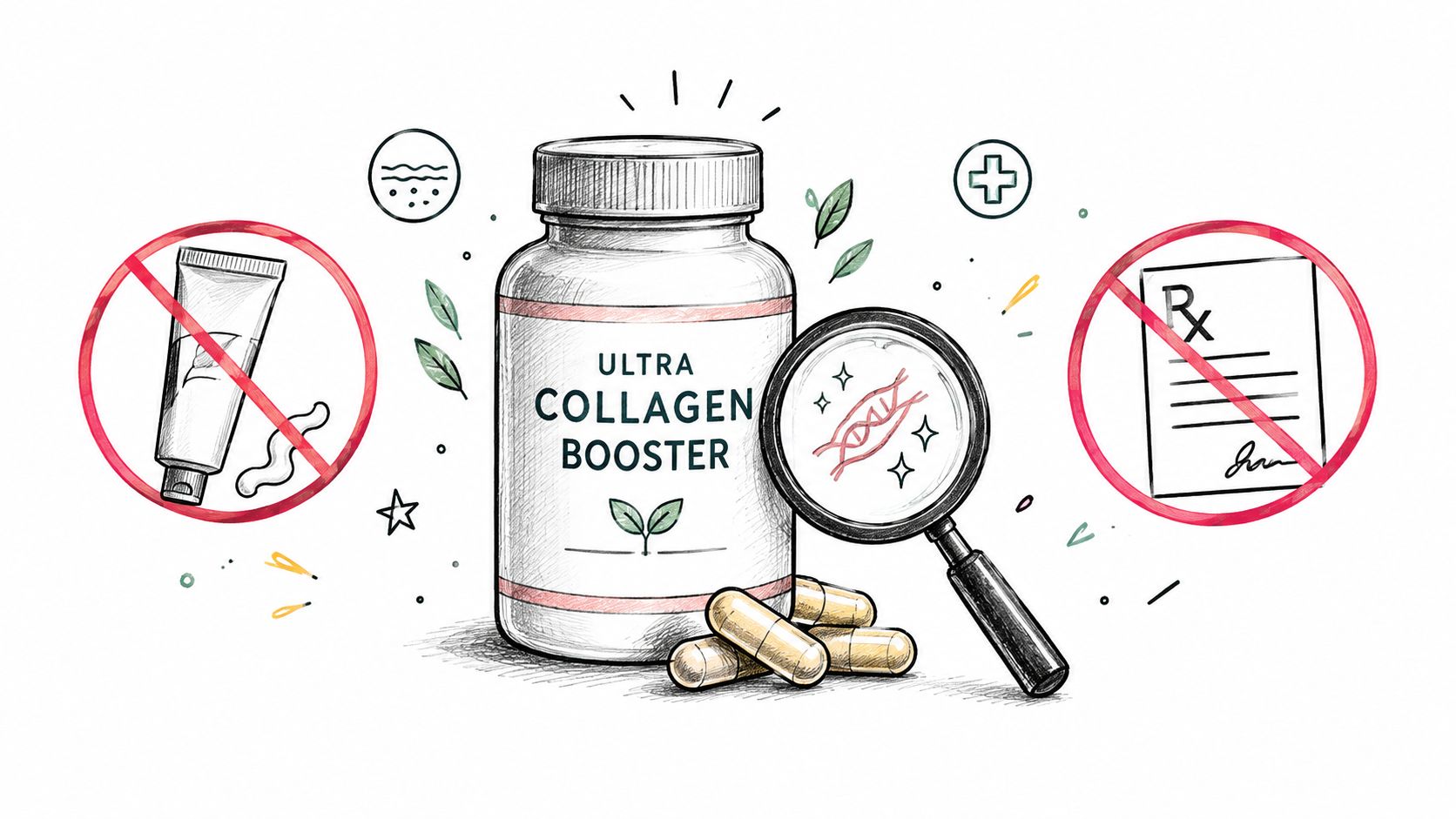
A shopper may see “collagen booster” and imagine a treatment that travels directly to a wrinkle, rebuilds cartilage, or switches on collagen production throughout the body. That isn't how an oral supplement should be understood. An ultra collagen booster is a dietary supplement, usually supplied as capsules, tablets, powder, or a drink mix, rather than a prescription medicine, topical cream, or procedure.
The central ingredient is generally hydrolyzed collagen, also called collagen peptides. Hydrolysis breaks collagen protein into smaller peptides that the digestive system can process. Those peptides and their constituent amino acids may contribute to processes involved in dermal matrix maintenance, but the consumer outcome studied most consistently is a change in skin measurements, especially hydration and elasticity.
Branding is not the formulation
Consider two products with nearly identical front labels. One may provide a clearly stated amount of hydrolyzed bovine collagen per serving. The other may list “collagen complex” inside a proprietary blend, with no individual quantity. They may look similar on a shelf, but they aren't equally assessable.
The word ultra can suggest extra strength, broader benefits, or a more advanced formula. It doesn't establish any of those things. The useful comparison is between the Supplement Facts panels, not between product names.
A product might also combine collagen peptides with hyaluronic acid, vitamin C, chondroitin, resveratrol, or grape-seed extract. These additions may be relevant to the formula's intended positioning, but their presence doesn't prove that the finished product has been tested in a clinical trial. Research on collagen supplementation generally applies most directly when the tested collagen source, peptide preparation, amount, schedule, and outcome measures are reasonably comparable.
For a practical example of how a collagen product page presents serving information and intended uses, compare the Vital Proteins Collagen Peptides review. Use product descriptions as a starting point, then verify the label and evidence independently.
Practical rule: Treat “booster” as a marketing description. Treat the disclosed collagen form, amount, source, and duration as the information that determines whether the product deserves consideration.
Key Ingredients and What the Evidence Says
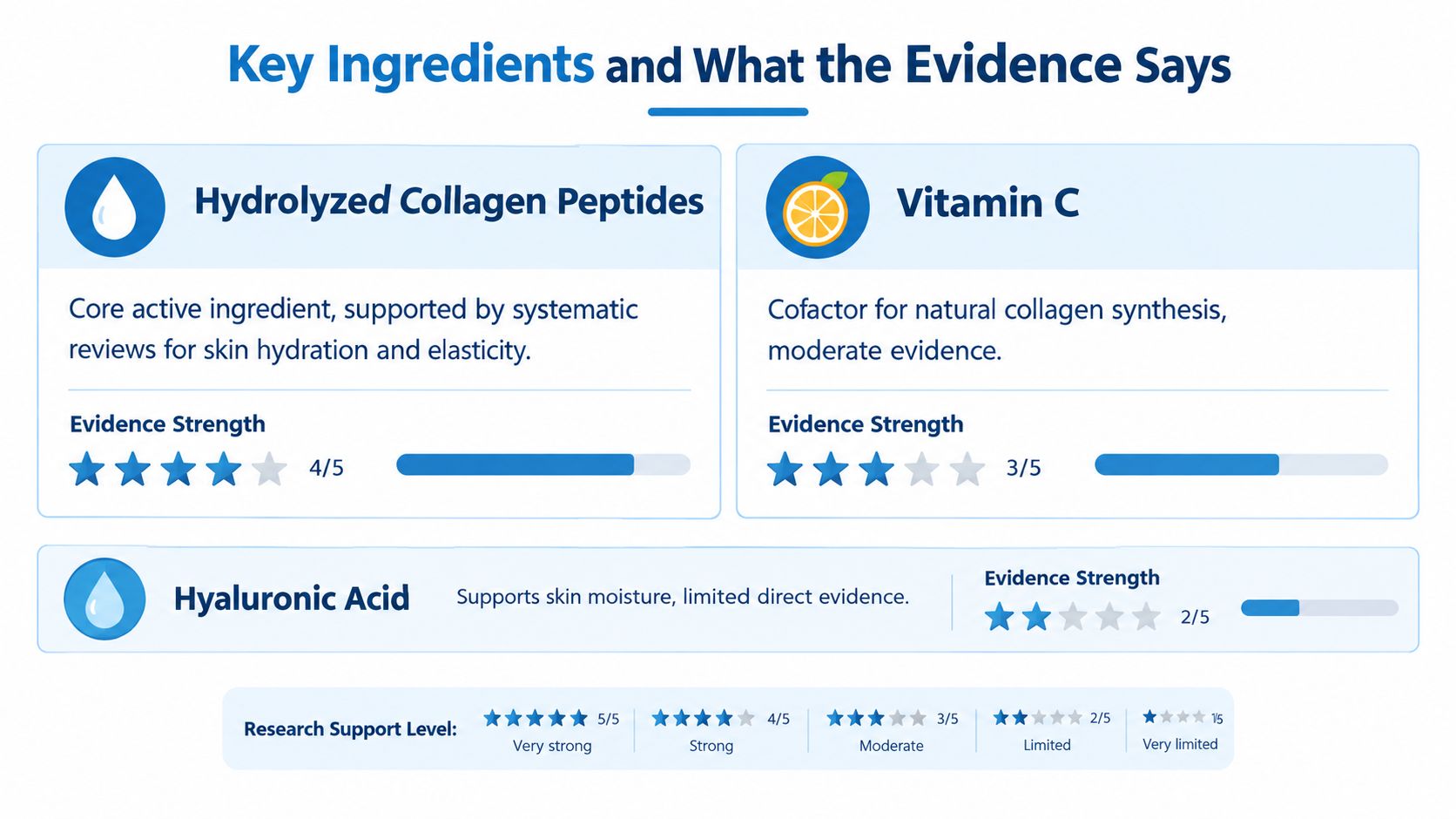
An “ultra” label does not give every ingredient equal scientific weight. The useful question is narrower: which ingredient has human evidence for which measured outcome, and how closely does that evidence match the product being considered?
Hydrolyzed collagen peptides
Hydrolyzed collagen peptides are the first ingredient to assess because they form the main evidence base for skin-focused collagen supplements. A systematic review of 11 randomized, placebo-controlled human studies involving 805 participants found that most trials used hydrolyzed collagen at approximately 2.5 to 10 grams daily for 8 to 24 weeks (systematic review of collagen supplementation). Separate collagen tripeptide trials commonly used 3 grams daily for 4 to 12 weeks. Those results should not be treated as proof that every collagen source, peptide profile, or serving size performs identically.
The clearest signal concerns skin hydration, elasticity, and related surface measurements. A later systematic review and meta-analysis of 26 randomized controlled trials involving 1,721 participants reported significant improvements in skin hydration and elasticity compared with placebo, with benefits becoming significant after at least 8 weeks (2023 collagen meta-analysis).
This places hydrolyzed collagen in the highest evidence tier for a skin-oriented formula. It does not prove guaranteed wrinkle removal, joint treatment, hair growth, or identical results from every retail product. The ingredient's evidence supports a limited claim about measured skin properties, not every promise attached to the word “booster.”
Vitamin C
Vitamin C participates in normal collagen synthesis, which explains its frequent inclusion. That biological role makes it a plausible supporting nutrient. It does not demonstrate that a finished supplement will produce a greater skin benefit than collagen alone.
Read the declared amount instead of treating a front-label mention as proof of a meaningful dose. Oral vitamin C also needs to be judged separately from topical vitamin C, since the delivery route and evidence questions differ.
Hyaluronic acid and botanical additions
Hyaluronic acid is associated with water retention and often appears in skin-focused formulas. Its presence supports a hydration-oriented rationale, but the amount still matters. Without a disclosed quantity, shoppers cannot judge whether the addition is substantial enough to compare across products.
Resveratrol and grape-seed extract are commonly presented as antioxidant ingredients. Antioxidant wording may describe a mechanism, but it does not establish a measurable improvement from the complete collagen formula. Chondroitin may be relevant to shoppers focused on joints. Evidence for one ingredient or one outcome should not be transferred automatically to skin, hair, nails, or pain.
A product such as Horbaach Multi-Collagen 2000 mg illustrates why the full label matters more than the product title. Check the listed collagen types, serving instructions, and quantities before comparing it with another formula.
| Ingredient category | Evidence-aligned interpretation | What it doesn't prove |
|---|---|---|
| Hydrolyzed collagen peptides | Best-supported core for measured skin hydration and elasticity | Guaranteed results from every product |
| Vitamin C | Relevant cofactor for normal collagen synthesis | A larger clinical effect from the finished formula |
| Hyaluronic acid | Plausible support for moisture-focused positioning | That the product will erase wrinkles |
| Botanicals and antioxidants | May support a broader formulation rationale | That each addition improves collagen outcomes |
Use the evidence hierarchy as a shopping filter. Start with the ingredient tied most directly to the outcome you want, then check whether the supporting ingredients are identified with clear amounts and whether the finished formula makes claims beyond its evidence.
Realistic Benefits and Expected Timeline
An ultra collagen booster is unlikely to produce a procedure-like transformation. The more defensible expectation is a gradual change in measured skin properties, especially hydration and elasticity, after consistent use. That distinction matters because device readings and mirror-based impressions answer different questions.
A 2019 randomized, placebo-controlled trial enrolled 72 healthy women. 36 participants received a collagen-containing supplement and 36 received placebo for three months. At enrollment, the groups had comparable elasticity, with an R2 index of 0.69 ± 0.05 AU in the supplement group and 0.71 ± 0.06 AU in the placebo group. After 12 weeks, the values were 0.81 ± 0.04 AU and 0.75 ± 0.06 AU, respectively, with a between-group result of p < 0.0004. Investigators also reported improvements in hydration, skin roughness, and density in the collagen group (2019 randomized clinical trial).
Those results came from device-based measurements rather than participants deciding that their skin looked better. They support a measured benefit under the study conditions, not a guarantee that every product or user will produce the same outcome.
What the timeline means
A more recent trial screened 140 volunteers and enrolled 138 eligible participants into four groups. The design compared an active collagen supplement with placebo, using daily and every-48-hours schedules. After 12 weeks, daily use was associated with a 13.8% increase in skin hydration, a 22.7% increase in the R2 elasticity index, and a 19.6% reduction in the Rz profilometry index. Each comparison was reported as statistically significant at p < 0.01. The daily group had also shown a 20.6% R2 elasticity increase versus placebo by week 6, while the every-48-hours group recorded an 18.6% increase by week 12 (2024 collagen clinical trial).
The practical reading is straightforward: some measurable signals may appear around six weeks, while the main assessment point is closer to three months. A shorter trial may be too early to judge a product fairly.
A sensible personal trial asks whether skin feels better hydrated and whether the product can be taken consistently. It does not promise that every visible line will disappear.
Results can vary with formulation, collagen source, peptide size, amount, diet, age, baseline skin condition, and study design. Even a statistically significant average effect does not mean every participant will notice the same change in a mirror.
The strongest benefit claim remains narrow: support for skin hydration and elasticity over time. Claims about regeneration, dramatic anti-aging, disease treatment, or effects on unrelated tissues extend beyond what these skin-focused trials establish.
How to Choose a High-Quality Collagen Product
A premium-looking tub can still leave the key question unanswered: how much collagen are you taking? Judge the label by its measurable details, not by its flavor, imagery, or list of added ingredients. The same questions apply to powders, capsules, gummies, and liquids.
Start with the collagen itself
Look for hydrolyzed collagen, collagen peptides, or a clearly identified collagen tripeptide preparation. The word “collagen” alone does not show whether the ingredient has been hydrolyzed, which source it comes from, or how much the serving provides.
Locate the collagen amount in grams per serving, then check the directions. The systematic review benchmark is approximately 2.5 to 10 grams per day for 8 to 24 weeks in many hydrolyzed collagen studies, as cited earlier. A lower amount is not automatically ineffective, but it should not be presented as equivalent to a study product that disclosed a higher dose.
Compare sources and formats
Bovine, marine, and other animal sources can differ in peptide composition, dietary suitability, allergen considerations, and consumer acceptability. Marine collagen may be unsuitable for someone with a relevant fish allergy. Bovine collagen may not fit particular dietary or religious requirements.
The format affects practicality more than biological credibility. Capsules are convenient, while powders can make a larger daily collagen amount easier to take. Gummies and flavored drinks may help some people maintain a routine, but taste cannot replace dose transparency.
Use the label as a quality filter
Use this checklist to separate evidence-relevant details from cosmetic promises:
| Criterion | What to look for | Why it matters |
|---|---|---|
| Collagen form | Hydrolyzed collagen or named collagen peptides | Shows whether the ingredient resembles commonly studied preparations |
| Amount per serving | Grams stated clearly | Lets you compare intake with research benchmarks |
| Serving schedule | Specific daily instructions | Supports a consistent trial rather than occasional use |
| Source | Bovine, marine, or another named source | Helps with allergies, dietary choices, and suitability |
| Supporting ingredients | Individual amounts, not only a blend name | Shows what you're actually buying |
| Testing information | Credible third-party testing details | Provides information about identity and manufacturing checks |
| Dietary attributes | Gelatin-free, halal, or other relevant certification where applicable | Helps match the product to personal requirements |
A proprietary blend requires caution because it can hide individual ingredient amounts. A long ingredient list may sound scientifically advanced while offering too little information to judge whether each component is present at a meaningful level. Evidence should be assessed ingredient by ingredient, with the stated amount matched to the outcome being claimed.
For a practical example, review Wellpath Renew Multi-Collagen Protein Powder, then apply the checklist to the current package. A review can help identify label details, but it should not replace checking the product's own serving size, source, and testing information.
Label-reading shortcut: Find the collagen grams first. If you cannot locate the amount, you cannot make a meaningful dose comparison.
Consider price and packaging only after the formula is clear. A transparent product with a specified collagen amount is easier to evaluate than a heavily marketed formula with undisclosed quantities, whatever its “premium” presentation.
Common Misconceptions About Collagen Supplements
A collagen booster is not a delivery service for wrinkles, tendons, nails, or joints. Digestion breaks collagen into peptides and amino acids, which the body uses according to its needs. Oral collagen has its clearest clinical support for selected skin outcomes, especially hydration and elasticity. Those measured changes do not guarantee benefits in every collagen-containing tissue.

Four claims that need careful translation
“It reverses aging.” Collagen may improve selected skin measurements, but it cannot reverse the aging process or promise complete wrinkle removal. Instrument-measured hydration or elasticity is narrower than a broad cosmetic claim.
“More ingredients mean better results.” A crowded formula may expand the marketing story without adding strong evidence. Each ingredient needs a plausible purpose, a disclosed amount, and research that matches the claimed outcome.
“You'll see a transformation in days.” Supplement studies generally assess results over weeks. The 2023 meta-analysis cited earlier reported significant skin benefits after at least 8 weeks, so rapid, dramatic change is not a reliable expectation.
“A higher price means higher effectiveness.” Price reflects presentation, branding, and formulation choices, not proof that a product matches a studied formula. Clear dosing and relevant evidence provide a better basis for comparison.
Hair, nails, joints, and pain create another common misunderstanding. A product marketed for all four areas may have evidence for only one outcome, such as skin hydration or elasticity. That evidence does not automatically show accelerated hair growth or treatment of joint disease. Match each promise to the specific result researchers tested.
After reading the front label, examine the Supplement Facts panel. Confirm the collagen form and amount per serving, then check serving frequency, source, and whether a blend conceals individual quantities. Manufacturing or independent-testing information can add useful context, but it does not turn an unsupported claim into a proven one.
The video below helps distinguish cosmetic positioning from evidence-based expectations.
Safety is also individual. General tolerability does not establish suitability for someone with an allergy, medical condition, restricted diet, or medication concern. Those questions call for a pharmacist or clinician's review rather than a universal promise on the bottle.
Safety, Label Transparency, and Regulatory Context
A structure/function statement such as “supports skin” isn't the same as an approved treatment claim. FDA guidance says supplement labels must provide the serving size, servings per container, each declared dietary ingredient and its amount unless it belongs to a proprietary blend. The same guidance says structure/function claims must be truthful, not misleading, substantiated, and accompanied by the required disclaimer (FDA guidance on dietary supplements).
Supplements generally can't claim to diagnose, treat, cure, or prevent disease without the applicable authorization. That distinction matters when marketing language shifts from “supports elasticity” to claims about treating joint disease, pain, or another medical condition.
Check the animal source before buying, especially if you have a fish or other relevant allergy, follow a dietary restriction, or need halal or gelatin-free attributes. Ask a pharmacist or clinician before use if you're pregnant, breastfeeding, taking medication, or considering the product for a diagnosed condition.
The label should make it possible to identify what you're taking and how much. If the formula hides key quantities inside a proprietary blend, treat that lack of transparency as a reason to compare alternatives.
CalVitamin offers dietary supplements and wellness products in formats such as capsules, powders, gummies, and liquid products, with selected items labeled for attributes including halal or gelatin-free suitability. Visit CalVitamin to compare collagen and other supplement options by their stated ingredients, serving information, and product details before choosing a routine.






