

At 11 p.m., you're scrolling through sleep support gummies and comparing milligrams, flavors, and ingredient lists. The popular advice says to choose the gummy with the “best” blend. A more important question comes first: does the gummy contain the amount printed on the label?
Sleep gummies can be convenient, useful for some routines, and easier to take than capsules. They also deserve more careful scrutiny than a colorful front label suggests. Melatonin is regulated as a dietary supplement in the United States, not like a prescription or over-the-counter drug, and independent testing has found substantial differences between labeled and measured amounts. The right approach isn't to dismiss gummies or treat them as magic. It's to understand the ingredients, check the quality signals, use them cautiously, and recognize when persistent sleep trouble needs medical attention.
Table of Contents
- Why Sleep Support Gummies Took Over the Supplement Aisle
- What's Actually Inside a Sleep Gummy
- What Sleep Gummies Can and Cannot Do
- The Label Accuracy Problem Nobody Talks About
- How to Dose and Time Sleep Gummies Safely
- Gummies Versus Other Sleep Supplement Formats
- Your Sleep Gummy Questions Answered
Why Sleep Support Gummies Took Over the Supplement Aisle
The shopper at the kitchen counter usually isn't looking for a complicated pharmacology lesson. They want something easy to swallow, pleasant enough to take consistently, and clearly labeled. A gummy seems to answer all three needs at once. It looks approachable, doesn't require water in the same way a capsule might, and can become part of a familiar evening ritual.
A sleep support gummy is a chewable dietary supplement made with one or more ingredients associated with sleep, relaxation, or nighttime routines. Melatonin is common, but formulas may also include herbs, minerals, amino acids, or CBD. The format itself doesn't determine whether a product works. It only determines how the ingredients are delivered.
Melatonin use has expanded within the broader U.S. supplement market. A peer-reviewed analysis of 55,021 adults aged 20 and older, drawn from 10 National Health and Nutrition Examination Survey cycles covering 1999–2000 through 2017–2018, found that reported adult melatonin use rose from 0.4% to 2.1% over that period, a more than fivefold relative increase (peer-reviewed analysis of U.S. melatonin use). Gummies are only one format among tablets, capsules, liquids, and chewables, but that history helps explain why convenient sleep products now occupy so much shelf space.
Convenience changes the buying decision
A gummy can make a routine feel less like taking medicine and more like having a small nighttime cue. That can help someone who dislikes pills or struggles to maintain a complicated supplement schedule. It can also encourage casual buying, especially when flavor, packaging, and a large ingredient list distract from the Supplement Facts panel.
The useful mental model is simple:
- The format is the vehicle. A gummy carries the active ingredients.
- The ingredient determines the intended role. Melatonin relates mainly to sleep timing, while herbs and other compounds may be positioned for relaxation.
- The label determines the stated dose. That statement still needs to be evaluated for transparency and quality control.
- Your sleep problem determines whether the product fits. A temporary schedule disruption is different from persistent insomnia.
Practical rule: Treat a gummy like any other supplement, not like candy and not like a guaranteed sleeping pill.
The questions that matter are therefore broader than “Which flavor tastes best?” Ask what each ingredient is supposed to do, whether the serving amount is clear, how the product was tested, how it should be stored, and whether your symptoms point to a problem a gummy can't address.
What's Actually Inside a Sleep Gummy
Start with the Supplement Facts panel, not the product name. The front may say “sleep,” “calm,” or “nighttime blend,” but the panel shows the actual ingredients and the amount per serving.
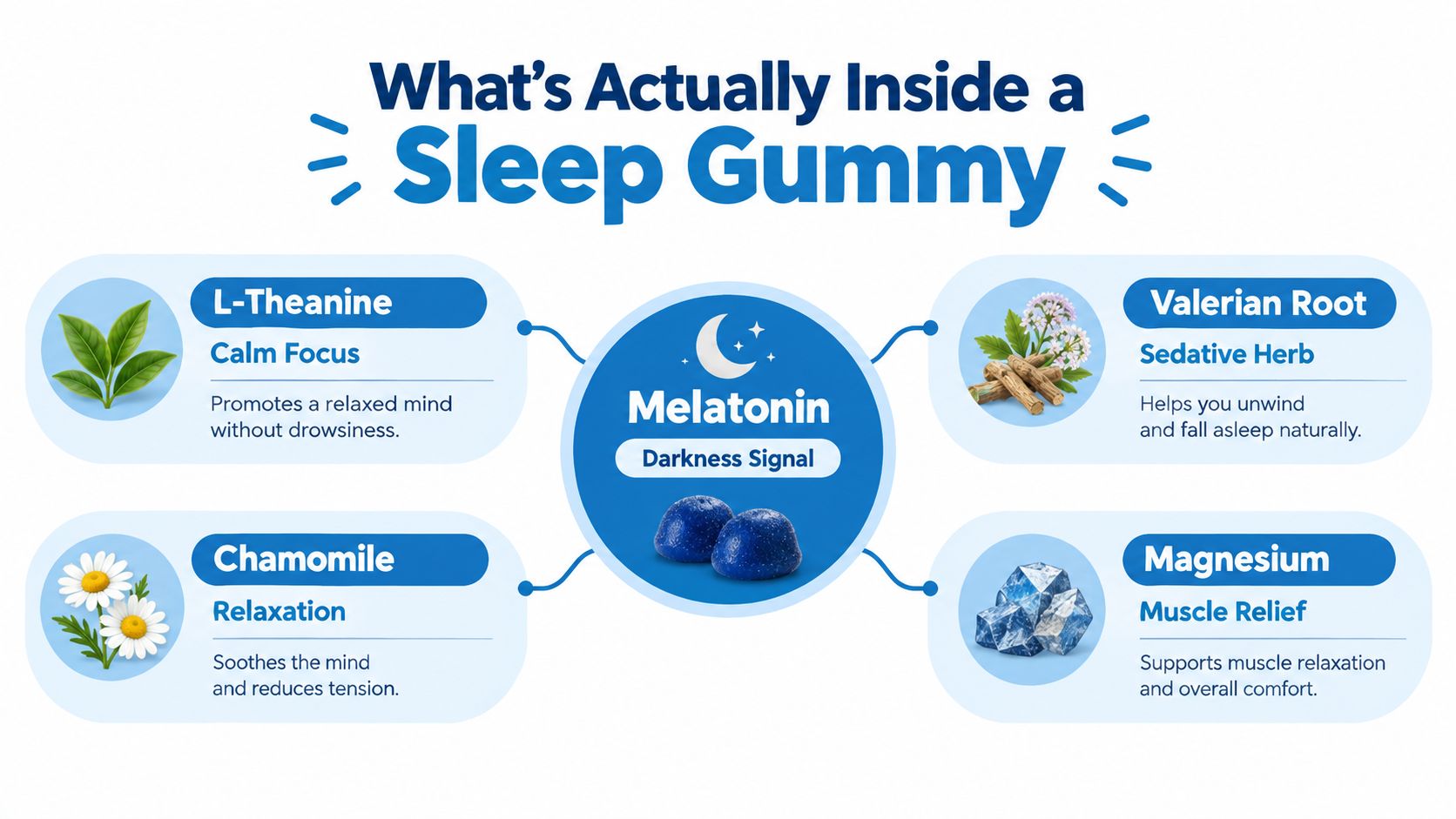
Melatonin is a timing signal
Melatonin is a hormone your body produces in response to darkness. It's better understood as a message that helps coordinate the body clock than as a force that knocks you unconscious. A melatonin gummy may be more relevant when your sleep timing is disrupted, such as during travel or an irregular schedule, than when worry, pain, breathing problems, or another health issue keeps you awake.
The amount printed beside melatonin matters, but the accuracy of that amount matters just as much. A low number on the front label doesn't automatically prove that the product delivers a low exposure.
Herbs and minerals have different roles
Chamomile is traditionally associated with relaxation and bedtime tea rituals. Valerian root is an herb commonly used in products intended to support calm or sleep. Passionflower and lemon balm also appear in some nighttime blends, usually because manufacturers associate them with relaxation.
These ingredients aren't interchangeable. A blend may contain several botanicals, but a longer list doesn't necessarily mean a stronger or better formula. It can make it harder to identify which ingredient affects you, especially if you experience morning grogginess or stomach upset.
Magnesium is a mineral involved in many body processes, including muscle and nerve function. Some products include it as part of a broader relaxation formula. That doesn't make every magnesium gummy a sleep product, and the label should identify the magnesium form and the amount provided.
L-theanine is an amino acid often included in calm-focused formulas. It's not the same type of ingredient as melatonin, and a product containing both is making two different formulation choices, one related to sleep timing and one related to relaxation.
CBD needs separate consideration
CBD, or cannabidiol, belongs in its own category. It isn't melatonin, a herb, or a mineral, and its regulatory treatment and evidence base differ by jurisdiction and product type. Don't assume that a CBD gummy is a stronger version of a standard melatonin gummy.
If you're considering CBD, check for a current certificate of analysis, or COA, that identifies the product's cannabinoid content and testing for relevant contaminants. People who take medicines, manage a health condition, or are pregnant or breastfeeding should ask a clinician before using it.
Single-ingredient products can make cause and effect easier to judge. Blends may suit someone who wants a combined routine, but they require closer label reading. For example, compare the declared amount per gummy with the serving size, then look for proprietary blends that conceal individual quantities.
For a straightforward example of how a melatonin and magnesium formula presents its ingredients, review the strawberry melatonin and magnesium sleep-support gummies, then compare its Supplement Facts panel with other products rather than judging only by flavor or packaging.
What Sleep Gummies Can and Cannot Do
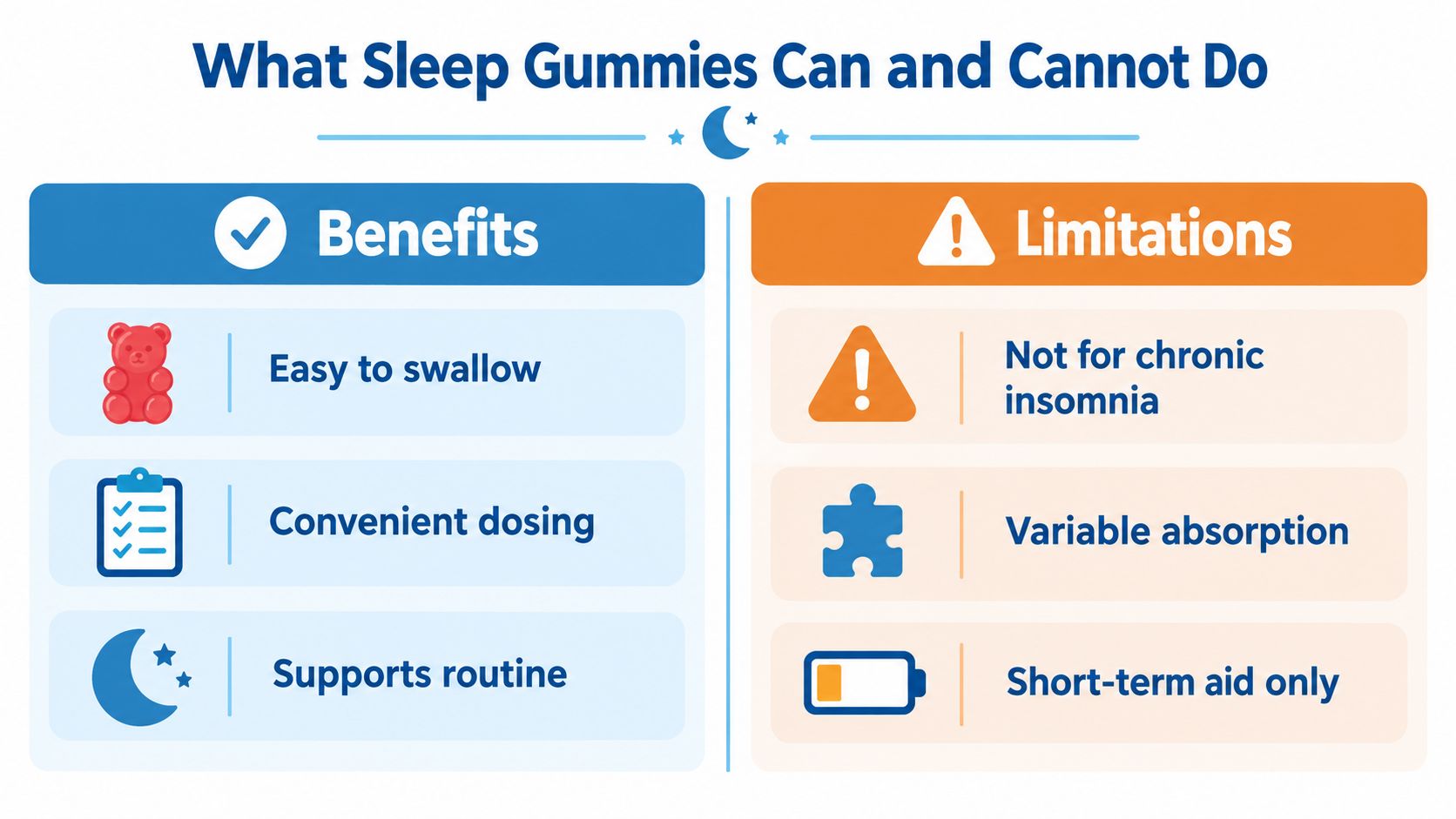
Sleep gummies offer practical advantages before they offer dramatic ones. They're easy to carry, simple to add to a bedtime routine, and often easier to swallow than capsules. A pre-measured serving can also remove the need to count drops or measure powder.
For occasional sleeplessness, a melatonin-based product may help some people align their sleep timing with a desired schedule. That's a narrower job than treating every cause of poor sleep. If your difficulty comes from a late-night work pattern, travel, or an inconsistent routine, a timing signal may be more relevant than if you're dealing with persistent anxiety or physical discomfort.
Think of melatonin as a thermostat
A thermostat nudges a room toward a target temperature. It doesn't repair a broken window, silence a noisy street, or remove a heat source. Melatonin works similarly as a sleep-timing cue. It may nudge the body clock in a useful direction, but it can't solve every reason you're awake.
The distinction helps set realistic expectations:
- They can support a routine. Taking a product at a consistent time may act as a reminder to begin winding down.
- They may help with timing. This is especially relevant when your sleep schedule is out of step with your desired bedtime.
- They can simplify swallowing. Gummies may work for adults who dislike tablets or capsules.
- They may cause unwanted effects. Next-day drowsiness, vivid dreams, or feeling sluggish can occur, particularly when the product delivers more than expected.
Know what the gummy cannot replace
A gummy won't substitute for a regular sleep schedule, a darker and quieter bedroom, or a medical assessment when symptoms persist. It also won't make sleep debt disappear after one serving. If you're repeatedly awake for long periods, waking unrefreshed, snoring heavily, or struggling with daytime alertness, self-treatment deserves a time limit.
Effects vary because people differ in metabolism, schedules, sensitivity, health conditions, and other medicines or supplements. Even two people taking the same labeled serving may describe very different experiences.
A calm way to judge the product is to track your response rather than chasing an immediate sensation. Note when you take it, when you go to bed, how long it seems to take to fall asleep, and how you feel the next morning. If the result is grogginess without better rest, increasing the amount is unlikely to be a sensible first response.
Some people also use non-melatonin ingredients for an evening routine. For example, a calm-focused option such as L-theanine with inositol belongs to a different formulation category and shouldn't be evaluated as though it were a melatonin product.
The Label Accuracy Problem Nobody Talks About
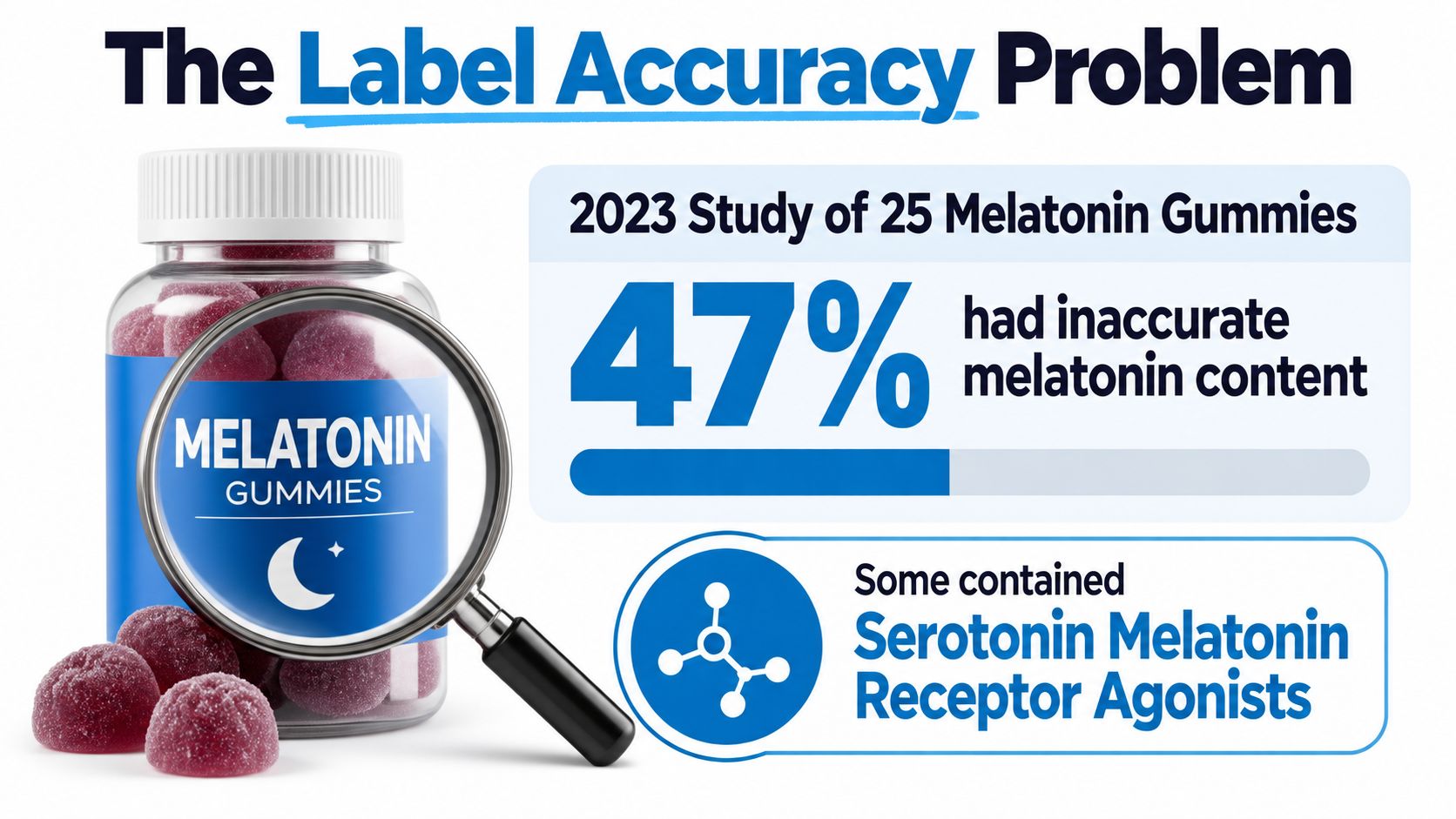
The most important number on a sleep gummy may be the one you can't verify from the front label. A 2023 analysis of 25 over-the-counter melatonin gummy products sold in the United States found that 22 were inaccurately labeled. Measured melatonin ranged from 74% to 347% of the declared amount, equivalent to 1.3 to 13.1 milligrams per serving, and one product contained no detectable melatonin (JAMA analysis of melatonin gummy content).
That finding doesn't prove that every gummy is defective. It does show that comparing products solely by the printed milligrams can create false confidence. A product advertised as low dose may deliver substantially more or less than expected, which changes how you interpret both benefits and side effects.
Why the front label isn't enough
In the United States, melatonin is regulated as a dietary supplement rather than as a prescription or over-the-counter drug. The National Center for Complementary and Integrative Health's melatonin overview explains that supplements don't go through the same premarket approval process for safety, effectiveness, and labeling as medicines.
That places more responsibility on manufacturers, retailers, and shoppers. A professional-looking bottle is not the same as independent verification. Nor is a large milligram number evidence that a product is more effective.
Look for quality signals that tell you how the product was made and checked:
- Clear serving information: The label should state the amount per gummy and define the serving size.
- Lot-specific documentation: A COA should relate to the actual production lot, not just a generic product description.
- Identity and potency testing: Testing should confirm that the intended ingredient is present and matches the declared amount.
- Contaminant checks: Reputable documentation may address contaminants relevant to the formulation and manufacturing process.
- Expiration and storage details: These help you judge whether the product was handled within its stability requirements.
- Transparent manufacturer information: You should be able to identify who made or distributed the product and how to contact them.
The concern extends beyond gummies. A Canadian analysis of 31 commercial melatonin supplements found labeled-content deviations ranging from 83% below to 478% above the stated amount, while different lots of the same supplement differed by as much as 465%. More than one-quarter of the products also contained serotonin that wasn't disclosed on the label (Canadian analysis of melatonin supplement quality).
A certificate of analysis doesn't guarantee that a product is right for you. It does provide evidence that someone tested the product against identifiable quality criteria.
How to Dose and Time Sleep Gummies Safely
A sleep gummy is easy to mistake for candy, which makes dosing discipline more important than flavor or convenience. Treat the first use as a cautious trial. Read the serving directions, check whether the stated amount applies to one gummy or several, and avoid combining it with another nighttime product until you know how you respond.
Build a conservative routine
For a melatonin-based product, labels and clinical routines often place use around 30 to 60 minutes before the intended bedtime. Melatonin acts more like a timing signal than an instant sedative. Taking extra immediately because you do not feel tired can expose you to more than planned before the first serving has had time to fit your schedule.
A practical routine:
- Choose the smallest labeled serving that makes sense for you. Do not begin by combining products.
- Take it at a consistent time. A steady schedule makes your response easier to interpret.
- Keep the rest of the evening predictable. The gummy does not make unlimited scrolling or late work harmless.
- Assess the following morning. Note sleep quality, alertness, dreams, headache, and grogginess.
- Stop and ask for advice if the response is troublesome. A pharmacist can review the product, timing, and possible interactions.
The smallest labeled serving is also the most sensible starting point when label accuracy is uncertain. A separate analysis of U.S. melatonin dose patterns found that use of doses above 5 milligrams per day rose from 0.08% of adults in 2005–2006 to 0.28% in 2017–2018 (analysis of melatonin dose patterns). That trend supports starting low rather than assuming a larger labeled amount will work better. A high label value may also be a poor comparison if the actual content varies.
Check medicines and storage risks
Ask a pharmacist or doctor before using melatonin if you take blood thinners, blood-pressure medicines, or other sedating substances. Seek advice during pregnancy, breastfeeding, or treatment for a health condition. Do not drive or perform safety-sensitive work if the gummy leaves you drowsy the next day.
Store gummies in their original, child-resistant packaging, out of children's sight and reach. Their shape and taste can resemble candy. The NCCIH safety information on melatonin reports that the Centers for Disease Control and Prevention estimated approximately 11,000 emergency-department visits from 2019 through 2022 involving unsupervised melatonin ingestion by children aged 5 years or younger.
The same NCCIH resource reports that melatonin-ingestion reports to U.S. poison-control centers among people aged 19 or younger rose from 8,337 in 2012 to 52,563 in 2021, an increase of roughly 530%. If a child takes an unknown amount, contact poison-control services or emergency care promptly instead of waiting for symptoms.
Review the routine visually:
Gummies Versus Other Sleep Supplement Formats
The best format depends on the person, the ingredient, and the quality controls behind the product. Gummies are attractive because they're enjoyable and pre-measured, but capsules, tablets, liquids, and chewables can offer different trade-offs.
| Format | Dose Precision | Onset | Best For | Watch-outs |
|---|---|---|---|---|
| Gummies | Pre-measured in principle, but verify testing | Depends on digestion and formulation | Adults who dislike pills and want a pleasant routine | Sugar, moisture, heat, and label accuracy |
| Capsules | Usually pre-measured | Depends on digestion and formulation | People who want a no-flavor, set routine | Difficult for people who dislike swallowing pills |
| Tablets | Usually pre-measured | Depends on ingredients and formulation | Shoppers who prefer compact, familiar products | May be harder to swallow or split appropriately |
| Liquids | Adjustable by measured volume | Can vary by route and ingredient | People who need flexible serving sizes | Measurement errors, leakage, and storage requirements |
| Chewables | Pre-measured in principle | Depends on digestion and formulation | People seeking a pill alternative | Texture, sweeteners, and dose verification |
Compare the practical trade-offs
A liquid may offer more adjustment, but only if the measuring device and concentration are clear. A capsule may avoid sugar and flavor concerns, while a gummy may be easier to take consistently. None of these advantages automatically proves that the active ingredient is more reliable.
Gummies can present particular formulation challenges because heat and moisture may affect dose uniformity over shelf life. That's why expiration dates, storage instructions, sealed packaging, and lot-specific testing deserve attention. A product that spends time in a hot car or damp bathroom may not be handled as the manufacturer intended.
The selection checklist applies across formats:
- Verify the declared amount: Look for a clear amount per serving, not only a headline blend.
- Request quality documentation: A COA should identify the lot and relevant test results.
- Check the storage instructions: Follow them, especially for gummies and liquids.
- Match the format to your routine: Choose the product you can take correctly and consistently.
- Separate format from efficacy: A tasty gummy isn't automatically more effective than a capsule.
People who prefer powdered minerals for an evening routine can also compare another delivery format, such as a magnesium powder for relaxation. The useful comparison is not which form looks most appealing. It's whether the ingredient, amount, testing, storage, and personal needs line up.
Your Sleep Gummy Questions Answered
Can you take sleep gummies every night?
That depends on the ingredient, your health, the product's reliability, and why you're using it. Occasional use may be a reasonable discussion point for some adults, but nightly self-treatment shouldn't become a substitute for investigating persistent sleep problems. If you need a gummy continuously to sleep, speak with a doctor or pharmacist about the underlying cause and the safest plan.
Can you combine a gummy with herbal tea or CBD?
Don't assume that “natural” means non-sedating or interaction-free. Combining melatonin with herbs, CBD, alcohol, or other sedating products can make your total response harder to predict, particularly when the gummy's actual potency may differ from its label. Introduce one product at a time and ask a pharmacist before combining supplements with medicines.
How should you store sleep gummies?
Keep them sealed in their original packaging, away from children, heat, moisture, and direct sunlight. Don't store them loose in a bedside dish where a child or visitor could mistake them for candy. Follow the product's specific storage instructions and discard it when it reaches its expiration date.
When should you stop self-treating?
Seek medical advice when sleep trouble is persistent, worsening, or accompanied by significant daytime sleepiness, loud snoring, breathing pauses, unusual nighttime behavior, pain, mood changes, or reliance on multiple products. A gummy may support a routine, but it can't diagnose sleep apnea, depression, medication effects, or other medical causes.
You now have a better buying question than “Which gummy has the strongest blend?” Ask whether the product makes its ingredients, serving size, testing, storage, and limitations clear. That shift turns a colorful supplement purchase into a more informed health decision.
CalVitamin offers vitamins, minerals, herbal supplements, gummies, capsules, and other wellness products in multiple formats, so you can compare products according to your routine and dietary preferences. Visit CalVitamin to explore the range and make label transparency part of your next supplement choice.






