
You're in the supplement aisle or scrolling a product page, trying to answer a simple question that turns out not to be simple at all. The bottle says hair, skin, and nail support, the label looks scientific, and the reviews sound convincing, but you still can't tell whether you need a supplement, which ingredient matters, or whether the dose is even reasonable.
The right starting point is not “Which pill makes hair shinier?” It's, Is there a deficiency or dietary gap to fix, and if so, what form and dose match the evidence? That lens keeps you from paying for marketing when the issue might be protein intake, iron status, zinc, or nothing at all.
Table of Contents
- Why Hair Nails and Skin Vitamins Deserve a Closer Look
- The Nutrients That Build Hair, Skin, and Nails
- Forms, Dosages, and What the Research Actually Recommends
- How to Read a Supplement Label Like a Pro
- Realistic Timelines and What Results Actually Look Like
- Safety, Interactions, and When to See a Clinician
- Choosing Supplements From a Trusted Retailer
- Your Take-Home Checklist
Why Hair Nails and Skin Vitamins Deserve a Closer Look
Standing in front of a wall of beauty supplements can make even a careful shopper feel rushed. One bottle promises glow, another promises strength, and a third stacks half a dozen ingredients into a glossy label that looks more like skincare marketing than nutrition.
These products are no longer a niche trend. One analysis found that the share of Americans taking hair, skin, and nail supplements in the previous month rose from 25% to 49% over the decade leading up to 2020, and reporting on that analysis describes use as “nearly doubled”. The same evidence base also found that female respondents were more than twice as likely to use these supplements as male respondents, with males showing an odds ratio of 0.579 relative to females (Today.com coverage of the trend).
That popularity is exactly why the decision matters. A mainstream category can still be poorly targeted if it skips the first question, am I deficient? If the answer is no, a bottle may offer little beyond expensive urine and a long ingredient list.
Practical rule: buy these products only after you've checked three things, whether there's a nutritional gap, whether the ingredient matches the problem, and whether the dose is safe.
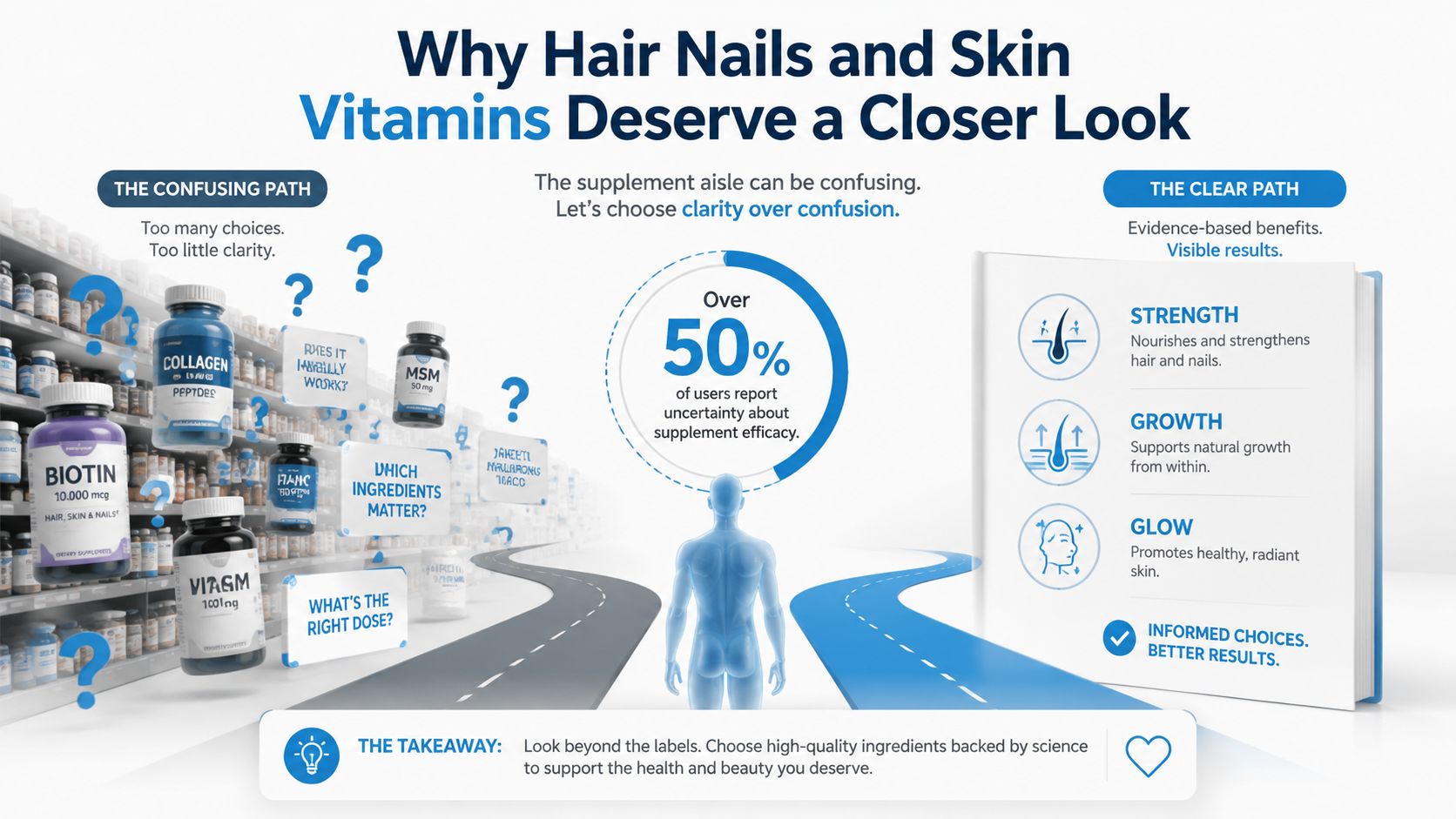
The market has also outpaced the science for generally healthy adults. Major reviews note that benefits are limited when there isn't a deficiency to correct, which is why this category deserves a clinical way of thinking instead of a cosmetic one. That doesn't make supplements useless. It means the label should come after the diagnosis, not before it.
The Nutrients That Build Hair, Skin, and Nails
Hair, skin, and nails are not built by one miracle ingredient. They are assembled by a team of nutrients, and each one supports a different part of the structure.
A useful first question is simple, what is missing? If the answer is a deficiency, the right nutrient can help repair the problem. If the answer is no, a supplement may have little to offer beyond a long label and a higher bill.
Biotin and deficiency
Biotin is the headline ingredient in many hair, skin, and nail vitamins, but the evidence for routine use in healthy people is weak. A review in NIH/PMC review says there is very limited evidence that biotin improves hair, skin, or nails in people without deficiency, and much of the positive signal comes from case reports rather than large controlled trials.
That distinction matters. Biotin deficiency can cause hair loss, skin rashes, and brittle nails, so the nutrient matters when there is a real shortage. Extra biotin does not automatically create a cosmetic benefit in someone who already gets enough through diet.
A few case reports in children with uncombable hair syndrome found that 3 to 5 mg daily improved hair health after 3 to 4 months, but that is a very specific situation, not a general beauty promise (NIH/PMC review).
Structural support nutrients
Other ingredients play a more structural role. Reviews of beauty supplements note that many formulas contain high doses of micronutrients such as vitamins A, B6, B12, E, and selenium, but excess intake can create problems, including hair loss linked to selenium, vitamin A, and vitamin E. A review in PubMed review also ties the category back to true nutritional problems, listing nutrients often linked to cutaneous findings such as B vitamins, vitamin C, vitamins A, E, and K, zinc, iron, copper, selenium, and essential fatty acids, while still separating true deficiency-related benefit from general supplement use.
For connective tissue support, expert dosing discussions often center on silica, collagen, zinc, and vitamin C. One evidence review reports that bioavailable silica at 10 to 40 mg/day, especially as orthosilicic acid or standardized horsetail extract, improved nail brittleness, increased hair growth rate and thickness, and enhanced skin elasticity after 8 to 12 weeks (evidence review). That same review places collagen in the support mix, which is why a product such as Vital Proteins Beauty Collagen Powder for skin, hair, and nails fits naturally into this nutrient group.
The cleanest way to think about these formulas is direct. Deficiency repair is a medical question, cosmetic enhancement is a marketing question.
The basic lesson is simple. Hair nails and skin vitamins make the most sense when they replace something missing, not when they are expected to override normal biology.
Forms, Dosages, and What the Research Actually Recommends
If you look at labels long enough, you'll notice a pattern. The better formulas usually cluster around the same evidence-informed nutrients, just in different delivery forms.
| Nutrient | Evidence-Informed Range | Primary Role |
|---|---|---|
| Silica | 10 to 40 mg/day | Nail strength, hair structure, skin elasticity |
| Collagen | 5 to 10 g | Connective tissue support |
| Zinc | 25 to 30 mg | Cell repair and tissue maintenance |
| Biotin | 2.5 to 5 mg | Keratin-related support, mainly when deficient |
| Vitamin C | 500 mg | Collagen synthesis |
Those ranges line up with a practical stack described in the evidence review, which pairs silica, collagen, zinc, biotin, and vitamin C because each contributes to tissue support differently (evidence review). That doesn't mean every person needs that full stack. It means the research tends to support a small cluster of ingredients more than a random grab bag.
The format matters too. Capsules are usually the easiest for dosing accuracy. Veggie capsules are similar, with fewer dietary restrictions. Gummies are convenient, but they're also where sugar, gelatin, and underdosed actives often creep in. Liquids or shots can be easy to take, though they vary more in taste, stability, and per-serving consistency.
If you want to compare a single-ingredient biotin product against a multi-ingredient beauty blend, the internal product pages can help you see how doses are structured, including options like this biotin capsule format.
One detail people miss is lab interference. Biotin can distort some test results, including TSH and troponin, so if you've got bloodwork scheduled, the label needs to be read with your clinician in mind, not just your mirror.
How to Read a Supplement Label Like a Pro
A Supplement Facts panel tells you more than the front label does, but only if you read it in the right order. Start with the serving size, because that tells you whether one capsule, two capsules, or a full gummy serving is the true dose.
Then check whether the ingredient list hides the active nutrients inside a blend. Blends can be legal and still be unhelpful, because they make it harder to see how much of anything you're really getting. If the label says “beauty complex” without clear amounts, you're guessing.
Four label traps to watch
- Mega-doses in a pretty package. High numbers on the front can look impressive, but they don't guarantee better results.
- Poorly named forms. Not every form is equally useful, and some labels look cleaner than the underlying formulation really is.
- %DV confusion. A percent daily value can be misleading when the ingredient is being used for a goal far from the reason that %DV was created.
- Hidden extras. “Other ingredients” can include sugars, melatonin, herbs, or animal-derived components that change the product's fit for you.
Simple test: if you can't tell the dose of the main active ingredients in under a minute, the label is doing too much marketing and not enough explaining.
That's where retailer transparency matters. A clear product page should show the full ingredient list, the serving size, and enough detail to compare one formula against another. The broader vitamin and supplement catalog at CalVitamin's nutrition section shows how shoppers can sort by product type instead of relying on front-label claims alone.
The goal isn't to memorize every ingredient. It's to learn whether the label gives you enough information to make a sober decision. If it doesn't, walk away.
Realistic Timelines and What Results Actually Look Like
Hair, nails, and skin change on different schedules because they renew on different biological clocks. That's why a product can seem “slow” for hair and “faster” for skin without being ineffective.
Hair grows at a pace that makes dramatic change slow. Nails also take time because you're waiting for new material to replace the old surface. Skin, by contrast, turns over more quickly, so texture and hydration changes can show up sooner if the underlying issue is nutritional.
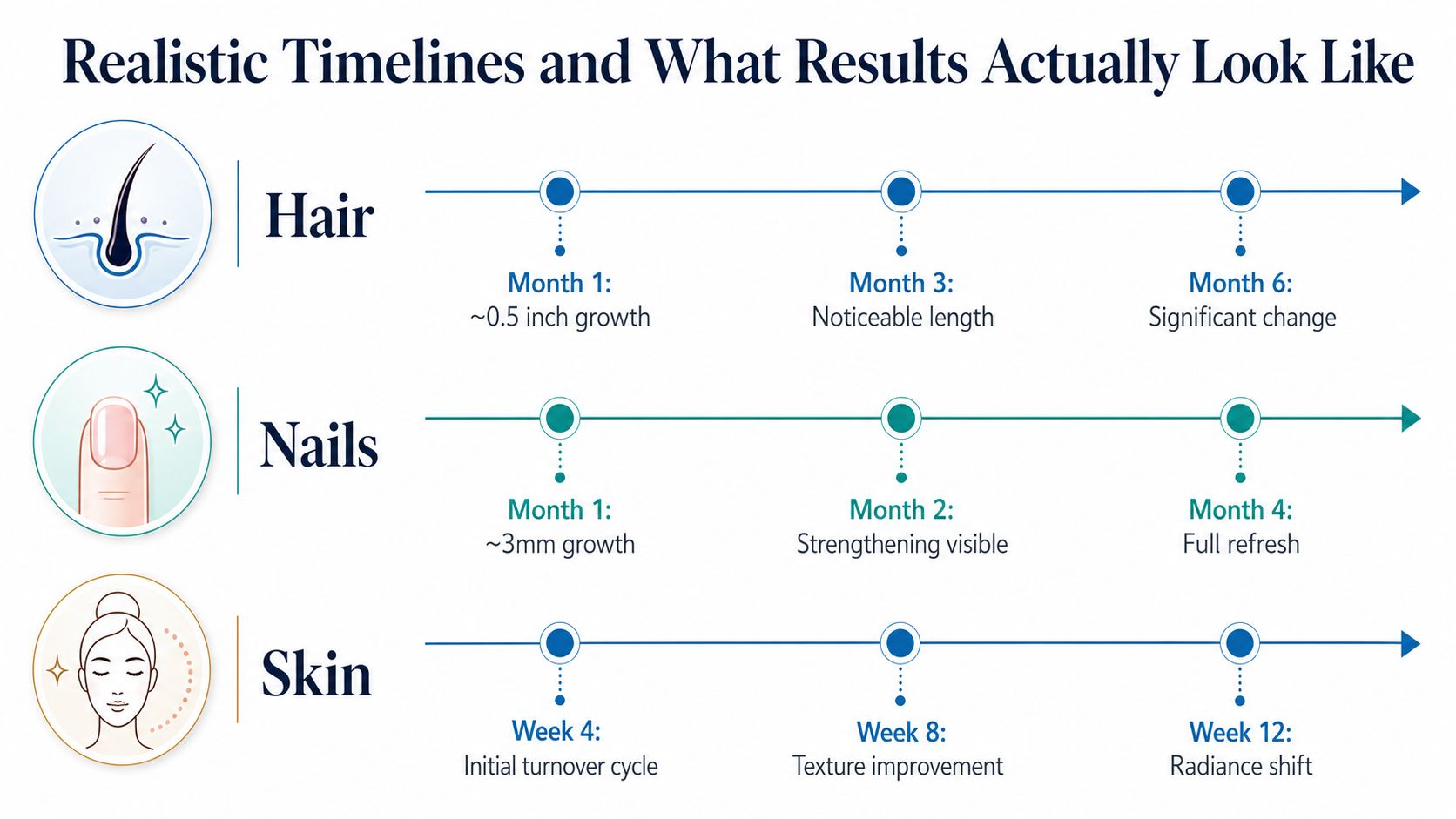
The timeline matters because it prevents a common mistake, quitting too early or staying too long on something that isn't helping. A person might notice nail changes before hair changes, or skin changes before either one, and that sequence is normal rather than suspicious.
You should also separate supplement effects from lifestyle effects. Better sleep, more protein, less sun damage, and better hydration can improve the same things people hope pills will fix. Supplements don't replace those basics, they sit underneath them.
Safety, Interactions, and When to See a Clinician
The main mistake in this category is assuming beauty supplements are harmless because they sit on the same shelf as everyday wellness products. Their safety depends on the formula, and many blends stack several active nutrients into one serving.
That matters because vitamins A, B6, B12, E, selenium, and similar ingredients are often present at high levels in these products, and excess intake can lead to side effects, including hair loss linked to selenium, vitamin A, or vitamin E. High-dose zinc can also cause gastrointestinal toxicity and copper deficiency, and biotin can interfere with lab tests such as TSH and troponin. NIH/PMC safety review
Who should be cautious first
- Pregnant or breastfeeding adults. Nutrient needs and safety margins change.
- People on thyroid or blood-thinning medication. Ingredient interactions matter.
- Anyone with kidney or liver disease. Clearance and storage can be different.
- People scheduled for surgery or bloodwork. Biotin and other ingredients can distort results.
Some beauty blends also include herbs, hormones, or animal-derived ingredients, which means the front label can hide part of the risk picture. NIH/PMC safety review That is why “natural” does not automatically mean low-risk.
Clinician's rule of thumb: if the label contains several active ingredients and you take medications, get the product reviewed before you start it.
Safety-first thinking is not alarmist. It keeps a supplement from becoming a hidden variable in a lab result or a medication plan.
Choosing Supplements From a Trusted Retailer
A trustworthy retailer makes the decision easier before you ever compare ingredient lists. The first sign is transparent dosing on the product page, not just on the bottle photo. The second is product variety, because people need different formats, capsules, veggie capsules, gummies, or liquid shots, to fit their routines.
The third sign is labeling clarity. If you care about halal, gelatin-free, or cruelty-free attributes, those should be visible without a scavenger hunt. The fourth is human support, because a phone number or email contact matters when a label raises a question and you want an answer from a real person.
CalVitamin fits this shopping model as an online retailer based in Jacksonville, Florida, with a listed toll-free support line at 1-888-510-9080, a broad catalog that includes vitamins, minerals, proteins, probiotics, herbal formulas, and beauty products, and multiple dosage forms that let shoppers match a supplement to their routine. The site also shows ratings, reviews, and As low as pricing on some items, which helps you compare value instead of guessing.
That doesn't make every product automatically right for every person. It does mean the shopping experience gives you the tools to compare cost per serving, review the full ingredient list, and check whether the format fits the way you take supplements day to day.
Your Take-Home Checklist
Before you buy any hair, skin, and nails vitamins, start with the cause, not the bottle. If you don't know what problem you're solving, the label is just decoration.
Use this short checklist:
- Confirm a likely deficiency first. Don't guess if the issue might be dietary, hormonal, medication-related, or unrelated to nutrition.
- Match the ingredient to the problem. Biotin is not a universal fix, and zinc or silica only make sense in the right context.
- Stay close to evidence-informed doses. The ranges that show up in the literature are more useful than whatever number looks biggest on the front label.
- Avoid mega-doses and proprietary blends. If the dose is hidden, the product is asking for trust it hasn't earned.
- Pause for bloodwork if biotin matters. Lab interference is real, so timing should be coordinated if you're getting tests.
- Choose a form you'll take consistently. Capsules, gummies, and liquids all have tradeoffs, and consistency matters more than hype.
- Compare per-serving cost, not just sticker price. A cheap bottle can become expensive if the dose is weak or the serving size is large.
The smartest plan is boring in the best way. Eat enough protein, protect your skin from sun damage, sleep regularly, hydrate, and use supplements only when they fit the evidence and your actual needs.
If you want to compare hair, skin, and nail formulas with a more evidence-first lens, browse CalVitamin for product pages that show serving sizes, ingredient details, and multiple format options. Use the retailer tools, read the full label, and choose the supplement that matches a real gap, not just a shiny promise.






