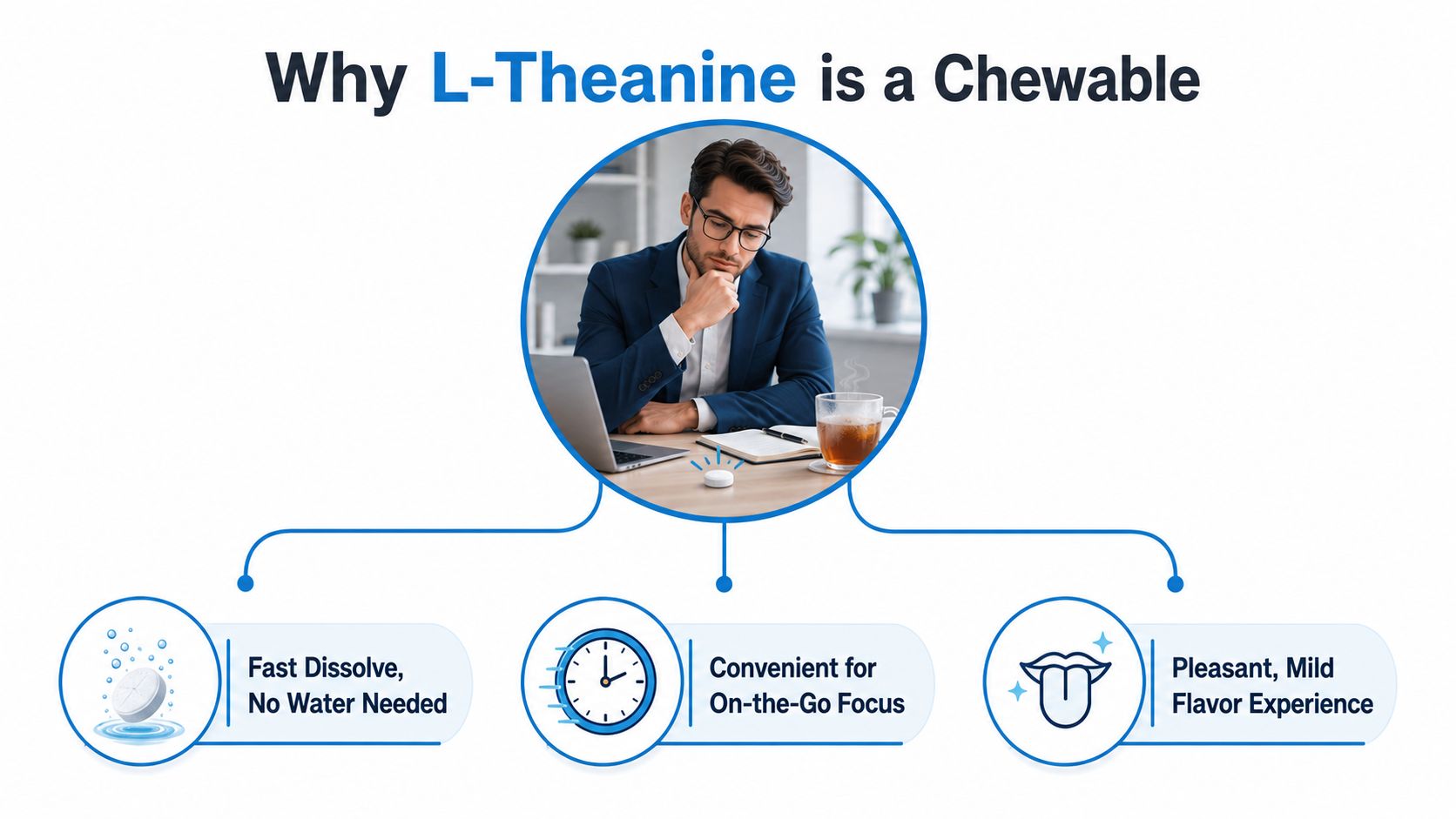
You're standing in the kitchen or at your desk, eyeing a third cup of tea, and wondering if there's a simpler way to get the calm you want without another mug to steep and finish. That's the basic appeal of an L-theanine chewable. It gives you a measured amount of an ingredient people normally associate with tea, but in a format that's easier to carry, easier to dose, and easier to fit into a busy day.
Table of Contents
- What L-Theanine Chewable Means and Why the Form Exists
- How L-Theanine Works in the Brain
- Typical Dosage, Onset, and How Long Effects Last
- Chewable vs Capsules, Gummies, and Sublingual Forms
- How to Choose a Quality L-Theanine Chewable
- Safety, Side Effects, and Who Should Avoid It
- Practical Use Tips and Common Shopper Questions
What L-Theanine Chewable Means and Why the Form Exists
A chewable makes sense the moment you picture the user. Someone wants the calm-supporting ingredient from tea, but doesn't want to brew tea, wait for it to cool, or rely on whatever happens to be in a random cup that day. That's where the chewable format earns its place. It turns a tea-associated compound into a portable, repeatable serving.
Why tea itself isn't a standardized source
L-theanine is a naturally occurring amino acid in tea, and brewed tea is a moving target. The verified data shows that white, green, oolong, and black teas typically contain 0.9% to 3.1% of the leaf's dry weight, which works out to about 5.8 to 32 mg per 200 ml cup brewed from 3 g of dried tea leaves. The same review notes that average commercially available teas have been reported at about 5 mg/g dry leaves, and intake from tea can vary widely even among frequent drinkers. Source review on tea variability and dose range
That variability matters. A cup of tea is fine as a ritual, but it's not a reliable delivery system if you want a predictable amount of the active ingredient. A chewable exists to solve that problem. Instead of guessing what your mug contains, you get a label-stated amount per tablet.
Practical rule: if you care about consistency, read the tablet label, not the tea bag box.
Why manufacturers moved to chewables
Chewables became a useful middle ground between tea and capsules. They let brands offer 100 mg per tablet or 200 mg per serving, which is far above the amount in a typical cup of tea but still within the dose range studied in clinical research. They also give manufacturers room to build a product that tastes acceptable and works for people who dislike swallowing pills. The active ingredient stays the same, but the delivery feels less clinical.
That's also why the excipient list matters. A chewable usually includes sweeteners, flavor systems, and bulking agents that shape mouthfeel and tolerability. If you want the specific product architecture side by side with another chewable format, the product page for Nature's Craft D3 K2 chewable cherry tablets shows how chewable supplements are often designed around convenience and taste.
How L-Theanine Works in the Brain
The easiest way to understand L-theanine is to treat it as a volume knob, not a switch. It does not shut the brain down. It appears to lower stress signaling while keeping attention channels open, which is why people often describe the effect as relaxed but alert. That description keeps expectations grounded. This is not a sleeping pill in disguise.
The alpha-wave idea in plain language
Branded ingredients such as Suntheanine® often point to a mechanistic claim tied to alpha brain-wave activity. In everyday language, alpha waves are usually associated with a calmer, more settled state without full sedation. That idea helps explain why someone may feel mentally steady and still able to focus on work, reading, or conversation. A related product page for NOW True Focus Neurotransmitter Support shows how ingredient-focused formulas are often framed around mental clarity rather than sleepiness.
The useful takeaway is simple. The science language points toward calmness with preserved alertness, not heaviness or fog. That is why many shoppers reach for L-theanine during workdays, not only at bedtime.
Calm support and sleep support are different claims. If a label blends them together, read it more carefully.
What users care about most
The practical benefits people usually look for are perceived stress reduction, better focus under pressure, and a smoother caffeine experience. The caffeine pairing matters because L-theanine is often used to soften a jittery feeling without taking away alertness. That is one reason it appears in both tea-based wellness routines and supplement stacks aimed at concentration.
Sleep is where confusion often starts. Some consumer pages include it, and the idea sounds appealing, but the stronger and more consistent positioning is still calmness and stress support. If you buy an L-theanine chewable because you want nighttime sedation, you are probably looking at the wrong use case. The more accurate expectation is steadier nerves during the day, while sleep effects remain less consistent.
Typical Dosage, Onset, and How Long Effects Last
The label is where the decision starts. For chewables, the common market band is 100 mg per tablet or 200 mg per tablet, and those two numbers matter because they map to different use styles. A 100 mg chewable is the lighter entry point. A 200 mg chewable is the more concentrated option and may fit people who want a once-daily serving or a simpler routine. Product label dosage bands
Reading the dose correctly
Don't just look at the serving size line and stop there. Some products state a dose per tablet, while others describe a dose per serving that could involve more than one chewable. The question is: how much L-theanine per tablet are you chewing? That's the number you use to compare products, especially when one label is built around a lighter relaxation-support serving and another is built around a stronger daily format.
A simple way to begin is to start low and let your own response guide you. If a product offers 100 mg tablets, that's the natural starting point for someone new to chewables. If the product is 200 mg per tablet, you're already at the upper end of the common chewable band, so it makes sense to be cautious about adding more on top.
Onset and duration in real life
Many want to know when they'll feel anything. The practical answer is that L-theanine is usually discussed in terms of a moderate, same-day onset, not an overnight effect. Think closer to the timing of a cup of coffee than a sleep aid. You take it, you give it some time, and then you assess how your body and attention feel.
If you want a quick internal check before trying a capsule alternative, the NOW True Focus neurotransmitter support capsules page is a useful comparison point for shoppers deciding between chewable and swallowable formats.
| L-Theanine Chewable Dose Bands at a Glance | ||
|---|---|---|
| Dose per tablet | Typical daily range | Best for |
| 100 mg | 1 tablet daily, or a conservative start | New users, lighter relaxation support, dose testing |
| 200 mg | 1 tablet daily, sometimes used as a stronger single serving | Users who want a simpler once-daily routine, higher serving strength |
Practical rule: start with one tablet, not the maximum label allowance, then judge how you feel on a normal workday before increasing.
Chewable vs Capsules, Gummies, and Sublingual Forms
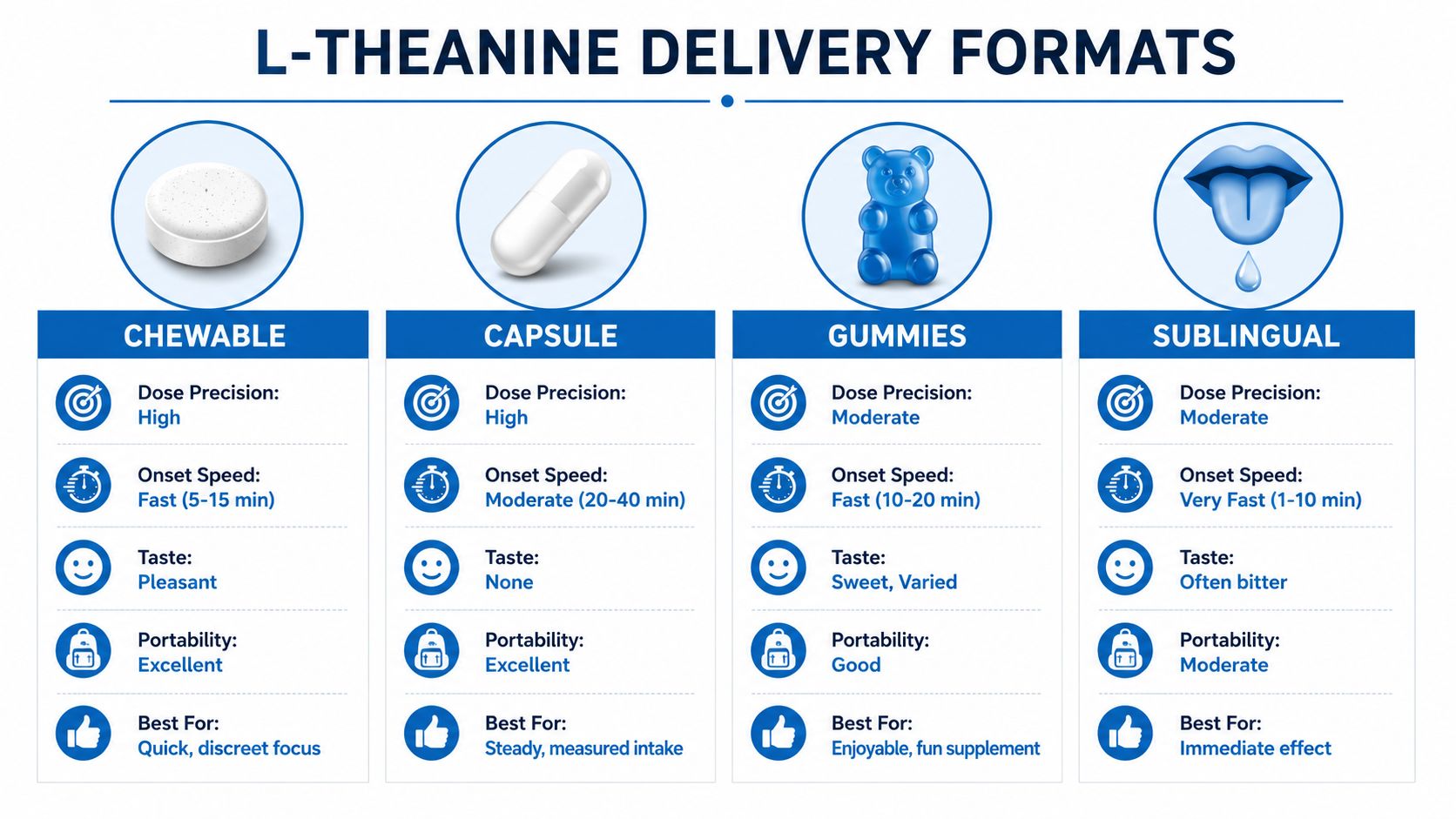
Choosing a format is mostly about trade-offs. The active ingredient can be the same, but the experience can feel very different depending on how you take it. If you want the clearest path to the right choice, use four criteria, dose precision, taste, portability, and fit with sugar restrictions.
How the formats compare
Chewables are strong on convenience and often easier to remember than capsules because they feel more like a routine than a task. They're also easy to split by serving habits when the product is built around 100 mg or 200 mg units. The downside is the excipient profile. As the verified data shows, chewable formulas can include ingredients such as xylitol, monk fruit extract, dextrates, gum arabic, and sometimes cane sugar. That means chewables can fit sugar-aware shoppers, but not every chewable is equally suitable.
Capsules are the cleaner option if you care about minimal extras. They usually win on purity, and they're often simpler for people who want a neutral-tasting supplement. If a shopper wants a direct product example, the NOW L-Theanine 200mg with Inositol capsules listing shows the more traditional capsule route.
Gummies overlap with chewables in feel, but they often lean sweeter and can blur the active dose behind a dessert-like experience. Sublinguals aim for speed, since they're designed to sit under the tongue, but many people dislike the flavor and texture.
Here's the fastest decision rule.
If you want measured dosing without swallowing pills, pick chewables. If you avoid sugar strictly, pick capsules or sugar-free chewables. If you want the fastest onset, look at sublinguals.
How to Choose a Quality L-Theanine Chewable
A shopper standing in front of two similar bottles can miss the differences if the label talks more about calm feelings than about what is inside. Start with the active ingredient itself. A quality chewable should clearly state 100 mg or 200 mg of L-theanine per tablet, so you can compare products without guessing. If the amount is hidden in a blend, split across servings, or described in a way that makes the dose hard to trace, the label is asking you to do too much work.
What to look for on the front and back label
Branding can matter, but only in a limited way. If you already know you want a named ingredient source, a branded form such as Suntheanine® gives the product a clearer manufacturing identity. That does not make every formula better on its own. It makes the ingredient easier to recognize, and the verified data notes products using that branded ingredient and ties them to Suntheanine® label claims.
Sweeteners deserve the same careful reading. A xylitol or monk fruit system usually points to a lower-sugar chewable, while a product using cane sugar may taste more like candy but also adds carbohydrate exposure. For anyone following a sugar-restricted plan, that difference changes whether the product belongs in the cart at all. The label can look friendly on the front and still be a poor fit once the excipients are checked.
The shortlist that prevents bad buys
Use this checklist before you buy a bottle.
- Dose clarity: Look for a clearly stated amount of pure L-theanine per tablet, not just a vague “relaxation blend.”
- Sweetener system: Choose xylitol/monk fruit if you want a lower-sugar profile, or accept sugar if taste matters more.
- Allergen and diet flags: Check for gelatin-free, vegan, halal, gluten-free, or other tags that matter to you.
- Inactive ingredients: Read the full excipient list so you know whether the chewable uses fillers, flavors, or sugar alcohols.
- Third-party testing: Look for certification marks when available, because they can make quality screening easier.
- Claim discipline: Be cautious when the front label promises dramatic sleep or anxiety results that outpace what the ingredient is known for.
CalVitamin's catalog includes multiple supplement forms, so shoppers can sort by dosage form and labeled attributes instead of guessing from marketing copy. That kind of filtering matters when you want a chewable that matches your diet and your delivery preference, not just a front label that sounds appealing.
Safety, Side Effects, and Who Should Avoid It
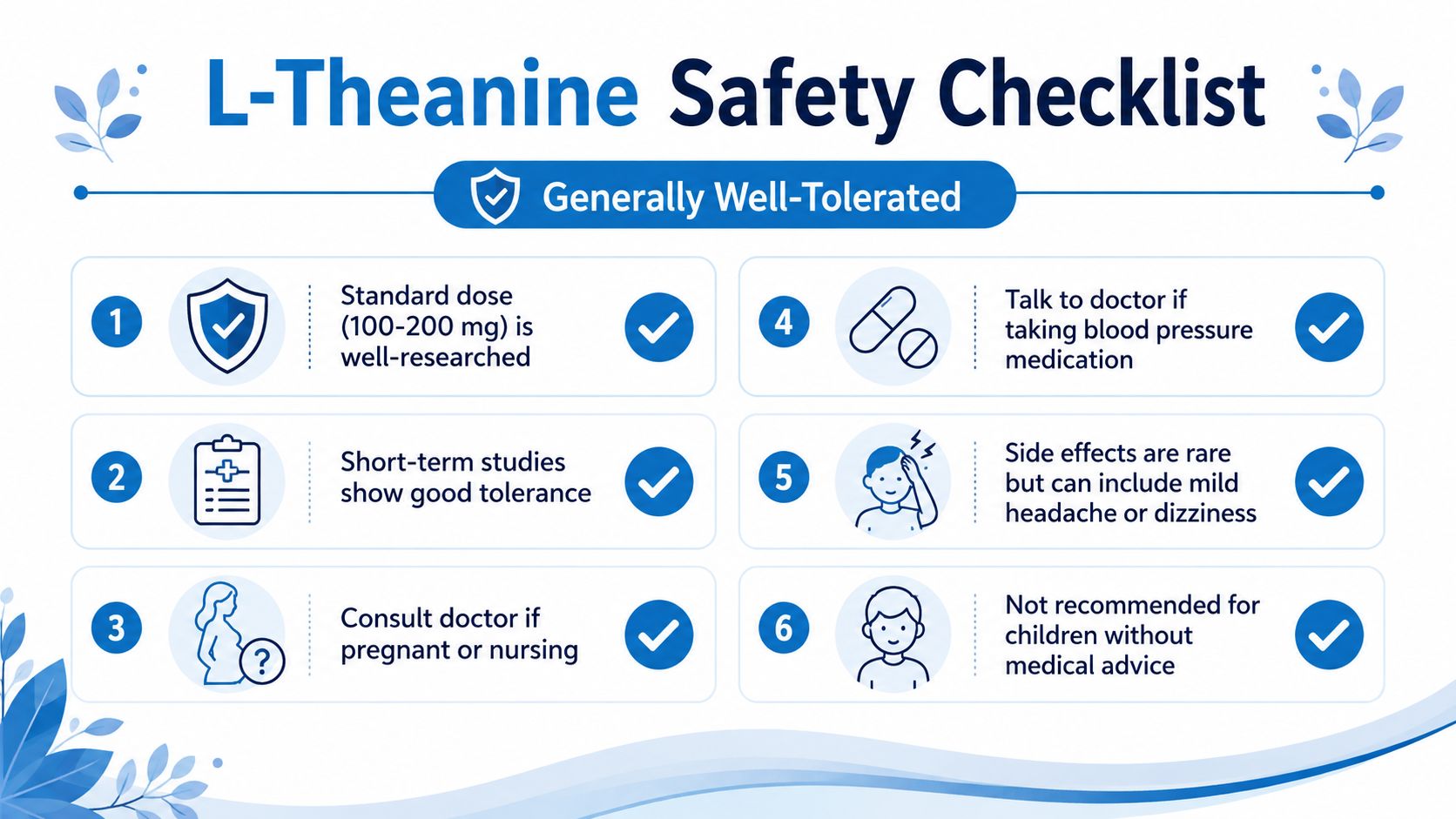
L-theanine is generally well tolerated in short-term use, and the common chewable dose band of 100 mg to 200 mg sits inside the range shoppers typically see in products. That said, “well tolerated” doesn't mean “right for everyone.” The practical question is whether the supplement fits your health situation, medications, and goals.
What to watch for
Most concerns are mild, but they still matter. People sometimes report drowsiness, especially if the serving is high for them personally. Others notice occasional gastrointestinal discomfort. Long-term safety data are still limited, so it's sensible to treat L-theanine as a supplement you use thoughtfully, not casually.
Regulatory language can confuse shoppers. Generally recognized as safe is not the same thing as proven ideal for your situation. It means the ingredient has a certain safety context, not that every person should take it without review.
Who should check with a clinician first
- Pregnant or breastfeeding individuals should avoid self-directing use unless a clinician approves.
- People taking blood pressure medication should ask first, because supplement effects can overlap with medication goals.
- People on stimulants or sedatives should be careful about additive effects.
- Anyone with chronic conditions or upcoming surgery should tell their healthcare provider what they take, including chewables.
The cleanest habit is simple. If you use supplements regularly, put them on the same list as prescriptions and bring that list to your next appointment. That's especially important when a product is part of your daily routine rather than an occasional experiment.
Practical Use Tips and Common Shopper Questions
A lot of people want the same four answers before they buy. The good news is that the practical guidance is fairly straightforward once you strip away the marketing.
Can I take it with coffee
Yes, that's one of the most common use cases. L-theanine is often chosen to smooth the jittery edge of caffeine while keeping the mental lift. If you already drink coffee in the morning, a chewable can fit into that routine without forcing a separate supplement window.
Will it make me sleepy
Usually not at standard serving sizes. The better expectation is calm without heavy sedation, though individual sensitivity varies. If you're unusually sensitive to relaxation aids, start with the lower dose and see how you respond on a normal day, not on a day when you can afford to feel slow.
Are sugar-free chewables effective
Yes. The active compound is L-theanine, not the sweetener. Sugar-free chewables can work just as well as sugar-containing ones, though the mouthfeel and flavor may differ. If you're avoiding sugar for blood sugar management or personal preference, the excipient list is the deciding factor, not the active ingredient.
How fast does it work and how often can I take it
Think in terms of a moderate same-day onset, not an immediate switch. Labeled use can vary by product, but the common retail pattern is one tablet daily for lighter use or a larger daily allowance when the label allows it. If you're unsure where to begin, try one tablet for two weeks and note your focus, calm, and caffeine response before changing the routine.
That two-week check-in matters because supplements work best when you evaluate them against real life, not the label promise. Use the same time of day, the same caffeine pattern, and the same work conditions if you can. Then decide whether the chewable earns a place in your routine.
If you want a supplement source that makes comparison shopping easier, CalVitamin carries a broad wellness catalog with different forms and label styles, which is helpful when you're deciding between a chewable, capsule, or other format. Visit CalVitamin to review the options and match the product details to your own diet, dose preference, and daily routine.