
Most advice about nettle root supplements starts with the wrong promise. It treats an herbal product as though it should shrink the prostate, correct every urinary problem, or deliver a noticeable effect overnight. The evidence points to a narrower and more useful role: nettle root may help some men manage lower urinary tract symptoms linked to benign prostatic hyperplasia, or BPH, but symptom relief is not the same as changing the underlying disease.
That distinction matters before you compare capsules, teas, and blended prostate formulas. If your goal is easier urination, less urgency, or fewer nighttime bathroom trips, nettle root may be worth discussing with a healthcare professional. If your goal is a smaller prostate or a lower PSA level, the clinical evidence doesn't support that expectation.
Table of Contents
- Rethinking What Nettle Root Can Actually Do
- The Clinical Evidence for Urinary Symptom Relief
- Finding the Right Dosage and Extract Type
- Root Extract Versus Leaf and Whole Herb
- Safety Profile and Potential Interactions
- How to Choose a High Quality Supplement
- Common Questions About Nettle Root Supplements
Rethinking What Nettle Root Can Actually Do
Stinging nettle root has a long history, but history alone doesn't establish what a supplement can accomplish today. The European Medicines Agency records traditional use reaching back centuries, including references associated with Paracelsus and Matthiolus. Its documented clinical and regulatory history also extends to at least the 1950s, when preparations were used for urinary tract disorders. Germany's Commission E later approved stinging nettle root for difficulty in urination associated with benign prostatic adenoma in stages I and II, as described in the European Medicines Agency assessment report on Urtica species root.
That background explains why nettle root appears in many prostate-support products. It doesn't prove that every nettle product works in the same way, however. Traditional use, laboratory findings, and clinical trials answer different questions, and a shopper shouldn't treat them as interchangeable evidence.
Symptom management is not disease modification
BPH can affect how urine moves through the lower urinary tract. A person may notice a weak stream, hesitancy, urgency, frequent urination, or waking during the night. A supplement that makes those symptoms easier to manage may improve daily comfort without changing the size of the prostate or the long-term course of the condition.
That is the central point for nettle root. Available evidence supports a symptom-targeted role, especially for mild-to-moderate obstructive urinary complaints. It doesn't justify describing nettle root as a prostate-shrinking treatment, a replacement for medical assessment, or a general vitality product.
Practical rule: Choose nettle root for the urinary symptom you want to address, not for a promise that the supplement will reverse prostate enlargement.
A large evidence review cited in the EMA report found that roughly 40,000 men with BPH had received stinging nettle root preparations across 34 clinical trials. That shows substantial historical study and use in the European herbal medicine market, but it doesn't mean every trial used the same extract or met the same standard of rigor.
The sensible conclusion is modest. Nettle root is one of the better-known botanical options for urinary symptoms associated with BPH, yet the product still deserves the same scrutiny as any other supplement. Start by identifying your goal, checking whether your symptoms need medical evaluation, and then looking for a root preparation that resembles the products used in clinical research.
The Clinical Evidence for Urinary Symptom Relief
The strongest evidence for nettle root concerns lower urinary tract symptoms, often abbreviated as LUTS, in men with BPH. Researchers have measured outcomes such as symptom scores, urinary flow, urgency, frequency, and nocturia. These are practical outcomes because they reflect what a person notices during ordinary activities and sleep.
One randomized, double-blind, placebo-controlled study followed 558 men who completed follow-up. After 6 months, the group taking a stinging nettle root extract showed a 40% decrease in symptom scores, compared with 9% in the placebo group. Peak urinary flow rate improved by 77% from baseline with the extract, compared with 31% with placebo, according to the published clinical report available through the Advocate Aurora Health institutional repository.
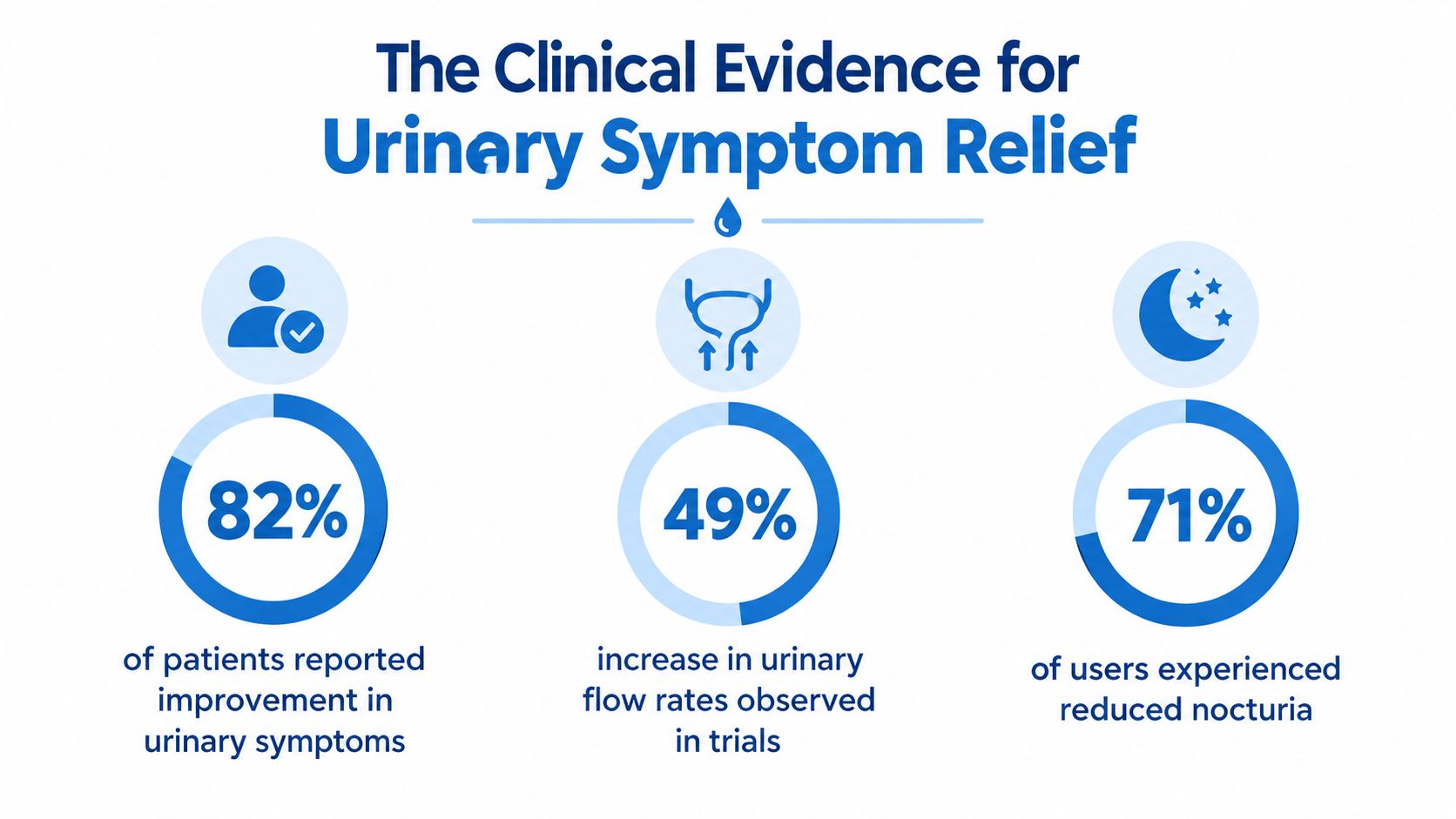
Another multicenter trial cited 253 evaluable men and reported significant symptom improvement at 24 weeks. A separate double-blind, placebo-controlled trial involving 620 men also found improvement in International Prostate Symptom Score, maximum urinary flow rate, and symptom relief over 6 months, as summarized by the National Center for Complementary and Integrative Health review of BPH approaches.
What improves and what stays the same
The outcomes that appear most relevant are the ones patients feel directly. Urinary frequency, urgency, nocturia, and flow may improve in some users. That can mean fewer interruptions during the night, less rushing to the bathroom, or a more satisfactory stream.
The less encouraging part is also the part most likely to be omitted from product marketing. A neutral review notes that nettle root improved urinary frequency, urgency, and nocturia versus placebo, but didn't meaningfully change prostate volume or PSA. In other words, a person can feel better without evidence that the prostate has become smaller or that PSA has changed.
This distinction prevents a common reasoning error. If symptoms improve, it doesn't automatically follow that the underlying prostate enlargement has reversed, or that a potentially serious urinary condition has been ruled out. Symptom improvement is useful, but it doesn't replace evaluation when symptoms are persistent, worsening, painful, or accompanied by blood in the urine or an inability to urinate.
For readers comparing ingredients, the CalVitamin review of saw palmetto for prostate health can provide additional context, but different botanicals shouldn't be assumed to have identical evidence. The important question remains specific: does the product contain a clinically relevant root extract, and are you tracking the urinary outcome you want to improve?
Finding the Right Dosage and Extract Type
A larger number on a nettle root bottle does not automatically mean a stronger or better product. Milligrams describe the amount of material in the capsule, but they do not show how the root was extracted, how concentrated it is, or whether it resembles a preparation studied in clinical research.
The preparation matters because extraction methods can produce different chemical profiles. Clinical reports describe an aqueous root extract used at approximately 360 mg daily for 6 months. Methanol extracts have been studied at 600 to 1,200 mg daily for 6 to 9 weeks, according to the clinical dosing and safety summary for nettles. These figures apply to studied preparations. They are reference points, not a universal prescription for every capsule.
Read the extract details, not just the front label
An aqueous extract uses water during processing. A methanol extract uses methanol and is then prepared as a finished botanical product. The same raw weight of nettle root can therefore produce a different mixture of compounds depending on the method. A capsule's total weight alone cannot establish that it matches a clinical trial extract.
Check four details before comparing products:
- Plant part: The label should identify nettle root or Urtica dioica root.
- Extract type: Look for the extraction method or a meaningful extract specification.
- Daily serving: Compare the full daily amount with studied ranges, rather than judging one capsule by itself.
- Standardization: The manufacturer should explain which compounds or quality measures are tested to keep batches consistent.
Nettle root is generally used as a daily supplement used over weeks or months, not as an acute product taken only when urinary urgency appears. Research assessed outcomes over several weeks or months, so taking one capsule and judging its effect within a day does not fairly test the evidence. Improvement in urinary flow or related symptoms also should not be treated as proof that a dose will shrink the prostate or alter PSA levels. Those are different outcomes.
A useful label question: Does this product identify its root extract clearly enough to compare with the preparations used in research?
Tea requires a separate comparison. A nettle tea can be a reasonable traditional beverage, yet it is not automatically equivalent to a concentrated root extract in a capsule. The Alvita organic nettle tea review helps explain why preparation format matters when choosing between a drink and a supplement.
If symptoms are significant, ask a clinician or pharmacist to review the label and dosing plan. A higher amount is not necessarily better. Increasing it without guidance can also make it harder to identify whether side effects come from nettle, another ingredient, or an interaction with medication.
Root Extract Versus Leaf and Whole Herb
“Nettle” is not a complete product description. The plant part changes the preparation, the chemistry, and the reason someone might use it. A shopper looking for urinary support should distinguish stinging nettle root from nettle leaf, leaf tea, and whole-herb powder before making a purchase.
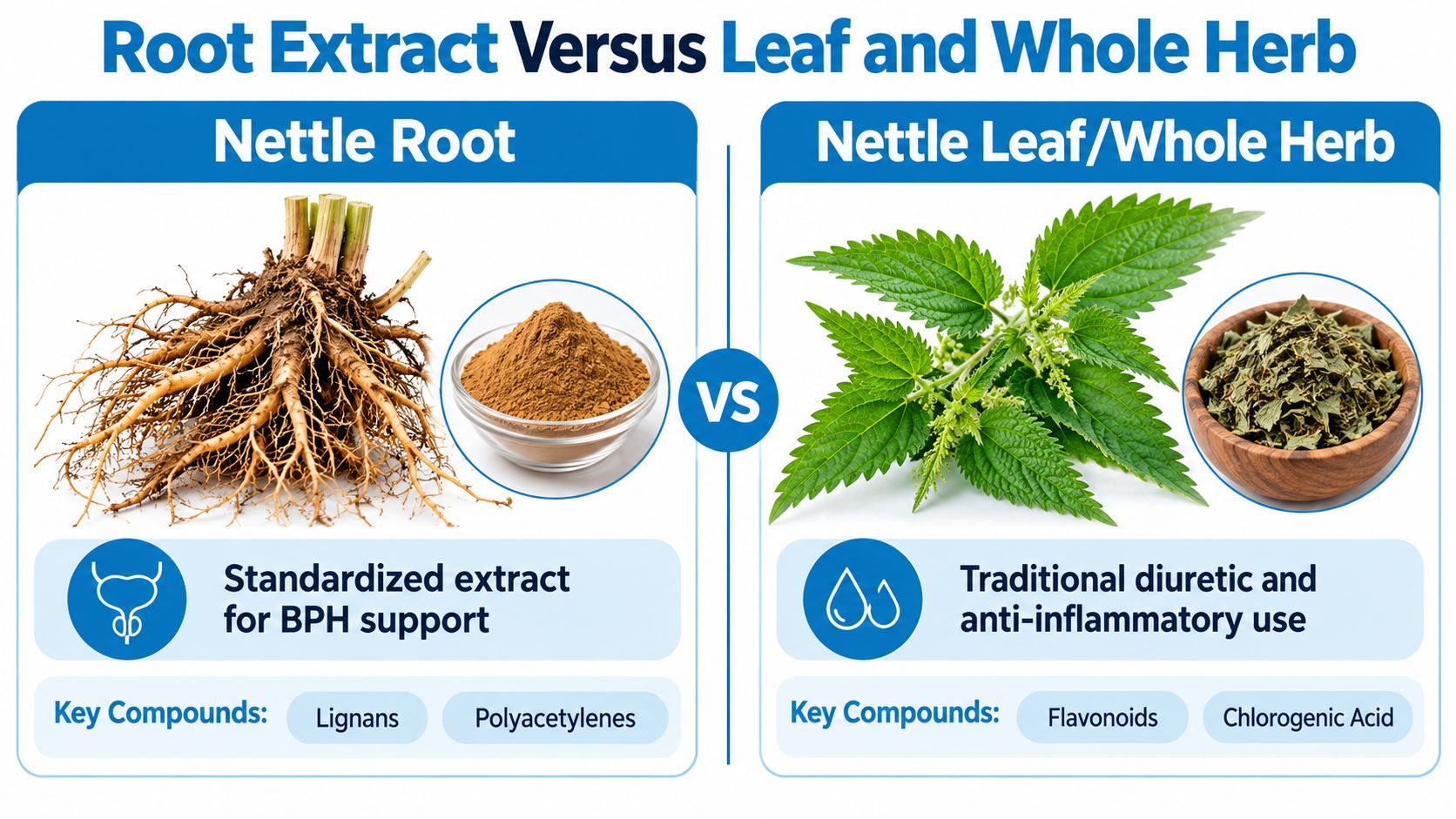
The root is the part most directly associated with the BPH and lower urinary tract research discussed above. That doesn't mean the leaf is useless. Leaf preparations have their own traditional applications, including diuretic and anti-inflammatory uses, but those uses shouldn't be presented as proof that a leaf capsule can reproduce the clinical findings for a standardized root extract.
Match the plant part to the goal
A simple comparison helps:
| Product description | More appropriate interpretation |
|---|---|
| Nettle root extract | The plant part most closely aligned with research on BPH-related urinary symptoms |
| Nettle leaf | A different botanical preparation with traditional diuretic and anti-inflammatory uses |
| Whole-herb powder | A broad, less specific material that may not match the extract used in clinical trials |
| Nettle tea | A beverage preparation that shouldn't automatically be treated as a concentrated root product |
Whole-herb products can sound attractive because they appear to include everything. The problem is that “everything” doesn't tell you whether the product contains enough root extract to resemble the evidence base. It can also make comparisons difficult when the label doesn't separate root from leaf or disclose the extract ratio.
For prostate and urinary goals, scan the Supplement Facts panel rather than relying on the product name. Check for the botanical name, the word root, the amount per serving, and any information about standardization. If the label only says “nettle blend” or “whole nettle,” you can't confidently assume it provides the preparation evaluated in BPH research.
The broader CalVitamin herbs collection illustrates why category browsing requires care. Herbal products can sit beside one another while targeting very different goals, so a shopper should compare the actual ingredient panel instead of treating every product in the same plant category as interchangeable.
The practical takeaway is narrow but valuable: root for the urinary evidence, leaf for its own traditional uses, and whole herb only when the product's purpose and labeling are clear. Selecting the wrong plant part is one of the easiest ways to buy a product that doesn't match your intended outcome.
Safety Profile and Potential Interactions
Nettle root may be reasonably well tolerated for short-term use, yet “natural” does not mean free of precautions. Safety has two parts: how the product feels in everyday use and how it fits with medicines, health conditions, or symptoms that need medical attention.
In a 4,087-person observation, people taking 600 to 1,200 mg daily for 6 months reported mild gastrointestinal distress in under 1% of cases and allergic skin reactions in 0.19%, as summarized in the nettles safety monograph. This suggests a low rate of reported problems in that observation. It does not show that every nettle preparation, dose, or combination formula will suit every person.
A practical safety screen
Before starting nettle root, review these points:
- Medication use: Ask a pharmacist or clinician to check the product if you take prescription medicines, particularly those affecting blood pressure, blood glucose, fluid balance, or clotting. Bring the full Supplement Facts panel, product name, and intended dose.
- Allergy history: Stop use and seek medical advice for hives, facial swelling, breathing difficulty, or another concerning allergic reaction.
- Digestive response: Mild stomach upset can occur. Taking the supplement with food may improve comfort, while persistent symptoms warrant medical advice.
- Urinary warning signs: Severe pain, blood in the urine, fever, sudden inability to urinate, or rapidly worsening symptoms require medical assessment rather than self-treatment.
- Pregnancy and breastfeeding: Discuss use with a qualified healthcare professional. The evidence described here concerns men using nettle root for BPH-related urinary symptoms.
Nettle root may improve urinary flow or ease symptoms without changing the underlying prostate condition. Symptom relief is not the same as shrinking the prostate, and it should not be treated as evidence that nettle root alters PSA levels. A person whose symptoms improve still needs appropriate medical follow-up when prostate evaluation is indicated.
Before adding a botanical: Include the supplement label in your medication history. A pharmacist needs to see the ingredient amounts, extract type, product name, and intended dose to assess the combination with your medicines.
The evidence also has limits. A medical monograph notes that many studies were open-label, and relatively few high-quality trials tested Urtica dioica alone against standard therapy. Clinical reviews have also questioned trial rigor and reproducibility. Those limitations do not erase the urinary findings, but they support caution about long-term claims, disease modification, and multi-ingredient products.
How to Choose a High Quality Supplement
A good nettle root product should make comparison easy. You shouldn't have to guess whether the capsule contains root, leaf, or a proprietary mixture, and you shouldn't need to infer the daily dose from vague marketing language.
Start with the identity of the ingredient. Look for Urtica dioica and the specific plant part, preferably “root.” If the product uses another nettle species or doesn't identify the species at all, it's harder to connect the label to the clinical evidence.
Four label checks that save time
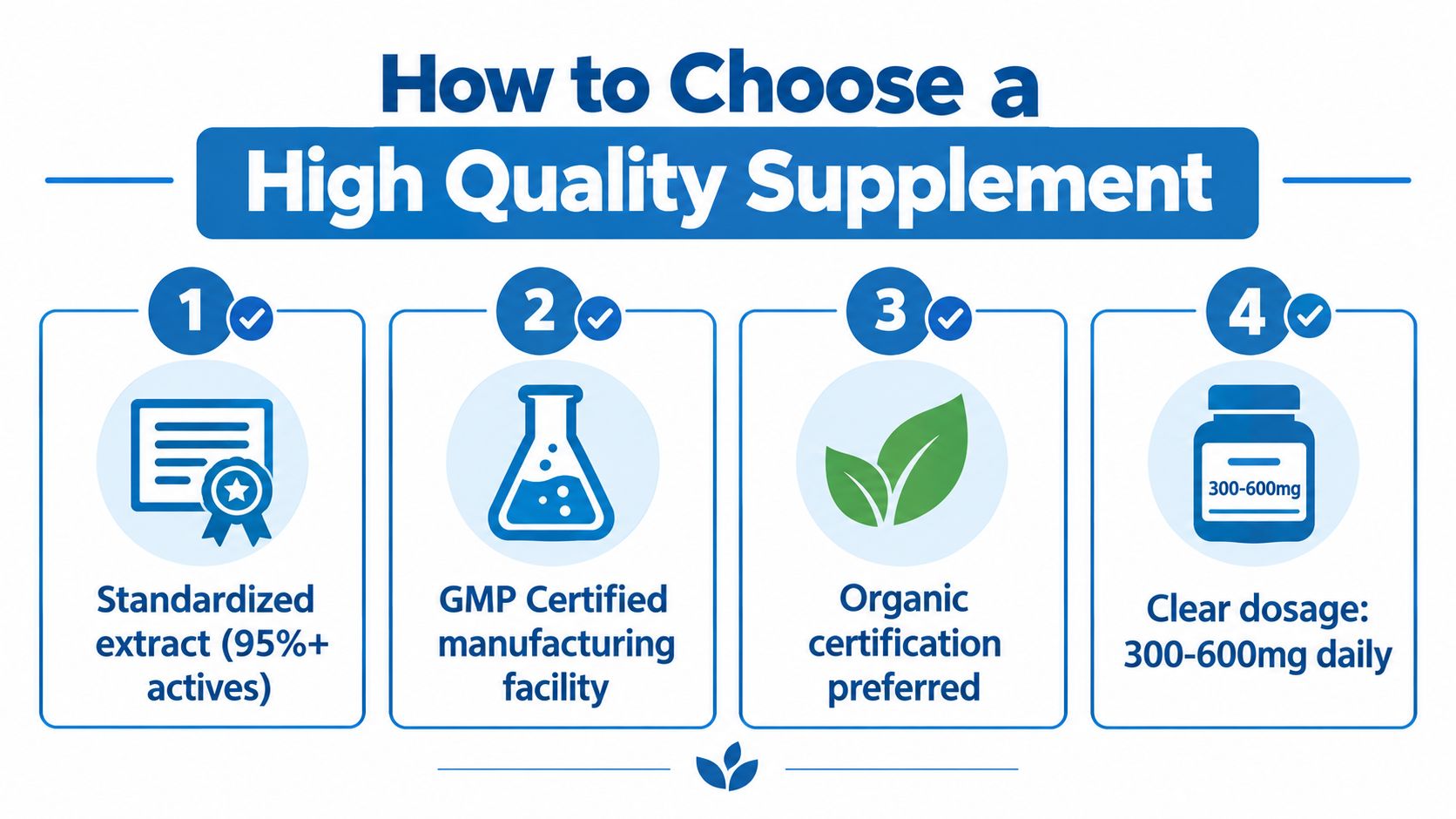
First, find the actual dose. The label should state the amount of root extract per serving and how many servings make up the daily intake. A proprietary blend that lists nettle alongside several botanicals without individual amounts prevents a meaningful comparison.
Next, look for manufacturing controls. Third-party testing, batch identification, certificates of analysis, and good manufacturing practice information can help you assess whether the company controls identity, purity, and consistency. These markers don't prove that the product will relieve your symptoms, but they improve transparency.
Then, examine standardization. Standardization can refer to a defined amount of selected compounds or a controlled extract specification. The label should explain what is standardized rather than using the word merely as a marketing decoration.
Finally, review the full formula. Unnecessary fillers aren't automatically dangerous, but a long blend can obscure the amount of nettle root and make side effects harder to trace. If the product combines nettle with saw palmetto, pumpkin seed, minerals, or prescription-like claims, evaluate the complete formula rather than focusing on the nettle name alone.
| Label feature | Why it matters |
|---|---|
| Species and plant part | Confirms that the product is actually a nettle root preparation |
| Extract amount | Lets you compare the daily serving with studied preparations |
| Testing information | Provides evidence of quality-control procedures |
| Full ingredient disclosure | Helps you assess fillers, combinations, and possible interactions |
A clean label can't turn limited evidence into certainty. It can, however, prevent the most common shopping mistake, buying a product whose contents are too vague to relate to the research.
Common Questions About Nettle Root Supplements
How long should I wait before judging the product?
A person taking nettle root for urinary symptoms shouldn't expect a reliable assessment after a single serving. The clinical research measured outcomes over several weeks and months, including follow-up at 24 weeks and 6 months in the trials described earlier. That doesn't establish a guaranteed timeline for every individual, but it does show why consistency matters more than occasional use.
Track one or two outcomes that matter to you. You might note nighttime bathroom trips, urgency, stream strength, or whether you need to wait before urine starts. Don't treat a better week as proof that the prostate has changed, because symptom variation and disease modification are separate questions.
Can I combine nettle root with saw palmetto?
People often combine prostate-support ingredients, but a multi-ingredient formula creates a more complicated evidence and safety picture. If symptoms improve, you may not know which ingredient contributed. If you develop digestive upset, dizziness, or another reaction, it can also be harder to identify the cause.
Discuss combinations with a healthcare professional, especially if you take medicines or have already been diagnosed with BPH. The fact that two botanicals are marketed for prostate health doesn't prove that combining them produces an additive benefit.
What if my symptoms don't improve?
Don't keep increasing the dose just because the first product didn't help. Recheck the label to confirm that it contains root extract, review how consistently you took it, and consider whether another ingredient could be responsible for a reaction or discomfort.
Persistent symptoms deserve a proper medical evaluation. Urinary problems can have more than one cause, and nettle root isn't designed to rule out infection, obstruction, bladder conditions, or other health concerns. The most important unanswered question may not be whether you need a stronger supplement, but whether your symptoms have been correctly identified.
Does symptom relief mean my prostate is smaller?
No. The available review evidence describes improvement in urinary symptoms without a meaningful change in prostate volume or PSA. That is why nettle root should be viewed as a possible aid for symptom management, not as proof that the prostate has shrunk or that long-term risk has changed.
You can use a simple decision rule. If your goal is better day-to-day urinary comfort, discuss a clearly labeled nettle root product with your clinician. If your goal is to change prostate measurements, manage abnormal PSA, or address severe symptoms, seek medical guidance instead of relying on a supplement.
CalVitamin offers an online selection of dietary supplements and herbal products, making it possible to compare ingredient panels, dosage forms, and product details in one place. Visit CalVitamin to review available wellness options, then choose a nettle root product only after confirming that its label matches your urinary health goals and discussing it with a healthcare professional when appropriate.






