

Yes, plant-based capsules are made from non-animal polymers such as HPMC or carrageenan instead of gelatin, and they can match or exceed gelatin performance for many formulations while supporting vegan, halal, and kosher diets. The global vegetarian capsules market was estimated at about US$1.9 billion in 2024 and is projected to reach roughly US$2.9 billion by 2030, showing how far these capsules have moved beyond a niche alternative.
But does “plant-based” automatically mean better? Not necessarily. The shell is only one part of a supplement, and the right choice depends on the active ingredients, moisture exposure, dissolution target, manufacturing controls, storage conditions, and the product's full certification trail.
A shopper choosing between gelatin-free, vegetarian, and vegan labels is often making a decision with incomplete information. HPMC may help protect a moisture-sensitive powder, while gelatin may dissolve faster in some conditions. A seaweed-derived shell may satisfy a dietary preference, but the ingredients inside can still require closer inspection.
Table of Contents
- What Plant Based Capsules Are
- HPMC and Carrageenan vs Gelatin Shells
- How Shell Quality Affects Dissolution and Stability
- Why the Plant Based Capsule Market Is Growing Fast
- How to Verify Quality and Label Claims
- When to Choose Plant Based Capsules and When to Reconsider
What Plant Based Capsules Are
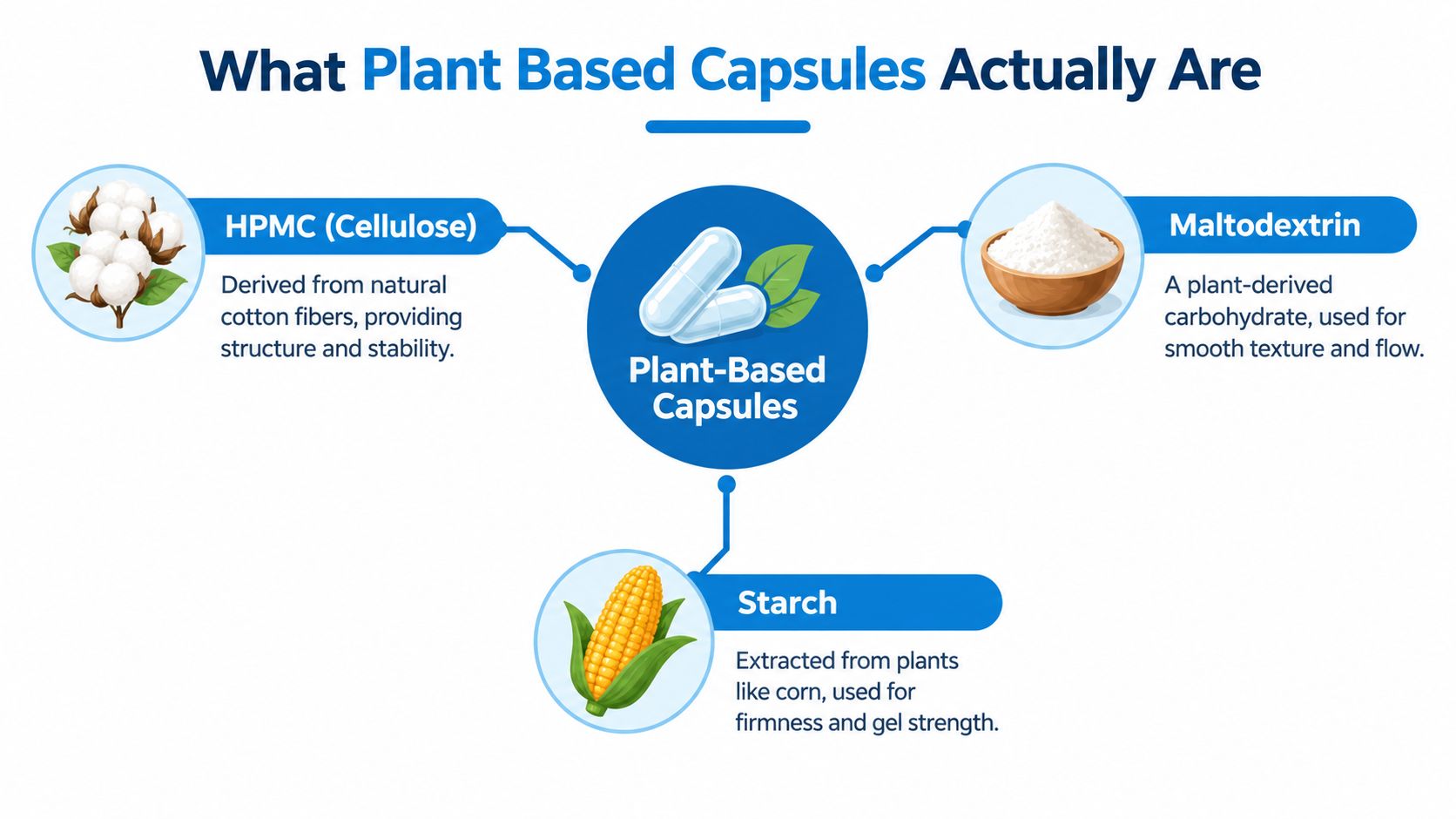
What makes a capsule plant-based, and does that description cover everything inside it?
A capsule is a protective container for a powder, liquid, or other supplement fill. Traditional gelatin shells use collagen from animals. Plant-based capsules use different polymers, most commonly cellulose-based HPMC or seaweed-derived carrageenan, to form the shell without animal gelatin. The shell can influence moisture handling and dissolution, but it does not determine the quality or suitability of the complete supplement.
Hydroxypropyl methylcellulose, or HPMC, is a modified form of cellulose. Manufacturers commonly derive its cellulose from plant material such as wood pulp, then process it into a material that forms a stable capsule shell. HPMC is widely used for hard capsules and suits many powder and botanical formulations. Its plant origin does not by itself confirm that every other ingredient or manufacturing step meets a particular ethical or religious standard.
Carrageenan comes from red seaweed. Catalent describes its Vegicaps technology as a carrageenan-based shell made from sustainably sourced red seaweed, with no animal derivatives, no gelatin, and no modified sugars. The technology supports non-gelatin softgel options for products that may require a different processing profile from traditional gelatin softgels. Catalent's Vegicaps overview also identifies suitability for vegetarian, vegan, halal, and kosher preferences, subject to the wider formulation and certification requirements.
The shell and the fill are different
The capsule shell is only the container. The fill may include an animal-derived active, an excipient with unclear sourcing, or a processing aid that conflicts with a shopper's dietary or religious requirements.
The three labels require different checks:
- Vegan: The shell, active ingredients, excipients, and processing practices generally must avoid animal-derived materials.
- Halal or kosher: Compliance depends on the relevant standards, ingredient sources, and manufacturing controls. Gelatin-free alone does not prove compliance.
- Vegetarian: The product may exclude meat-derived ingredients while allowing some other animal-derived materials, depending on its definition and certification.
Read the full ingredient and certification information, not just the shell description. A plant-based capsule can contain a fill that needs separate verification.
HPMC and Carrageenan vs Gelatin Shells
Which capsule shell fits the formula, rather than the label? HPMC, carrageenan, and gelatin serve similar containment roles, but their material properties create different trade-offs. HPMC is the most common hard-shell plant-based option, carrageenan appears in certain softgel technologies, and gelatin remains common in hard and soft capsules.
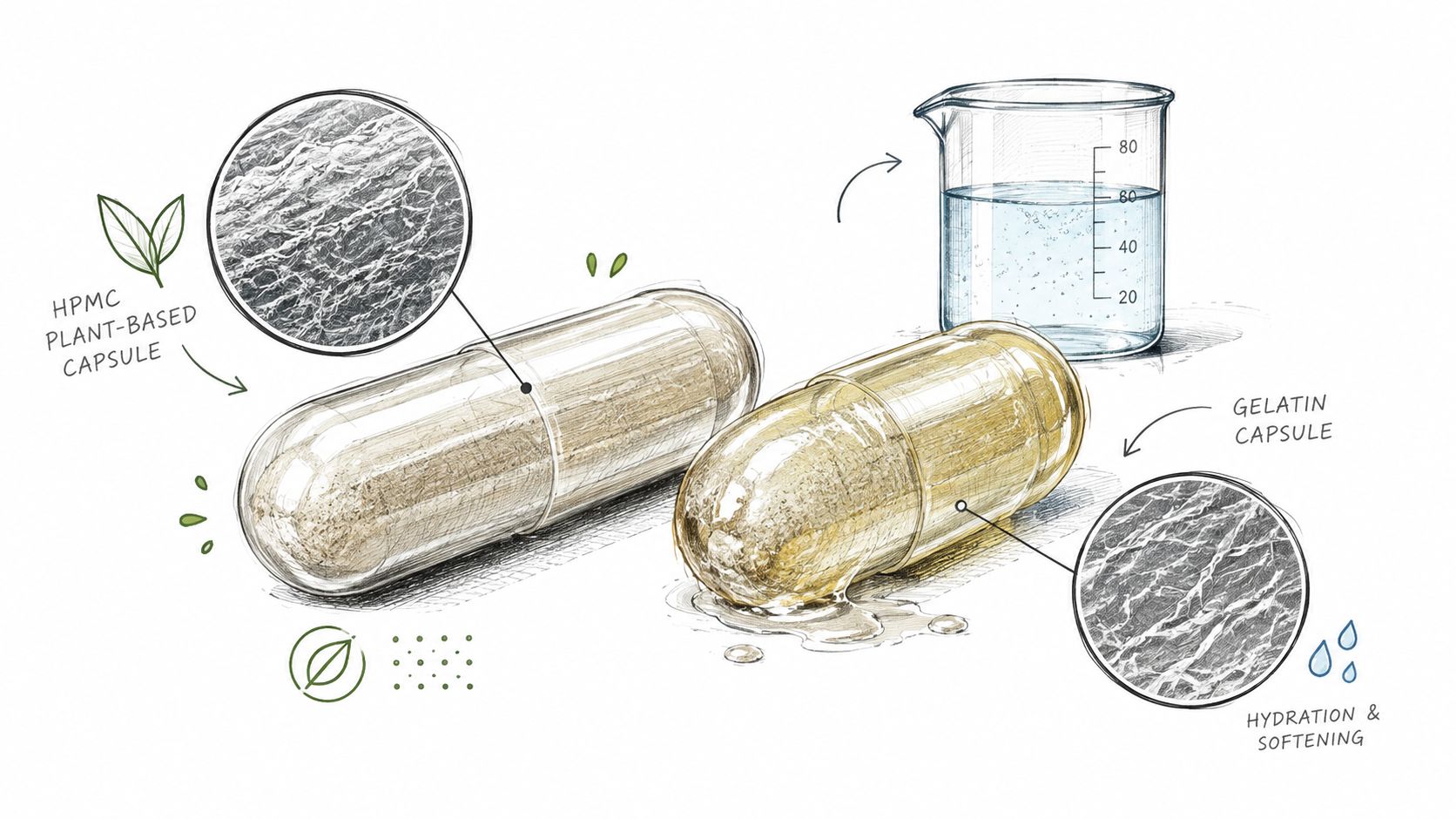
Moisture is a major dividing point. At 50% relative humidity, one review reported approximately 6% moisture in HPMC versus 14% in gelatin. A drier shell may reduce water transfer into a hygroscopic fill, such as some vitamins, herbal extracts, or probiotics. The formulation discussion and figures appear in this review of HPMC capsule performance.
| Shell Type | Source | Moisture Content | Dissolution Speed | Best For |
|---|---|---|---|---|
| HPMC | Cellulose-based polymer | About 6% in the cited condition | Rapid and reproducible when properly processed, though often slower than gelatin | Moisture-sensitive powders, botanical extracts, vitamins, probiotics, and vegan formulations |
| Carrageenan | Red seaweed-derived polymer | Depends on formulation and process | Engineered for the intended softgel release profile | Non-gelatin softgels and plant-based formulations |
| Gelatin | Animal collagen, commonly bovine or porcine | About 14% in the cited condition | Often faster in simple water-based testing | Conventional formulas where animal-derived gelatin is acceptable |
What each material changes
HPMC can help protect a sensitive fill from added moisture, but it does not guarantee longer shelf life. Shell grade, drying, packaging, fill composition, and warehouse conditions determine how the finished product behaves. The shell is one variable; the formulation inside is another.
Carrageenan gives formulators a seaweed-derived alternative for some softgels. Its origin removes gelatin from the shell, while the full product still requires separate review of ingredients and certifications.
Gelatin can remain practical when fast dissolution, familiar manufacturing, or cost control matters. To see what gelatin means in a real supplement, shoppers can compare this beef gelatin dietary supplement. That example does not answer whether a particular capsule's active formula suits a dietary or religious requirement.
Practical rule: Choose the shell around the formula's risks, not the front-label adjective alone.
How Shell Quality Affects Dissolution and Stability
A plant-based shell can perform very well, but performance depends on how the manufacturer makes and stores it. Two capsules can both say HPMC on the label and still behave differently if their polymer concentration, residual moisture, drying conditions, fill, or packaging differs.
A 2026 NIH study tested HPMC capsules dried at 30 to 40 °C and 50 to 60% relative humidity. The shells retained roughly 7.9% to 9.0% residual moisture, achieved complete disintegration within 15 minutes across the tested media at 11% to 15% polymer concentration, and delivered more than 85% cumulative release within 30 minutes for model drugs. The study also found dissolution similarity to conventional gelatin capsules under its test conditions. The NIH-published capsule study is useful because it shows that HPMC isn't automatically slow or unreliable.
Slower doesn't always mean worse
A pharmaceutics review found that HPMC capsules disintegrated in about 4 minutes in water at 37 °C after ambient storage, compared with about 1 minute for gelatin. That difference may matter when a product needs very rapid shell opening, but it isn't automatically a defect.
A slightly slower and more controlled shell response can suit a formulation where the manufacturer prioritizes stability, compatibility, or reduced interaction with a sensitive fill. The relevant question isn't “Which shell is fastest?” It is “Does this shell release the product consistently for its intended use?”
Moisture creates a manufacturing balancing act
HPMC benefits from lower shell moisture, yet a poorly dried shell can create its own problem. The same review linked higher shell moisture with slower or more variable early dissolution, while controlled drying improved consistency.
That creates several practical implications:
- Drying matters: The manufacturer must control how much moisture remains in the shell rather than treating all HPMC as identical.
- Packaging matters: Bottles, desiccants, seals, and storage instructions can influence exposure to humidity after production.
- The fill matters: Hygroscopic powders can pull moisture from their environment, while other ingredients may interact with the shell in different ways.
- Testing matters: A finished product should be assessed as a complete capsule, not judged from the shell material alone.
Retail and home environments add uncertainty. Temperature swings, bathroom humidity, an opened bottle, and prolonged storage can all change the conditions around a capsule. Plant-based doesn't guarantee immunity from those variables. It means the formulator has a different material platform to manage.
Why the Plant Based Capsule Market Is Growing Fast
Plant-based capsules now solve several problems at once. They remove animal gelatin from the shell, support vegetarian and vegan product lines, provide options for halal and kosher positioning, and can offer useful moisture characteristics for sensitive formulations.
The commercial category reflects that broader role. The global vegetarian capsules market was estimated at about US$1.9 billion in 2024 and is projected to reach roughly US$2.9 billion by 2030, implying a 7.7% compound annual growth rate over that period, according to Research and Markets' vegetarian capsules analysis. Another forecast puts the market at US$1.84 billion in 2025 and US$3.27 billion by 2034, representing 7.2% annual growth, while a separate estimate reports growth from US$1.57 billion in 2024 to US$1.76 billion in 2025, a 12.3% increase.
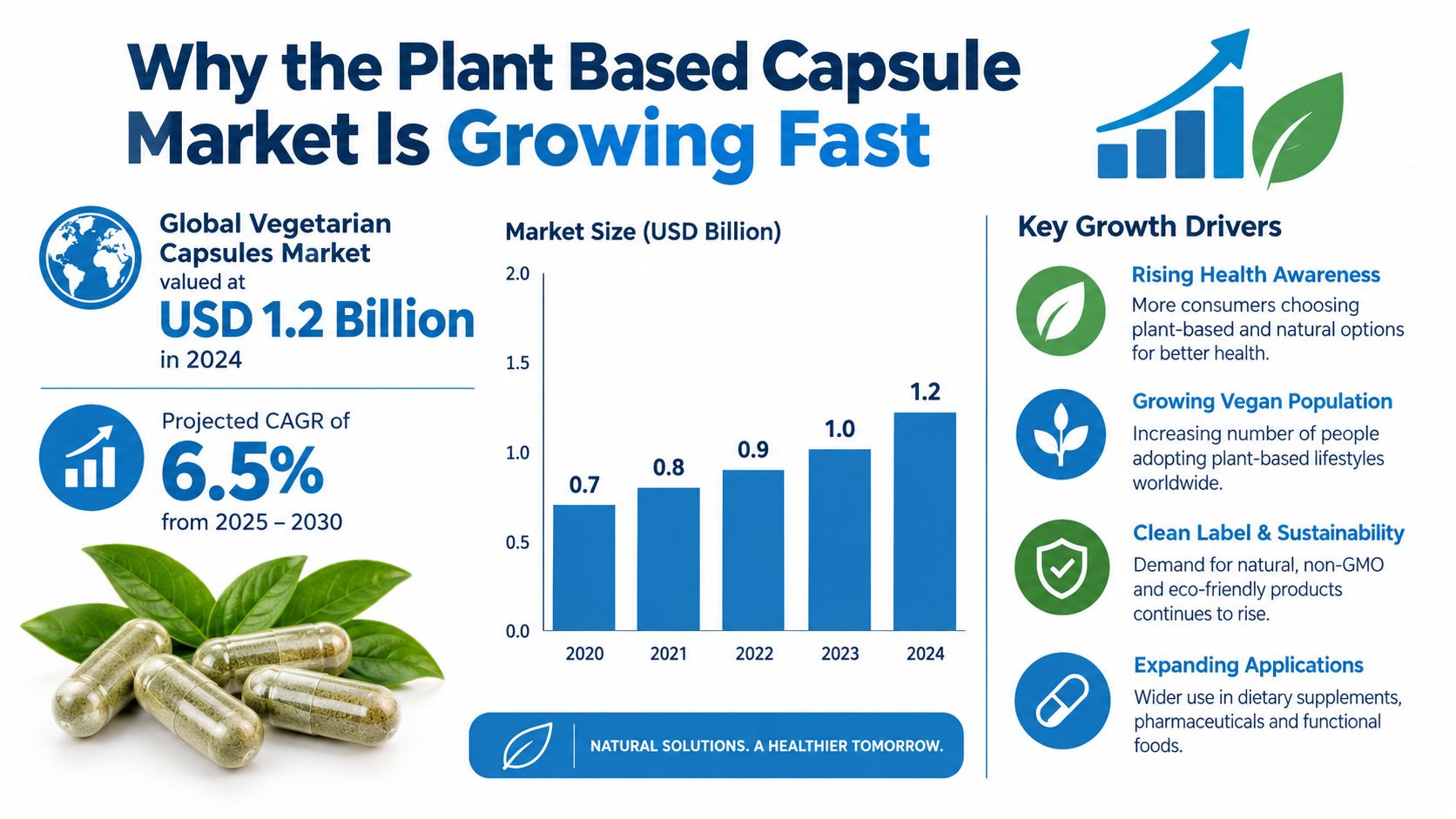
More than a vegan purchase decision
A supplement company may select HPMC because its formula contains a moisture-sensitive botanical. Another may choose carrageenan to offer a non-gelatin softgel. A retailer may stock plant-based capsules because shoppers want dietary flexibility, clearer sourcing, or a product compatible with personal faith requirements.
North America was identified as the largest regional market in 2025 in one forecast, which indicates that major supplement markets adopted plant-based formats early. That adoption also creates a responsibility for manufacturers and retailers. As more products use the format, shoppers need clearer information about shell material, active ingredients, excipients, certifications, and storage.
The market's growth doesn't prove that plant-based capsules outperform gelatin in every application. It shows that manufacturers have found enough technical, commercial, and consumer value to keep investing in the category.
How to Verify Quality and Label Claims
Start with the full product label, not the capsule color or the word “vegetable” on the front. A plant-based shell is a useful clue, but it doesn't establish that the active ingredients, lubricants, fillers, or manufacturing process meet every dietary requirement.
Use a four-part label check
Confirm the shell material. Look for HPMC, hydroxypropyl methylcellulose, vegetable cellulose, carrageenan, or another clearly named polymer. “Vegetarian capsule” is less informative than a label that identifies the material.
Read the entire ingredient list. Check the active ingredients, binders, flow agents, colors, and other excipients. If an ingredient's source isn't clear, contact the manufacturer rather than assuming it is plant-derived. Magnesium stearate, for example, can have different source pathways, so the name alone doesn't answer the sourcing question.
Match certification to your requirement. A vegan shopper may prioritize a recognized vegan certification. Someone following halal or kosher requirements should look for the relevant symbol or certificate, not infer compliance solely from “gelatin-free.” A clean-label shopper may also want a verified non-GMO claim rather than relying on general plant language.
Look for quality evidence. Third-party testing, batch-specific certificates of analysis, and transparent good manufacturing practice information can provide more useful evidence than broad phrases such as “pure” or “natural.” The test should relate to the concern, such as identity, contaminants, potency, or microbial quality.
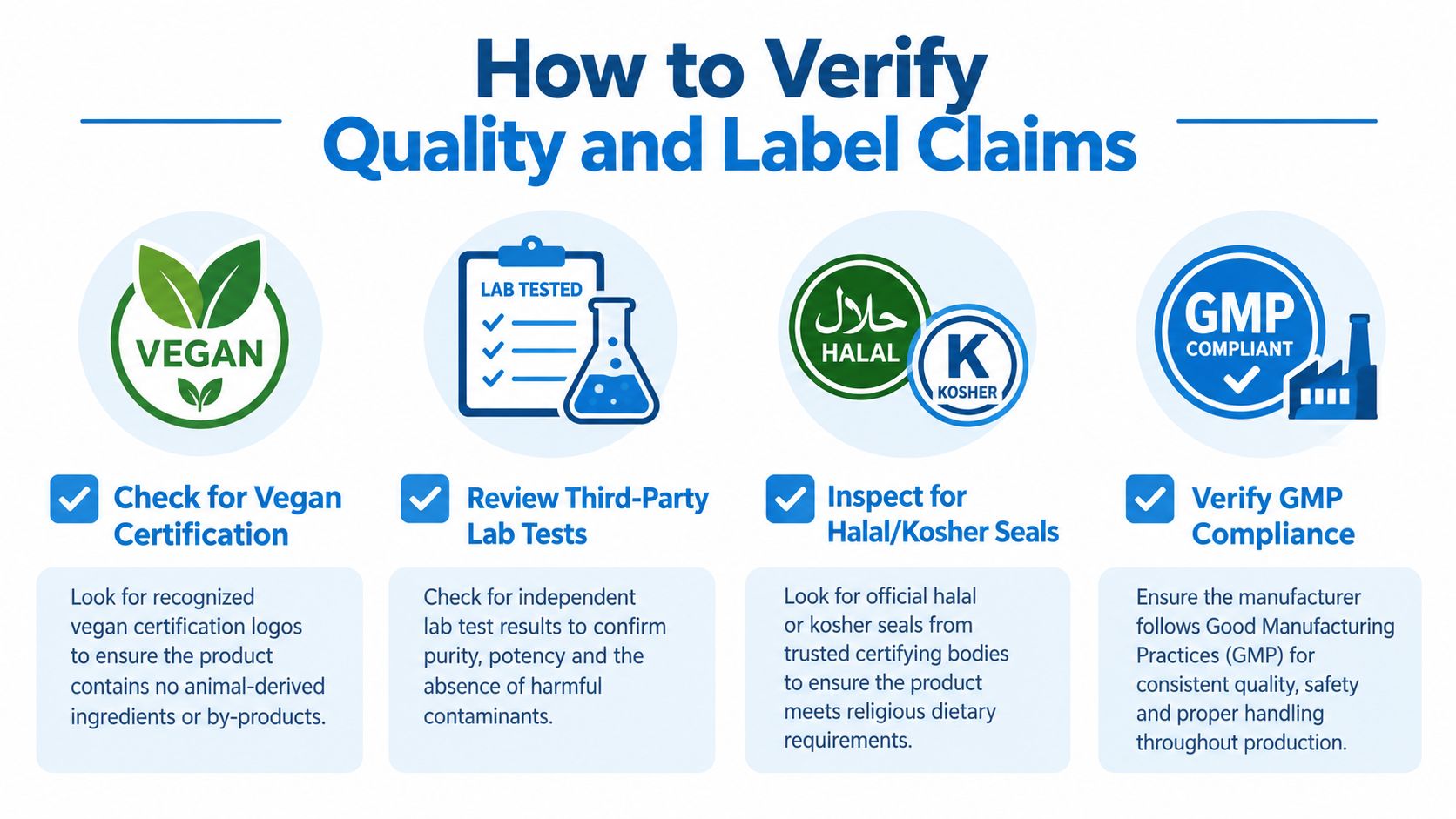
A product can be suitable for one shopper and unsuitable for another. Someone avoiding gelatin may only need confirmation of the shell and fill sources. Someone observing halal or kosher requirements may need certification covering ingredients, equipment, and processing. Someone avoiding genetically modified inputs may need a verified non-GMO statement. Someone with an allergy should focus on the full formula and facility disclosures.
Label-reading shortcut: Treat “vegan,” “halal,” “kosher,” “cruelty-free,” and “non-GMO” as separate claims that each need their own evidence.
The same approach applies when comparing liquid and capsule products. For example, a shopper researching a plant-based liquid zinc option should still review the active ingredients, excipients, certifications, and storage directions. A different delivery format doesn't remove the need for source verification.
When to Choose Plant Based Capsules and When to Reconsider
Suppose you're browsing maca or shilajit capsules and see two products marked gelatin-free and vegan. You shouldn't assume they're identical. Compare the active formula, shell material, storage instructions, certification evidence, and the manufacturer's information about testing.
Plant-based capsules are often a strong fit for moisture-sensitive powders, botanical extracts, probiotics, and shoppers avoiding animal-derived materials. They may also suit products designed for vegetarian, vegan, halal, or kosher markets. A plant-based beauty formula, such as a plant-based skin hydration supplement, still deserves the same full-label review.
Reconsider the format when very rapid dissolution is the primary requirement, when the formula has unusual shell compatibility risks, or when cost is the dominant constraint. Those decisions belong to the formulator, not the marketing label.
Industry projections estimate that vegetable capsules could rise from US$1,984.6 million in 2026 to US$3,486.2 million by 2033, while plant-based capsule supplements could grow from US$5.8 billion in 2025 to US$10.2 billion by 2034, according to Coherent Market Insights' vegetable capsules analysis. Adoption is expanding, but consumer education still needs to catch up.
Plant-based capsules are often an excellent choice, but “plant-based” isn't a complete performance guarantee. Verify the shell, the full ingredient list, relevant certifications, manufacturing evidence, and storage directions before deciding.
CalVitamin offers dietary supplements in several formats, including products identified with plant-based or vegetable capsule attributes. Visit CalVitamin to compare product labels, ingredient lists, and capsule formats against your dietary and formulation priorities.






