
You're standing in front of a shelf of powders, comparing labels that all promise better digestion and healthier gut bacteria. One tub lists “prebiotic fiber,” another says “soluble fiber,” and a third highlights a large scoop size without clearly naming the ingredient that makes up the scoop.
Those products aren't interchangeable. A useful comparison starts with the named fiber source, the grams of that specific fiber, how quickly it ferments, and how well you tolerate it. A prebiotic fiber powder can be practical, but it works best as a targeted addition to a varied diet, not as a substitute for understanding what you're buying.
Table of Contents
- What Prebiotic Fiber Powder Actually Is
- The Main Fiber Types Used in Powders
- How Each Fiber Behaves in the Colon
- Dosing a Prebiotic Fiber Powder Safely
- Comparing Three Powders Side by Side
- Claims Worth Questioning on the Label
- When to Pause, Stop, or See a Clinician
- A Simple Framework for Your Next Purchase
What Prebiotic Fiber Powder Actually Is
A prebiotic fiber powder is a concentrated source of nondigestible carbohydrates that can be fermented by microorganisms in the colon. Unlike carbohydrates digested in the small intestine, these fibers travel farther through the digestive tract, where microbes use them as carbon sources for fermentation pathways. That microbial activity can produce short-chain fatty acids such as acetate, propionate, and butyrate.
Common ingredients include inulin and fructooligosaccharides, often abbreviated as FOS. These compounds occur naturally in foods such as chicory root, onions, garlic, wheat, and bananas. A scientific review notes that typical diets in the United States and Europe provide only several grams of naturally occurring inulin and FOS per day, so a powder can materially increase exposure in a small serving. You can review the underlying discussion in this scientific review of inulin and FOS.
Fiber and prebiotic aren't synonyms
This distinction prevents one of the most common shopping mistakes. Dietary fiber is a broad category. It includes nondigestible carbohydrates that may add stool bulk, affect bowel-movement frequency, influence blood glucose, or support other physiological functions.
Prebiotic is narrower. It refers to a substrate that microorganisms use in a way associated with a health benefit. That means a fiber can be useful without meeting the more specific meaning of prebiotic. A 2024 review also noted that not all dietary fibers qualify as prebiotics, and the U.S. Food and Drug Administration doesn't maintain a separate established regulatory definition for “prebiotic.”
Practical rule: Don't judge a powder by the word “fiber” alone. Find the exact ingredient and ask what outcome has been studied for that ingredient.
Whole foods remain another delivery route. Onions, garlic, wheat, bananas, and chicory root can contribute naturally occurring fibers, while a powder offers a more concentrated and measurable format. The product comparison framework throughout this guide therefore focuses on named fiber source, actual dose, fermentation behavior, and tolerability, rather than front-label promises. CalVitamin also publishes digestive health content about prebiotics, which can help shoppers orient themselves before comparing products.
The Main Fiber Types Used in Powders
The ingredient panel matters more than the product name. A tub marketed as a “prebiotic blend” may contain one dominant fiber, several fibers in small amounts, or a broader soluble-fiber mixture whose prebiotic contribution isn't clearly separated.
The main names you'll encounter include inulin, FOS, GOS, resistant starch, acacia, partially hydrolyzed guar gum, and psyllium. They differ in structure, fermentation pattern, viscosity, and evidence for particular outcomes.
Recognize the ingredient families
Inulin and FOS are inulin-type fructans. They're associated with foods such as chicory root, onions, garlic, wheat, and bananas, and are common in powders and fortified foods. Their ability to ferment makes them relevant to microbial metabolism, but that same property can create gas or bloating when the dose rises too quickly.
Galactooligosaccharides, or GOS, are another named oligosaccharide. Research products may use GOS to examine changes in specific bacterial groups, particularly Bifidobacterium. Look for “GOS” or “galactooligosaccharides” rather than assuming that a generic soluble-fiber blend contains a meaningful amount.
Resistant starch resists digestion in the small intestine and reaches the colon. Product labels may identify resistant starch from potato, banana, or corn sources. Its slower fermentation pattern can make it different from rapidly fermentable inulin-type fibers.
Acacia and partially hydrolyzed guar gum are soluble fibers that may be included in formulations designed for a gentler texture or lower viscosity. Psyllium is best known for its water-binding and stool-forming behavior. It may support bowel function, but a product should not automatically be called prebiotic just because it contains psyllium.
| Fiber Type | Common Sources | Label Names to Spot | Approx. g per tsp |
|---|---|---|---|
| Inulin and FOS | Chicory and other plant sources | Inulin, chicory inulin, FOS, fructooligosaccharides | Not reliably comparable without the product label |
| GOS | Enzymatically produced lactose-derived or vegan formulations | GOS, galactooligosaccharides | Not reliably comparable without the product label |
| Resistant starch | Potato, banana, or corn sources | Resistant starch, potato starch, green banana flour, high-amylose starch | Not reliably comparable without the product label |
| Acacia and other gums | Acacia, guar, or related plant fibers | Acacia gum, gum arabic, PHGG, partially hydrolyzed guar gum | Not reliably comparable without the product label |
| Psyllium | Psyllium husk | Psyllium husk, psyllium powder | Not reliably comparable without the product label |
A teaspoon isn't a dependable unit for comparison because powders have different densities and serving conventions. Compare grams of named fiber per serving, not the number of teaspoons or the total weight of the scoop. If you're considering psyllium, examine the ingredient and directions on a product such as this organic psyllium husk powder, rather than treating it as identical to inulin or GOS.
How Each Fiber Behaves in the Colon
Two powders can contain the same number of fiber grams and still feel very different. Polymer structure, fermentability, viscosity, and dose all affect where and how microbes use the material.
Rapidly fermentable inulin-type fructans can deliver an early substrate pulse in the colon. That may support changes in microbial metabolism, but it can also produce gas before a person has adapted to the higher intake. More slowly degradable polysaccharides and resistant starch can extend fermentation farther through the colon and are more often associated with butyrate production.
Speed changes the experience
Shorter chains tend to be fermented more readily. Longer or more structurally complex fibers may provide a slower supply of substrate and can support a different short-chain-fatty-acid pattern. This isn't a simple ranking from “fast” to “best.” A product that stimulates a particular bacterial group may not produce the same metabolite profile as a blend designed for sustained fermentation.
Viscosity adds another practical difference. A thick, water-binding powder can change texture and stool consistency, while a lower-viscosity fiber may mix more easily and feel less bulky. Your response depends on your existing diet and microbiome, so a label can't predict the experience perfectly.
| Fiber Type | Fermentability Speed | Gas Potential | Viscosity | Tolerated Dose |
|---|---|---|---|---|
| Inulin and FOS | Often relatively rapid | Can be higher when increased quickly | Usually low to moderate | Individual and formulation-specific |
| GOS | Variable, depending on formulation | Can cause gas in sensitive users | Usually low | Individual and formulation-specific |
| Resistant starch | Generally slower and more extended | Variable | Usually low to moderate | Individual and formulation-specific |
| Acacia gum | Generally slower | Often lower, but not zero | Low | Individual and formulation-specific |
| Partially hydrolyzed guar gum | Generally slower | Variable | Lower than intact guar gum | Individual and formulation-specific |
| Psyllium | Limited fermentation compared with inulin-type fibers | Usually not its main issue | Higher because it absorbs water | Individual and formulation-specific |
The FDA's dietary-fiber guidance explains why isolated or synthetic nondigestible carbohydrates need evidence of a beneficial physiological effect before they can qualify as dietary fiber for U.S. labeling purposes. For shoppers, that supports a straightforward habit: identify the material first, then assess its dose and expected behavior.
Dosing a Prebiotic Fiber Powder Safely
A shopper may tolerate one powder at a small amount yet react to another at the same scoop size. The useful comparison is the named fiber source, grams of prebiotic fiber, fermentability, and personal tolerance, not the scoop alone.
Controlled research provides benchmarks, not a universal serving. One randomized trial used 16 grams per day of inulin-type fructans for six weeks, while an earlier peer-reviewed review included 16 grams per day of combined inulin and oligofructose for twelve weeks. Those findings apply to the tested formulations, participants, durations, and outcomes, as described in this clinical microbiome study.
Starting with the full label serving can introduce more fermentable carbohydrate than your gut is ready to handle. Begin below that amount, mix the powder with food or liquid, and increase only after the current dose feels comfortable. Dividing it between meals may be easier than taking it all at once.
Read symptoms as feedback
Gas and mild bloating can occur as gut microbes ferment newly introduced carbohydrate. They do not confirm that the product is working, and you do not need to endure them to receive a benefit. Cramping, persistent loose stool, worsening constipation, reflux, or pain are reasons to reduce the dose or pause.
People with IBS, inflammatory bowel disease, or other digestive sensitivity may need an individualized plan. The suitable amount depends on the fiber source, formulation, and condition. A review summary cautions that people with IBS or inflammatory bowel disease may need adjusted doses for tolerability.
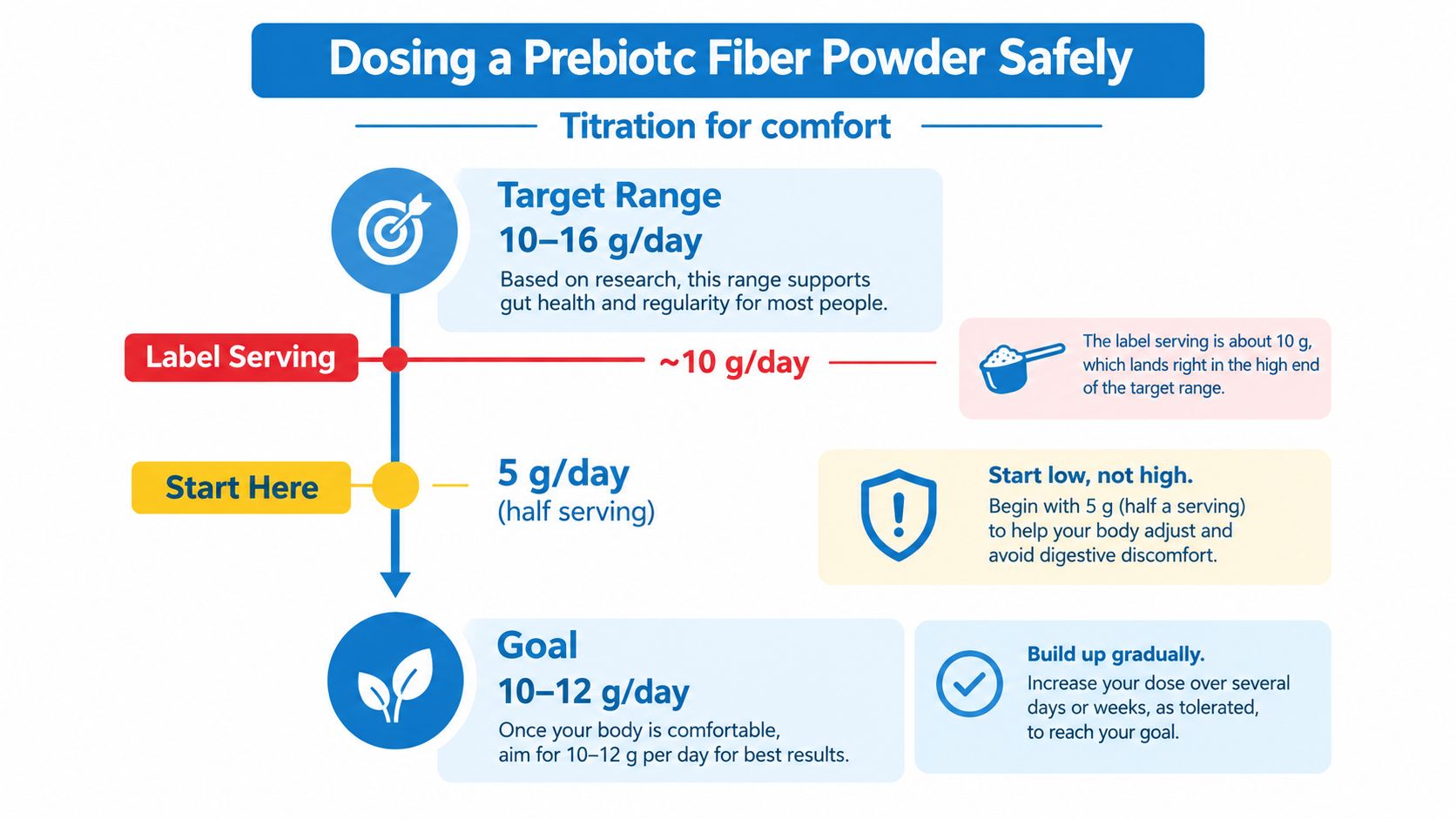
Food still contributes to your daily total. U.S. targets summarized in an authoritative review are 38 grams per day for adult men and 25 grams per day for adult women, counting dietary fiber from food and supplements, rather than prebiotic fiber alone. The review of dietary-fiber definitions and intake explains that distinction.
Treat the full label serving as a possible destination, not a requirement. If symptoms rise after each increase, the fiber source, dose, or timing may not suit you.
Comparing Three Powders Side by Side
A shopper comparing three hypothetical products might see a budget inulin powder, a mid-price GOS blend, and a premium acacia powder. The point isn't to declare one universally superior. It's to show how a meaningful comparison works when the products have different fiber sources and different tolerability profiles.
The examples below are deliberately hypothetical, not claims about real products or prices. A retailer can't calculate value from a front-label scoop unless the label states the grams of the named prebiotic ingredient.
| Attribute | Budget Inulin Powder | Mid-Price GOS Blend | Premium Acacia Fiber |
|---|---|---|---|
| Named fiber source | Inulin, possibly from chicory | GOS or galactooligosaccharides | Acacia gum or gum arabic |
| Prebiotic fiber per serving | Must be stated separately from total powder weight | Must be stated separately from total powder weight | Must be stated separately from total powder weight |
| Dose per scoop | Compare the labeled grams, not scoop volume | Compare the labeled grams, not scoop volume | Compare the labeled grams, not scoop volume |
| Added ingredients | Check for flavors, sweeteners, or sugar alcohols | Check for flavors, sweeteners, or sugar alcohols | Check for flavors, sweeteners, or sugar alcohols |
| Price per gram of named prebiotic | Calculate only from stated price and named-fiber grams | Calculate only from stated price and named-fiber grams | Calculate only from stated price and named-fiber grams |
| Likely shopping rationale | More named inulin may be available for the money | A specific oligosaccharide may suit a targeted comparison | Lower-viscosity fiber may appeal to a sensitive user |
A label claiming 15 grams of fiber could, in principle, include mostly soluble corn fiber while providing only 3 grams of a specifically named prebiotic. Those figures are an illustrative labeling scenario, not a claim about a particular product. The lesson is to separate total fiber from the ingredient you want to evaluate.
A low-cost inulin product may offer more inulin per dollar, while an acacia product may appeal to someone prioritizing texture and tolerance over maximum fermentable grams. A GOS product may be worth comparing when the research question concerns a particular bacterial response. Before buying, use the same three filters every time: named source, grams of that source, and a realistic symptom plan. A listing such as Bulletproof InnerFuel Prebiotic should be assessed through those label details rather than its marketing category.
Claims Worth Questioning on the Label
A tub promising “more” may still be a poor fit. Compare the fiber type and dose match the intended outcome and your tolerance, rather than judging the powder by its total fiber claim. A highly fermentable powder can cause more discomfort at a large serving than a different fiber taken in a smaller amount.
“More grams is always better”
Total fiber does not identify which ingredient supplies those grams. A label may combine several fibers, so record the named fiber, daily dose, duration, baseline diet, tolerability, and endpoint before comparing research with a product. Results from one inulin-type formulation cannot establish that every powder will produce the same microbial or digestive response.
The gram amount matters, but its source and your response matter just as much.
“Gas means it's working”
Gas can show that microbes are fermenting the fiber. It does not prove that the powder will improve symptoms or deliver a meaningful health benefit. The trial publication describes measurable microbial and short-chain-fatty-acid changes after an inulin-type intervention, yet those findings do not make discomfort a treatment goal.
Use symptoms as information, not as a scorecard. Persistent bloating, pain, diarrhea, or constipation calls for a pause and a reassessment of the fiber source, serving size, and other dietary contributors.
“Mood and immunity benefits are guaranteed”
Gut-brain and gut-immune research is developing. A change in bacterial groups or metabolites does not automatically prove a mood, immune, weight, or inflammation effect.
In a 12-week intervention, a powder containing acacia gum and milled carrot was associated with affect improvements in females, while fecal short-chain fatty acids, cortisol, and inflammatory markers did not change significantly, according to the Purdue report on mixed fibers. That mixed result is a useful warning against treating one positive endpoint as proof of a broad benefit.
Check whether the label names the fiber, states its dose, and matches the claimed outcome to a suitable study. Broad promises are marketing until those details support them.
When to Pause, Stop, or See a Clinician
Fiber supplementation is conditional. It may be useful for some people, but a worsening digestive pattern isn't a challenge to overcome through willpower.
Start with a small amount and monitor the trend. If mild gas settles as your body adapts, you can decide whether to increase gradually. If bloating persists, constipation worsens, or symptoms keep returning after a cautious trial, pause the powder and reassess the ingredient, serving size, other sources of fiber, and your baseline condition.
Use a safety-first decision tree
- Mild, short-lived gas: Hold the current amount or reduce it. Don't increase until symptoms settle.
- Persistent bloating or worsening constipation: Pause and seek advice if the problem doesn't improve after stopping or adjusting the product.
- Abdominal pain, ongoing diarrhea, bleeding, or unexplained weight loss: Stop self-experimentation and contact a clinician.
- Known digestive disease or sensitivity: Ask a gastroenterologist or dietitian about the fiber type and dose before starting.
People diagnosed with IBS or inflammatory bowel disease may need individualized amounts. A recent review summary also emphasizes that there isn't one official universal prebiotic intake recommendation for healthy people, because formulations and responses vary. A 12-week intervention with a diverse prebiotic blend reported wind, bloating, mild constipation, abdominal pain, and mild diarrhea among participants, although it reported no severe treatment-related adverse events or withdrawals caused by side effects, as described in this summary of prebiotic blend evidence.
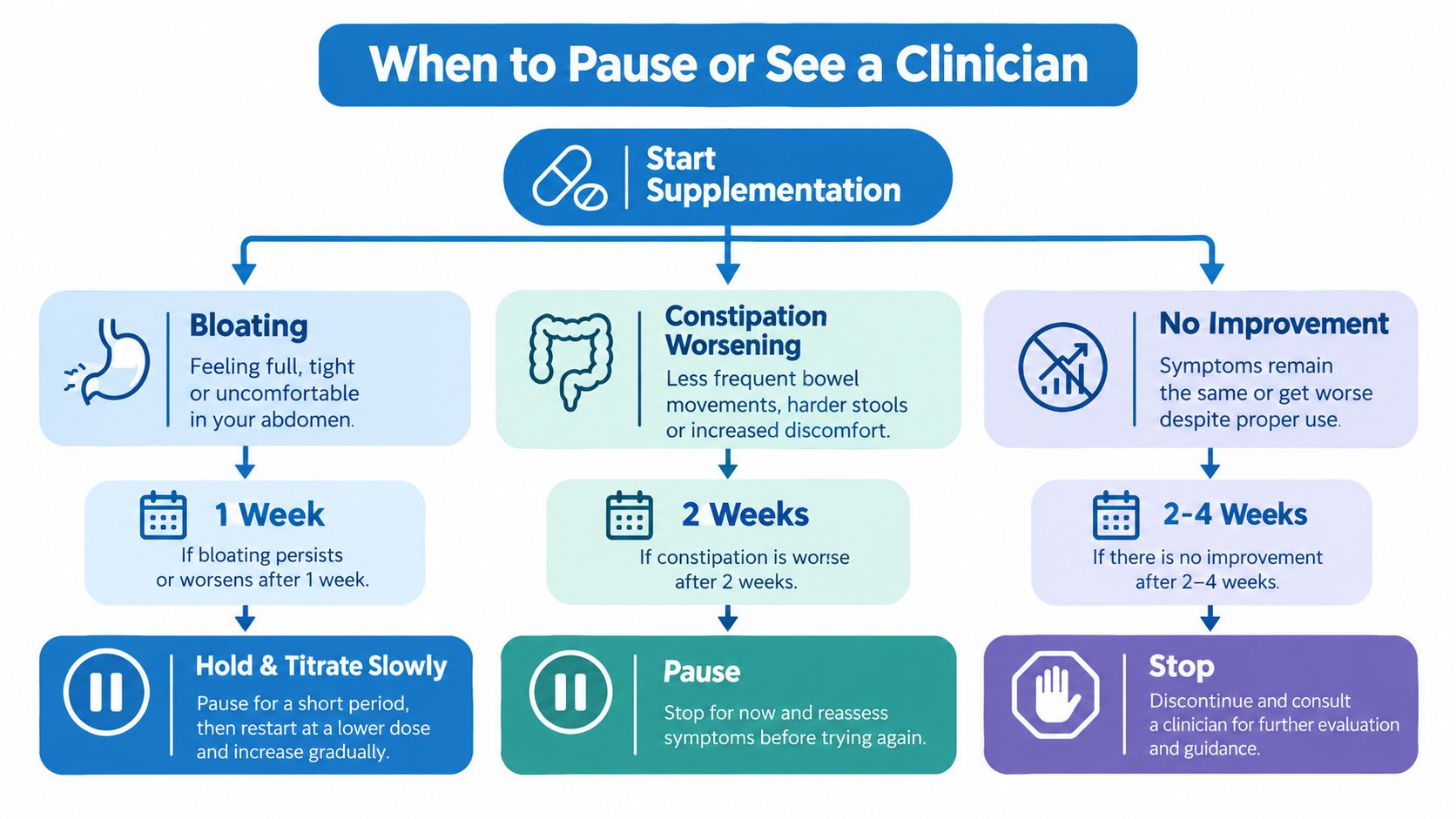
Seek medical review rather than changing the dose if you have blood in the stool, severe or persistent pain, repeated vomiting, significant dehydration, or unexplained weight loss. Those symptoms need evaluation, not a different scoop of powder.
A Simple Framework for Your Next Purchase
Use three filters before placing a prebiotic fiber powder in your basket.
Filter one is source clarity. Look for a named ingredient such as chicory inulin, FOS, GOS, resistant starch, acacia gum, or partially hydrolyzed guar gum. Be cautious when a proprietary blend hides the amount of each fiber, because you can't compare it meaningfully with clinical research or another label.
Filter two is grams of the named fiber. Total powder weight and scoop size aren't enough. Record the grams of the specific ingredient per serving, whether the serving uses one scoop or several, and whether the product combines a named prebiotic with other soluble fibers.
Filter three is tolerability. If you're generally healthy and already eat fermentable foods comfortably, a modest amount of inulin or FOS may be reasonable. If you have a history of digestive sensitivity, a lower-viscosity fiber such as acacia or partially hydrolyzed guar gum may be worth discussing with a clinician or dietitian. No category guarantees comfort.
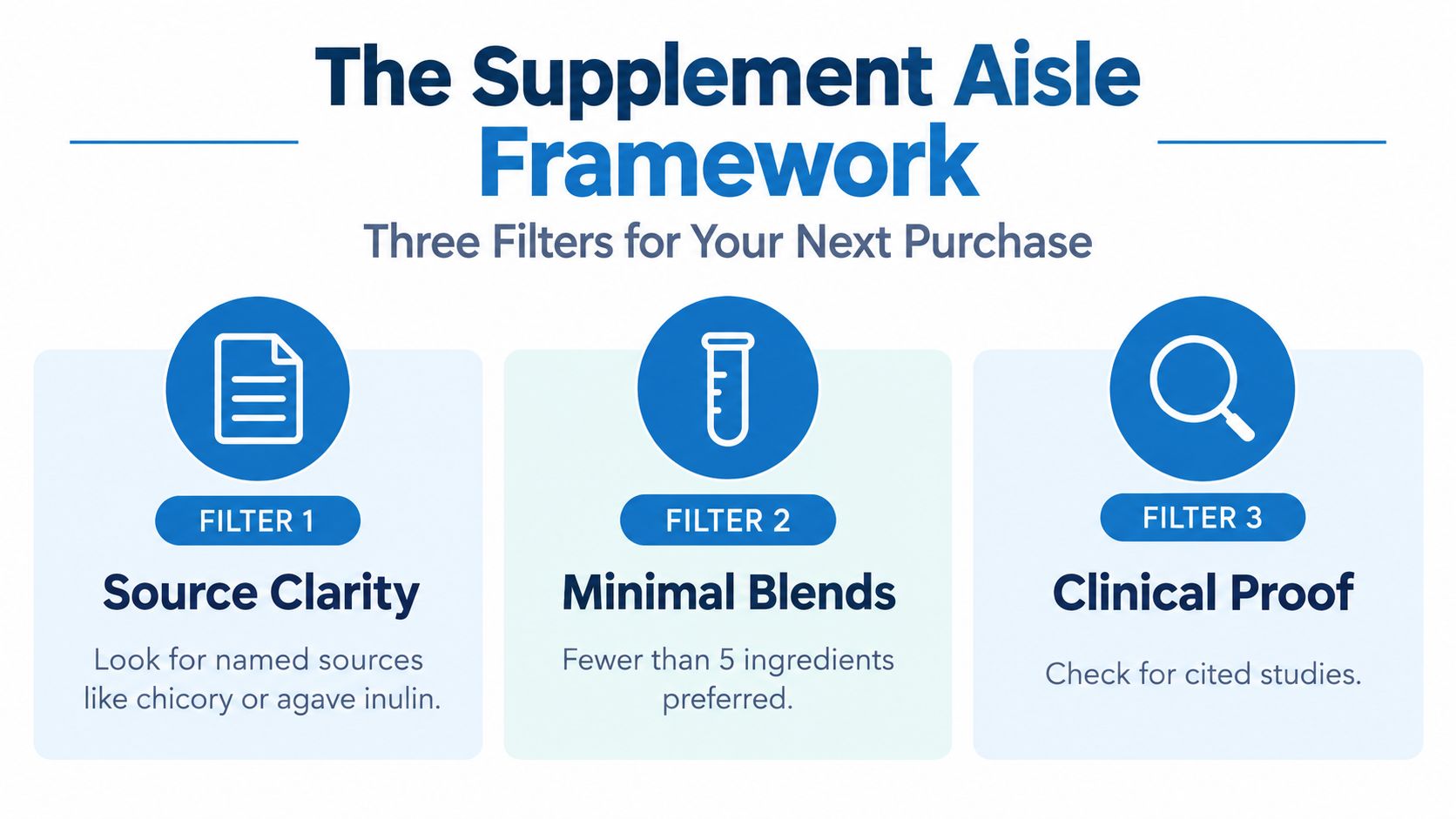
Start below the full label serving, keep the amount steady while you assess symptoms, and increase only when your current dose is comfortable. Choose the product whose ingredient panel supports a clear decision, not the one with the loudest claim.
CalVitamin offers vitamins, minerals, probiotics, prebiotics, proteins, and other wellness products in multiple formats, so you can compare digestive-support options alongside your existing routine. Visit CalVitamin to review available products and check each label for its named fiber, serving information, and added ingredients before you buy.