
A major shift happened in 2023, when researchers pulled together 28 randomized controlled trials with 2,108 total participants on adaptogens for stress and anxiety, moving the conversation from tradition to measurable outcomes. In that evidence base, ashwagandha stood out as the most studied adaptogen, with 8 trials and 624 participants and a standardized mean difference of -0.75 for perceived stress, while the same analysis also found a mean cortisol reduction of -3.27 μg/dL versus placebo for ashwagandha systematic review and meta-analysis. That's why adaptogens for stress relief deserve a careful, practical look, not a vague wellness label.
Table of Contents
- What the Clinical Evidence Shows
- How Adaptogens Work in the Body
- Top Adaptogens and Their Evidence Profiles
- Matching Your Stress Pattern to the Right Adaptogen
- Choosing Quality Supplements and Reading Labels
- Safety Considerations and Realistic Timelines
- Common Misconceptions and Building a Complete Strategy
What the Clinical Evidence Shows
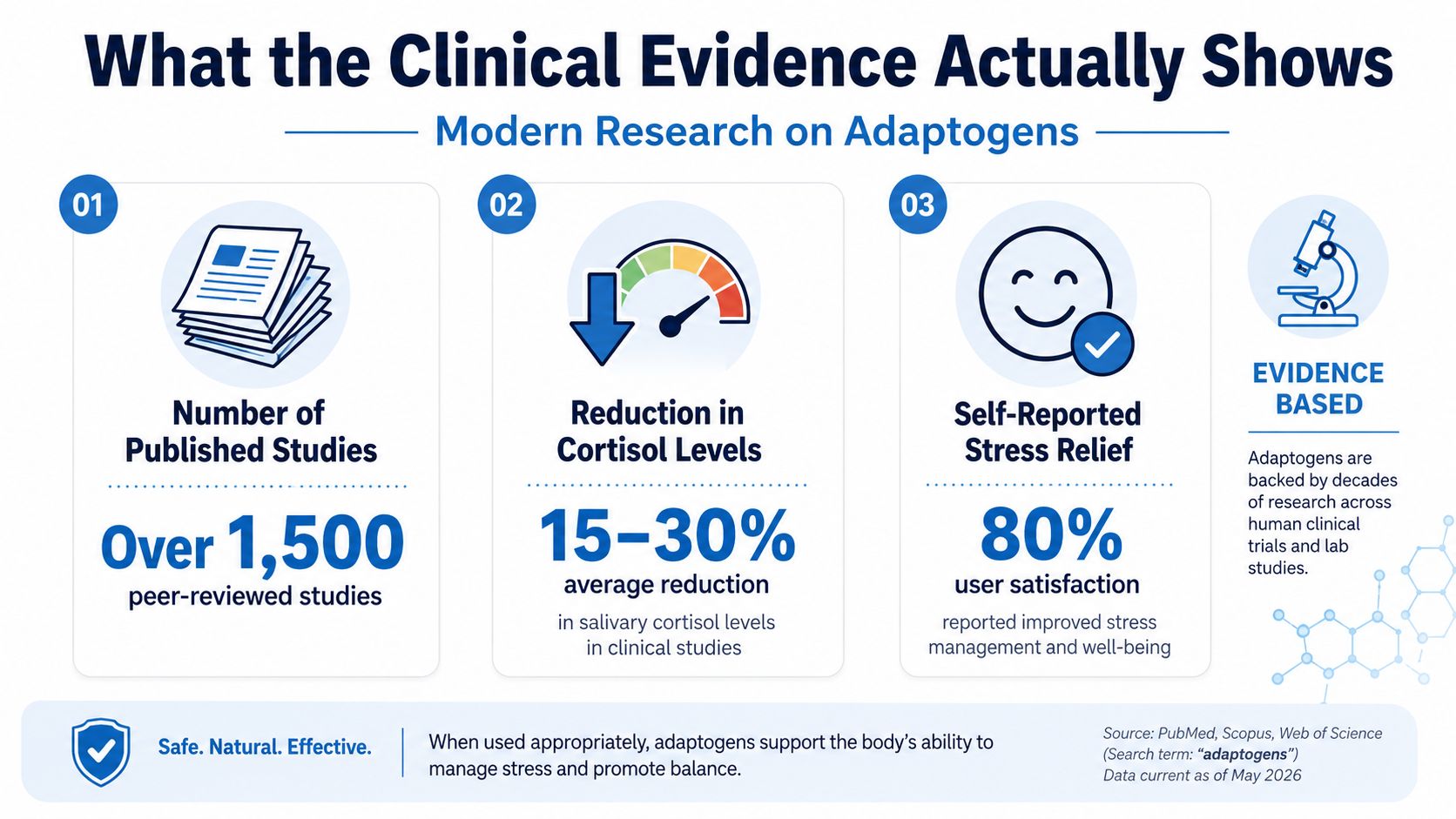
The research picture is stronger than casual wellness marketing suggests, but it is still narrower than many labels imply. A systematic review and meta-analysis brought together 28 randomized controlled trials with 2,108 participants evaluating adaptogens for stress and anxiety, and the clearest signal was for ashwagandha, with significant effects on perceived stress and cortisol systematic review and meta-analysis. The same analysis also reported significant stress-related effects for rhodiola rosea and Panax ginseng, which matters because it shows the category is not one herb in disguise.
What the numbers show
The strongest takeaway is that the human evidence is uneven. Some herbs have been tested repeatedly, while others still rest more on traditional use and early-stage research. That is why it helps to separate adaptogens into a few better-supported tools rather than treating them as interchangeable calming herbs.
Practical rule: if a product claims “stress support,” ask whether the claim is based on human trials measuring stress scores, cortisol, fatigue, or sleep, because those outcomes are not the same thing.
The ashwagandha data also helps set expectations. The more convincing results tend to show up when use lasts at least 56 to 60 days, and the pooled evidence points toward a dose-response pattern, with stronger results when treatment continues long enough for the body to adapt meta-analysis summary. That timeline explains why some people feel underwhelmed when they expect a capsule to work like caffeine or a sleeping pill.
Why homeostasis matters here
The older scientific framing described adaptogens as substances that non-specifically increase resistance to stressors and help the body maintain homeostasis under physical or mental strain. That language still matters because it separates adaptogens from sedatives, stimulants, and symptom-only shortcuts. They are discussed as helping the system hold a steadier response instead of forcing one direction.
Stress subtype matters too. A person with anxiety-dominant stress often wants a herb that takes the edge off without flattening alertness, while someone with fatigue-dominant stress may need support for low energy and mental endurance rather than simple calming. Mixed stress patterns sit in between, where sleep, tension, and low resilience show up together. The clinical literature does not support a one-size-fits-all answer, so the right herb depends on the pattern you are trying to address.
Historical tradition helped bring adaptogens into wellness culture, but clinical research is what keeps them interesting now. The evidence does not support hype, but it does support a realistic conversation about which herbs have the most human data, which stress patterns they may fit best, and why expectations should be measured in weeks rather than hours.
How Adaptogens Work in the Body
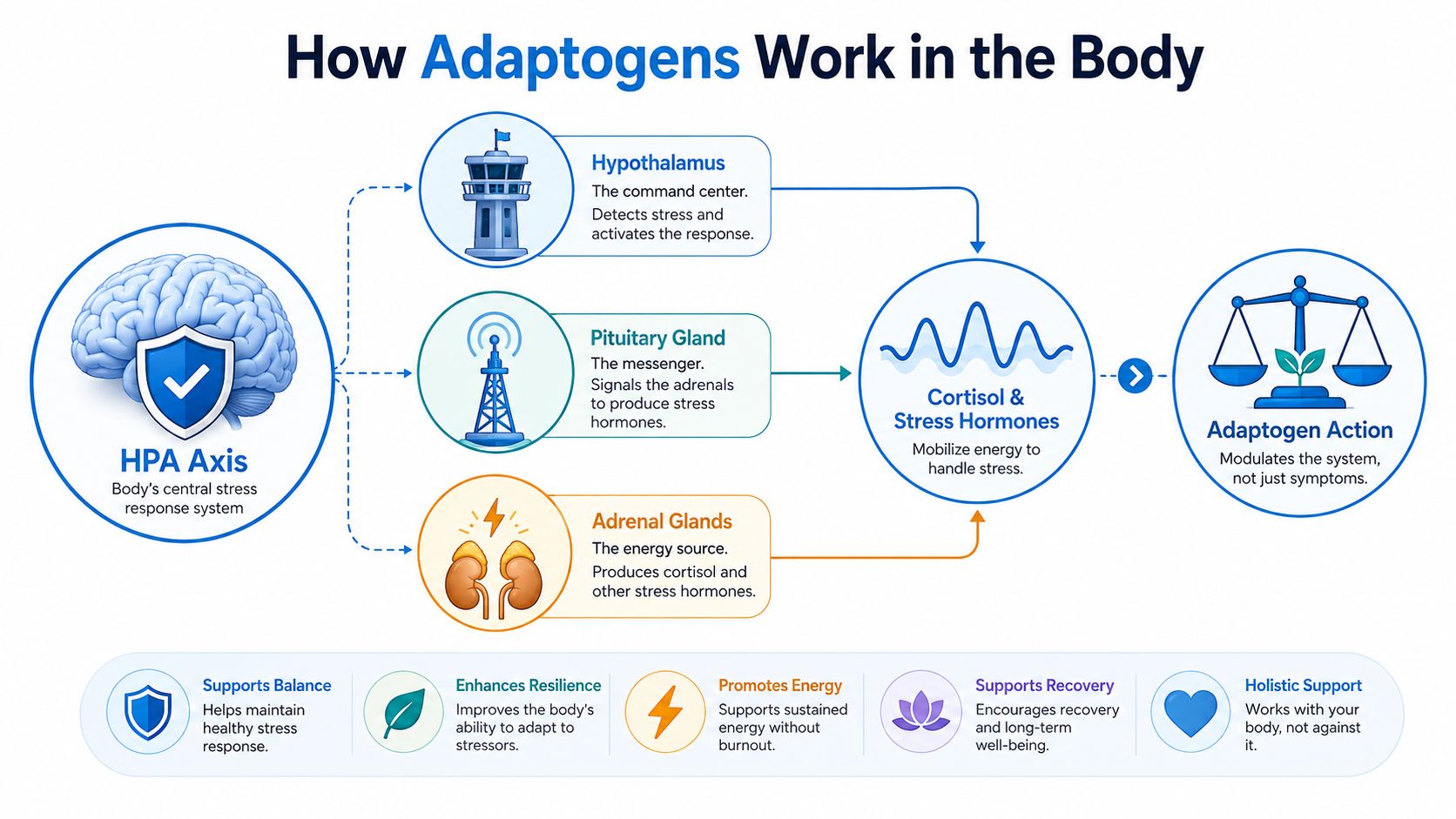
The HPA axis functions as your body's stress command center. It links the hypothalamus, pituitary gland, and adrenal glands, then coordinates the release of cortisol and other stress hormones when life gets demanding. Adaptogens are described as modulators, not blunt suppressors, which is why they are discussed as “normalizing” agents rather than sedatives.
The thermostat analogy
A thermostat does not create heat on its own. It helps keep the room near a target temperature. That is a useful way to understand homeostasis. When stress pushes your system too high, or leaves you flattened and under-responsive, adaptogens are thought to nudge the response toward balance instead of pushing you harder in one direction.
This is also why adaptogens are not the same as sedatives or stimulants. A sedative can lower arousal, while a stimulant can raise alertness, but neither one is trying to help the body adapt more smoothly to repeated stressors. Adaptogens are usually discussed as helping the system respond with more resilience over time.
Stress subtype matters here. A person with anxiety-dominant stress often wants a herb that takes the edge off without flattening alertness, while someone with fatigue-dominant stress may need support for low energy and mental endurance rather than simple calming. Mixed stress patterns sit in between, where sleep, tension, and low resilience show up together. The clinical literature does not support a one-size-fits-all answer, so the right herb depends on the pattern you are trying to address.
Historical tradition helped bring adaptogens into wellness culture, but clinical research is what keeps them interesting now. The evidence does not support hype, but it does support a realistic conversation about which herbs have the most human data, which stress patterns they may fit best, and why expectations should be measured in weeks rather than hours. A broader clinical analysis gives a useful overview of that pattern, and a rhodiola and bacopa formula shows how ingredient combinations are often built around different stress needs rather than a single calming effect.
Top Adaptogens and Their Evidence Profiles
The most useful way to compare adaptogens is by what stress problem they're best suited for. That's where the evidence becomes practical, because not every herb is trying to do the same job. Some are better supported for calm stress relief, others for fatigue, endurance, or cognitive resilience under pressure.
Side-by-side comparison
| Adaptogen | Best For | Evidence Level | Typical Dose | Timeline |
|---|---|---|---|---|
| Ashwagandha | Anxiety-dominant stress, cortisol support | Strongest human data for stress relief | 240 to 1250 mg/day | Often 56 to 60 days or longer |
| Rhodiola rosea | Fatigue, burnout, mental stamina | Human evidence suggests stress-related effects | Qualitative use guidance only | Often earlier-day, gradual |
| Panax ginseng | Stress-related energy and performance | Human evidence suggests stress-related effects | Qualitative use guidance only | Gradual with steady use |
| Holy basil | Calm focus, everyday stress support | Promising traditional and human use | Qualitative use guidance only | Gradual with steady use |
| Schisandra | Resilience, mental clarity under pressure | Promising traditional and human use | Qualitative use guidance only | Gradual with steady use |
| Eleuthero | Physical stamina, stress tolerance | Promising traditional and human use | Qualitative use guidance only | Gradual with steady use |
Ashwagandha first, for good reason
Ashwagandha has the clearest stress-relief data in humans. A 2021 meta-analysis of 7 randomized trials with 491 participants found significant reductions in stress, anxiety, and cortisol using root or root-leaf extracts at 240 to 1250 mg/day, and a separate pooled analysis reported a mean cortisol reduction of 1.16 μg/dL and a Perceived Stress Scale improvement of 4.72 points across 9 RCTs with 558 participants ashwagandha meta-analysis summary. The signal was strongest when treatment lasted at least 56 to 60 days and when doses were 600 mg/day or higher for 8+ weeks ashwagandha meta-analysis summary.
That means ashwagandha is the adaptogen most think of for calm, but it's not a quick fix. It's better suited to a steady stress pattern than to an emergency moment.
Rhodiola, ginseng, and the energy side of stress
Rhodiola and Panax ginseng show up more often in conversations about fatigue, performance, and mental endurance under stress than in conversations about pure calm. That distinction matters. If stress leaves you foggy, flat, and worn out, an herb with a more energizing profile may fit better than one chosen mainly for relaxation.
For a product example tied to this category, one rhodiola option is listed here: Rhodiola supplement. It's a reminder that label reading matters as much as ingredient choice, because two products with the same herb can still differ in extract quality and dosing approach.
Matching Your Stress Pattern to the Right Adaptogen
Not all stress feels like anxiety. Some people feel wired, tense, and unable to sleep. Others feel flat, exhausted, and mentally slow. A third group has both, usually on different days, and that's where matching the herb to the pattern becomes more useful than shopping by popularity.
Anxiety-dominant stress
If your main symptoms are racing thoughts, tight shoulders, and sleep disruption, ashwagandha and holy basil make the most sense as starting points because they're discussed most often for calmer stress support. The point isn't to sedate you. It's to help take the edge off a nervous system that feels stuck in overdrive.
If stress shows up as insomnia first, avoid assuming an energizing herb will fix it. That can make nighttime feel worse, not better.
Fatigue-dominant stress
If your stress looks like burnout, mental fog, or a heavy, exhausted body, rhodiola rosea, Panax ginseng, and eleuthero fit better conceptually. These are the adaptogens people usually explore when the problem isn't too much activation, but too little usable energy under pressure. The earlier evidence summary also noted that rhodiola and Panax ginseng showed significant stress-related effects in human trials systematic review and meta-analysis.
Mixed stress
Mixed stress is common. Someone can feel tired during the day, then wired at night. In that pattern, an adaptogen choice should lean on the dominant problem, not the secondary one, because otherwise the formula can send mixed signals. A calmer herb fits better if sleep is the bigger issue, while a stamina-oriented herb fits better if daytime burnout is the blocker.
The point is simple. Pick the herb by the symptom pattern you're trying to change, not by the herb with the broadest marketing language. That's how you avoid treating every stress state like the same problem.
Choosing Quality Supplements and Reading Labels
Two ashwagandha bottles can look almost identical and still perform very differently. One may use a standardized extract with a clear marker profile, while the other is only a plain root powder. That difference matters because the label is what tells you whether you are comparing something consistent from batch to batch or something much harder to judge.
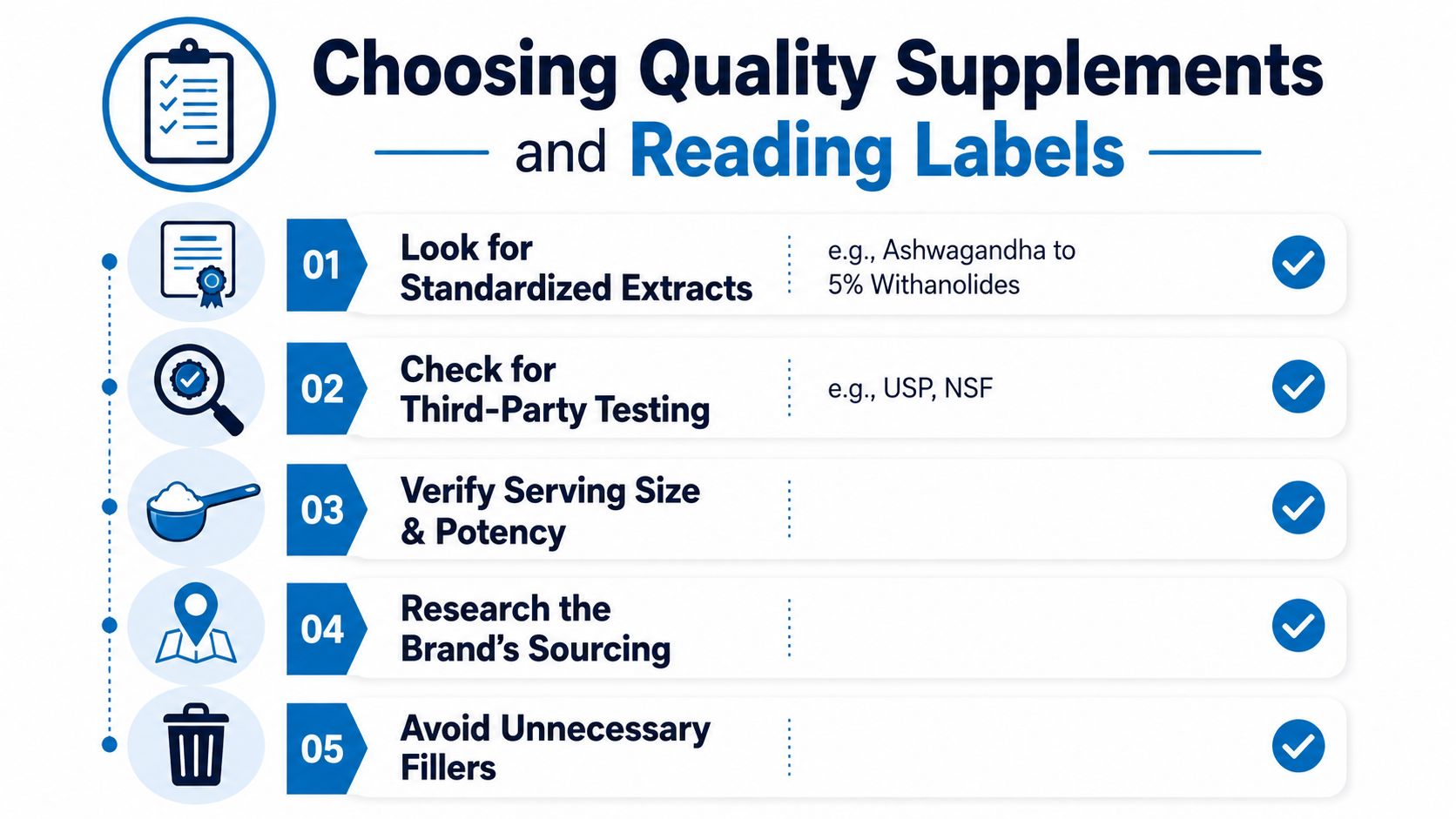
The front of the bottle can be friendly to read, but the back label does the real work. A trustworthy product usually states whether the herb is a standardized extract or a simple powder, and that distinction helps you compare products without relying on marketing language. Standardization means the maker has identified a target compound or marker profile, which gives you a better sense of consistency from bottle to bottle. With ashwagandha, that often means checking the extract type instead of stopping at the word “ashwagandha” alone.
The other details are practical, not cosmetic. Third-party testing shows the product has been checked by someone outside the company's own claims, and a clear serving size lets you compare one formula with another in a realistic way. Fillers do not automatically make a product poor, but unnecessary extras can crowd out the ingredient you want and make the label harder to interpret.
- Look for standardized extracts: This helps you compare potency across brands instead of trusting broad claims.
- Check for third-party testing: Independent verification is more informative than a vague quality promise.
- Verify serving size and potency: A capsule count means little if the actual amount per serving is too low for the intended use.
- Review the sourcing statement: Good brands usually say whether the herb is root, leaf, berry, or mushroom fruiting body.
- Avoid unnecessary fillers: Simpler formulas are easier to evaluate and often easier to tolerate.
For a concrete example, this ashwagandha capsule product is the kind of listing you would inspect for extract details, serving size, and any testing or standardization information the brand provides. The label should help you judge the product against the evidence profile, not just the promise on the front panel.
If you want a quick shortcut, use the same order every time. Start with the plant part, then the extract type, then the testing statement. That simple sequence keeps you from buying a product that sounds good but gives you very little usable information.
Buying rule: if the label will not tell you what part of the plant is used, how it is standardized, or who tested it, keep looking.
Safety Considerations and Realistic Timelines
A patient once told me she took an adaptogen for five days, didn't feel anything, then doubled the dose because she assumed more would work faster. She got jittery, slept worse, and decided the herb “wasn't for her.” That's a common mistake, because adaptogens aren't built for rapid escalation, and they're not a substitute for judgment around medications or health conditions.
Most meaningful human trials ran for 56 to 60 days or longer before showing clear stress changes, so a week of use usually isn't enough time to judge whether a product is helping clinical summary. If you're testing one, start low, keep the rest of your routine steady, and give it time before changing the dose.
When to be cautious
People on thyroid medication, immunosuppressants, or sedatives should be especially careful, because adaptogens can overlap with those systems in ways that matter clinically. Pregnancy, breastfeeding, autoimmune conditions, and complex medication regimens are not the right place for guesswork. A pharmacist or physician should be part of the plan if any of those apply.
Timing matters too. More energizing adaptogens are usually better earlier in the day, while calmer ones often make more sense later. If sleep gets lighter, appetite changes, or you start feeling wired, that's a sign to stop and reassess rather than push through.
A product that feels “stronger” isn't necessarily a better product. It may just be a worse fit for your stress pattern.
Cycling can help some people, but it's not mandatory if the herb is working well and the dose is appropriate. The larger point is that adaptogens should fit the person, the schedule, and the medical context, not the other way around.
Common Misconceptions and Building a Complete Strategy
The biggest myth is that adaptogens replace sleep, exercise, or stress management. They don't. They sit alongside those basics, and they work best when the rest of the routine gives the nervous system something stable to lean on. If sleep is short, movement is absent, and caffeine is high, even a well-chosen adaptogen has a narrow lane.
The second myth is that more is better. With adaptogens, that thinking usually backfires because the goal is modulation, not brute force. Once the dose is high enough to cause side effects, you've moved away from stress support and toward a tolerability problem.
A realistic way to use them
Use adaptogens as one part of a larger stress plan. That usually means cleaner sleep habits, some physical activity, a sensible caffeine window, and a supplement choice matched to the dominant symptom pattern. A calming herb may help at night, while a stamina-oriented herb may support daytime resilience, but neither one fixes everything.
Marketing often blurs these distinctions. Products get described as calming, energizing, balancing, and mood-supportive all at once, even when the underlying evidence is stronger for one outcome than another. The smarter question is simple: does this match my stress subtype, and do I have enough time to test it properly?
If you're ready to try adaptogens, start with one goal, one product, and one timeline. That's how you learn what's helping, what's not, and whether the herb fits your stress pattern instead of fighting it.
If you want help choosing an adaptogen based on calm, fatigue, or mixed stress, visit CalVitamin to review supplement formats, ingredient labels, and product details before you buy. You can compare adaptogen capsules, blends, and herbal formulas in one place, then use the evidence in this guide to narrow your choice with more confidence.






