
A green supplement label can make a simple purchase feel like a shortcut to better nutrition. Organic chlorella powder is often presented as clean, concentrated, and broadly beneficial, but “organic” is only the first question. It doesn't tell you how much protein you'll consume, whether the product has been tested for contaminants, or whether the powder's processing makes its nutrients easier to use.
A better approach starts with the ingredient itself, then moves to serving size, evidence, safety, and the information printed on a specific tub. By the end, you should be able to decide whether chlorella fits your routine and whether the product in front of you deserves your trust.
Table of Contents
- Why a Tub of Green Powder Deserves a Closer Look
- What Organic Chlorella Powder Is
- Nutritional Profile and What the Numbers Mean
- Potential Benefits and the Limits of the Evidence
- Organic Chlorella Powder vs Spirulina and Other Greens
- How to Use Organic Chlorella Powder Day to Day
- Does Organic Mean Safer
- How to Choose a High-Quality Product
Why a Tub of Green Powder Deserves a Closer Look
You're standing in the kitchen with a new pouch of green powder beside your blender. The front label highlights organic chlorella, plant protein, chlorophyll, and perhaps language about cleansing or vitality. The product looks wholesome, and the organic seal feels reassuring.
That reaction is understandable, but it hides an important assumption: organic automatically means safe, effective, and well controlled. It doesn't. Organic production addresses how an ingredient is cultivated and which inputs are permitted. It doesn't by itself prove that a finished powder is free from environmental contaminants, pharmaceutical residues, processing problems, or poor storage conditions.
The more useful question is practical: what does this powder deliver in the amount you'll take, and how can you distinguish a carefully controlled product from a mediocre one?
Practical rule: Treat the organic seal as a starting filter, not as a complete quality report.
A label can also make nutrition look more impressive than it feels in daily use. Chlorella may contain a high proportion of protein when measured per 100 g, but people use only a small scoop. That difference matters. A nutrient-dense ingredient can still make a modest contribution to your total diet when the serving is only a few grams.
The same careful reading applies to health claims. Chlorella contains pigments and minerals that make it interesting, and research continues to examine possible metabolic effects. Yet recent evidence also emphasizes uncertainty, mild digestive reactions, contamination concerns, and medication interactions. Those caveats don't make the ingredient useless. They make accurate product evaluation more important.
What Organic Chlorella Powder Is
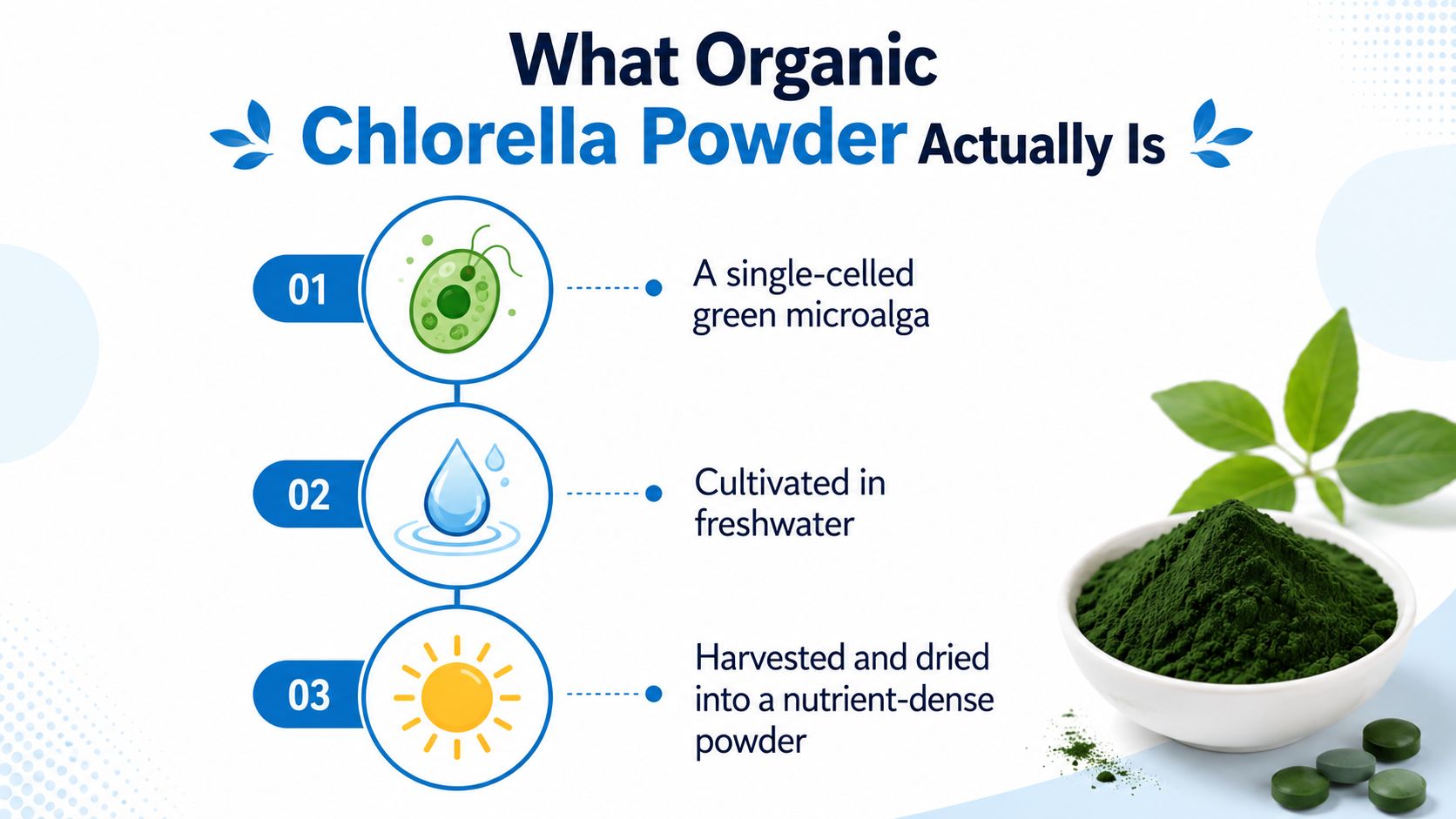
Chlorella is a single-celled freshwater microalga. It is microscopic biomass, not a leafy plant ground into powder. The organism is cultivated, harvested, dried, and sold as a food or supplement ingredient. One historical account describes it as roughly the size of a human red blood cell and traces its discovery to Dutch microbiologist Martinus Beijerinck in 1890. The historical background of chlorella outlines how interest in chlorella moved beyond laboratory observation.
Chlorella's history also explains its association with protein production. During World War I, large-scale cultivation was proposed in Germany as a possible protein source. After World War II, food-use research expanded in the United States, Germany, and Japan. Chlorella gradually shifted from scientific curiosity to an industrially cultivated food ingredient, then appeared on supplement shelves.
What the organic label means
Organic chlorella powder is dried whole Chlorella microalgae cultivated under an organic production system. Organic certification generally addresses permitted cultivation practices and inputs, including restrictions on synthetic pesticides and fertilizers. It does not change the species, guarantee a contaminant-free finished product, or replace post-harvest testing.
Freshwater cultivation still depends on the growing environment, water management, equipment, harvesting, drying, and packaging. Those stages can affect the finished powder. Separate checks may therefore be needed for metals, residues, microbial problems, and cross-contamination. A batch number, testing documentation, and a clear explanation of broken-cell-wall processing can tell you more about a specific jar than the word “organic” alone.
The powder contains cultivated microalgal biomass rather than an isolated chlorophyll extract. Its color, taste, protein, minerals, and pigments appear together because the ingredient remains close to the whole organism. The useful working definition is simple: a dried, nutrient-dense freshwater microalga grown under certified organic production practices.
Nutritional Profile and What the Numbers Mean
Chlorella's nutrient-dense reputation comes from its whole-algae composition, yet the numbers on a label can create the wrong impression. Protein is often listed per 100 g, even though a normal serving is only a few grams. Commercial products commonly contain about 50% to 66% protein by weight, according to this chlorella nutrition reference. The same reference reports fat, carbohydrates, dietary fiber, chlorophyll, beta-carotene, calcium, iron, and magnesium.
One analysis lists 66.0 g protein, 3.5 g fat, 17.5 g carbohydrates, 4.0 g fiber, 1,179 mg chlorophyll, 165 mg beta-carotene, 270 mg calcium, 83.0 mg iron, and 270 mg magnesium per 100 g. These figures describe the powder's composition, not what a person typically consumes at once. Treat the 100 g column like a map of the whole container, not a prediction of one scoop.
A more practical example uses a 4 g serving. One consumer-facing label provides 16 calories, 2 g protein, and 5 mg iron, equal to 27% of the Daily Value. The difference between these two views matters. A large per-100 g number may look impressive, while the serving-size column shows what the product contributes to an actual routine.
| Nutrient | Per 100 g | Per 4 g Serving | Why It Matters |
|---|---|---|---|
| Protein | 50.0 to 66.0 g | About 2 g in the cited label example | High density, but a small scoop contributes a modest amount |
| Fat | About 3.5 to 15.0 g | Label-dependent | Helps describe the powder's overall composition |
| Carbohydrates | About 17.0 to 22.0 g | Label-dependent | Includes the carbohydrate portion of whole algal biomass |
| Dietary fiber | About 4.0 to 15.0 g | Label-dependent | The amount depends on the product and serving size |
| Iron | 83.0 mg in one analysis | 5 mg in the cited label example | A small serving can still contribute meaningful iron |
| Chlorophyll | 1,179 mg in one analysis | Not provided in the cited label example | Helps explain the intense green color |
| Beta-carotene | 165 mg in one analysis | Not provided in the cited label example | A notable pigment in the biomass |
Independent technical literature places dry-powder protein around 58 to 66 g per 100 g. It also highlights the serving-size reality: a common 3 to 5 g scoop supplies only about 1.7 to 3 g protein. This technical review of chlorella composition helps compare a product's marketing language with the amount delivered by one serving.
Potential Benefits and the Limits of the Evidence
Chlorella can add concentrated nutrients to a plant-focused diet, including protein density, iron, chlorophyll, and beta-carotene. That profile makes it nutrient-rich in a narrow sense. A small scoop still cannot replace varied foods, medical care, or a diet that supplies every essential nutrient.
Its color offers a useful illustration of the evidence gap. Chlorophyll produces the deep green appearance, and beta-carotene adds another active pigment. Their presence explains part of chlorella's composition, but it does not establish that the powder will deliver a specific health result. A pigment is a chemical feature, not a treatment claim.
Where research remains cautious
Research leaves room for possible metabolic benefits, yet the overall certainty reported for these findings is very low. The available review evidence and safety discussion supports restrained wording. A possible benefit is different from a dependable treatment effect, and low-certainty evidence may change as stronger studies become available.
That distinction matters at the point of purchase. Product pages that say “may support” reflect uncertainty more than claims that chlorella “detoxifies,” “removes toxins,” or “prevents disease.” Detox language often suggests a proven mechanism and outcome that the evidence does not establish.
Who should be more careful
Many users tolerate chlorella, although mild gastrointestinal effects can occur. Contamination presents a separate quality concern, so cultivation controls, third-party testing, and batch information deserve attention even when a label says organic. Organic describes a production standard. It does not, by itself, prove that every finished batch is free from contamination or that the product suits every user.
People taking blood-thinning medication should discuss chlorella with a clinician because possible interactions have been raised in reviews. Anyone with a relevant medical condition, a history of sensitivity, or uncertainty about combining supplements should check before starting.
Chlorella can be a reasonable dietary add-on, but its value depends on the serving, the product's quality controls, the strength of the evidence, and the person taking it.
Organic Chlorella Powder vs Spirulina and Other Greens
Chlorella and spirulina share a shelf because both are concentrated algae powders, but they aren't interchangeable in every respect. Chlorella is typically recognized for its deep green color and chlorophyll-rich profile. Spirulina has a blue-green appearance associated with phycocyanin and is often chosen by shoppers who prefer its flavor or formulation.
Wheatgrass and moringa sit in a different part of the greens category. They're plant powders rather than single-celled freshwater algae, so their flavor, texture, protein density, and mineral profiles vary according to the plant and preparation. A buyer choosing among them should start with the intended use, not the word “superfood.”
| Feature | Organic Chlorella Powder | Spirulina | Wheatgrass / Moringa |
|---|---|---|---|
| Primary color | Deep green | Blue-green | Green, with variation |
| Protein emphasis | High for a powder, but serving size matters | High for a powder, with serving size still important | Usually a secondary feature |
| Key differentiator | Chlorophyll and whole-algae biomass | Phycocyanin and algae-based protein | Broader plant variety |
| Typical taste | Grassy, earthy | Often stronger and more seaweed-like | Herbal or grassy |
| Best fit | Shoppers seeking a freshwater algae powder with pigments and minerals | Shoppers comparing algae powders and prioritizing taste or phycocyanin | People who prefer plant-based greens with different flavor profiles |
A blend may also combine several ingredients, which makes the label more difficult to interpret. For example, a shopper comparing chlorella with an algae combination can review the ingredient order, serving size, and testing information on a product such as KOS Bolt From the Blue Spirulina Blend, rather than assuming every blue-green powder has the same composition.
Cost should be treated as a product-specific question, not a fixed property of the ingredient. Organic certification, testing, processing, packaging, and serving size can all influence value. Compare the amount of powder per container and the number of servings, then compare what each serving contributes.
How to Use Organic Chlorella Powder Day to Day
Most chlorella routines are easier to sustain when the powder becomes part of something you already prepare. Product labels and study protocols commonly sit around 3 to 5 g per day, often divided into one or two servings, but technical literature on chlorella intake shows why you should interpret those amounts alongside serving-size and tolerance information.
Start at the lower end if you're new to algae powders. Give your digestive system time to respond before increasing within the product's directions. If you develop persistent discomfort, stop and review the ingredient list with a healthcare professional instead of forcing the routine.
Three low-effort formats
Water or juice is the simplest test. Stir the powder into a small glass and drink it promptly. Citrus or another strongly flavored juice can make the grassy taste less prominent, although water gives you the clearest sense of the product's natural flavor.
For a more forgiving option, use a fruit-forward smoothie. Berries, citrus, banana, or pineapple can balance the earthy notes, while the powder's color remains visible even when the flavor softens. Add the chlorella after blending the main ingredients so you can adjust the amount without rebuilding the drink.
Overnight oats and energy bites make portion control easy. Stir the powder into oats with fruit, yogurt, or a nut-based ingredient, or mix it into a small batch of no-bake bites. These formats spread the flavor across other ingredients and help you remember how much you used.
Timing is less important than consistency and tolerance. Morning smoothies suit some people, while others prefer taking chlorella with food later in the day. Keep the first few uses simple so you can identify whether the powder itself agrees with you. If you're also comparing other greens, BareOrganics Raw Organic Wheatgrass Powder illustrates why each powder should be evaluated separately rather than treating all green ingredients as interchangeable.
Does Organic Mean Safer
Organic certification and contaminant testing answer different questions. Organic status describes approved cultivation practices and inputs. It does not confirm that the growing water, surrounding environment, equipment, processing line, or finished packaging is free from every unwanted substance.
A green seal can tell you how the algae was grown, much like a farming label describes the field but not every later stop in the supply chain. Safety also depends on harvesting, drying, processing, packaging, and storage.
A 2025 multi-product analysis of 52 spirulina and chlorella supplements found that all samples met EU toxic-metal limits, while pharmaceutical residues were still detected. The analysis found no significant contamination difference between organic and conventional products. The published analysis of microalgae supplements shows why organic status should support, not replace, product-specific quality evidence.
The related full-text publication discusses the same analysis and reports that 23 of the 52 products were organic. Detectable heavy metals appeared in all samples, although the products complied with EU limits, and pharmaceutical residues were also identified. The full discussion of organic status and contamination is a companion presentation of the evidence, not a separate product-safety guarantee. Organic cultivation can coexist with contamination pathways outside pesticide and fertilizer use.
What a trustworthy product should show
A useful label connects the powder in your hand with a documented quality-control process:
- Third-party testing: The brand should identify independent testing for heavy metals and other relevant contaminants.
- Batch-specific documentation: A current Certificate of Analysis should match the lot number on your container, rather than offering only a general company statement.
- Transparent sourcing: The label or product page should identify the cultivation region or country and explain meaningful production details.
- Processing disclosure: Look for clear information about drying, cell-wall processing, and any processing aids.
- Complete labeling: Every ingredient, flavoring, capsule material, and blend component should appear on the label.
What the evidence doesn't mean: Detection does not automatically mean a product exceeds a legal limit. It does mean shoppers should ask how a specific batch was tested and whether the brand shares those results.
The following video may help visual learners examine supplement quality and product scrutiny. It cannot replace a batch-specific Certificate of Analysis.
How to Choose a High-Quality Product
The strongest purchase decision usually comes from ranking evidence rather than collecting attractive claims. A green color, an organic seal, and a long list of nutrients can all appear on a label that gives you little information about contamination control. Evaluate the product in an order that reflects actual risk and usefulness.
Start with independent testing
Third-party testing comes first. Look for a named independent laboratory or a clear testing program that covers heavy metals and residual contaminants. If a brand says “tested for purity” but doesn't explain what was tested, who performed the testing, or how the results connect to your lot, treat the statement as incomplete.
A batch-specific Certificate of Analysis is more useful than a general quality promise. Check whether the document includes the lot number, test date, laboratory identity, and analytes relevant to algae powders. You don't need to become a laboratory scientist, but you should be able to match the paperwork to the container.
Use organic certification as a supporting signal
Organic certification still has value. It can tell you that the cultivation system follows a defined standard and restricts certain inputs. It shouldn't carry the entire burden of proving finished-product safety.
Check the certifier's name rather than relying only on a green logo. Also review the ingredient list for unnecessary additions. A plain powder with one clearly identified algae ingredient is easier to evaluate than a proprietary blend that conceals individual amounts.
Understand broken-cell-wall processing
Chlorella has a resilient cell wall, so brands often advertise broken-cell-wall processing. The claim generally refers to mechanical processing intended to make the contents more accessible during digestion. It isn't a guarantee of superior absorption, and it doesn't prove that a product is cleaner.
Ask how the processing is performed and whether the method is disclosed. A transparent explanation is more useful than a large front-label claim. If a brand provides no meaningful detail, record that as an unanswered question rather than assuming the best.
Examine cultivation and packaging details
Cultivation location and water-source information can help you understand how the producer manages environmental exposure. These details don't guarantee purity, but vague sourcing makes quality verification harder.
Packaging matters because powder can be affected by moisture, light, and repeated exposure to air. Prefer a tightly sealed container with clear storage instructions and a visible lot or expiration reference. Once opened, keep the powder dry and use a clean, dry utensil.
Run a sixty-second shelf check
Use this quick screen before adding a product to your cart:
- Identity: Does the label clearly state that it contains chlorella powder?
- Serving: Can you see the serving amount and number of servings?
- Testing: Does the brand explain independent contaminant testing?
- Documentation: Can you request a batch-specific Certificate of Analysis?
- Processing: Does it explain whether the cell wall has been processed?
- Sourcing: Does it identify where and how the algae was cultivated?
- Ingredients: Is every ingredient listed plainly?
- Storage: Are packaging and storage instructions specific?
- Tolerance: Can you start conservatively rather than jumping into a large serving?
- Personal context: Have you checked medication and health-condition concerns?
A product can be organic and still fail several of these checks. Conversely, a plain-looking label may provide the documentation you need. If you're comparing a chlorella-containing formula rather than a standalone powder, Amplicell Super Greens Extract Formula lists chlorella powder at 100 mg per serving, so read the formula's serving size instead of assuming it provides the amount found in a full powder scoop.
Know when to ask before taking it
Talk with a clinician before using chlorella if you're pregnant or breastfeeding, taking blood-thinning medication, immunocompromised, or managing an autoimmune condition. People with significant digestive sensitivity or known reactions to algae-related products should also proceed carefully.
For other adults, a conservative trial may be reasonable if the product has credible testing and the person understands what the serving can realistically contribute. The three central lessons are straightforward: chlorella is nutrient-dense but modest per serving, organic is a useful cultivation signal but not a complete safety guarantee, and your medications and health circumstances matter as much as the label.
CalVitamin offers vitamins, minerals, proteins, probiotics, herbal formulas, and ingredient-focused wellness products for shoppers comparing supplement formats and routines. Visit CalVitamin to review its broader catalog, then use the testing and labeling checklist above before choosing an organic chlorella powder.






