
You're standing in the supplement aisle with a bottle of vitamin D in one hand and a blood test result in the other, wondering why your number didn't move the way you hoped. Maybe you've already tried a regular D3 pill, maybe you've heard that K2 belongs with it, and now a liposomal version is staring back at you with a higher price tag and a bigger promise. That's the exact moment people start asking whether liposomal vitamin D3 K2 is a real upgrade or just smarter packaging.
The short answer is that liposomal delivery can change how quickly and how much of a nutrient shows up in the bloodstream, but that doesn't automatically mean better long-term health outcomes. For a shopper, that gap matters. A product can look impressive on a label because it absorbs well in the short term, yet still leave open the bigger question of whether it improves bones, cardiovascular health, or anything else that matters day to day.
Table of Contents
- Why Shoppers Are Eyeing Liposomal D3 and K2
- 什麼是脂質體傳遞
- The Bioavailability Numbers Everyone Quotes
- The Synergistic Role of D3 and K2
- How to Dose Liposomal D3 and K2 in Practice
- Liposomal Versus Softgels, Tablets, and Oil Drops
- How to Read a Liposomal D3 and K2 Label
- Who Should Switch and Who Can Skip It
Why Shoppers Are Eyeing Liposomal D3 and K2
A common story starts with a routine checkup. Someone has been taking a standard D3 softgel for months, expecting their lab work to reflect it, then the result comes back flatter than expected. That's when the label-reading begins, and “liposomal” starts looking less like marketing fluff and more like a possible fix for an absorption problem.
Fat-soluble vitamins are part of the issue. Vitamin D3 and vitamin K2 both need a delivery path that works well in the digestive tract, and plain tablets or simple oils don't always feel intuitive to shoppers who've already been disappointed once. The appeal of a liposomal vitamin d3 k2 product is simple, it promises to package the nutrients in a way your body may handle more efficiently, with less dependence on the exact meal you ate or the form the supplement came in.
That promise has helped create an entire category of products, from sprays to liquids to capsules. One example is the NOW Vitamin D3 & K2 Liposomal Spray reviewed by CalVitamin, which shows how this format has moved from niche idea to mainstream shelf option. If you're comparing products, that's the underlying question underneath the hype, not whether liposomal sounds advanced, but whether the delivery system changes something that matters to you. You can see one consumer-facing version of that format in CalVitamin's NOW Vitamin D3 & K2 liposomal spray listing.
Practical rule: Don't start with the word liposomal. Start with the problem you're trying to solve, poor absorption, inconsistent labs, or difficulty taking pills.
什麼是脂質體傳遞
脂質體可以直接理解成一個很小的運送外殼。維生素是裡面的內容物,外殼由磷脂質組成,這也是細胞膜的基本材料。這樣的結構不是單純包住營養素而已,它還能讓營養素在消化道裡多一層保護,減少直接暴露在環境中的機會。
常見的原料是葵花卵磷脂或磷脂酰膽鹼,它們幫助形成這些微小囊泡。實際上,活性成分會被一層類脂質結構包覆,這有助於在液體或軟膠囊中做出比較穩定的配方。乾燥型脂質體規格會標示150 到 600 nm的脂質體直徑、**低於 2%的殘留水分,以及低於 0.01%**的殘留乙醇,這些數字讓你看得出來,製程會刻意控制結構保存 Knowde liposomal vitamin K2 D3 freeze-dried specification。
更容易理解的對照是這樣,一般錠劑比較像把內容物直接送進郵局,脂質體則像把營養素先放進密封包裹裡,再送去旅程中可能比較不穩定的區段。這不代表一定完美,但它說明了為什麼消費者會期待脂質體產品和一般膠囊有不同表現。
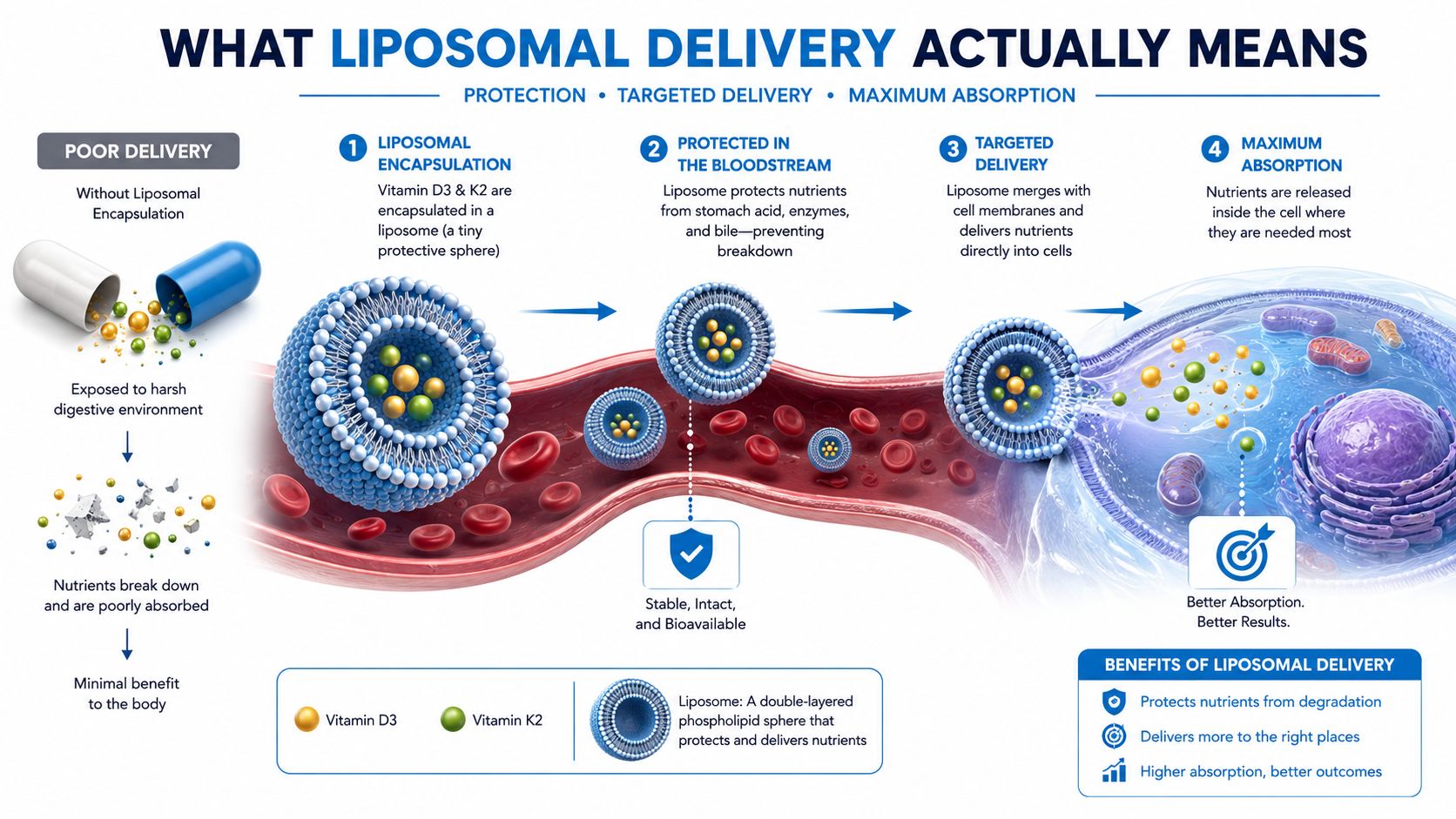
這種做法也會出現在不同的產品型態裡。像脂質體噴霧,核心概念仍然是靠包覆結構來送達營養素,只是外觀和使用方式不同。若想看品牌怎麼把這個概念呈現給消費者,可以參考 Zenwise daily liposomal vitamin C product page,它能幫助理解同一種配方思路如何被延伸到 D3 和 K2 以外的品類。
The Bioavailability Numbers Everyone Quotes
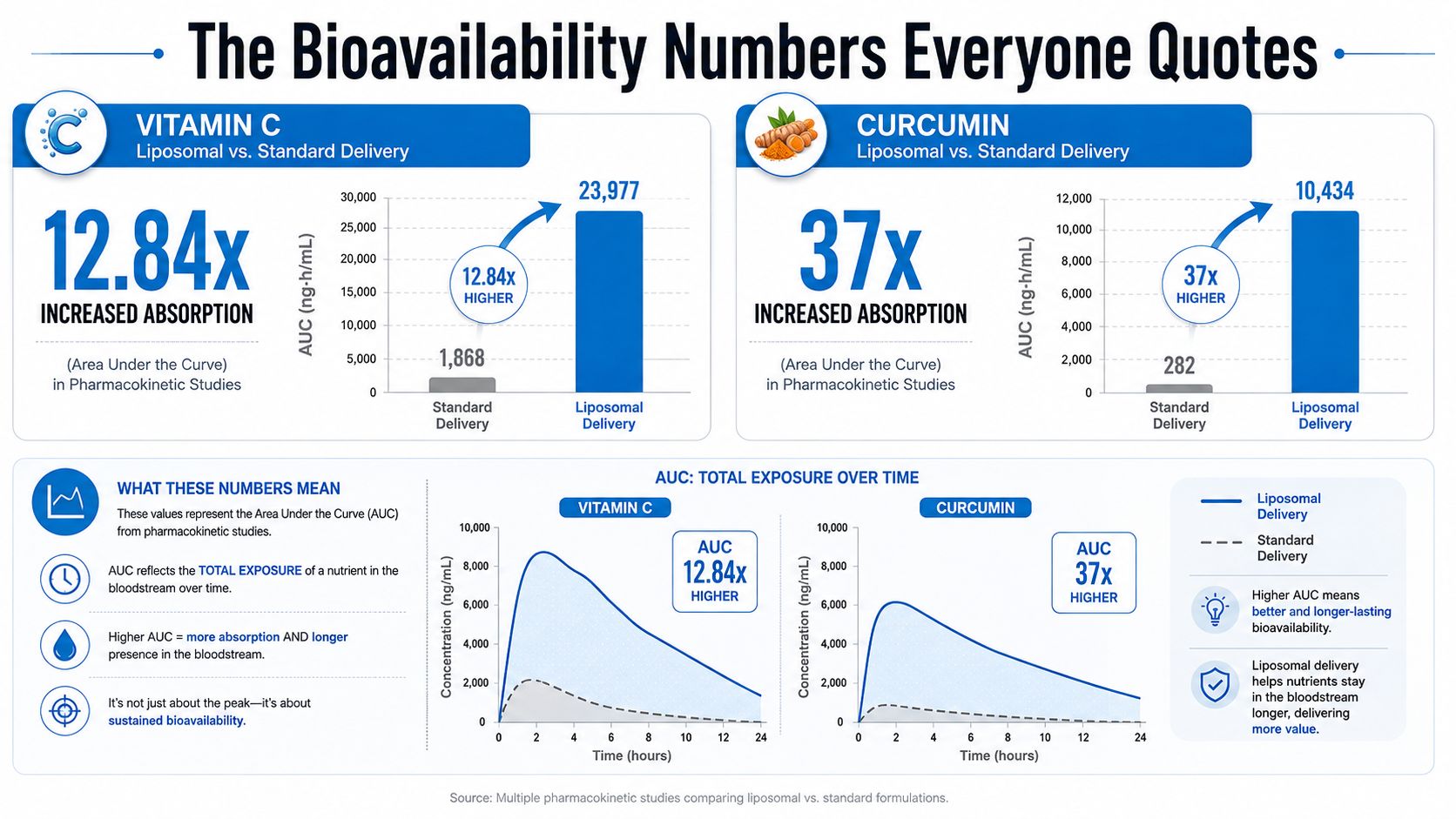
The reason shoppers keep asking about liposomal supplements is simple, the absorption data looks stronger than what they usually see on a label. In a 2026 human clinical study, a liquid liposomal vitamin D3+K2 supplement showed 12.84 times higher bioavailability for vitamin D3, measured as serum 25(OH)D, and 37 times higher bioavailability for vitamin K2, measured as plasma K2-MK7, compared with a non-liposomal tablet comparator 2026 liposomal D3+K2 bioavailability study. The same study also reported a peak serum 25(OH)D concentration of 52.94 ng/mL after a single 1,000 IU dose of the liposomal D3 product.
Those numbers are striking, but they answer only one part of the shopper's question. They show that blood levels rose faster and higher in the short term, not that the product prevents fractures, improves cardiovascular outcomes, or beats every other format over months or years. That difference matters because “higher bioavailability” often gets treated as if it already proves a better health outcome, and the evidence does not go that far yet.
A second line of evidence points in the same direction. In a peer-reviewed study of pancreatic-insufficient patients with cystic fibrosis, a liposomal fat-soluble vitamin supplement enriched with K2 performed better than standard formulations, and the paper reported a statistically significant improvement for vitamin D with p = 0.008 peer-reviewed liposomal fat-soluble vitamin evidence. Related work in that evidence base found an AUC about 4 times larger than an oily formulation, plus a faster absorption slope for liposomes, 4.01 × 10^-4 1/min versus 7.03 × 10^-5 1/min.
These results help explain why liposomal products attract attention. The early blood-level picture can shift in a meaningful way, much like a package that gets through the first checkpoints faster and arrives with less damage. What the numbers do not do is establish a universal dose, prove that every brand behaves the same, or guarantee a specific clinical benefit.
The Synergistic Role of D3 and K2
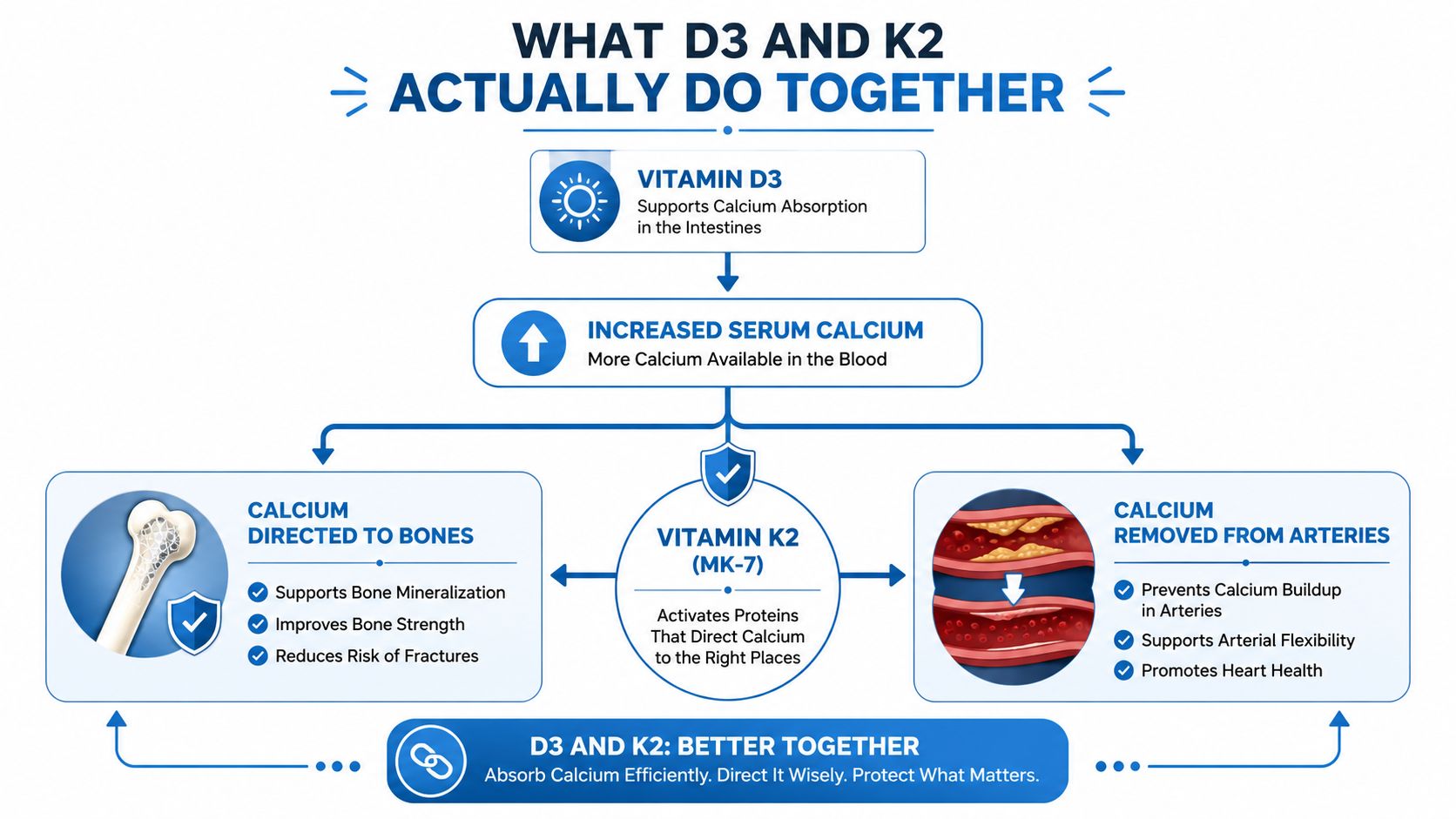
A shopper sees vitamin D3 and vitamin K2 on the same label and usually wants a simple answer about why they travel together. The short version is that vitamin D3 helps raise calcium availability in the body, while vitamin K2, especially MK-7, helps steer that calcium toward bone-related pathways instead of letting it linger where it is less welcome. That is why the pair is often described as a calcium-management team rather than two unrelated vitamins.
Bone health is the clearest reason the combination gets attention. If D3 helps calcium enter circulation, K2 is often described as the nutrient that helps guide it to where it belongs. Cardiovascular health enters the discussion because people worry about calcium showing up in soft tissue, especially arteries, and K2 is frequently discussed in that context. Immune support also belongs in the picture because D3 has a long-standing role in immune function, which is one reason many shoppers include it in a daily routine even when they are not focused on bones.
The science is narrower than the sales pitch. A review of vitamin D and K review says there still is not enough evidence to recommend combined supplementation for osteoporosis prevention or treatment. That matters for shoppers because a plausible mechanism does not automatically become a proven clinical outcome. Researchers have also continued to debate whether K2 is necessary when someone is taking vitamin D, which is why clinicians often treat the pairing as a reasonable option rather than a settled rule.
The practical takeaway is modest and useful. The mechanism makes sense, the pairing is biologically plausible, and the short-term absorption data are promising. What is still missing is strong proof that a combined liposomal product reliably changes hard outcomes in the general population, so the buying decision should be based on formulation quality, tolerance, and the reason the product is being used, not on a promise that the label alone guarantees better health.
How to Dose Liposomal D3 and K2 in Practice
The first thing to notice on a label is that doses vary a lot. Real-world examples in this category include 50 µg D3 + 200 µg K2 per daily dose, 100 µg D3 + 25 µg K2 per capsule, and 125 µg D3 + 375 µg K2 per 25 mL serving liposomal product examples. That spread is one reason you can't assume every liposomal bottle is interchangeable, even when the front label looks similar.
Start with the label, not the buzzword
Micrograms and IU are easy to confuse, so read the panel carefully. A shopper trying to maintain a vitamin D routine should pay attention to both the form and the amount, then compare it with what their clinician recommended or what their labs have shown. Liposomal delivery may change how efficiently the dose is absorbed, but it doesn't erase the fact that the number on the label still matters.
A useful rule is to take the supplement consistently and to keep an eye on bloodwork if you're using it to correct a deficiency. Fat-containing meals can still be helpful, even with a liposomal product, because real-world digestion is messy and not every liposomal formula behaves the same way.
Who needs extra caution
People on blood thinners, especially anticoagulants, should not self-direct K2 intake without medical guidance. People with kidney issues also need individualized advice because calcium and vitamin D handling can be more complicated for them. If you're already using a high-dose D3 regimen, the liposomal format doesn't make that automatically safer, it just changes the delivery path.
| Common Liposomal D3+K2 Dose Formats at a Glance | Vitamin D3 per Serving | Vitamin K2 per Serving | Typical Use Case |
|---|---|---|---|
| Liquid daily dose | 50 µg | 200 µg | Daily maintenance with a higher K2 emphasis |
| Capsule | 100 µg | 25 µg | Simple once-daily format |
| Liquid serving | 125 µg | 375 µg | Higher-strength liquid routine |
Liposomal Versus Softgels, Tablets, and Oil Drops
A shopper usually makes the final choice at the shelf. Liposomal products have the strongest absorption story, but that does not make them the right default for everyone. A standard softgel is familiar, stable, and easy to store. A tablet is often the most compact option. An oil drop can be simple and affordable, even if its absorption behavior looks less impressive in some comparisons.
The clearest case for liposomes appears when absorption speed matters most. As noted earlier, liposomal products performed better than an oily formulation in the pharmacokinetic evidence, with a much larger overall exposure and a faster rise in levels. That kind of result helps explain why shoppers who feel they did not get enough from basic formats start looking at a different delivery system, but it does not prove that liposomes are automatically the best choice for every routine or every goal.
Which format fits which buyer
If your main goal is absorption, liposomal is the strongest candidate.
If your main goal is budget or familiarity, a standard softgel or tablet may still make more sense.
If your main goal is convenience, oil drops and sprays can win on routine, even if they do not win on pharmacokinetics.
A practical example is the Nature Made Vitamin D3 K2 5000 IU softgels listing at CalVitamin, which sits on the conventional side of the shelf. A product like that can still be a sensible choice for someone who already responds well to standard D3 and does not need a more elaborate delivery system.
The comparison is really about fit, not hype. Liposomal delivery may matter most for people who want a formulation built around absorption, while softgels, tablets, and oil drops still have clear advantages in simplicity, familiarity, and cost.
How to Read a Liposomal D3 and K2 Label
A liposomal label should answer a few basic questions before you buy. It should tell you which active nutrients are inside, which form of K2 it uses, and what the delivery system is made from. If the front of the bottle says “liposomal” but the back gives no clear information about phospholipids, vesicle format, or testing, that is a sign to pause and read more closely.
Checklist worth using in the aisle
- Phospholipid source: Look for sunflower lecithin or phosphatidylcholine, since those are common building blocks for the vesicle.
- K2 form: Check whether the product uses MK-7 or MK-4, because those are not interchangeable on a label.
- Dosage form: Decide whether you want spray, liquid, capsule, or softgel based on your own routine.
- Testing language: Third-party testing claims are more useful when they are specific instead of vague.
- Manufacturing details: If the label or spec sheet mentions vesicle size, residual moisture, or residual solvent limits, that usually points to a more technical formulation approach.
A useful example is the freeze-dried specification mentioned earlier, which shows what a more formal product description can look like. It lists a liposome diameter of 150 to 600 nm, residual water below 2%, and residual ethanol below 0.01%. You do not need every product to list those exact controls, but when a label includes details like these, it gives you a better sense that the maker is thinking about stability as well as marketing.
The comparison is simple. A bottle that only says “advanced liposomal formula” is asking for trust. A bottle that tells you what it contains and how it was made gives you something concrete to evaluate.
Who Should Switch and Who Can Skip It
The people most likely to justify a liposomal upgrade are the ones who have a reason to care about absorption, not just branding. That includes people with documented malabsorption, people whose 25(OH)D hasn't moved much on standard D3, and older adults who want a format that may be easier to take consistently. The short-term evidence suggests the delivery system can matter, so these are the shoppers most likely to benefit from trying it.
Healthy adults with stable labs on a decent softgel are a different story. If your current routine is working and your clinician is happy with your numbers, the premium may not buy you much. In that situation, a liposomal product might be interesting, but it's not automatically necessary.
A plain decision filter
- Choose liposomal if you've had absorption problems, inconsistent results, or you want the delivery system with the strongest blood-level data.
- Stay with a standard softgel or tablet if your labs are stable and you'd rather keep costs and complexity down.
- Ask your clinician first if you take anticoagulants, have kidney disease, or are already using a high-dose D3 plan.
The biggest trap is assuming that higher absorption equals better health in every case. The evidence is strongest for short-term biomarkers, not for long-term outcomes, so the smart shopper separates “this gets into the blood well” from “this will definitely improve my health over time.”
If you want a practical place to compare formats, labels, and nutrient forms, CalVitamin carries a wide range of supplements, including liposomal and conventional vitamin options. Visit CalVitamin to review product details, compare delivery systems, and choose the D3 and K2 format that fits your routine and your goals.