
An amino acid complex combines selected amino acids, but its usefulness depends on which amino acids it contains, the dose, and whether you already get enough dietary protein. The nine indispensable amino acids recognized in the WHO/FAO/UNU framework have an adult combined requirement of 84 mg/kg/day, with individual requirements ranging from 3.5 mg/kg/day for tryptophan and valine to 14 mg/kg/day for leucine and phenylalanine (WHO/FAO/UNU technical report).
That answer challenges the most popular advice in the supplement aisle: more amino acids don't automatically mean more muscle, faster recovery, better skin, or improved energy. An amino acid complex is a tool, not a universal upgrade. The right formula can fill a dietary gap or suit a specific situation, while an expensive blend can add little if complete protein already covers your needs.
The practical question isn't “Which amino acid complex is strongest?” It's “Which amino acids match my goal, and what problem am I trying to solve?” That means examining protein adequacy, amino acid class, serving size, delivery form, label transparency, dietary restrictions, and health risks before buying.
Table of Contents
- Why Amino Acid Complexes Need a Goal-First Approach
- Understanding the Amino Acid Complex Core Concept
- Essential Nonessential Conditional and BCAA Classes
- Evidence for Recovery Lean Mass Skin and Metabolism
- Forms Dosage Factors and Practical Use
- How to Choose Vegan Halal and Gelatin-Free Products
- Safety Interactions and Shopping Decisions
- A Practical Plan for Evaluating Amino Acid Complexes
Why Amino Acid Complexes Need a Goal-First Approach
An amino acid complex is not automatically a better version of protein. A blend can support a specific purpose, yet the same formula may be poorly suited to recovery, connective tissue, training without food, or general nutrition. The ingredient list matters because amino acids take part in many processes, but their presence alone does not show that the finished product will produce a meaningful outcome.
Start with the situation you are trying to address. A person who eats little protein, trains fasted, or cannot manage a complete meal is asking a different question from someone whose diet already provides enough high-quality protein. Age, training demands, health status, and the amino acid classes in the formula can all change the choice. Evidence for supplementation is uneven, so a goal-first approach helps separate a targeted use from an expensive substitute for food.
A simple analogy is a repair kit. You choose the tool for the job before opening the box. Use the same logic when comparing amino acid complexes:
- Recovery or lean-mass support: Check for a complete essential amino acid profile. A BCAA-only product does not supply every building block needed for new protein construction.
- Collagen and connective-tissue support: Review whether the formula contains amino acids associated with collagen structure, then distinguish free amino acids from collagen peptides.
- Fasted or demanding training: Consider whether rapid availability is useful because a full meal is impractical.
- General wellness: First ask whether ordinary food already meets the nutritional need.
Practical rule: If you cannot explain why each major ingredient belongs in the formula, the product is probably not closely matched to your goal.
The market now offers more choice, which makes label literacy more important. Grand View Research valued the global amino acids nutritional supplements market at US$11,167.7 million in 2025 and projected US$23,323.3 million by 2033 (market context for amino acid nutritional supplements). A larger category does not make every blend necessary. It gives you more labels to examine, serving sizes to compare, and reasons to decide whether free-form amino acids add value beyond the protein already in your diet.
Understanding the Amino Acid Complex Core Concept
An amino acid complex is not automatically a stronger version of protein. It is a selected mixture of amino acids, while protein foods and powders provide those building blocks in longer peptide chains that digestion breaks down. Whey, casein, soy, and carefully formulated plant proteins can contribute to total protein intake and usually present a wider amino acid pattern.
A targeted supply list is a better comparison than a toolbox. Each formula gives the body a particular group of materials, and its usefulness depends on what is missing from the rest of the diet. A blend may suit a narrow purpose, while another product may offer a broader essential amino acid profile. The label, serving size, and intended use matter more than the word “complex.”
Three products that look similar but aren't
Protein powder provides intact protein molecules or peptides for digestion. It generally supplies a broader amino acid pattern and can help meet overall protein needs.
An amino acid complex provides free-form amino acids, peptide-bound amino acids, or both. It may contain all nine indispensable amino acids, selected essentials, or a mixture that leaves out some of the building blocks required for new protein formation.
A single-ingredient supplement centers on one compound, such as pure L-leucine or L-glutamine. That focused format may fit a clearly identified use, but it does not provide the wider pattern found in an EAA complex.
The form changes how quickly the nutrients appear in circulation. Free-form amino acids bypass the initial digestion of larger protein structures, producing higher and faster plasma peaks of total and essential amino acids, followed by a quicker decline (technical review of free amino acid absorption). This can be convenient around training or when a full meal is impractical. A rapid rise still does not equal sustained nutritional coverage, so convenience should not be confused with completeness.
Read the formula before believing the category
“Complex” does not confirm that a product is complete. Check whether the label lists histidine, isoleucine, leucine, lysine, methionine, phenylalanine, threonine, tryptophan, and valine. These are the nine indispensable amino acids recognized in the WHO/FAO/UNU framework.
A blend that omits one or more essential amino acids may still have a defined role, but its purpose is narrower. A BCAA product cannot substitute for a complete protein, and a free-form blend cannot serve as a full meal. Compare the formula with the protein already supplied by food, then decide whether the added speed or selected ingredients solve a real dietary need.
Essential Nonessential Conditional and BCAA Classes
Amino acid labels describe supply and function, not product quality. The categories overlap, so one formula may fit more than one group. BCAAs, for example, are a subset of essential amino acids. Glutamine and arginine may also appear in sports formulas, even though the body can generally produce them under ordinary conditions.
Essential amino acids must come from food or supplementation. The recognized list includes histidine, isoleucine, leucine, lysine, methionine, phenylalanine, threonine, tryptophan, and valine. If the diet provides too little of one or has an imbalanced pattern, protein production can be limited despite an adequate supply of other amino acids.
Nonessential amino acids can usually be synthesized internally. Glutamic acid and alanine are familiar examples. “Nonessential” describes the usual source, not the compound's value. These amino acids still contribute to proteins and metabolic pathways.
Conditionally essential amino acids may require greater attention during illness, physiological stress, recovery, or intense training. Glutamine and arginine commonly appear in products positioned for recovery or metabolic support. Their inclusion describes the formula's intended use, not proof that supplementation benefits every healthy person.
Branched-chain amino acids, or BCAAs, are leucine, isoleucine, and valine. They belong to the essential category but are sold separately because sports formulas often focus on them. A berry-flavored BCAA amino complex should therefore be evaluated as a BCAA product, not treated as a complete EAA formula.
Amino Acid Classes at a Glance
| Class | Representative Amino Acids | Typical Role | Common Inclusion Reason |
|---|---|---|---|
| Essential | Lysine, threonine, methionine | Supplied through diet and used for protein construction | Support a broader dietary amino acid pattern |
| Nonessential | Glutamic acid, alanine | Usually produced by the body and used in protein and metabolic pathways | Add targeted nutritional or formulation features |
| Conditionally essential | Glutamine, arginine | May become more relevant during physiological stress | Position a product for recovery, immune, or metabolic use |
| BCAA | Leucine, isoleucine, valine | Essential amino acids commonly associated with muscle metabolism | Support sports-focused formulas and convenient peri-workout use |
Match the class to the goal. An EAA blend offers a broader pattern, a BCAA formula emphasizes three amino acids, and a single-ingredient product targets one compound. The category alone does not show whether your diet lacks an amino acid, whether the serving provides a meaningful amount, or whether the formula suits your needs.
Evidence for Recovery Lean Mass Skin and Metabolism
An amino acid complex is most useful when its formula matches a defined need. Essential amino acids supply the raw materials for building proteins, while leucine also acts as a signal involved in muscle protein synthesis. A signal, however, is only one part of the process. Tissue construction still requires the other necessary amino acids and enough total nutrition.
This difference helps separate an EAA product from a BCAA-only formula. BCAAs provide leucine, isoleucine, and valine. A complete EAA formula also supplies the other indispensable amino acids. If your diet already provides enough complete protein, adding isolated amino acids may offer limited extra value. Results also vary with the person, dietary adequacy, and intended use.
What the evidence supports most clearly
A 12-week EAA multi-ingredient study in healthy elderly subjects found improvements in muscle mass, strength, power, and vertical jump performance. Fatigue myoelectric measures did not change. The result supports a targeted role for EAA-based formulas in older adults, particularly when age-related anabolic resistance makes muscle support more difficult. It does not show that every amino acid complex produces the same outcome.
Skin-related formulas call for a separate reading of the label. Glycine, proline, and lysine contribute to collagen structure and synthesis, which explains their inclusion. Clinical research in this area has focused more on collagen peptides than on free-form amino acids. A blend containing those three amino acids therefore should not automatically be treated as equivalent to a collagen peptide product.
Metabolic and immune-related claims depend heavily on context. Glutamine participates in nitrogen transport and can matter to gut and immune tissues. Arginine is connected with nitric oxide pathways. BCAAs also take part in energy metabolism, but biochemical involvement alone does not establish a dependable effect on body composition, endurance, or metabolic health for every user.
Amino acid classes and the goals they best support
| Benefit Goal | Most Relevant Amino Class | Evidence Strength | Practical Caveat |
|---|---|---|---|
| Recovery and lean-mass support | Complete EAA blends, with BCAAs included | More supportive when dietary intake is inadequate or in older adults | Whole-food protein may already cover the need |
| Muscle-focused peri-workout use | BCAAs or EAAs | Context-dependent, with broader support for complete EAA patterns | BCAAs don't provide all indispensable amino acids |
| Skin and collagen relevance | Glycine, proline, lysine, or collagen peptides | More clinically established for collagen peptides | Free amino acids aren't interchangeable with collagen peptides |
| Metabolic or immune-stress support | Conditionally essential amino acids such as glutamine and arginine | Variable and situation-specific | Don't infer a general benefit from biochemical involvement |
The best choice follows the goal. An EAA blend resembles a full set of building materials, whereas a BCAA product supplies only three pieces. A single-ingredient formula is more focused still. For example, Onnit Glutamine Amino Acid represents a single-amino-acid approach. That may suit a narrow purpose better than a broad blend, but it is less appropriate as a general replacement for protein.
Forms Dosage Factors and Practical Use
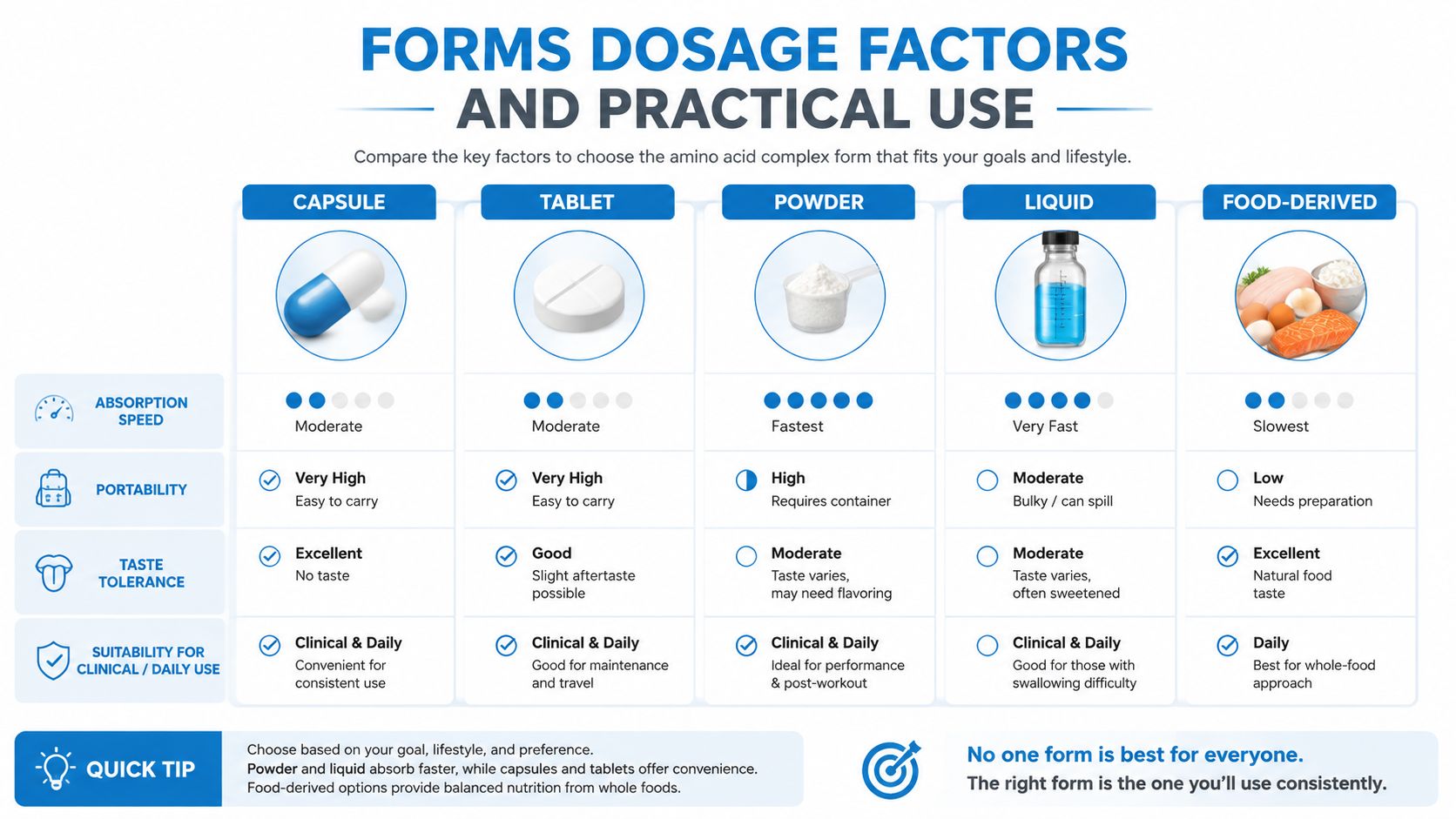
The delivery form changes convenience, measurement, and how quickly a product is available, but it does not change the amino acid class itself. Capsules and tablets travel well and are easy to count. A larger serving may require several units. Powders can put more amino acids into one drink and make split servings simpler, although flavor and mixing quality differ.
Liquids may suit people who have difficulty swallowing capsules. Food-derived products can fit a meal-based routine. Free-form amino acids generally become available sooner because they do not need to be released from an intact protein structure. That quicker rise can also be followed by a shorter period of availability, so rapid absorption should not be confused with a better overall result.
How to read the serving panel
Read the serving size first, then check the total amino acids supplied. If one label defines a serving as two capsules, compare another product using its stated serving rather than one capsule. Check the listed amounts of leucine, isoleucine, valine, and other EAAs. A proprietary blend that hides individual quantities makes goal-based selection harder.
The percent Daily Value may be missing or provide little guidance because amino acids do not always have a standard Daily Value on supplement labels. Review sweeteners, flavors, acids, flow agents, and fillers if you have sensitivities or use multiple products.
There is no single dose for everyone. Body size, training load, age, health status, and total dietary protein all affect the decision. A fasted trainee or older adult might divide a serving around training. Someone who has just eaten a complete protein-rich meal may gain little from adding a quickly absorbed blend.
Use timing as a convenience, not a guarantee. A supplement cannot replace adequate food, sufficient sleep, or a suitable training plan.
Prolonged-release and staggered formulas aim for a steadier appearance of amino acids instead of one sharp rise. That describes a delivery strategy, not evidence that the formula will outperform a complete meal. The label should therefore answer two questions: does the form suit your routine, and does the amino acid profile match your goal?
How to Choose Vegan Halal and Gelatin-Free Products
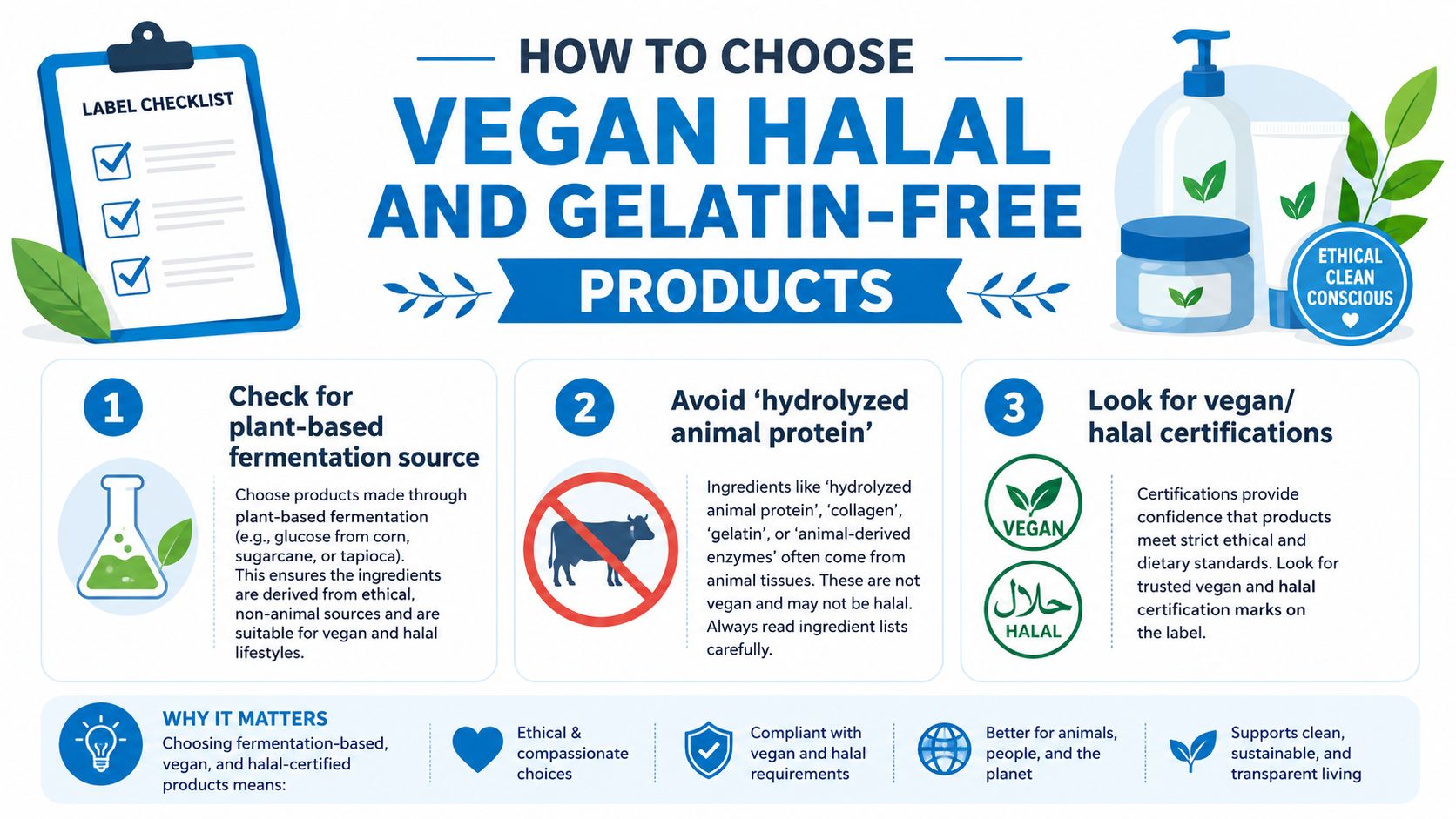
Amino acid fermentation does not automatically make a finished supplement vegan, halal, or gelatin-free. Many individual amino acids come from microbial fermentation, which avoids animal-derived hydrolysis, yet the capsule, flavor system, or other ingredients may have a different origin. Read the complete ingredient list instead of relying on “amino acid” on the front label.
Certification can provide another layer of verification. Look for a recognized vegan mark, halal certification, or kosher certification that applies to the finished product. Fermentation may satisfy one dietary requirement while leaving another unresolved, so match the certification to your own standards.
Inspect the capsule and the extras
Gelatin usually comes from animal collagen. Anyone avoiding it should check the capsule material directly. HPMC and pullulan are common plant-based options, but the product page or manufacturer should identify the capsule composition clearly.
Review these details:
- Animal-derived ingredients: Check for hydrolyzed animal protein, gelatin, dairy ingredients, and non-vegan flavor carriers.
- Allergen statements: Fermentation does not remove the need to read shared-facility or cross-contact warnings.
- Flavor and sweetener systems: Acids, sugar alcohols, artificial flavors, and intense sweeteners can affect tolerance.
- Certification scope: Confirm that certification covers the finished supplement, not only the amino acid raw material.
- Dose per serving: Compare the amino acid amount, since a lower price may reflect a smaller serving.
A beef gelatin product such as Vital Proteins Beef Gelatin Unflavored Dietary Supplement belongs to a different category from a vegan amino acid complex. Its clearly stated source shows why ingredient origin matters more than broad marketing language.
A short video offers another way to approach label review:
Safety Interactions and Shopping Decisions
Amino acids occur naturally in food, but concentrated supplements deserve the same caution as other active products. High-dose single amino acids can cause problems for some people, including gastrointestinal discomfort, headaches, flushing, mood changes, or blood-pressure effects. The risk depends on the ingredient, amount, personal health, and combination with medicines.
Potential interactions deserve professional review. People taking MAOIs, levodopa, immunosuppressants, or diabetes medications shouldn't assume that an amino acid complex is inert. Amino acids can share transport pathways with nutrients or medicines, and changes in absorption or metabolism may matter clinically.
The required safety graphic URL isn't available in the provided asset list, so no substitute image is included.
Who should pause before using one
Speak with a qualified clinician before starting a concentrated amino acid product if you're pregnant or nursing, have kidney or liver disease, or have a diagnosed amino acid metabolism disorder such as maple syrup urine disease or phenylketonuria. A product containing phenylalanine is especially unsuitable for people with PKU unless a specialist has advised otherwise.
A sensible buyer checklist includes:
- Transparent quantities: Every major amino acid should have an individual amount.
- Manufacturing controls: Look for GMP information and, where relevant, testing programs such as USP, NSF, or Informed Sport.
- Clear forms: The label should identify whether ingredients are free-form, peptide-bound, or part of a hydrolyzed source.
- Allergen disclosure: Check both the ingredients and facility warnings.
- Personal compatibility: Review medicines, diagnoses, pregnancy status, and prior intolerance.
If a label hides the dose behind “proprietary blend,” you can't make a meaningful comparison or judge whether the formula matches your goal. Transparency is a safety feature, not merely a shopping convenience.
A Practical Plan for Evaluating Amino Acid Complexes
Use a four-part decision process:
- Assess dietary protein and training load. Review your regular meals, training schedule, and whether you can eat before or after exercise.
- Identify the primary goal. Choose one priority, such as recovery, lean-mass support, aging-related muscle support, or a narrowly defined metabolic purpose.
- Match the class to the goal. Consider a complete EAA blend for a broader essential pattern, BCAAs for a narrower sports formula, or a conditionally essential amino acid when a clinician or clearly defined use supports it.
- Validate the product. Check individual quantities, serving size, form, allergens, certifications, and independent testing information.
The supplied safety and fitness infographic URLs were not valid pre-uploaded assets, so the exact required visuals can't be reproduced without inventing or altering URLs.
Start conservatively, use the lowest practical serving shown on the label, and monitor digestion, sleep, soreness, training quality, and overall tolerance during a consistent trial. If you have a chronic condition or take prescription medicine, ask your clinician before experimenting.
Choose the product only after food, goal, formula, and safety all point in the same direction.
CalVitamin offers vitamins, minerals, proteins, sports blends, and ingredient-focused wellness products, including dietary options such as halal and gelatin-free items on select products. Visit CalVitamin to compare amino acid and protein choices by ingredient, format, and label details before you buy.






