
“Natural” is not a safety guarantee, and a long list of herbs isn't an evidence review. The practical question for herbal supplements for memory isn't which bottle makes the boldest promise. It's which ingredient has credible human evidence, whether the studied product resembles the one you're buying, and whether you should avoid it because of your medicines or health history.
The research is more sobering than most marketing pages suggest. A landmark randomized trial found no measurable memory benefit from ginkgo in older adults without cognitive impairment after six weeks, while the large GEM prevention trial found that long-term ginkgo use didn't prevent dementia or Alzheimer's disease. Bacopa has a more encouraging signal in a newer analysis, but even that evidence is specific to certain memory outcomes rather than proof of broad cognitive enhancement. The 2002 ginkgo trial and its negative findings are summarized in this review, and the GEM trial results are available in the full research report.
This guide takes a buyer's approach. It separates plausible mechanisms from demonstrated outcomes, compares popular herbs by evidence quality, explains why dosing labels can mislead, and puts risk stratification before product ranking.
Table of Contents
- Why Most Memory Supplement Articles Get It Wrong
- How Herbal Supplements Affect Memory and Brain Function
- Comparing the Most Popular Memory Herbs by Evidence Level
- Dosing and Timing for Memory Support Herbs
- Safety Concerns and Drug Interactions You Need to Know
- How to Evaluate Supplement Quality and Avoid Low-Grade Products
- Building a Practical Memory Supplement Strategy
Why Most Memory Supplement Articles Get It Wrong
A longer herb list does not make a memory guide more reliable. Bacopa, ginkgo, lion's mane, rhodiola, gotu kola, ashwagandha, and huperzia often appear together, each paired with terms such as “supports,” “enhances,” or “optimizes.” That presentation puts ingredients on one evidence tier, even though their human data, preparations, and safety profiles differ.
A proposed mechanism is not a clinical result. An extract may affect circulation, neurotransmitters, or stress biology in laboratory research without improving recall, working memory, or everyday function. Marketing routinely turns preliminary findings into confident promises, so the first filter should be the quality of the human evidence.
The label rarely matches the trial
Clinical studies usually specify the botanical species, extract preparation, active constituents, dose, and participant group. A retail product may list raw powder, a vague “herbal blend,” or a proprietary mixture that hides each ingredient's amount. Even when the plant name matches, the extract ratio and standardization may not.
This makes product comparisons unreliable. A study of Bacopa monnieri does not validate every product sold as “Brahmi.” Evidence for a defined ginkgo extract does not show that an unspecified ginkgo powder will produce the same results.
Practical rule: Treat the exact extract and dose as part of the intervention, not as minor label details.
Negative results deserve equal space
The ginkgo memory trial published in 2002 tested 219 older adults without cognitive impairment. After six weeks, it found no measurable benefit in standard neuropsychological tests, self-reported memory, or observer ratings. Although 203 participants, or 88%, completed the protocol, ginkgo and placebo still showed no significant differences. The trial is discussed in the Frontiers review of herbal cognitive research.
The GEM prevention study examined a different question: whether long-term use could prevent dementia or Alzheimer's disease. Participants received 240 mg of ginkgo daily and were followed over years. By five years, probable Alzheimer's disease occurred in 61 people in the ginkgo group versus 73 in the placebo group, with a hazard ratio of 0.84, 95% CI 0.60 to 1.18, p=0.306. The GEM findings are reported in this open-access study.
The wider evidence base also has limits. A 2023 umbrella review identified small samples and weak methodology across herbal dementia research, even where individual interventions showed possible benefit. That review reports the limitations and the measured signals of benefit. The practical conclusion is narrower than the advertising: some herbs may warrant study, but confidence should match the strength and relevance of the evidence.
How Herbal Supplements Affect Memory and Brain Function
Memory depends on separate stages: encoding registers information, consolidation stabilizes it, and retrieval brings it back. An herb that improves alertness may support attention during encoding without strengthening long-term retention. A compound associated with synaptic plasticity may require a different timeframe and produce a different result.
Acetylcholine helps the brain register incoming information, which is why cholinergic signaling often appears in discussions of memory supplements. Bacopa and huperzia are linked to this pathway, but a plausible biochemical mechanism does not establish better learning or recall in consumers.
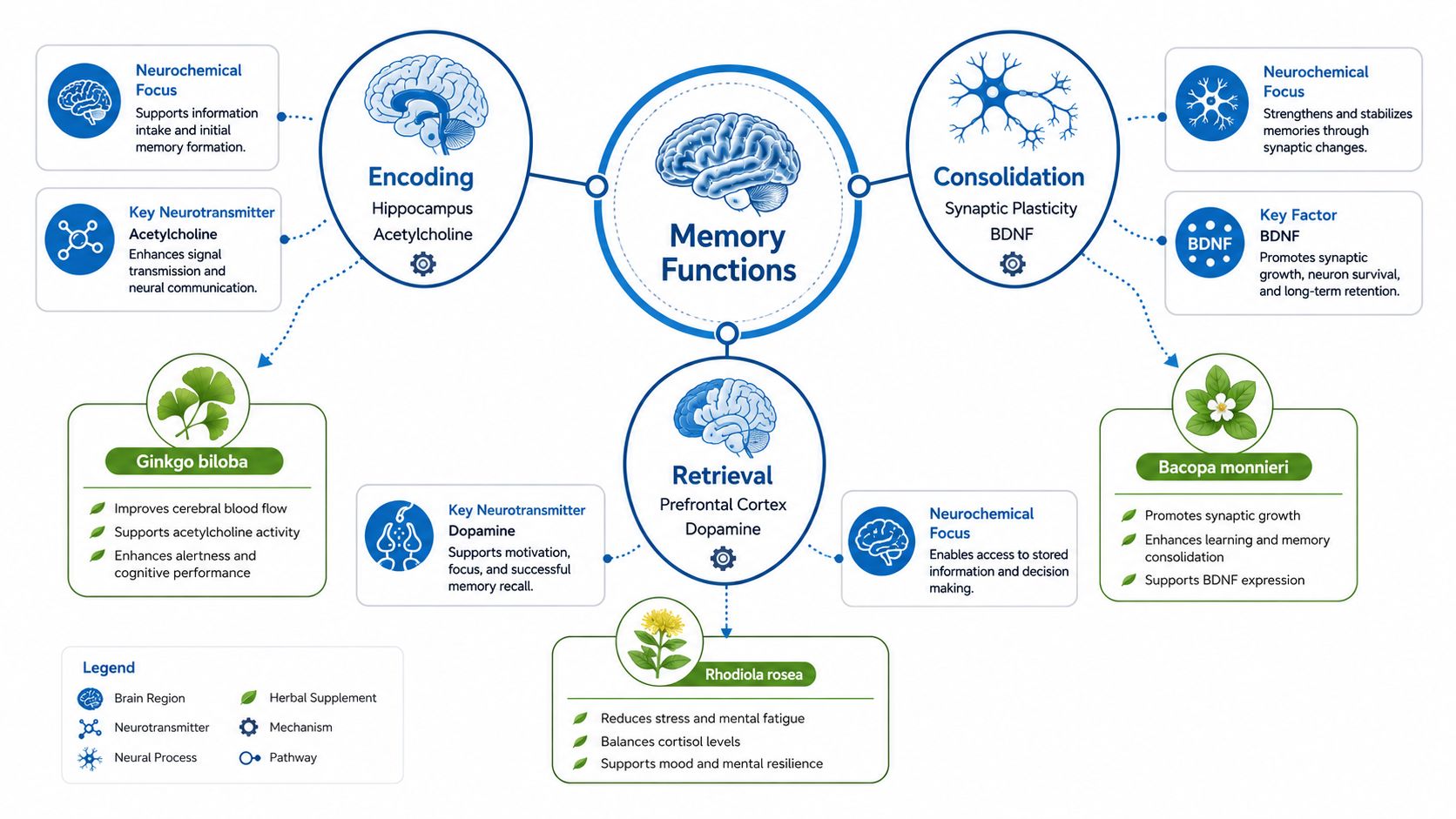
Four proposed routes, four different questions
- Cholinergic signaling: Bacopa and huperzia influence pathways involved in acetylcholine activity. The practical question is whether that influence improves recall or learning, rather than whether the pathway sounds relevant.
- Synaptic support: BDNF and NGF are described as signals involved in maintaining neural connections. Their presence in a product does not guarantee a measurable memory benefit, because absorption, dose, and the person's baseline health also matter.
- Cerebral blood flow: Ginkgo is marketed for circulation and blood flow. That mechanism does not establish dementia prevention, and the long-term prevention findings discussed earlier temper circulation-based promises.
- Stress regulation: Rhodiola and ashwagandha may fit cases where stress, fatigue, or poor sleep disrupts concentration. That use differs from directly reversing age-related memory decline.
Bioavailability can stop a promising idea at the gut
An oral supplement must survive digestion, cross the intestinal barrier, enter circulation, and, for some effects, reach the brain. Plant compounds can have limited or inconsistent bioavailability, while extraction methods affect how much active material is available. A standardized extract therefore gives buyers more useful information than a broad label such as “supports brain health.”
Judge the product against a defined preparation, a studied dose, and an outcome that matches the goal. The strongest current Bacopa signal is domain-specific. A network meta-analysis of 29 randomized controlled trials involving 2,107 participants found the clearest effects for high-dose Bacopa on working memory and short-term memory, with no significant advantage for sustained attention, selective attention, or processing speed. The analysis is indexed in PubMed.
Mechanism and marketing can explain why an herb is interesting. They cannot show who should take it, who should avoid it, or whether the finished product matches the research. Those judgments require human outcomes, transparent labeling, and safety screening.
Comparing the Most Popular Memory Herbs by Evidence Level
Popularity is a poor proxy for proof. Compare these herbs by the quality of human trials, consistency across outcomes, and how closely the studied preparation matches what buyers can purchase. Mechanism language and traditional use can make an ingredient interesting, but they do not establish a dependable memory benefit.
| Herb | Evidence level | Primary mechanism | Typical onset | Key caveat |
|---|---|---|---|---|
| Bacopa monnieri | Moderate, with a specific memory signal | Cholinergic and synaptic support | Usually gradual | Results depend on extract, dose, and memory domain |
| Ginkgo biloba | Extensive human research, mixed or negative for prevention | Circulation and neurochemical effects | Variable | Negative memory and dementia-prevention benchmarks |
| Lion's mane mushroom | Preliminary human evidence | NGF-related and neurotrophic pathways | Unclear | Human memory evidence remains limited |
| Rhodiola rosea | More relevant to stress and fatigue | Adaptogenic stress response | Often faster for subjective fatigue | Direct memory evidence is less established |
| Gotu kola | Preliminary and traditional use | Neurovascular and stress-related pathways | Unclear | Limited high-quality human memory research |
| Ashwagandha | More relevant to stress-related cognition | Stress-response modulation | Variable | Safety and medication screening are important |
| Huperzia serrata | Preliminary, with cholinergic relevance | Acetylcholinesterase inhibition | Unclear | Long-term safety and interactions require caution |
Bacopa has the clearest current memory signal
Bacopa stands out because the available analysis found a stronger pattern for working memory and short-term memory than for attention or processing speed. Higher-dose formulations performed better than lower-dose Bacopa, ginkgo, and placebo in the analyzed comparisons. The finding supports a specific, gradual memory claim, not a universal promise for every cognitive task or every user. Read the PubMed-indexed network meta-analysis.
The result still requires careful product matching. A Bacopa capsule may use a different extract, preparation, or amount than the formulation studied in clinical research. Buyers should look for a clearly identified extract and compare its label with the research intervention. For a practical label example, review the labeled Bacopa monnieri memory and focus capsules, then check whether the product states its extract details rather than relying on a generic herb name.
Ginkgo has the longest marketing history, not a clean victory
Ginkgo has more human research than many newer ingredients, yet the outcomes do not support its broadest marketing claims. A short-term randomized trial found no measurable memory improvement, while the GEM prevention study found no meaningful dementia-prevention benefit despite long-term use. Its evidence category is therefore well researched but not reliably effective for the broad promises often attached to it.
Lion's mane remains a plausible research subject because of its proposed neurotrophic activity, but human memory evidence is still limited. Rhodiola and ashwagandha fit a different risk-and-benefit profile. They may suit concentration problems linked with stress, fatigue, or poor sleep, rather than a direct attempt to enhance memory.
Gotu kola and huperzia deserve stricter screening. Their proposed pathways do not compensate for limited high-quality human memory research, and huperzia's cholinergic activity makes medication review particularly important. Anyone with a medication regimen, pregnancy, a neurological condition, or an unexplained change in memory should resolve the safety question before choosing an herb.
Dosing and Timing for Memory Support Herbs
Dosing is where many supplement buyers make an avoidable mistake. A product can contain a familiar herb but still fail to resemble the studied intervention because the label omits extract standardization, uses a different preparation, or supplies an amount that hasn't been tested for the intended outcome.
Use clinical dosing as a reference framework, not as a personal prescription. The verified evidence here supports a clearer Bacopa signal than it does universal dosing rules for every herb.
| Herb | Clinical dose range | Time to effect | Best timing |
|---|---|---|---|
| Bacopa monnieri | High-dose formulations at 600 mg/day or more showed the strongest working-memory effects in the network analysis | Gradual, not an immediate stimulant effect | With food if it causes stomach discomfort |
| Ginkgo biloba | The GEM prevention study used 240 mg/day | Variable | Earlier in the day if it feels activating |
| Lion's mane mushroom | No verified universal clinical dose range in the provided evidence | Unclear | Follow the product label |
| Rhodiola rosea | No verified universal clinical dose range in the provided evidence | Unclear | Earlier in the day if it feels stimulating |
| Gotu kola | No verified universal clinical dose range in the provided evidence | Unclear | Follow the label and response |
| Ashwagandha | No verified universal clinical dose range in the provided evidence | Unclear | Timing depends on whether it feels calming or activating |
| Huperzia serrata | No verified universal clinical dose range in the provided evidence | Unclear | Use only with professional review when medicines are involved |
The table's omissions are deliberate. The supplied clinical evidence doesn't verify the commonly repeated retail ranges for lion's mane, rhodiola, gotu kola, ashwagandha, or huperzia. Filling those gaps with confident numbers would create false precision.
Set expectations before changing the dose
Bacopa shouldn't be judged like caffeine. A person looking for an immediate boost may misclassify a slow, domain-specific intervention as ineffective, while another buyer may keep increasing the dose because the first few days felt uneventful. Neither response is a sound evaluation method.
Start with one product, follow its labeled serving, and record the date, perceived focus, recall difficulty, sleep, digestion, and any unusual symptoms. Don't stack several new herbs at once, because you won't know which ingredient caused either a benefit or a problem.
Buyer's discipline: If the product doesn't disclose the extract identity and amount, you can't meaningfully compare your experience with the clinical literature.
Safety Concerns and Drug Interactions You Need to Know
Safety comes before a speculative memory benefit. The risk is higher for older adults taking anticoagulants, antiplatelet drugs, blood-pressure medicines, thyroid medication, or several prescriptions at once. A supplement can add a clinically relevant interaction without producing an obvious warning on the label.
The clearest concern here is bleeding risk with ginkgo, particularly alongside anticoagulants or antiplatelet drugs. Botanicals may also cause nausea, headache, sedation, or toxicity that increases with dose. The review of herbal and nutritional medicines in older adults explains the low-quality evidence and safety gap.
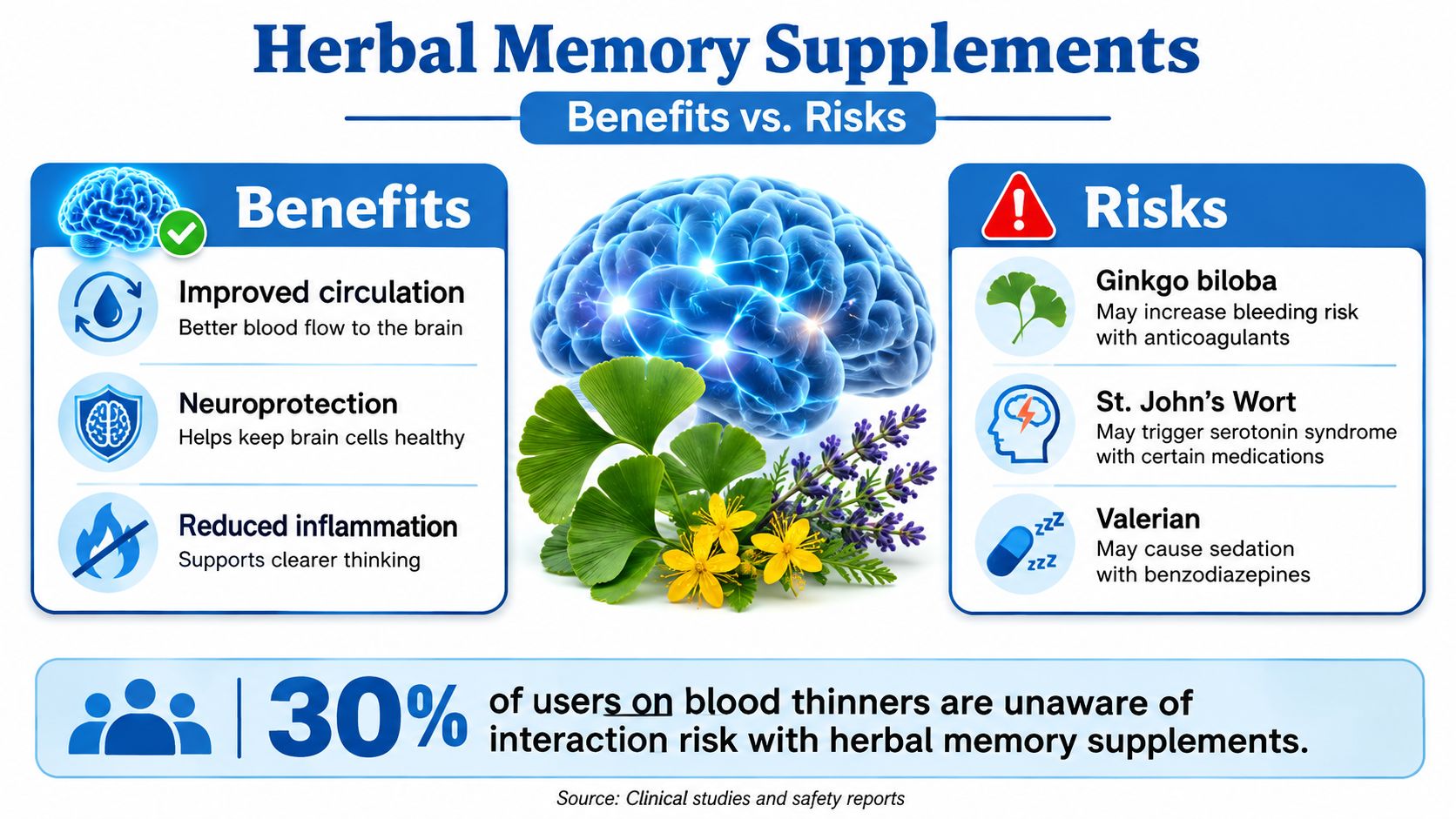
Who should pause before buying
- People taking blood thinners or antiplatelet medicines: Ask a pharmacist or prescriber to review ginkgo and every multi-herb formula before use.
- Older adults using multiple medicines: Adding one more active ingredient makes it harder to identify the cause of a side effect or interaction.
- People preparing for surgery: Tell the surgical team about every supplement, even if it seems unrelated to the procedure.
- Pregnant or breastfeeding individuals: Do not self-start memory herbs without qualified medical guidance.
- People with autoimmune, thyroid, heart-rate, or liver concerns: The decision depends on the specific herb, extract, health condition, and medication list.
The practical problem is risk stratification. Online rankings rarely identify which users face the greatest harm, and a product marketed for memory may be inappropriate for someone with a bleeding risk or complex prescription regimen.
Evidence quality also limits broad recommendations. A review of older-adult research found substantial risk of bias and low overall certainty, so the findings do not justify general endorsement of herbal memory products for aging populations. These products also should not replace conventional treatment for mild cognitive impairment or Alzheimer's disease.
Before starting, photograph the Supplement Facts panel and your medication list, then show both to a pharmacist. That review is more useful than adding a second or third nootropic based on a customer testimonial.
Here's a short visual resource on the interaction issue:
For shoppers comparing ginkgo products, inspect the Herbal Secrets Ginkgo Biloba 120 mg product listing, but treat the listing as product information, not as a substitute for medication screening.
How to Evaluate Supplement Quality and Avoid Low-Grade Products
A polished label can still leave major questions unanswered. The first audit is simple: identify the exact botanical, plant part, extract type, active-compound standardization, serving size, and amount per serving. “Herbal extract” without those details tells you very little.
Standardization can improve comparability. A label stating a defined percentage of bacosides or ginkgo flavone glycosides gives you more information than a label that lists only the raw herb name. It still doesn't prove effectiveness, but it helps you determine whether the product resembles studied preparations.
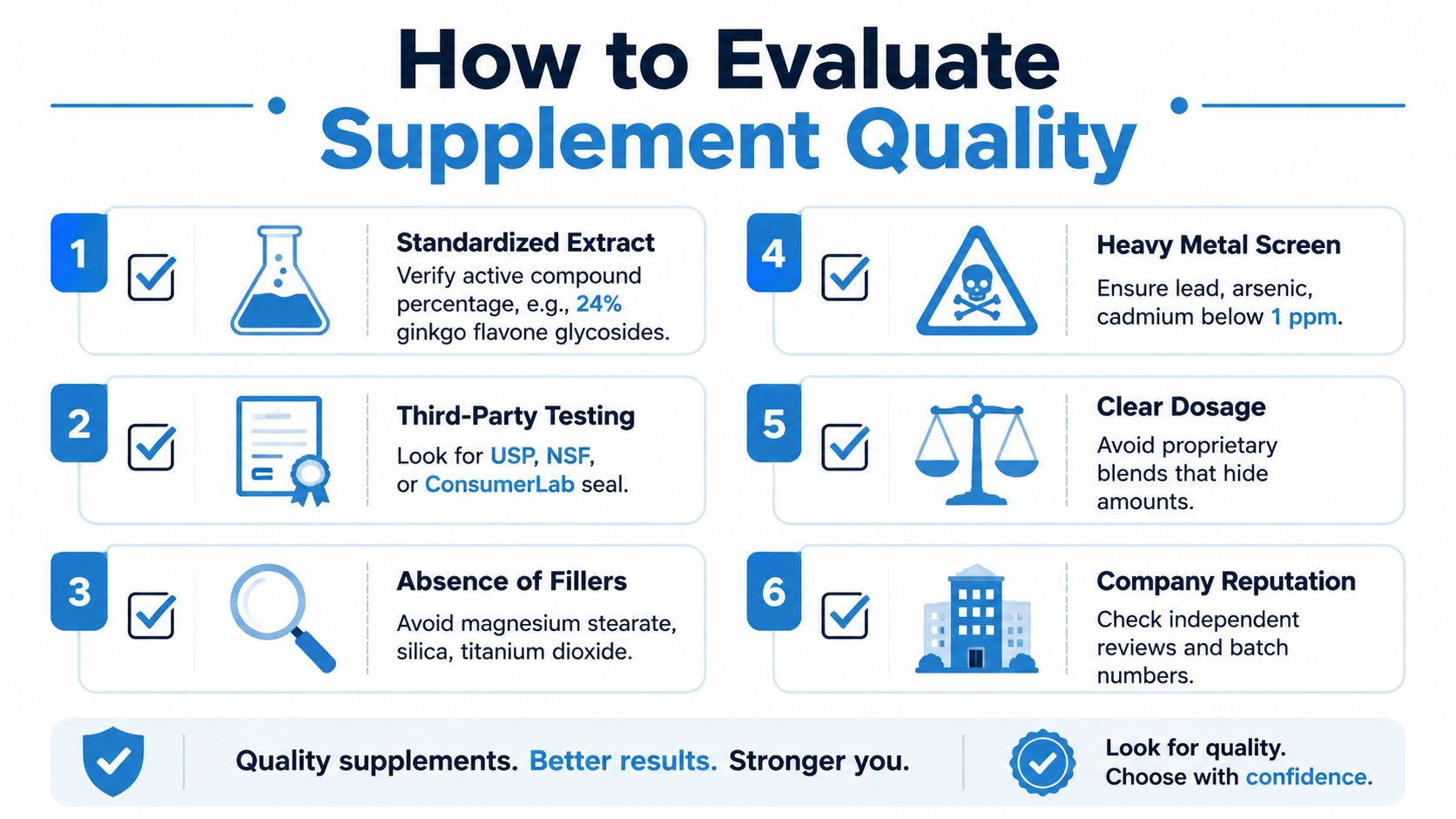
Use a label-audit checklist
- Confirm the identity: Look for the full botanical name and plant part, not just a marketing name.
- Check standardization: Find the declared active constituents and extract details.
- Reject hidden dosing: Proprietary blends make it impossible to assess the amount of each ingredient.
- Look for independent testing: USP, NSF, or ConsumerLab verification can provide manufacturing and contents checks, but no seal guarantees that a product will improve memory.
- Ask for batch documentation: A credible company should be able to provide a current certificate of analysis, or COA, that corresponds to the batch.
- Review contaminant controls: Ask whether the company tests for heavy metals, microbial contamination, pesticides, and adulteration.
The absence of fillers isn't the main quality test. A familiar excipient may be acceptable, while a “clean” formula can still contain an ineffective or contaminated extract. Focus first on identity, dose transparency, testing, and traceability.
A useful distinction: Third-party testing can tell you more about what's in the bottle. It can't tell you whether the ingredient will solve your memory concern.
A company's product page should also show a lot number, expiration information, storage guidance, and a way to contact support. If the seller refuses to explain the extract or testing process, move on. CalVitamin's herbal supplements category can be used as a shopping starting point, but you should still perform the same label audit on every product.
Building a Practical Memory Supplement Strategy
Start with the concern, not the herb. Gradual age-related change, stress-related brain fog, and short-term focus problems call for different decisions. Supplements cannot explain every cause of poor memory. Persistent or worsening symptoms need clinical evaluation instead of self-treatment.
Use a conservative plan:
- Choose one target: Do not begin by treating memory, stress, sleep, and energy with a large stack.
- Match the evidence to the goal: Bacopa has the clearest current signal for certain memory domains. Rhodiola or ashwagandha may fit stress-related concentration better, but their evidence should remain a limited claim.
- Screen for risk first: Review medicines, planned surgery, pregnancy or breastfeeding, autoimmune conditions, thyroid problems, heart-rate concerns, and liver history.
- Track before judging: Record recall difficulty, working-memory performance, subjective focus, sleep, digestion, headaches, and signs of bleeding or sedation.
- Stop if risk exceeds value: New adverse effects, unexplained symptoms, or a possible interaction warrant stopping the product and seeking professional advice.
Use one defined product at a time. Combining herbs does not reliably create additive benefits. A larger stack increases possible interactions and makes it harder to identify which ingredient caused a reaction.
Sleep, movement, nutrition, and appropriate medical care remain the foundation. An herbal supplement is an optional adjunct with a limited, specific evidence claim, not a replacement for diagnosis or treatment.
An umbrella review reported cognitive signals for some interventions, including Chinese herbal medicine used with pharmacotherapy and vinpocetine, while also describing small samples and poor methodological quality. Treat those findings as preliminary rather than proof that a supplement is established therapy.
Before buying, verify the label and ask a pharmacist to check interactions. CalVitamin lists vitamins, minerals, proteins, probiotics, and herbal products in one online catalog, allowing comparison of formats and labels, but the safety checklist should guide the purchase.
If you compare herbal supplements for memory, visit CalVitamin to review labeled wellness products and herbal formulas. Bring the product details to a pharmacist or clinician, especially when prescription medicines are involved. Evidence and safety checks matter more than marketing promises.






