

Niacin flush free is a label most often applied to inositol hexanicotinate, a form of vitamin B3 marketed to avoid the redness and warmth caused by nicotinic acid. The European safety benchmark commonly used for flushing-related safety is 10 mg per day of nicotinic acid, but that benchmark doesn't mean a flush-free product will provide the same biological effects as regular niacin.
The popular advice is simple: choose “flush free” and get all the benefits without the uncomfortable reaction. That advice skips the most important question, which benefit are you seeking? If your priority is avoiding warmth, redness, and tingling, inositol hexanicotinate may be appealing. If you're shopping for a proven cholesterol intervention, the label deserves much more scrutiny.
Table of Contents
- What Niacin Flush Free Means
- Why Regular Niacin Causes a Flush
- The Evidence Gap on Lipid Effects
- Comparing the Main Forms of Vitamin B3
- How to Use a Flush Free Niacin Supplement
- Safety, Side Effects, and Interactions
- Choosing a Quality Flush Free Product
What Niacin Flush Free Means
“Flush free” usually describes a different compound rather than regular nicotinic acid with its flushing response removed. The label generally refers to inositol hexanicotinate, which combines six nicotinic acid units with inositol. Supplement labels and official guidance may also call it no-flush niacin, distinguishing it from nicotinic acid, the form most closely associated with flushing. The NIH-linked review of niacin forms describes inositol hexanicotinate as a vitamin B3 supplement form that does not produce the typical redness and warmth.
Vitamin B3 is a family name, not one molecule. Its two direct dietary forms are nicotinic acid and nicotinamide, also called niacinamide. Inositol hexanicotinate belongs to another category. Its structure attaches nicotinic acid units to an inositol carrier, and the body is thought to hydrolyze that structure gradually.
A useful, simplified analogy is a slow-release capsule wrapped in a carrier. Immediate-release nicotinic acid becomes available quickly, whereas inositol hexanicotinate is thought to release its niacin components more gradually. That proposed release pattern helps explain the flush-free marketing claim. It does not establish that the compound supplies the same amount of active niacin to the same tissues.
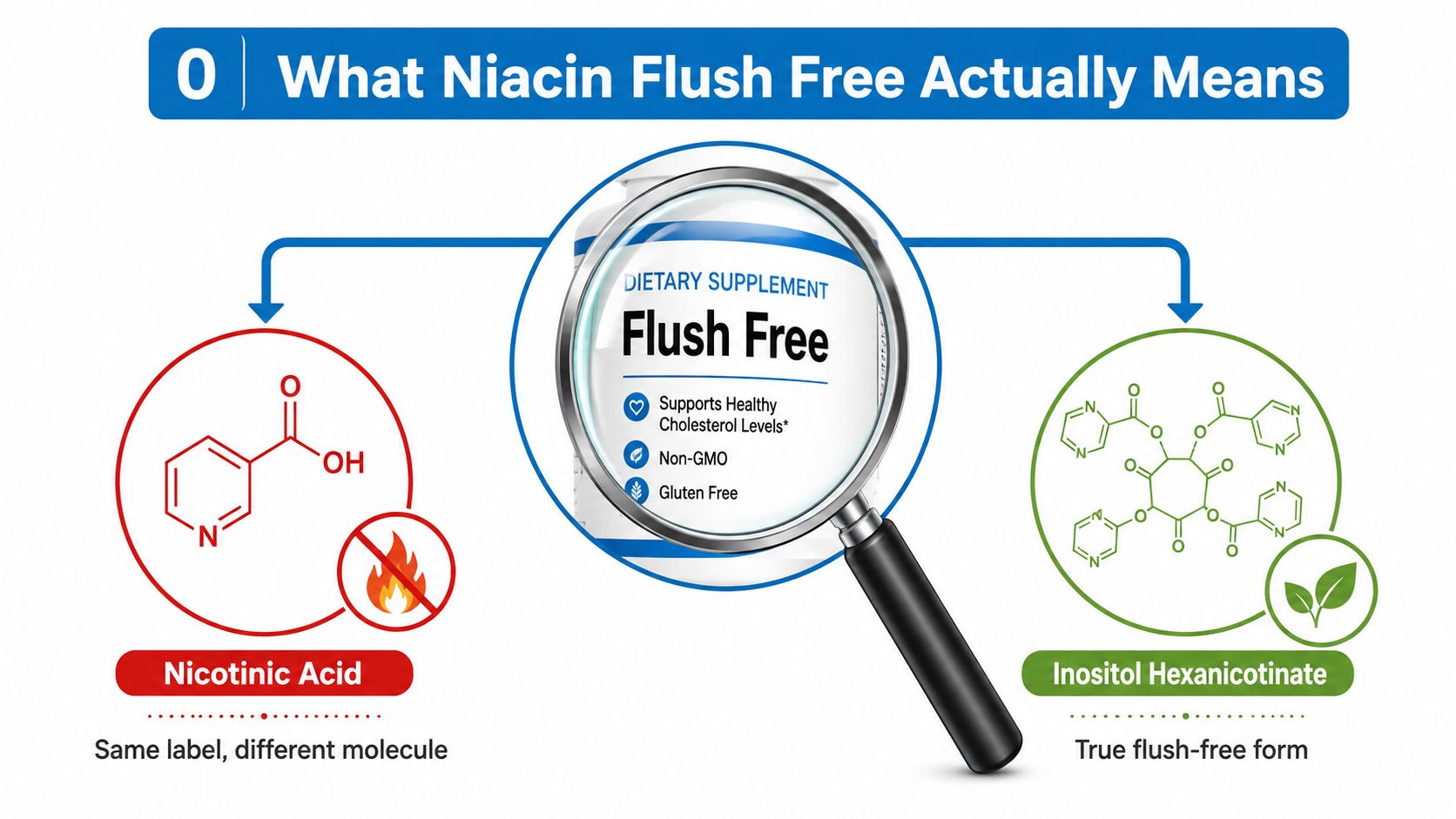
Don't confuse it with niacinamide
Nicotinamide also generally avoids flushing, but it is not inositol hexanicotinate. As a direct, single-molecule form of vitamin B3, nicotinamide is commonly used for vitamin intake rather than presented as a special slow-release product.
That distinction matters on a Supplement Facts panel. A bottle may feature “niacin,” “no-flush niacin,” or “flush-free blend” on the front, while the ingredient panel identifies whether the formula contains nicotinic acid, nicotinamide, or inositol hexanicotinate.
The tolerability benefit is therefore easier to understand than the therapeutic one. Avoiding the flush may make supplementation easier to continue, but it may also mean choosing a form whose niacin activity is less certain.
Label rule: Treat “flush free” as a marketing description, not a guarantee of a standardized molecule or a proven therapeutic effect.
Why Regular Niacin Causes a Flush
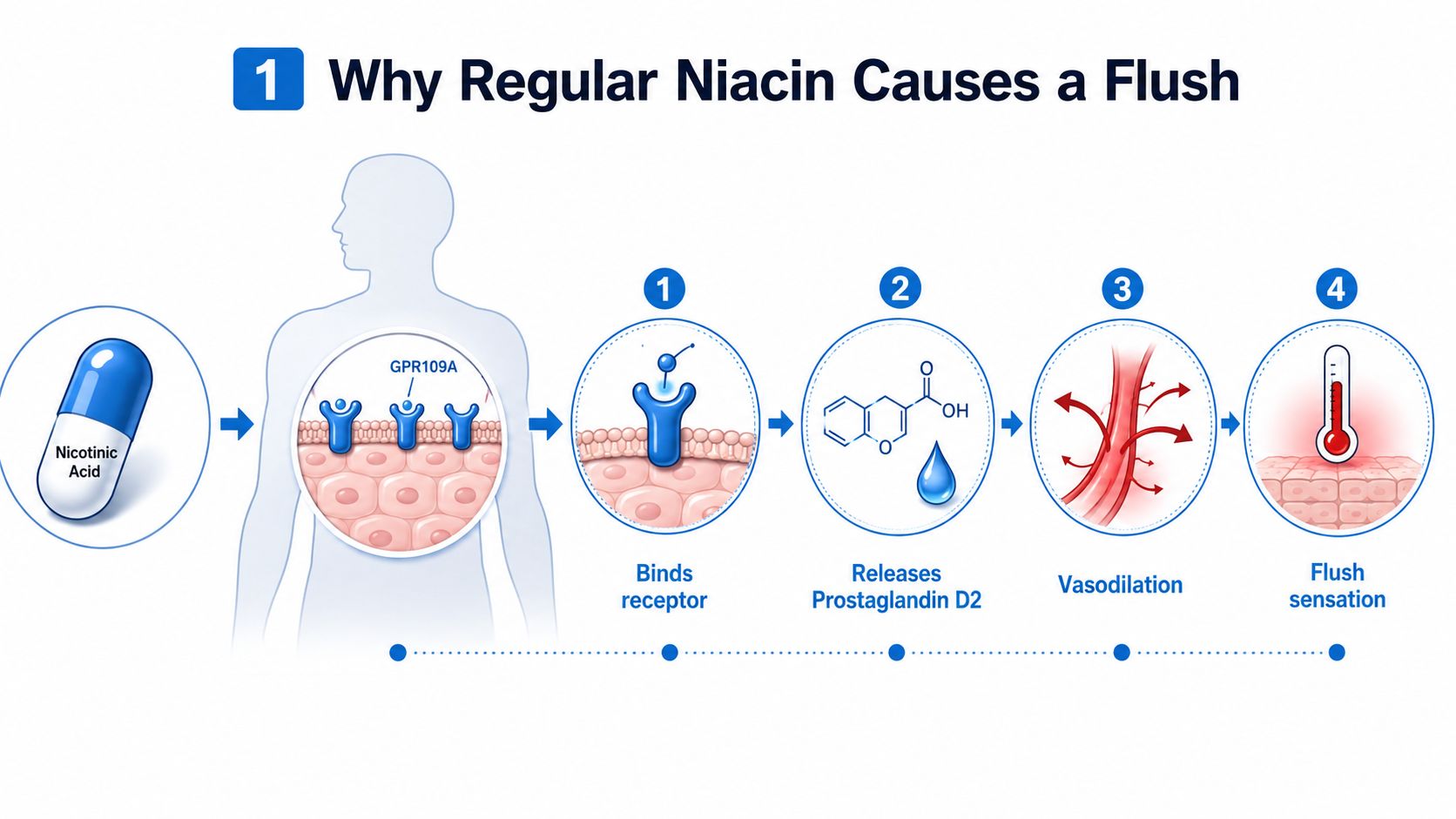
The flush begins with nicotinic acid, not with every form of vitamin B3. After oral nicotinic acid reaches the body, it can bind to the GPR109A receptor on immune-related Langerhans cells in the skin. That receptor signal prompts the release of prostaglandins, particularly prostaglandin D2 and, to a lesser extent, prostaglandin E2.
Those prostaglandins act on small blood vessels near the skin's surface. The vessels widen, blood flow increases locally, and the person may feel warmth, see redness, or notice tingling and itching. The reaction is usually uncomfortable rather than dangerous, although severe symptoms should never be dismissed as an ordinary supplement response.
The discomfort has real consequences for adherence. A person may begin a nicotinic acid routine for a health goal, experience a dramatic flush, and stop taking it. One randomized trial reported flushing in 100% of niacin users compared with 3% on placebo after a single dose, and 9% required medical attention for severe adverse effects such as flushing, chills, or gastrointestinal symptoms, as described in the clinical trial review.
Why inositol hexanicotinate is different
Inositol hexanicotinate is thought to hydrolyze slowly, releasing niacin more gradually than immediate-release nicotinic acid. If circulating nicotinic acid doesn't rise in the same way, the skin receptor pathway may be activated less strongly, which offers a plausible explanation for reduced flushing.
That mechanism remains a proposed explanation, not a guarantee of therapeutic activity. The absence of a flush tells you that the skin response is lower. It doesn't tell you that the product is producing the lipid changes associated with pharmacological nicotinic acid.
A visual walkthrough can make the pathway easier to follow:
The Evidence Gap on Lipid Effects
Flush-free niacin often attracts shoppers seeking cholesterol support. The appeal is easy to understand: regular nicotinic acid has a long history of pharmacological use for changing blood lipids, so a product labeled “niacin” may seem to promise similar results without the discomfort.
The evidence does not support treating these forms as interchangeable. The Mayo Clinic Proceedings review reports that inositol hexanicotinate has not been shown to release free niacin, raise circulating niacin levels, or improve plasma lipid levels. That distinction matters because the absence of a flush mainly shows that the skin response is reduced. It does not establish the lipid activity associated with pharmacological nicotinic acid.
This is the tradeoff behind many flush-free products. Improved comfort can reflect lower exposure to the form and pathway associated with niacin's established lipid effects.
Lipid Effect Evidence by Niacin Form
| Form | Evidence for Lipid Change | Typical Outcome |
|---|---|---|
| Nicotinic acid | Established lipid activity at pharmacological use, but clinical decisions require medical supervision | Can affect lipid measures, with flushing as a common limitation |
| Extended-release niacin | Prescription extended-release products can reduce flushing while preserving lipid efficacy | A medically managed option, not a generic substitute for supplements |
| Inositol hexanicotinate | Reviews haven't shown improvement in lipid parameters | Usually a tolerability-led vitamin B3 supplement |
| Nicotinamide | Not established as a lipid-modifying substitute | Used for vitamin B3 intake without the classic flush |
The label claim “flush free” therefore answers a tolerability question, not a treatment question. Inositol hexanicotinate may suit someone who wants vitamin B3 intake without the classic skin reaction, while its role in changing LDL, HDL, or triglycerides remains unsupported by the evidence summarized here.
Choose a flush-free product for general B3 intake. For lipid changes, discuss the form and your treatment plan with a clinician rather than using an over-the-counter product as a replacement for proven care.
Comparing the Main Forms of Vitamin B3
Not all vitamin B3 forms deliver the same outcome. The ingredient named on the panel helps determine whether you are getting flushing activity, potential lipid effects, or neither. A flush-free choice can improve tolerability, but it should not automatically be treated as a therapeutic substitute.
Nicotinic acid, particularly in immediate-release form, is the classic flushing form. It activates the skin pathway described earlier and has the clearest history of pharmacological lipid activity. That activity comes with a tolerability burden, while high-dose or medically prescribed use requires attention to safety monitoring.
| Form | Flushing | Lipid Effects | Safety Notes | Typical Use |
|---|---|---|---|---|
| Immediate-release nicotinic acid | Commonly associated with flushing | Proven pharmacological activity, but not a self-directed cholesterol strategy | Dose and medical context matter | Clinician-directed lipid management |
| Extended-release nicotinic acid | Designed to reduce flushing | Can preserve lipid efficacy | Formulation-specific monitoring is important | Prescription or supervised treatment |
| Nicotinamide | Doesn't produce the classic flush | No convincing evidence that it substitutes for lipid-modifying nicotinic acid | Generally selected for vitamin B3 intake, with individual risks still relevant | Nutritional supplementation |
| Inositol hexanicotinate | Marketed as flush free | Hasn't been shown to improve lipid parameters in clinical reviews | The product label and dose still matter | Tolerability-led B3 supplementation |
Extended-release nicotinic acid changes the release pattern to reduce the frequency or intensity of flushing while retaining lipid effects. It is not interchangeable with every sustained-release product sold over the counter. The NIH Office of Dietary Supplements professional fact sheet distinguishes among nicotinic acid, extended-release niacin, and inositol hexanicotinate, distinctions that matter when reading a label.
Nicotinamide, also called niacinamide, is a direct form of vitamin B3 that does not trigger the same GPR109A-mediated skin response. It can suit someone seeking B3 intake without flushing, but the absence of a flush does not establish cholesterol-lowering activity.
The form most closely tied to the phrase niacin flush free is inositol hexanicotinate. Its slow hydrolysis is a proposed explanation for its tolerability. Clinical reviews have not shown improvement in lipid parameters, so shoppers should not treat it as a cardiovascular replacement for proven care.
For a product example, shoppers can inspect the ingredient and serving information on Life Extension Vitamin B3 Niacin 500 mg capsules, then compare the named form with the intended use. The brand name matters less than whether the ingredient matches the outcome sought.
How to Use a Flush Free Niacin Supplement
Start with the label, not the product title. A genuine inositol hexanicotinate product should name inositol hexanicotinate in the Supplement Facts panel. If the panel only says “niacin,” “nicotinic acid,” or “flush-free blend,” you don't yet know what form you're buying.
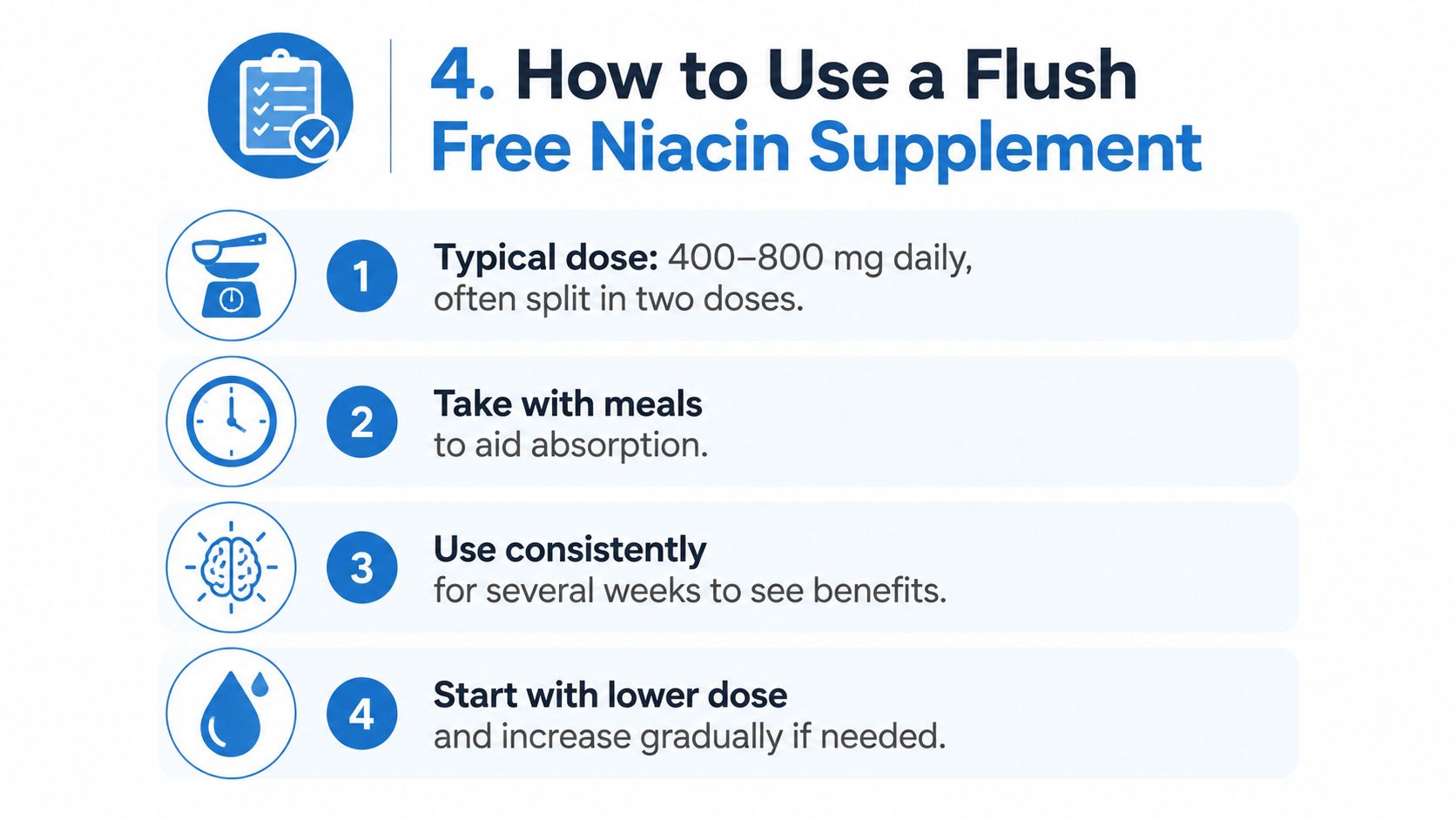
Product directions commonly place inositol hexanicotinate in the 400 to 800 mg daily range, sometimes divided into separate servings. Those figures are product-use guidance rather than a universal prescription. The NIH review of inositol hexanicotinate supports the broader point that form matters, while your own clinician should determine whether supplementation fits your health situation.
A practical routine
- Confirm the active ingredient. Look for inositol hexanicotinate rather than relying on “flush free” printed on the front.
- Follow the bottle's serving direction. Don't increase the amount because the product doesn't cause warmth.
- Take it with a meal. Food may make the routine easier to tolerate and can help avoid taking a concentrated supplement on an empty stomach.
- Watch your response. If warmth or tingling appears, taking the product earlier in the day may make the experience less disruptive.
- Stay consistent. A supplement routine only makes sense when you can evaluate how your body responds over time.
Use the panel to set expectations
Don't judge effectiveness by the absence of a flush. The reaction is a skin response, not a universal test of vitamin status or cardiovascular benefit. If your purpose is vitamin B3 replenishment, focus on the named ingredient, serving instructions, and product quality. If your purpose is lipid treatment, arrange professional guidance before starting or changing a niacin product.
Someone comparing forms may also encounter products such as Thorne Niacel 400 Nicotinamide Riboside. Its name illustrates why ingredient-level reading matters. Nicotinamide riboside isn't the same compound as inositol hexanicotinate, even though both may appear in conversations about non-flushing B3-related products.
Safety, Side Effects, and Interactions
Safety becomes clearer when you separate the flush, the liver, and medication interactions. “Flush free” addresses mainly the first category. It doesn't automatically settle the other two.
The flush is only one part of the picture
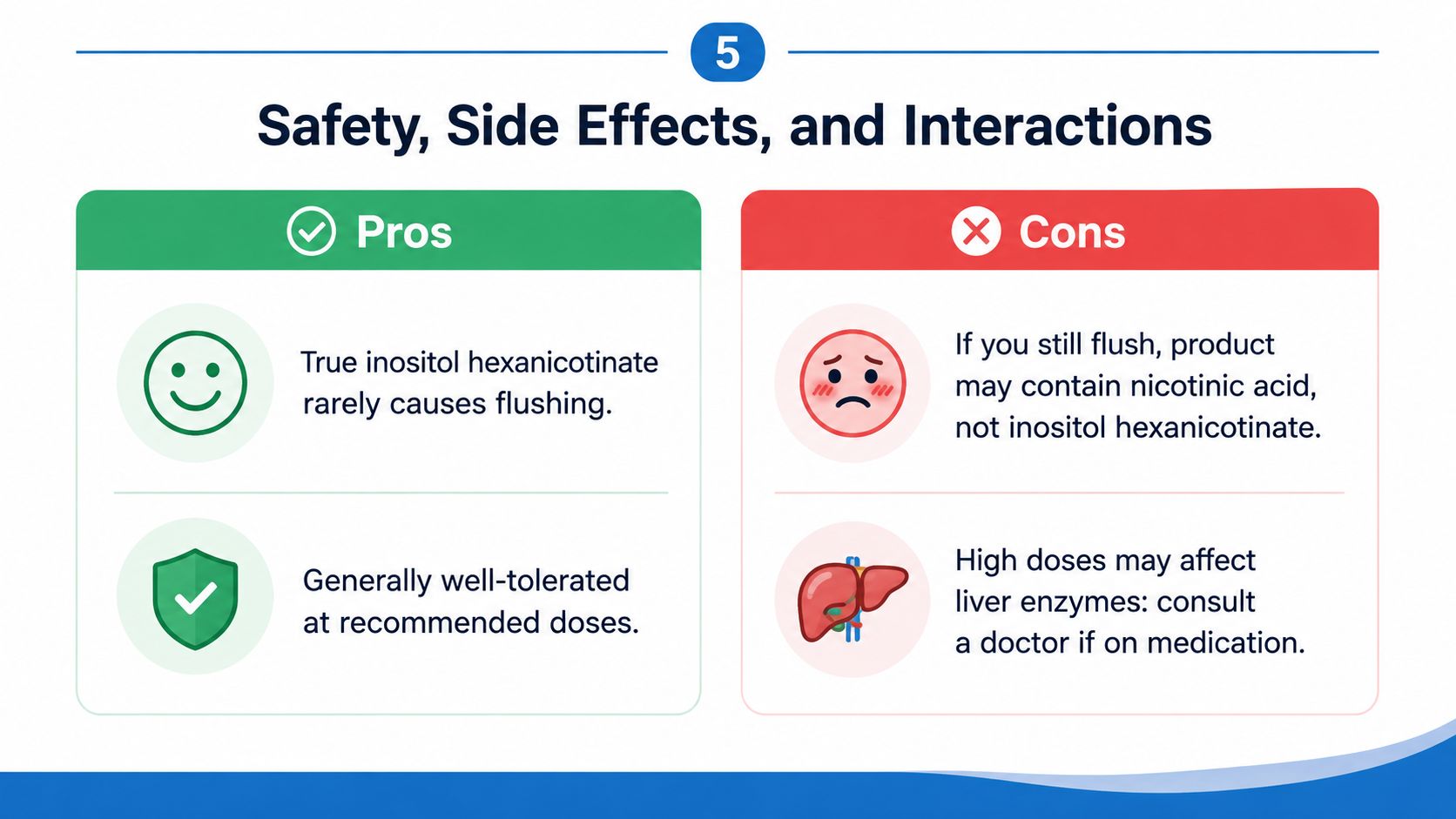
True inositol hexanicotinate rarely produces the classic nicotinic acid flush. If a product advertised as flush free causes obvious warmth, redness, or tingling, check the ingredient panel. The product may contain nicotinic acid, a mixed formula, or an ingredient description that doesn't clearly identify the active form.
The fact that flushing is absent also doesn't prove that a product is safer overall. Review literature has raised a particular concern about some sustained-release formulations, which may reduce flushing while increasing liver risk. That warning applies to formulation and dose, not automatically to every ordinary inositol hexanicotinate product.
Liver and medication considerations
People with liver disease should speak with a clinician before using any concentrated niacin product. The same applies to anyone taking multiple cardiovascular or metabolic medicines, because combined effects can complicate blood pressure, glucose management, or lipid treatment.
Potential interaction questions deserve a medication review, especially with:
- Statins: Combining lipid-active therapy can change the monitoring needs and adverse-effect profile.
- Bile acid sequestrants: Timing and treatment response may require professional adjustment.
- Blood pressure medicines: Added effects could contribute to dizziness or low blood pressure.
- Diabetes medicines: Niacin formulations may affect glucose management, so monitoring matters.
Pregnant individuals, people with active liver or gallbladder disease, and adults taking several cardiovascular medicines shouldn't select a high-dose B3 product casually. A clinician or pharmacist can identify whether the exact form, dose, and medication combination are appropriate.
Safety principle: A product that avoids flushing may solve an adherence problem, but it doesn't remove the need to check the ingredient, dose, medical history, and drug list.
People should stop self-directed use and seek medical advice for concerning symptoms such as persistent gastrointestinal problems, unusual weakness, jaundice, or severe abdominal discomfort. The absence of a flush isn't permission to ignore those warning signs.
Choosing a Quality Flush Free Product
A good buying decision starts with a specific molecule. Look for inositol hexanicotinate in the ingredient panel if that's the form you intend to purchase. Vague phrases such as “flush-free blend” don't tell you how much of each ingredient is present, and a generic “niacin” listing can leave the form unclear.
Use this short checklist before adding a bottle to your cart:
- Confirm the form: Make sure the panel names inositol hexanicotinate, nicotinamide, or nicotinic acid clearly.
- Confirm the amount: Avoid proprietary blends that hide the quantity per serving.
- Question the promise: Be skeptical of claims that present flush-free niacin as a proven substitute for prescription lipid therapy.
- Check quality controls: Look for recognized third-party testing marks such as USP or NSF, and verify that any certificate of analysis corresponds to the lot number on the bottle.
- Review the combination: Be cautious with products pairing niacin forms with prescription-style ingredients or multiple aggressive cardiovascular compounds.
People taking statins or blood pressure medicines should get medical guidance before using a concentrated product. The same caution applies to anyone with liver disease, gout, active peptic ulcers, or a history of medication-related reactions. Pregnant or breastfeeding users should ask a healthcare professional before supplementing.
CalVitamin offers an online catalog where shoppers can compare labeled vitamin and supplement ingredients, including products that use niacinamide rather than inositol hexanicotinate. Visit CalVitamin to inspect product labels, compare forms, and choose a B3 product that matches your actual goal instead of relying on the phrase “flush free.”






