
The most popular advice about resveratrol anti aging is also the least defensible: take a capsule, activate “longevity genes,” and expect the aging process to slow. Human evidence doesn't support that simple story. Resveratrol has produced meaningful biological signals in animals and some measurable changes in human skin and metabolic markers, but those findings aren't the same as extending lifespan or preserving healthspan.
The central problem is exposure. Resveratrol's effects depend on the tissue reached, the formulation used, and the outcome measured. A product can contain a substantial amount of the ingredient while producing limited systemic exposure. That distinction helps explain why promising laboratory mechanisms coexist with mostly neutral human anti-aging trials.
Table of Contents
- What Resveratrol Promises and What It Actually Delivers
- How Resveratrol Interacts With Aging Biology
- What Mouse Studies and Human Trials Actually Show
- The Skin Endpoint Where Resveratrol Works Best
- Why Bioavailability Changes the Whole Picture
- Dosage, Safety, and Food Sources in Context
- How to Choose a Resveratrol Supplement Worth Buying
- The Honest Takeaway on Resveratrol and Aging
What Resveratrol Promises and What It Actually Delivers
Resveratrol's longevity reputation rests on a narrower finding than popular summaries suggest. It emerged as a possible caloric-restriction mimetic, a compound that might reproduce selected cellular effects of eating fewer calories. In the landmark 2006 Nature study, resveratrol given to middle-aged mice on a high-calorie diet significantly improved survival and shifted several physiological measures toward those of mice eating a standard diet. The same study found no increase in overall survival or maximum lifespan among mice on the standard diet. The original Nature study reported improvements in insulin sensitivity, IGF-I levels, AMPK activity, mitochondrial number, and motor function in the high-calorie-diet setting.
The result supports a metabolic effect under a specific dietary stress. It does not establish resveratrol as a human longevity treatment. Improved insulin sensitivity, lower oxidative stress, or altered senescence markers are intermediate outcomes. They may be relevant to aging biology, yet they do not show longer life, delayed frailty, or better cognition in people.
The human evidence is narrower than the marketing
A 2014 prospective cohort followed 783 adults aged 65 and older in Italy for 9 years. It recorded 268 deaths, or 34.3%, and found no significant association between urinary resveratrol metabolites and all-cause mortality. Mortality across the metabolite quartiles was 34.4%, 31.6%, 33.5%, and 37.4%, while the hazard ratio for the lowest versus highest quartile was 0.80, with a 95% confidence interval of 0.54 to 1.17. Those findings do not demonstrate a protective mortality effect.
Clinical evidence points to a smaller target. A 2024 systematic review of purified resveratrol clinical trials summarized more than 150 human studies and concluded that most reported neutral effects. The defensible interpretation is modest: resveratrol may change selected biomarkers, particularly in metabolically unhealthy adults, and may improve some skin endpoints when delivery is effective. It has not been shown to function as a lifespan drug in healthy adults.
The bioavailability problem explains why plausible mechanisms and measurable laboratory signals have not translated into a broad anti-aging effect. A capsule's labeled content does not reveal how much active compound reaches relevant tissues.
Evidence-calibrated expectation: Treat resveratrol as a targeted, formulation-sensitive intervention, not as a general-purpose fountain of youth.
How Resveratrol Interacts With Aging Biology
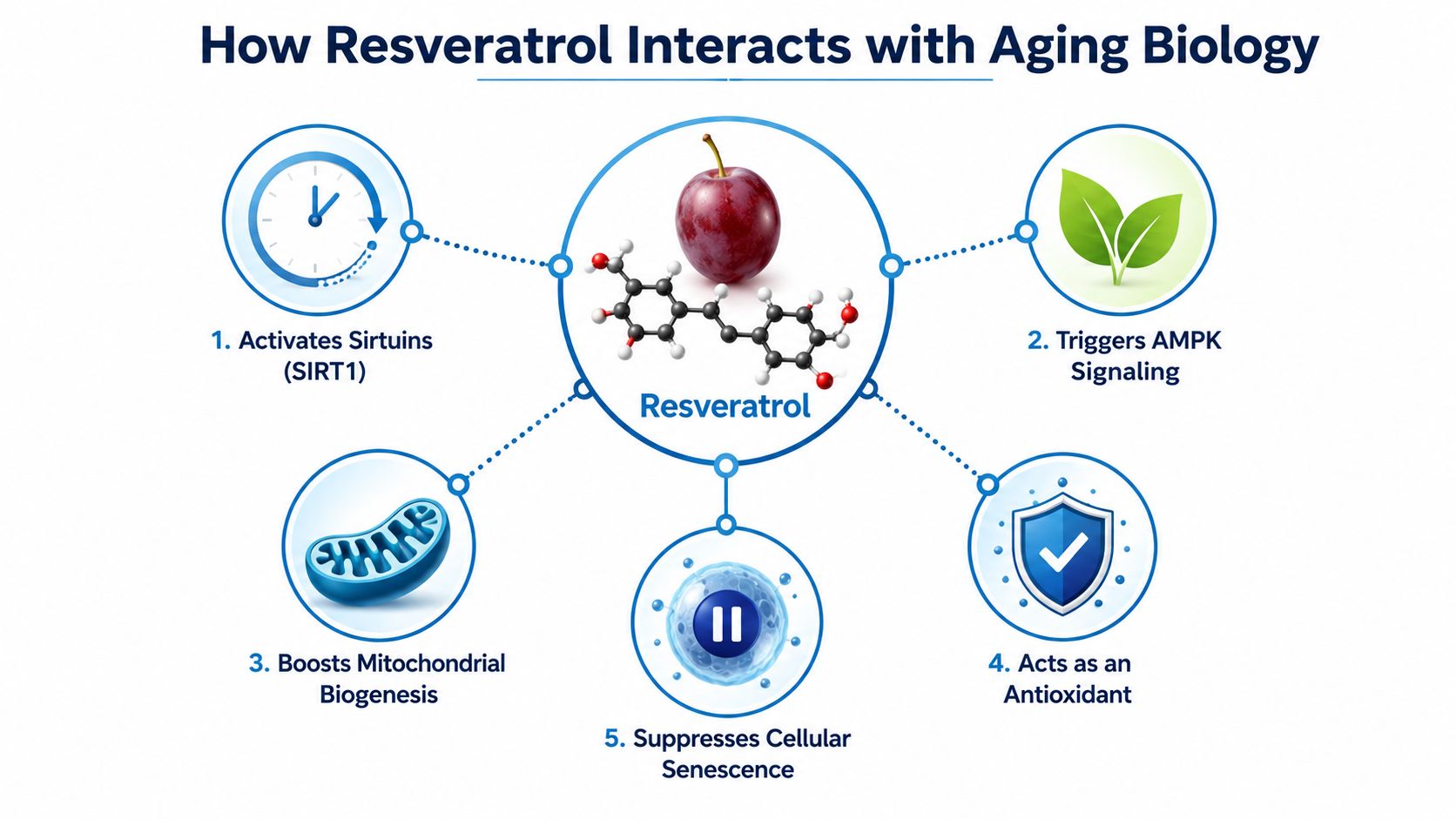
Resveratrol's anti-aging reputation rests on several biological pathways involving energy regulation, oxidative stress, mitochondria, and cellular senescence. Those pathways make the compound plausible, not proven. Oral resveratrol must be absorbed, reach the relevant tissue, and produce a durable change in a meaningful human endpoint. That chain helps explain why laboratory findings have often been stronger than clinical outcomes.
Sirtuins and energy sensing
Sirtuins act as cellular maintenance regulators, coordinating responses to energy availability, stress, and repair. Resveratrol has been studied especially in relation to SIRT1, a sirtuin involved in metabolic regulation and stress-response pathways. The practical connection remains indirect. A pathway that changes in cultured cells may not respond consistently after a person takes an oral supplement.
AMPK functions as an energy sensor. When cellular energy is limited, it helps shift activity toward energy production and away from energy-intensive processes. The 2006 mouse study associated resveratrol with increased AMPK activity and improved metabolic markers, including insulin sensitivity, in mice consuming a high-calorie diet. As noted earlier, those findings support a conditional metabolic effect, not evidence that the same pathway extends human life.
Mitochondria and oxidative stress
Mitochondria generate cellular energy, so aging research often examines whether their function declines under persistent metabolic and oxidative pressure. The mouse study reported more mitochondria under high-calorie-diet conditions. That result offers a possible explanation for improved energy metabolism, but it does not establish better human healthspan.
Oxidative stress provides a second line of investigation. Translational research has described lower reactive oxygen species generation and changes in antioxidant capacity, along with shifts in senescence-associated markers such as p53, p21, p16, and SA-β-gal. A skin-focused intervention reported a reduction in ROS generation of about 32.26%, alongside improvements in hydration, elasticity, roughness, and wrinkle depth. The translational review presents these results as evidence of redox control and possible senescence modulation. They do not prove that resveratrol directly increases collagen.
The distinction matters when comparing ingredients aimed at cellular aging. A product such as a bioavailability-focused fisetin formula may be promoted through related senescence research, while resveratrol's own human results still depend on the endpoint, dose, and delivery method.
Cellular senescence
Senescent cells no longer divide but can remain metabolically active. Their accumulation and signaling may contribute to tissue dysfunction, inflammation, and altered repair. Resveratrol can influence senescence-associated pathways in experimental and translational settings, but describing it as a senolytic can imply selective removal of senescent cells that has not been established in people.
The most defensible model is narrower. Resveratrol may regulate stress signaling and senescence markers in particular biological contexts, especially where metabolic or oxidative stress is present. That mechanism justifies continued study, while the modest human evidence argues against treating it as a general anti-aging solution.
What Mouse Studies and Human Trials Actually Show
The evidence changes sharply between animals and people. In mice, the strongest signal appeared under a defined metabolic strain. Human research has produced narrower findings, and the result varies with the population studied, the dose, the formulation, and the endpoint selected.
The mouse result that launched the field
The 2006 Nature study tested resveratrol in middle-aged mice consuming a high-calorie diet. Treatment improved survival and shifted several physiological measures toward those seen in mice on a standard diet, including insulin sensitivity, IGF-I levels, AMPK activity, mitochondrial number, and motor function. It did not increase overall survival or maximum lifespan in mice eating the standard diet. The full study report therefore supports a conditional metabolic effect, not a general lifespan benefit.
The interpretation is narrower than the popular longevity story. Resveratrol may offset selected consequences of metabolic stress without slowing aging across ordinary conditions. That distinction also explains why a positive mouse result cannot establish a universal human anti-aging effect.
What the Italian cohort adds
The Italian cohort examined habitual exposure rather than assigning participants to a resveratrol treatment. Researchers measured urinary resveratrol metabolites in older adults and followed them for 9 years. Mortality did not differ significantly across exposure groups, so the findings did not show that ordinary dietary resveratrol intake reliably predicts longer survival. The cohort publication is more useful as a warning about inference: a biomarker of consumption is not the same as proven biological exposure, and an observational association cannot establish that resveratrol caused any outcome.
The larger clinical record
A 2024 systematic review covering more than 150 human studies found that most purified-resveratrol trials reported neutral effects. Some studies did identify changes in biomarkers, particularly in narrowly defined metabolic settings, but the combined record has not produced a consistent anti-aging outcome in people.
Cognition offers another boundary. A 52-week Alzheimer's trial found resveratrol was safe, yet it did not improve clinical measures such as MMSE, CDR, or ADAS-cog. Safety, movement in a biomarker, and improvement in daily function are separate findings and should not be treated as interchangeable evidence.
The most credible human signal is therefore modest and endpoint-specific. Effects are more plausible when researchers measure a defined cardiometabolic or tissue biomarker and address exposure through formulation. Claims about lifespan, broad healthspan, or general cognitive preservation extend beyond what current trials establish.
The Skin Endpoint Where Resveratrol Works Best
Skin is the strongest human setting for measurable resveratrol results, but the finding is narrower than the usual longevity story. It suggests that tissue targeting and delivery route can influence whether a plausible ingredient produces a visible outcome. The evidence supports a skin-specific effect, not a universal anti-aging action.
A randomized, double-blind, placebo-controlled clinical study enrolled women over 40 and compared oral trans-resveratrol, topical use, and combined oral-plus-topical treatment. Over 8 weeks, all active approaches improved selected visible skin-aging measures, while the combined group achieved the greatest improvement in wrinkle scores. The researchers also reported changes in pigmentation and oil-balance measures. The clinical skin study therefore points to a formulation and route effect, rather than equivalent performance across every resveratrol product.
Why the combination matters
Topical application places the ingredient near the tissue being assessed. Oral administration follows a different path through digestion and metabolism before any resveratrol-related exposure reaches the skin. Using both routes could address different exposure constraints, although this single study does not show that every oral-plus-topical combination will produce the same result.
Product categories also represent different experiments. A cream, serum, and capsule may all list trans-resveratrol, yet their absorption pathways, local concentrations, and relevant endpoints are not interchangeable.
For shoppers comparing a targeted facial product, Andalou Naturals Age Defying Dermal Filler shows why format must match the claim under review. A topical product should be assessed through skin-relevant evidence, tolerability, ingredient transparency, and realistic expectations. Oral longevity claims cannot substitute for that assessment.
What the skin evidence doesn't prove
The study supports improvement in selected visible skin parameters. It does not establish that resveratrol reverses biological aging throughout the body, extends life, or prevents age-related disease. Even in skincare, a better appearance is a different endpoint from deeper tissue repair or systemic health.
Practical reading rule: Match the evidence to the claimed outcome. For a skin benefit, look for topical or combined-delivery trials, and do not treat a skin result as proof of systemic longevity.
Why Bioavailability Changes the Whole Picture
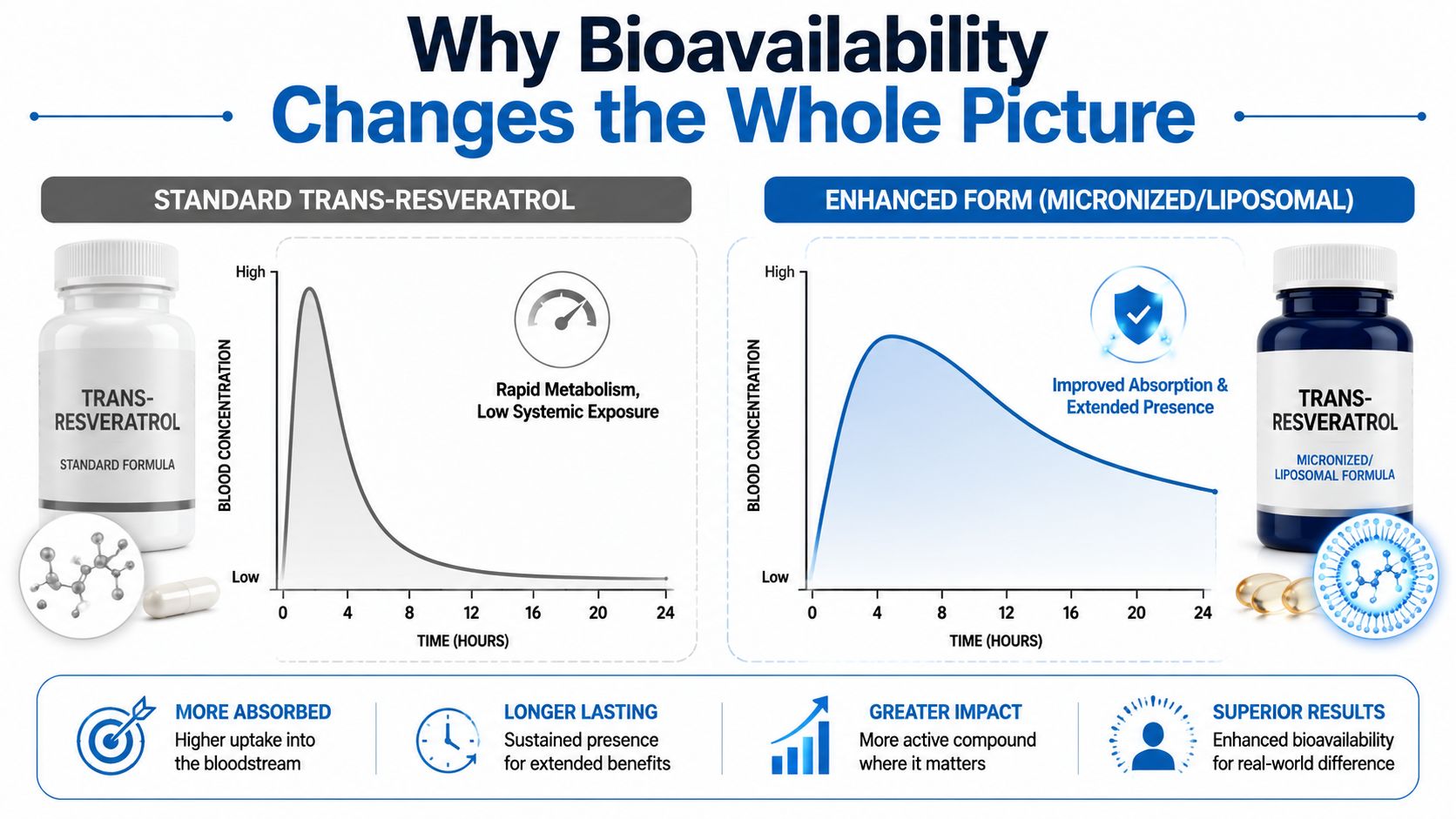
Resveratrol's longevity reputation often outruns its pharmacology. Standard oral trans-resveratrol can be absorbed and then rapidly metabolized, so the swallowed amount does not directly indicate how much unchanged resveratrol circulates or reaches a target tissue. A large serving on the label can therefore signal exposure in theory without proving meaningful biological exposure in practice.
Four ways products try to solve exposure
Standard trans-resveratrol is the conventional oral form. Its chemistry may be appropriate, yet rapid metabolism can restrict the amount of active compound available systemically.
Micronized powders use smaller particles to improve dispersion and contact with absorptive surfaces. The rationale is plausible, but “micronized” alone does not show that a finished product produces better exposure. Product-specific pharmacokinetic or clinical evidence still matters.
Liposomal preparations place the ingredient in lipid-based carriers. The design aims to protect resveratrol and improve transport, but “liposomal” describes a delivery method, not a guaranteed improvement in patient outcomes.
Topical formulations reduce dependence on gastrointestinal absorption and concentrate use on the skin. The human skin trial is relevant because topical and combined use produced measurable changes in wrinkle scores, pigmentation, and oil balance. As noted earlier, those findings support formulation-specific evaluation, not a general claim that every delivery system improves systemic aging.
How to use the idea when shopping
Taking more conventional powder does not necessarily solve a delivery constraint. If metabolism limits exposure, a larger swallowed amount may raise the dose without a proportional increase in useful tissue exposure, while also affecting tolerability and interaction considerations.
Compare the exact active form, stated amount, delivery technology, and evidence for the finished product. A separate compound such as nicotinamide riboside in capsule form should not be treated as a resveratrol substitute. Different compounds have different pharmacology and evidence bases.
The practical conclusion is limited but useful. Enhanced delivery may improve the chance of a measurable effect, but it does not convert resveratrol into a proven longevity therapy. The more defensible expectation is modest improvement in selected cardiometabolic or skin biomarkers, provided the formulation delivers enough compound to matter.
Dosage, Safety, and Food Sources in Context
Published oral studies commonly use resveratrol amounts in the range of 150 to 500 milligrams daily, with both lower and higher amounts reported across clinical research. Those trial amounts describe research exposure, not a universal personal prescription. They also shouldn't be read as a simple ladder in which the largest dose is automatically the best choice.
The bioavailability problem makes dose interpretation especially difficult. If the body rapidly metabolizes much of a conventional oral product, a higher amount may not deliver a proportionally greater benefit. Individual factors, product quality, medications, health conditions, and the intended endpoint all matter.
Safety deserves its own assessment
Resveratrol has generally been well tolerated at studied doses, but “generally tolerated” isn't the same as “risk-free for everyone.” People using blood thinners should seek professional advice before supplementing, because resveratrol may affect bleeding risk. Caution also makes sense with medications metabolized through CYP3A4, since interaction potential can depend on the drug and the individual.
Ask a pharmacist or clinician before using it if you're pregnant, preparing for surgery, managing a chronic condition, or taking several prescription medicines. Don't use a supplement to replace treatment for diabetes, cardiovascular disease, cognitive decline, or any other diagnosed condition.
Food sources are relevant, but not equivalent
Resveratrol occurs naturally in grape skins, red wine, peanuts, and berries. Food exposure is best understood as part of a dietary pattern, not as a reliable way to reproduce supplemental research amounts. Red wine also contains alcohol, so drinking more wine isn't a sensible resveratrol strategy.
| Source | Approximate resveratrol | Notes |
|---|---|---|
| Grapes | Not specified in the verified evidence | Resveratrol is found in grape skins, but food amounts aren't equivalent to supplemental doses. |
| Red wine | Not specified in the verified evidence | Contains resveratrol and alcohol. More wine isn't a substitute for evidence-based supplementation. |
| Peanuts | Not specified in the verified evidence | A food source, but not a standardized resveratrol dose. |
| Berries | Not specified in the verified evidence | Provide dietary variety, but their resveratrol content isn't standardized here. |
| Supplements | Research products use varied amounts | Published oral studies commonly use 150 to 500 milligrams daily, but formulation and exposure differ. |
The sensible role for food is complementary. A varied diet can provide many nutrients and plant compounds, while a supplement creates a more controlled, labeled intervention.
How to Choose a Resveratrol Supplement Worth Buying
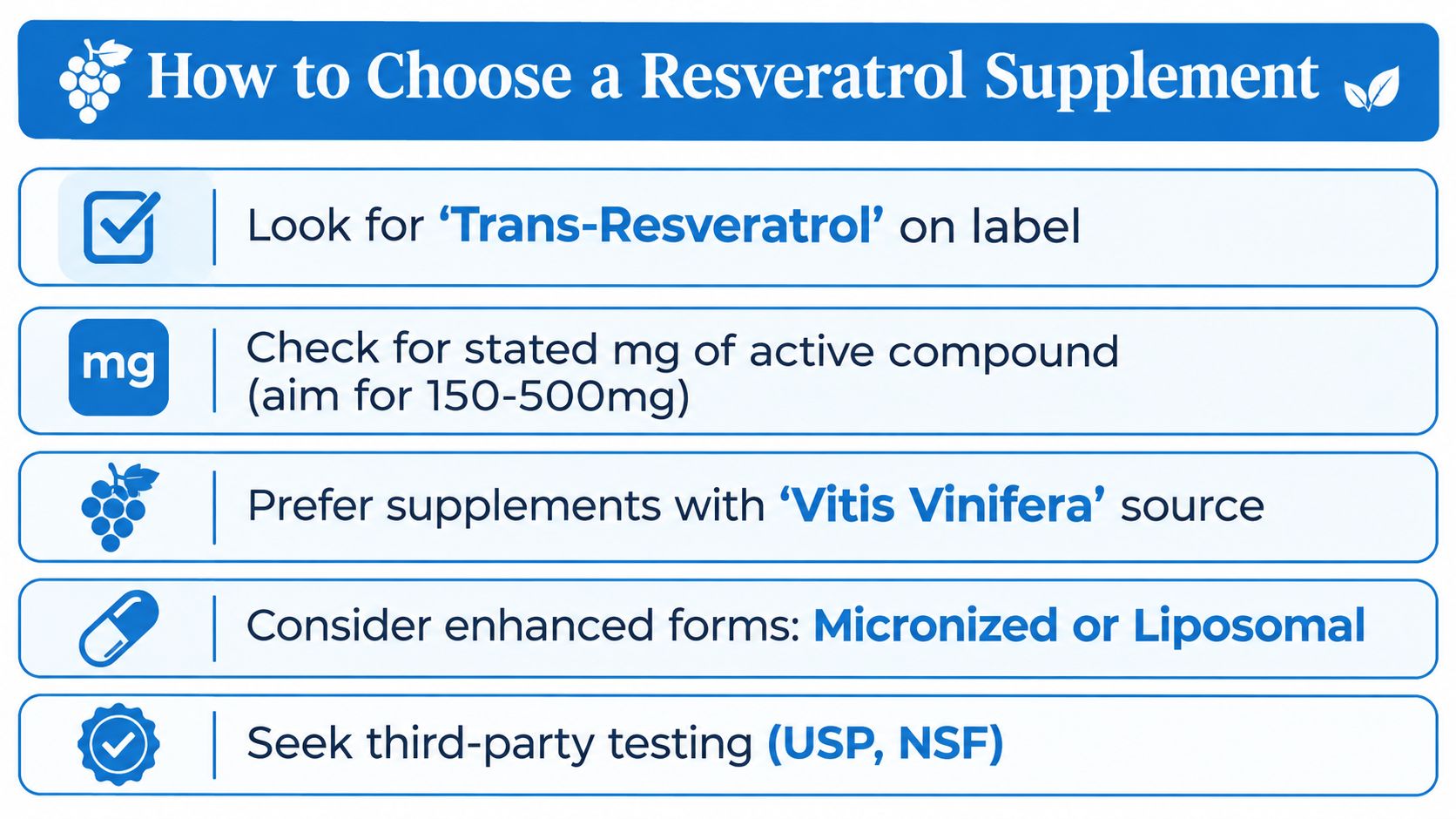
A resveratrol label should answer basic questions without forcing you to decode marketing language. Start with the chemical form. “Trans-resveratrol” is more informative than a vague reference to red wine extract because it identifies the compound being provided.
Next, look for the stated milligrams of active resveratrol per serving. Proprietary blends make comparison difficult when they disclose only a combined botanical weight or conceal the amount of each ingredient. A transparent label lets you compare the product with the exposure used in human research without pretending that label dose equals tissue exposure.
A practical label checklist
- Identify the active form: Look for trans-resveratrol rather than relying on a broad “grape” or “red wine” description.
- Check the active amount: The label should state how much resveratrol each serving provides.
- Separate source from dose: Vitis vinifera may identify a grape source, but it doesn't by itself reveal the active amount.
- Inspect the delivery format: Micronized, liposomal, oral, and topical products address exposure differently.
- Look for independent quality checks: Marks associated with USP, NSF, or ConsumerLab can provide useful verification, when applicable to the finished product.
Match the format to the objective
Capsules are convenient for a systemic experiment, while topical products make more sense when the goal is skin appearance. Liquids and gummies may suit people who struggle with capsules, but the format doesn't guarantee better absorption or stronger evidence. Ask what outcome you're trying to measure before choosing the form.
Other attributes are personal but legitimate. Gelatin-free capsules may matter to plant-based or dietary-restricted shoppers. Halal certification and cruelty-free policies can matter for ethical or religious reasons. These features don't prove efficacy, but they can determine whether a product fits your requirements.
Be skeptical of language such as “activates longevity genes” when the label provides no formulation data, third-party testing, or human endpoint relevant to the claim. A better product is one that makes modest claims clearly.
The Honest Takeaway on Resveratrol and Aging
Does resveratrol slow aging in healthy adults?
That hasn't been demonstrated. Human research supports selected biomarker and skin changes, but the evidence doesn't establish longer lifespan or broad healthspan extension in generally healthy adults. The most credible systemic case is narrower, involving modest cardiometabolic effects in people with metabolic problems.
Should you stack resveratrol with other antioxidants?
Evidence doesn't show that combining resveratrol with other antioxidants produces a reliable anti-aging benefit. More ingredients can also make it harder to identify what caused a benefit, side effect, or interaction. A focused trial of one product is easier to evaluate than an unstructured stack.
Is topical use worthwhile if you already take oral resveratrol?
For skin goals, topical use may be more directly relevant because it delivers the ingredient to the target tissue. The randomized skin study found the combined oral-plus-topical approach produced the greatest wrinkle-score improvement, but that result shouldn't be generalized to every product or every systemic aging outcome. Choose based on the endpoint, formulation quality, and your tolerance for uncertainty.
The honest verdict is simple: resveratrol is biologically interesting, clinically limited, and highly dependent on delivery. Its strongest present-day case is not a fountain of youth. It's a carefully selected supplement or topical ingredient for specific, measurable goals.
CalVitamin offers a broad selection of supplements and wellness products, including ingredient-focused formulas and different delivery formats for shoppers comparing options. Visit CalVitamin to review product labels, dosage forms, and attributes such as gelatin-free or halal availability before making a decision.






