
What if the most important question about a mucuna pruriens supplement isn't whether the bottle says “velvet bean,” but how much levodopa is inside each serving? Mucuna pruriens is a biologically active plant, and its natural L-DOPA content can vary widely between seeds, extracts, processing methods, and finished products. A familiar botanical name doesn't guarantee a predictable dose.
That distinction changes how you should evaluate benefits, dosing, safety, and product quality. The useful starting point isn't the number of capsules in the bottle. It's the validated L-DOPA amount per serving, supported by transparent testing and a label that tells you what you're taking.
Table of Contents
- What a Mucuna Pruriens Supplement Actually Is
- Active Compounds and How They Work
- Evidence-Backed Benefits and Practical Uses
- Typical Dosages and How to Read the Numbers
- Safety, Side Effects, and Who Should Avoid Mucuna
- Forms, Extracts, and How to Evaluate Product Quality
- Buying a Mucuna Pruriens Supplement in the US
- Quick Answers to Common Mucuna Questions
What a Mucuna Pruriens Supplement Actually Is
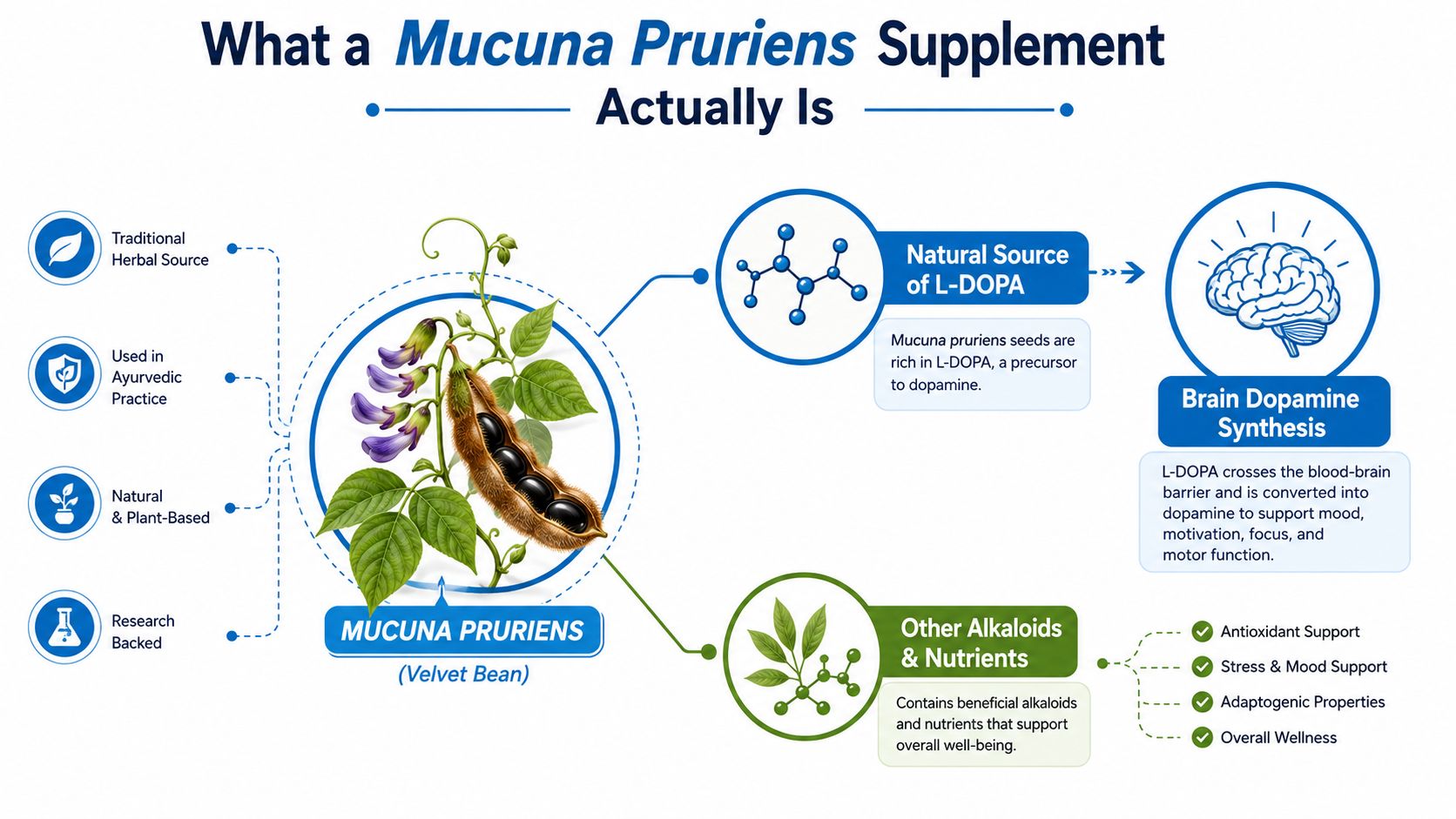
Mucuna pruriens, also called velvet bean, is a tropical legume traditionally known in Ayurvedic practice by names including kapikacchu. Modern supplements usually use its seeds in a powder or extract. The plant matters because those seeds naturally contain L-DOPA, or levodopa, a compound the body can convert into dopamine.
That makes mucuna different from a general botanical such as a fiber-rich plant powder. Its principal active constituent has a direct relationship to dopamine production, and levodopa is also the active precursor used in pharmaceutical Parkinson's treatment. This doesn't make a supplement equivalent to prescribed medication, but it does mean you should treat mucuna as a potent, variable botanical rather than a harmless wellness ingredient.
The label name isn't the active dose
A product may list “Mucuna pruriens seed extract” prominently while giving little attention to the compound that drives its pharmacological effect. That omission matters because authenticated seed extracts have been reported at roughly 2.5% to 3.9% levodopa, while broader seed studies found levels ranging from 0.58% to 6.42% of dry weight (review of Mucuna composition and product quality).
In practical terms, two capsules with the same plant name may deliver materially different L-DOPA exposures. One may state a standardized percentage and provide batch testing. Another may disclose only a total extract weight, leaving you unable to estimate the active amount with confidence.
Practical rule: Read “L-DOPA per serving” before “Mucuna extract per serving.”
You can use CalVitamin's herbal supplement category as a starting point for learning how botanical products are commonly organized, but the same evaluation rule applies anywhere you shop. Look for the plant identity, the extract ratio if provided, the L-DOPA standardization, and evidence that the finished batch was tested.
Active Compounds and How They Work
The simplest way to understand mucuna is to follow its main pathway:
Mucuna seed compounds → L-DOPA → dopamine synthesis
L-DOPA is a precursor, meaning the body can use it to make dopamine. L-DOPA can cross the blood-brain barrier more readily than dopamine itself, after which enzymes convert it into dopamine in nervous tissue. That pathway helps explain why mucuna has attracted attention for movement symptoms and why it can also produce noticeable neurological effects.
The pathway doesn't guarantee a particular experience. Dopamine participates in movement, motivation, attention, reward processing, and mood, but increasing precursor availability doesn't affect every person in the same way. Absorption, dose, existing dopamine activity, medication use, and individual sensitivity all influence the result.
What else is in the seed
L-DOPA does the heavy lifting, but it isn't the only constituent. Mucuna seeds also contain other alkaloids, amino acids, and plant compounds with antioxidant activity. Those substances may influence the overall character of a preparation, yet human evidence doesn't establish that they reliably improve or soften the effects of L-DOPA.
That distinction helps you sort useful label information from marketing decoration. A product may highlight “full-spectrum” seed compounds, but unless it also discloses a measured L-DOPA amount, you still don't know the central exposure.
| Label detail | What it tells you | What it doesn't tell you |
|---|---|---|
| Total seed powder | The weight of the raw ingredient | The actual L-DOPA dose |
| Extract ratio | How concentrated the extraction process was | Whether L-DOPA survived processing |
| Standardized L-DOPA percentage | The declared active-compound target | Whether every batch meets it without testing |
| Independent assay | Whether a tested sample matched its specification | How your body will respond |
A formula that includes mucuna alongside ingredients marketed for dopamine support can look more refined, but extra ingredients don't resolve an undisclosed levodopa dose. For comparison, a product such as Dopamine Advantage illustrates why shoppers should inspect the complete Supplement Facts panel rather than judge a product by its front-label theme.
Evidence-Backed Benefits and Practical Uses
The strongest human evidence concerns Parkinson's disease motor symptoms, not general energy or everyday motivation. In a 2004 double-blind, randomized crossover trial, 8 patients received a 30 g Mucuna pruriens preparation and standard levodopa/carbidopa. The mucuna preparation reached effect onset faster, 34.6 minutes versus 68.5 minutes, with p = 0.021; the trial reported no significant differences in dyskinesias or tolerability (PubMed record for the clinical trial).
That result is clinically interesting, but the sample was small and the preparation was specific. It doesn't prove that every retail capsule works the same way, or that a healthy person will experience better mood, focus, or drive.
What the wider human record shows
A 2025 systematic review identified 5 human clinical trials published between 1995 and 2024, with 108 participants overall and individual study sizes ranging from 7 to 60 (systematic review of human Mucuna pruriens trials). The review found a consistent signal for improvements in Parkinson's symptoms and therapy-related complications, including shorter time to the “on” state, longer duration of that state, and fewer adverse events.
The same review emphasized limitations. The studies were small, and the preparations differed, so you can't assume that a powdered seed product, a standardized extract, and a clinical preparation are interchangeable.
Mood, libido, stress resilience, fertility, and cognitive performance are common marketing themes. They may be biologically plausible because L-DOPA affects dopamine pathways, but the human evidence is thinner for these general wellness uses. Traditional use can inform questions for research, but it isn't the same as confirmation in controlled clinical trials.
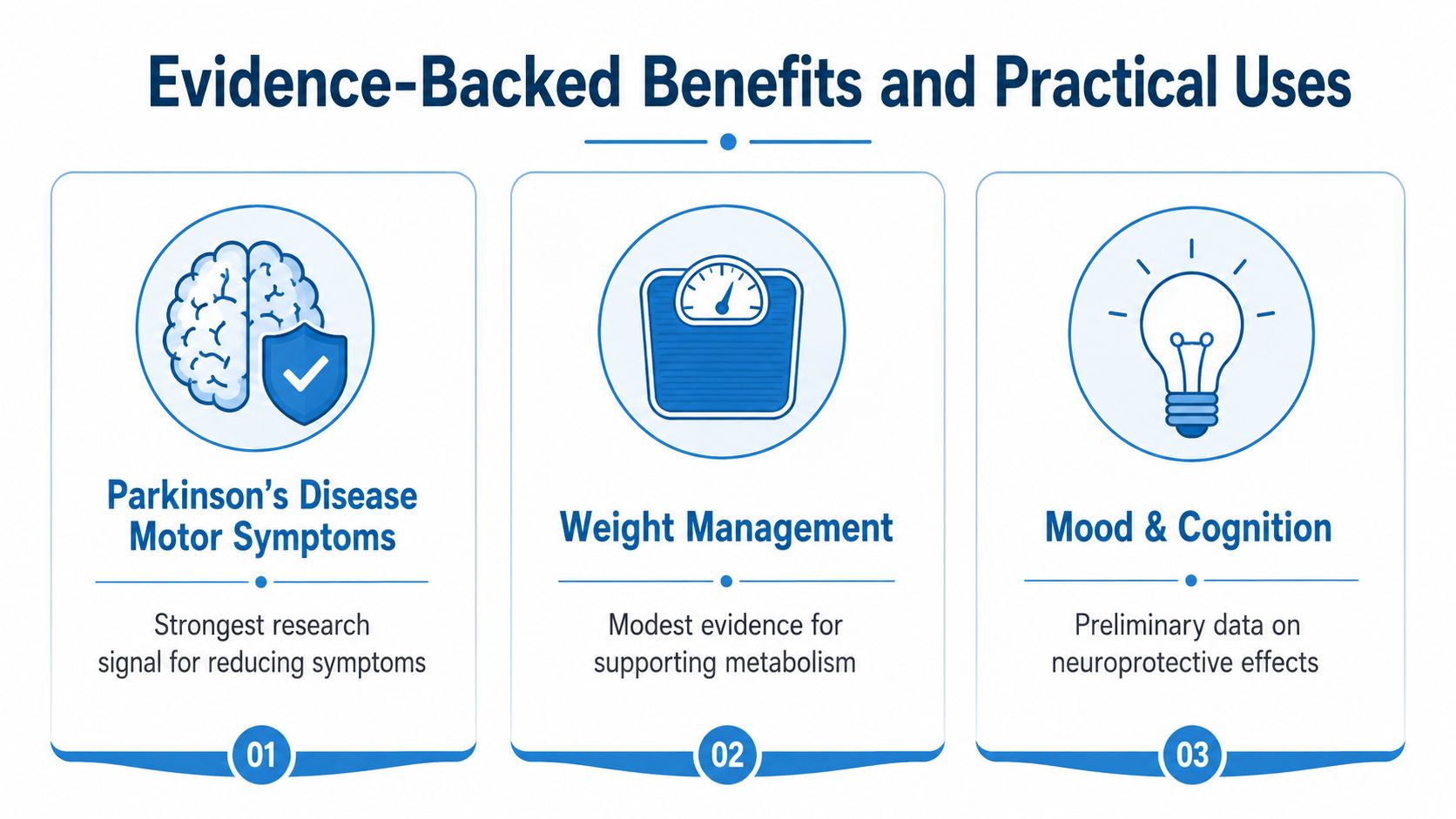
The most defensible conclusion is narrow. Mucuna has meaningful human evidence in a Parkinson's context, while many popular wellness claims remain preliminary or unconfirmed.
For a visual overview of the topic, this educational video on Mucuna pruriens can complement, but not replace, medical guidance.
Typical Dosages and How to Read the Numbers
Dose labels become confusing because manufacturers may describe the same product in different ways. One bottle might list raw seed powder in milligrams. Another might list an extract weight and a percentage of L-DOPA. A third might hide the botanical and its active compound inside a proprietary blend.
The useful calculation is straightforward:
L-DOPA amount = extract weight × standardized L-DOPA percentage
For example, a label stating 500 mg of extract standardized to 20% L-DOPA would imply approximately 100 mg of L-DOPA per serving. That calculation is only an estimate of the declared content, not proof that the bottle contains it. A certificate of analysis or independent assay provides stronger support.
Three practical exposure tiers
There isn't a universally established general-wellness dose that makes every product or user safe. Instead of treating “one capsule” as a meaningful dose, use the label's L-DOPA figure to create a cautious framework.
Beginner exposure: Choose the lowest clearly disclosed L-DOPA serving available, and don't increase just because you don't notice an immediate effect. This approach limits the risk created by product uncertainty and personal sensitivity.
Standard labeled exposure: Follow the manufacturer's serving only when the product clearly states its L-DOPA amount and provides credible quality information. Don't compare this tier across brands unless the active-compound amounts are comparable.
Upper-bound exposure: Treat high-L-DOPA products as a clinical-style decision rather than a routine supplement choice. Higher exposure can intensify both desired and unwanted dopaminergic effects, especially when combined with medication.
A historical product analysis found labels claiming 25 to 250 mg of L-DOPA per dose, yet 4 of 6 products showed large discrepancies, with some containing less than 10% of the claimed amount (analysis of Mucuna product variability). That finding is why capsule count alone is a poor dosing guide.
If a label gives only “Mucuna pruriens extract” without a percentage, milligram L-DOPA figure, or assay documentation, you can't calculate a dependable dose. Choose transparency over a larger-looking extract number.
Safety, Side Effects, and Who Should Avoid Mucuna
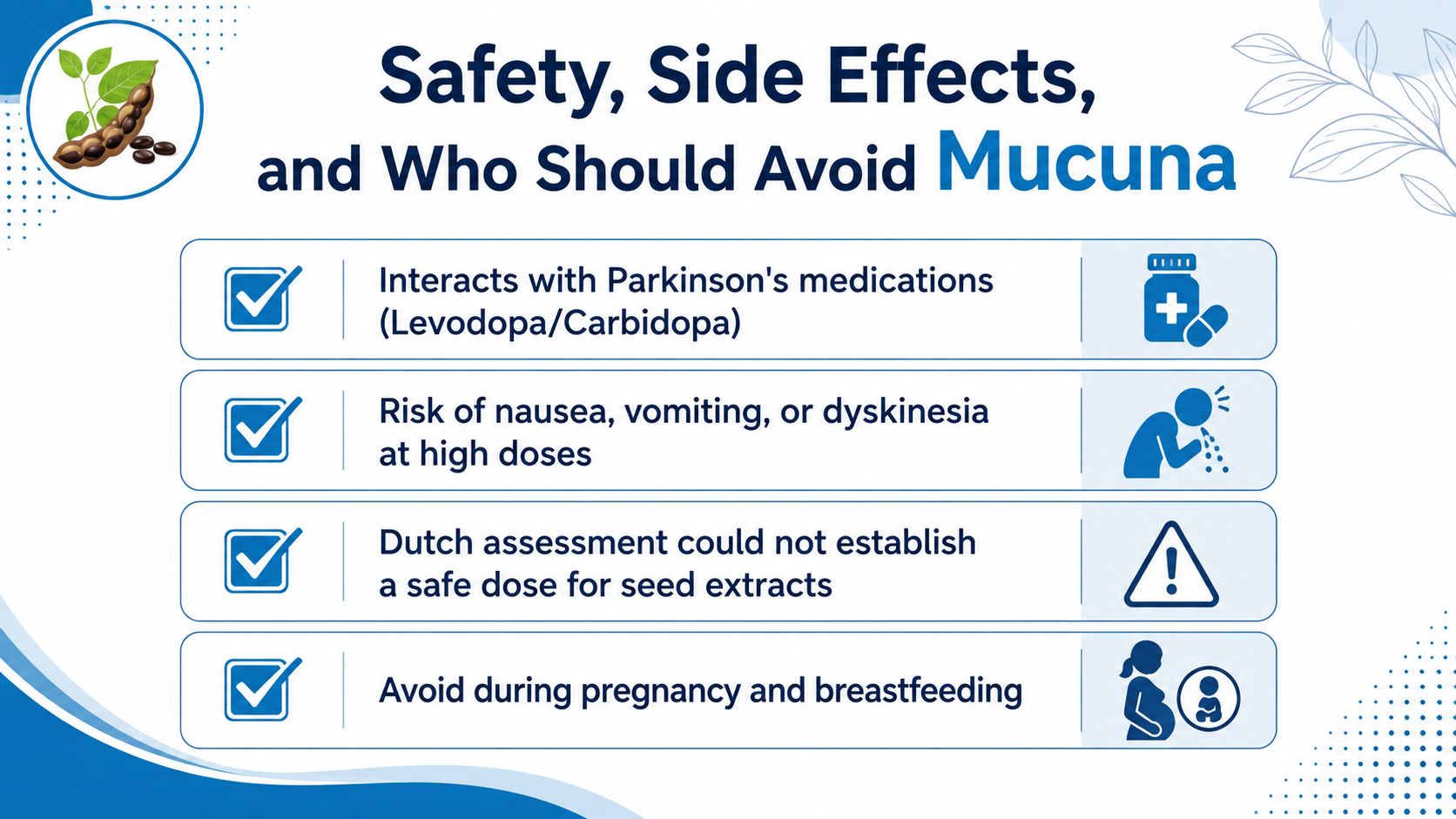
“Natural” doesn't mean predictable or risk-free. Because mucuna supplies L-DOPA, it can act on dopamine-related pathways, and recent clinical commentary links excessive use with dyskinesia, dopamine dysregulation syndrome, and psychiatric complications while long-term safety information remains scarce.
Common problems may include nausea, headache, vivid dreams, sleep disruption, dizziness, or blood pressure changes. A mild, short-lived stomach response may call for stopping the product or reassessing how you take it. New involuntary movements, severe agitation, hallucinations, faintness, intense insomnia, or major mood changes are reasons to stop and seek prompt medical advice.
People who should avoid self-directed use
The most important caution groups are specific:
People using levodopa or other dopaminergic medicines: Combining exposures can produce effects that are difficult to predict and may alter treatment control.
People taking psychiatric medication: Medicines that influence dopamine or related neurotransmitter systems can interact with mucuna. Don't add it casually to antidepressant, antipsychotic, or other centrally acting treatment.
Pregnant or breastfeeding people: Safety data are inadequate, and fetal-development concerns have been raised in a Dutch national risk assessment.
People with liver or kidney disease: The same assessment found indications of possible negative effects on the liver and kidneys.
People with movement or psychiatric symptoms: Dopamine-active products may worsen involuntary movements, agitation, impulsivity, or other symptoms in susceptible individuals.
The Dutch assessment concluded that a safe dose couldn't be determined for seed extracts and identified concerns involving liver, kidney, and fetal development (Dutch national risk assessment of Mucuna pruriens). That is more meaningful than a generic instruction to “use responsibly.”
If you take prescription medication, have a chronic condition, are pregnant, or are breastfeeding, discuss mucuna with a qualified clinician before use. Don't use a supplement to adjust Parkinson's treatment on your own.
Forms, Extracts, and How to Evaluate Product Quality
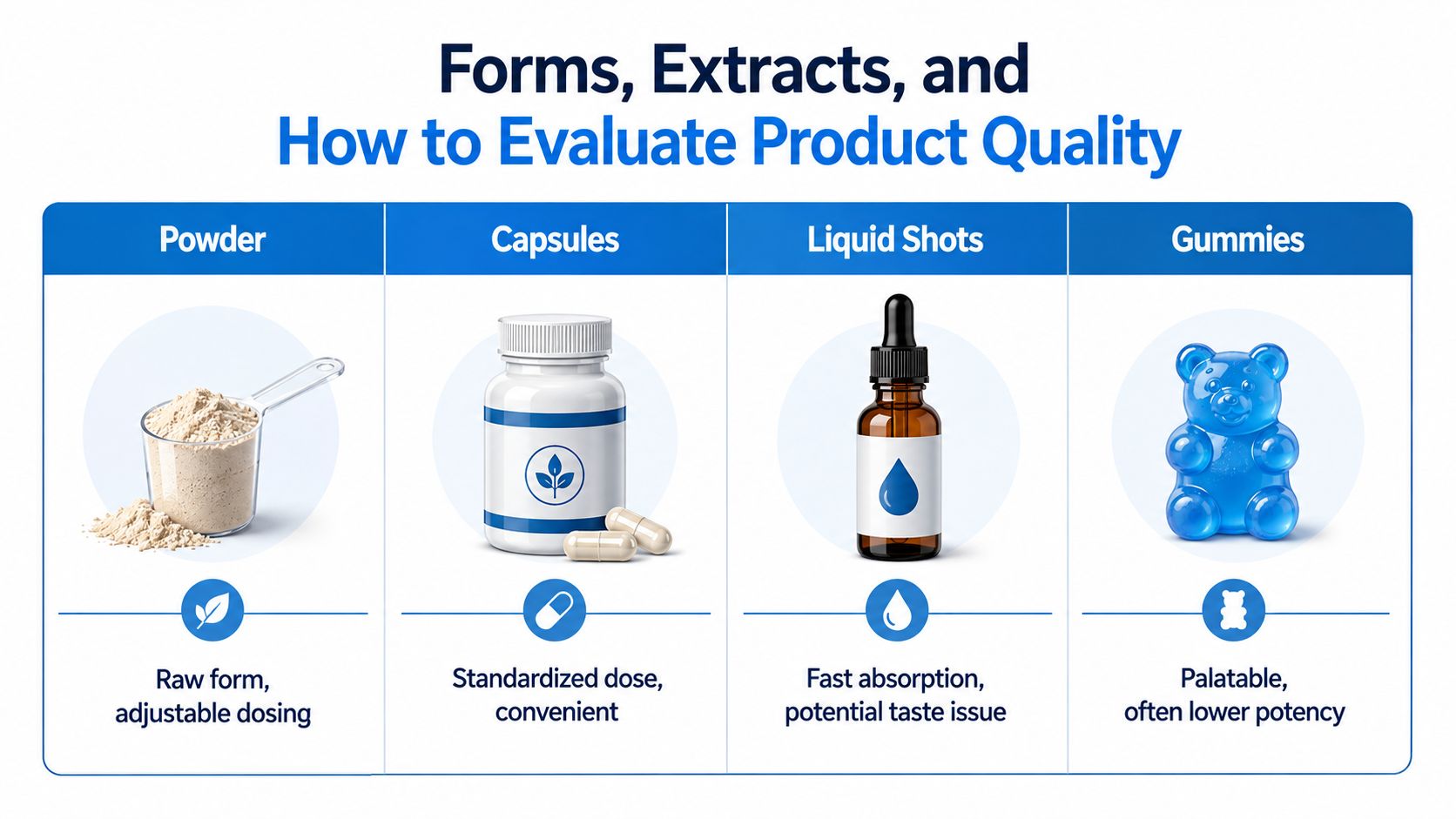
Mucuna products come as raw powders, capsules, liquids, and gummies. The form affects convenience, taste, portability, and how easily you can measure a serving, but it doesn't solve the central quality question. You still need to know the actual L-DOPA per serving.
Comparing the common formats
Raw seed powder gives you the least refined form and may allow flexible portioning, but the natural L-DOPA concentration can vary. Without laboratory testing, adjusting the powder by volume won't create reliable dosing.
Standardized extracts are more useful when the label states a target L-DOPA percentage and the manufacturer verifies each batch. An extract can be more concentrated than raw powder, so the total botanical weight isn't a substitute for the active-compound amount.
Capsules offer convenience and reduce taste issues. They become a good choice only when the capsule's active content is transparent. A capsule with no L-DOPA disclosure is convenient, but its pharmacological exposure remains unknown.
Liquid shots may be easy to swallow and carry, yet liquids can create additional stability and flavor challenges. Check whether the label states the amount per measured serving and whether storage instructions are clear.
Gummies may improve palatability, but a pleasant format can encourage casual use of a biologically active ingredient. Don't assume that a lower serving size means lower risk unless the L-DOPA amount is shown.
A quality checklist
Before purchasing, look for:
- Identity: The label should name the plant part and form, such as seed powder or seed extract.
- Active assay: Find L-DOPA in milligrams or as a standardized percentage.
- Batch verification: Prefer a certificate of analysis that identifies the tested batch and reports L-DOPA results.
- Contaminant testing: Look for relevant testing for heavy metals, microbes, and adulterants.
- Manufacturing information: A clear manufacturer, lot number, expiry date, and contact method make accountability possible.
Ingredient-focused raw supplement options can help you compare forms, but don't let “raw” or “full spectrum” replace a verified active-compound specification.
Buying a Mucuna Pruriens Supplement in the US
US shoppers often encounter a polished product page before they see the information that matters. Marketing may emphasize energy, motivation, or traditional use, while the Supplement Facts panel gives no clear L-DOPA amount. Reverse that order. Start with the facts panel, then evaluate the seller.
A repeatable shopping filter
Find the L-DOPA disclosure. Look for milligrams per serving or a percentage tied to a stated extract weight. If the product lists only total mucuna, you can't compare it fairly with a standardized product.
Check the serving definition. Confirm whether the stated amount applies to one capsule, several capsules, a scoop, or a liquid volume. A large bottle count doesn't tell you how much active compound each serving delivers.
Look for batch evidence. A credible certificate of analysis should connect the test to a lot number and show the method or result for L-DOPA. “Third-party tested” without any supporting documentation is weaker than a specific assay report.
Review manufacturing details. GMP-related information, a named manufacturer, an address, and a reachable customer-service channel give you ways to resolve labeling or quality questions.
Compare the panel with the sales copy. If the front label promises a standardized extract but the Supplement Facts panel doesn't identify the standardization, treat that mismatch as a warning.
Read recent reviews for patterns. Reviews can't verify potency, but repeated complaints about inconsistent effects, damaged seals, unusual taste, or poor support can signal purchasing risk.
A transparent US retailer should also publish clear return and refund terms. Those policies don't prove product potency, but they show whether the seller has made the buying process accountable.
Don't choose the bottle with the biggest extract number. Choose the bottle that lets you calculate and verify the active exposure.
Quick Answers to Common Mucuna Questions
How long will a bottle last?
It depends on the number of servings, the serving size, and whether you use the full labeled serving. A bottle containing a month's supply lasts longer if you use less, but reducing capsule count doesn't tell you the resulting L-DOPA amount unless the label provides enough information for calculation.
How quickly does mucuna work?
The 2004 Parkinson's trial found a faster onset with its 30 g preparation than with standard levodopa/carbidopa, 34.6 minutes versus 68.5 minutes (trial details on PubMed). You shouldn't transfer that exact timing to every commercial supplement because retail products differ in preparation, L-DOPA content, and absorption.
Is mucuna the same as pharmaceutical levodopa?
No. Mucuna is a plant preparation containing naturally variable L-DOPA plus other seed constituents. Pharmaceutical levodopa products are manufactured and dosed under a different quality and treatment framework. Don't substitute one for the other or alter prescribed therapy without medical supervision.
Can you combine it with L-theanine or ashwagandha?
There isn't enough reliable information to call every combination safe. The absence of a known interaction isn't proof of safety, especially when mucuna is combined with medication, other products affecting the nervous system, or supplements that change alertness or blood pressure.
What should you do after a missed dose?
Don't automatically double the next serving. Follow the product directions, and if you're using mucuna under clinical supervision, ask your prescriber how to handle missed doses. A doubled amount can turn a routine omission into an unnecessary exposure spike.
The practical plan is simple: identify the L-DOPA amount, verify the batch when possible, start cautiously, and stop if concerning symptoms appear. For Parkinson's disease, pregnancy, breastfeeding, chronic kidney or liver disease, psychiatric treatment, or any dopamine-active medication, get professional guidance before taking a mucuna pruriens supplement.
CalVitamin offers a broad selection of herbs, raw ingredients, vitamins, minerals, and wellness products for US shoppers, with product pages, customer reviews, and support resources to help you compare options. Visit CalVitamin to review its supplement categories and choose products using the same label-first approach described in this guide.






