
Can a prenatal gummy be vegan, pleasant to take, and still provide the nutrients a vegan pregnancy needs? That's the question many expecting parents skip when they see “gelatin-free,” “organic,” or “easy to swallow” on the front of a bottle.
A gummy may solve a real problem. Large prenatal pills can feel impossible during nausea, reflux, or a period when even familiar flavors become unpleasant. But a comfortable format isn't automatically a complete prenatal plan. The important comparison is tolerability versus nutritional coverage, especially for nutrients such as vitamin B12, iodine, choline, iron, and DHA.
Table of Contents
- Why Vegan Gummy Prenatal Vitamins Are Gaining Popularity
- How Vegan Gummy Prenatal Vitamins Are Made
- Essential Nutrients in Prenatal Vitamins and Gummy Limitations
- Pros and Cons of Choosing Gummy Format
- Reading Labels and Verifying Vegan Certifications
- Buying Tips and When to Consult Your Healthcare Provider
- Common Questions About Vegan Gummy Prenatal Vitamins
Why Vegan Gummy Prenatal Vitamins Are Gaining Popularity
An expecting vegan parent may begin pregnancy with a straightforward goal: take a prenatal every day without swallowing a large capsule. Morning sickness changes that plan quickly. A pill that once seemed manageable can become a nausea trigger, while a fruit-flavored gummy may feel easier to keep down.
That practical benefit matters because a supplement only helps when someone can take it consistently. Gummy formulas also fit ethical preferences by replacing gelatin and other animal-derived ingredients with plant-based ingredients. The category has moved beyond niche health-food stores, with products such as Garden of Life Organics Prenatal Gummies marketed as USDA Organic, Non-GMO Project Verified, Vegan, NSF Certified Gluten-Free, and Kosher. The product listing also identifies lichen as the source of its vitamin D3 and presents the product in a 30-day supply format through Whole Foods Market's product listing.
The format is growing, but the decision isn't only about taste
Independent market data identifies gummies as the fastest-growing prenatal format in North America, while capsules and softgels still held 59.68% share in 2025 according to Mordor Intelligence's North America prenatal supplements data. That contrast captures the buying dilemma. Many people want the easier experience of a gummy, but traditional formats may offer more room for a broad nutrient profile.
A gummy can therefore be a sensible choice for someone who would otherwise skip a prenatal. It may be less suitable as the only supplement when its label leaves out important nutrients or provides amounts that don't match an individual's needs.
Practical rule: Choose the format you can take reliably, then check whether it delivers enough of the nutrients your pregnancy plan requires.
The central question isn't whether a product is vegan. It's whether the product's actual Supplement Facts panel supports your diet, medical history, laboratory results, and clinician's recommendations.
How Vegan Gummy Prenatal Vitamins Are Made
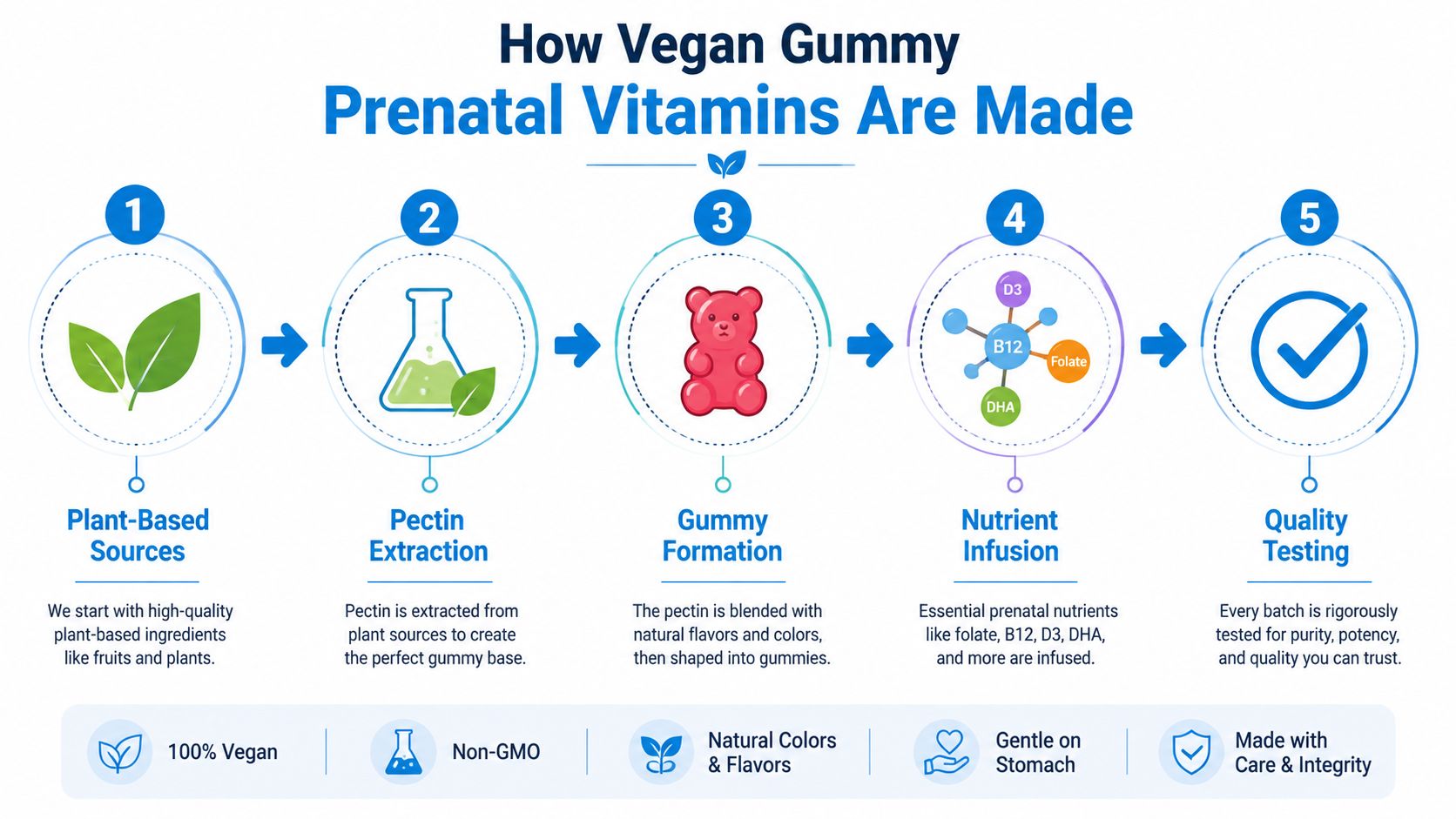
A vegan gummy usually begins with pectin, a plant-derived gelling ingredient, rather than gelatin. Pectin provides the structure that lets manufacturers create a chewable supplement without using animal collagen. That substitution supports vegan labeling, but it also changes the technical behavior of the product.
Think of the gummy base as a small delivery system, not merely a candy-like coating. The matrix controls how the product handles moisture, how firm or soft it feels, and how evenly nutrients disperse through each serving. A formula must balance texture, flavor, shelf stability, and the amount of active ingredient that can fit comfortably into the finished gummy.
Why some nutrients fit the matrix better than others
Manufacturers often favor nutrients such as folate, vitamin D, iodine, and vitamin B12 in gummy prenatal formulas because they can be incorporated into a chewable matrix more readily than some high-dose minerals or highly reactive ingredients. By contrast, iron can bring metallic flavor and digestive concerns, while calcium requires a comparatively large amount of material for meaningful dosing.
Moisture-sensitive, sugar-rich matrices also create formulation challenges. Heat, humidity, and oxidation can affect susceptible nutrients during processing and storage. The manufacturer may use protective technologies, separate ingredients, or select more stable nutrient forms to reduce those risks. A pectin-based vegan prenatal example from Lifeable's prenatal multivitamin gummies illustrates the category's use of no-gelatin formulations alongside nutrients such as folate, vitamin D, iodine, and choline.
The manufacturing sequence typically involves several decisions:
- Source the ingredients: Select plant-compatible excipients and nutrient ingredients that meet the intended dietary and labeling requirements.
- Build the pectin matrix: Combine pectin with the ingredients that create the gummy's texture and moisture behavior.
- Form the gummies: Shape the mixture into consistent pieces so each serving can contain a predictable amount.
- Add or disperse nutrients: Incorporate vitamins and minerals in a way that supports uniform distribution and acceptable taste.
- Test the finished product: Check identity, quality, stability, and label consistency before release.
A peer-reviewed study of vitamin gummy stability found that encapsulation and polymer protection maintained vitamin C retention above 90% over 180 days, while conventional gummies lost about 25% during processing under comparable conditions. That finding doesn't mean every prenatal gummy has the same performance, but it explains why formulation technology matters and why a gummy's nutrient list alone doesn't reveal the entire quality picture.
Essential Nutrients in Prenatal Vitamins and Gummy Limitations
Prenatal nutrition isn't a checklist where every nutrient has equal formulation difficulty. Some nutrients fit efficiently into gummies, while others are harder to include at pregnancy-relevant amounts. Vegan diets add another layer because several nutrients deserve deliberate planning rather than casual label scanning.
Folate or folic acid supports early fetal development, so a prenatal should identify its folate ingredient and amount clearly. Vegan gummy formulas often include folate because it can be incorporated more easily than bulky minerals. A label may list folic acid or a methylated folate form. Neither phrase alone tells you whether the complete product fits your needs, so compare the stated dose with guidance from your obstetric or midwifery team.
Vitamin B12 deserves particular attention in vegan pregnancy. In the prospective PREFORM study in Toronto, suboptimal B12 status below 210 pmol/L occurred in 35% of participants at 12 to 16 gestational weeks and increased to 43% at delivery. Frank deficiency below 148 pmol/L rose from 17% to 38% over the same period, as reported in the peer-reviewed PREFORM study. The same source discusses a broader 2019 review reporting low B12 prevalence of 19.2% in vegans versus 15.4% in nonvegetarians. A gummy that contains B12 can be useful, but the presence of B12 doesn't prove the dose is adequate for you.
Iron is a common weak point. Gummies have limited physical space, and iron can affect taste and gastrointestinal comfort. Some vegan gummy prenatals omit it or provide less than a capsule-based product, which may leave a separate iron plan necessary when laboratory results or clinical recommendations call for one.
Iodine can appear in gummy formulas and matters for thyroid-related pregnancy needs. Yet intake depends on the entire diet, including whether iodized salt or fortified foods are used. Don't assume that a small amount on the label covers every individual situation.
DHA is another nutrient that requires close inspection. A vegan formula needs an algae-based source if it includes DHA. Some gummies emphasize DHA, while others leave it out because oils and omega-3 ingredients can complicate taste, oxidation control, and physical stability.
Choline supports pregnancy nutrition but may be difficult to provide in a gummy at a meaningful amount because of dose volume. Calcium has a similar space problem. Vitamin D is more commonly included because it requires less material and fits the format more easily.
| Nutrient | Typical gummy coverage | Common limitations |
|---|---|---|
| Folate or folic acid | Often included | The form and dose still require label review |
| Vitamin B12 | Often included | Vegan pregnancy may require closer assessment of intake and status |
| Vitamin D | Commonly included | The amount may not match individual needs |
| Iodine | Frequently included | Dietary intake and clinician guidance still matter |
| Iron | Often limited or absent | Taste, size, and gastrointestinal tolerance can restrict dosing |
| DHA | Variable, sometimes absent | Vegan products need an algae-derived source |
| Choline | Variable | Meaningful amounts can be difficult to fit into a gummy |
| Calcium | Often limited | The required material volume makes high-dose inclusion difficult |
A capsule or softgel may therefore provide a broader profile, particularly for minerals and oils. For comparison, readers evaluating a non-gummy format can review the nutrient panel of Nature Made Prenatal Multivitamin DHA softgels, then compare it with the exact serving size and nutrient list of a vegan gummy. The goal isn't to favor one format automatically. It's to identify what the gummy provides, what it doesn't, and what your healthcare provider wants monitored.
Pros and Cons of Choosing Gummy Format
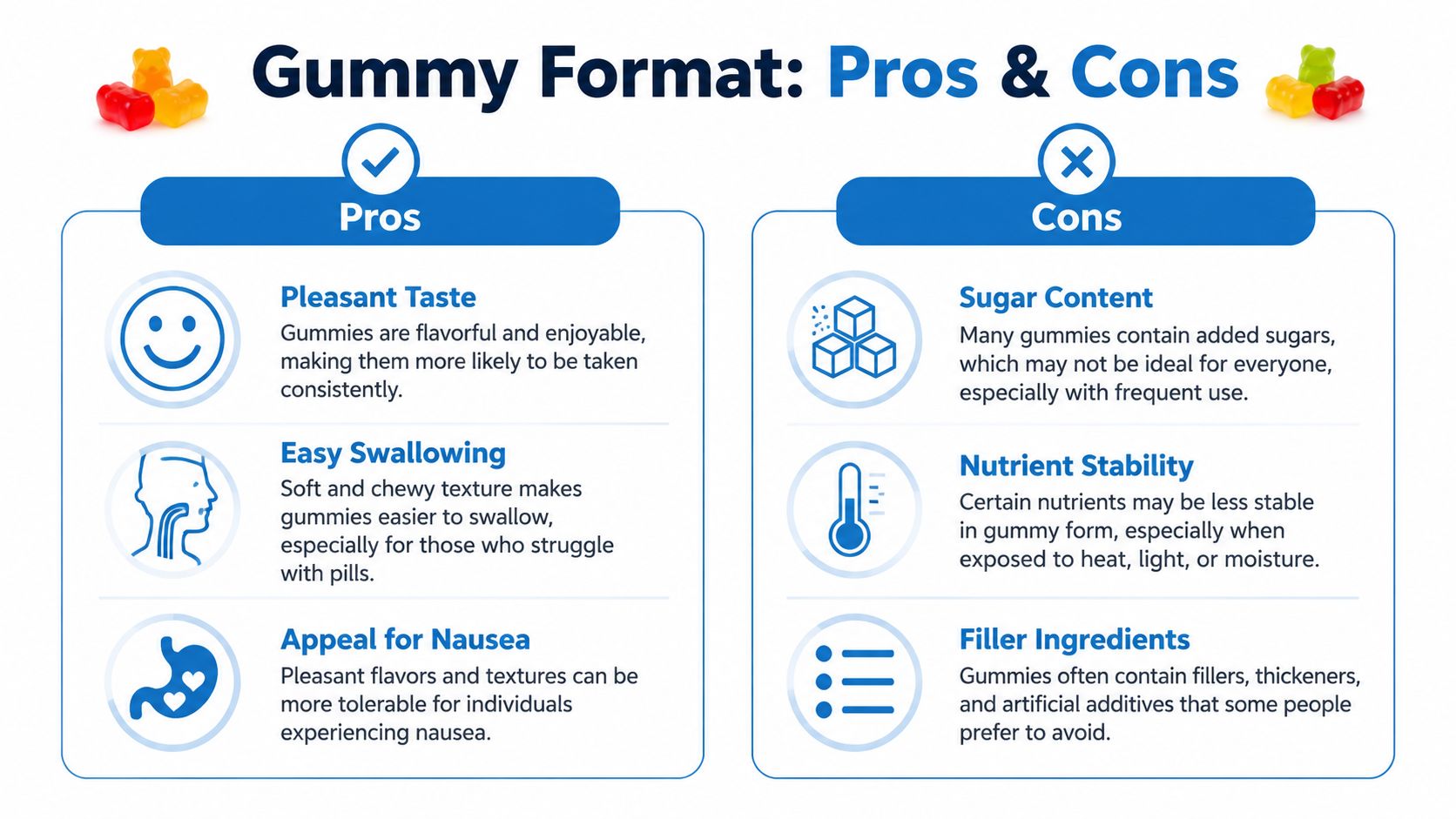
A gummy can be the right prenatal format for someone who struggles with pills. It's usually easier to chew, simpler to swallow, and often more appealing during nausea or flavor sensitivity. Those advantages can make daily use feel realistic rather than like another difficult pregnancy task.
The drawbacks become clearer when you compare the gummy with a capsule side by side.
Where gummies help
- Ease of swallowing: Chewing avoids the physical challenge of a large pill, which can matter during nausea, reflux, or pill aversion.
- Taste and texture: Fruit flavors and a soft texture may make the daily routine less unpleasant.
- Adherence: A product that someone can tolerate may be more useful than a nutritionally dense product that gets skipped.
- Dietary fit: Pectin-based products can avoid gelatin and support a vegan routine.
Where capsules often have an advantage
- Mineral capacity: Capsules and tablets generally provide more physical room for ingredients such as iron and calcium.
- Sugar exposure: Marketed vegan gummies commonly use ingredients such as tapioca syrup and cane sugar alongside pectin, so they may be more sugar-forward than capsules, as illustrated by Bird&Be Gentle Prenatal's product listing.
- Stability: Gummies are exposed to moisture, heat, and oxidation through their matrix, which can create more demanding stability conditions than a dry capsule.
- Nutrient breadth: A capsule or softgel may combine vitamins, minerals, and oil-based nutrients in a way that's harder to achieve in a chewable product.
A pleasant flavor can improve the routine, but it can't compensate for a missing nutrient.
Sugar deserves a personalized discussion rather than a blanket judgment. Someone managing gestational diabetes risk, nausea-related food limitations, or strong flavor fatigue may need to consider how the gummy fits into meals and the rest of the day. A lower-sugar or sugar-free product may be preferable for some people, but “sugar-free” doesn't guarantee complete prenatal coverage.
Storage also affects the trade-off. Keep the bottle closed and follow its storage instructions, especially in warm or humid conditions. A gummy that absorbs moisture can change texture, and a product that's repeatedly exposed to heat may not maintain the same quality as one stored carefully.
The best format depends on the person. If a gummy is the only prenatal you can take consistently, it may offer a meaningful adherence advantage. If your formula omits iron, DHA, calcium, or choline, the apparent convenience may come with a separate supplementation plan.
Reading Labels and Verifying Vegan Certifications
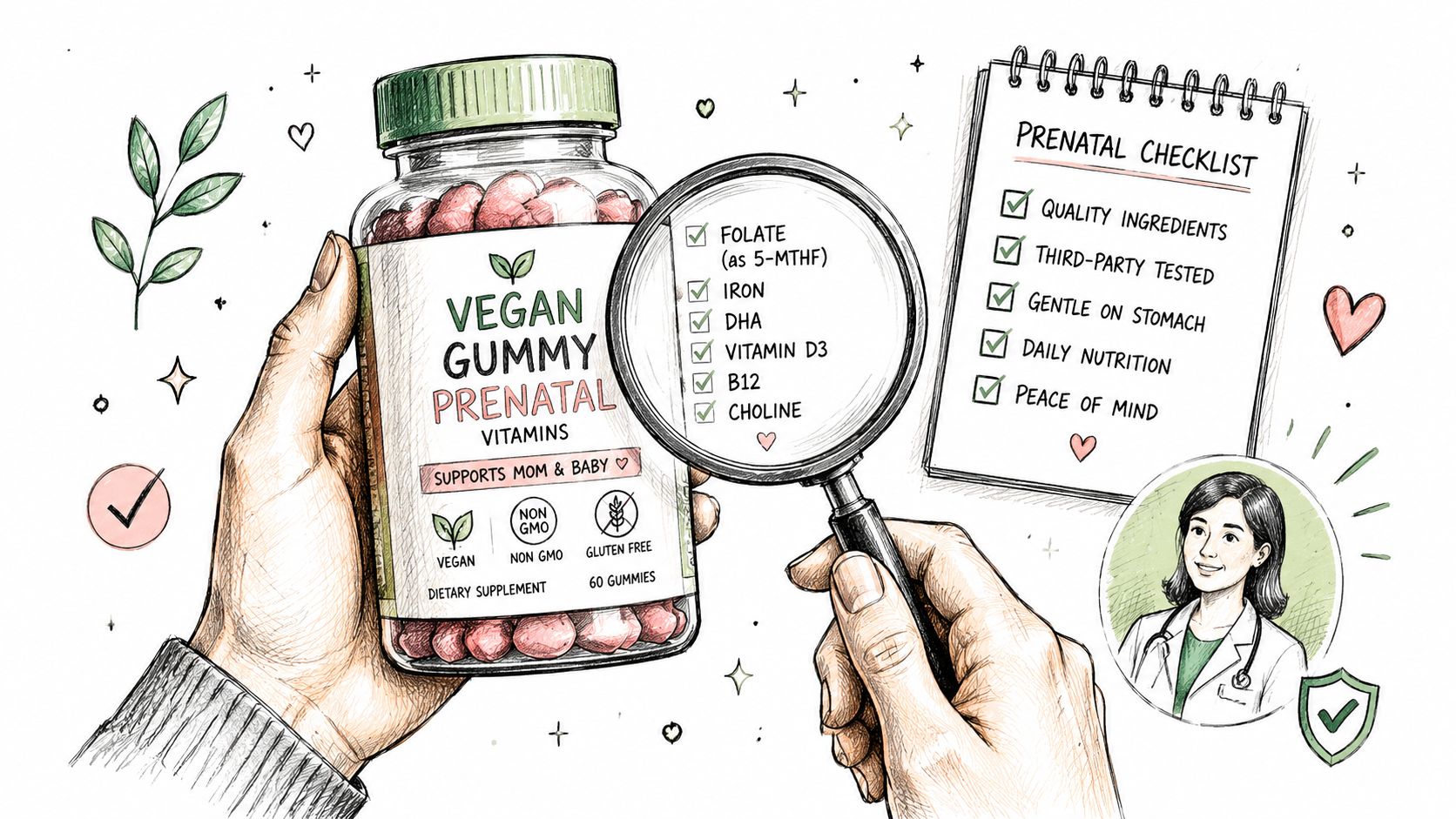
The front label tells you what the manufacturer wants you to notice. The Supplement Facts panel tells you what you're buying. Start with the serving size, then assess the nutrients per serving rather than judging the bottle by the number of gummies alone.
Five label checks that matter
- Confirm the vegan claim. Look for a clear vegan statement or a recognized vegan certification. “Plant-based” may describe selected ingredients without guaranteeing that every component is vegan.
- Check for gelatin. Review the full ingredient list, including the gummy base, coating, colors, and flavor system. Pectin is the common plant-derived alternative, but the complete list still matters.
- Separate testing from marketing. Certifications such as Non-GMO Project Verified or NSF Certified Gluten-Free can provide specific assurances, but each logo covers a defined attribute. One certification doesn't prove complete nutrient adequacy or confirm every manufacturing standard.
- Read nutrient forms and doses. Folate may appear as folic acid or a methylated form. B12 may have a named chemical form. The form can be relevant, but the amount and the rest of your nutrition plan matter just as much.
- Look for missing nutrients. A vegan gummy that lists folate, B12, and vitamin D may still omit iron, DHA, calcium, iodine, or choline. Missing information is a reason to investigate, not a reason to assume the product is incomplete in every respect.
Marketing language needs context
“Organic,” “clean label,” “natural flavors,” and “cruelty-free” can align with your preferences, but they don't answer the adequacy question. A product can meet several ethical or ingredient standards and still require separate iron or algae-derived DHA.
Also review allergens, added sugars, storage instructions, expiration dates, and the manufacturer's contact information. If you're comparing a gummy with another vegan supplement format, Addot Welllife hemp vitamin gummies can serve as a reminder to distinguish a general wellness gummy from a product specifically formulated as a prenatal. Similar packaging and chewable delivery don't make two supplements interchangeable.
Label-reading habit: Write down the nutrients you need to verify before you shop. Then compare products using the back label, not the front-panel promises.
Buying Tips and When to Consult Your Healthcare Provider
Begin with your actual pregnancy needs, not the flavor or certification on the front of the bottle. A vegan gummy may work well as a primary prenatal when its label covers the nutrients your clinician expects, your diet supplies the rest, and you can take it consistently without worsening nausea or blood sugar concerns.
A different strategy may be better when the product leaves out iron, DHA, calcium, or choline. You might use the gummy for the nutrients it supplies and add a separate capsule, liquid, or algae-based product, but that combination should be checked for duplicated ingredients and excessive intake. Don't build the stack by guessing from several labels.
A practical buying sequence
- Start with the panel: Record the serving size and the amounts of folate, B12, iodine, vitamin D, iron, DHA, choline, and calcium.
- Assess your diet: Note fortified foods, iodized salt, legumes, leafy greens, nuts, seeds, and algae-based foods or supplements.
- Consider tolerance: If pills trigger vomiting or severe nausea, a gummy may be a practical adherence choice. If the sweetness is unpleasant, a capsule or liquid format may be easier over time.
- Plan storage: Follow the package instructions, close the container promptly, and avoid leaving gummies in heat or humidity.
- Arrange monitoring: Ask your provider whether your prenatal plan calls for assessment of B12, iron status, thyroid-related markers, or other nutrients.
Talk with an obstetrician, midwife, registered dietitian, or other qualified healthcare professional before changing your prenatal routine. That conversation is especially important with a vegan pregnancy, a history of anemia or B12 concerns, thyroid disease, gestational diabetes risk, severe nausea, malabsorption, or a pregnancy plan involving more than one supplement.
A clinician can help distinguish an incomplete formula from one that's appropriate alongside a well-planned diet. If you're considering a capsule-based alternative, you can also review EU Natural Conception fertility and prenatal capsules, but don't treat a product page as a substitute for individualized advice.
Common Questions About Vegan Gummy Prenatal Vitamins
Can a vegan gummy be a complete prenatal?
Some formulas may cover many important vitamins, but you shouldn't assume a gummy is complete because it says “prenatal.” Check whether it includes iron, iodine, DHA, choline, calcium, folate, B12, and vitamin D, then compare the amounts with your clinician's recommendations and dietary intake.
Is B12 especially important during a vegan pregnancy?
Yes. Vegan diets can make B12 planning more demanding, and the clinical data discussed earlier showed that low status and deficiency increased during pregnancy. A gummy containing B12 may help, but your provider may recommend a particular dose, form, or laboratory assessment.
What if the gummy doesn't contain iron or DHA?
Don't add separate products automatically. Ask your healthcare provider whether your diet, laboratory results, and pregnancy history indicate a need for iron, algae-derived DHA, or another supplement. The safest plan accounts for the total intake from every product.
Does sugar make a prenatal gummy unsuitable?
Not necessarily, but the amount and your circumstances matter. If you're managing gestational diabetes risk, nausea, or food-related blood sugar concerns, discuss the gummy's sweeteners and serving routine with your care team. A lower-sugar formula still needs a complete nutrient review.
When should you switch to capsules?
Consider another format if the gummy causes nausea, adds unwanted sugar, lacks nutrients you need, or becomes difficult to store properly. Capsules may offer more room for minerals and other ingredients, but the best choice remains the one that matches your medical plan and that you can take consistently.
CalVitamin offers a broad selection of vitamins, minerals, gummies, capsules, and other supplement formats for shoppers comparing options for a vegan prenatal routine. Review the product details at CalVitamin, compare labels carefully, and discuss your final choice with your healthcare provider.






