

Many people asking for the best time to take a probiotic supplement expect a simple answer: morning or night. That answer is too shallow to be useful. For most conventional probiotic products, the important question isn't the hour on the clock. It's whether the strain and delivery system can survive your stomach, and whether you take the capsule alongside food in a way that supports viability.
The old empty-stomach rule also deserves a closer look. Current evidence supports a more practical approach: follow the label, choose a consistent routine, and usually take an unprotected bacterial probiotic with or shortly before a meal, particularly one containing some fat. Acid-resistant, encapsulated, spore-based, and yeast-based products may follow different rules.
Table of Contents
- Why Probiotic Timing Matters More Than Clock Time
- The Meal Timing Science Behind Probiotic Survival
- How Different Probiotic Types Change the Timing Rule
- Timing Probiotics Around Antibiotics and Medications
- Quick Reference Schedules for Different Probiotic Products
- Storage and Dosing Tips That Preserve Probiotic Viability
Why Probiotic Timing Matters More Than Clock Time
Morning isn't automatically better than night. A probiotic taken at breakfast can be a sensible choice for one product, while an evening dose may suit another. The deciding factors are strain identity, formulation, meal context, and medication timing, not a universal biological advantage attached to a particular hour.
The stomach presents a difficult environment for live microorganisms. During fasting, stomach acidity can reduce bacterial survival before the organisms reach the intestine. A 2026 clinical guidance review concluded that taking probiotics with or shortly after meals, especially meals containing fat, improves viability during gastrointestinal transit, while also stating that human evidence remains insufficient to recommend one exact time of day for every product. See the clinical guidance review on probiotic administration timing for the evidence behind that distinction.

Why the empty-stomach rule is no longer enough
Some consumer guidance still recommends taking probiotics before eating or at bedtime. That may be appropriate for a specific product, but it shouldn't be treated as a rule for all gut probiotics. Food can dilute and buffer stomach acid, giving vulnerable organisms a better chance of surviving transit.
The most useful routine for a standard, non-encapsulated bacterial capsule is usually with breakfast or lunch, provided the label doesn't direct you otherwise. Taking it with food also makes adherence easier for many people. A routine you follow consistently is more useful than an idealized schedule you regularly forget.
Practical rule: Choose the meal you reliably eat, then check whether the label specifies with food, without food, refrigeration, or another timing instruction.
The decision framework
Use this order of priority:
- Read the product label first: Manufacturer instructions account for the particular strain blend and delivery system.
- Identify the formulation: Enteric coating, microencapsulation, and spore technology can make meal timing less restrictive.
- Check your medication schedule: Antibiotics create a separate timing issue for bacterial probiotics.
- Build a repeatable habit: Breakfast, lunch, or dinner can work if it fits the product and your routine.
The direct answer is simple. There isn't one universally superior morning-or-night schedule. For many ordinary bacterial supplements, food matters more than clock time.
The Meal Timing Science Behind Probiotic Survival
Food changes the conditions probiotics encounter during digestion. A meal can provide a protective matrix, reduce the impact of stomach acidity, and help deliver live organisms farther through the gastrointestinal tract. That doesn't mean every food or beverage offers the same protection.
A 2011 in vitro transit study found that survival of all bacteria in the tested probiotic product was best when it was taken with a meal or 30 minutes before a meal, specifically with cooked oatmeal plus milk. Taking the product 30 minutes after the meal produced poor survival. The same study found significantly better survival in milk with 1% fat and in oatmeal-milk gruel than in apple juice or spring water. These findings are detailed in the 2011 probiotic transit study.
The practical implication is counterintuitive for anyone who has been taking a capsule with plain water immediately after waking. Breakfast with oatmeal and milk, or another meal containing some fat, may provide a more favorable setting than an empty stomach. Apple juice isn't equivalent to a buffering meal, and taking the supplement well after eating may miss the protective window observed in that study.
What the newer digestion research adds
A 2025 in vitro digestion study examined Lactobacillus rhamnosus GG and reported higher viability when the organism was consumed with a meal, at 5.39 to 5.92 log CFU/g, or after a meal, at 5.19 to 6.38 log CFU/g, compared with an empty-stomach scenario, at 4.93 to 6.04 log CFU/g. The data appears in the recent digestion study of Lactobacillus rhamnosus GG.
These are laboratory digestion results, not a promise that every commercial probiotic will behave identically in people. They do, however, reinforce a useful direction: meal-associated intake deserves priority over automatic fasting advice when the product is a conventional, unprotected bacterial formula.
| Consumed With | Survival Outcome | Reason |
|---|---|---|
| Cooked oatmeal plus milk | Best survival in the tested product | The meal matrix and dairy supported protection during transit |
| Milk with 1% fat | Significantly better survival than water or apple juice in the tested study | Fat and dairy can help buffer stomach conditions |
| Apple juice | Poorer survival than milk and oatmeal-milk gruel | It didn't provide the same buffering meal matrix |
| Spring water | Poorer survival than the tested food options | Water doesn't supply the same food-associated protection |
| Thirty minutes after a meal | Poor survival in the 2011 tested product | The timing missed the more favorable meal-associated window |
A practical breakfast decision
Take a standard bacterial probiotic with breakfast or shortly before it, rather than making an empty-stomach water dose your default. If breakfast is inconsistent, lunch is a perfectly reasonable alternative. The exception is a label that specifically requires fasting or provides a formulation designed to protect the organisms without food.
How Different Probiotic Types Change the Timing Rule
A probiotic label isn't just a list of bacteria. It also tells you how those organisms are packaged and protected. That delivery format can determine whether food is essential, helpful, or largely optional.
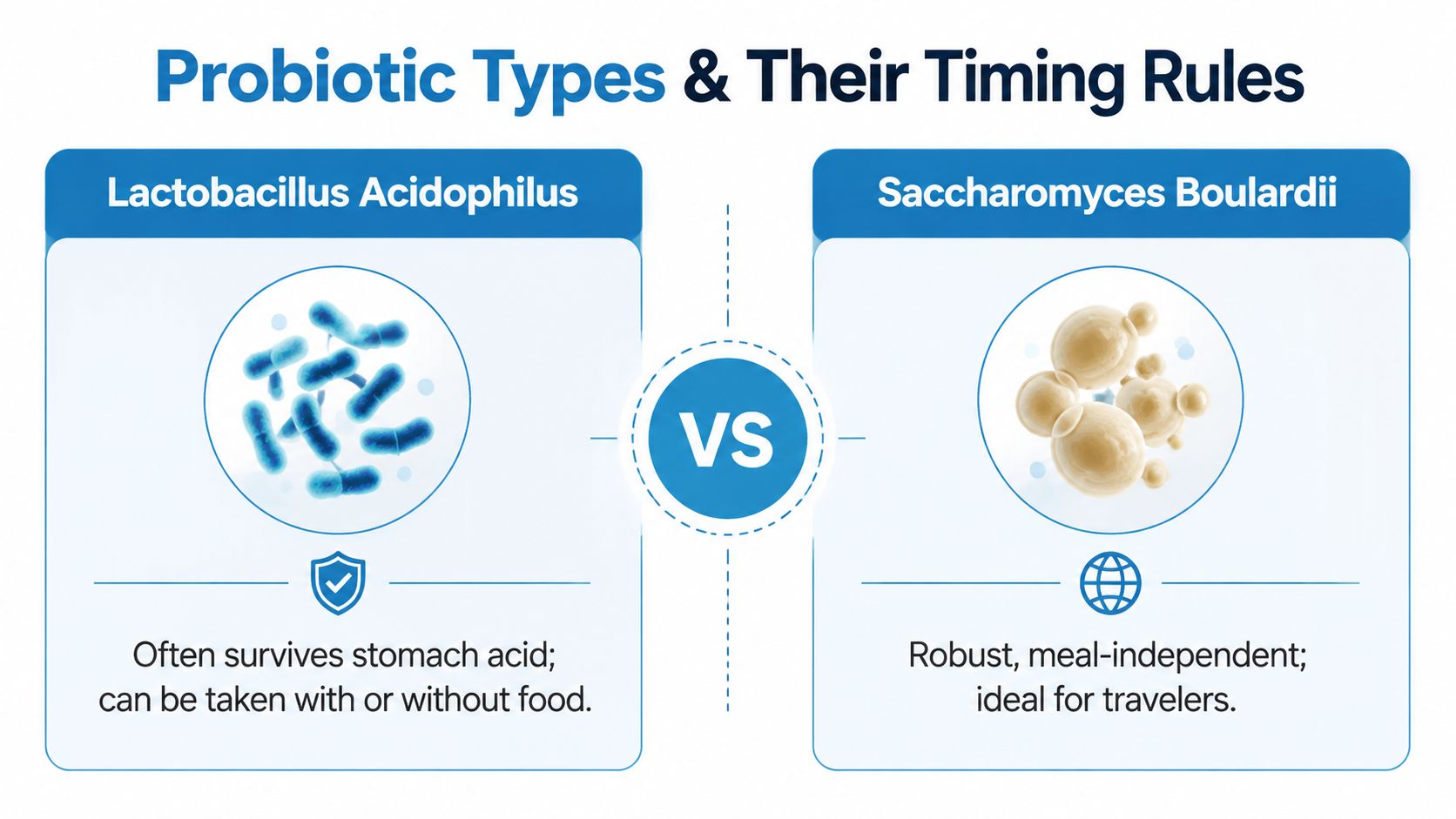
Regular, non-encapsulated Lactobacillus and Bifidobacterium products are generally more exposed to stomach acid. Research summarized in a UCL review of probiotic survival and formulation describes gastric pH around 2.2 to 2.8 as capable of causing major viability loss for many strains. More than 80% of tested strains were susceptible to real human gastric fluids, while encapsulation preserved viability for at least 4 hours at low pH in the cited findings. Non-encapsulated strains could fall to undetectable levels within 30 minutes under pH 2 conditions.
That evidence doesn't support treating every product as fragile, either. Strain identity matters. One study found Lactobacillus rhamnosus GG survived gastric exposure best over 90 minutes at pH 2.0, while another Lactobacillus strain became undetectable after 30 minutes. The same product category can therefore contain organisms with very different tolerance.
Match the schedule to the format
- Standard capsules: Pair these with a meal unless the label says otherwise. Food is the safer default for unprotected bacterial strains.
- Enteric-coated products: These are designed to delay release until conditions are less acidic, so meal timing may be more flexible. Follow the product directions rather than assuming food is required.
- Microencapsulated formulas: Encapsulation can protect organisms during low-pH exposure, reducing dependence on a precise meal window.
- Spore-based products: Spore-forming organisms are generally more resistant to harsh conditions and can be easier to fit into a daily routine. The label still takes precedence.
- Saccharomyces boulardii: This is a yeast, not a bacterium. Its timing rules differ from bacterial probiotics, including when antibiotics are involved.
The phrase “acid-resistant” deserves scrutiny. A label claim can refer to a particular coating, capsule, or strain, but it doesn't mean every organism inside the product has identical tolerance. Look for specific wording such as enteric-coated, microencapsulated, or spore-based, then use the stated directions.
For shoppers comparing products, the NatureWise time-release probiotic option illustrates why delivery format belongs in the timing decision. A time-release design should be evaluated according to its label instructions, not according to generic advice intended for an unprotected capsule.
A short visual explanation can help clarify why formulation changes the schedule:
The decisive question isn't “morning or night?” Ask instead: What strain is present, and what protects it before release?
Timing Probiotics Around Antibiotics and Medications
Antibiotics create a different problem from stomach acid. They can affect bacterial probiotics directly, so taking a bacterial supplement at the same time as an antibiotic may expose the probiotic organisms to the medication before they can pass through the digestive tract.
For bacterial probiotics, separate the supplement from the antibiotic dose. Practical guidance commonly uses a window of at least two hours, and some schedules require a longer separation depending on the medication and the product. The exact interval should follow your prescriber, pharmacist, and product label. Don't change a prescribed antibiotic schedule to accommodate a supplement.
A workable medication routine
- List the antibiotic times first. Keep the prescribed doses evenly scheduled as directed.
- Place the bacterial probiotic between doses. Choose a time that creates clear separation, ideally alongside food if the product is a conventional bacterial capsule.
- Keep the routine consistent. A lunch dose may work better than a morning dose if breakfast sits too close to the antibiotic.
- Ask a pharmacist about other medicines. Medication instructions such as taking a drug away from food can affect where the probiotic fits.
Saccharomyces boulardii is different. It is a yeast-based probiotic rather than a bacterial organism, so antibiotics don't target it in the same way. The practical guidance on probiotic timing during antibiotic use identifies this distinction as a reason S. boulardii may be taken at the same time as an antibiotic, while bacterial probiotics generally require separation.
Medication rule: Never assume that all probiotics can be taken alongside antibiotics. Identify whether the product contains bacteria or Saccharomyces yeast.
Antibiotic-associated digestive symptoms also deserve appropriate attention. A probiotic isn't a substitute for medical care, particularly if symptoms are severe, persistent, or accompanied by warning signs. CalVitamin's guide to diarrhea relief and gut health offers related consumer guidance, but medication decisions should remain with a qualified healthcare professional.
Quick Reference Schedules for Different Probiotic Products
The best schedule is the one that respects the label and protects the product's main vulnerability. For a standard capsule, that usually means using a meal. For a protected or spore-based product, consistency may matter more than a narrow food window. For Saccharomyces boulardii, antibiotic compatibility offers greater flexibility.
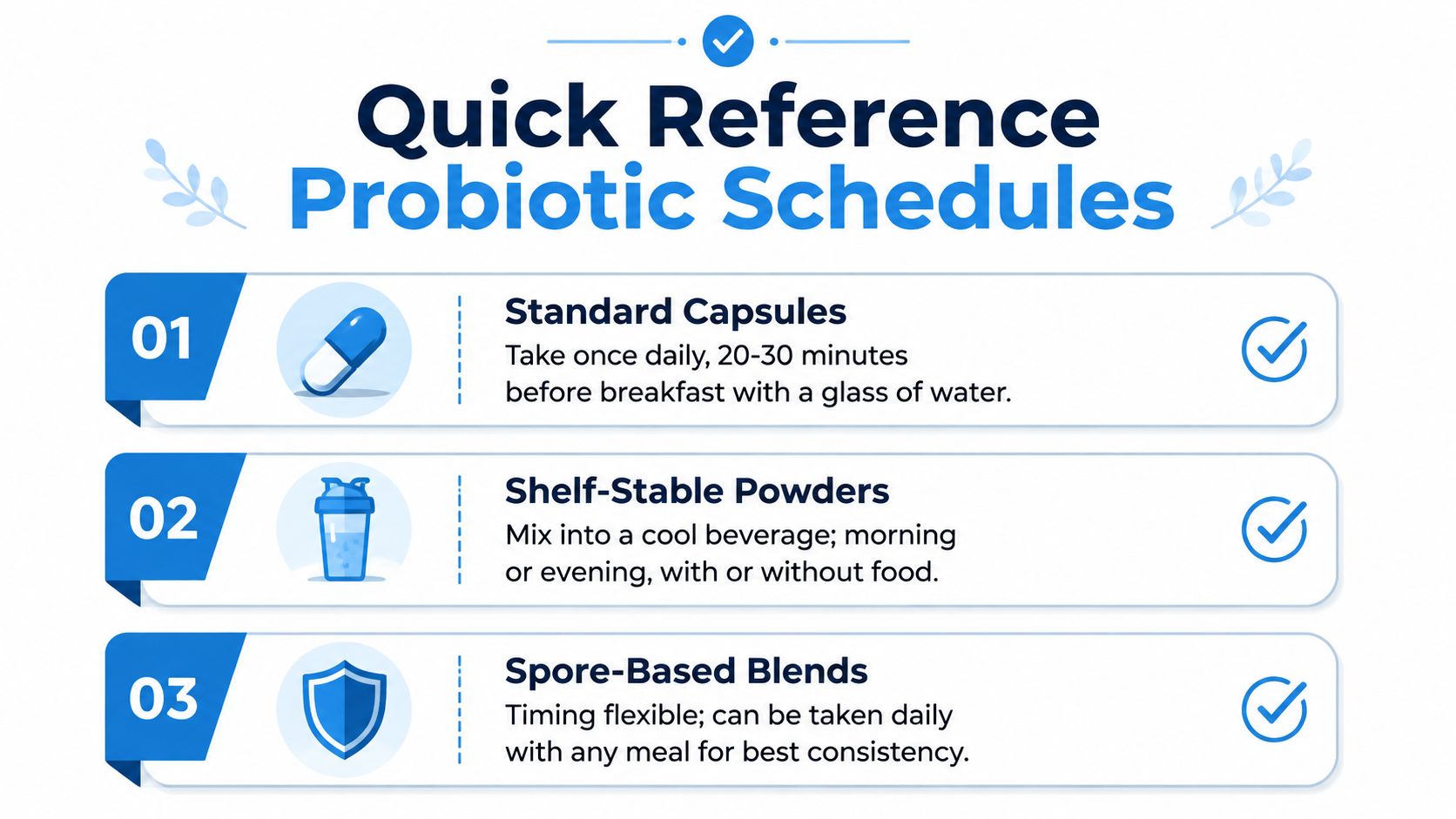
Three schedules that work in real routines
Standard non-encapsulated bacterial capsule: Take it with breakfast or lunch, preferably alongside a meal containing some fat, unless the label says to take it differently. If you're taking an antibiotic, place the probiotic in a separate window and confirm the interval with a pharmacist.
Enteric-coated or microencapsulated product: Take it according to the label. These products are built to reduce acid exposure, so a precise morning-versus-night rule is less important, but taking it at the same daily anchor can prevent missed doses.
Spore-based blend: Attach the dose to any reliable meal. Food may support consistency even when the formulation is less dependent on stomach conditions.
Saccharomyces boulardii: Follow the product directions and coordinate the dose with your antibiotic plan. Because it is yeast-based, it can generally be taken at the same time as an antibiotic, subject to professional advice and label instructions.
| Product Type | Best Timing | With or Without Food | Antibiotic Note |
|---|---|---|---|
| Standard non-encapsulated bacterial capsule | With breakfast or lunch | Usually with food | Separate from antibiotics |
| Enteric-coated or microencapsulated product | Label-directed daily time | Depends on the label | Confirm medication spacing |
| Spore-based blend | A consistent meal | Usually flexible, with food for routine | Check the product and medication instructions |
| Saccharomyces boulardii | Label-directed routine | Product-specific | May be taken with antibiotics because it is yeast-based |
If the label conflicts with generic online advice, the label wins. Product-specific directions account for the formulation that was tested by the manufacturer.
Storage and Dosing Tips That Preserve Probiotic Viability
A well-timed dose can't compensate for poor storage. Probiotic organisms are sensitive to environmental conditions, so heat and moisture can reduce viability before the capsule reaches your stomach. Some products require refrigeration, while others are shelf-stable because of freeze-drying or protective packaging.
Store the product according to its label
- Check refrigeration instructions: If the manufacturer requires refrigeration, keep the container in the refrigerator and avoid leaving it in warm areas.
- Control moisture: Close the container promptly after use. Don't store it beside a sink, shower, or steaming kettle.
- Protect it from heat: A car, windowsill, or hot delivery location can expose the product to conditions the label doesn't permit.
- Respect the expiration date: Replace the product when it reaches its stated expiration, particularly if the label ties potency to shelf life.
- Use the original container: It provides the storage environment and labeling information supplied for that product.
Shelf-stable doesn't mean indestructible. It means the product has been designed for storage under specified conditions. Follow those conditions rather than assuming room temperature is always suitable.
Make dosing boring and repeatable
Take the same labeled dose at a dependable daily anchor. Put the container beside the meal you choose, set a reminder, or connect the dose with another routine you already complete. Don't double the next dose after forgetting one unless a healthcare professional or the product label tells you to do so.
For a conventional bacterial probiotic, the complete decision framework is:
- Label first.
- Formulation second.
- Food context third.
- Medication spacing where relevant.
- Consistency every day.
Florastor is a familiar example of a Saccharomyces boulardii product category. You can review the Florastor daily probiotic capsules for product-specific directions, then compare those instructions with your medication schedule and healthcare provider's advice.
The best time to take a probiotic supplement isn't a magic hour. It's the time that matches the organism, protects viability, follows the label, and fits a habit you can maintain.
CalVitamin offers probiotic products alongside vitamins, minerals, proteins, and other wellness supplements, with product pages that provide usage information for shoppers comparing formats. Visit CalVitamin to review probiotic options and choose a product whose strain, delivery system, storage needs, and timing instructions fit your routine.






