

Why does this question keep coming up at the exact moment you're holding a probiotic bottle in one hand and a multivitamin in the other? The usual yes-or-no answer misses the part that matters, which is how these supplements behave in the gut, when timing changes the result, and which people should slow down before combining them. For most healthy adults, can you take probiotics with vitamins is a practical yes, but the more useful answer is that the pairing can be smart, neutral, or something you should clear with a clinician depending on the person and the product.
Table of Contents
- The Short Answer and Why It Is Not the Whole Story
- How Probiotics and Vitamins Actually Work Together
- What the Research Shows About Combined Use
- Timing and Stacking Rules That Change Results
- Special Cases That Bend the Routine Advice
- A Simple Decision Framework for Your Routine
- Common Myths Worth Letting Go Of
- Putting It All Together for Your Daily Routine
The Short Answer and Why It Is Not the Whole Story
For healthy adults, probiotics and vitamins are generally safe to take together. That simple answer is the reason so many shoppers combine them in the same morning routine and move on with their day.
The catch is that safety isn't the same thing as usefulness. The question is whether the combination helps, hurts, or just works fine without making much difference. That's where the gut biology, the timing, and the specific nutrient pairing start to matter.
A better way to think about it is a quick three-part check. Safe means the combination is usually reasonable for a healthy person. Cautious means timing or product choice may matter. Ask a doctor first means the person has a medical situation that changes the risk, especially gastrointestinal disease, immune compromise, or recent antibiotic use. Cleveland Clinic's probiotic guidance is important here because it emphasizes that probiotic safety evidence is mainly strongest for healthy people, not everyone (Cleveland Clinic probiotic overview).
There's also a reason this topic gets confusing. People often assume the question is only about whether two pills can sit in the same cabinet. In reality, the bigger issue is whether they interact in the stomach and small intestine, and whether that interaction changes absorption or survival. That's where the next layer of evidence becomes useful.
Practical rule: if you're healthy and taking a standard multivitamin with a probiotic, the combination is usually reasonable. If you're managing a condition or a medication schedule, the routine deserves more thought.
How Probiotics and Vitamins Actually Work Together
Think of your gut like a kitchen. Vitamins and minerals are the ingredients, and probiotics are more like helpful cooks than decorative labels on a shelf. The cooks don't replace the ingredients, but they can change how well the ingredients get prepared, used, and delivered.
A probiotic is a live microorganism taken in a form meant to support the gut microbiome. Vitamins and minerals are nutrients your body needs in small amounts for normal function. They don't do the same job, but they often meet in the same place, mainly the digestive tract, where absorption happens.
The gut is not just a tunnel
The small intestine is the main site where your body absorbs many nutrients. The colon is where gut microbes do a lot of their fermenting work, and that microbial activity can influence the availability of certain nutrients. That's why microbiota and micronutrients don't just coexist, they interact.
A 2024 systematic review found that probiotic intake was associated with improvements in several micronutrient markers, including vitamin B12, folate, calcium, zinc, and iron status, although the authors noted that the results weren't fully consistent across studies (systematic review on probiotics and micronutrient markers). A separate 2024 review also concluded that probiotics and micronutrients can act synergistically and that the relationship is bidirectional, meaning micronutrients affect the microbiota and the microbiota affects vitamin and mineral bioavailability (same review source).
That bidirectional idea matters because it moves the conversation beyond “Do they clash?” and into “How does the gut handle them together?”
Why the same capsule can behave differently in real life
Two people can take similar supplements and get different results because the microbiome isn't identical from one person to the next. The probiotic strain, the nutrient type, and even the meal all affect what happens after swallowing. That's why a one-size-fits-all answer falls apart fast.

For shoppers comparing supplement formats, a probiotic product like CalVitamin's Probiotic Multivitamin Complex is one example of how brands package this idea into a single routine. The important part isn't the convenience alone, it's recognizing that the gut environment can change how the nutrients are handled.
The gut is less like a pipe and more like a workshop. What gets absorbed depends on the tools, the material, and the timing.
What the Research Shows About Combined Use
The strongest evidence does not say every probiotic and every vitamin pair behaves the same way. It shows that the interaction is real, measurable, and nutrient-specific.
B vitamins show the clearest absorption signal
A 2024 rat study gave the clearest numerical evidence so far. In that experiment, Lactobacillus strains increased absorption of vitamins B1, B3, B5, and B12 by approximately 14.5% to 71.2% across groups, with n = 8 per group in the main animal experiment. The same study also used in vitro testing (n = 3 per group) and a pseudo-germ-free rat pharmacokinetic model (n = 6 per group) to show that the effect came mainly from gut microbiota-mediated mechanisms, not from probiotics directly manufacturing the vitamins (2024 rat study).
That finding matters because it gives a plain-language answer to a common question. The probiotic is not just sitting beside the vitamin, it may be changing how the gut processes the nutrient after it arrives.
The same line of research helps explain why a combined product like CalVitamin's probiotic multivitamin complex can fit some routines, especially for people who want one daily supplement instead of separate capsules.
Vitamin D has human data, but not a universal rule
A vitamin D plus probiotic review found that combined supplementation was generally more beneficial than placebo, vitamin D alone, or probiotics alone across multiple populations, and it reported a dose-dependent effect. That supports combined use when the goal is immune or metabolic support, but it does not mean the same pattern applies to every vitamin or every strain.
Human studies can point in the right direction without giving a one-size-fits-all answer. The gut environment still matters, and the result depends on the nutrient, the probiotic, and the person taking them.
Minerals and micronutrient markers also point in the same direction
A systematic review found probiotic intake associated with better markers for B12, folate, calcium, zinc, and iron status, although the authors were careful that the results were not fully consistent across studies. That caution matters. The findings are promising, but they do not support the idea that every person will absorb every nutrient better just by adding a probiotic.
Taken together, the research suggests a shared pattern. Probiotics can influence how some vitamins and minerals are handled in the gut, but the benefit depends on the specific nutrient pair and the conditions around it.
Timing and Stacking Rules That Change Results
A lot of supplement advice falls apart because it treats timing like a minor detail. It isn't. The moment you take a probiotic or vitamin can change how much survives stomach acid and how well nutrients compete or cooperate in the gut.
Food changes the story
Taking probiotics with food can help them survive stomach acid, which is why many people do better with a meal than on a fully empty stomach. That doesn't mean every product needs the same timing, but it does mean the meal itself can act like a buffer. Consumer guidance also often notes that probiotics are commonly taken about 30 minutes before meals when the goal is to reduce acid exposure, although individual products can differ (probiotic timing guidance).
Fat-soluble vitamins, especially A, D, E, and K, also make more sense with a meal that contains healthy fat. That's not because fat makes the vitamin “stronger,” it's because the body absorbs these nutrients better when fat is present.
Spacing can matter when minerals compete
Some mineral supplements are not ideal roommates in a single gulp. Iron and zinc can compete for absorption if they're stacked together, and some people feel less stomach upset when they don't take a heavy mineral load all at once. If your multivitamin already contains several minerals, spreading out the rest of the day's supplements can be easier on the gut.
A simple default routine looks like this:
- Morning with breakfast: probiotic, especially if the meal calms your stomach.
- Midday or with lunch: multivitamin if it contains iron or other minerals that bother you on an empty stomach.
- Dinner: fat-soluble vitamins if they're separate from your multivitamin.
That's a starting point, not a law. The right schedule also depends on the supplement format. Capsules, gummies, powders, and food-based probiotics don't behave the same way in the digestive tract, so “take them together” can mean different things in practice.
Timing rule of thumb: if your probiotic upsets your stomach, move it closer to food. If your vitamin contains fat-soluble nutrients, pair it with a meal that includes fat.
For shoppers who want a broad supplement aisle in one place, CalVitamin's vitamins and supplements selection is an example of the kind of catalog where these timing choices matter in daily life.
Special Cases That Bend the Routine Advice
Some people can follow a straightforward daily routine. Others need a more careful plan because the situation changes the stakes.

Antibiotics change the calendar
Someone finishing antibiotics often wants to protect gut health while also staying on top of vitamins. The practical issue is that antibiotics can interfere with live microbes, so spacing matters more than usual. Many clinicians advise separating a probiotic from an antibiotic dose by a few hours, often around 2 to 3 hours, so the probiotic has a better chance of surviving the trip through the gut.
That timing rule matters because antibiotics do not treat probiotics and vitamins the same way. A vitamin is a nutrient, while a probiotic is a live organism that has to pass through a changing digestive tract. If the antibiotic is still active in the gut, the probiotic can be knocked down before it has much chance to do its job.
Strain choice matters more than brand hype in this setting. Some strains are used more often in antibiotic-related routines, while others fit everyday maintenance better. The point is to match the schedule and the product to the situation, not to assume every probiotic acts the same.
Pregnancy deserves a clinician check
A pregnant person is often trying to support folate, iron, and overall nutrient status, so the gut-nutrient connection becomes especially relevant. Pregnancy also changes the risk conversation, because probiotic safety data are more limited than the average supplement ad suggests. That is why a prenatal stack should be reviewed, not built on convenience alone.
If you are pregnant, the safest approach is to treat probiotics and vitamins as a plan to check, not a casual add-on. A clinician can look at the specific vitamin form, the mineral load, and the probiotic product to see whether they fit the prenatal routine. Small details matter here, because what feels gentle in one person can feel harsh in another.
Immune compromise changes the rulebook
Cleveland Clinic guidance above makes the same point clearly, probiotic safety evidence is mainly for healthy people. That matters for adults with immune compromise, serious gastrointestinal disease, or recent critical illness or surgery.
In those cases, the question is not just whether probiotics and vitamins can be taken together. It is whether a probiotic belongs in the routine at all. A gastroenterologist or primary care provider should be part of the decision if there is a complex medical background.
A Simple Decision Framework for Your Routine
Start with the goal, then build the stack backward. That's easier than copying someone else's shelf.
| Common Supplement Goal | Best Pairing Strategy | Timing Notes |
|---|---|---|
| General wellness | A standard probiotic with a multivitamin is usually reasonable for healthy adults | Use food if your stomach is sensitive |
| Immune support | Vitamin D plus probiotic is the pairing with the strongest combined-use signal in the evidence | Keep the vitamin with a meal that includes fat |
| Digestive support | Probiotic alone or with a light meal if the product feels harsh on an empty stomach | Adjust to tolerance first |
| Deficiency recovery | Separate the nutrient that needs the most attention, then add the probiotic if it's part of the plan | Use clinician guidance if iron, B12, or chronic issues are involved |
A worked example makes the logic clearer. Say someone wants immune support, knows their vitamin D is low, and drinks coffee with breakfast. Coffee doesn't change the basic question of whether probiotics and vitamins can be taken together, but it can make the stomach feel more sensitive in the morning. In that case, the probiotic can move to breakfast with food or just before the meal, while vitamin D stays with a meal that includes fat.
If the multivitamin causes nausea, the person can shift it to lunch. If the vitamin D is a separate softgel, dinner may be easier because the meal usually contains more fat. The point is not to find one perfect clock time, it's to place each supplement where it works best and feels easiest to keep doing.
Common Myths Worth Letting Go Of
The internet loves oversimplified supplement rules, but the gut is more like a busy kitchen than a light switch. Three common myths tend to confuse the picture.
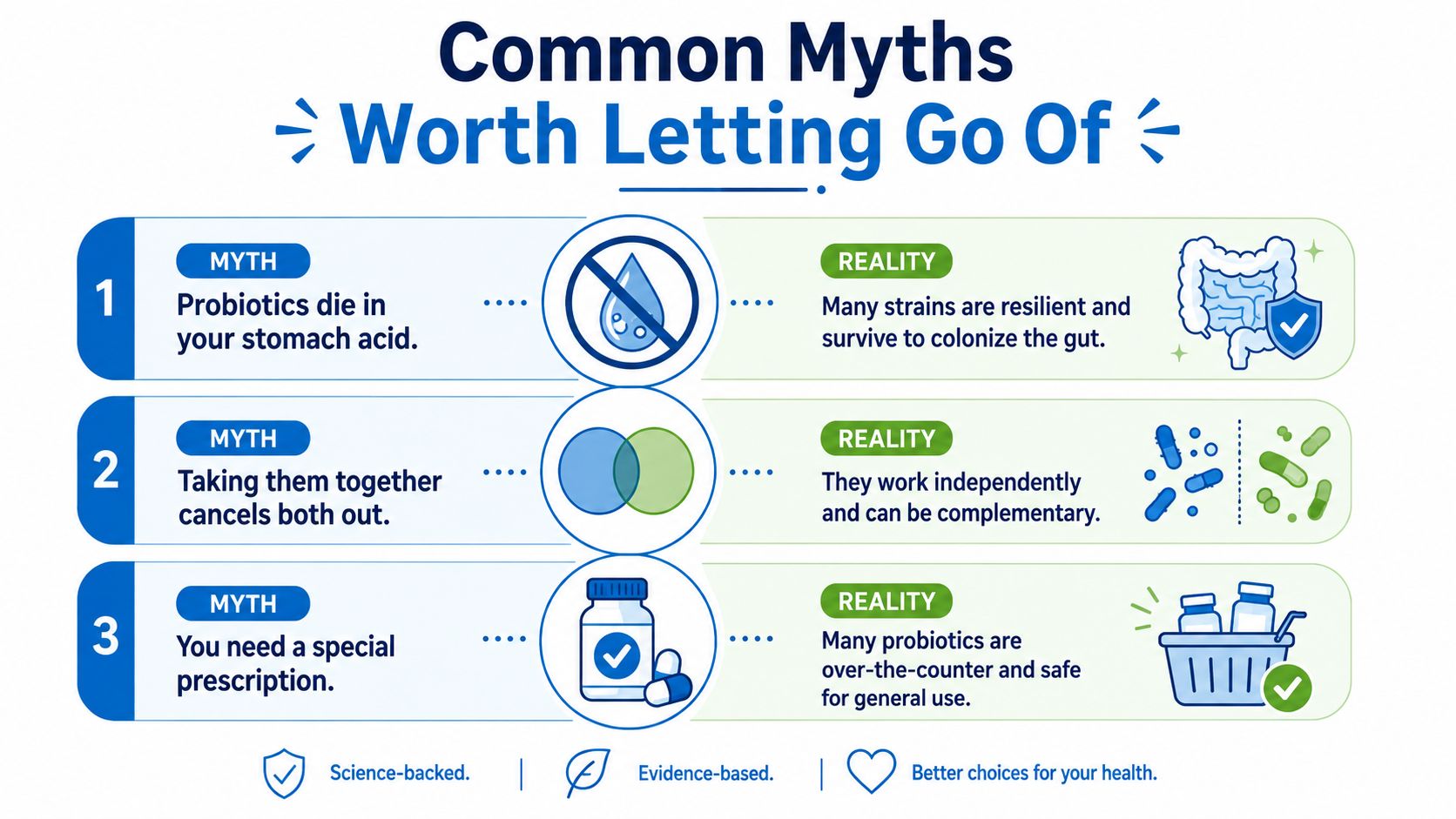
Myth one, probiotics always die in stomach acid
Some probiotic strains are more delicate, but many are built to make the trip through digestion. Formulation matters here, because capsules, coatings, and storage conditions all shape how many organisms stay intact long enough to reach the gut.
Food matters too. A meal can buffer stomach acid, which is why probiotics are often easier to tolerate with breakfast, lunch, or another snack.
Myth two, more CFUs automatically means better
CFUs describe dose, not quality by themselves. A higher count can matter in some products, but it does not make a supplement better on its own.
Strain identity, storage, and formulation matter just as much, and sometimes more. A product with a huge number on the label still may not fit the goal if the strain is not the right one or if the product is not stable by the time you use it.
Myth three, vitamins cancel out probiotics
The evidence does not support that simple idea. B vitamin research suggests probiotics can support absorption in some settings, and vitamin D plus probiotics have shown combined benefits in the review literature, as noted in the review cited above. Vitamins and probiotics are often working in overlapping parts of the same system, so they usually do not get in each other's way.
The bigger question is timing and tolerance, not cancellation. A probiotic may be easier with food, while some vitamins fit better at a different meal depending on the type and how your stomach reacts.
Putting It All Together for Your Daily Routine
If you want one simple rule, use this: combine when convenience helps, separate when absorption or tolerance improves, and ask a clinician when your health situation makes the choice less routine. For many healthy adults, a probiotic with breakfast and a multivitamin later in the day is an easy default, while fat-soluble vitamins often fit well with dinner.
On travel days, keep it simpler. Put the probiotic with the meal that's easiest on your stomach, and take the vitamin with whatever meal has the most fat or the least nausea. If you're unsure whether a routine is helping, track it for 14 days and note energy, digestion, and any side effects after the change.
That small log is usually more useful than guessing from the label alone. It tells you whether your body likes the timing, the format, and the specific pairing.
If you want help choosing supplements that fit a real routine, CalVitamin carries vitamins, minerals, probiotics, and combination products that make it easier to compare formats in one place. Visit CalVitamin to review options that match your timing, tolerance, and daily goals.






