The most popular advice about hair supplements for women is also the least useful: buy biotin, wait a few months, and expect thicker hair. That advice survives because it's simple, not because it's broadly true.
A better question is this: what problem is the supplement trying to solve? Hair follicles respond to nutrition, hormones, stress, genetics, illness, and time. If the cause is a nutrient deficiency, targeted supplementation can help. If the cause is genetic thinning, postpartum shedding, a thyroid issue, or a scalp disorder, a gummy marketed for “hair, skin, and nails” may do very little.
That's why the smartest way to think about hair growth vitamins for women isn't as a shopping list. It's as a decision process. Look for evidence, identify the likely cause, check whether the dose makes sense, and know when supplements aren't the answer.
Table of Contents
- The Search for a Hair Growth Solution
- Understanding Why Female Hair Is Thinning
- The Essential Building Blocks for Healthy Hair
- Evaluating the Clinical Evidence for Hair Supplements
- How to Read a Supplement Label Like an Expert
- Debunking the Great Biotin Myth and Other Untruths
- Your Action Plan for Healthier Hair
The Search for a Hair Growth Solution
The hardest truth about hair supplements is also the least marketable one. The right pill for one woman can be a waste of money for another.
That gap between hope and evidence explains why this category causes so much confusion. Hair loss feels urgent and visible. A capsule with before-and-after photos offers a cleaner story than a workup for anemia, thyroid disease, hormonal shifts, recent illness, or stress. But hair growth vitamins for women are only worth considering after you ask a more basic question: what problem is this supplement supposed to solve?
A useful way to judge any product is to stop thinking like a shopper and start thinking like a reporter. What outcome was studied. Who was studied. Did the benefit show up in women with a confirmed deficiency, in women with temporary shedding after a trigger, or in healthy adults with no clear nutritional gap. Those are very different groups, and companies often blur them together.
Biotin shows why that distinction matters. It is one of the most promoted ingredients in this market, yet broad claims for healthier women tend to run far ahead of the evidence. Hair supplements can help when thinning is tied to a real deficiency. They are far less convincing as a blanket fix for every kind of shedding, slow growth, or reduced density. Improvement also tends to be slow, because hair responds over months, not days.
That does not make supplements useless. It makes them conditional.
Practical rule: If a formula claims to treat every form of hair thinning with the same ingredient list, read the marketing more skeptically than the label.
This section is where many women save themselves time and money. Before comparing ingredients, compare logic. A plausible supplement should match a plausible cause, use doses that make physiological sense, and point to human evidence that resembles your situation. If it cannot clear those three bars, the smarter move may be testing, diagnosis, or a change in treatment, not another bottle.
Understanding Why Female Hair Is Thinning
Some women are dealing with sudden shedding. Others notice a gradually widening part. Others see short, fragile hairs that never seem to gain length. Those patterns matter because they often point to different causes.

Shedding and thinning aren't the same problem
Telogen effluvium is the classic shedding story. Hair shifts out of its growth phase and into its resting phase after a trigger such as illness, major stress, childbirth, surgery, restrictive dieting, or a nutritional gap. Women often describe it as “my hair is coming out everywhere all at once.” This is the form of hair loss most likely to overlap with nutrition, which is why supplements sometimes help here.
Androgenetic alopecia, often called female pattern hair loss, behaves differently. It usually appears as a slow reduction in density, especially at the part line or crown. The issue isn't a missing vitamin so much as how follicles respond over time to genetic and hormonal influences. A supplement may support general hair quality, but it usually won't solve the underlying process by itself.
Hormonal shifts can complicate both patterns. Postpartum shedding can look dramatic but is often temporary. Perimenopause and menopause can bring a mix of hormonal change and age-related reduction in hair density. Thyroid problems and some medications can also mimic “vitamin-related” hair loss, which is one reason self-diagnosis goes wrong so often.
Why diagnosis changes everything
If your problem is diffuse shedding after a clear trigger, a clinician may think about iron status, vitamin D, recent stressors, diet, or illness. If your problem is slow miniaturization over time, the conversation often shifts toward pattern loss and scalp-focused treatment options.
A simple framework helps:
- Sudden heavy shedding: Think trigger first. Stress, postpartum change, illness, dieting, or deficiency may be involved.
- Gradual thinning at the part or crown: Think pattern loss or hormonal contribution.
- Breakage more than shedding: Look at hair care practices, heat, chemical processing, and shaft fragility, not just supplements.
- Scalp symptoms: Itching, scaling, redness, or pain suggest the scalp itself may need medical attention.
Hair is often the visible clue, not the whole story. A nutrient deficiency, endocrine change, or stress event may show up there before it shows up anywhere else.
That's why hair growth vitamins for women should come after one question, not before it: what is the most likely reason this started? Without that answer, even a well-formulated supplement becomes a guess.
The Essential Building Blocks for Healthy Hair
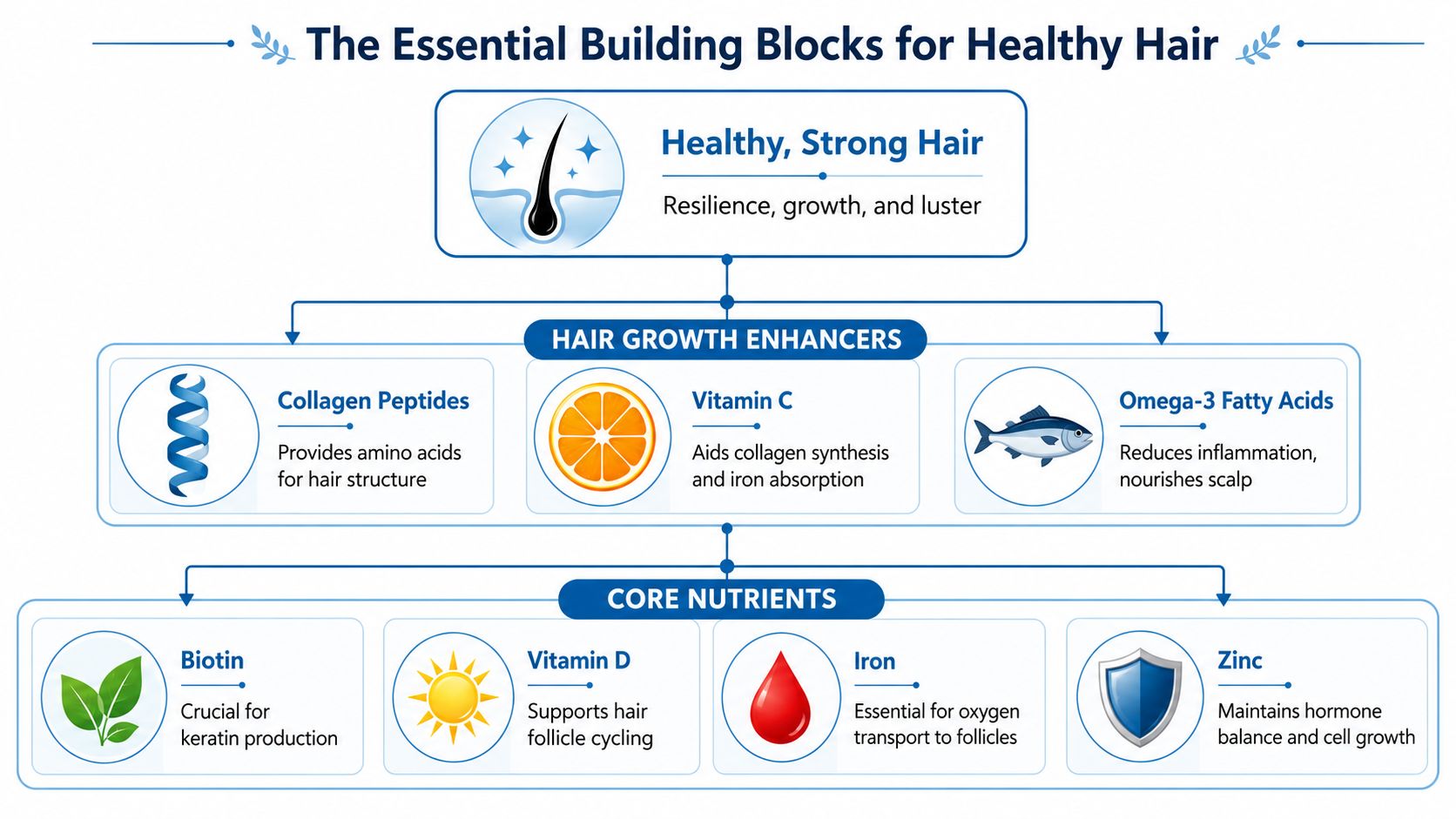
Hair supplements are often marketed as if one missing nutrient explains every shed strand. Biology is less convenient. A follicle grows hair only when several systems are working at the same time: protein availability, oxygen delivery, cell turnover, hormonal signaling, and a calm enough immune environment to keep the growth cycle on track.
What hair follicles need most
Start with protein. Hair shafts are built largely from keratin, so chronically low protein intake can show up as weaker growth or increased shedding. But protein alone does not solve much if the follicle is also short on iron, zinc, or vitamin D.
Iron deserves special attention because hair follicles are among the body's more metabolically active tissues. If iron stores are low, oxygen delivery can suffer, and hair growth may slow before anemia becomes obvious on a standard blood count. That gap matters. Women are often told their labs are “normal” even when the number is not ideal for a person worried about shedding.
Vitamin D plays a different role. It appears to be involved in follicle cycling and signaling rather than “feeding” hair. Zinc supports tissue repair and normal cell division. Vitamin C helps the body absorb non-heme iron from plant foods and also contributes to collagen formation. B vitamins support energy metabolism across many tissues, which is why a deficiency can affect hair, but also why a high-dose B-complex is not automatically useful.
The practical takeaway is simple. Match the supplement to the likely problem. A formula that piles in large doses of every trendy nutrient can be less rational than a targeted product built around a documented gap.
Before thinking about powders or capsules, it helps to visualize nutrition as layers. This short video gives a useful overview of how nutrients relate to hair structure and growth:
A food first view of hair nutrition
Food still does the quiet, unglamorous work better than marketing copy. Iron-rich meals usually bring protein with them. Fruits and vegetables can improve iron absorption. Eggs, dairy, fish, legumes, seeds, and leafy greens cover several hair-relevant nutrients at once, often in forms the body handles well.
For readers comparing beauty-focused products, some shoppers also explore collagen blends such as Vital Proteins Beauty Collagen Powder for skin, hair, and nails, but collagen makes more sense as a supporting add-on than as a fix for unexplained shedding.
Here's a practical reference table.
| Nutrient | Role in Hair Health | Excellent Food Sources | Signs of Deficiency |
|---|---|---|---|
| Iron | Supports oxygen delivery to hair follicles | Red meat, lentils, beans, spinach, fortified foods | Fatigue, weakness, diffuse shedding |
| Vitamin D | Supports normal follicle cycling | Fatty fish, fortified dairy or alternatives, egg yolks | Low mood, fatigue, hair shedding |
| Zinc | Helps cell growth and repair | Oysters, beef, pumpkin seeds, legumes | Poor wound healing, brittle hair, shedding |
| Vitamin C | Supports collagen formation and iron absorption | Citrus, berries, peppers, broccoli | Easy bruising, low iron support |
| B vitamins including biotin | Support cellular metabolism and keratin-related processes | Eggs, dairy, legumes, meats, whole grains | Varies by nutrient, may include fatigue or brittle hair |
A better way to judge any “hair vitamin” starts here. Ask which nutrient problem it is trying to solve, whether the dose makes physiological sense, and whether your symptoms suggest deficiency at all. That framework is more useful than any label claim.
Evaluating the Clinical Evidence for Hair Supplements
The honest answer to “Do hair supplements work?” is yes, sometimes. But the details matter so much that the word “sometimes” does most of the work.
What the strongest studies actually show
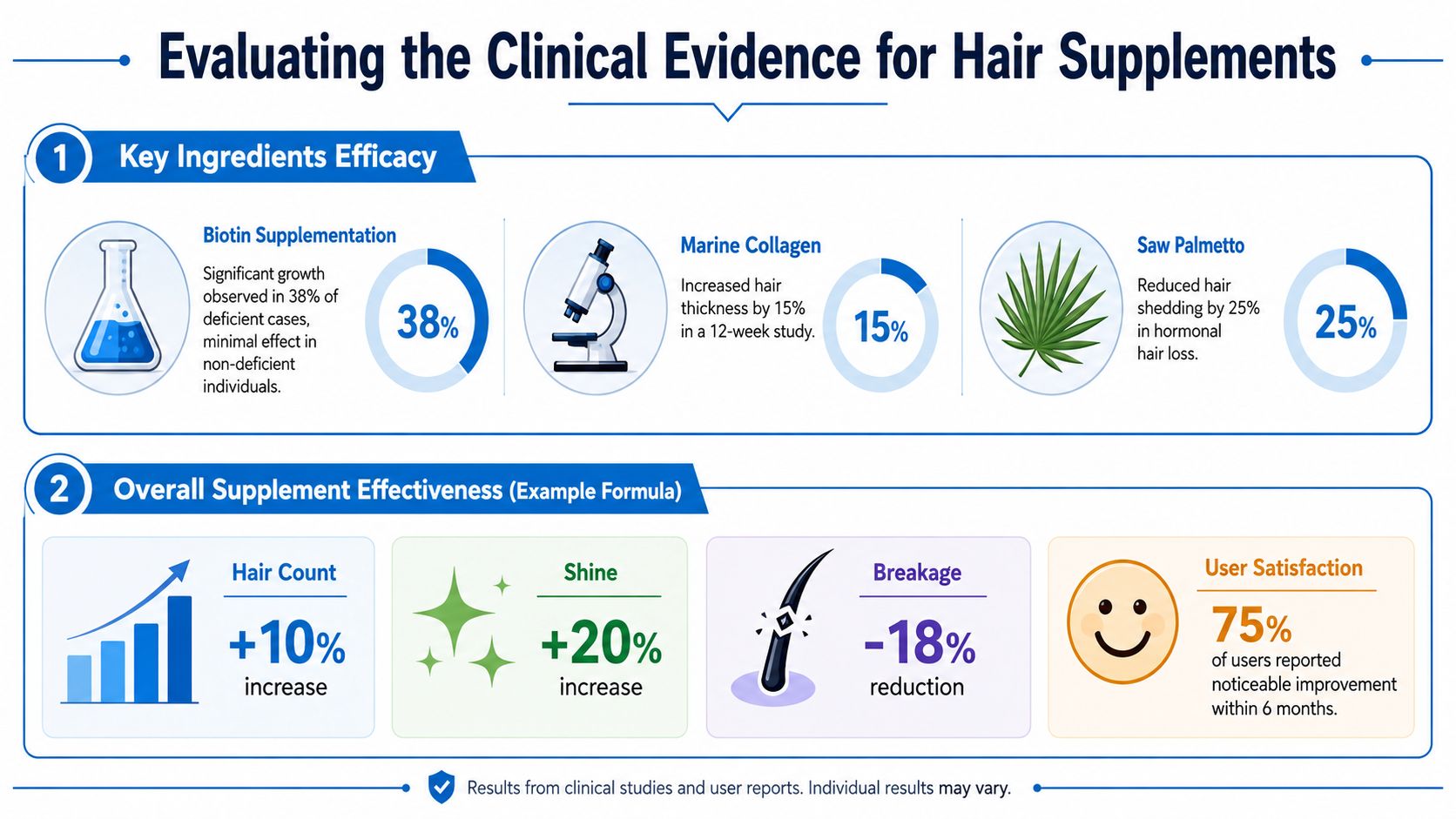
One randomized, placebo-controlled clinical study in women with thinning hair found that 38% of women complaining of hair loss had a biotin deficiency, yet biotin alone showed mixed results. By contrast, women who took a blend of nutrients and botanicals had a 10.1% increase in hair density between baseline and 6 months, while the placebo group had a 2% decrease. The same trial recorded a 10.2% improvement in hair strength tensile measurements in the test group, with no adverse reactions reported (placebo-controlled clinical study on a nutrient and botanical blend).
A different double-blind, placebo-controlled study in women with temporary hair thinning found that daily use of a proprietary oral nutritional supplement increased mean terminal hair count from 271.0 at baseline to 571 after 90 days and 609.6 after 180 days, again with no adverse events reported (double-blind study on oral nutritional supplementation and terminal hair count).
Those are encouraging results, but they point to a more nuanced conclusion than most ads do.
What these results mean in real life
First, multi-ingredient formulas appear more promising than single-ingredient hype, especially when the users have temporary thinning or nutritional compromise. That doesn't prove every blend works. It suggests that hair biology responds better to a coordinated nutritional approach than to one celebrity nutrient.
Second, study populations matter. These trials involved women with thinning hair, not necessarily healthy women taking beauty supplements “just in case.” That distinction is easy to miss and central to making a smart decision.
Third, time matters. Hair changes slowly. The more impressive findings in the second study continued to build over months, which fits what clinicians see in practice. Hair follicles don't care that a bottle's marketing cycle is thirty days long.
The useful takeaway isn't that all supplements work. It's that some formulas can help when they're designed for the right problem and used long enough to affect the hair cycle.
That's the critical-thinking lens many readers need most. Don't ask whether supplements work in the abstract. Ask whether the formula, the evidence, and your likely cause line up.
How to Read a Supplement Label Like an Expert
A supplement label can tell you whether a product was built by people who respect evidence or by people who respect marketing. Once you know what to scan for, weak products become easier to spot.
Start with the ingredient panel
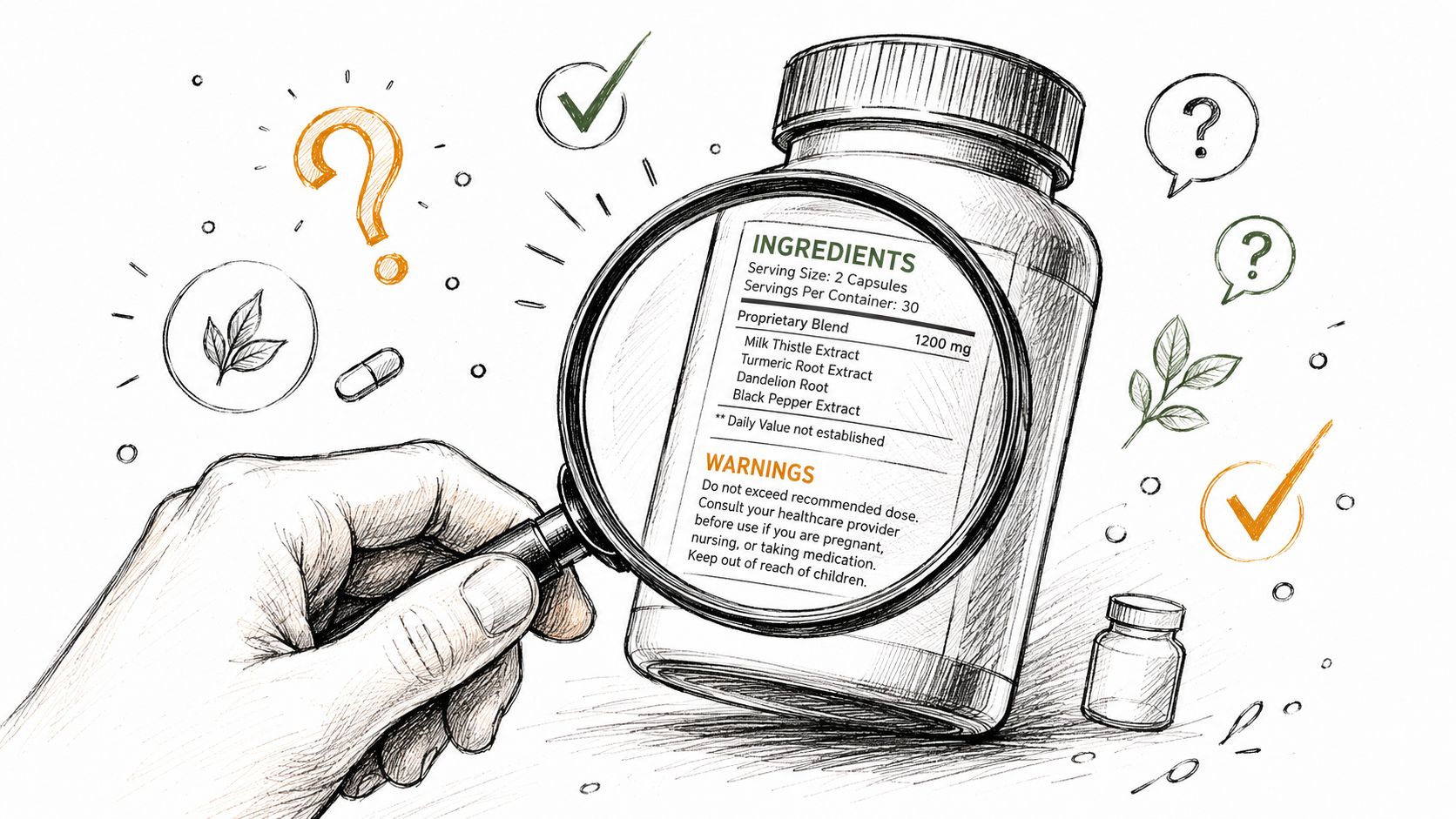
Look for specific ingredients with stated amounts. “Supports hair health” is marketing language. Iron bisglycinate, zinc picolinate, vitamin D3, or a listed botanical extract with a disclosed dose is more informative.
Then ask whether the formula matches a plausible need. A woman with low ferritin may care far more about iron content and tolerability than about a trendy mushroom blend. A woman with no documented deficiency should be cautious about megadoses sold as universal fixes.
Use this simple checklist when browsing vitamins, supplements, and nutrition products:
- Match the formula to the problem: Shedding after illness or restrictive dieting raises different questions than slow genetic thinning.
- Check the exact dose: A label should tell you how much of each active ingredient you're getting.
- Prefer transparency over mystery: If a brand hides amounts inside a proprietary blend, you can't judge whether the formula is meaningful.
- Review safety context: Extra vitamin A, selenium, iron, or zinc isn't automatically better.
- Look for quality signals: Third-party testing and clear manufacturing details are reassuring, especially in a category where shoppers often over-rely on branding.
Red flags that deserve skepticism
Some labels are designed to distract. They feature huge biotin numbers, glossy before-and-after language, and ingredient lists so long they create the illusion of sophistication. But a crowded formula can be a weak formula if the brand doesn't disclose what's inside.
Be wary of products that imply they work for postpartum shedding, menopausal thinning, stress loss, thyroid-related shedding, and genetic hair loss all at once. Those are not the same condition.
A better label reads more like a clinical document than a beauty ad. It tells you the ingredients, the amounts, the intended use, and the cautions. If the package makes big promises while hiding the dose, move on.
Debunking the Great Biotin Myth and Other Untruths
Biotin became the face of hair supplements because it offers a clean, memorable story. Hair is made of keratin. Biotin is associated with keratin. Therefore more biotin must mean more hair. That leap is neat, marketable, and often wrong.
Why biotin became the default answer
The International Society of Hair Restoration Surgeons takes a much more restrained view. It states that the belief that biotin supplements universally improve hair in healthy women is a myth, that biotin deficiency is extremely rare, and that over 90% of women taking biotin for hair loss likely don't need it. The same guidance warns that excess biotin can cause dangerously false lab results, making unsupervised use risky (ISHRS guidance on nutrition, vitamins, and biotin risks).
That last point doesn't get enough attention. A supplement marketed as harmless beauty support can interfere with lab testing in ways that matter far beyond hair.
For readers who've been considering high-dose beauty formulas, it's worth seeing how strongly biotin is marketed in products such as biotin 10000 mcg hair skin nails support. Marketing popularity and clinical necessity are not the same thing.
Other supplement claims worth questioning
The next myth is that “natural” means risk-free. It doesn't. Hair supplements can overshoot safe intake, duplicate nutrients you already get elsewhere, or delay evaluation of an underlying medical cause.
Another myth is that if a product helped someone online, it should help you. Hair loss stories are emotionally persuasive, but they rarely tell you whether that person had low ferritin, postpartum shedding, pattern loss, a medication change, or a scalp condition.
Reality check: The best supplement for one woman can be useless for another if they're treating different causes with the same bottle.
The sharpest consumer habit isn't optimism or cynicism. It's discrimination. Separate plausible biology from broad claims. Separate diagnosed need from wellness theater.
Your Action Plan for Healthier Hair
The most effective plan usually starts with restraint, not impulse. That sounds less exciting than buying a bottle today, but it's how you avoid wasting months on the wrong solution.
A practical sequence that protects your time and money
Start with basics you can control. Eat regularly, prioritize protein-rich meals, and watch for restrictive dieting patterns that often show up in hair before they show up elsewhere. If your shedding began after a major stressor, illness, postpartum change, or dramatic shift in eating, write down the timeline. Pattern matters.
Next, consider medical evaluation before supplement experimentation. Ask a clinician whether blood work makes sense, especially if your history suggests iron or vitamin D issues. If a deficiency is confirmed, a targeted supplement has a much better chance of helping than a random beauty blend.
Then use the label-reading framework from above. Choose products that disclose doses clearly, avoid kitchen-sink formulations, and don't pretend to solve every type of hair loss at once.
A smart sequence looks like this:
- Stabilize diet and routine: Hair hates chaos, especially crash dieting and inconsistent nutrition.
- Identify the pattern: Sudden shedding and gradual thinning point in different directions.
- Check for deficiencies when appropriate: Targeted treatment beats guesswork.
- Choose a supplement only if it fits the likely cause: Evidence matters more than branding.
- Give any reasonable plan time: Hair responds slowly, and changing course too often adds confusion.
When to stop self-treating
See a dermatologist or physician if you have scalp pain, redness, scaling, patchy loss, rapid worsening, or signs that your hair loss may reflect a broader medical issue. Get help if your part is steadily widening, if shedding persists despite correcting obvious triggers, or if you're tempted to keep stacking supplements without a diagnosis.
Hair growth vitamins for women have a place. They're just not the starting point that is widely promoted. The better model is diagnosis first, nutrition second, supplementation third. That order won't satisfy the beauty industry, but it serves women much better.
If you're comparing supplements with a more informed eye, CalVitamin offers a broad selection of vitamins, minerals, proteins, and wellness products to browse. Use the framework from this guide to evaluate any option carefully: identify your likely cause, look for transparent labels, avoid hype-driven megadoses, and choose products that fit a real need rather than a marketing promise.