
Milk thistle extract produces small movements in liver enzymes and is not a proven treatment for liver disease. Pooled trial data put silymarin's effect at a mean difference of 7.25 IU/L for alanine aminotransferase and 5.36 IU/L for aspartate aminotransferase versus placebo, shifts measured on a lab printout rather than in less scarring, fewer hospital admissions, or longer survival.
That distance between a number that moves and an outcome a patient would feel is where most milk thistle marketing falls apart. Bottles promise liver support, detox, clearer skin, and sometimes weight loss. The trial literature behind the ingredient supports a far narrower claim, and only for standardized extracts at defined doses.
This guide reads that record the way a careful buyer would. It sorts the claims into what holds up, what stays unproven, and what to ignore entirely, then turns the numbers into label checks and stop rules you can use while standing in an aisle. Milk thistle extract benefits are real in a narrow biochemical sense, and much thinner than the shelf talk suggests.
Table of Contents
- Which Milk Thistle Extract Benefits Hold Up
- What Silymarin Does Inside the Liver
- Liver Enzymes Are Not the Same as Outcomes
- How the Big Trials Looked Condition by Condition
- Safety Checks Before You Start a Bottle
- How to Read a Milk Thistle Label
- Decide Whether This Extract Belongs in Your Plan
Which Milk Thistle Extract Benefits Hold Up
| Claimed benefit | Evidence snapshot | What studies found | Reader takeaway |
|---|---|---|---|
| Liver enzymes (ALT, AST) | Modest pooled reduction | ALT down 7.25 IU/L, AST down 5.36 IU/L | Lab signal only, not reversed disease |
| Survival in chronic liver disease | No significant benefit | Mortality odds ratio 0.8 (0.5 to 1.5), P=0.6 | Not a survival treatment |
| Hepatitis C | No better than placebo | Liver function, virus levels, and quality of life unchanged | Do not replace antiviral care |
| Alcohol-related liver disease | Conflicting or insufficient evidence | No clear gain in complications or histology | Not a substitute for stopping alcohol |
| Fatty liver or MASLD | Low to very low certainty evidence | Some enzyme and fatty-liver index changes | Does not replace metabolic care |
| Skin, acne, or weight loss | Not established | Claims exceed controlled human evidence | Do not buy for these goals |
| General antioxidant wellness | Plausible, inconsistent in people | Lab antioxidant effects without reliable patient benefit | Optional support, not medicine |
The first row is the only one where the pooled evidence shows a consistent signal. A 2026 systematic review covering 47 studies, 37 of them randomized controlled trials, found that silymarin cut alanine aminotransferase by a mean difference of 7.25 IU/L (95% CI, −11.60 to −2.89) across six trials and aspartate aminotransferase by 5.36 IU/L (95% CI, −8.45 to −2.27) across four trials. Both confidence intervals sit below zero, so the direction of the effect is reliable even though the size is small.
Small is the operative word. Those enzymes leak out of injured liver cells, so a lower reading can hint at less ongoing hepatocellular injury. The same review is direct about the limit: enzyme improvement shouldn't be read as proof that milk thistle reverses fibrosis, prevents cirrhosis, or improves survival.
What the last column asks you to do
Read the table as a set of instructions rather than a scoreboard. "Modest pooled reduction" means a blood test moved. "No significant benefit" means the bottle should never sit where a treatment belongs. "Not established" means the claim is a marketing decision, not a research finding, and you shouldn't spend money hoping otherwise.
Skin, acne, and weight loss sit firmly in that last category. Popular roundups list them because a few lab studies and small trials showed interesting signals in cells or animals. Controlled human evidence doesn't justify buying an extract for clearer skin or a smaller waist, and no trial in this record was designed to test it.
Buying rule: the published numbers belong to defined silymarin preparations, so a bottle that names no silymarin amount isn't the product the trials studied, whatever the front panel says.
Extract standardization, total silymarin content, dose per serving, and third-party quality testing are the variables that decide whether a purchase connects to any of this evidence. A jar of ground seed powder labeled milk thistle carries none of those guarantees.
What Silymarin Does Inside the Liver
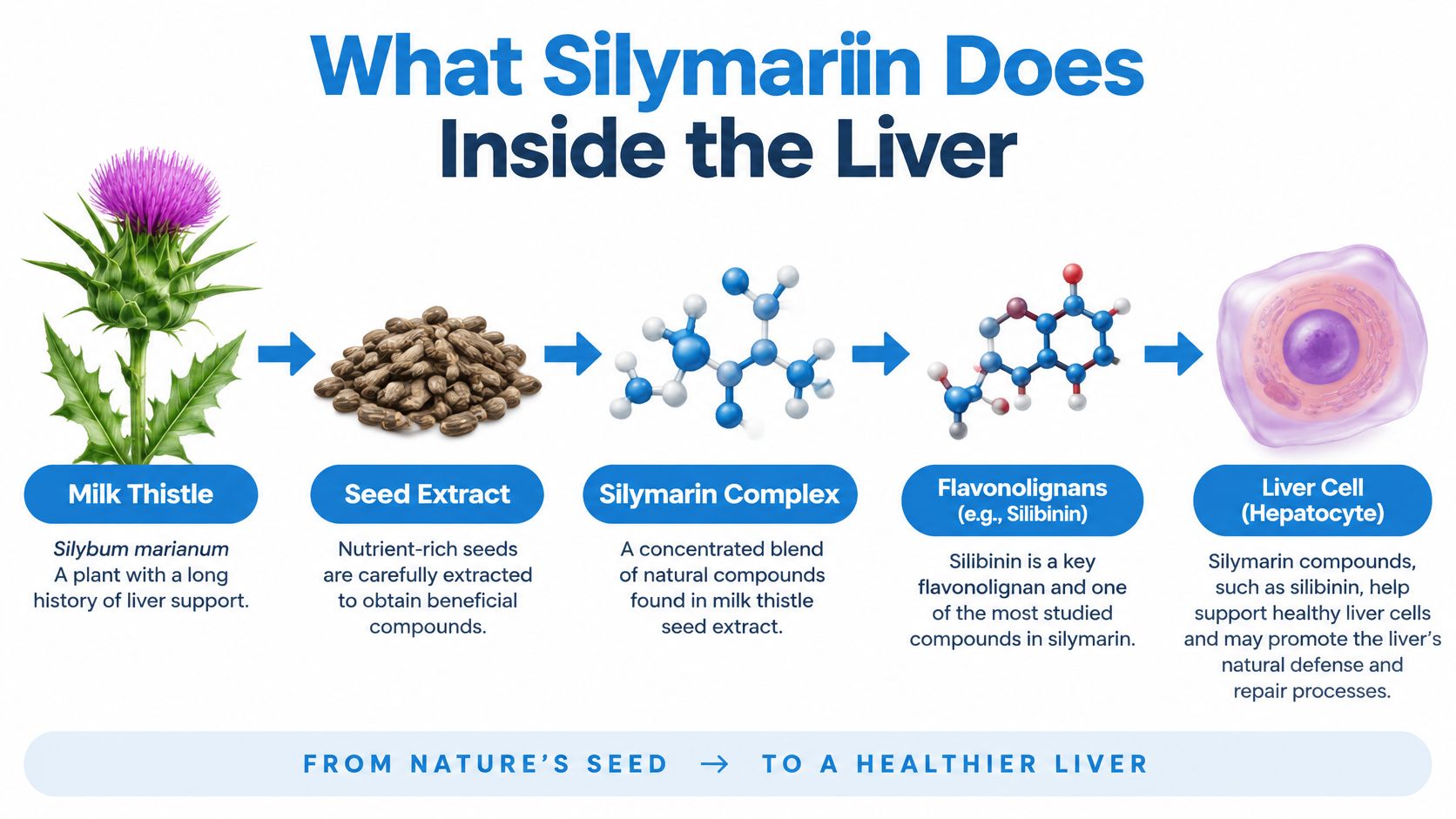
Two bottles can share a front label and contain quite different things. Milk thistle is Silybum marianum, a thistle in the daisy family, and the part that gets used is the seed. Manufacturers extract those seeds and standardize the result to silymarin, a family of flavonolignans whose best-known member is silybin.
A coffee bag that states a caffeine amount per cup tells you the dose. A bag that only says coffee does not. Silymarin is that stated number. Two products both called milk thistle can land far apart on it.
The pipeline from plant to capsule looks like this.
Where the lab story and the human story part
The proposed protection is chemically sensible. Pharmacology references describe silymarin acting as an antioxidant inside hepatocytes, supporting glutathione-related defenses and limiting free-radical damage generated when the body processes substances such as ethanol and acetaminophen, as summarized in the NIH liver toxicology reference. A rust inhibitor on metal is a fair comparison. It is a plausible way to reduce ongoing chemical stress, not a promise that existing damage gets repaired.
Human trials have not confirmed that story in a way you can bank on. Oral doses and study designs differ, and outcomes conflict. NIH's National Center for Complementary and Integrative Health concludes the evidence is conflicting or insufficient for hepatitis, alcohol-related liver disease, and fatty liver disease. Pooled reviews of randomized trials likewise find no clear improvement in mortality, liver-disease complications, or liver histology.
That split is the buying point. A mechanism that looks protective in cells can still miss the results people want: less fibrosis, fewer complications, and survival. A small enzyme shift, when one appears, answers a narrower question than those outcomes.
Promising chemistry and flat clinical results put the honest label on this herb at supportive wellness supplementation. It is not a stand-in for diagnosis, antiviral therapy, metabolic treatment, or the blood work your clinician schedules.
Liver Enzymes Are Not the Same as Outcomes
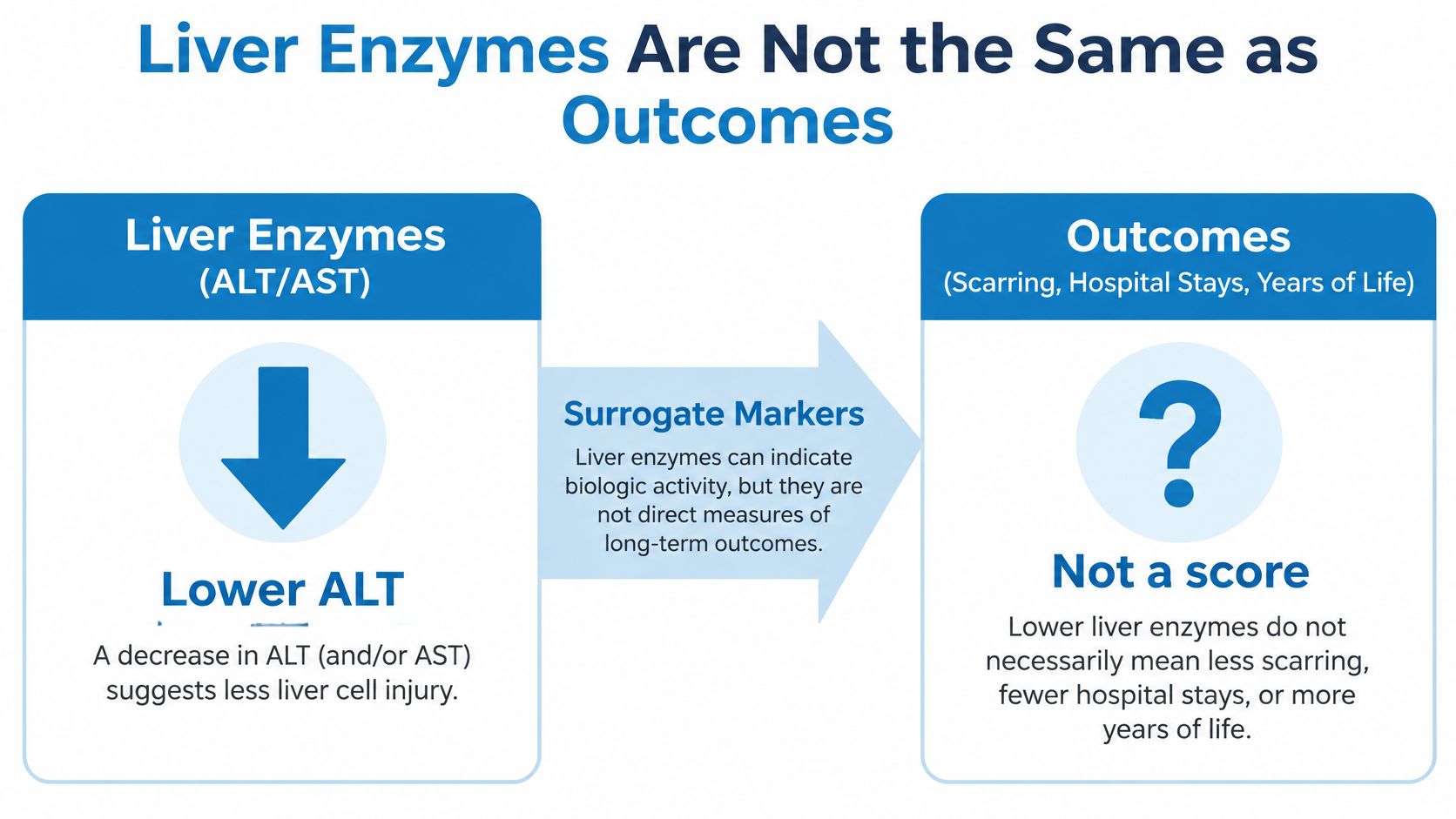
A thermometer in a hot room reads lower an hour after you open a window. The fire hasn't gone out. Liver enzymes behave the same way. ALT and AST fall when liver cells are less inflamed or less leaky, and that number tells you nothing direct about how much scar tissue sits in the organ or how the next five years will go.
That distinction matters because supplements get sold on the movement, not the outcome.
The condition list where trials have been run, per the NIH complementary medicine review of silymarin, covers alcohol-related liver disease, hepatitis B and C, fatty liver disease, and liver problems tied to chemotherapy or toxins. Across those conditions the evidence is described as conflicting or insufficient, and two NCCIH-funded studies of silymarin, one in hepatitis C and one in nonalcoholic steatohepatitis, found no benefit.
What the metabolic trials actually found
The metabolic liver story is the most nuanced part of the file. A 2025 summary of a Cochrane review reports that silymarin may lower some liver enzymes in adults with metabolic dysfunction-associated steatotic liver disease, but certainty was low to very low and overall benefits and harms stayed unclear. Another review of 26 randomized trials involving 2,375 people reported improvements in liver enzymes, fatty-liver indexes, and some histologic measures, while fibrosis progression, complications, and mortality remain inadequately established.
Read those two findings together and the pattern is consistent. The closer a study looks at something a patient would notice, the weaker the result gets.
Enzyme and imaging changes are early clues. Fibrosis stage, cirrhosis, hospitalization, and survival are the outcomes that change how your care is managed.
When an advertisement leads with "clinically shown to support liver health," ask which measure moved. If the answer is a lab value, the claim is about a surrogate marker. If the answer is a hospital stay or a biopsy result, the ad is claiming something the trials haven't delivered.
An extract also can't do the work that changes liver outcomes. Weight management, cutting alcohol, hepatitis vaccination, treatment of viral hepatitis, and clinician-directed MASLD care all carry evidence this herb does not, and none of them can be replaced by a capsule.
How the Big Trials Looked Condition by Condition
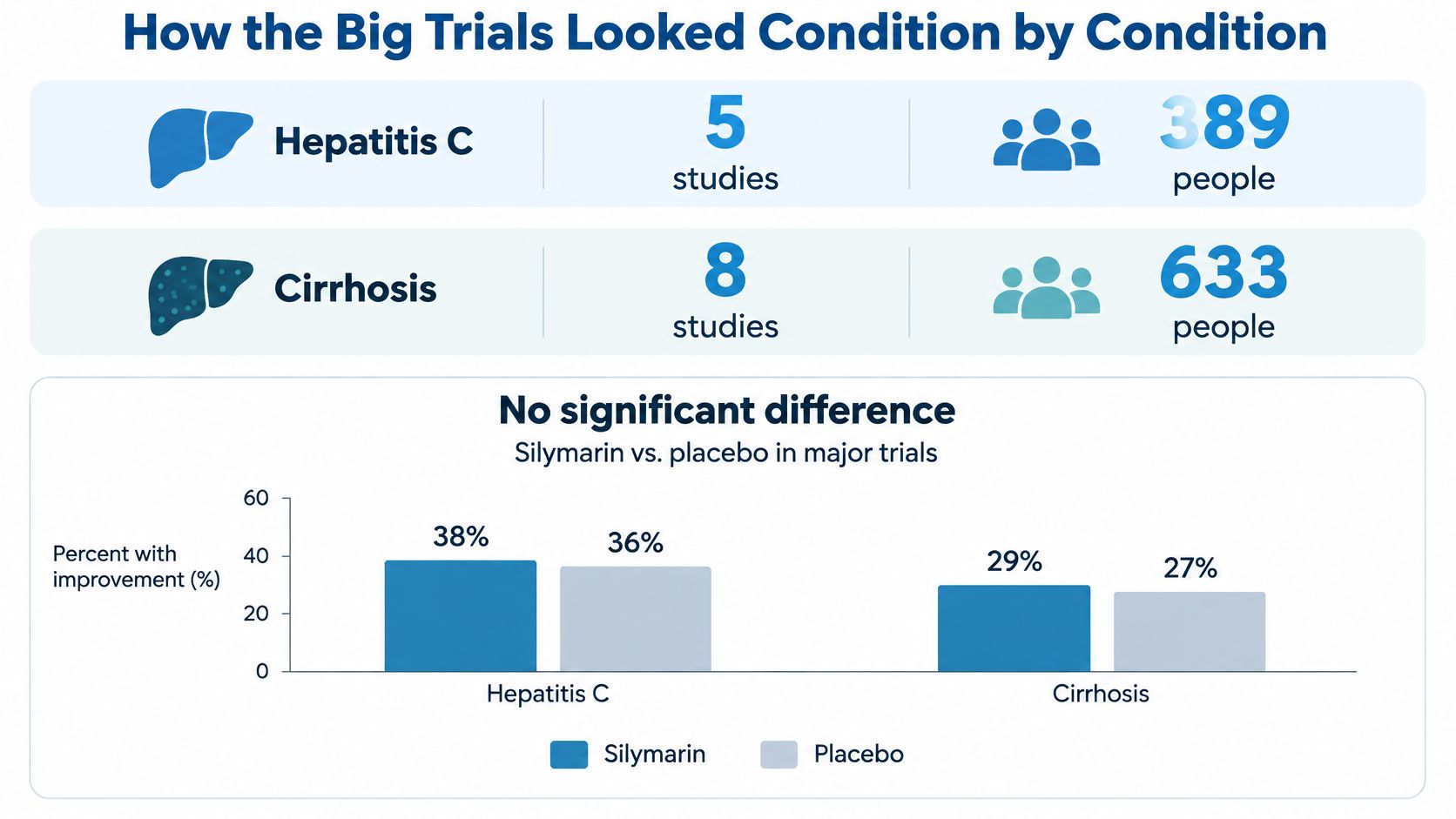
Hepatitis C provides a clear test of whether milk thistle can change measurable disease outcomes. A 2014 evaluation of five studies involving 389 people found that silymarin did not improve liver function or reduce hepatitis C virus levels compared with placebo.
A separate trial in people whose hepatitis C had not responded to treatment also found no advantage over placebo. Silymarin did not improve a liver-function measure, viral levels, or quality of life. A later review likewise found, at most, small changes in ALT and AST, which do not establish that people feel better or avoid disease complications.
The older mortality record
For chronic liver disease, the evidence is older and similarly limited. A 2002 systematic review of 14 randomized trials found four trials reporting mortality, covering 433 participants. The pooled mortality odds ratio was 0.8, with a 95% confidence interval of 0.5 to 1.5 and P=0.6, showing no statistically significant survival benefit.
Across the studies, milk thistle did not consistently improve liver histology, ALT, AST, albumin, or prothrombin time. One biochemical result was a 9 IU/L drop in ALT among people with chronic liver disease. The review described that change as clinically negligible, and it was no longer statistically significant when the analysis was limited to longer or higher-quality studies. Adverse effects were infrequent and comparable to placebo.
These results separate biological plausibility from demonstrated benefit. Antioxidant activity does not establish that an extract prevents fibrosis, reduces complications, or extends life.
For buyers, the evidence does not support claims that milk thistle treats hepatitis C, cirrhosis, or another liver disorder. Small shifts in liver enzymes are not proof of those outcomes, and a supplement should not replace prescribed care.
Safety Checks Before You Start a Bottle
Side effects in the trial record were uncommon and close to placebo, which is reassuring for a healthy adult. It is not a free pass for everyone, because the people most drawn to a liver supplement are often the ones with the most reason to check first.
| Situation | Why it matters | Practical step |
|---|---|---|
| Pregnancy or nursing | Benefit unproven and safety not established for this use | Ask a clinician before any dose |
| Taking prescription medicine | Interaction evidence is limited | Show the exact label to the prescriber |
| Diagnosed liver disease | Extract is not a proven therapy | Keep monitoring and prescribed treatment |
| Ragweed or Asteraceae allergy | Plant-family cross-reaction is a known caution | Avoid unless a clinician clears it |
| Children | Cited trials studied adults | Do not use adult doses without pediatric advice |
| Choosing a higher dose | Trials tested a wide oral range with mixed results | Do not treat a bigger dose as better care |
Work down that table. Pregnancy and breastfeeding top the list because nothing in this literature establishes benefit for that use, and it's the wrong moment to run a personal experiment. Prescription medicine comes next: interaction data for milk thistle is thin, so anyone on antivirals, diabetes medication, or a daily cardiac drug should bring the actual bottle to the prescriber instead of guessing.
If you're stacking herbs, read our guide to curcumin and piperine and how pairings change absorption before you add a second capsule to the routine. Combining two botanicals multiplies the unknowns, not the evidence.
Stop rules that apply to anyone
A new rash, severe stomach upset, or yellowing of the skin or eyes means stop the product and get medical care. Those symptoms can signal an allergic reaction or a liver problem that needs assessment, and neither is something to ride out while waiting for a bottle to help.
Dose logic: human studies tested a range, not a target. A 560 mg capsule isn't the "strong" version of a 150 mg one; it's simply a different point on a range that produced conflicting results.
Anyone with a diagnosed liver condition should treat the first conversation as medical, not commercial. A normal starting point for a healthy adult is still a conversation when there's a diagnosis on the chart.
How to Read a Milk Thistle Label
Standing in an aisle with a bottle in hand, run six checks in order. They take about 30 seconds and they separate a product with a traceable dose from one with a story.
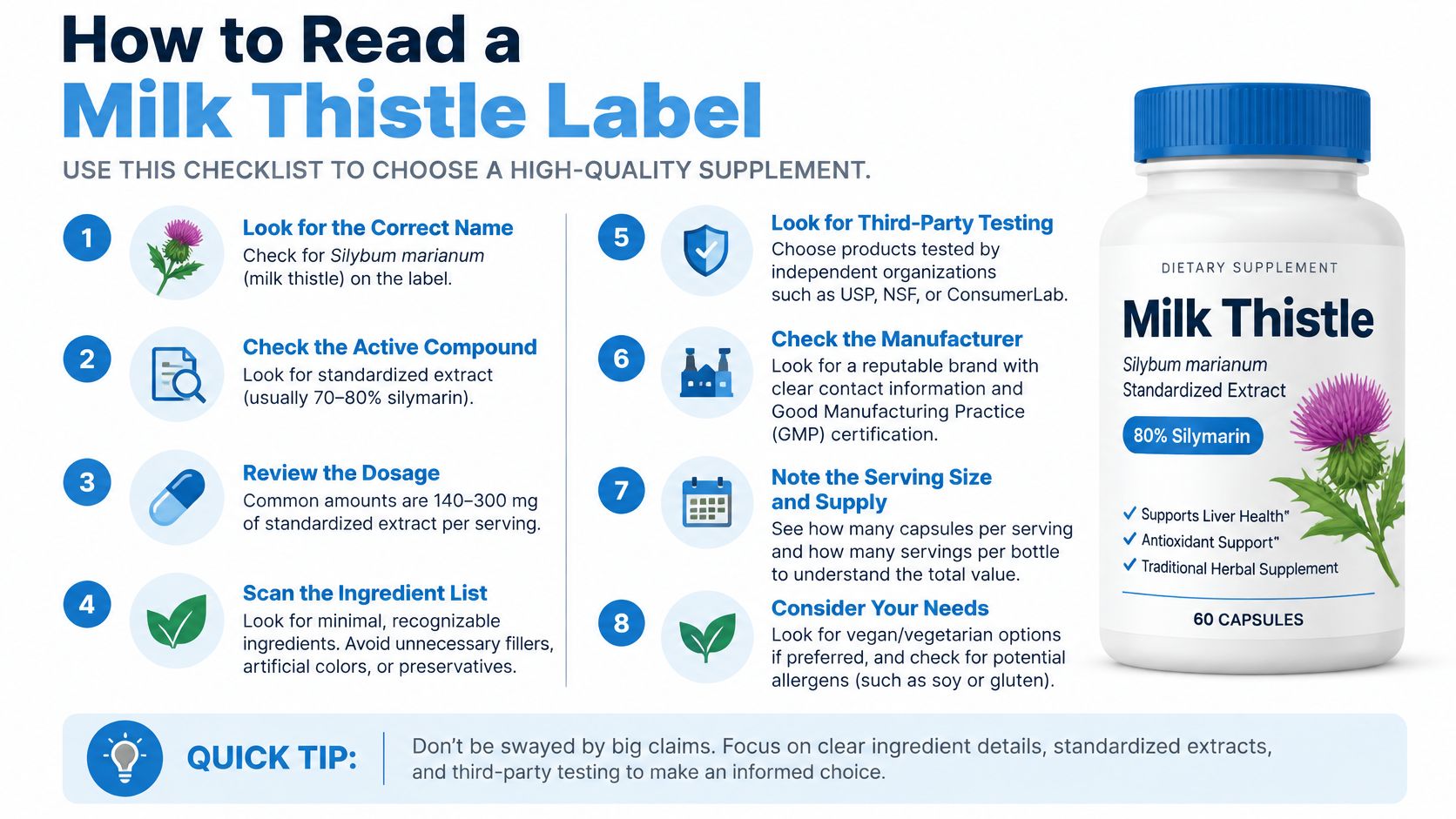
- Find the plant part. You want milk thistle seed extract, not "milk thistle herb" or a whole-plant powder. The seed is where silymarin comes from, so a label naming the aerial parts is describing a different material.
- Locate the silymarin figure. It may appear as a standardized percentage, as total silymarin, or as silybin milligrams. Write the number down. If there's no number, stop here.
- Convert to a daily amount. Serving size is the trap. Three capsules a day at 150 mg each is a different intake from one capsule at 150 mg, and the label's front panel won't do that math for you.
- Match the extract to the research. The clinical evidence in this guide applies to defined silymarin preparations, so a standardized extract with a stated milligram amount is the only format you can map onto it.
- Check quality testing. Look for third-party testing and a clean allergen statement. Supplements aren't regulated like drugs, so independent verification is the only outside check on what's in the capsule.
- Reject extra promises. Weight loss, acne clearing, hepatitis cures. Every one of those is a claim the trials don't support, and a label that makes them is telling you how it treats evidence.
A grocery run is one way to understand it. The standardized milligrams are the nutrition panel. The disease promise on the front is an unregulated slogan, and the slogan is usually the part with the biggest font.
Where labels go vague
Three formats make the checks impossible. A proprietary blend buries silymarin inside a total milligram count with no breakdown. A tincture lists droppers instead of milligrams. A "liver formula" names milk thistle in the ingredient list without any extract specification, often alongside five other herbs at unknown amounts.
Our walkthrough on how to read a supplement label covers the rest of the panel, including the claims and structure-function language that legally sits on a bottle without proof.
Pass rule: if the label won't tell you how many milligrams of silymarin are in a daily serving, none of the research in this guide can be applied to that bottle. Put it back.
Decide Whether This Extract Belongs in Your Plan
Four decisions settle this, and the second and third involve shopping.
Anyone with a liver diagnosis books the clinician first. Hepatitis C, alcohol-related liver disease, MASLD, or unexplained enzyme changes stay in medical care. Antivirals, alcohol reduction, metabolic treatment, vaccination, and scheduled monitoring stay in place. The condition trials did not establish a supplement substitute. A bottle that delays a blood test is a bad trade.
A healthy adult who still wants a capsule should expect very little. The realistic ceiling is a possible small ALT or AST movement of the size shown in the opening table. Clearer skin, weight loss, slower fibrosis, and extra years are outcomes those trials do not support. If that limited enzyme shift is not worth the money, skip the purchase and keep the cash.
Open the bottle only if the safety questions are clear and the label states silymarin milligrams per day. Both conditions, not one. Ragweed allergy, pregnancy, a child in the house, or a daily prescription each turn this into a clinician conversation rather than a shelf decision.
Plan the next blood test with your clinician before you start. A lab change is a clue to follow, not proof that a disease reversed. A small enzyme drop is also not permission to ease off the treatments and habits that change fibrosis, complications, and survival.
A standardized silymarin preparation may nudge liver enzymes. It does not treat liver disease. If those steps are clear and the comparison is between products rather than slogans, CalVitamin stocks herbal formulas with ingredient panels you can read before you buy. The Phytoral Liver Support review shows how to weigh a liver formula's label against the evidence in this guide. CalVitamin lists dose per serving and extract standardization on those panels, which is the information a cart decision needs. Start with the milligrams on the back, and let the next blood test show whether the capsule is doing anything at all.


