
Which iron tablet is stronger: the one printed 325 mg or the one printed 65 mg?
A common choice is the 325. It's the wrong answer, and it explains why so many iron routines fall apart before they help anyone. The 325 is the weight of the whole compound, ferrous sulfate, not the iron your gut takes up. That tablet carries roughly 65 mg of elemental iron, and elemental iron is the only figure worth comparing with what your body needs.
Get that number right and the rest becomes a set of trade-offs you can reason about. Dose first, schedule second, and interactions with everything else in your medicine cabinet third.
Table of Contents
- Read Elemental Iron on the Label
- Iron Supplement Timing and Dose at a Glance
- How to Take Each Dose Step by Step
- Foods and Medicines That Block Iron Absorption
- Fixing Side Effects by Changing the Schedule
- Confirm Your Iron Plan With a Clinician
Read Elemental Iron on the Label
Iron salts don't carry iron in equal proportions. Ferrous sulfate is about 20 percent elemental iron by weight, ferrous fumarate runs higher, ferrous gluconate lower. A large-looking gluconate tablet can deliver less usable iron than a smaller sulfate one, so you can't rank two products by the number on the front of the bottle.
The Supplement Facts panel is where the figure sits, listed as elemental iron per tablet. Compare that against your target, not against the compound weight. Our walkthrough on how to read a supplement label shows exactly where that line falls on a panel and which other entries you can skip past.
The reference numbers worth memorizing
The NIH Office of Dietary Supplements sets daily recommended amounts at 8 mg for adult men and postmenopausal women, 18 mg for premenopausal women to cover menstrual losses, and 27 mg in pregnancy, with an adult tolerable upper intake level of 45 mg per day from food and supplements unless a clinician prescribes more.
That ceiling isn't a formality. The same guidance warns that doses at or above it are associated with gastrointestinal side effects, which is why nausea, constipation and abdominal cramping turn up so predictably in people who treat the upper limit as a daily target.
| Group | Daily amount (mg elemental iron) | Practical note |
|---|---|---|
| Adult men | 8 | Supplement only when a deficiency is confirmed |
| Postmenopausal women | 8 | Same allowance as adult men |
| Premenopausal women | 18 | Higher allowance to cover menstrual iron losses |
| Pregnancy | 27 | Ask a prescriber about dose and timing |
| Adult upper limit, food and supplements | 45 | Exceed only when a clinician prescribes it |
The elemental amount also decides whether a product does anything at all. A controlled trial cited in that same guidance gave 215 adults who had donated blood either 37.5 mg of elemental iron daily as ferrous gluconate or no iron for 24 weeks. The supplemented group recovered lost hemoglobin and iron in less than half the time the unsupplemented group took.
So the foundation is unglamorous: convert the label to elemental iron, compare it with the table or with the target your clinician set, and store the bottle out of reach of children. Iron is one of the supplements where a toddler swallowing a handful of tablets becomes an emergency room visit.
Iron Supplement Timing and Dose at a Glance
Once-daily elemental iron is the ordinary starting point, and it's defensible. What surprises people is how little the clock matters compared with the spacing. Iron temporarily raises hepcidin, a hormone that limits further iron uptake, so a dose taken today can blunt the dose you take tomorrow.
What the Swiss trial found
A randomized controlled trial of 150 young Swiss women with low iron stores compared 100 mg of iron on consecutive days for 90 days with 100 mg on alternate days for 180 days, with the same total dose in both arms (the trial record on PubMed). Median ferritin came out at 43.8 mcg/L on consecutive days and 44.8 mcg/L on alternate days, a difference that wasn't statistically significant.
Comfort separated the groups where ferritin didn't. Gastrointestinal side effects on dosing days were more frequent with consecutive-day treatment, with a likelihood-per-repeat of 1.56 and a 95% confidence interval of 1.38 to 1.77. The alternate-day group also carried lower median hepcidin, 1.9 nM against 3.0 nM, which fits the uptake story neatly: less hormonal braking, more iron moving across the gut.
A separate randomized study summarized alongside it reported cumulative fractional absorption of 21.8% with alternate-day dosing against 16.3% with consecutive-day dosing.
| Schedule | Dose pattern | What the research shows | Best fit |
|---|---|---|---|
| Once daily, consecutive days | 100 mg elemental iron daily for 90 days | Median ferritin 43.8 mcg/L; more GI side effects on dosing days | Default start if well tolerated |
| Every other day | 100 mg every 2 days for 180 days | Median ferritin 44.8 mcg/L; fewer dosing-day side effects | Nausea, constipation or missed doses on daily dosing |
| Alternate-day vs daily, separate study | 100 mg daily vs every other day | Cumulative fractional absorption 16.3% daily vs 21.8% alternate-day | Explains why spacing can improve uptake |
| Every other day, higher dose | 200 mg every other day | Almost twice the total absorption of 100 mg taken daily | Clinician-directed treatment of confirmed deficiency |
| Twice daily | 60 mg two times a day | Faster early hemoglobin rise than 120 mg every other day; similar final hemoglobin gain | Clinician-directed when a quicker early response is needed |
The pattern across these comparisons is consistent and worth stating plainly: spacing doses improves the fraction you absorb and the comfort you feel, but it doesn't manufacture extra iron out of thin air. If a prescriber set your schedule because your ferritin was very low, switching it on your own can delay your recovery even while your stomach feels better.
How to Take Each Dose Step by Step
Dose and schedule are decisions. The routine is execution, and execution is where many people drift. Here's the sequence I'd hand anyone starting iron today.
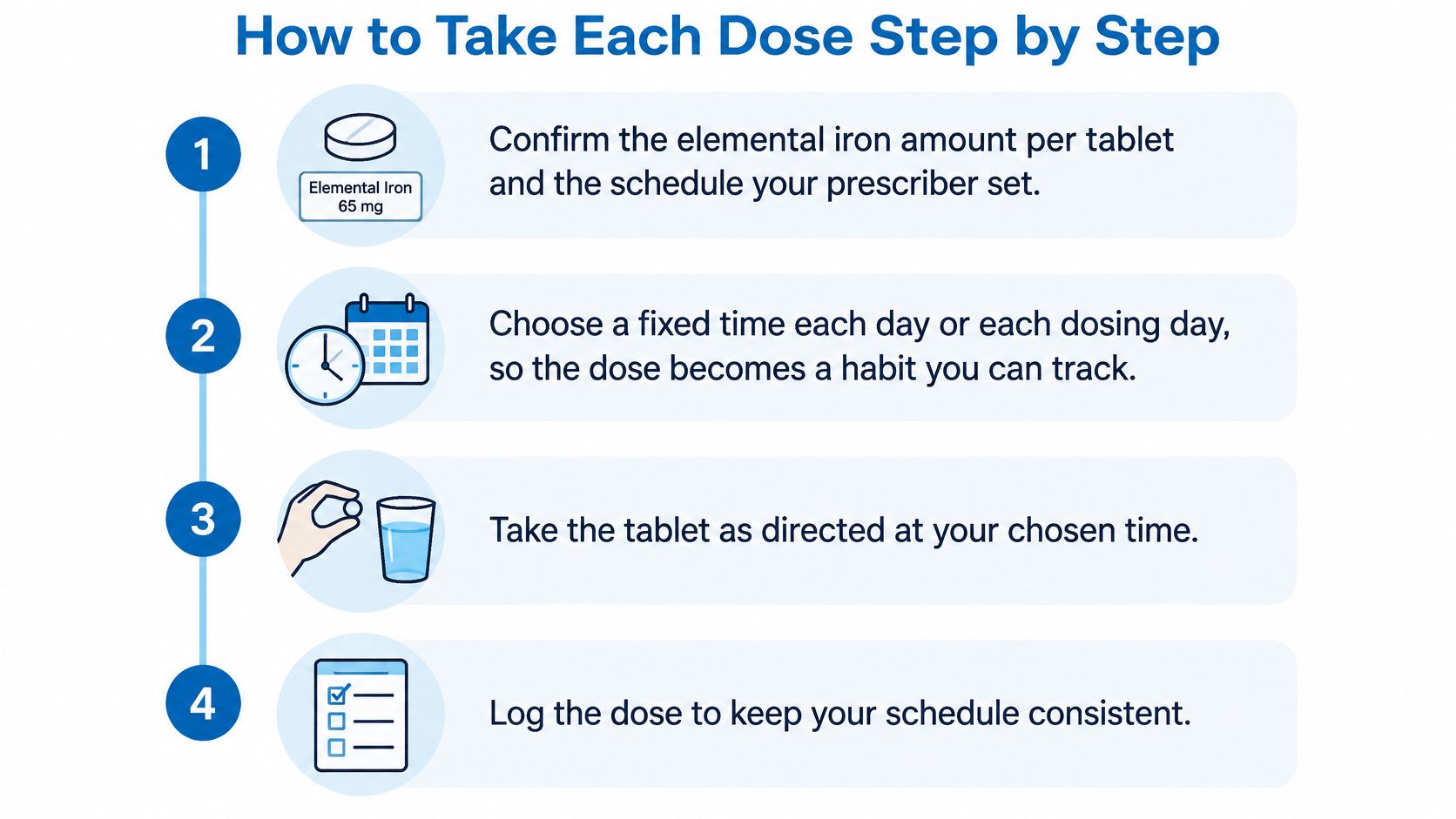
- Confirm the elemental amount per tablet and the schedule you were given. Write both on the bottle in marker if you have to. Everything downstream depends on that number being right.
- Pick a fixed time and keep it. Same hour each day, or each dosing day. A dose anchored to something you already do, like brushing your teeth, survives a busy week better than one anchored to a reminder you'll swipe away.
- Swallow it with a full glass of water, ideally on an empty stomach. About an hour before breakfast is the classic window, because food components compete with iron for absorption. If that timing wrecks your stomach, adjust in the next step rather than abandoning the dose.
- If nausea appears, take it with a small snack instead of skipping it. A few crackers or a piece of fruit is enough. Skip the large dairy-heavy or high-fiber meal at that sitting, since both work against you.
- Keep the bottle closed and out of sight of children. Accidental pediatric iron ingestion is the reason this step appears in every serious set of instructions.
- If you miss a dose, take it when you remember, unless the next one is close. Then let it go. Doubling up buys nothing and costs you a rough afternoon.
- Log two weeks of dosing and side effects. A phone note is fine. Actual dates and symptoms turn a vague "it upset my stomach" into information a clinician can act on.
One more habit worth building: keep the water glass and the bottle in the same place every day, so the routine doesn't depend on memory.
Practical test: if you can run this routine for four weeks without strong side effects, you've found a schedule you can keep. A schedule you can keep beats a perfect one you quit.
Foods and Medicines That Block Iron Absorption
Start with the sequence, not the rule. Prescriber's instructions come first, and no general advice on this page outranks them. Next, confirm the elemental amount so you know what you're protecting. Then separate iron from the items that fight it, on a pharmacist's direction. Only after that do you pick a time that's tolerable.
Calcium is the one people miss. The NIH guidance notes that calcium and iron are best taken at different times because calcium may interfere with iron absorption, which means your calcium-rich multivitamin and your iron tablet shouldn't share a swallow. The same source identifies interactions with levodopa and levothyroxine, and notes that proton-pump inhibitors may reduce iron absorption (NIH Office of Dietary Supplements, Iron fact sheet for health professionals). Our guide to how to take calcium supplements covers the other side of that spacing problem.
| Interacting item | Effect on iron | How to separate |
|---|---|---|
| Calcium supplements or calcium-rich multivitamins | Calcium can reduce iron absorption | Take iron at a different time, as a pharmacist directs |
| Tea and coffee | Compounds in tea and coffee reduce absorption | Avoid drinking them around the dose |
| Antacids | May reduce absorption | Space the doses apart as the pharmacist advises |
| Proton-pump inhibitors | May reduce absorption | Ask the prescriber whether the plan needs review |
| Levothyroxine | Interacts with iron absorption | Follow the prescriber's timing; do not change thyroid timing alone |
| Levodopa | Interacts with iron absorption | Confirm timing with the prescriber or pharmacist |
A word on juice. Vitamin C does help you absorb non-heme iron, but it isn't a solvent for every interaction. Taking your tablet with orange juice while also swallowing a calcium chew, a thyroid tablet and an antacid gets you a crowded stomach, not a clever workaround.
Zinc belongs on the separation list too. One of our zinc products, NOW Zinc 50 mg, carries the explicit instruction not to take it at the same time as high doses of calcium or iron, because they compete for the same absorption pathway.
Practical rule: write down every medicine, vitamin and mineral you take, then hand that list to a pharmacist before you lock in an iron time. Two minutes of review beats six weeks of a schedule that never had a chance.
If an empty-stomach dose is intolerable, choose a time you can live with. A dose taken with food absorbs less than a dose taken on an empty stomach, but it beats a dose you skip. And a deficiency that persists despite consistent supplementation deserves investigation for blood loss, poor absorption or a wrong diagnosis, not another bottle.
Fixing Side Effects by Changing the Schedule
When daily iron brings nausea, cramping or constipation that threatens your consistency, the evidence-based move is to cut the frequency, not to raise the dose. In iron-depleted women, alternate-day administration of 100 or 200 mg of elemental iron produced significantly higher fractional absorption than consecutive-day dosing, and one randomized comparison found nausea less common with alternate-day treatment (Gut, the British Society of Gastroenterology journal).
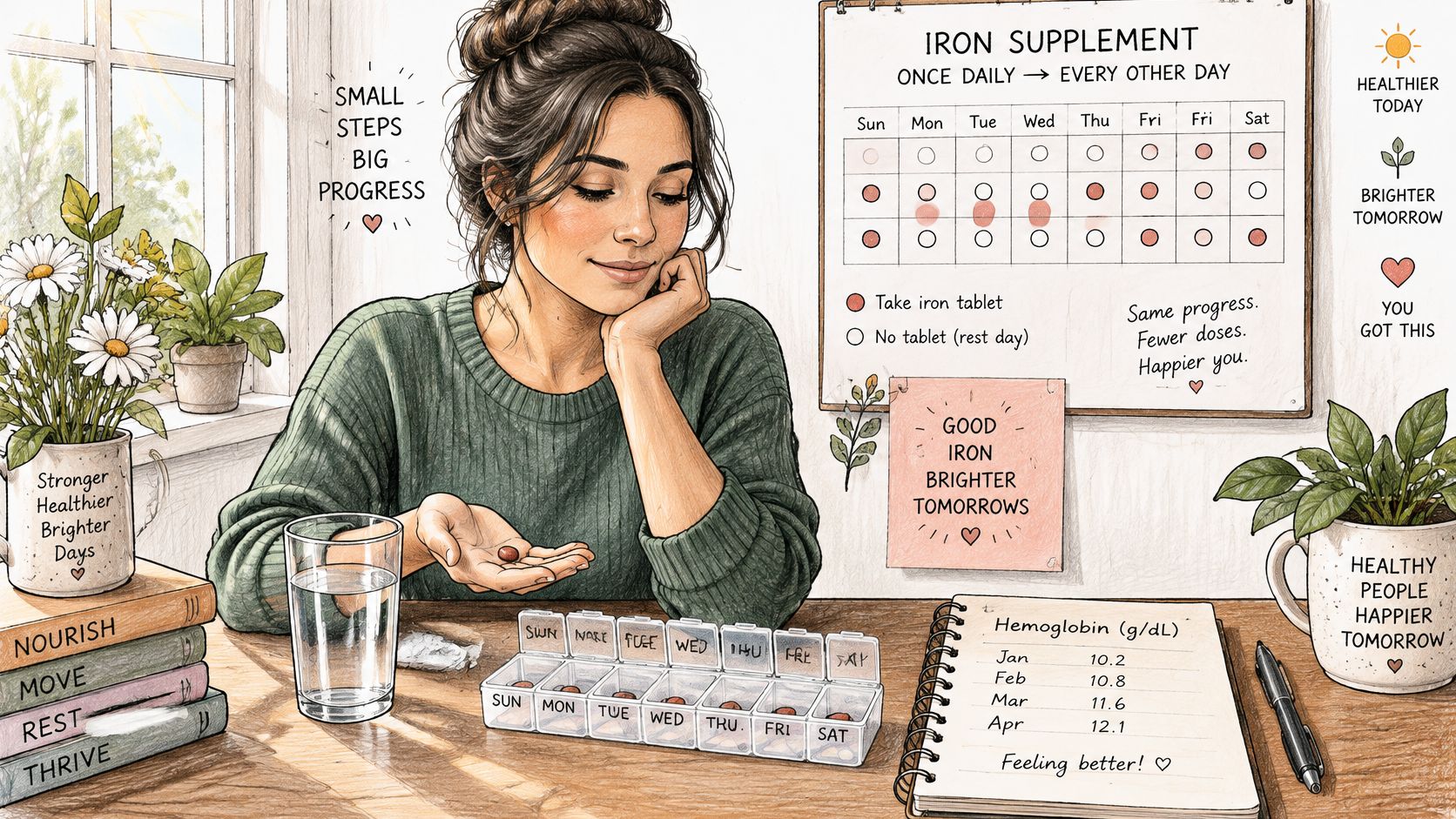
That gives you a stepwise method rather than a pile of options. Begin with once-daily elemental iron. Watch how you tolerate it and track your hemoglobin through labs. If adverse effects threaten whether you take the dose at all, move to every other day. Then reassess your laboratory response with the clinician who ordered the treatment.
Where vitamin C fits, and where it doesn't
Guidance on vitamin C is genuinely split. NIH sources identify vitamin C as enhancing non-heme iron bioavailability, while the British Society of Gastroenterology notes that routine vitamin C coadministration isn't clearly necessary for oral replacement therapy. Read that as permission, not prescription: adding vitamin C with your dose is an option, and skipping it is entirely reasonable.
Change one variable at a time. Shift the schedule first, give it a fair trial of several weeks, and only then consider the next adjustment, such as the time of day or the form of iron. Two changes at once leave you guessing which one helped.
"Take it with orange juice" is the most repeated advice in iron supplementation and the least useful on its own. It says nothing about frequency, and frequency is where most of the comfort comes from.
Here's a short walkthrough of the timing logic before you settle on a plan.
Then match the symptom to a first fix, and know your call point in advance so a bad week doesn't turn into a stopped treatment.
| Side effect | What to try first | When to call a clinician |
|---|---|---|
| Nausea | Take with a small snack or switch to every other day | Vomiting that prevents you from taking the dose |
| Constipation | Increase fluids and fiber, or switch to every other day | No bowel movement for several days, or severe pain |
| Stomach cramps | Lower the frequency or take with food | Pain that persists or gets worse |
| Dark stools | Usually harmless with iron | Black, tarry stools with dizziness or weakness |
Any change to a schedule a clinician set goes through that clinician. Bring your notes and your latest labs to the conversation instead of making the switch on your own and hoping the next blood test explains it.
Confirm Your Iron Plan With a Clinician
Iron treats a cause. It isn't a standing habit like a multivitamin, and treating it as one hides the problem instead of solving it. Tiredness or pallor that persists despite weeks of consistent supplementation needs a proper look: blood loss, poor absorption and an incorrect diagnosis all produce the same story on the surface.
Ask for a blood count and iron studies, including ferritin and hemoglobin, before you settle into indefinite self-supplementation. Then ask two questions at the visit. How long should I keep taking this, and when is my next blood test due? Those two answers turn an open-ended routine into a treatment with an end point you can measure.
Warning signs that skip the wait
Some symptoms shouldn't wait for a scheduled appointment. Get prompt care for chest pain, shortness of breath or fainting, and for black, tarry stools accompanied by dizziness or weakness, which suggest bleeding rather than a supplement side effect. Any symptom that persists after two weeks of schedule changes belongs in front of a clinician, not on a forum.
Pregnancy and breastfeeding move the whole conversation under a prescriber's supervision, because the dose and the timing affect two people. And if a child swallows iron tablets, call Poison Control or emergency services immediately, without waiting for symptoms to appear.
Bring three things to the appointment: the bottle with the elemental iron amount visible, your schedule and side-effect notes, and every medicine and supplement you take, including anything you'd call "just a vitamin."
That last item matters more than it might seem at first glance. If you keep halal, gelatin-free or cruelty-free products in your routine, the halal iron supplements guide covers how to check a capsule shell or coating without losing track of the elemental dose.
The habit worth keeping is a short review at every visit: does this dose, this timing and this testing plan still fit what my labs are showing? Supplements don't adjust themselves. Someone has to look at the numbers, and that someone should be you and your clinician together.
If you're rebuilding your routine from the label up, CalVitamin stocks vitamins, minerals and single-ingredient supplements, and every product page lists the facts panel so you can check an elemental amount before anything arrives. Our Jacksonville-based support team answers questions by phone and email if you'd rather talk through a schedule than guess at one. Visit CalVitamin to compare what's in the bottle, then take that list to your next appointment.


