

Vitamin A supports night vision, immune defenses, growth and development, reproduction, and the cell linings of the eyes, airways, and gut. Adult men need 900 micrograms RAE a day and adult women need 700, and taking more doesn't sharpen ordinary vision once those targets are already met.
If a label promises sharper eyes, does that mean a bigger dose is better? Most explanations stop at a benefit list and never separate treating a real shortage from topping up a diet that already covers the job. The table below is the map. Match a row to your concern, then use the later sections to check intake and the point where extra preformed vitamin A starts adding risk.
Table of Contents
- What Vitamin A Helps With at a Glance
- How Vitamin A Works Inside the Body
- Vision, Night Sight and Eye Health
- Immune Defenses and Healthy Child Growth
- Who Is Most at Risk of Low Vitamin A
- Daily Vitamin A Needs Measured in RAE
- Foods That Supply Vitamin A
- Safe Upper Limits and a Weekly Intake Check
What Vitamin A Helps With at a Glance
What does vitamin A help with comes down to a short list: dim-light vision, immune defenses, growth and development, reproduction, and the linings of the eyes, airways, and gut. In 2025, the U.S. National Institutes of Health Office of Dietary Supplements stated that vitamin A is involved in immune function, cellular communication, growth and development, and male and female reproduction. That list is broad. The strength of the evidence is not the same for every row.
Shortage builds slowly, so the first clues are easy to shrug off. Trouble seeing at dusk, or more colds than usual, can show up long before anyone names a nutrient gap.
| Body function | What vitamin A does | Sign when intake is too low |
|---|---|---|
| Vision | Makes visual pigment that lets eyes adjust to dim light | Night blindness and dry eyes |
| Immune defenses | Keeps mucosal barriers and immune cells working | More frequent infections |
| Growth and development | Supports normal cell specialization in growing children | Slowed growth |
| Skin and mucous membranes | Maintains the linings of the eyes, airways and gut | Dry, rough skin and weakened linings |
| Reproduction | Supports male and female reproductive function | Impaired reproduction in severe deficiency |
| Gene regulation | Helps control which genes cells switch on | No single sign; shows up through the other rows |
Find the rows that match what you're noticing. The next sections show how the same nutrient does those jobs, who is likely to fall short, and how to compare a label with a real daily target.
How Vitamin A Works Inside the Body
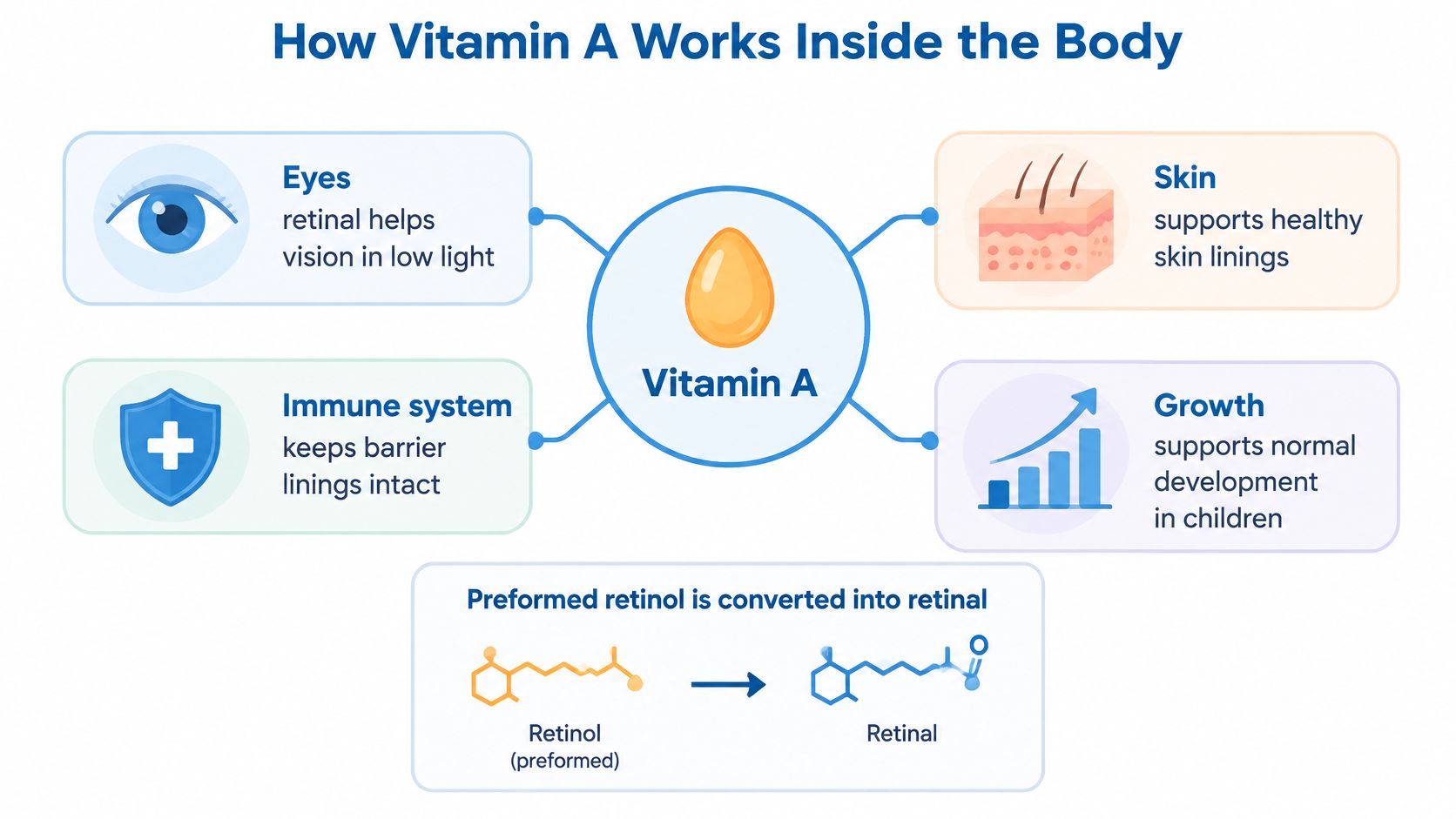
Think of vitamin A as one shared part that several departments draw from, each using it differently. The eyes need a light-catching form. Skin, airways, and gut need a form that tells cells how to finish maturing. Run low, and more than one department can stumble at once.
From retinol to night vision
The body converts preformed retinol into retinal. Retinal pairs with the protein opsin to form rhodopsin in the rod cells of the retina. When light hits rhodopsin, the molecule changes shape, and the eye has to rebuild it. If retinol is scarce, that rebuild slows, and adapting to a dark room is the first thing to slip.
A switch for cell linings
Other vitamin A–derived forms act like switches. They help decide which genes a cell turns on, so epithelial cells in the eyes, airways, and gut can become a healthy lining instead of a dry, fragile one. That's why dry eyes, rough skin, and gut trouble can share one root even when they look unrelated.
Two food forms, two speeds
Preformed vitamin A arrives ready-made from animal foods. Provitamin A carotenoids from plants have to be converted, and the body doesn't convert them one-for-one. Because vitamin A is fat-soluble, it needs dietary fat to be absorbed and it can be stored, which is also why a single huge dose is the wrong fix. The practical difference between fat-soluble and water-soluble vitamins is storage: water-soluble extras leave more readily, while fat-soluble extras can accumulate.
A varied plate beats a one-time megadose because each department needs a steady supply, not a spike.
Vision, Night Sight and Eye Health
The job people know best is helping the eyes adjust when the lights drop. The earliest sign of too little is night blindness: a room that should be easy to walk through after sunset feels dim, and driving at dusk takes longer to feel safe.
How a shortage can worsen
Leave the gap in place and the eye surface can dry and break down. That condition is xerophthalmia, damage to the conjunctiva and cornea. In severe cases the damage becomes irreversible blindness. The World Health Organization identifies vitamin A deficiency as the leading preventable cause of childhood blindness. Each year, an estimated 250,000–500,000 vitamin-A-deficient children become blind, and approximately half are estimated to die within 12 months of losing their sight. WHO also reports that deficiency is a public-health problem in more than half of all countries, with particularly high burdens in Africa and South-East Asia.
Say a child lives where meals rarely include eggs, liver, or orange and dark green vegetables. Night blindness can be the first visible clue, long before anyone connects diet to the eyes.
Where the claim stops
For someone whose intake is already adequate, extra vitamin A doesn't sharpen daytime vision or replace other eye nutrients. Pairing this nutrient with carotenoids aimed at the macula is a different question, which is why a lutein and zeaxanthin gummies review sits beside this topic rather than inside it.
Practical rule: New night-vision trouble or persistently dry eyes needs testing, not a self-chosen high dose.
Immune Defenses and Healthy Child Growth
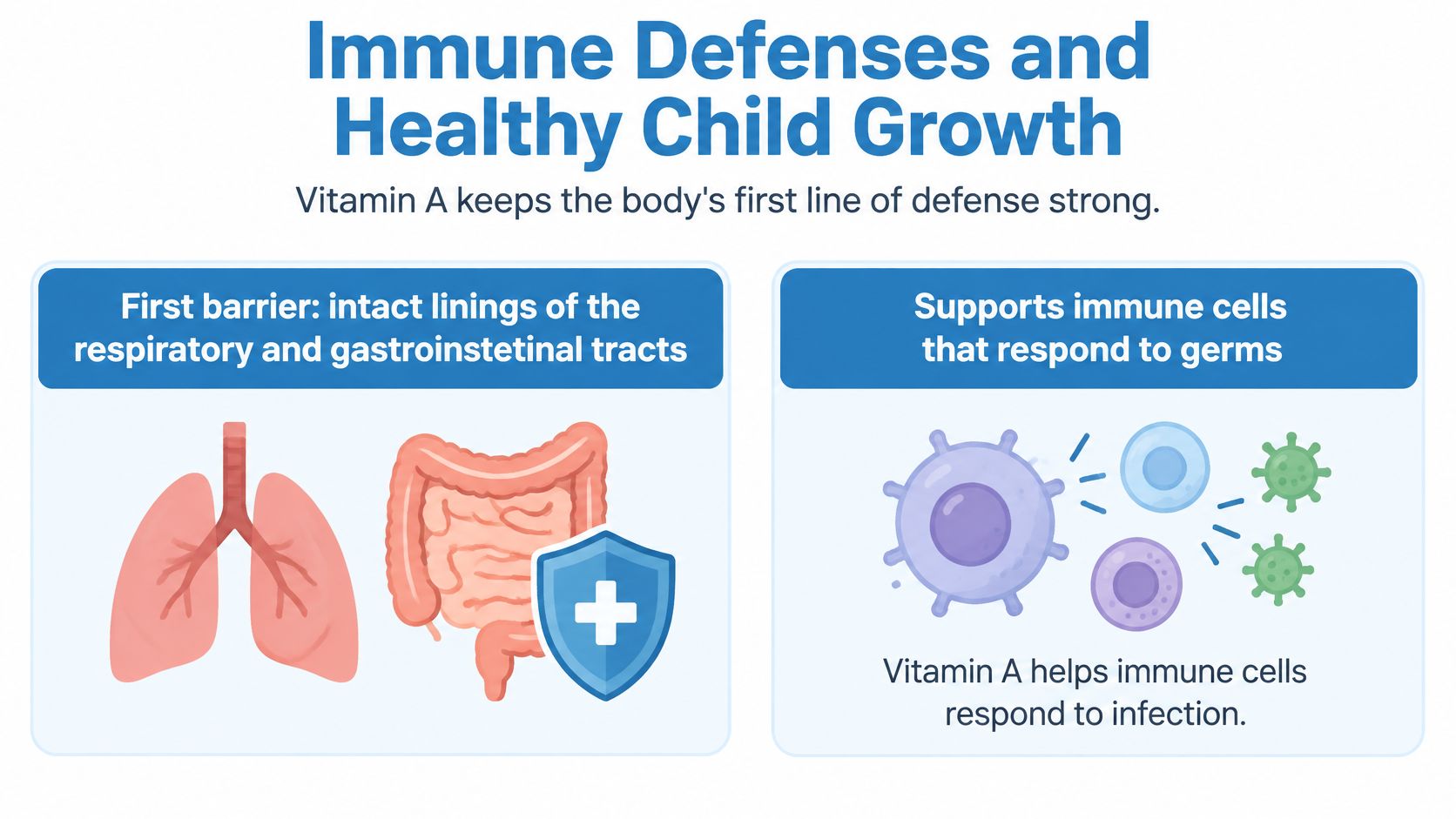
Vitamin A keeps the linings of the respiratory and gastrointestinal tracts intact. Those linings are the first physical barrier germs meet. It also supports the immune cells that respond once an infection gets past that barrier. When intake is too low, measles and diarrheal disease become more dangerous, especially for young children whose stores are small.
A WHO review pooled 17 randomized trials involving 194,795 children aged 6 months to 5 years. Compared with placebo or no supplementation, vitamin A was associated with a 24% reduction in all-cause mortality, with a risk ratio of 0.76 and a 95% confidence interval of 0.69–0.83. The same review found a reduction in diarrhea-related mortality, with a risk ratio of 0.72 and a 95% confidence interval of 0.57–0.91. WHO guidance recommends supplementation for children aged 6–59 months where deficiency is a public-health problem. Those trials were run across Asia, Africa, and Latin America, so the pattern isn't limited to one country.
Who those numbers do not cover
The benefit belongs to deficient children in high-risk settings. It isn't a reason to give every child a high dose, and reviews found no mortality benefit in some younger infant groups. Vitamin A doesn't replace vaccination, medical treatment, or a balanced diet. Other immune support vitamins have their own evidence, and none of them stand in for those basics.
A short explainer walks through how barrier tissues and immune cells depend on this nutrient:
Whether the trial evidence applies depends on the population, not on the nutrient's name alone.
Who Is Most at Risk of Low Vitamin A
Shortage clusters in a few groups, not in every adult who skips a multivitamin.
- Young children, and pregnant or breastfeeding women, in places where animal foods and orange or dark green vegetables are scarce. Stores run down faster when needs are high and the plate stays narrow.
- People who don't absorb fat well. Cystic fibrosis, celiac disease, Crohn's disease, and gastric bypass surgery can all cut absorption of this fat-soluble vitamin even when the diet looks reasonable on paper.
- Very restricted eaters. A vegan pattern that also skips carotenoid-rich plants can drift low. A vegan pattern built on sweet potato, carrots, and leafy greens usually doesn't.
- Premature infants. Liver stores are lower at birth, so clinicians watch intake rather than waiting for a symptom.
Night blindness, dry eyes, frequent infections, and slow growth in a child are the signs worth acting on. Say a young adult avoids dairy, eggs, and liver and also eats almost no colored produce. That pattern can sit near the edge without an obvious illness. Someone eating a mixed diet most days usually hits the target from food.
If you fall in one of these groups, ask a clinician for testing before you pick a supplement dose.
Daily Vitamin A Needs Measured in RAE
Intake is counted in micrograms of retinol activity equivalents (RAE) because retinol and plant carotenoids don't convert at the same rate. Treat a microgram of beta-carotene as equal to a microgram of retinol and you'll overread the label.
The NIH Office of Dietary Supplements fact sheet for health professionals sets the conversions: 1 microgram RAE equals 1 microgram retinol, 2 micrograms supplemental beta-carotene, 12 micrograms dietary beta-carotene, or 24 micrograms dietary alpha-carotene or beta-cryptoxanthin. Adult RDAs are 900 micrograms RAE a day for men and 700 for women, and the U.S. adult Daily Value is 900 micrograms RAE.
| Group | Recommended intake (mcg RAE per day) |
|---|---|
| Children 1-3 years | 300 |
| Children 4-8 years | 400 |
| Children 9-13 years | 600 |
| Teen boys and men, 14 years and older | 900 |
| Teen girls and women, 14 years and older | 700 |
| Pregnancy | 770 |
| Breastfeeding | 1,300 |
Read a label with the conversion
A bottle that lists 1,500 micrograms of beta-carotene is not 1,500 micrograms of retinol. Supplemental beta-carotene counts at 2 micrograms per 1 microgram RAE, so that figure is closer to 750 micrograms RAE. Dietary beta-carotene from a carrot is even less efficient, at 12 micrograms per 1 microgram RAE.
- Find your row in the table.
- Add the RAE from foods you eat most days.
- Convert any carotenoid supplement with the factors above.
- Compare the total with your target before you buy anything extra.
Pregnancy and breastfeeding rows jump for a reason. Those stages need more, and they also have stricter safety rules, covered next.
Foods That Supply Vitamin A
Food splits into two piles, and mixing them up is how people misread both labels and plates.
Preformed retinol comes from animal foods. Beef liver is far richer than anything else in a normal kitchen. Eggs and fortified milk add smaller, steadier amounts. Provitamin A carotenoids come from plants: sweet potato, carrots, spinach, and other orange or dark green vegetables. The body converts those pigments only as it needs them, which is why a big serving of carrots isn't the same safety problem as a big serving of liver.
| Food | Serving | Form |
|---|---|---|
| Beef liver, cooked | 3 ounces | Preformed retinol |
| Spinach, boiled | 1/2 cup | Provitamin A carotenoids |
| Carrot, raw | 1/2 cup | Provitamin A carotenoids |
| Sweet potato, baked | 1 medium | Provitamin A carotenoids |
| Fortified milk | 1 cup | Preformed retinol |
| Egg, cooked | 1 large | Preformed retinol |
Liver holds so much preformed vitamin A that pregnant women should treat it as an occasional food, not a weekly staple.
Fat on the plate, then a sample day
Both forms absorb better with some fat. Oil on spinach, or butter on a sweet potato, does more than a dry salad. One realistic day for many adults: an egg at breakfast, a baked sweet potato at lunch, and a half cup of spinach at dinner. That mix covers a large share of the adult target without a supplement and without a liver meal.
Pick two foods you already eat. Set them against your life-stage row and see whether the gap is real before you add a pill.
Safe Upper Limits and a Weekly Intake Check
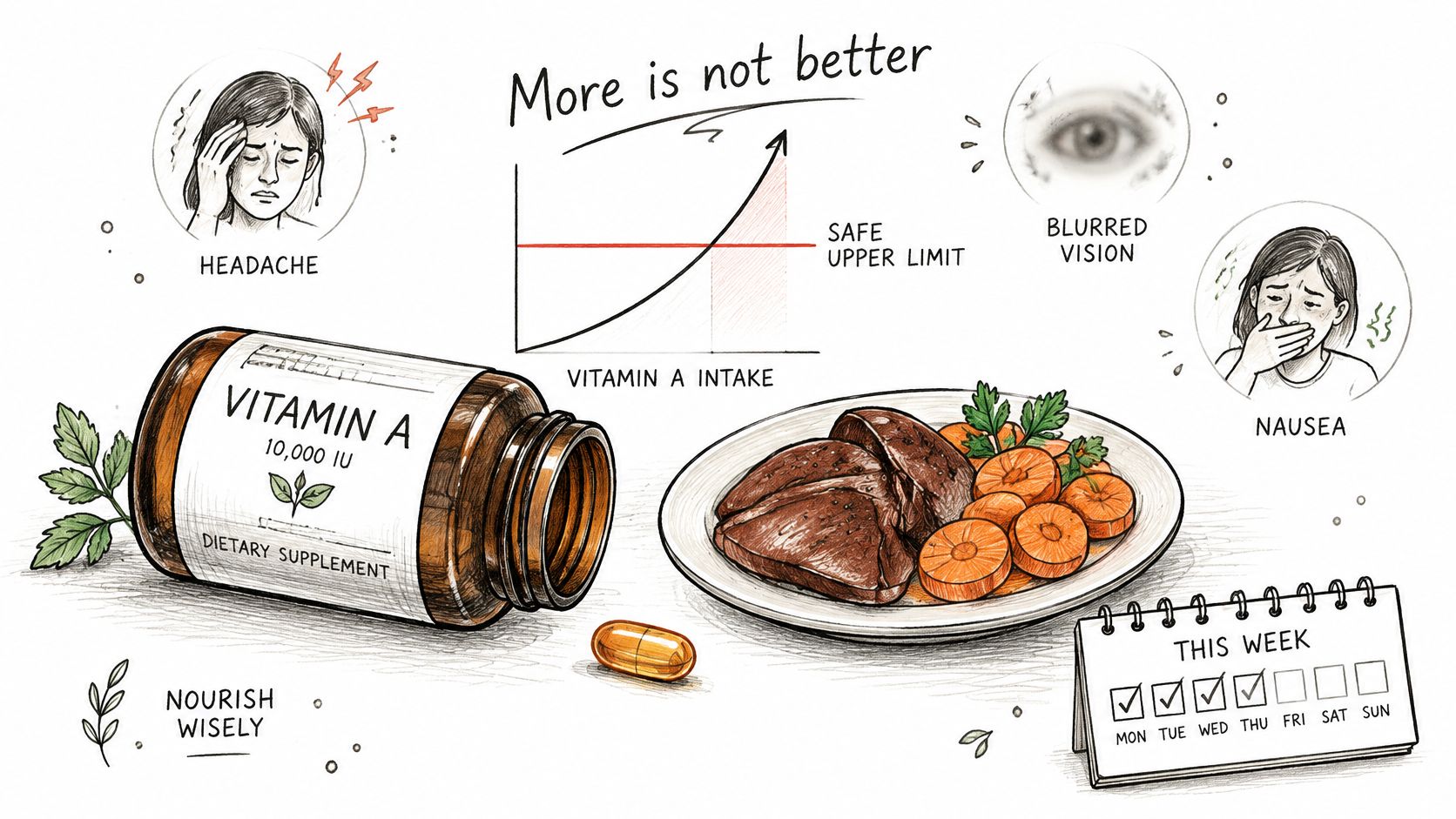
More is not better once you're past the requirement. The NIH consumer fact sheet warns that excess preformed vitamin A can cause headache, blurred vision, nausea, liver-related injury, and, in severe cases, coma or death. Deficiency is rare in the United States, so people with a varied diet generally gain nothing from a high-dose pill and can still cross into toxicity.
| Group | Tolerable upper intake (mcg RAE per day) |
|---|---|
| Children 1-3 years | 600 |
| Children 4-8 years | 900 |
| Children 9-13 years | 1,700 |
| Ages 14-18 years | 2,800 |
| Adults 19 years and older | 3,000 |
These caps apply to preformed vitamin A from supplements, fortified foods, and liver. Carotenoids from vegetables are far less likely to cause toxicity because conversion slows when stores are full. High-dose beta-carotene supplements are a separate product, not a vegetable.
Pregnancy and a five-step check
High-dose preformed vitamin A in pregnancy can cause fetal abnormalities. It should not be self-prescribed. CalVitamin states that its products are not intended to diagnose, treat, cure, or prevent any disease, so a label is not a treatment plan.
- List foods across a typical week and total their micrograms RAE from the food table.
- Compare that total with your life-stage target.
- Add vitamin A from any multivitamin or fortified food, using the label and the RAE conversions.
- Set the grand total against the upper limit for your group.
- If you're short and you're not pregnant, discuss any dose with a clinician before you start.
Night vision problems, dry eyes, frequent infections, or a fat-absorption condition need a professional assessment, not guesswork. Questions about a product label can go to CalVitamin support at info@calvitamin.com or 1-888-510-9080. Questions about symptoms belong with a healthcare provider.
CalVitamin carries everyday vitamins and minerals for people who want a clear label and a dose that matches a real gap, not a promise of sharper vision from extra vitamin A. If your weekly check shows food already covers your RAE target, you don't need another high-dose retinol product on top. Browse the vitamin selection at CalVitamin and match any product to the life-stage row and upper limit in this guide before you add it to your cart.


