

The short answer comes down to solubility. Fat-soluble vitamins, A, D, E and K, dissolve in dietary fat, are absorbed with it, and are stored in the liver and fat tissue in amounts large enough that a deficiency can take more than a year to appear. Water-soluble vitamins, vitamin C and the eight B-complex vitamins, dissolve in water, travel in body fluids and are mostly excreted in urine, so most of them need replacing within weeks to months.
The popular version of this is blunter, and half wrong. You've probably heard that water-soluble vitamins are harmless because you pee out the extra, while fat-soluble ones are the risky group. But high doses of niacin, vitamin B6 and vitamin C can cause real harm, and a normal-dose vitamin D capsule taken with dinner is not a hazard. The difference between fat soluble and water soluble vitamins is a starting point for understanding absorption, not a safety rating.
What determines whether a vitamin helps or hurts you is dose, how long you take it, the chemical form in the bottle, how well your kidneys and liver are working, and how many products you're stacking. The group label sits at the bottom of that list.
Table of Contents
- Fat-Soluble and Water-Soluble Vitamins Compared Side by Side
- Which Vitamins Belong in Each Group and What They Do
- How Your Body Absorbs and Stores Each Group
- How Long Each Vitamin Takes to Become Deficient
- Toxicity Risks and Upper Limits by Vitamin
- Food Sources and Daily Habits That Protect Vitamins
- How to Choose a Supplement by Group
Fat-Soluble and Water-Soluble Vitamins Compared Side by Side
Fat-soluble vitamins dissolve in fat and are absorbed alongside dietary fat, while water-soluble vitamins dissolve in water and circulate in body fluids. That single physical difference drives every practical one.
Fat-soluble and water-soluble vitamins compared
| Feature | Fat-soluble (A, D, E, K) | Water-soluble (C and B-complex) |
|---|---|---|
| Dissolves in | Fat and oils | Water |
| Absorption | Absorbed with dietary fat in the intestine | Absorbed through carrier-mediated and facilitated intestinal transport |
| Storage | Liver and fat tissue, in relatively large amounts | Little storage; vitamin B12 is the major exception |
| Excretion | Slower; excess can accumulate | Mostly cleared in urine |
| Time to deficiency | Generally more than one year | Weeks to months, but B12 takes years |
| Replacement need | Less frequent | More regular |
| Toxicity risk at high doses | Higher, especially vitamins A and D | Lower but not zero, with niacin, B6 and vitamin C the main concerns |
Read the rows as a pattern rather than a rulebook. The fat-soluble group sits in reserve, so a shortfall takes longer to surface and repeated high doses have somewhere to accumulate, while the water-soluble group is used or cleared quickly, so supply has to keep arriving.
One vitamin on the water-soluble side behaves like a fat-soluble one. Vitamin B12 is held in the liver in a reserve big enough to cover years, so its timeline looks nothing like thiamin's or vitamin C's.
Each row of that table stands alone as a practical question: which vitamins belong to each group, how the gut handles them, how fast a shortfall shows up, and where the genuine risk of excess sits.
Which Vitamins Belong in Each Group and What They Do
Sort any label in seconds. If the nutrient is A, D, E or K, it's fat-soluble. If it's vitamin C or one of the eight B vitamins, thiamin, riboflavin, niacin, pantothenic acid, vitamin B6, biotin, folate or vitamin B12, it's water-soluble. That's four on one side and nine on the other.
Here's the full map, with the job each one does.
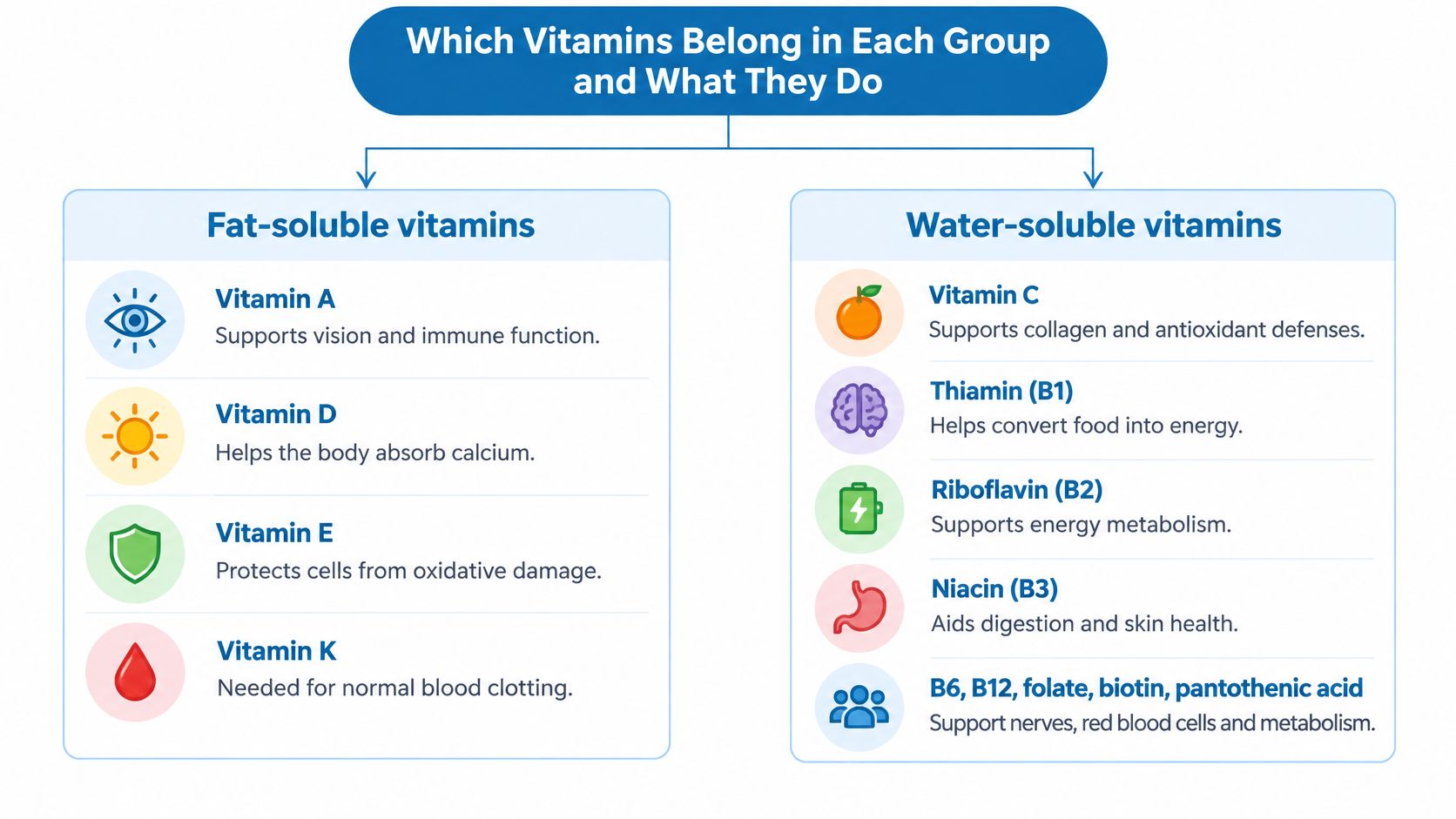
The four fat-soluble vitamins
- Vitamin A keeps the retina working in dim light and maintains the surfaces of the eyes, airways and gut.
- Vitamin D increases absorption of calcium and phosphorus, which is how bone stays mineralised.
- Vitamin E limits oxidative damage to the fats that make up cell membranes.
- Vitamin K switches on the clotting proteins and helps lay calcium into bone.
The nine water-soluble vitamins
- Vitamin C builds collagen, raises iron absorption from plant foods and supports immune cells.
- Thiamin, riboflavin, niacin, pantothenic acid and biotin act as coenzymes, the molecules that let cells release energy from carbohydrate, fat and protein.
- Vitamin B6 converts amino acids and supports red blood cells and nerve function.
- Folate and vitamin B12 are both needed to make DNA and red blood cells, and B12 also maintains the sheath around nerves.
The B vitamins overlap enough in energy and nerve support that it pays to read them as one team rather than nine separate purchases. This guide to the vitamin B complex walks through which ones do what and where they show up in food.
The two-group split isn't modern marketing. In 1913, American nutrition researcher Elmer McCollum divided vitamins into "fat-soluble A" and "water-soluble B," building on experiments such as Christiaan Eijkman's 1897 finding that polyneuritis in chickens tracked with a diet of polished white rice and cleared when unpolished rice was provided, and Casimir Funk's 1912 work showing a rice bran concentrate could cure a similar deficiency in pigeons, as the Encyclopaedia Britannica entry on vitamins sets out.
Those jobs predict the first signs of a shortfall. Night blindness points to A, soft or aching bones to D, easy bruising and bleeding to K or C, and anaemia with tingling hands to folate or B12.
How Your Body Absorbs and Stores Each Group
Follow a meal through the gut and the two groups part company almost immediately. The Merck Manual overview of vitamins frames it as a difference in how each group is absorbed, stored and eliminated, and that framing is the clearest way to picture it.
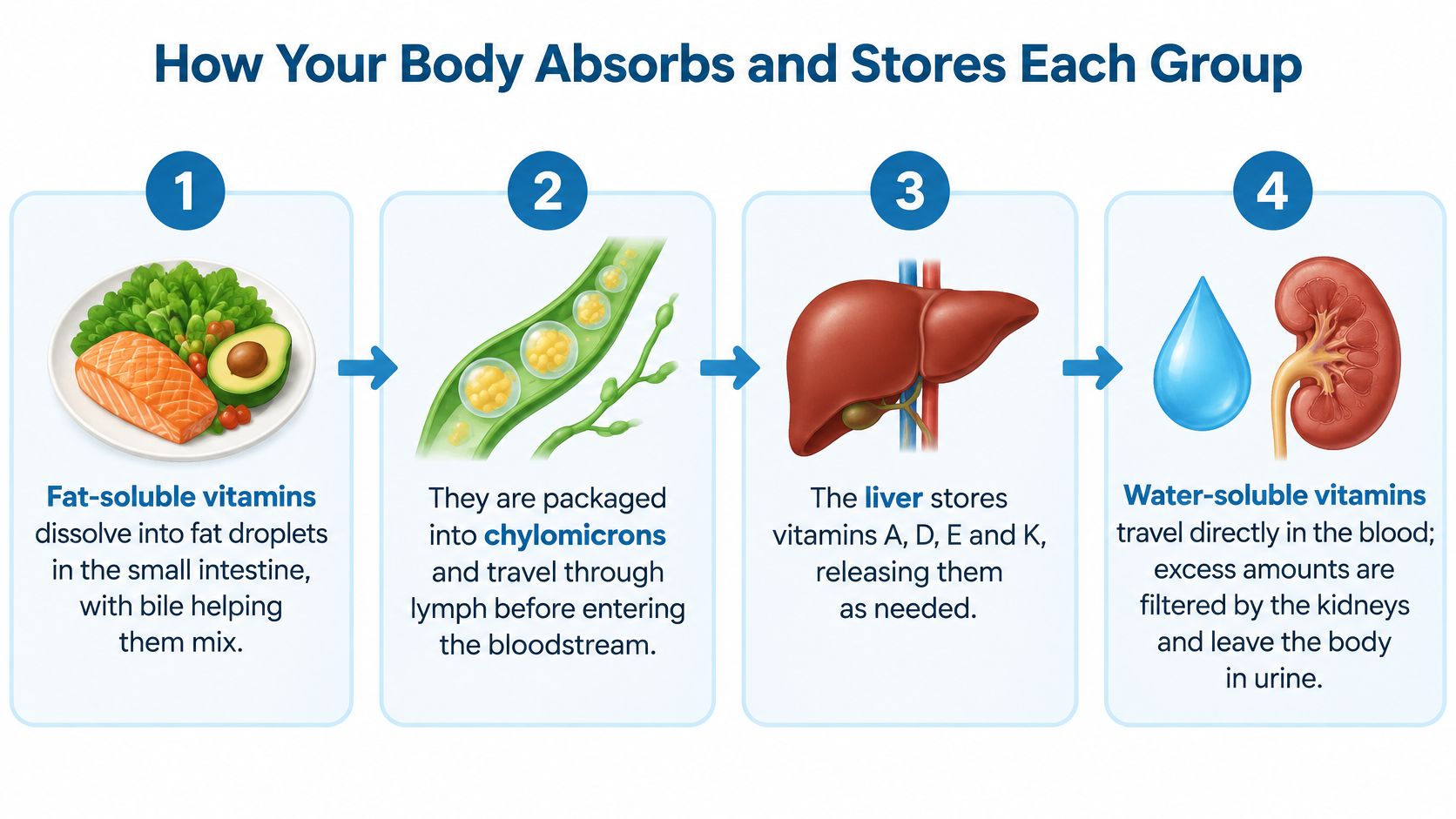
Step one, the fat-soluble vitamins find the fat. They're released from food, dissolve into the fat droplets in your small intestine, and bile helps mix them so they can be absorbed along with the rest of the dietary fat. Eat a meal with almost no fat and this step is weaker, which is why the same capsule can perform differently at breakfast and at dinner.
Step two, they travel by lymph before reaching the bloodstream. The vitamins are packaged into fat-carrying particles, carried through lymph, and delivered to the liver. The liver holds meaningful reserves of vitamins A, D, E and K, and fat tissue takes up some as well. That reserve is the reason a shortfall in this group is slow to appear.
Step three, water-soluble vitamins go straight into the blood. They cross the intestine through carrier-mediated and facilitated transport, then circulate in the watery compartments of the body and reach tissues quickly. Nothing needs bile, nothing waits for fat, and nothing gets banked in any meaningful quantity.
Step four, excess leaves in urine. Your kidneys filter out what the tissues don't take up. B12 is the exception that proves the rule, since the liver holds it substantially and releases it over a long stretch.
Practical rule: put your fat-soluble supplement with the meal that contains the most fat in your day, not with black coffee and a banana.
Vitamin K breaks the tidy pattern. Adult liver reserves are modest, so someone who absorbs fat poorly can run low much faster than the year-plus timeline suggests for vitamins A, D and E. Newborns are the clearest case, with little transfer across the placenta and a gut that hasn't yet built its own supply, which is the reasoning behind vitamin K prophylaxis at birth.
How Long Each Vitamin Takes to Become Deficient
The time column below estimates how long a deficiency may take to appear after intake drops and stays low. It does not describe how quickly a vitamin builds up. Most water-soluble vitamins, except B12, can become deficient over weeks to months, while reserves of fat-soluble vitamins and B12 may last longer than a year, according to the Merck Manual professional overview of vitamins.
Time to deficiency and early signs by vitamin
| Vitamin | Group | Main storage | Time to deficiency | Early sign |
|---|---|---|---|---|
| Vitamin A | Fat-soluble | Liver | Over 1 year | Night blindness |
| Vitamin D | Fat-soluble | Fat tissue and liver | Over 1 year | Soft or weak bones |
| Vitamin E | Fat-soluble | Fat tissue and liver | Over 1 year | Nerve and muscle weakness |
| Vitamin K | Fat-soluble | Liver, limited | Over 1 year in adults, faster in newborns | Easy bruising or bleeding |
| Vitamin C | Water-soluble | Not stored | Weeks to months | Bleeding gums, bruising |
| Thiamin (B1) | Water-soluble | Limited | Weeks | Fatigue, nerve changes |
| Riboflavin (B2) | Water-soluble | Limited | Weeks | Cracked lips, sore throat |
| Niacin (B3) | Water-soluble | Limited | Weeks | Skin rash, diarrhoea |
| Pantothenic acid (B5) | Water-soluble | Limited | Weeks | Fatigue, numbness |
| Vitamin B6 | Water-soluble | Limited | Weeks to months | Anaemia, nerve changes |
| Biotin (B7) | Water-soluble | Limited | Weeks to months | Hair loss, scaly rash |
| Folate (B9) | Water-soluble | A few months | Weeks to months | Anaemia |
| Vitamin B12 | Water-soluble | Liver, large reserve | Years | Anaemia, numbness |
Why the water-soluble group runs out first
Most water-soluble vitamins have limited reserves, so persistently low intake can lead to deficiency within weeks or months. Severe deficiencies have recognizable patterns: vitamin C deficiency causes scurvy, thiamin deficiency causes beriberi, and niacin deficiency causes pellagra. B6 deficiency can involve anaemia and nerve changes.
Folate has a modest reserve, while B12 is the outlier: its liver stores can last for years. That long buffer can delay signs such as numbness or anaemia, even when intake has been inadequate for a long time.
Use early signs as a reason to seek medical advice and testing, not as a diagnosis. Fatigue, cracked lips and tingling fingers can have many causes, and taking a high-dose supplement based on a guess may not address the problem.
When the timeline speeds up
Poor fat absorption can shorten the time before fat-soluble deficiencies develop. Conditions such as untreated coeliac disease, cystic fibrosis or chronic pancreatitis, and surgery that bypasses part of the intestine, can reduce absorption of fat and vitamins A, D, E and K. A restricted diet can also reduce intake of water-soluble vitamins, including B12 on a plant-only diet and folate when greens and legumes are scarce.
Toxicity Risks and Upper Limits by Vitamin
"Water-soluble means safe in any dose" is the claim worth pushing back on hardest. The kidneys clear what they can at the rate they can, and clearance is not the same as harmless. The NCBI Bookshelf clinical review of vitamin toxicity lays out the specifics: excessive niacin can cause toxicity, high vitamin B6 exposure can produce neurological problems, and large vitamin C doses can cause gastrointestinal effects. Kidney function sits in the middle of all three, because renal excretion is how the excess leaves.
The fat-soluble group is not the dangerous one either. Vitamins A, D, E and K are stored in liver and adipose tissue, so chronic overconsumption accumulates more readily, and high-dose vitamin D raises blood calcium. But "fat-soluble equals dangerous, water-soluble equals harmless" is too crude a rule for anyone standing in a supplement aisle, as that same clinical review notes.
Adult upper intake limits by vitamin
| Vitamin | Upper limit per day (adults) | Main concern at high doses |
|---|---|---|
| Vitamin A | Set for preformed retinol, not for beta-carotene from food | Liver damage, weaker bones, birth defects in pregnancy |
| Vitamin D | 100 mcg (4,000 IU) | High blood calcium, kidney damage |
| Vitamin E | 1,000 mg | Increased bleeding risk |
| Vitamin K | Not set | Generally low toxicity |
| Vitamin C | 2,000 mg | Diarrhoea, stomach upset, kidney stones |
| Niacin (B3) | 35 mg from supplements | Flushing, liver damage |
| Vitamin B6 | 100 mg | Nerve damage |
| Folate (B9) | 1,000 mcg from supplements | Can mask vitamin B12 deficiency |
| Vitamin B12 | Not set | Generally low toxicity |
| Thiamin, riboflavin, pantothenic acid, biotin | Not set | Rarely toxic at typical high intakes |
The real risk is stacking, not the group
A multivitamin, a fortified cereal, a sports formula and a single-nutrient capsule can each carry the same vitamin, and the totals add up. Read every label in your cupboard in one sitting and write down the daily amount of each nutrient you'd take. If the supplement label lists 100 mg of B6 in a "nerve support" blend alongside a B-complex with another 50 mg, you're past the adult limit before you've opened a second bottle.
Ask a clinician before you go further if you're pregnant, have kidney or liver disease, take regular medication, or are already holding two bottles that list the same nutrient.
Food Sources and Daily Habits That Protect Vitamins
Food first, and group the shopping list the way the body handles it. Fat-soluble vitamins arrive attached to fat in the same meal, which is why a carrot eaten with olive oil or a leafy green sautéed in butter gives you more than the same vegetable plain.
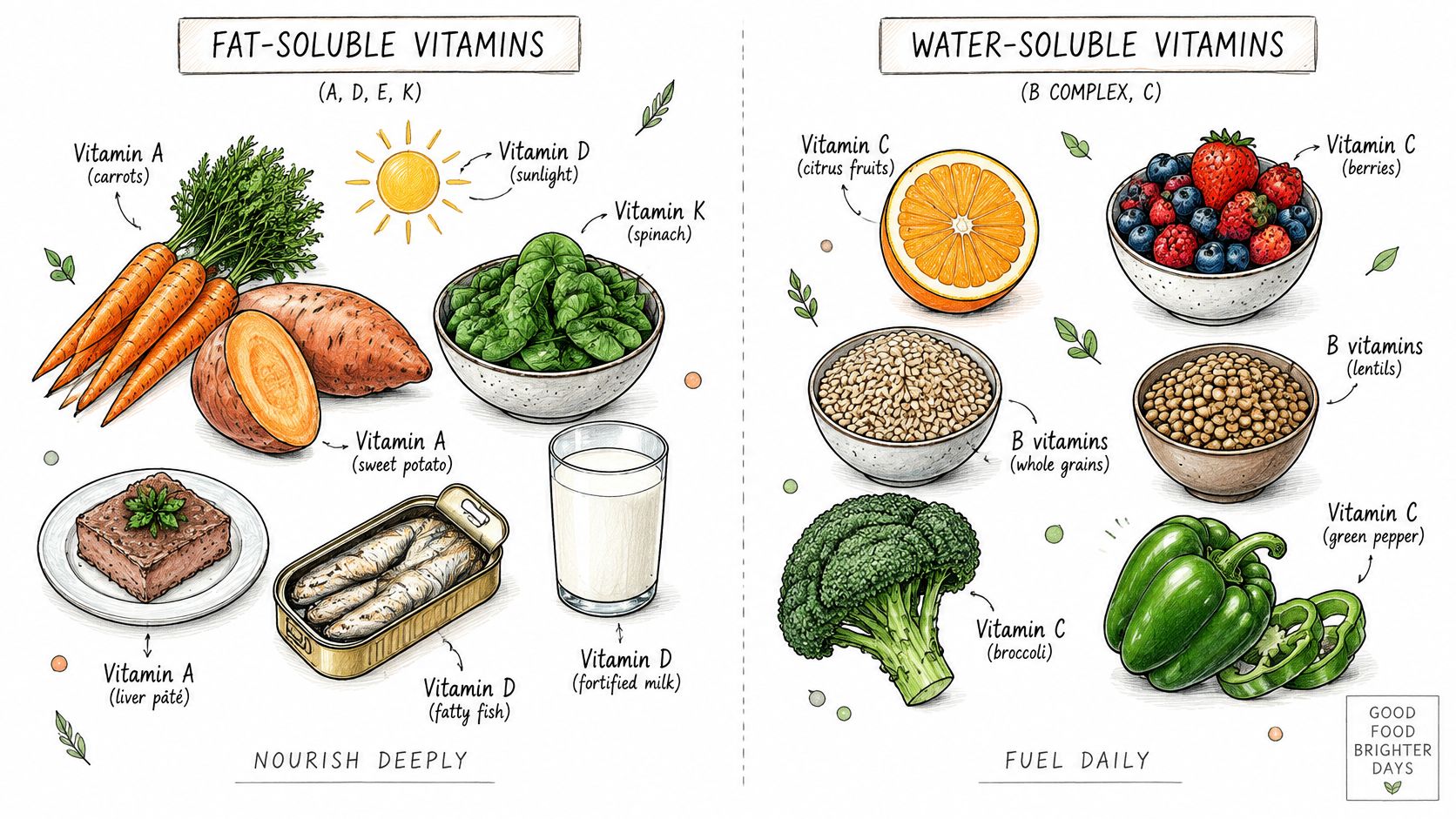
Fat-soluble sources. Vitamin A comes as preformed retinol from liver, oily fish, eggs and dairy, and as beta-carotene from carrots, sweet potatoes and spinach, which the body converts at a variable rate. Vitamin D is in fatty fish and fortified milk, and your skin makes it from sunlight. Vitamin E sits in nuts, seeds and vegetable oils. Vitamin K comes from leafy greens, and the K2 form from fermented foods such as natto and aged cheese.
Water-soluble sources. Vitamin C is in citrus, peppers, broccoli and strawberries. Thiamin comes from whole grains and pork, riboflavin from dairy and eggs, niacin from poultry, fish and peanuts, and B6 from chickpeas, potatoes and bananas. Biotin is in eggs and nuts, folate in leafy greens, legumes and fortified grains, and B12 in animal foods, with fortified foods or supplements doing the job on a plant-only diet.
Handling habits worth adopting this week
- Steam briefly instead of boiling hard. Vitamin C and folate leach into cooking water and break down with heat and light, so a long boil on a bright stove costs you more than a quick steam.
- Store produce cool, dark and sealed. Cut fruit left on a sunny counter loses vitamin C faster than whole fruit in the fridge drawer.
- Pair fat-soluble supplements with a meal that contains fat. Oil, eggs, dairy, nuts or fatty fish all do the job.
- Skip the splitting ritual. Most water-soluble vitamins don't need dividing into several daily doses, since there's no small storage pool to top up.
If you'd rather watch the two groups in motion before adjusting your routine, this short walkthrough covers the same ground at a glance.
How to Choose a Supplement by Group
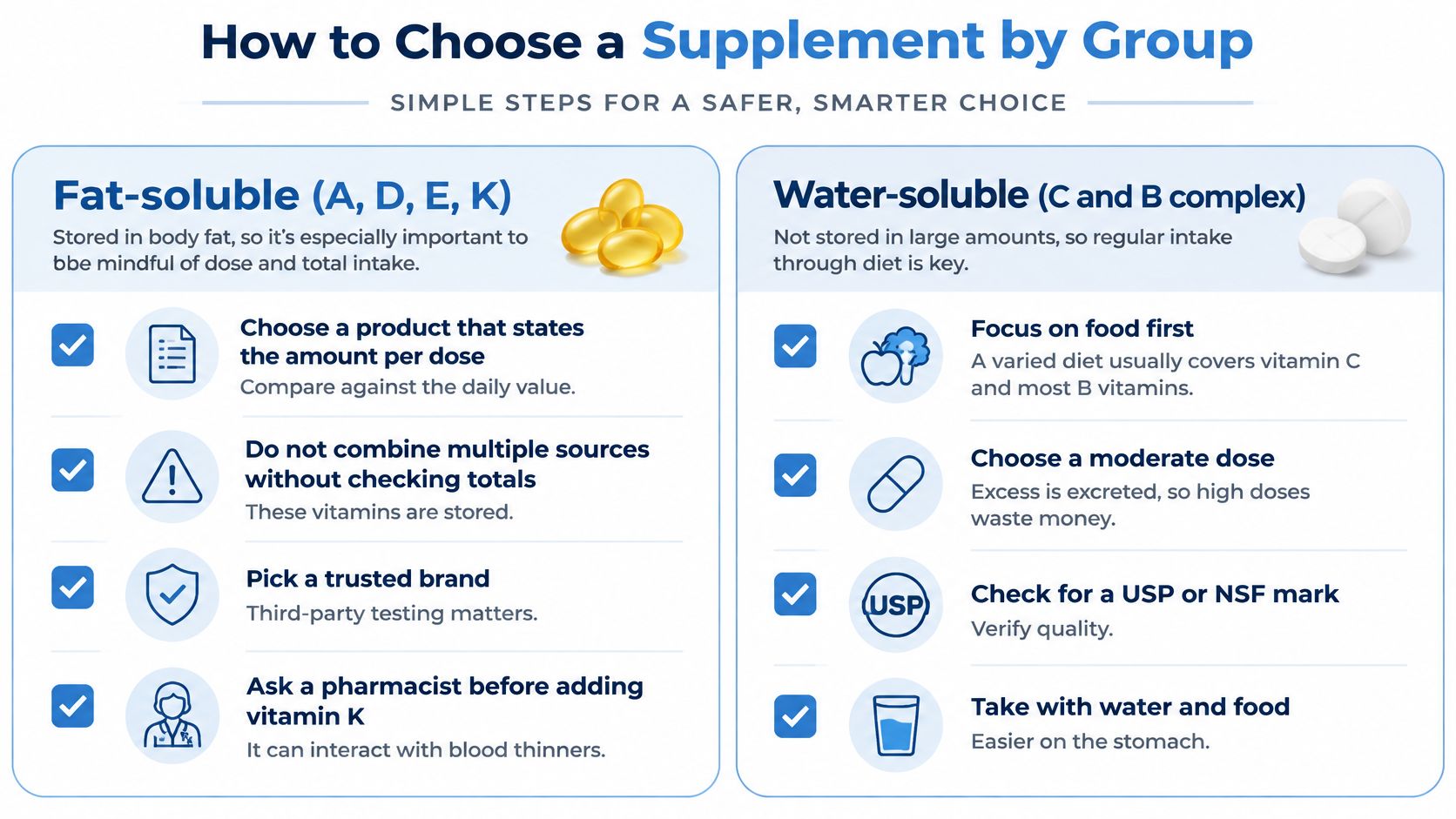
Turn the comparison into a buying sequence you can run in the aisle.
- Start from the gaps in your plate. A varied diet covers vitamin C, vitamin K and most B vitamins. The usual shortfalls are vitamin D, B12 for anyone eating no animal foods, and vitamins A and E on a very low-fat diet.
- Buy the nutrient that tested low, not another multivitamin. If a clinician has confirmed a deficiency, a second multi-product just duplicates what you already swallow.
- Mark each line on the panel. Highlight A, D, E and K as stored nutrients, and C plus the B vitamins as daily-supply nutrients. The split takes ten seconds and tells you which totals to watch.
- Swallow fat-soluble products with fat. A meal with oil, eggs, dairy, nuts or fatty fish is the partner they need. Our vitamin D3 softgels are built on this principle, suspending cholecalciferol in MCT oil so the vitamin arrives in a fat carrier.
- Keep routine water-soluble products near the labelled daily value. Treat high-dose niacin, B6 and vitamin C as short courses set by a clinician, because urine clearance doesn't make them harmless.
- Count the form as the same vitamin. D2 or D3, folic acid or methylfolate, cyanocobalamin or methylcobalamin all land in the same nutrient total.
- Ask before combining. Pregnancy, kidney or liver disease, a blood thinner, or two bottles listing the same nutrient are all reasons to check first. Our support team can help you compare labels at info@calvitamin.com or 1-888-510-9080.
The label tells you amounts, not whether you need them. Our products are not intended to diagnose, treat, cure, or prevent any disease, so let a blood result and a clinician settle the question of deficiency while the label settles the question of dose.
CalVitamin stocks vitamins, minerals, proteins, probiotics and herbal formulas in capsules, softgels, liquids and gummies, which makes it easier to compare forms instead of guessing at the shelf. If you're unsure whether your fat-soluble and water-soluble products overlap, the team can go through the labels with you before you buy. Visit CalVitamin to browse the range and match each product to the group that needs steady daily supply or the group that needs a careful ceiling.


