
The usual advice in the BCAA vs EAA debate is to buy EAAs because they're more complete. That's a useful starting point, but a poor buying rule: a more complete supplement can still duplicate what you already get from meals. The better question is whether you're trying to address post-exercise soreness, a protein-intake gap, or a promise of muscle growth that the product hasn't demonstrated.
Start with your food intake, then test the label against that need. You might choose an EAA formula, consider BCAAs for a narrower recovery goal, or decide neither deserves a place in your budget.
Table of Contents
- BCAA vs EAA at a Glance
- Amino Acid Profiles Side by Side
- Dietary Sources and Who Should Check First
- What Muscle-Protein Synthesis Research Shows
- Recovery, Soreness and Performance Claims
- Dose Benchmarks for Leucine and Total EAA
- How to Check a BCAA or EAA Label
- Choose BCAA or EAA for Your Protein Gap
BCAA vs EAA at a Glance
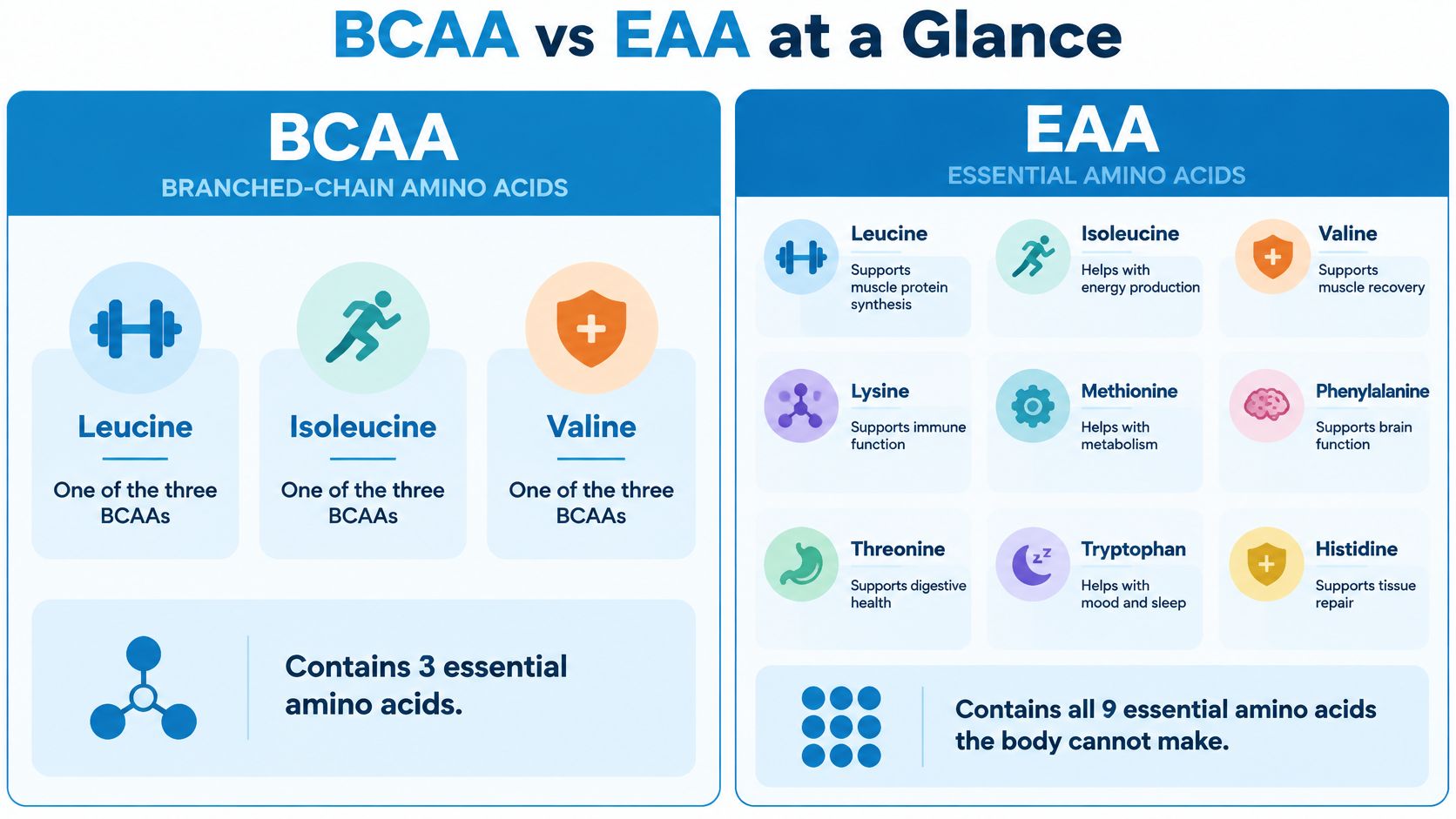
A BCAA product contains three essential amino acids, leucine, isoleucine, and valine. A complete EAA product contains all nine essential amino acids that must come from your diet. BCAAs are therefore a subset of EAAs, not a separate category of equal scope.
BCAA and EAA side by side
| Feature | BCAA | EAA |
|---|---|---|
| Essential amino acids included | 3 | 9 |
| Amino acids included | Leucine, isoleucine, valine | All nine essential amino acids |
| Supplies full set of muscle-protein building blocks | No | Yes |
| Most consistent evidence | Reduced post-exercise soreness | Stronger muscle-protein synthesis signaling |
| Role of leucine | Main anabolic trigger | Trigger plus the remaining building blocks |
| Best fit | Recovery symptoms and low-calorie training support | Low-protein meals, fasting, older adults, energy deficit |
The count matters more than scoop size or flavor. A larger serving of BCAAs still doesn't supply the essential amino acids missing from that formula, while an EAA label doesn't automatically establish that its dose is appropriate.
The distinction is easier to see when the ingredient groups are placed together.
Match the outcome before choosing the product
Read the evidence-backed-use row carefully. Less soreness isn't the same outcome as more muscle, and stronger synthesis signaling isn't proof of greater long-term strength or lean mass. Those distinctions prevent a narrow finding from becoming an oversized purchase justification.
Leucine appears in both products, so its presence alone won't settle the comparison. What matters is whether you need a targeted amino-acid addition or a complete essential-amino-acid supply.
The best-fit row is a starting point, not a prescription. Someone eating well but struggling with soreness faces a different decision from someone repeatedly training after a protein-poor meal. Identify which problem you have before comparing tubs.
Amino Acid Profiles Side by Side
Read the ingredient panel as a checklist, not as a collection of scientific-sounding names. Leucine, isoleucine, and valine belong in both categories; the remaining essential amino acids distinguish a full EAA formula from a BCAA-only product.
According to the NIH Office of Dietary Supplements exercise-performance fact sheet, BCAAs make up approximately 14%–18% of the amino acids in human skeletal-muscle proteins. Their importance doesn't make them a complete protein profile.
Essential amino acids in BCAA and EAA products
| Amino acid | In BCAA | In EAA |
|---|---|---|
| Leucine | Yes | Yes |
| Isoleucine | Yes | Yes |
| Valine | Yes | Yes |
| Histidine | No | Yes |
| Lysine | No | Yes |
| Methionine | No | Yes |
| Phenylalanine | No | Yes |
| Threonine | No | Yes |
| Tryptophan | No | Yes |
Check the names that aren't on the front label
Leucine often receives the most attention because of its signaling role. Isoleucine and valine complete the BCAA group, but seeing those familiar ingredients doesn't establish that the rest of the essential profile is present.
Continue down the label for histidine, lysine, and methionine, then phenylalanine, threonine, and tryptophan. Each missing essential amino acid remains missing, regardless of how prominently the manufacturer advertises the total blend weight.
This is also why “amino acid complex” isn't enough information by itself. Our guide to an amino acid complex provides context for the category, but the individual product's composition should drive your decision.
Label check: Confirm the non-BCAA essential amino acids individually before treating a product as a complete EAA formula.
Added non-essential amino acids don't change the essential count. A blend can list many ingredients without supplying the complete essential profile, and its overall powder weight may include ingredients other than amino acids. Count the required names first, then examine their amounts.
Dietary Sources and Who Should Check First
Food deserves the first review. Meat, poultry, fish, eggs, dairy, and soy provide complete essential-amino-acid profiles, while plant-based eaters can use a varied combination of legumes and grains across the day. A plant-based diet isn't, by itself, a reason to buy an amino-acid supplement.
A 2024 protein-meal study indexed by PubMed found no significant difference in muscle-protein-synthesis fractional synthesis rates between complete, complementary, and incomplete essential-amino-acid profiles over 24 hours, with P = 0.38. That finding cautions against judging a whole day's diet from the amino-acid profile of an isolated meal; it doesn't establish that protein quantity or dietary variety is irrelevant.
Review meals before adding a powder
Consider breakfast, lunch, dinner, and snacks together. If breakfast contains little protein, ask whether adding eggs, dairy, soy, or another suitable protein food would solve the problem more directly than buying an amino-acid drink.
For plant-based meals, assess the range of foods you eat rather than demanding that every ingredient be complete on its own. Legumes and grains can contribute complementary profiles without turning every meal into a supplement calculation.
A dietary pattern needs assessment. A diet label, such as vegan or omnivorous, isn't enough to identify a protein gap.
Medical conditions change the decision
A 2025 randomized controlled trial in International Urology and Nephrology gave adults over 65 with chronic kidney disease 7.5 g daily of leucine-enriched BCAAs for 12 weeks. That was a clinical intervention, not a general recommendation for people with kidney disease.
If you have kidney disease or another condition affecting dietary management, review the proposed product and dose with your clinician. A trial's existence doesn't establish that its intervention is appropriate for you, particularly outside the clinical setting in which it was tested.
What Muscle-Protein Synthesis Research Shows
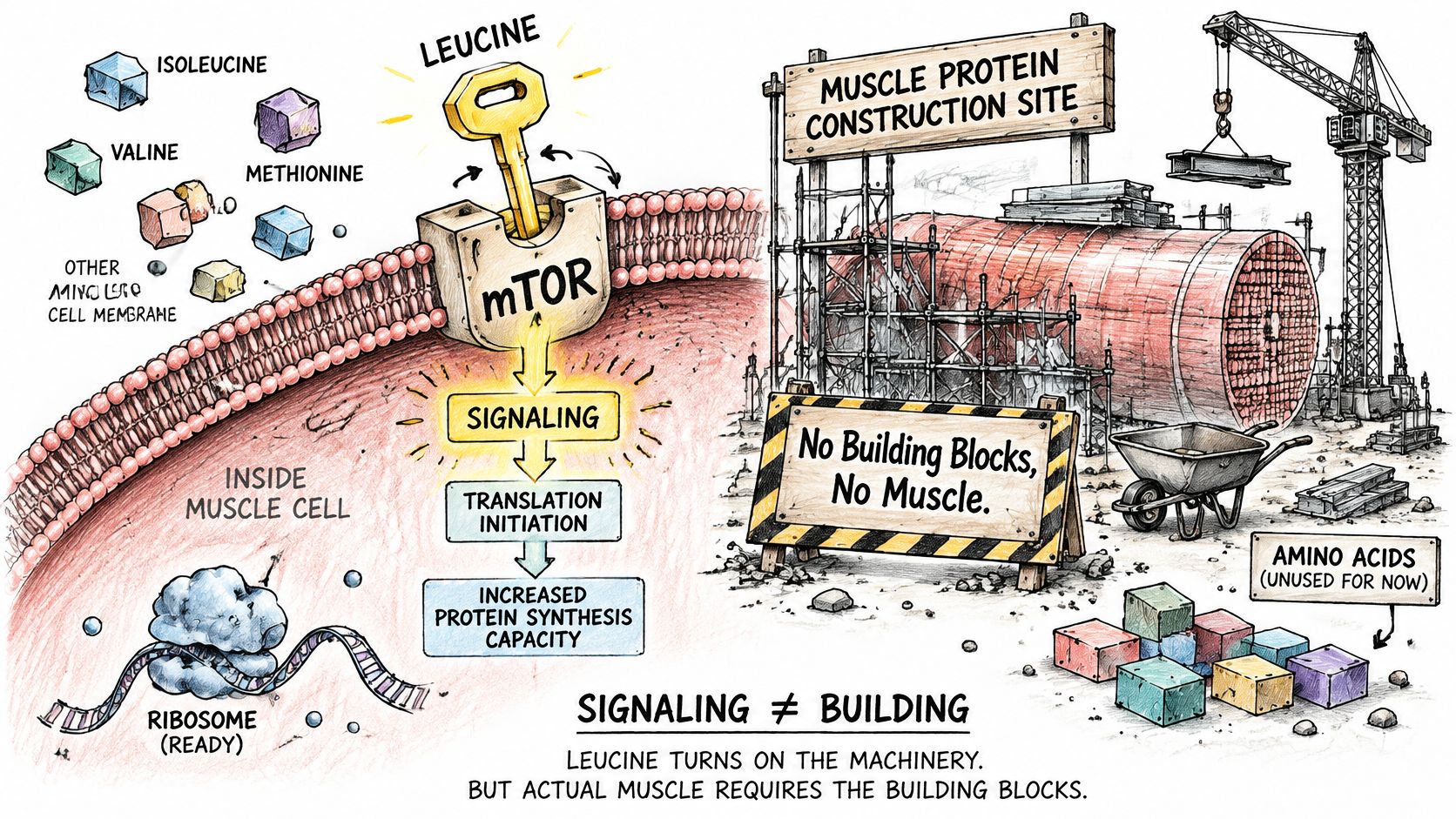
Muscle-protein synthesis, or MPS, is the assembly of new muscle proteins. BCAAs can activate anabolic signaling, including pathways involving mTOR, but a signal isn't a replacement for the amino acids required to assemble the protein.
The diagram separates those jobs: initiating the process and supplying its materials.
A systematic review of athlete studies found that BCAAs generally had negligible effects on performance and body composition, with some reduction in soreness after resistance training and inconsistent endurance findings. It also reported stronger anabolic signaling with EAAs in some comparisons, although recovery differences were often small.
That combination of findings matters. A physiological advantage for a complete essential-amino-acid mixture doesn't mean every EAA product has demonstrated better athletic results, and modest recovery differences shouldn't be presented as a decisive muscle-building advantage.
Where completeness becomes useful
Consider someone who trains after a low-protein breakfast and can't eat a substantial meal afterward. In that situation, a complete EAA formula addresses a broader supply problem than BCAAs alone.
The same reasoning applies when training happens far from a full protein serving or during a period of restricted food intake. The relevant question isn't whether leucine can activate a pathway. It's whether the person has the essential amino acids available to support the response.
The accompanying video provides another format for considering the comparison.
Don't turn an acute response into a growth guarantee
Short-term signaling and synthesis measurements help explain how a product might work. They don't, by themselves, establish greater lean-mass gains over a training program.
- For an amino-acid supply gap: EAAs are the technically complete option.
- For a narrow recovery preference: BCAAs may be considered when low-calorie intake or tolerability matters.
- For long-term muscle gain: Don't treat either label as proof of a superior outcome.
The defensible conclusion is conditional: EAAs have a broader physiological rationale when essential-amino-acid availability is the problem. That's more precise than claiming they always produce more muscle, and more useful than treating BCAAs and EAAs as interchangeable workout drinks.
Recovery, Soreness and Performance Claims
Supplement marketing often bundles growth, strength, endurance, fatigue, and recovery into a single promise. Buyers shouldn't accept that bundle. Feeling less sore after training doesn't demonstrate that you lifted more weight, sustained a faster pace, or gained muscle.
A 2025 review of 22 randomized controlled trials found that pure BCAA supplementation may reduce muscle soreness, while evidence for improvements in strength, endurance, and body composition remained inconsistent. The authors concluded that BCAAs should primarily be viewed as a recovery intervention rather than a performance enhancer.
Separate comfort from capacity
Soreness is a meaningful outcome if discomfort interferes with your routine. It's still a different outcome from measurable training capacity, so a product that helps the former hasn't automatically demonstrated the latter.
The broader narrative evidence is also context-dependent, with more favorable recovery findings under demanding training conditions or energy restriction. That supports a targeted discussion, not a blanket recommendation for everyone who exercises.
Less soreness can be useful without being evidence of faster muscle growth.
A muscle-damage biomarker adds another distinction. A laboratory marker, a soreness rating, and a long-term lean-mass measurement answer different questions, even when a supplement label places them under the same recovery claim.
Test the claim against your goal
For someone mainly seeking comfort after demanding sessions, BCAAs may be worth evaluating cautiously. For someone seeking maximal strength, better endurance, or visible hypertrophy, the evidence doesn't justify recommending them as a standalone solution.
Our sports performance nutrition guide can help place a recovery supplement within the broader nutrition plan. Before purchasing, answer these questions:
- Training frequency: How often do you train, and which sessions leave you unusually sore?
- Between-session recovery: Are you ready for the next planned session, or does discomfort disrupt it?
- Protein intake: What does your actual daily food record show?
- Desired outcome: Are you seeking less discomfort or a measurable change in muscle, strength, or endurance?
These answers also give you a fair way to judge a purchase. If the goal is soreness relief, assess soreness rather than assuming that a pleasant-tasting drink has improved performance. If the goal is muscle gain, don't use reduced discomfort as a substitute for evidence of progress.
Dose Benchmarks for Leucine and Total EAA
Leucine grams and total EAA grams are more useful than a blend ratio alone. The following benchmarks come from an amino-acid and muscle-protein-synthesis review; they describe study contexts rather than universal minimum effective doses.
Dose benchmarks from the research
| Benchmark | Amount | What it means |
|---|---|---|
| Leucine threshold, younger adults | About 2 g | Typical single-serving target for muscle-protein synthesis |
| Leucine threshold, older adults | About 3 g | Higher leucine dose needed with age |
| EAA mix mimicking whey | 6.7 g EAA vs about 15 g whey | Amino acid composition match from one cited comparison |
| EAA vs balanced amino acids | 18 g EAA vs 40 g balanced amino acids | Comparable effect, with fractional synthetic rate up 33 percent |
| Young women after exercise | 1.5 g EAA vs 15 g or 20 g whey | No difference in myofibrillar protein synthesis in the 2025 study cited below |
The final row comes from a 2025 American Journal of Physiology study, which found that postexercise myofibrillar protein synthesis did not differ after 1.5 g of EAAs, 15 g of whey, or 20 g of whey in young women. That finding prevents a simplistic rule that a small EAA serving must be ineffective.
Use benchmarks without treating them as guarantees
The whey-composition comparison describes a formulation match, not proof that the products are nutritionally interchangeable. Likewise, an acute synthetic response doesn't establish equivalent long-term muscle gain.
For older adults, assess a leucine-rich EAA formula against the older-adult benchmark rather than assuming the same serving suits everyone. During energy restriction or difficulty eating a protein serving, completeness also matters, but those circumstances don't establish a universal dose requirement.
Buying rule: Compare the disclosed leucine amount and the complete EAA dose together. Neither number is enough on its own.
A prominent BCAA ratio tells you the relative proportions of its ingredients, not whether the serving delivers a useful amount. Conversely, a large total blend can conceal an unclear leucine dose or include substantial non-EAA ingredients.
Neither BCAAs nor EAAs replace adequate daily dietary protein. Use these benchmarks to assess a supplement's role around food, not to justify removing protein-rich meals.
How to Check a BCAA or EAA Label
Turn the label over before comparing flavors or package sizes. Use the Supplement Facts panel and ingredient list together, because the product name may describe a category without establishing its completeness.
Count the essential amino acids. Match the names against the full essential profile. This identifies whether you're buying BCAAs, complete EAAs, or another type of amino-acid blend.
Find the leucine amount per serving. Compare the disclosed amount with the age-relevant benchmark. If it's hidden inside an undifferentiated blend, you can't make that comparison reliably.
Check total EAA grams. Exclude flavoring and other non-EAA ingredients from the total. Don't reject a smaller dose solely because it's small, but don't assume it matches a studied formulation either.
Calculate cost per gram of leucine. Divide the package price by its servings, then divide that result by leucine grams per serving. As a hypothetical example, a $40 tub with 30 servings and 2.5 g leucine per serving costs about $1.33 per serving and $0.53 per gram of leucine. This compares leucine value, not overall formula quality.
Review the extras. Check added sugars, caffeine, and other ingredients against your intended use. They don't add to the essential-amino-acid count, even when you find them useful.
Compare the form and serving burden. Powder, capsules, and tablets can deliver the same named amino acids, but the quantity you must take may differ. Compare the complete labeled serving, not a single capsule against a scoop.
Don't confuse price with suitability
We list Thorne EnteroMend Amino Acid Formula Orange Vanilla Flavored 5.9 Oz at $55.09 on CalVitamin. That price and product name alone don't establish that it's a complete EAA formula or an appropriate sports-nutrition choice.
Check composition before calculating value. Finish by asking whether the serving addresses a documented dietary gap rather than merely adding another product to an already adequate routine.
Choose BCAA or EAA for Your Protein Gap
If food already supplies adequate daily protein and a complete essential-amino-acid intake, neither supplement is required to complete that supply. This is the most important filter because it can eliminate the purchase before brand comparisons begin.
A review of amino-acid supplementation and muscle outcomes describes more consistent associations between EAAs or leucine and increased muscle-protein synthesis, while BCAA benefits are more context-dependent. The anabolic-response hierarchy discussed in this literature also favors intact protein over BCAAs, and BCAAs over leucine alone when sufficient leucine is present, which argues against treating an isolated trigger as equivalent to a protein feeding.
Which product fits your situation
| Situation | Better fit | Reason |
|---|---|---|
| Daily protein intake from food is already adequate | Neither required | Whole protein supplies all nine essential amino acids |
| Low-calorie training with soreness concerns | BCAA | Strongest evidence is for reduced soreness |
| Small or skipped protein meals, or fasting | EAA | Supplies every essential building block for synthesis |
| Older adult or person in energy deficit | Leucine-rich EAA using the relevant dose benchmark | Age may raise the leucine target; energy deficit increases the importance of assessing protein adequacy |
| Goal is strength, endurance or lean mass alone | Neither as a standalone | Performance and body composition evidence is inconsistent |
Interpret the situation, not just the product category
The soreness row is an option, not evidence that BCAAs outperform EAAs for everyone eating fewer calories. If calorie restriction has also reduced protein intake, the supply gap deserves attention before a recovery-focused purchase.
Small or skipped protein meals create a different problem. EAAs offer a complete essential-amino-acid dose when eating a full protein serving is difficult, but taking them during a planned fast means you're consuming amino acids rather than maintaining an amino-acid-free fast.
Older age and energy restriction also shouldn't be treated as identical conditions. Age informs the leucine benchmark; energy restriction prompts a closer review of protein adequacy. Neither automatically makes a supplement necessary.
Make the purchase conditional
Use our guide to calculating how much protein you need to establish a food-first target. Then write down what you eat and identify whether the shortfall concerns total protein, a particular meal, or recovery symptoms despite adequate intake.
Choose the matching situation, inspect the ingredient profile, and compare the useful dose with its cost. The best result of a BCAA vs EAA comparison may be choosing neither, especially when the proposed supplement merely repeats what your meals already provide.
CalVitamin offers protein products, amino-acid formulas, and sports-nutrition selections alongside educational guides. Visit CalVitamin with your food record and label checklist, then compare products by their disclosed ingredients and useful serving amounts before buying.


