
Have you ever picked up a supplement because the label said third party tested, without knowing who ran the tests or what they looked for? The term means an independent organization that isn't the manufacturer or seller evaluated the product against defined specifications, so quality doesn't rest only on the company's own quality-control results. It confirms identity, strength, purity and manufacturing controls, and it says nothing about whether the product does anything for you.
That gap between what a seal covers and what shoppers assume it covers shows up in buying habits. In a 2025 Frontiers in Nutrition survey of 662 athletes, 29% (194) consistently used third-party-tested supplements while 71% (468) used them inconsistently.
Three questions turn a label claim into a document you can check: what was tested, on which lot, and who signed the report. Answer them and a seal becomes evidence. Skip them and you're trusting a logo.
Table of Contents
- What Third Party Tested Means in Plain Terms
- What Each Test Checks and What It Misses
- How an Independent Testing Program Works
- Three Misconceptions About the Label
- How to Verify a Claim Before You Buy
- Check the Claim on Your Next Supplement Purchase
What Third Party Tested Means in Plain Terms
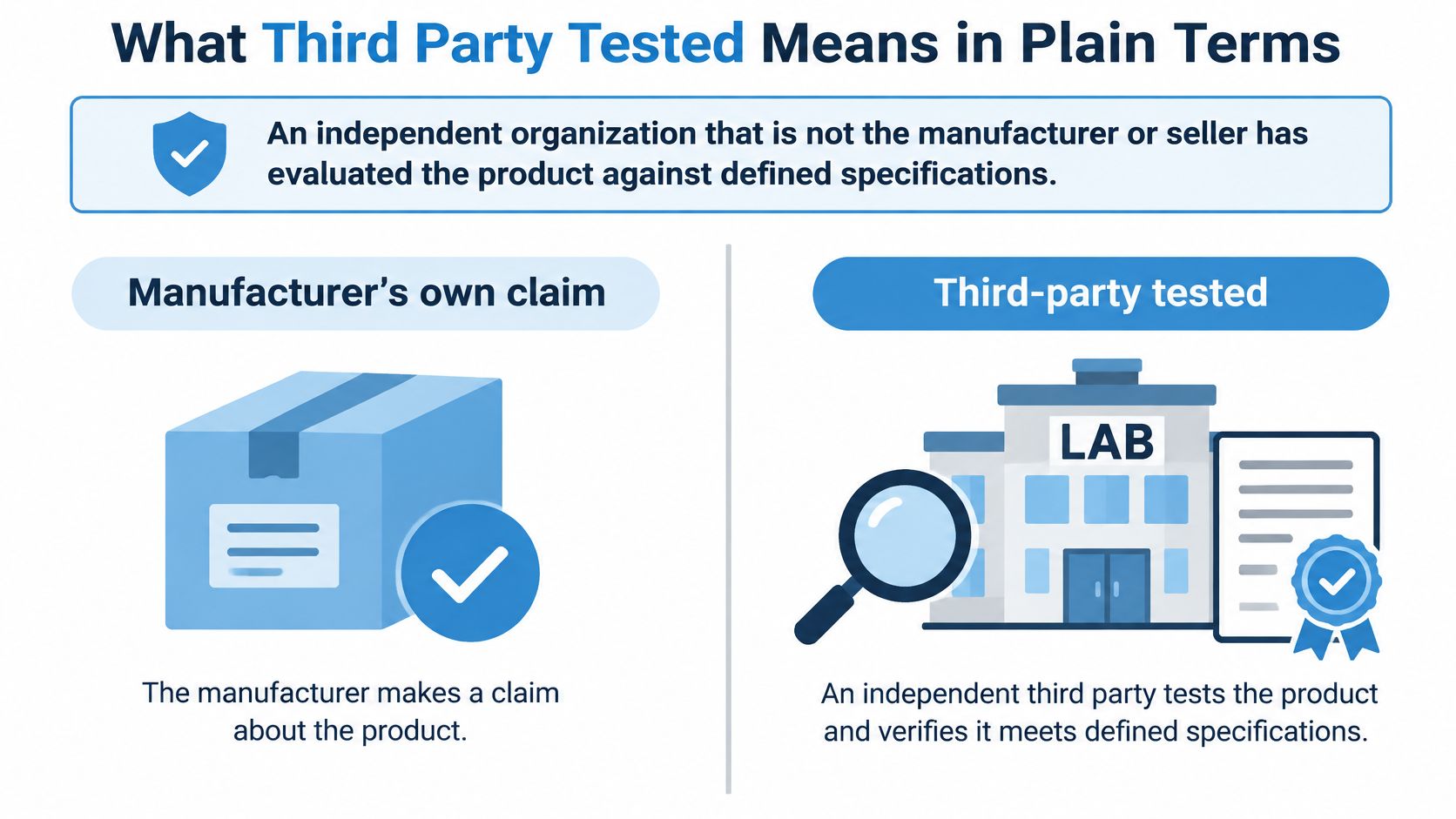
An independent organization with no manufacturing role and no share of the sale evaluates the product against defined specifications. Independence is the load-bearing part. The USP Dietary Supplement Verification Program frames its own job that way: an outside evaluator examines the product rather than relying on the manufacturer's quality-control results.
The classroom version makes the point faster. A student who marks their own exam can be careful, honest and still miss the errors, because the person who wrote the answers is doing the grading. A teacher with an answer key isn't smarter. They're independent. Internal testing is the student with the red pen, and a company announcing its own lab checks is telling you something true and something incomplete at once, since the seller still decides what gets sampled, what gets tested and what gets published.
The phrase gets attached to vitamins, minerals, proteins, probiotics, herbal formulas and sexual wellness products, and each category has its own soft spot. Herbal powders are hard to identify by eye. Protein claims live or die on amount per serving. Probiotics depend on viable count at the end of shelf life, not at the factory gate. Sexual wellness products sit in a market where marketing outruns evidence. An outside check is the only one that answers any of those.
A real program examines three things:
- Ingredients present. The compounds printed on the label are detectable in the product.
- Declared amounts. Those ingredients appear in the strengths and quantities stated on the panel.
- Contaminant limits. The product stays inside defined ceilings for unwanted substances.
USP tests samples in a laboratory against USP–NF standards or the manufacturer's own specifications, and reviews the manufacturing documentation behind them. Its scope covers identity, purity, strength, contaminant limits and performance attributes.
The sentence worth memorizing: third party tested means outside evaluation against stated criteria, not a guarantee of results.
What Each Test Checks and What It Misses
A seal summarizes a panel, and the panel decides what the seal is worth. Read the table as a scope statement rather than a score.
| Check | What it confirms | Usually covered by independent testing? | What remains unchecked |
|---|---|---|---|
| Identity | The ingredient in the bottle matches the label | Yes | Whether it produces a health effect |
| Strength | The labeled amount per serving is present | Yes | Whether that dose suits your needs |
| Purity and contaminants | Heavy metals, pesticides and microbes are within set limits | Yes, for the substances named on the test panel | Contaminants not on the panel |
| Manufacturing practice | The facility follows FDA GMP rules under 21 CFR Part 111 | Yes, through a facility audit | Every batch, unless individual lots are sampled |
| Health outcome | The product treats or improves a condition | No | Effectiveness, which needs clinical evidence |
| FDA premarket approval | Government approval before sale | No | FDA does not routinely test supplements before they reach consumers |
Identity answers the narrowest question on the list: the material in the bottle is the material named on the label. For a powdered herb that row matters most, since ground root and ground leaf look identical on a bench without a lab. Strength measures the declared amount per serving, and a product can pass identity while failing here, which is why the two results get reported separately.
Purity is the row shoppers overread. A result covers the substances on the panel and nothing beyond it, so a screen built around heavy metals and microbes says little about pesticide residue unless pesticides were named. Find out what was listed before you read "purity tested" as a clean bill of health.
Manufacturing practice is judged at the facility, not in the bottle, against FDA current Good Manufacturing Practices. It tells you the process is controlled. It doesn't tell you every lot was sampled.
The last two rows are where labels get ahead of the evidence. The FDA's consumer questions and answers on dietary supplements explains that the agency doesn't routinely analyze supplements before they reach consumers, and that quality-control testing stays with manufacturers. No seal is government approval, and no seal is clinical proof. If you're comparing vitamin D products, our guide to vitamin D supplement forms and strengths treats label amount and label accuracy as two separate questions, which is exactly the split the table draws.
A maca capsule can pass identity, strength and contaminant testing and still do nothing for the goal you bought it for. That isn't a testing failure. It's a question the test was never designed to answer.
Practical rule: when a seal appears, name the rows it covers before reading it as a full guarantee.
How an Independent Testing Program Works
Verification is a multi-stage system, not one lab test performed once. USP's verification FAQ lays out the sequence: a manufacturing-facility audit, a review of quality-control and production records, laboratory testing of product samples, and periodic off-the-shelf testing to confirm the product still complies. The program also checks whether manufacturing follows FDA current Good Manufacturing Practices under 21 CFR Part 111.
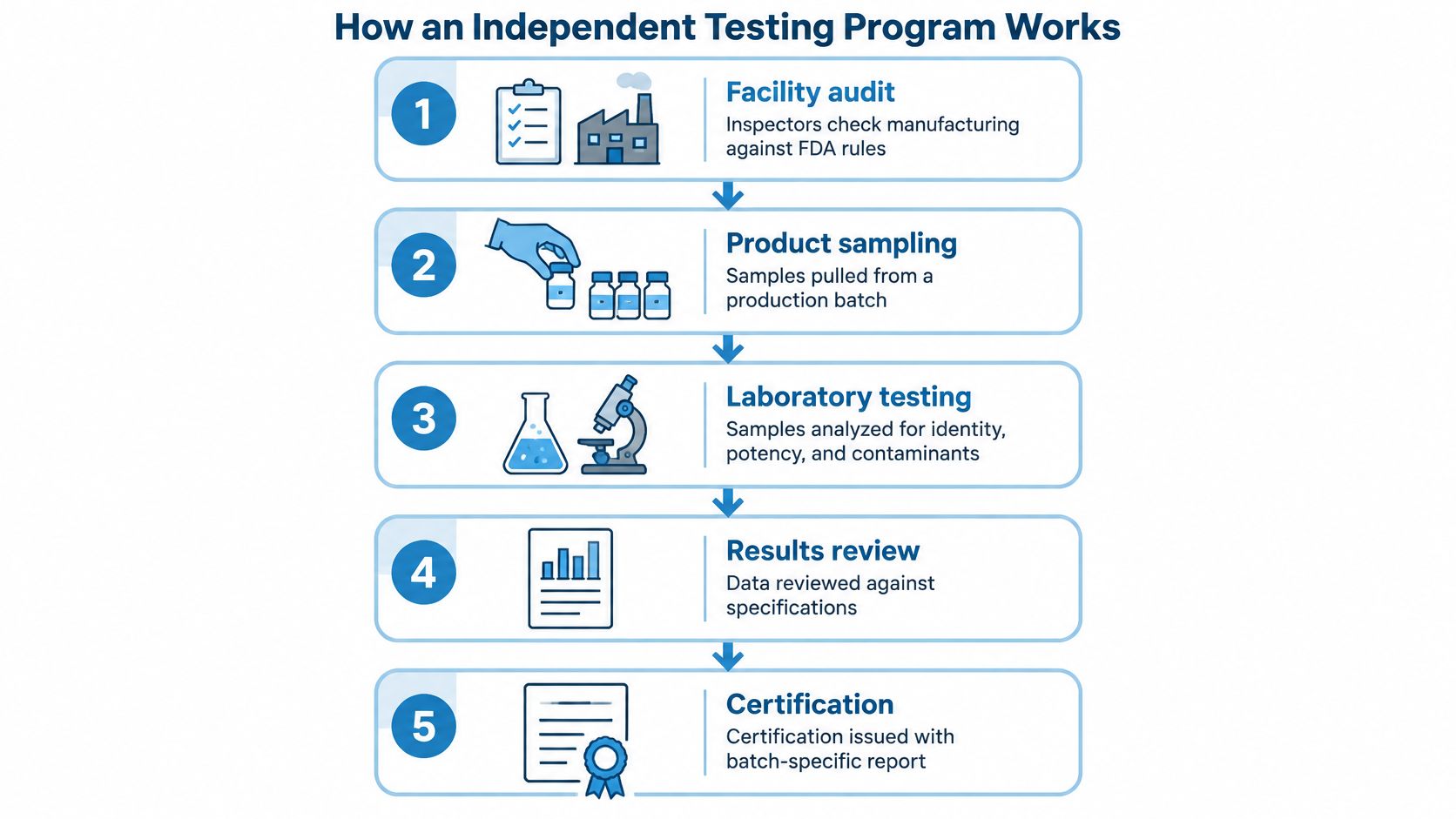
The stages stack for a reason. Each one catches a failure the others miss.
- Facility audit. Inspectors walk the plant and examine the process rather than the finished bottle. A mixing step that changed without documentation shows up here and nowhere else.
- Records review. Reviewers read the production and quality-control paperwork for the run, so what the line did has to match what the file says it did.
- Laboratory testing. Samples pulled from production are analyzed for identity, strength and the contaminants on the panel.
- Off-the-shelf sampling. Products bought from retail shelves are tested periodically, which shows what shoppers receive rather than what left the dock.
- Ongoing surveillance. Testing, documentation review and audits repeat on an annual cycle, so certification is a checkpoint that keeps running instead of a one-time approval.
Consider a lot that passes its lab test while the facility's records are thin. The result looks fine, the batch ships, and the weakness sits in the process waiting for a busier week. The audit is what surfaces it, and it's the reason a serious program needs both halves.
For a visual walkthrough of how the stages connect, this explainer covers the same ground in a few minutes.
The phrase itself isn't a universal guarantee. Its meaning depends on who performed the testing, which lots were sampled, which analytical methods were used and which substances were included. Ask which stage a seal reflects, and keep the standing audit separate from the result for the lot in your hand.
Three Misconceptions About the Label
An NSF 2024 consumer report found that 89% of respondents preferred certified dietary supplements, while 86% expected retailers to sell supplements tested for safety and quality. That's a demand signal, and it says nothing about the bottle in front of you. Three readings of the label cause most of the confusion.
Misconception one, the seal means safe, effective and FDA-approved. The NIH's Office of Dietary Supplements answers this directly: independent quality seals generally indicate a product was manufactured properly, contains the labeled ingredients and lacks harmful contaminant levels, and they don't guarantee safety or effectiveness. Nothing about a seal is premarket government approval.
Misconception two, the seal means the product works for your goal. A sexual wellness capsule or a maca blend can pass identity and contaminant screening and still fail to produce the outcome the shopper pictured. A tested product can also interact with a medication you take, or be unsuitable for a condition you manage. Testing answers a quality question. Suitability is a different conversation, and it belongs with your clinician.
Misconception three, no seal means poor quality. Plenty of competent manufacturers sell unverified products, because independent certification is voluntary and it costs money. A missing logo is missing information, not evidence of a bad batch.
Where the label stops
Nothing printed on a supplement label or product page is a medical claim. As our own site states, statements about dietary supplements have not been evaluated by the Food and Drug Administration, and the products are not intended to diagnose, treat, cure or prevent any disease. If a halal claim matters to you, our guide to halal certified vitamins shows how to trace that certification back to its issuing body, the same move you'd make on a testing seal.
The accurate reading isn't "third party tested, so it's safe." It's "independently evaluated against defined criteria, and the criteria still need checking."
How to Verify a Claim Before You Buy
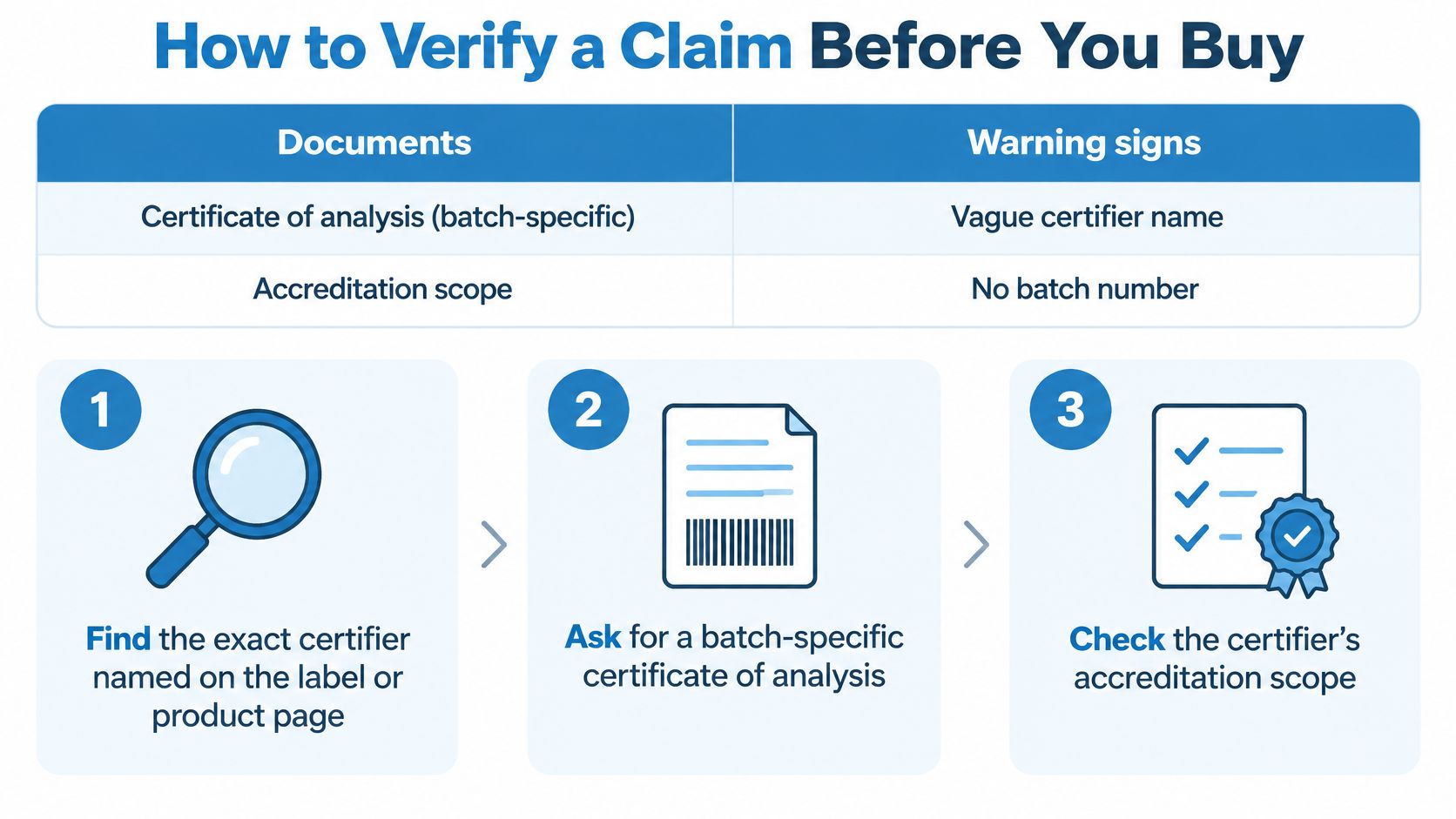
Start with the uncomfortable detail. USADA's guidance on reducing supplement risk notes that the supplement company typically pays the certifier, and that certified products may go through continuing compliance processes. Payment doesn't invalidate a certification. It does make five things worth seeing: the certifier's name, the test scope, the product identity, the lot and the certificate date.
| Item | What it shows | Warning sign |
|---|---|---|
| Batch-specific certificate of analysis | Which lot was tested, the methods and the results | Only a general statement with no lot number |
| Certifier listing or database entry | The seal is current for this exact product | A logo with no way to look it up |
| Product name and dosage form | The tested formulation matches what you are buying | Different strength or form from the report |
| Test date | The results are recent relative to the production lot | Report older than the lot on sale |
| Scope of testing | Which contaminants and ingredients were checked | A vague claim with no list of tests |
| Facility GMP statement | Manufacturing controls were audited | Says GMP but names no facility or certifier |
Then run the routine. It takes about ten minutes on a product page.
- Find the certifier. Note the exact organization named on the label or listing, not the phrase "lab tested."
- Ask for the batch certificate. A certificate of analysis tied to the lot you're buying, not a generic document for the product line.
- Search the certifier's own register. Credible programs publish a lookup tool. If the product isn't there, the seal doesn't hold.
- Match the product exactly. Same name, same dosage form, same formulation, same strength.
- Compare dates. A report older than the lot on sale describes a different production run.
- Read the scope. Which contaminants and which ingredients were in the panel, and which were left out.
One distinction trips people up more than any other. A seal covering the manufacturer or facility speaks to how the product was made. A seal covering the finished product speaks to the bottle. The NIH names ConsumerLab, NSF and USP as organizations offering quality testing while noting they take different approaches, so a logo alone won't tell you whether contaminants or ingredient amounts were checked. Only the panel does. If label reading is the weak spot, our walkthrough on how to read a supplement label covers what each figure on the panel is telling you.
Where the bottle comes from matters too. To get the genuine product, buy from the official CalVitamin website or from authorized supplement retailers, so the lot you receive can be matched to the certificate behind it.
Check the Claim on Your Next Supplement Purchase
Three questions settle most of this before you pay.
- What was tested? Identity and strength only, or contaminants and banned substances as well.
- Which lot was tested? A certificate for a different production run answers a different question.
- Who did the testing? A named organization you can look up, or a phrase with no owner.
Say you're comparing two protein powders with near-identical labels. The first product page names its certifier, posts a certificate for the lot currently on sale and dates the report to the same quarter as the batch. The second shows a logo and nothing else. On evidence, the first is the buy. Not because the powder is better, but because it's the only one of the two making a claim you can check.
If the certificate can't be produced for the lot in your hand, treat the claim as unverified. That isn't an accusation, it's the honest state of the evidence.
A verified claim supports quality, and quality is where it stops. Our products are tested for quality and purity and manufactured under strict GMP standards, which is the part a certificate can speak to. Whether a supplement belongs in your routine is a separate decision, and one worth making with your doctor.
CalVitamin carries vitamins, minerals, proteins, probiotics, herbal formulas and sexual wellness products, and our listings state where a product is tested and made under GMP standards so you know what to check before you buy. If you want to see the specification behind a specific item, our support team is reachable at 1-888-510-9080 or by email and can walk you through the quality details on the page. Visit CalVitamin to browse the catalog, then apply the three questions above to whichever bottle you're considering.


