
Supplements do lose strength and stability after the printed date, but US rules do not require a date, and an expired product is rarely dangerous overnight. So why do so many people treat that date like spoiled milk? A time-limited warranty ends when the maker stops standing behind the product, not when the item turns harmful at midnight. A cabinet shelf is the same idea in a kitchen: the bottle can sit there looking unchanged while labeled quality gradually slips. Do supplements expire in the practical sense of strength, purity, and stability, and the useful answer depends on the form in your hand.
Table of Contents
- Do Supplements Expire? The Short Answer by Form
- Decoding the Expiration Date and What It Promises
- How Storage and Packaging Shorten Shelf Life
- Signs a Supplement Has Degraded and What to Do
- What Changes After the Date
- Check the Date, Condition and Source Before You Take It
Do Supplements Expire? The Short Answer by Form
Yes. Active ingredients can lose strength, purity, and stability while the bottle still looks ordinary. Most products do not become dangerous the day after the printed date. Older bottles are common, which is why the date matters at home. A 2024 peer-reviewed analysis of U.S. NHANES data included 12,529 adults and found that approximately 40% of supplement users had taken supplements for more than 5 years, a span that makes leftover bottles likely, as reported in the NHANES supplement-use analysis.
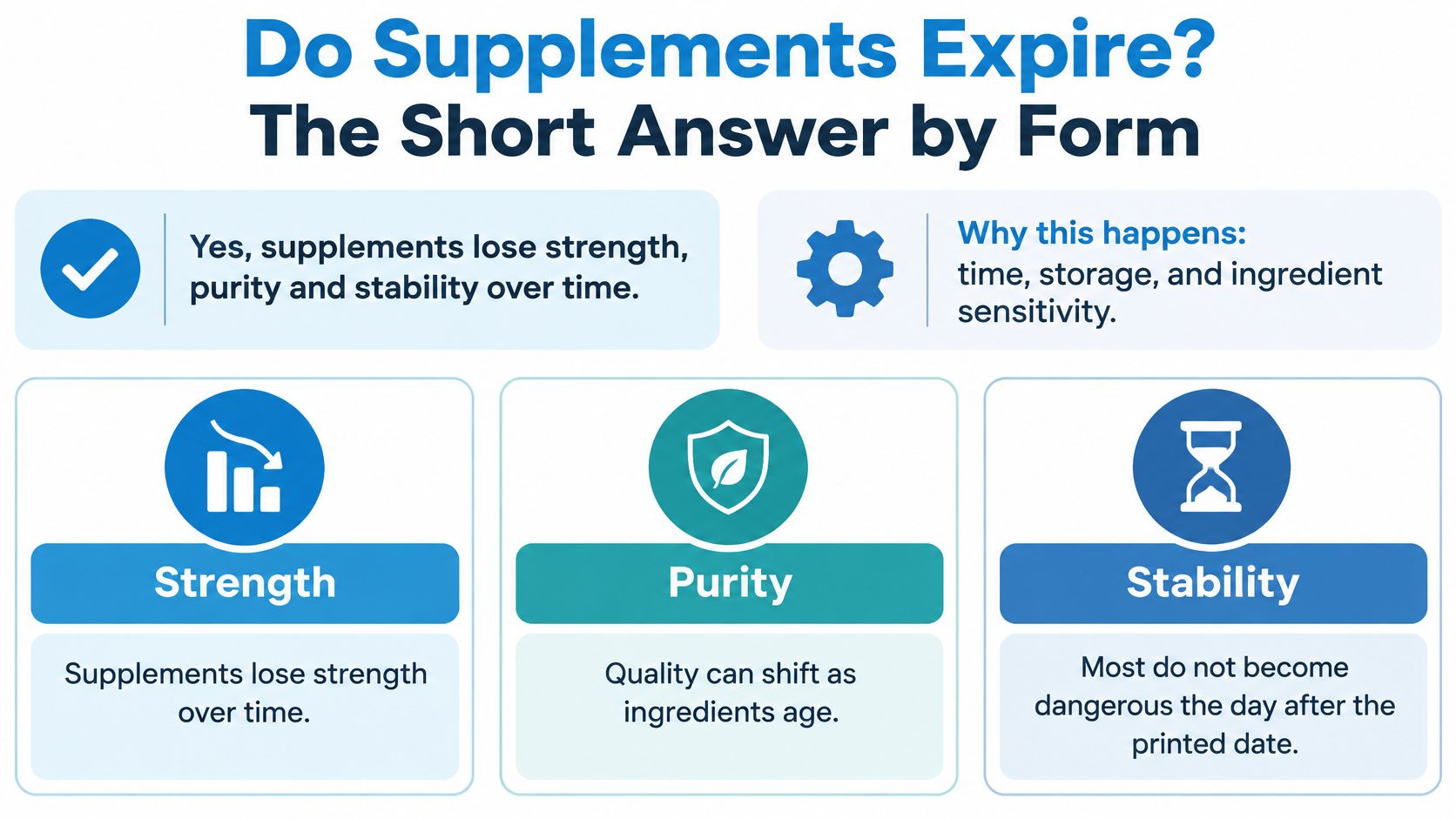
Use the form, not a single cutoff
Match the product to one row. Note the main degradation driver, then check how the bottle was stored and whether it still looks, smells, and feels normal. The table is a starting point, not a verdict on any brand. A dry mineral tablet and a live-culture capsule do not age on the same clock. Whether the main worry is lower strength, or lower strength plus a contamination risk, depends on that row.
| Form | Main degradation driver | Expired-product concern |
|---|---|---|
| Tablets and hard capsules (multivitamins, minerals) | Moisture and slow potency loss | Lower strength, rarely harmful |
| Powders (vitamin C, protein, greens) | Moisture, clumping and oxidation | Potency loss and clumping |
| Liquids and shots | Oxidation and microbial growth | Potency loss and possible contamination |
| Softgels and fish or plant oils | Oxidation | Rancid taste and reduced benefit |
| Gummies | Heat and humidity | Texture change and potency loss |
| Probiotics (capsules and powders) | Decline in live organisms | Fewer live organisms than the label states |
| Herbal and botanical blends | Ingredient variation and oxidation | Potency change and possible contamination |
Practical rule: Read the matching row, then the rest of this guide, before you decide to keep the product.
A sealed multivitamin tablet mainly asks whether you still get the labeled dose. A liquid shot, a fish-oil softgel, a gummy, or a probiotic asks a second question about whether the formula stayed intact. Say you open a greens powder and it pours freely with its usual smell. That row points to moisture and oxidation, so you still check the date and the cap. A sticky gummy or a sharp oil smell is a different decision, even on the same calendar day.
Decoding the Expiration Date and What It Promises
Read the bottle in a fixed order so the printed mark means something specific.
- Find the marks. Look on the bottle base, the carton, and the seal for a date and a lot code.
- Name the label type. Exp. marks the manufacturer-supported end of the quality period. Best if used by is a quality estimate, not a safety cutoff. A manufacture date, when printed, marks the start of the shelf-life period. The lot code identifies the batch for a recall check.
- Record it. Write the lot code down and photograph the label with your phone.
- Count the remaining months. Compare the date with today. EXP 06/2027, read in early 2026, leaves about a year and a few months of manufacturer-supported quality.
- Ask when nothing is printed. Contact the manufacturer or seller with the lot code and ask what stability data supports the product.
- Keep the paper trail. Store the receipt with the lot number so a later recall notice can be matched to your bottle.
What the date actually promises
In the United States, supplements can expire in the practical sense that ingredients may lose strength, purity, or stability, but federal law does not require every supplement to display an expiration, shelf-life, or "best if used by" date. The FDA small-entity cGMP guide states that manufacturers are not required to establish an expiration date. If a company voluntarily places one on the label, it should possess data supporting that date. For new dietary ingredients, the proposed "use by" or expiration date should be backed by stability data showing identity, strength, and purity through the end of the recommended shelf life, including whether new degradants form and whether their identity and safety are understood.
Treat a supported date as the endpoint of documented quality under the stated storage conditions, especially for probiotics, oils, liquids, and some herbal preparations. It is the end of the warranty, not a switch that makes the contents harmful at midnight. Medicines are a different system. Dietary supplements use a Supplement Facts panel and are regulated as food products, while over-the-counter medicines use Drug Facts labeling under separate drug rules, as the FDA Drug Facts overview explains. Two similar capsules can carry very different evidence behind their dates.
A missing date does not prove a product is unsafe. It gives you less verified information about remaining potency. If the panel itself is hard to parse, our guide on how to read a supplement label walks through the parts that sit next to the date. Statements about dietary supplements on this website have not been evaluated by the Food and Drug Administration (FDA). The products are not intended to diagnose, treat, cure, or prevent any disease.
How Storage and Packaging Shorten Shelf Life
Heat, humidity, oxygen, and light set the speed of chemical and biological decline. A bottle left in a hot bathroom, a parked car, or a sunny window can age faster than the same bottle kept sealed in a cool, dry cabinet. Packaging is part of that math. The commercial container is what the date assumes.
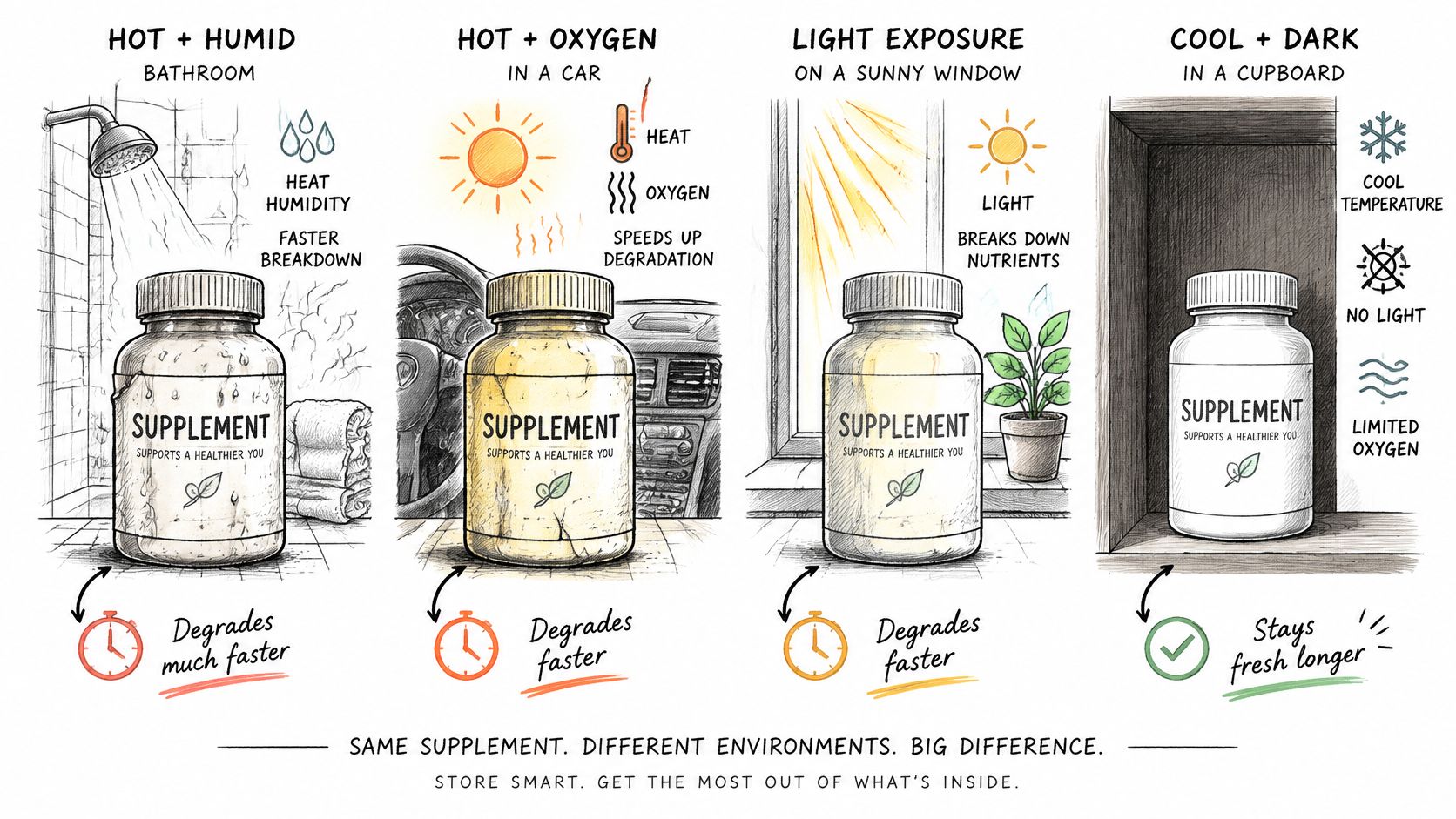
Why the same date behaves differently
Oxidation-prone oils react with air. Moisture-sensitive powders clump. Botanicals can shift with light and oxygen. Live organisms lose viability even when the capsule still looks normal. Probiotics make the pattern easy to see. Recent comparative evidence found that refrigeration or freezing preserved probiotic viability more effectively than ambient storage. At the end of declared shelf life, six of ten tested products met their labeled counts under refrigeration, while only three did so at ambient temperature, as reported in this probiotic storage comparison. Freezing can damage some formulas, so the label's storage line controls, not a blanket cold rule. Our comparison of refrigerated versus shelf-stable probiotics is the place to match that instruction to the product you bought.
Any storage outside the label's conditions shortens the window the date promises.
Habits that protect the labeled window
- Keep the original container. It is built to block light and moisture, and the lot code stays with the product.
- Close the cap right away. Each open minute admits air and humidity.
- Don't park tablets in a pill organizer for weeks. The organizer exposes them to air and room moisture. Fill only the days you will use soon.
- Keep bottles off bathroom shelves. Shower steam cycles humidity even when the room feels dry an hour later.
- Read the storage line before you choose a cupboard or a fridge. Cold helps some live cultures and hurts formulas that pick up condensation.
Screen the dosage form, the storage statement, the seal, and any time the bottle spent in heat. A short clip on kitchen storage makes the cabinet-versus-bathroom contrast easier to picture before you rearrange a shelf.
Signs a Supplement Has Degraded and What to Do
Discard a product that shows swelling, leakage, a broken or missing seal, an unusual odor, discoloration, or moisture clumping, even when the printed date has not passed. Your senses sort the rest.
Match what you see, smell, or feel
| Symptom | Likely cause | Action |
|---|---|---|
| Clumping or hard lumps in a powder | Moisture exposure | Discard if lumps stay or the smell changes |
| Rancid, paint-like or fishy smell in oils | Oxidation | Discard |
| Cloudiness, separation or sediment in a liquid | Microbial growth or breakdown | Discard |
| Swollen, leaking or bulging bottle | Gas, microbes or broken seal | Discard immediately |
| Faded color or mottled tablets | Light or heat exposure | Discard if the change is clear |
| Sticky or sugar-coated gummies | Heat and humidity | Discard if the texture has changed beyond normal |
| No visible change in a probiotic | Loss of live organisms cannot be seen | Use within the date and store as the label directs |
A protein powder that clumps into rocks has taken on moisture. Fish-oil or plant-oil softgels that smell like old paint or strong fish have oxidized. A liquid shot that clouds, separates, or grows sediment is no longer the formula you bought. Gummies that turn sticky or grow a sugary coat have seen heat and humidity. Tablets that fade, mottle, or crumble have been stressed by light, heat, or moisture.
Sight has a hard limit. A probiotic capsule can look perfect while the live count has already fallen, so a normal appearance cannot confirm potency. If you are unsure, trust the sign over the hope that the bottle is still fine. Do not run a home taste test on a suspect oil, liquid, or powder.
Seal a discarded product in a bag and place it in household trash according to local rules, or use a pharmacy take-back program if one is available. Leaving the bottle in the cabinet is how it gets used by mistake.
What Changes After the Date
The common question treats expiration as a yes-or-no safety cutoff. That framing fails because risk varies by dosage form, ingredient, packaging, and storage history. An expired multivitamin tablet in a sealed bottle mainly raises a potency concern. An expired probiotic, liquid, gummy, or moisture-sensitive product can add stability and contamination concerns.
For probiotics, the NIH Office of Dietary Supplements says viable organisms can decline during shelf life, and some labels report colony-forming units (CFUs) only at manufacture, not through the expiration date. You may receive fewer organisms than the headline number suggests, even before the printed date, and still fewer after it.
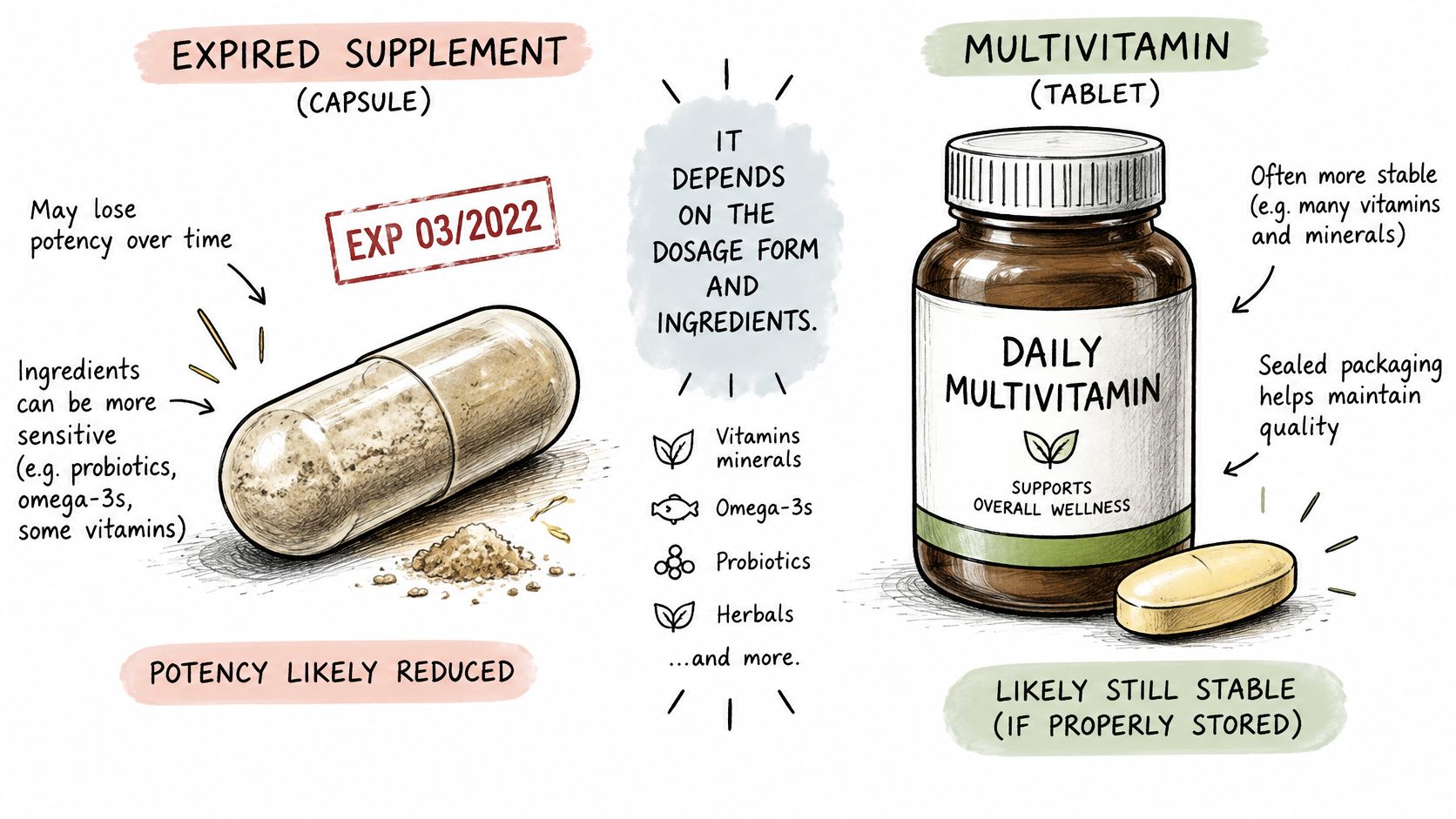
Two bottles, two answers
Say a multivitamin tablet is two years past the date and has stayed sealed in a cool drawer. The likely change is a softer dose, not a sudden toxin. Say a probiotic spent a summer in a hot car. Heat speeds the loss of live organisms, and the capsule will not show it. The first bottle is a potency judgment. The second is a reason to replace the product.
Three questions for the bottle you hold
- Is this form sensitive? Oils, liquids, gummies, powders, and live cultures move faster than a dry mineral tablet.
- Was it stressed? Heat, humidity, a loose cap, or a damaged seal change the odds even inside the printed window.
- Does the label promise potency at expiration? Some labels state the count at manufacture only. Others support the number through the date. Read which promise you bought.
There is no single answer for an expired supplement. Judge the product in front of you.
Check the Date, Condition and Source Before You Take It
A printed date cannot confirm authenticity, proper storage, or ingredient safety. Run three checks, in order, before you take the product.
Date and potency
Confirm the printed date and how many months of supported quality remain. If the label gives CFU only at manufacture, do not treat the headline number as a promise through the last day.
Condition and storage history
Ask where the bottle lived. A promotion stash in a car, a humid bathroom, or a warm mail pile is not the same product as one kept sealed and cool. Then use smell, color, texture, and the seal. An odd odor or a broken seal ends the decision.
Lot code and recall status
Write down the lot code and check current FDA recall and safety listings. FDA recall records on health fraud show that some dietary supplements have been removed for undeclared drug ingredients or contamination, including notices involving products marketed for sexual enhancement and products with possible Salmonella contamination. An in-date bottle is not automatically safer than an older one if the source is unreliable, storage was poor, or the lot was recalled. FDA review before sale is not the same system as drug approval, and a date does not create an approval.
Buy from sellers who can stand behind the lot. To get the genuine product, buy from the official CalVitamin website or from authorized supplement retailers. Skip damaged or resealed packaging, and keep the lot with the receipt. A short guide to choosing the best online supplement store covers what to look for in the seller before you stock up.
Pick up one bottle you own today. Read the date and the lot code, check the seal and the contents, and record the lot number before you decide to keep it.
CalVitamin carries vitamins, minerals, proteins, probiotics, herbs, and other wellness products with the dates, storage lines, and lot codes you need for the checks above. Use those details before you open a new bottle or finish an old one. Visit CalVitamin to shop the catalog and match the form to how you store supplements at home.


