
Most shoppers get the same advice: pick a vitamin C supplement with rose hips because it's more natural. That sounds sensible. It's also where a lot of confusion starts.
Fresh rose hips are famous for their vitamin C content. But many people don't realize that processing can destroy much of that natural vitamin C, so the finished supplement may depend on added ascorbic acid instead of the fruit's original content. If you've ever looked at a label and wondered whether you're buying a whole-plant product or a standard vitamin C pill with a little rosehip powder sprinkled in, you're asking the right question.
A good rosehip vitamin C supplement can still be useful. The key is knowing what you're paying for.
Table of Contents
- Is Your Rosehip Supplement What It Seems
- The Power Packed into a Rosehip
- Health Benefits Beyond the Common Cold
- Rosehip vs Other Vitamin C Supplements
- Decoding the Label What to Look For
- Finding Your Rosehip Supplement at CalVitamin
- Frequently Asked Questions
Is Your Rosehip Supplement What It Seems
The biggest myth in this category is simple: if the bottle says rosehip, the vitamin C must come from rose hips. That isn't always true.
According to WebMD's rose hip monograph, fresh rose hips contain 10 to 50 times more vitamin C than oranges, but standard drying and processing methods destroy most of this nutrient. That's why many commercial products rely on added synthetic vitamin C. In plain terms, some formulas use rosehip more as a label feature than as the main vitamin C source.
That doesn't make every blended formula bad. It just means you should stop treating the word “rosehip” as proof of quality.
Why this confuses buyers
Supplement labels often blur an important distinction:
- Vitamin C with rose hips usually means ascorbic acid is doing most of the heavy lifting, with rosehip included as a companion ingredient.
- Rosehip extract standardized for vitamin C suggests the manufacturer is measuring and controlling the active content coming from the plant material itself.
Those are not the same product concept, even if the front label looks similar.
Practical rule: If a brand highlights “natural rosehip vitamin C” but doesn't clarify the source or standardization, pause before buying.
A product such as Nature Made Vitamin C 500 mg with Rose Hips is a useful example of the naming pattern shoppers see every day. The label language matters. “With rose hips” tells you something very different from “vitamin C from rosehip extract.”
The natural myth in one sentence
Think of fresh rose hips like fresh orange juice. Once you heat, dry, and process them heavily, you shouldn't assume the finished product still matches the raw ingredient. The fruit and the finished capsule may be related, but they're not interchangeable.
The Power Packed into a Rosehip
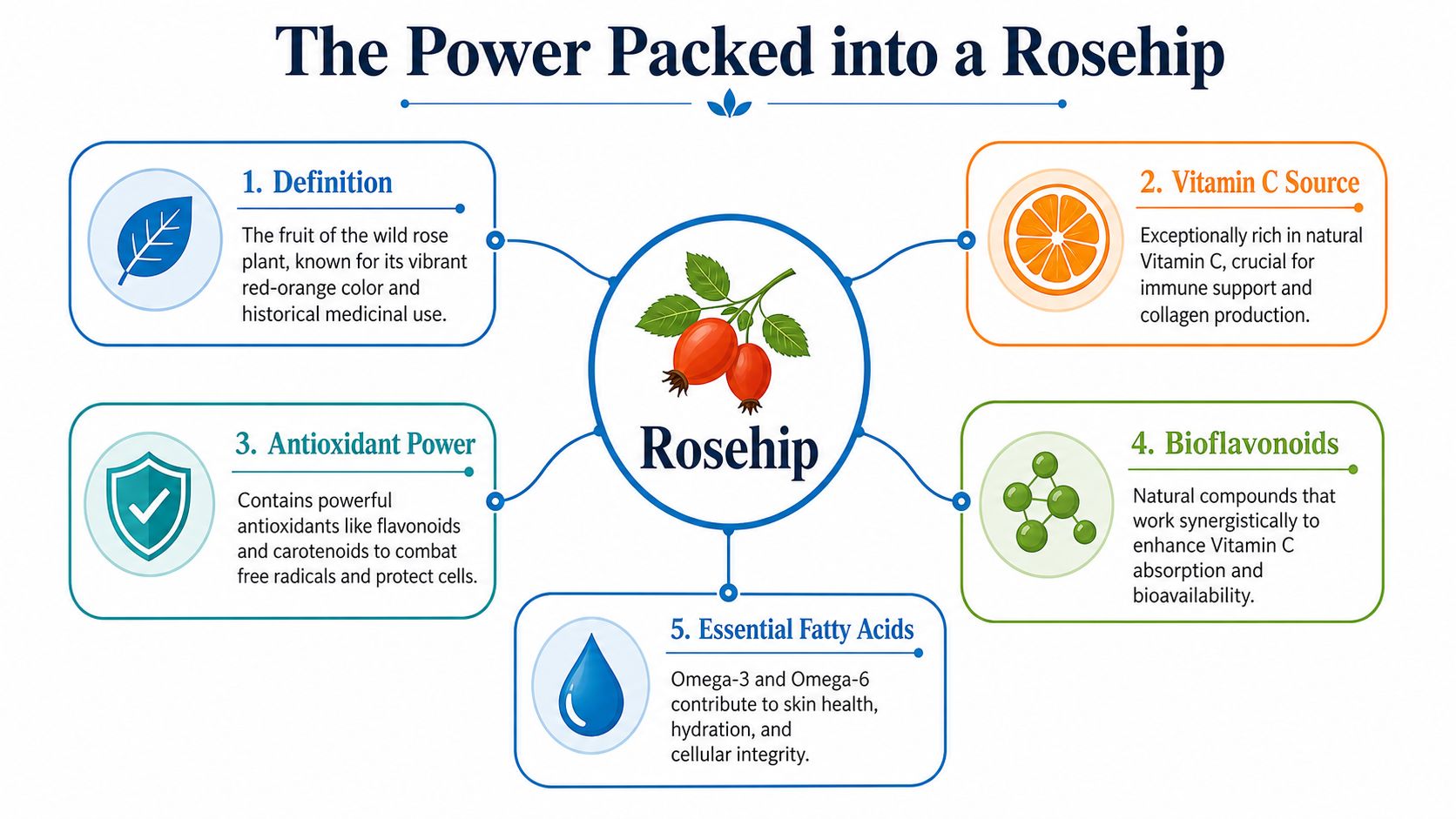
Rose hips are the fruit of the rose plant. When people talk about them in nutrition, they're usually talking about the bright red to orange fruit that forms after the flower stage. Historically, people valued them as a food and traditional remedy because they're unusually rich in protective plant compounds.
In their natural state, rose hips have a strong nutritional reputation because of vitamin C. The fruit provides about 426 mg of vitamin C per 100 grams, equal to 473% of the daily value, and some cases can reach up to 2,000 mg per 100 grams, depending on species and growing conditions, as described in this rose hip nutrition reference.
Why the whole fruit gets attention
If isolated vitamin C is like a solo instrument, a whole rose hip is more like a small ensemble. The fruit contains vitamin C, but that's only part of the story. It also contains plant compounds that help explain why rosehip remains popular even when buyers are already familiar with standard vitamin C tablets.
Three pieces matter most:
- Vitamin C itself: important for immune function and collagen production.
- Bioflavonoids: natural companion compounds that may support how vitamin C performs in the body.
- Other plant constituents: these are part of why rosehip is discussed for broader wellness goals, not just cold-season use.
Raw ingredient versus finished supplement
Many readers struggle with this distinction. The impressive nutrient profile belongs to the fruit in a natural state. A supplement has to preserve, concentrate, or replace that value through manufacturing. Some products do this carefully. Some don't.
A strong rosehip vitamin C supplement aims to deliver more than a romantic plant story on the label. It should answer practical questions:
| What to ask | Why it matters |
|---|---|
| Is the vitamin C measured? | Measured potency gives you something concrete to evaluate. |
| Is it an extract or just powder? | Extracts are often designed for consistency. |
| Does the formula include supporting plant compounds? | Whole-plant value depends on more than one isolated nutrient. |
Rosehip isn't magical because it's “natural.” It's useful when the product preserves or clearly declares what the plant contributes.
That distinction helps you avoid two extremes. One is assuming all synthetic vitamin C is inferior. The other is assuming every rosehip product is automatically superior. The better question is more specific: what is this formula delivering?
Health Benefits Beyond the Common Cold
A rosehip vitamin C supplement earns its place on your shelf only if it does more than trade on a natural-sounding label. This matters here too. The potential benefits come from what survives processing, what is standardized, and what the formula delivers, not from the word "rosehip" by itself.
Immune support and daily resilience
Immune support is the reason many people first look at vitamin C, but rosehip is not interesting only during cold season. Vitamin C supports normal immune function year-round, and rosehip has a long history as a food and herbal ingredient used when nutrient-dense produce was less available.
That history is useful context, not proof of every modern marketing claim. It tells you why people paid attention to rosehip in the first place.
A cautious shopper should keep one distinction in mind. A capsule can contain rosehip powder, rosehip extract, added ascorbic acid, or a mix of all three. If a product promises immune support, the practical question is simple: how much vitamin C are you getting per serving, and does the label make that clear?
Skin and collagen support
Vitamin C is required for collagen production. Collagen helps maintain skin, blood vessels, cartilage, and other connective tissues, so the interest in rosehip goes well beyond immunity.
This is easier to understand if you picture a repair crew working with the right materials. Without enough vitamin C, the body cannot carry out parts of the collagen-building process efficiently. That does not mean a rosehip capsule acts like a beauty product. It means the nutrient supports a basic structural job the body already performs.
For someone comparing products, the natural myth can present a challenge. Some rosehip supplements imply skin benefits because rosehip sounds wholesome, while the actual vitamin C content is low or unclear. Others pair vitamin C with complementary compounds in a more transparent way, such as a vitamin C formula with Bio-Quercetin phytosome tablets, where the label makes the active ingredients easier to evaluate.
Joint comfort and inflammatory support
Joint support is one of the more interesting reasons people look beyond plain ascorbic acid. Rosehip contains plant compounds that have been studied for anti-inflammatory effects, which is why it comes up in conversations about osteoarthritis and rheumatoid arthritis.
The key word is support. Rosehip is not a stand-alone treatment for joint disease, and it should not replace medical care.
As noted earlier from WebMD's rosehip guidance, rosehip has also been used traditionally for sore throat and indigestion, and guidance discussed there includes use of powder-filled rosehip capsules taken twice daily for rheumatoid arthritis as an adjunctive approach. Adjunctive means it is used alongside standard care, not instead of it. That is the balanced way to read the evidence. There is enough interest to justify a closer look, but not enough to turn cautious language into a miracle claim.
Tea, capsules, and realistic expectations
Rosehip tea and rosehip supplements are not interchangeable. Tea can be pleasant and traditional, but it is harder to judge how much vitamin C remains after drying, storage, and brewing. Heat, air, and time all work against vitamin C stability.
Capsules are usually easier to assess because the label can tell you the amount of vitamin C, the form used, and whether the manufacturer added ascorbic acid to make up for losses during processing. That last point matters. Many products do exactly that, which is not automatically bad, but it does mean "rosehip vitamin C" sometimes refers to a blend of plant material plus added vitamin C rather than naturally preserved vitamin C from the fruit alone.
If your goal is measurable intake, choose the format that gives you measurable information. If your goal is a soothing traditional drink, tea may still have a place. The benefit depends less on romance and more on what the product can honestly show you.
Rosehip vs Other Vitamin C Supplements
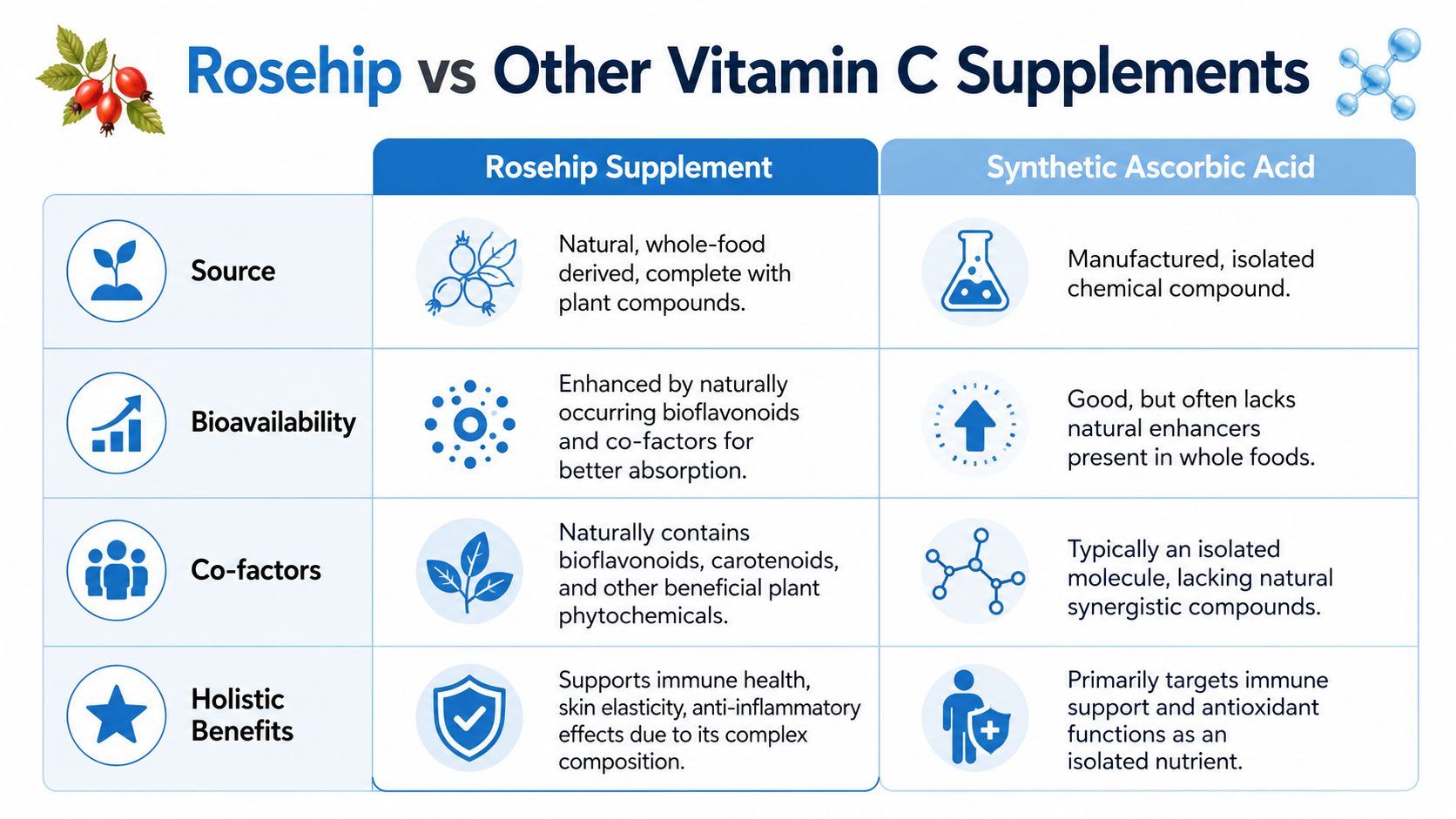
Choosing a rosehip vitamin C supplement makes more sense when you compare it with the alternatives shoppers see: plain ascorbic acid, vitamin C paired with bioflavonoids, and other plant-based options.
The main difference isn't that one category is “real” and another is “fake.” The actual difference is formulation.
What rosehip can add
One reason people look for rosehip on a label is the presence of bioflavonoids. According to this product specification describing vitamin C with bioflavonoids and rose hips, the synergistic effect of rosehip bioflavonoids with vitamin C can enhance antioxidant capacity and absorption by 20 to 30% compared with isolated ascorbic acid.
That doesn't mean every rosehip formula automatically performs that way. It means co-factors matter, and they may help explain why some people prefer a mixed plant-based formula over a bare-bones tablet.
Quick comparison
| Type | Best fit | Main tradeoff |
|---|---|---|
| Plain ascorbic acid | Shoppers who want a straightforward vitamin C product | Often lacks the broader plant matrix found in rosehip formulas |
| Rosehip-based or rosehip-inclusive formula | People who want vitamin C plus plant co-factors | Label reading becomes more important because “rosehip” can mean different things |
| Vitamin C with added bioflavonoids | Buyers focused on complementary compounds | The source of vitamin C may still be isolated rather than plant-derived |
| Liposomal vitamin C | People who prefer alternative delivery formats | The label may emphasize delivery system more than plant content |
A formula such as Life Extension Vitamin C and Bio-Quercetin Phytosome vegetarian tablets shows another path some shoppers take. Instead of focusing on rosehip itself, it pairs vitamin C with added flavonoid support.
How I'd frame the choice
Buy rosehip when you want the broader identity of the plant and the possibility of useful co-factors. Buy plain vitamin C when simplicity matters most. Buy a more engineered formula when you care more about companion ingredients or delivery style than botanical sourcing.
The wrong move is assuming the word “rosehip” answers all those questions for you. It doesn't.
Decoding the Label What to Look For
The front of the bottle is advertising. The supplement facts panel is where the truth usually starts.
If you want a rosehip vitamin C supplement that's more than marketing language, read the label with the same mindset you'd use when buying olive oil or honey. The product name gets your attention. The details tell you whether the product deserves your trust.
Start with the wording
Two phrases can look similar while meaning very different things.
- “Vitamin C with rose hips” often points to a standard vitamin C supplement that includes rosehip as a secondary ingredient.
- “Rosehip extract” suggests the plant itself is a more central part of the formula.
- “Standardized” is especially useful because it implies the manufacturer is targeting a measurable active content.
That last point matters because consistency is one of the biggest challenges in botanical supplements.
Look for standardization and specifications
A quality rosehip extract for manufacturing is often standardized to at least 45% vitamin C by titration, with specifications for heavy metals, microbiological limits, and a shelf life of around 3 years, according to this rosehip extract material specification.
That kind of language is far more helpful than vague claims like “packed with natural goodness.”
Label check: “Standardized extract” is usually more informative than “proprietary botanical blend.”
Here's a simple screening list you can use in a store or while shopping online:
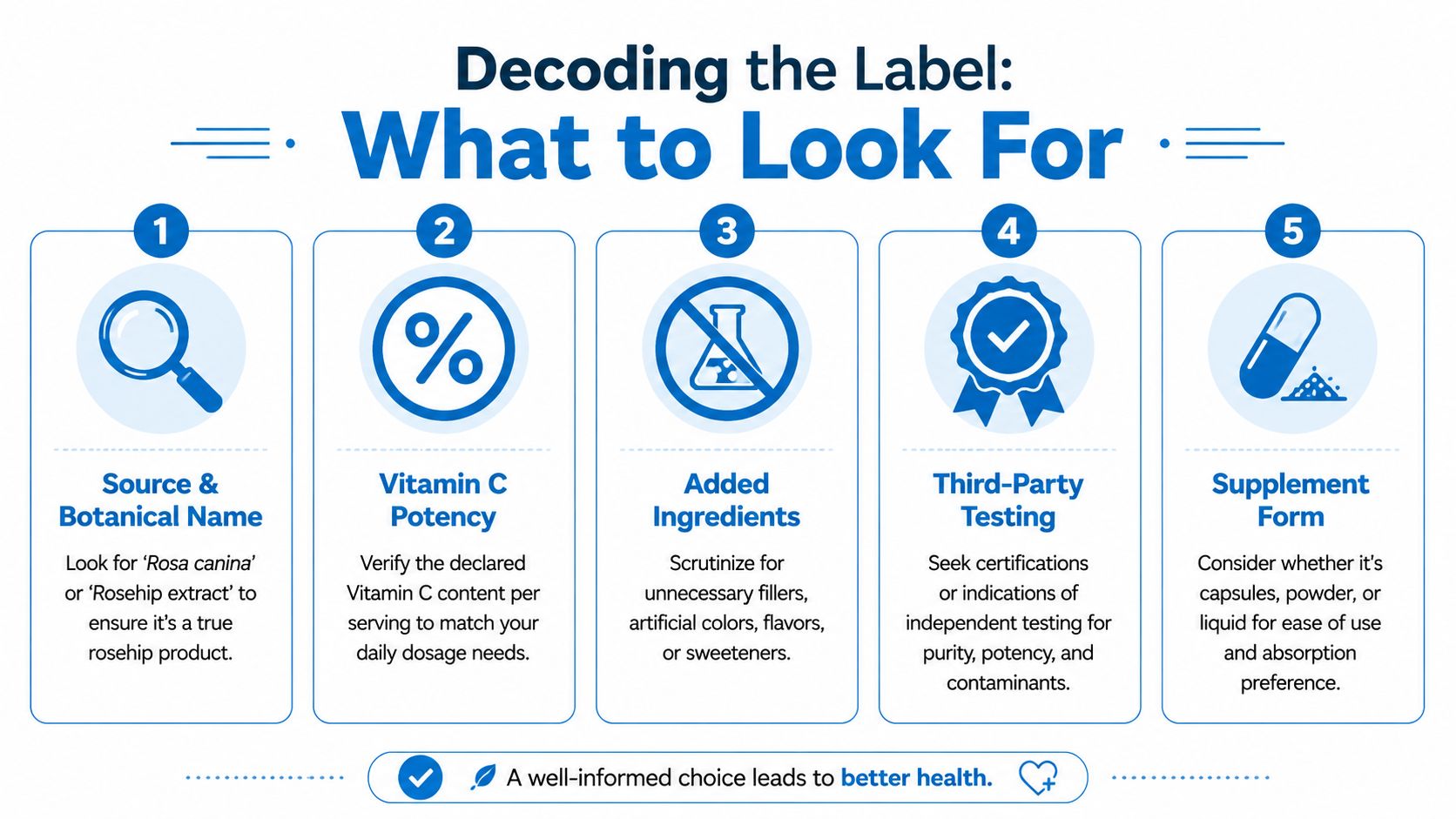
- Botanical identity matters. Look for a specific rosehip ingredient name, such as rosehip extract or Rosa canina.
- Declared vitamin C content matters more than front-label mood words. If the amount per serving is clear, you have something to compare.
- Added ingredients tell you what role rosehip is playing. If ascorbic acid appears as the main vitamin C source and rosehip comes later, that's a clue.
- Testing language is worth your attention. Purity and contaminant controls matter in concentrated botanical products.
- Dosage form affects compliance. The best supplement is one you'll take consistently.
For readers who like video walkthroughs, this overview is helpful as a general companion while you practice reading labels:
Don't confuse delivery style with ingredient quality
A capsule, powder, gummy, or liposomal format can all be reasonable choices. Format tells you how the supplement is delivered. It doesn't automatically tell you whether the rosehip content is meaningful.
For example, a product such as Zenwise Daily Liposomal Vitamin C capsules may appeal to someone focused on delivery format. That's a separate decision from whether the vitamin C comes from rosehip extract or from added ascorbic acid.
Different questions. Same shelf.
Finding Your Rosehip Supplement at CalVitamin
Once you know how to read the label, a large supplement catalog becomes easier to browse. Instead of browsing by buzzwords, you can browse by criteria.
That's useful on a store like CalVitamin because the catalog spans many wellness categories and multiple supplement forms. You're not limited to one style of product. You can compare capsules, vegetarian tablets, gummies, and other formats based on what you'll realistically take.

Use filters like a short list, not a shopping spree
A focused search helps. Start with the traits that matter most to you:
- Form preference: capsules, tablets, gummies, or liquid-style options
- Dietary needs: gelatin-free or other labeled attributes where available
- Ingredient strategy: plain vitamin C, rosehip-inclusive formulas, or blends with added flavonoids
- Value signals: special pricing and tiered “As low as” offers for repeat buyers
That approach is better than searching “best rosehip supplement” and clicking whatever appears first.
What to compare on the product page
When you open a product listing, check the details in this order:
| What to review | Why it helps |
|---|---|
| Supplement facts | Shows whether vitamin C is clearly declared and how rosehip is listed |
| Dosage form | Helps you decide if the product fits your routine |
| Attributes | Useful if you care about gelatin-free or similar preferences |
| Reviews and ratings | Can highlight practical issues like pill size or ease of use |
| Price format | Helps you see whether multi-unit pricing changes the value |
If you've read this far, you already know the main trap: don't reward a product just for using the word “rosehip.” Reward clarity. Reward specifics. Reward formulas that tell you what the plant contributes and what the added vitamin C contributes.
The best online supplement shopping habit is simple: compare the ingredient panel before you compare the branding.
That habit works whether you're shopping for rosehip, probiotics, minerals, or anything else in a broad wellness store.
Frequently Asked Questions
Is rosehip tea the same as a rosehip vitamin C supplement
Not really. Tea and supplements can both have a place, but they serve different purposes. Tea fits traditional use and can be enjoyable as a daily ritual. A supplement is usually easier to measure and compare because the serving details are printed on the label.
Does rosehip always mean the vitamin C is natural
No. Some products contain added ascorbic acid plus rosehip powder or extract. That can still be a reasonable formula, but it isn't the same as a product where the vitamin C content is clearly tied to standardized rosehip extract.
Is a product with added vitamin C automatically worse
No. Added vitamin C isn't automatically a problem. The primary issue is transparency. If the label clearly tells you what comes from rosehip and what comes from added vitamin C, you can make an informed choice.
Can rosehip help with joints
It may have a role as supportive care, especially because rosehip products are discussed for anti-inflammatory effects and adjunctive use in joint-related conditions. But it shouldn't replace medical treatment. If joint symptoms are persistent, get medical guidance rather than trying to self-manage with supplements alone.
Who should be cautious with rosehip products
Pregnant or lactating women, infants, and people who are sensitive to high vitamin C intake should be careful. Available guidance notes a lack of safety studies for some groups, and some users may experience gastrointestinal distress related to the vitamin C content.
How do I choose the best product for me
Start with your goal. If you want simplicity, a plain vitamin C product may be enough. If you want plant co-factors, look more closely at rosehip-inclusive or standardized rosehip extract products. Then read the supplement facts panel before you read the marketing copy twice.
If you want to compare vitamin C formats, ingredient labels, and rosehip-inclusive options in one place, browse CalVitamin. A wide catalog is only useful when you know how to read it. Now you do.






