

Morning or early afternoon is the most practical time to take maca, but the best time to take maca is the time you can follow consistently. If you're using it for energy, libido, or general wellness, daily use matters more than finding a perfect minute on the clock.
You may be asking this while standing in the kitchen, balancing coffee, breakfast, and a crowded to-do list. The maca container is nearby, but you're unsure whether to stir it into your smoothie, take capsules with lunch, or save it for an evening routine.
That uncertainty is understandable. Many people approach maca as though it works like a fast-acting stimulant, where the exact timing determines the result. In practice, timing helps you manage convenience, digestion, energy, and sleep, while consistency gives the routine its foundation.
Table of Contents
- Why Timing Your Maca Routine Matters
- The Core Truth About Maca Timing and Consistency
- How to Take Maca for Maximum Tolerance
- Morning Versus Evening: Choosing Your Window
- Building Your Personal Maca Routine
- Cycling Strategies and Managing Side Effects
Why Timing Your Maca Routine Matters
Consider two common mornings. In the first, you make coffee, prepare breakfast, answer messages, and rush out the door. You intend to take maca, but the powder stays on the counter. In the second, you add it to the same breakfast every day, or take the labeled capsule serving with your meal. The second routine is less exciting, but it's more likely to survive a busy week.

Maca fits best into a habit you already have. Breakfast, a morning smoothie, or an early lunch can provide a reliable anchor. If you prefer capsules, placing the container beside your usual breakfast items can make the action visible. If you use powder, keeping it near the blender or oats can remove one small decision from your morning.
Timing should solve a practical problem
People often search for the best time to take maca because they want to improve the supplement's usefulness. The more helpful question is, which time makes you least likely to forget it and least likely to experience unwanted effects?
Morning or early afternoon may suit people who associate maca with daytime energy. It also creates distance from bedtime if the supplement leaves you feeling restless. Taking it with food can make the routine gentler on your stomach, which matters because a supplement you tolerate is easier to use regularly.
Practical rule: Choose a time that fits an existing meal, then adjust only if your body gives you a reason to change it.
Build the cue before chasing optimization
A new supplement competes with established routines. Willpower is an unreliable reminder, especially when your schedule changes. A recurring cue, such as breakfast or lunch, works more like a train station. When the train arrives, you already know what happens next.
You can also use a simple backup plan. If you miss your breakfast routine, take maca with an earlier lunch rather than abandoning the day or trying to compensate with extra product. Follow the serving instructions on your product label, and treat the clock as a scheduling tool, not a performance test.
The Core Truth About Maca Timing and Consistency
You take maca with breakfast, then wonder whether an evening serving would work better. That question is understandable, but the clock is rarely the main variable. Available guidance does not establish a superior hour or prove that morning works better than evening, or that taking maca at one particular point around a meal is best. A WebMD overview of maca notes that timing has not been directly studied in a way that confirms those differences, while describing maca's potential benefits as developing over roughly 6–12 weeks rather than appearing instantly.
The more useful question is whether you can make maca a stable part of your day. A single serving at an ideal hour contributes little if the routine keeps stopping and restarting. A cumulative supplement rewards repeated, ordinary use. Consistency works like laying one brick at a time: no single brick builds the wall, but the structure depends on returning to the task.
Consistency has three parts
A dependable routine usually includes three practical elements:
- A repeatable cue: Pair maca with breakfast, an early lunch, or another event that already happens. The cue reduces the need to remember a separate task.
- A tolerable method: Follow the product's serving instructions, and use food if taking maca alone causes stomach discomfort. A routine that feels unpleasant is harder to maintain.
- Realistic evaluation: Observe your response over time instead of judging the routine after one serving. Short-term impressions may not reflect the gradual pattern described by available guidance.
This approach also makes your experience easier to interpret. If you change the product, timing, meal, and other supplements at once, you cannot tell which change affected the result. Keep the routine simple long enough to notice how your body responds, then adjust one factor at a time.
Missing a precise hour is usually less important than abandoning the habit.
Maca's reputation as an adaptogen can create expectations of a dramatic, immediate effect. That expectation may prompt repeated timing changes before the routine has had a fair chance to become consistent. Choose a practical window, use the product as directed, and assess your experience over the longer period described by the WebMD overview. Morning may suit a daytime routine, while evening may fit someone whose schedule is calmer then. The dependable choice is the window you can repeat and tolerate.
How to Take Maca for Maximum Tolerance
Your maca routine works best when the form and serving method fit your daily life. Powder stirred into a drink on an empty stomach may feel uncomfortable, while the same powder with breakfast may be easier to tolerate. Capsules can suit people who travel or prefer to avoid maca's taste.
Start with the label and your meal
Follow the serving instructions for the product you bought. A larger serving is not a shortcut, and advice for one maca product may not apply to another.
Food is often the gentler starting point. It can improve tolerability and reduce mild gastrointestinal discomfort, according to guidance on maca dosing and safety. You can mix powder into porridge, yogurt, or a smoothie, or take capsules during a meal. Food works like a buffer, giving your stomach something to process alongside the supplement.
Choose a format you will use consistently
Raw and gelatinized maca can feel different from one person to another. Gelatinized maca has been processed to remove some starch, which some users find easier to digest. Raw maca may suit someone who prefers a less processed powder, but your tolerance matters more than the label.
Powder works well in foods and drinks. Capsules avoid the taste and make the serving easier to manage away from home. A product such as Extra Strength Super Maca Complex may suit shoppers who prefer capsules. Follow that product's directions rather than copying instructions from another supplement.
Treat pre-workout timing as optional
For performance-oriented use, some guidance suggests taking maca 60–90 minutes before training. Use that window only if it fits your schedule and feels comfortable.
Precise pre-workout timing is not a requirement. The same guidance describes maca's effects as cumulative over 6–12 weeks, so a daily meal-based routine may serve you better than shifting each serving around your workouts. The clock is only one part of the routine. Tolerability and repeated use give the schedule its value. If evening training coincides with poorer rest, take maca with an earlier meal instead.
Morning Versus Evening: Choosing Your Window
Your first serving can fit breakfast, lunch, or dinner. The better choice depends less on finding a perfect hour and more on selecting a time you can repeat while watching how maca affects your energy and sleep. Morning or early afternoon gives many people a practical starting point because it places possible energy support during the day and leaves more time before bed. The Forbes Health guide to maca describes this daytime window as the most consistently recommended option.
Evening use can still suit someone whose dinner routine is calm and dependable. The trade-off is comfort. If maca leaves you feeling restless, unusually alert, or slower to settle, a late serving may work against your sleep.

Morning may be the safer starting window
Try maca with breakfast or another early meal if you want daytime support or do not yet know your response. This gives you time to observe your energy during the day and your ability to wind down at night.
Breakfast does not have to be the anchor. If mornings are rushed, an earlier lunch can provide a more reliable daytime window without forcing you to eat before you are ready.
Evening depends on your response
Dinner may be suitable when it is the meal you remember most easily and maca does not affect your sleep. It is a poorer fit if you already have trouble winding down or tend to react strongly to stimulating botanical products.
| Your situation | More practical window |
|---|---|
| You want a daytime routine | Morning or early afternoon |
| Breakfast is unreliable | An earlier lunch |
| You notice restlessness | Move the serving earlier |
| Dinner is your most consistent meal and sleep is unaffected | Evening may be workable |
| You have a sensitive stomach | Take it with food |
No strong trial establishes morning as universally superior. The recommendation mainly reflects the usefulness of daytime energy effects and the possibility that late use may disturb sleep for some people. Consistency remains the larger principle: a repeatable window is more useful than constantly adjusting the clock.
Keep maca separate from a late-night routine if sleep is your concern. A product such as Strawberry Melatonin Magnesium Sleep Support Gummies serves a different sleep-support purpose and should not determine when you take maca. If your chosen window repeatedly makes you feel uncomfortable, shift the serving earlier rather than treating precise timing as the key to results.
Building Your Personal Maca Routine
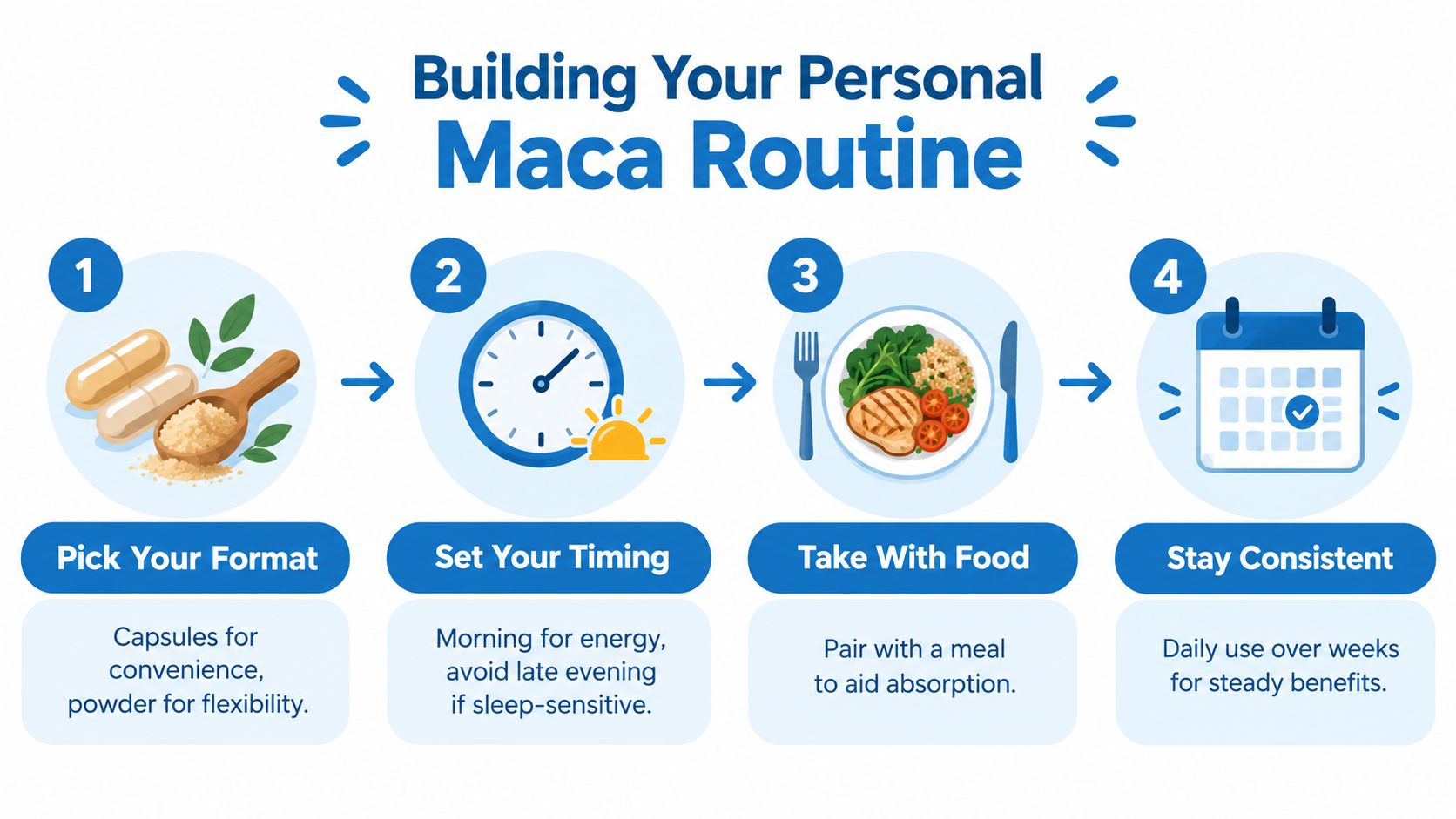
A useful maca routine has to survive real life. The best format isn't the one with the most elaborate instructions. It's the one you can take correctly, tolerate comfortably, and remember without disrupting your day.
Pick the format that removes friction
Powder works well when you already prepare smoothies, oats, yogurt, or other breakfast foods. Capsules make more sense if you dislike the taste, want a pre-measured serving, or need a portable option.
The right choice is behavioral. If powder adds too many steps, you may skip it. If capsules make you forget because they're hidden in a cabinet, place them beside a meal-related item instead.
Set a clear anchor
Choose one primary cue:
- Breakfast: Add powder to a familiar food or take capsules with the meal.
- Early lunch: Use this option when mornings are unpredictable.
- Training routine: If you want to test the pre-workout window, take it before planned activity while keeping the broader daily habit intact.
- Dinner: Reserve this for situations where it's the most reliable meal and you don't notice sleep disruption.
You don't need to change the anchor every day. Repetition makes the routine easier to follow and gives you a stable basis for observing your response.
Keep a simple response log
For the first several weeks, record the basics rather than chasing dramatic signals. Note whether you took maca with food, your approximate time, and any noticeable change in digestion, energy, mood, or sleep.
That record can reveal practical patterns. You may discover that morning use feels comfortable, that an empty-stomach serving doesn't suit you, or that early afternoon works better than breakfast because your mornings are too rushed.
Consistency beats complexity: A modest routine you follow is more useful than an ideal routine you repeatedly postpone.
For broader wellness planning, you can also review vitamins for sexual health, especially if libido is one part of a wider nutrition and lifestyle goal. Keep the expectations measured. The available guidance describes maca's potential effects as cumulative over 6–12 weeks, so a few isolated servings won't provide a reliable basis for judgment.
Cycling Strategies and Managing Side Effects
Cycling maca is often presented as a way to prevent tolerance, but the verified guidance doesn't establish a universal cycling schedule. Maca has traditionally been treated as a food, and whether you take breaks should depend on your product directions, personal response, and professional advice rather than an invented calendar.
If you experience mild digestive discomfort, take maca with a meal and consider whether the product form suits you. If you notice restlessness or sleep disruption, move the serving earlier or stop using it until you've discussed the issue with a qualified healthcare professional.
Watch for patterns instead of pushing through them. People who are pregnant, breastfeeding, taking medication, or managing a health condition should ask a doctor or pharmacist whether maca is appropriate for them.
CalVitamin offers maca formulas alongside vitamins, minerals, proteins, probiotics, herbal products, and sexual wellness options in formats such as capsules and gummies. Visit CalVitamin to compare products, check serving directions, and choose a maca option that fits your food preferences and daily routine.






