
The most common advice about male enhancement pills is also the least reliable: “They're just herbal supplements, so they're harmless.” That assumption can put your health at risk. Some products are ordinary dietary supplements with clearly listed ingredients. Others belong to a poorly controlled gray market, where pills marketed for stamina or erection support may contain undeclared pharmaceutical ingredients.
So, what are male enhancement pills? They're products sold to improve sexual performance, erection quality, stamina, libido, or orgasm intensity. They may come as capsules, tablets, gummies, liquid shots, or herbal blends. Their labels often feature familiar ingredients, but the product category deserves more scrutiny than a standard multivitamin because regulators have repeatedly found hidden drugs in products sold for sexual enhancement.
The practical question isn't only whether an ingredient sounds natural. It's whether the product's contents, dosage, manufacturer, and claims can be verified.
Table of Contents
- The Reality Behind Male Enhancement Supplements
- How Common Herbal Ingredients Actually Work
- Evaluating the Clinical Evidence for Popular Blends
- Hidden Dangers and Severe Cardiovascular Risks
- How to Read Labels and Verify Product Quality
- Prescription Treatments Versus Over-the-Counter Options
- Smart Buying Strategies for Online Supplement Shoppers
The Reality Behind Male Enhancement Supplements
Male enhancement pills are usually marketed as dietary supplements, but that label doesn't guarantee that the contents are safe, effective, or accurately described. The FDA warns that sexual enhancement products are often contaminated with undeclared compounds, while the National Center for Complementary and Integrative Health's guidance on sexual enhancement states that no complementary health approach has been shown to be safe and effective for erectile dysfunction.
That distinction matters. A conventional supplement generally provides nutrients or botanical ingredients within a declared formula. A product that promises a rapid, drug-like erection may be crossing into a very different category, even if its packaging says “natural.” Prescription erectile dysfunction medicines undergo formal review. Many online enhancement products don't receive that level of premarket scrutiny.
Why the gray market matters
In a major consumer warning issued in December 2020, the FDA said it had identified nearly 50 over-the-counter male enhancement and weight-loss products sold through online marketplaces such as Amazon and eBay. Testing found that 80% contained undeclared active pharmaceutical ingredients, as documented in the agency's consumer warning about hidden drug ingredients.
Those findings explain why a pill can look like a supplement while acting more like an unapproved drug. Hidden sildenafil, tadalafil, or related compounds may produce a noticeable effect, but the user won't know the dose, the manufacturing conditions, or how the ingredient will interact with existing medicines.
The issue also isn't limited to a single product launch or an old batch. FDA sexual enhancement notifications continued to list new public warnings by September 2026, indicating an active, recurring enforcement problem.
Practical rule: Treat a bold sexual-performance claim as a reason to investigate the product, not as proof that the product works.
Natural does not mean medically neutral
A botanical ingredient can affect blood pressure, heart rhythm, anxiety, hormone-related pathways, or medication metabolism. A capsule can also contain undeclared ingredients that never appear on the label. Men with cardiovascular conditions, diabetes, or prescriptions for blood pressure or chest pain need especially strong caution.
The safest way to view this category is as a spectrum. Some formulas may offer general wellness support. Some have limited or inconsistent evidence. Others may be mislabeled drug products in supplement packaging. Reading the front label alone won't tell you which one you're holding.
How Common Herbal Ingredients Actually Work
The ingredients in male enhancement formulas usually aim at one of a few biological targets. Some are intended to support nitric oxide signaling and blood flow. Others are marketed for energy, stress response, hormone-related pathways, or sexual desire. These mechanisms sound precise, but a plausible mechanism isn't the same as a proven result in a complete product.
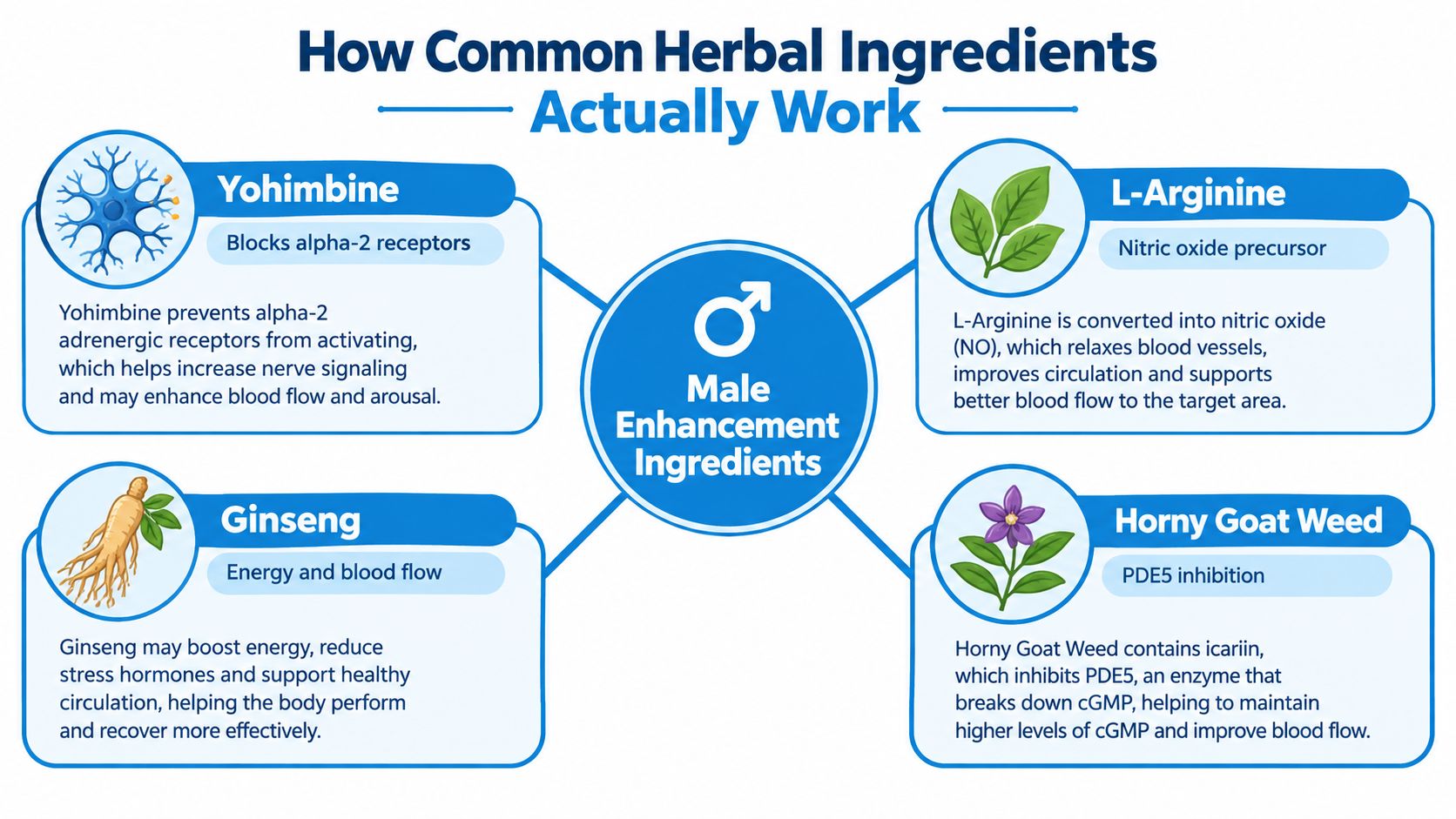
Think of blood vessels as flexible plumbing. The endothelium, the thin lining inside the vessels, helps regulate whether those vessels relax or tighten. Nitric oxide acts as one of the signals involved in relaxation. L-arginine can serve as a precursor for nitric oxide production, although the body's response depends on many factors, including baseline health and the rest of the formulation.
Blood flow and vascular signaling
L-arginine is often included because the body can use it in nitric oxide pathways. L-citrulline may also appear in circulation-focused formulas because it participates in the same broader pathway. That doesn't mean either ingredient works like an approved ED medicine, and a supplement label doesn't establish a clinically effective dose for a particular person.
For readers comparing formulas, an ingredient-focused explanation of L-arginine and L-citrulline products can help separate the proposed mechanism from the much larger question of whether a finished enhancement blend has been tested.
Horny goat weed, often associated with the compound icariin, is marketed as a plant-based support for blood flow. Laboratory discussions sometimes compare its activity with PDE5-related pathways, but laboratory activity doesn't establish that an over-the-counter capsule will produce a predictable or safe erection response in humans.
Ginseng is generally positioned around energy, vitality, and circulation rather than a single direct erection mechanism. Its effects may be relevant to perceived stamina, but marketing language often moves faster than clinical validation. The form, extract standardization, dose, and other ingredients all matter.
Desire, stress, and hormone-related claims
Yohimbine comes from the bark of the yohimbe tree and is associated with alpha-2 receptor blockade. That action can influence nerve signaling and blood flow, which helps explain its place in enhancement formulas. It can also stimulate unwanted cardiovascular and psychiatric effects, particularly when the amount is uncertain or the product contains additional stimulants.
Ingredients such as maca and shilajit are commonly marketed for vitality, libido, or hormone-related support. These claims should be evaluated separately from erection claims. Feeling more energetic isn't identical to improving penile blood flow, and a change in desire isn't proof that testosterone or another hormone has meaningfully changed.
A mechanism can explain why an ingredient is interesting. It can't, by itself, prove that a finished pill is effective or safe.
The useful label-reading habit is to ask three questions: What pathway is the ingredient supposed to affect? Has the complete product been tested in people? Can the amount and identity of every ingredient be verified? A broader overview of vitamins associated with sexual health may help with general nutrient questions, but it shouldn't be mistaken for proof that a male enhancement blend treats ED.
Evaluating the Clinical Evidence for Popular Blends
Ingredient folklore and clinical evidence often point in different directions. A plant may have a long history of traditional use, a plausible laboratory mechanism, or a small human study, yet still lack strong evidence for a complete male enhancement pill.
A systematic review of common male enhancement ingredients found that L-arginine, yohimbe, tribulus, horny goat weed, and zinc appeared frequently in the category. It also found that no whole-product male enhancement pill had published randomized controlled trial evidence. Only a minority of ingredients had strong positive evidence, while most had contradictory, negative, or insufficient data, according to the review of herbal and nutritional supplements for ED.
| Ingredient | Proposed mechanism | Clinical evidence status |
|---|---|---|
| L-arginine | Nitric oxide precursor that may support vascular signaling | Some human evidence for selected uses, but not proof that every enhancement blend works |
| Yohimbe or yohimbine | Alpha-2 receptor blockade with effects on nerve signaling and blood flow | Safety concerns are substantial, and evidence doesn't validate unregulated products |
| Horny goat weed | Icariin is discussed in relation to PDE5-related activity | Mechanistic interest doesn't establish reliable clinical effectiveness |
| Tribulus terrestris | Traditionally marketed for libido, vitality, or hormone support | Evidence is contradictory or insufficient for broad enhancement claims |
| Zinc | Nutrient involved in normal physiological functions, including reproductive health | Useful when deficiency exists, but not a universal ED treatment |
| Ginseng | General vitality and possible circulation-related effects | Product and extract differences make broad conclusions difficult |
Why the whole product matters
A supplement facts panel may list several ingredients, but studies on one ingredient don't automatically validate the combination. Extract strength, purity, dosage, manufacturing quality, and interactions can change the practical risk. A product may also use a proprietary blend that prevents the buyer from seeing how much of each compound is present.
This creates a common reasoning error: a shopper sees a familiar ingredient and assumes the entire formula has clinical support. In reality, ingredient evidence and product evidence are separate questions.
Zinc illustrates the difference clearly. Correcting a deficiency can support normal body functions, but taking more zinc doesn't turn a general nutrient into a guaranteed erection treatment. Tribulus and horny goat weed present the opposite problem: strong marketing narratives can outpace the evidence available for consistent human outcomes.
What a responsible conclusion looks like
The evidence doesn't justify treating every ingredient as useless, and it doesn't justify treating any blend as a proven ED therapy. A reasonable conclusion is narrower. Some ingredients may support a specific physiological pathway or address a nutritional gap, but most products lack the rigorous whole-product testing needed to predict results for an individual user.
Don't use a table of familiar herbs as a substitute for a medication review, particularly if you take cardiovascular medicines or have an ongoing erection problem.
Hidden Dangers and Severe Cardiovascular Risks
The central danger is not just that a supplement fails. A product sold as “natural” may contain an undeclared prescription drug that changes blood pressure or interacts with medicine you already take. That is the regulatory reality of the gray market: packaging can resemble a legitimate dietary supplement while the contents remain difficult to verify.
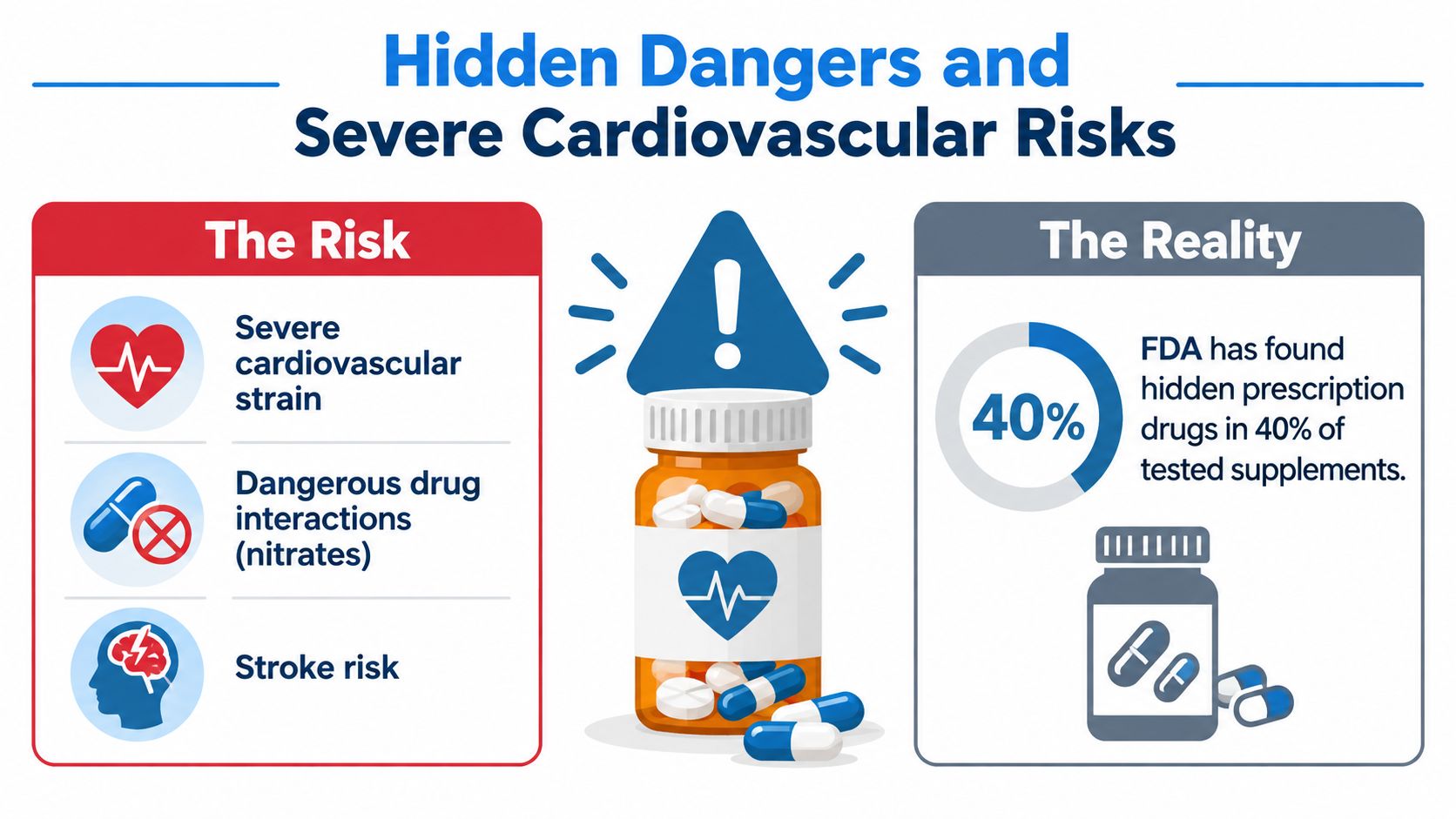
FDA enforcement actions have identified hidden sildenafil and tadalafil in sexual-enhancement products. Warnings included products such as Man Fuel Xtreme Edition and Man Fuel Male Enhancement Shooter in 2019. The agency continued issuing recalls and advisories in 2024 and 2025, with new warnings appearing by 2026, as reflected in the FDA's consumer bulletin on hidden ingredients and serious interactions.
The nitrate interaction
Sildenafil and tadalafil are PDE5 inhibitors that can lower blood pressure. Combined with nitrates, an undeclared PDE5 inhibitor may cause a dangerous or life-threatening drop. Nitrates treat certain heart conditions, so someone could unknowingly pair a hidden ingredient with medicine prescribed for chest pain.
The risk also depends on a person's wider health and medication list. The FDA has warned that men with diabetes, high blood pressure, high cholesterol, or heart disease may experience dangerous blood-pressure drops if they unknowingly take these hidden drugs. Supporting general cardiovascular health with basics such as magnesium taurate for heart muscle function may be reasonable, but it does not replace medical review of an enhancement product.
A label cannot warn you about an ingredient it conceals.
Yohimbine brings a different set of hazards
Yohimbine products can create serious risks even without a hidden PDE5 inhibitor. FDA warnings describe possible severe high blood pressure, irregular heartbeat, heart attack, seizures, anxiety, and psychosis. An incomplete label or inconsistent dose between batches makes the outcome harder to predict.
If you use nitrates, have heart disease, or take several cardiovascular medicines, avoid experimenting with an online enhancement pill. Ask a pharmacist or physician to review the exact product first.
Stop taking the product and seek urgent medical help for chest pain, fainting, severe shortness of breath, a new irregular heartbeat, or a painful erection that does not resolve. Do not take another dose while trying to identify the cause. Keep the packaging for clinicians, since it may help investigators identify a hidden ingredient.
The useful question is whether you can verify the contents and confirm compatibility with your health history. With adulterated products, a dependable answer may not be available.
How to Read Labels and Verify Product Quality
A careful shopper can reduce avoidable risk by treating the label as a document to verify, not a sales pitch to trust. Start with the full Supplement Facts panel and the manufacturer information. A product that hides ingredient amounts, uses vague claims, or offers no accountable business details deserves extra caution.
A practical label inspection
Read every listed ingredient. Look for botanical names, extract standardization, serving size, and the amount of each active compound. “Natural blend” isn't enough information to evaluate dose or interactions.
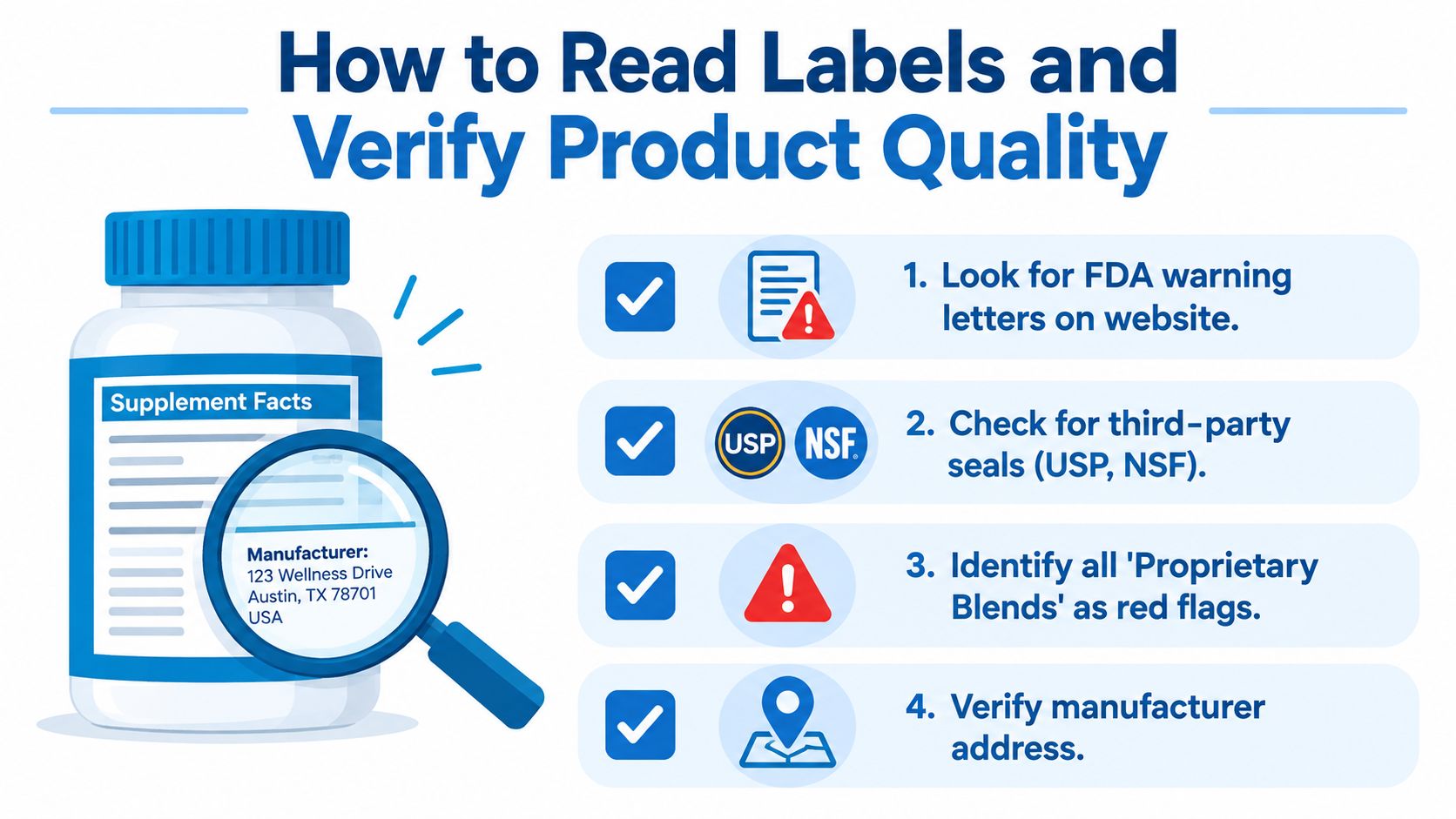
Treat proprietary blends cautiously. A proprietary blend may list several ingredients without showing the amount of each one. That makes it difficult to compare products or determine whether a stimulant or herb is present at a meaningful level.
Check the company identity. Look for a physical address, customer-support route, lot information, and clear instructions for reporting an adverse reaction. A polished storefront doesn't replace traceability.
Look for independent quality testing. Seals from organizations such as USP or NSF can provide useful quality signals when the certification applies to the specific product. A logo printed on a package isn't proof by itself, so verify the claim through the certifier where possible.
Search regulatory warnings. Review FDA warning letters and sexual enhancement notifications before buying. A product that promises prescription-like results while avoiding a transparent ingredient list should move to your “do not buy” list.
Halal, gelatin-free, and ethical requirements
Capsule material matters. A product may use bovine gelatin, porcine gelatin, fish gelatin, or a vegetable-based capsule. If you need halal or gelatin-free products, confirm the exact certification or capsule material rather than assuming that “herbal” means compliant.
Check excipients as well as active ingredients. Colorants, binders, flavorings, and softgel components may affect dietary suitability. For cruelty-free preferences, look for a clear manufacturer statement and a credible certification rather than relying on a general wellness slogan.
The same careful approach applies to products marketed as vegan, vegetarian, or allergen-free. Verify the finished product, because the source of a single capsule component can differ from the source of the botanical ingredients.
Quality verification can't guarantee that a product will treat ED. It can, however, help you avoid products with unclear composition, missing accountability, or dietary attributes that don't match your needs.
Prescription Treatments Versus Over-the-Counter Options
Prescription ED medicines and over-the-counter supplements solve different problems. A prescription treatment is evaluated as a drug and selected for a defined medical purpose. A supplement may provide general nutritional or botanical support, but it isn't automatically a treatment for erectile dysfunction.
That distinction helps explain why a supplement's gradual or subjective effect shouldn't be compared directly with a prescription medicine's targeted pharmacological action. If erections became persistently weaker, the change may reflect medication effects, diabetes, vascular disease, hormonal issues, stress, relationship factors, or another condition that deserves evaluation.
When medical care matters
Make a healthcare appointment if erection problems are persistent, sudden, painful, or accompanied by other symptoms. A clinician can review your medicines, cardiovascular risk, mental health, sleep, and relevant laboratory testing. Erectile changes can sometimes be an early signal that deserves attention rather than a problem to conceal with an online pill.
Medical guidance is especially important if you take nitrates, use multiple blood-pressure medicines, have heart disease, or have diabetes. Those circumstances can make an unverified product more dangerous, even if the package claims that the formula is natural.
Where a supplement may fit
A transparent supplement can be considered for general wellness or vitality when the user understands its limits, checks the ingredients, and confirms compatibility with a pharmacist. It shouldn't replace a diagnosis, a prescription when one is appropriate, or treatment for an underlying condition.
The safest comparison is therefore not “natural versus pharmaceutical.” It's verified product versus unknown product, and wellness support versus treatment of a medical disorder. That framing removes the stigma from seeking help while preserving room for responsible supplement use.
Smart Buying Strategies for Online Supplement Shoppers
Online convenience makes it easy to compare forms, ingredients, dietary attributes, and customer-service options. It also makes it easy to buy from a seller that provides little information once payment is complete. A reputable retailer should make product evaluation easier, not ask you to rely on urgency, secrecy, or exaggerated promises.
Start with the product page. Look for a complete label, serving directions, manufacturer identity, warnings, and a way to contact support. Customer reviews can describe the shopping experience, but they don't establish that a product is safe or clinically effective.
Use a short pre-purchase checklist
- Verify the seller: Confirm a real business address, working support contact, and accessible returns or refund policy.
- Inspect the product page: Check the Supplement Facts panel, capsule material, allergen information, and manufacturer details.
- Avoid miracle language: Claims of instant, permanent, or prescription-like results should trigger skepticism.
- Compare the actual formula: Don't choose based only on a product name such as “platinum,” “extreme,” or “natural.”
- Check dietary fit: Confirm halal, gelatin-free, vegetarian, vegan, or cruelty-free status from product-specific information.
- Use secure checkout: The payment page should use standard security practices and provide an order record.
- Ask a pharmacist first: Bring the exact product name and ingredient list, especially if you take regular medicines.
CalVitamin is one online retailer with categories for male and female sexual wellness, vitamins, minerals, herbs, proteins, probiotics, and products marked with attributes such as halal or gelatin-free on select items. Its catalog includes different dosage forms and product pages with ingredient and customer-review information where available, but shoppers should still evaluate each product individually.
Don't treat a marketplace rating, a dramatic product name, or a “natural” claim as evidence of safety. The strongest buying decision is the one you can explain: what the product contains, who made it, how it fits your dietary needs, and why it doesn't conflict with your health history.
If you're comparing male enhancement products, browse CalVitamin to review sexual wellness formulas alongside vitamins, minerals, and herbal options with different dosage forms and dietary attributes. Use the product details as a starting point, then ask a pharmacist to check any formula against your medicines and health conditions before you buy.






